
You're probably here because the trip is real now. A board meeting moved up. A family itinerary got complicated. An airline schedule no longer works, and someone suggested chartering a jet as if that were a simple button click.
It can be simple, but only if you understand what you're buying.
Most first-time clients don't struggle with the idea of private aviation. They struggle with the booking process. They don't know how quotes are built, why one aircraft is recommended over another, or what to verify before sending payment. That's where expensive mistakes happen.
This Haute Jets Journal guide to 25. how to book a private jet is built around the two areas most articles gloss over: real cost control and operator verification. If you know how to define the mission, read the quote properly, and confirm who is flying you, you'll book with far more confidence and usually with a better result.
The Modern Way to Charter a Private Jet
A decade ago, many charter bookings started with a phone call, a broker's Rolodex, and a lot of back-and-forth. Today, the process is more transparent. You can describe the trip, review multiple aircraft options, compare availability, and move to confirmation much faster than most first-time flyers expect.
That shift matters because speed is often the reason people charter in the first place. A traveler may need to leave after a meeting runs late, add a pet, change the destination airport, or arrange a same-day return. Modern booking tools handle those variables much better than the old concierge-only model.
According to BlackJet's private jet booking guide, over 80% of initial charter inquiries now occur digitally, same-day bookings can be feasible within two to three hours for most domestic routes, and platforms may aggregate over 10,000 operators so travelers can compare aircraft, pricing, and availability in near real time.
What the process usually looks like now
For most charters, the workflow is straightforward:
Submit trip details
Departure and arrival airports, travel dates, passenger count, and any special requirements.Review aircraft options
You'll typically see several aircraft choices rather than a single take-it-or-leave-it quote.Choose and book
Once you approve the aircraft and pricing, the trip moves into confirmation and operational planning.Receive final flight details
That includes the operator, airport terminal details, and pre-departure instructions.
Booking a private jet isn't only for people with an existing broker relationship anymore. It's increasingly a structured purchasing process, which is good news for first-time clients.
What hasn't changed is the need for judgment. Faster booking doesn't automatically mean smarter booking. The best results still come from asking the right questions before you request the first quote.
Define Your Mission Before You Request a Quote
Clients often begin with a route. New York to Miami. London to Nice. Los Angeles to Aspen. That's useful, but it's not enough.
A private aircraft isn't chosen the way you pick a commercial airline seat. Charter matching starts with the mission. What are you trying to accomplish on this trip, and what constraints matter most? Industry guidance notes that upfront requirements gathering materially improves aircraft matching, and Paramount Business Jets explains that booking one to two weeks ahead often improves aircraft selection and pricing, while last-minute requests reduce choice and can inflate rates.
Start with the purpose of the trip
A corporate roadshow and a family holiday can follow the same route and require completely different aircraft.
If the passengers need to work en route, cabin layout, noise level, and Wi-Fi matter. If the trip involves skis, golf bags, strollers, or large pet crates, baggage volume may matter more than seat count. If the return is same day, the crew duty profile and wait-time terms should be discussed early rather than after the quote arrives.
Use this short mission brief before you request pricing:
Trip purpose
Decide whether the priority is speed, privacy, comfort, image, or schedule flexibility.Time structure
Confirm firm dates, acceptable departure windows, and whether a same-day turnaround is necessary.Passengers Count everyone who will fly, including children, staff, or security.
Baggage and special loads
Soft bags, hard cases, skis, golf clubs, garment bags, pets, or medical equipment all change aircraft suitability.Cabin priorities
Specify whether Wi-Fi, enclosed lavatory, stand-up cabin, pet access, or catering matters.
Match the aircraft to the real mission
One of the most common mistakes is booking by category label alone. “Light jet” or “midsize jet” sounds precise, but it isn't enough. Two aircraft in the same broad class can behave very differently when runway length, baggage space, or nonstop range enters the picture.
A short business hop may justify a smaller aircraft if everyone is traveling light. A leisure trip with fewer passengers may still require a larger cabin because the baggage profile is bulky. A ski weekend is the classic example. Four travelers with winter gear can force a very different decision than four travelers with overnight bags.
Practical rule: If you're unsure whether baggage is “normal,” assume it isn't and disclose it early.
Choosing Your Aircraft Class by Mission
| Aircraft Class | Typical Passenger Count | Use Case Example | Estimated Hourly Rate (2026) |
|---|---|---|---|
| Turboprop | Smaller groups | Short regional hop into smaller airports | From the lower end of the on-demand charter range |
| Light Jet | Smaller groups | Fast domestic business trip with limited baggage | Part of the typical $2,000 to $14,000+ per billable hour range |
| Midsize Jet | Mid-size groups | Longer domestic flight with more comfort needs | Varies within the same market range |
| Large or VIP Jet | Larger groups | Cross-country or high-amenity itinerary | Often toward the upper end of the market range |
| Ultra-long-range jet | Larger groups on long sectors | International nonstop travel where range is critical | Can extend into the top end of quoted charter pricing |
This table is intentionally broad because actual pricing depends on aircraft, route, timing, and operating conditions. The point is to align the cabin with the mission before you let the quote drive the decision.
Understand Charter Pricing and Avoid Hidden Fees
A first quote can look straightforward until you compare the estimate against the final wire amount. The gap usually comes from charter mechanics that are obvious to operators and opaque to first-time buyers.
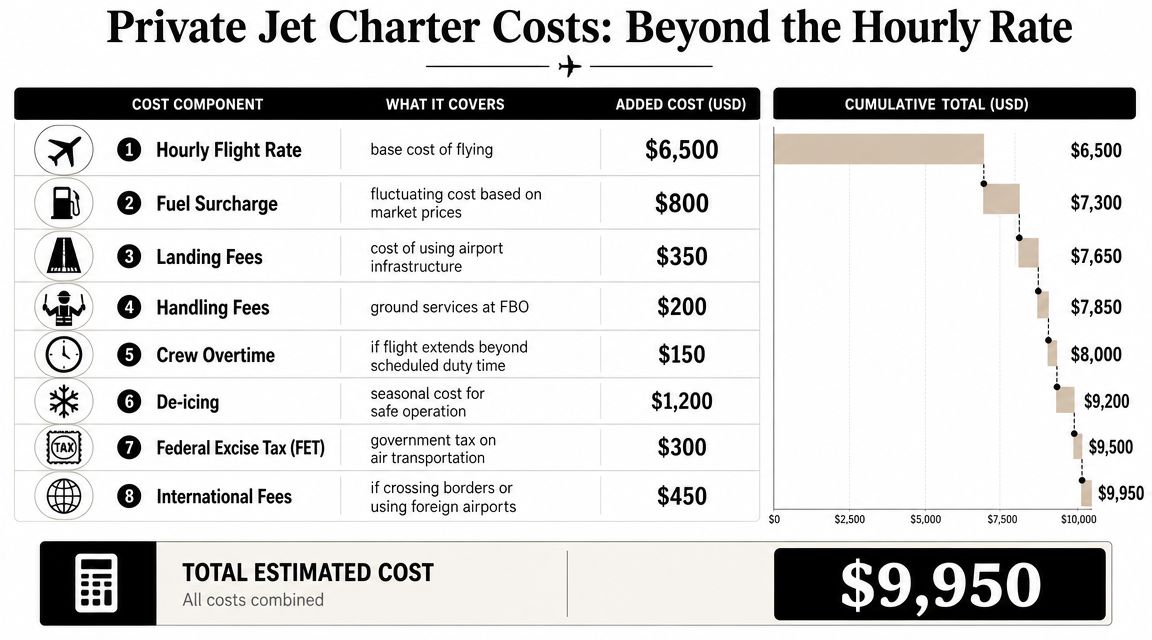
The hourly rate is only one line item. Charter pricing is built around aircraft time, crew logistics, airport charges, tax treatment, and how efficiently the airplane can serve your route. Two midsize jets can quote very differently for the same city pair if one is already nearby and the other has to be ferried in empty.
That ferry flight is where many clients overpay.
What the hourly rate actually means
Charter is priced by aircraft use, not by seat. Whether one passenger is onboard or every seat is filled, the operator is still covering the same airframe, crew, fuel burn, and schedule commitment. A low hourly number can still produce an expensive trip if the billing structure is inefficient.
Three items usually drive that inefficiency:
Positioning or ferry flights
If the aircraft is not based near your departure airport, you may be billed for the empty leg required to reach you.Daily minimums
Short trips often trigger a minimum amount of billable flight time, even if the wheels-up time is lower.Short-leg pricing
Very brief sectors can be expensive on a per-hour basis because fixed operating costs still apply.
The smart way to compare quotes is to ask for the full trip total and the assumptions behind it. Hourly rate first, all-in price second, works backward. All-in price first, then reviewing each charge, is how experienced buyers do it.
The fees that deserve a direct question
Some charges are normal. The problem is not that they exist. The problem is that they are often buried in vague language such as "operational adjustments" or folded into a quote without explanation.
Review these items carefully:
- Crew overnights and standby time for multi-day trips or aircraft that remain with you
- Airport handling and landing fees, which can vary sharply by airport
- Federal excise tax and segment fees on domestic U.S. charter
- De-icing and weather-related services during winter operations
- Catering, Wi-Fi, pets, and ground transportation, which may be optional but not always separated clearly
- Cancellation and substitution terms, especially on peak dates
I tell clients to ask one blunt question before approving any estimate: What am I paying for besides occupied flight time?
That question tends to expose the expensive parts of a quote very quickly.
Repositioning is the hidden cost many buyers miss
Repositioning matters because it changes the economics of the trip without changing the passenger experience. You still board the same category of aircraft. You just pay more to get it to you.
A quote from Teterboro to Miami may look competitive until you learn the aircraft is coming from another state before pickup. In practice, that can wipe out the apparent savings versus a slightly higher hourly quote on an aircraft already local to the departure point.
This is one reason local sourcing works in the client's favor. If the provider can source from aircraft already near the mission origin, there is less deadhead exposure and fewer surprise logistics costs. Haute Jets explains that structure well in its breakdown of private jet charter pricing and cost components.
How to read a quote like a professional
Before you sign, get clear answers on five points:
- The exact aircraft make and model
- The departure base of that aircraft
- Any repositioning included in the price
- Minimum flight time rules affecting the itinerary
- Which items are included versus estimated
That last point matters more than clients expect. An "included" charge is committed. An "estimated" charge can move.
Good booking decisions are rarely about finding the cheapest jet. They come from understanding why one quote costs more than another, then deciding whether the difference buys you something useful, such as a better-located aircraft, lower cancellation risk, or a cleaner operating schedule.
Verify Operator Safety Ratings Before You Book
The aircraft matters. The operator matters more.
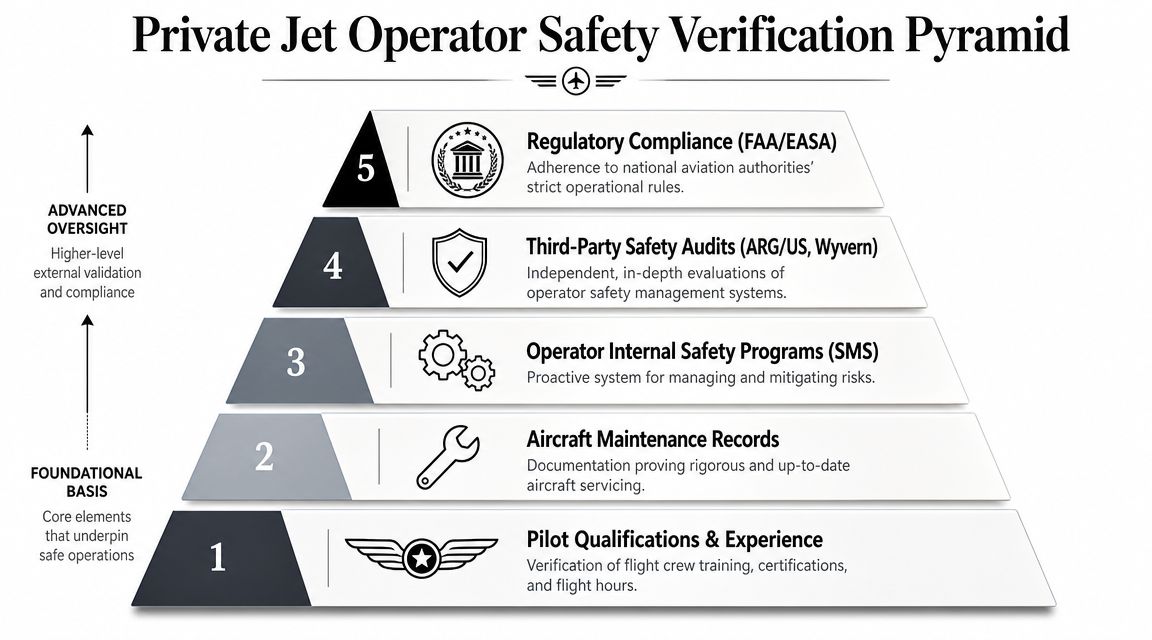
A polished quote, a recognizable jet model, and a competitive price can create false confidence. None of those tells you enough about who is operating the flight, how that operator is audited, or whether the safety standard matches what you think you're buying. That gap is common in consumer-facing charter content, and L33 Jets points out that a thorough process should include confirming the operator's third-party safety rating, such as Wyvern or ARGUS, not just the aircraft type.
The operator check that should never be skipped
Ask one simple question before paying: Who is the actual operator of this flight?
That answer should lead to a second question: What third-party safety rating does that operator hold? A serious charter booking should include that verification as part of normal due diligence, not as an afterthought once the wire has been sent.
Third-party auditors like Wyvern and ARGUS are widely recognized in private aviation because they evaluate operational standards beyond the baseline regulatory framework. Clients don't need to become auditors themselves, but they do need to insist on transparency.
What to verify before funds go out
A strong booking process includes more than “the jet looks right.” Confirm these practical details:
Operator identity Make sure you know the certificate holder flying the trip.
Third-party audit status
Verify the operator's Wyvern or ARGUS standing rather than relying on marketing language.Tail number
Ask for the assigned aircraft once confirmed.Crew details
Request crew information closer to departure, especially on high-value or time-sensitive itineraries.Operational policies
Confirm baggage rules, pet handling, and any airport-specific constraints.
For readers who want a concise overview of what these audit systems mean in practice, Haute Jets has a related explainer on Wyvern and ARGUS private aviation safety ratings.
A quick visual primer can help if these terms are new to you.
Price is not a safety strategy
The cheapest quote can still be the wrong flight.
That doesn't mean lower pricing is automatically suspicious. It means price only becomes meaningful after you verify the operator, the aircraft assignment, and the terms under which the flight will be delivered. A serious buyer looks at all three together.
A good charter decision balances aircraft fit, total cost, and operator quality. If one of those is unknown, the quote isn't ready to approve.
Finalize Your Itinerary and Payment
Once you've selected the aircraft and accepted the quote, the booking moves from shopping to execution. The success of a smooth trip is determined during this phase. Small details matter more than many first-time clients expect.
The final confirmation stage should leave nothing ambiguous. You should know where you're departing, who is flying you, what has been ordered on board, and what paperwork is still needed from each passenger.
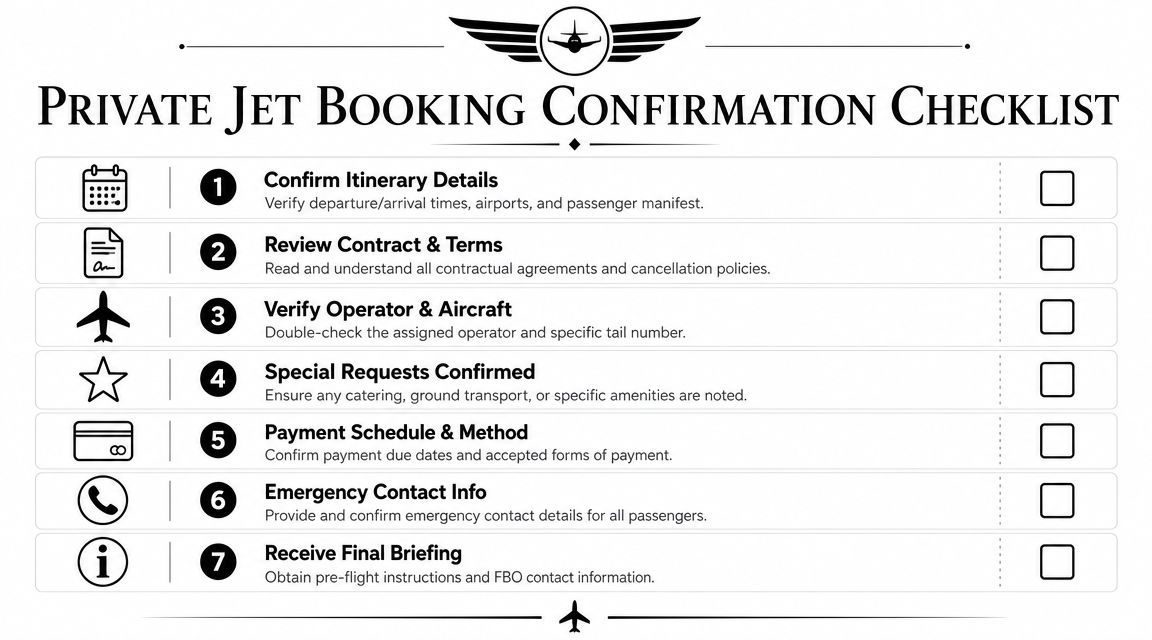
What to lock down before signing
Think of the final stage as a checklist, not a formality.
Passenger manifest
Names must match travel documents exactly, especially on international itineraries.Airport details
Confirm the actual departure and arrival airports, not just the city pair. In private aviation, the wrong airport assumption can create real operational problems.Special requests
Catering, pet approval, car service, and cabin amenities should be confirmed in writing.Contract terms
Review cancellation language, substitution rights, and any duty-of-care obligations.Payment instructions
Confirm due date, accepted methods, and when the flight is considered fully ticketed or released.
International travel needs more precision
International private flights introduce additional documentation and timing issues. Passport information, visa status where applicable, and any destination-specific entry requirements should be handled early, not in the final hours before departure.
This also applies to passenger changes. A last-minute addition may seem easy operationally, but cross-border travel can become complicated if manifest details and document checks lag behind the itinerary.
Payment should be clear, simple, and documented
Most charter transactions are completed through standard payment channels such as wire transfer or card, depending on operator policy and timing. What matters most is clarity. You should know the payment deadline, what amount is due, and whether any additional charges remain provisional.
If you're ready to move from planning to trip-specific pricing, the most efficient next step is to request a quote from Haute Jets. The useful part of any quote process isn't speed alone. It's getting the aircraft, operator, and trip requirements aligned before money moves.
Before sending funds, read the agreement as if the trip might change. Weather, timing, and passenger revisions are common. Your paperwork should tell you exactly what happens if they do.
Your Pre-Flight Checklist and Pro Tips
A first-time charter client often assumes the hard part ends when the wire is sent. In practice, the last 24 hours are where small misses turn into day-of-travel problems.
A solid pre-flight process confirms what is operating, who is flying, where you need to be, and whether any trip details changed after booking. For international flights, document prep deserves extra attention. If you want a practical refresher before departure, this stress-free international travel guide is a useful general resource.
The last checks that protect your trip
Start with the aircraft itself. Confirm the exact tail, not just the jet category, especially if baggage space, cabin configuration, or Wi-Fi matters to your group. I always advise clients to treat aircraft substitutions as a review point, not an administrative detail. A replacement may be perfectly acceptable, but it should still match the mission you booked.
Then confirm the operating details in writing:
Departure terminal and show time
Private flights do not use the main commercial terminal, and the wrong FBO can cost you more time than the flight check-in itself.Passenger manifest
Names should match government ID exactly. Even a minor typo can slow down security screening or customs processing.Special requests
Reconfirm pets, catering, child seats, accessibility needs, and ground transportation. These are easy to promise early and easy to miss later.Operational packet
Ask for the tail number, FBO address, contact numbers, and crew details if available.Weather and airport limitations
De-icing, runway conditions, and airport curfews can affect timing and cost, particularly on early-morning or winter departures.
Habits that save money and reduce friction
Experienced charter clients are usually disciplined about a few simple things. They give accurate passenger counts and luggage estimates. They mention golf bags, skis, strollers, and pets early. They leave some flexibility in departure time when the schedule allows.
That matters because the cheapest quote can become the expensive one if the aircraft has to be changed at the last minute, waits on the ground longer than planned, or cannot carry what the trip requires. The same rule applies to repositioning. If you book through a sourcing model that checks nearby aircraft first, you often avoid paying for unnecessary ferry time that was never obvious in the headline rate.
One more practical point. Save your charter agreement, invoice, and final itinerary in one place on your phone. If weather shifts, the aircraft swaps, or customs asks a question, having the paperwork ready makes the day much easier.
Haute Jets handles this part well by pairing on-demand charter sourcing with full pre-flight confirmation, so clients see the assigned aircraft, operator details, and trip logistics before departure rather than sorting them out on the runway.