
You're probably doing this the way most first-time transatlantic clients do it. You have a fixed date, a destination that is final, a family or executive team that doesn't want a connection, and a broker asking whether you want a “heavy” or “ultra-long-range” jet before you've even seen a useful quote.
That's backwards.
On a transatlantic private jet mission, the questions aren't just hourly rate or cabin photos. They're simpler and more expensive than that. Can the aircraft make the crossing nonstop with your passenger load? Is the jet already near your departure airport, or are you paying to bring it in empty? And if you care about sustainability, can the operator source SAF on the route you're flying, or are they just repeating a marketing line?
This guide is written for Haute Jets Journal and for clients who want straight answers. If you're flying New York to London next week, or Los Angeles to Europe on a hard schedule, aircraft category fit, positioning cost, and fuel strategy will decide your quote far more than the glossy brochure will.
Why Transatlantic Private Jet Travel Is Its Own Category
A client calls on Monday for a New York to London departure the following week. The request sounds routine until the details show up. Six passengers. Full luggage. Preferred departure from Teterboro. Early morning arrival into London. Interest in SAF if it is available, not just promised on a brochure. At that point, this stops being a standard charter request and becomes a long-haul planning exercise.
That is why transatlantic private jet travel sits in its own category.
The mistake first-time buyers make is asking for a flat hourly rate before confirming the mission fit. That approach works on short domestic sectors. It breaks down over the Atlantic, where the quote is shaped by three things first: the right aircraft category, the cost of positioning that aircraft to your departure airport, and whether the operator can source the fuel strategy you want on both sides of the route.
What makes this category different
Start with aircraft fit.
A jet can look large, have a premium cabin, and still be the wrong tool for this trip. Atlantic flying is less forgiving than domestic charter because payload, winds, runway choice, and reserve fuel all affect what the aircraft can realistically do. One industry overview of transatlantic-capable business aircraft notes that operators typically separate these missions into heavy and ultra-long-range categories for exactly that reason, rather than treating them like a simple upgrade from midsize charter in this guide to aircraft that can cross the Atlantic.
Then there is positioning.
If the right aircraft is already based near your departure airport, your quote looks one way. If the operator has to bring that aircraft in empty from Florida, Texas, or mainland Europe, the price changes fast. That empty leg is not a side issue. On many transatlantic charters, repositioning is one of the biggest line items and one of the easiest places to overpay if nobody is sourcing from owner-operators with the aircraft already in the region.
Airport selection matters too, but mostly because it affects the first two points. New York and London each give you several workable airport combinations, and the chosen pair can change runway performance, handling costs, slot pressure, and crew timing. Those variables do not usually kill the trip. They do change which aircraft category is sensible and whether a quote is clean or padded.
SAF also belongs in the planning conversation earlier than many clients expect.
If sustainable aviation fuel matters to you, ask where the operator can physically obtain it, in what blend, and on which leg. Availability still varies by airport and supplier. A seller who cannot answer that directly is giving you a marketing answer, not an operating answer.
My recommendation: For a first transatlantic charter, do not shop by cabin photos or hourly rate. Shop by mission fit, operator location, and fuel plan.
Why domestic pricing logic fails here
Domestic charter buyers can get away with broad category shopping. Transatlantic buyers cannot.
The aircraft category drives whether the trip is straightforward or expensive. The aircraft location drives whether you are paying for useful flying or empty repositioning. Fuel sourcing, including SAF, can add constraints that do not exist on a short U.S. leg. Those three factors are why two quotes for the same city pair can be far apart even before catering, deicing, or overnight fees enter the picture.
That is also why owner-operator sourcing matters so much on Atlantic missions. It gives you a practical way to cut deadhead cost, match the trip to the right category instead of the biggest cabin offered, and get a clearer answer on what fuel options are available.
What Makes a Private Jet Transatlantic Capable
A jet becomes transatlantic-capable when it can cross with the right reserves, the right payload, and enough margin that the dispatcher isn't gambling on ideal conditions.
That's why I don't like vague claims such as “Europe-capable.” I want the actual category fit.
Start with what doesn't work
A light jet in the Citation CJ3 class sits around 2,000 nautical miles in the planning scenario you're considering here. That isn't a New York to London aircraft with passengers and bags. It's not close. A transatlantic private jet generally needs roughly 3,500 to 4,000 nautical miles of practical range, and one industry guide notes that light and most midsize jets usually need a fuel stop, while heavy jets around 4,000 to 6,000 nautical miles are the workhorses and ultra-long-range jets around 6,000 to 8,200 nautical miles can cross in both directions with full payload according to FlyIUS on transatlantic aircraft capability.
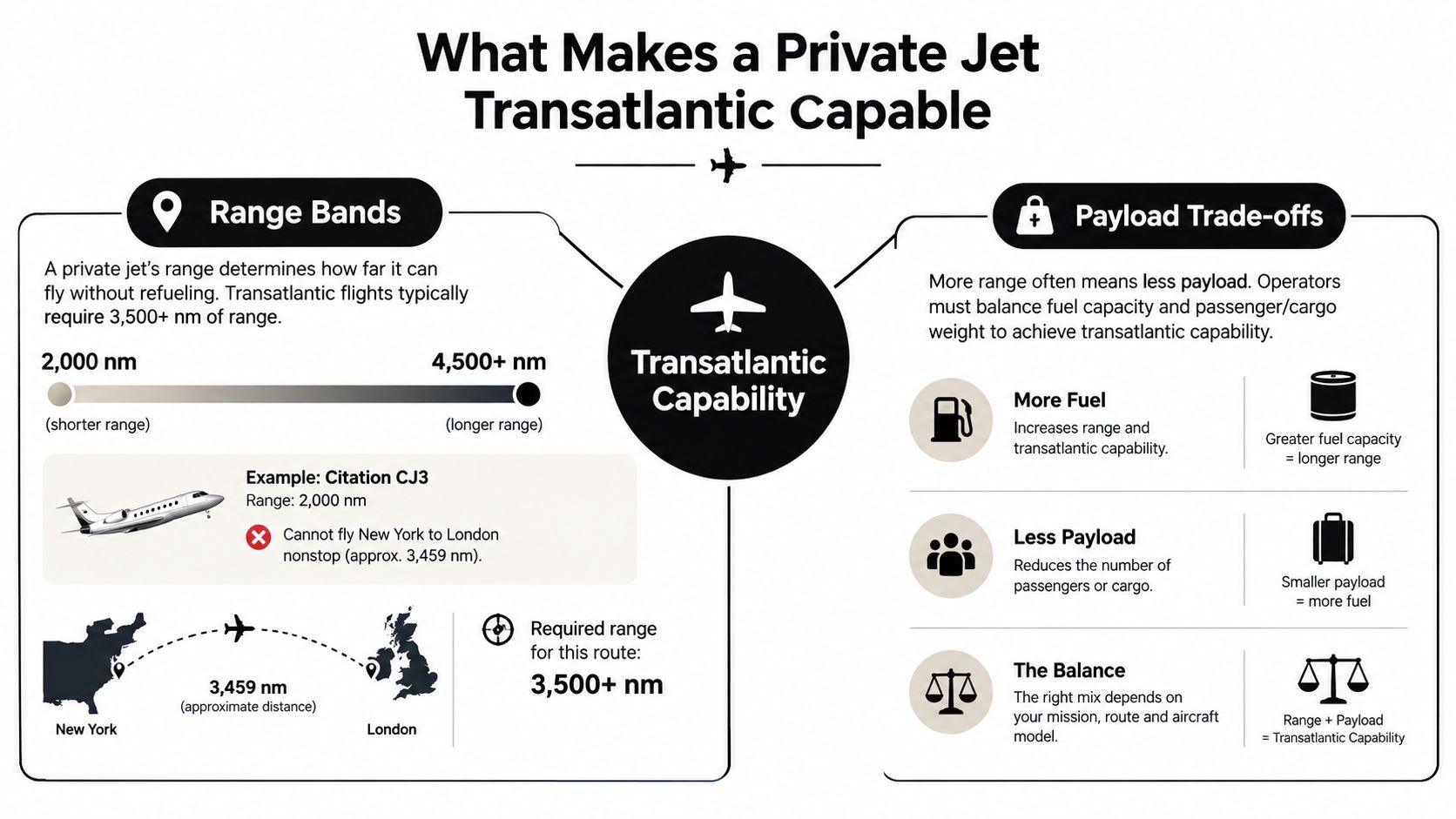
If you want a cleaner view of the category that usually solves this problem, review ultra-long-range jets.
Range bands matter more than marketing labels
Here's the simple progression:
Light jet
Good for regional flying. Not a practical nonstop Atlantic choice.Super midsize
The conversation starts, not where certainty starts. Some super-midsize aircraft can enter the Atlantic discussion at the lower end of viable crossings, but they're often conditional.Heavy jet
The practical standard for most nonstop East Coast to Europe charter.Ultra-long-range jet
The category you book when you want margin, full payload confidence, or a West Coast departure.
A jet burns fuel to carry fuel. That's the part many first-time clients miss. Add passengers, bags, reserves, and weather margin, and the advertised range gets less useful very quickly.
Brochure range is not dispatch range
Manufacturer assumptions tell you why two aircraft with similar-looking specs behave differently in real life. Bombardier states the Global 8000 at around 8,000 nautical miles with NBAA IFR reserves at Mach 0.85, while Cessna's Citation Longitude brochure states 3,500 nautical miles based on a 4-passenger mission under specific assumptions including winds, ISA, and NBAA IFR reserves, as shown in Bombardier's Global 8000 performance materials.
That's the lesson. Range claims are conditional. If your trip depends on nonstop certainty, buy margin, not hope.
Heavy, Ultra Long Range, and Super Midsize Compared
A client asks for New York to Paris, eight passengers, full bags, and a hard nonstop requirement. The wrong move is shopping by cabin photos or a flat hourly rate. The right move is matching the mission to the aircraft category, then checking whether the trip will require repositioning and whether SAF is available at the departure or uplift point.
Transatlantic Jet Categories Compared
| Category | Range (nm) | Typical Pax | Best Transatlantic Use |
|---|---|---|---|
| Super midsize | Around 4,000 | Smaller groups | Shorter East Coast crossings with light payloads and favorable conditions |
| Heavy jet | About 4,000 to 6,000 | 8 to 12 | Core East Coast U.S. to Europe missions with better cabin and baggage flexibility |
| Ultra long range | About 6,000 to 8,200 | Larger groups, longer missions | West Coast to Europe, stronger nonstop margin, fuller payloads, fewer operational compromises |
Those labels matter less than fit. A super midsize can price attractively on paper and still become expensive if it needs a fuel stop, has to leave bags behind, or is sitting far from your departure airport. A heavy or ultra-long-range aircraft can cost more per hour and still be the better buy once you account for repositioning, payload, and the odds of making the route as booked.
Heavy jets: the practical Atlantic workhorse
For first-time transatlantic charter clients, heavy jet is usually the right place to start.
This category covers a large share of East Coast to Europe flying without forcing you into the top end of the market. You get a proper transatlantic cabin, meaningful baggage space, and better odds of keeping the trip nonstop under normal operating conditions. Aircraft in the Gulfstream G450 and Falcon 900 class sit in this conversation for a reason. They are often the sensible answer for clients who want capability without paying ultra-long-range money by default.
Heavy jets also give you a broader sourcing pool. That matters. More available aircraft usually means a better chance of finding an owner-operated option positioned close to your departure point, which can trim repositioning cost and improve schedule control.
For readers comparing cabin and range differences across the brand, this guide to top Gulfstream jets for luxury transatlantic flights in 2025 is a useful reference.
Ultra long range: pay more, get margin
Ultra-long-range aircraft earn their premium on missions where margin matters more than optics.
If you are departing from the West Coast, carrying a larger group, moving with heavier bags, or insisting on a nonstop in both directions, this is the category to book. Aircraft such as the G650 and Global 7500 are not just more luxurious options. They solve operational problems. They carry more fuel without turning the payload trade-off into a fight, and they give dispatch more room to work around headwinds, alternates, and reserve requirements.
They also widen your airport and fuel-planning options. That can matter if you want SAF and the preferred departure airport has limited supply. In practice, some clients end up choosing the aircraft first, then the uplift plan, because SAF availability is uneven and can affect both routing and price.
Super midsize: use carefully
Super midsize belongs in the conversation only when the mission is forgiving.
It can work for shorter Atlantic sectors with a lighter passenger count, lighter bags, and favorable conditions. It is a poor choice for a first-time client whose instruction is simple: nonstop, no surprises. The category can save money, but only if the trip stays inside a narrow operating envelope. Once you add a fuel stop, repositioning, or payload restrictions, the savings often disappear.
My recommendation is blunt. If nonstop certainty matters, start with heavy jet. If payload, westbound performance, or West Coast departure matters, book ultra long range. Use super midsize only when the mission clearly supports it and the operator can prove the numbers, not just quote the brochure range.
Common Transatlantic Routes and Realistic Flight Times
You approve a nonstop to Europe, then the quote comes back with a fuel stop, a ferry leg, or a different airport than you expected. That usually happens because the route was treated as a flat mileage problem instead of an aircraft-fit problem.
City pair matters. So do winds, passenger count, bags, preferred airports, and whether you want SAF uplift at departure. A New York to London crossing gives you room to compare categories. Los Angeles to London does not. Once the mission starts on the West Coast, the list of realistic nonstop aircraft gets much shorter, and repositioning can become a bigger cost driver than many first-time clients expect.
Common Transatlantic City Pairs
| City Pair | Distance | Heavy Jet | Ultra Long Range | Super Midsize |
|---|---|---|---|---|
| New York to London | Shorter core Atlantic crossing | Realistic nonstop option | Strong nonstop option | Possible on the right day, with limits |
| Miami to Madrid | Longer East Coast to Europe mission | Often practical | Strong fit | Usually a poor nonstop choice |
| Chicago to Zurich | Mid-continent to Europe | Practical on selected aircraft | Strong fit | Often too tight for comfort |
| Los Angeles to London | West Coast to Europe mission | Often restrictive | Standard nonstop solution | Not realistic nonstop |
| San Francisco to Paris | West Coast to Europe mission | Often restrictive | Standard nonstop solution | Not realistic nonstop |
The table is only useful if you read it the right way. “Possible” is not the same as “smart to book.” If you are flying eastbound with a light cabin, flexible bags, and no insistence on SAF at a specific airport, you may have more options. If you want a westbound return, a full cabin, and operational margin, the category decision hardens fast.
New York to London is the testing ground
New York to London is common because it sits in the range band where several aircraft classes can work, but they do not work equally well.
A heavy jet can be the right answer here. It often gives you a clean nonstop without paying ultra long range pricing for no reason. An ultra long range jet buys you more than cabin prestige. It gives dispatch more room for headwinds, alternates, fuel reserves, and airport choice. That matters if the trip needs to depart from a specific Teterboro or London-area airport, or if you are trying to secure SAF uplift without rebuilding the whole plan around fuel availability.
This route is also where owner-operator sourcing can pay off. If the aircraft is already positioned on the East Coast or in the UK, you may avoid a costly ferry and still book the right category. If the operator has to bring the aircraft in from another market, the quote can jump even though the passenger leg looks identical on paper.
East Coast to Western Europe is where first-time clients should compare categories carefully, then compare positioning just as carefully.
West Coast to Europe is a different mission
West Coast departures to Europe should be treated as ultra long range missions first.
Heavy jets can sometimes cover them under favorable conditions, but that is not a planning standard I recommend for a first booking. The route is longer, the penalty for headwinds is larger, and any requirement around payload, alternates, or SAF can narrow the operating window further. Once a technical stop appears, the headline savings from booking a smaller aircraft often disappear.
Published flight time is secondary. The question is whether the aircraft can fly the mission the way you want to fly it, from the airport you want, with the passenger load you expect, and without adding repositioning cost that wipes out the apparent deal.
Transatlantic Private Jet Pricing in 2026
Here's the blunt answer. There is no honest single “price to Europe.”
Transatlantic private jet pricing is segmented by aircraft category, route fit, and positioning reality. Two quotes for what sounds like the same trip can land far apart because one operator is local to the departure airport and another is ferrying the airplane in from somewhere else.
What the market looks like
Recent 2026 pricing data places Europe long-haul missions starting around €77,000 and rising to €150,000+ for transatlantic ultra-long-range flights. On the core New York to London lane, examples range from roughly $68,000 to $95,000 for a heavy jet and $110,000 to $160,000 or more for an ultra-long-range aircraft, according to the Jet Supply private jet charter price index.
That spread is the story. Not all “New York to London” quotes are pricing the same operational answer.
2026 Transatlantic Charter Pricing by Class
| Aircraft Class | Typical Hourly (USD) | NY-London | LA-Paris | MIA-Madrid |
|---|---|---|---|---|
| Super midsize | Qualitatively lower than heavy and ultra-long-range categories | Often not the right nonstop tool | Generally unsuitable nonstop | Mission-sensitive |
| Heavy jet | Varies by operator and mission | Roughly $68,000 to $95,000 | Often less practical than ultra-long-range | Practical on many missions |
| Ultra long range | Highest category pricing | Roughly $110,000 to $160,000 or more | Core category for this mission type | Strong fit |
| Europe long-haul missions overall | Varies | Starting around €77,000 | Can rise to €150,000+ for transatlantic ultra-long-range flights | Varies |
Why one quote can be tens of thousands higher
The levers are usually these:
Repositioning
If the aircraft isn't near your airport, you may pay for the empty leg to get it there.Aircraft class
Moving from heavy to ultra-long-range often changes price sharply, even when the route distance seems similar.Airport pair
Teterboro to Farnborough doesn't price the same as a different pairing, even if the route sounds broadly identical.Operator positioning
A jet already near origin can beat a theoretically cheaper aircraft that starts elsewhere.
Pricing insight: On Atlantic charter, the aircraft's home base can matter almost as much as its cabin.
If you want a disciplined buying strategy, compare total mission cost, not hourly rate. Hourly pricing is where bad transatlantic decisions hide.
Overflight Permits, Customs, and Fuel Planning
The quote isn't the trip. Operations are the trip.
A transatlantic private jet booking lives or dies on permit timing, customs handling, and fuel planning. This is the part many charter comparisons skip because it's less glamorous than cabin photos and more important than almost everything after safety.
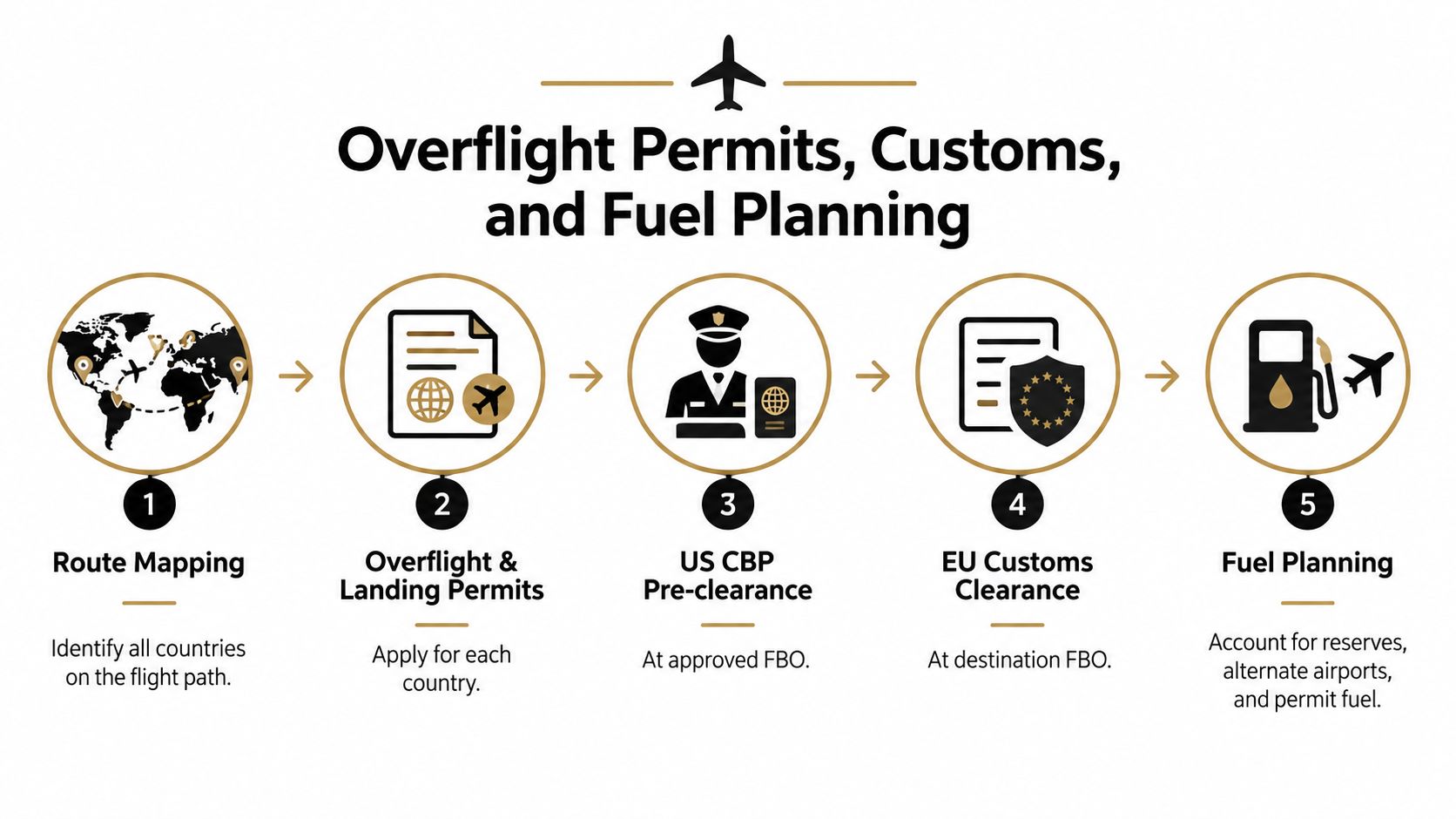
The operational checklist that actually matters
Route permissions
Every country on the routing matters. Overflight and landing permissions have to line up with the actual path and destination.Customs coordination
U.S. departure and European arrival both need to be handled through the right FBO process. Smooth customs isn't automatic. It's planned.Fuel strategy
Nonstop versus technical stop often comes down to payload and reserve planning, not brochure range.
If you want a practical overview of how these permissions work, this page on private jet overflight permits is a useful reference.
Later in the planning chain, this operational overview helps visualize the moving parts:
SAF is now an operational variable
Sustainability isn't just branding anymore. It affects sourcing and planning. UK aviation policy sets a goal of at least 10% SAF use by 2030, and EU policy requires fuel suppliers at EU airports to deliver jet fuel containing at least 2% SAF in 2025, rising to 6% in 2030 and 20% in 2035, as outlined in the UK Jet Zero strategy document.
That doesn't mean every airport offers the same SAF access. It means your operator has to plan for airport-by-airport variability, especially on European legs.
If you care about SAF, ask where it will actually be uplifted. Don't accept a generic sustainability promise.
Why tech stops still happen
A stop in Shannon, Keflavik, or another Atlantic routing point usually means one of three things. The payload is heavy, the selected aircraft is tight on margin, or the operator chose a more economical category and accepted the operational compromise.
That isn't always a bad decision. It's only a bad decision when the client thought they were buying nonstop.
How Owner Operator Sourcing Changes the Equation
If you want to move the price meaningfully on a transatlantic private jet, stop obsessing over brand first and start asking where the aircraft is based.
That's the lever.
A long-haul charter quote gets expensive when it carries too much empty flying. The wrong sourcing model turns a sensible Atlantic mission into a ferry-flight invoice disguised as a luxury booking.
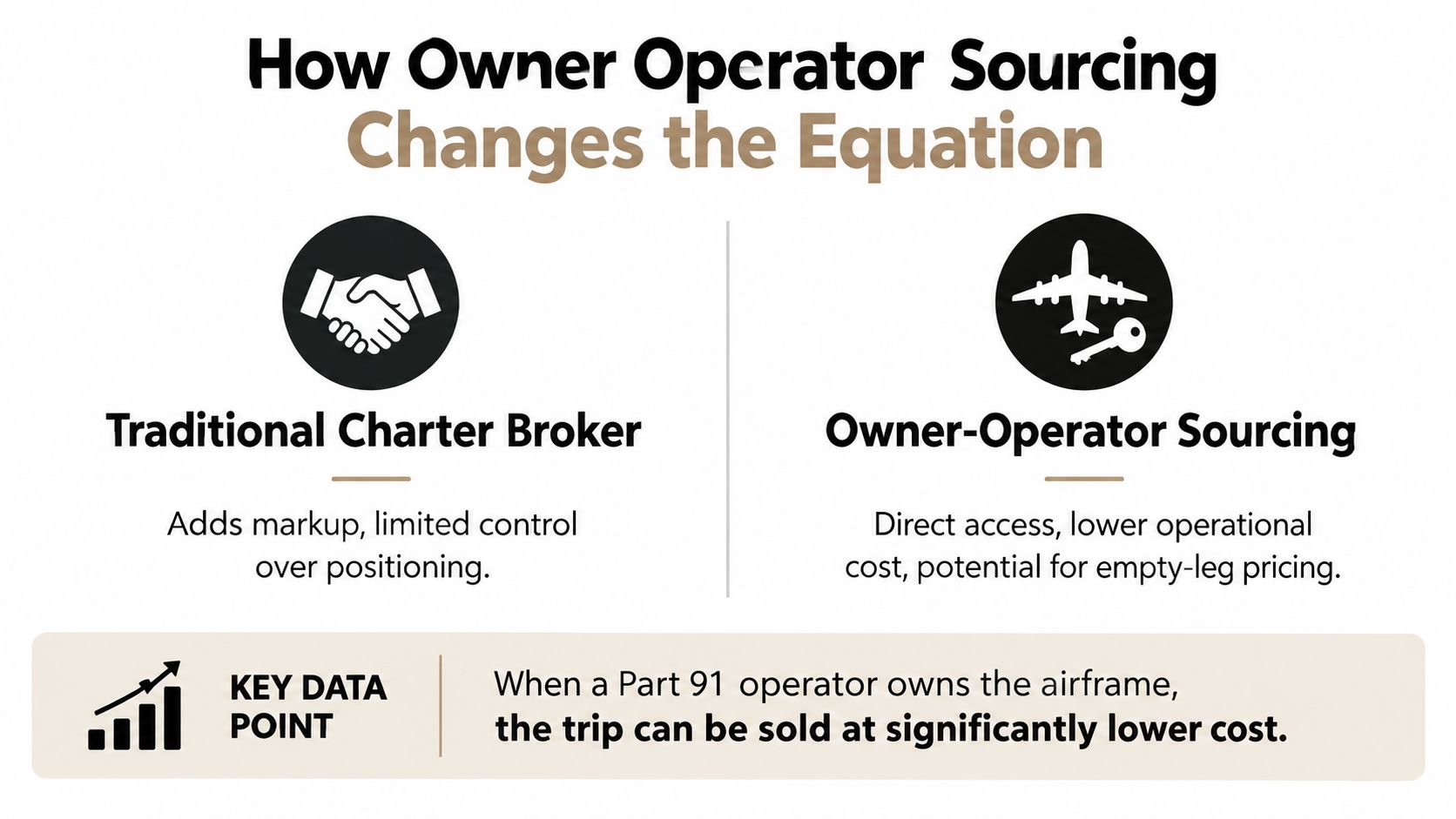
Why local aircraft beat marketplace abstraction
The cleanest transatlantic quotes usually come from operators that already have the right jet near the departure city. A New York-based long-range aircraft starting in Teterboro is a different economic proposition from the same model flying in empty from another market.
Owner-operator sourcing matters because it can cut markup layers and reduce repositioning drag. In plain terms, fewer middlemen and less empty flying usually produce a more rational quote.
Haute Jets is one example of this model. It sources from owner-operators and focuses on aircraft near the departure point, which is directly relevant on repositioning-heavy international missions.
The trade-offs are real
This model isn't magic. It has trade-offs.
Less redundancy
The broad marketplace may show more backup options at once.Cabin variation
Two aircraft of the same model can be very different inside.Operator differences
You still need to check safety credentials, insurance, and route experience carefully.
That said, for Atlantic bookings, the sourcing model often matters more than clients expect. If the operator is local and the airplane fits the mission, the quote usually improves before you negotiate anything else.
Booking a Transatlantic Charter Without Surprises
Most unpleasant charter invoices don't come from fraud. They come from vagueness. The client heard “nonstop capable,” saw a category name they recognized, and never forced the operator to itemize the mission properly.
Do the opposite.
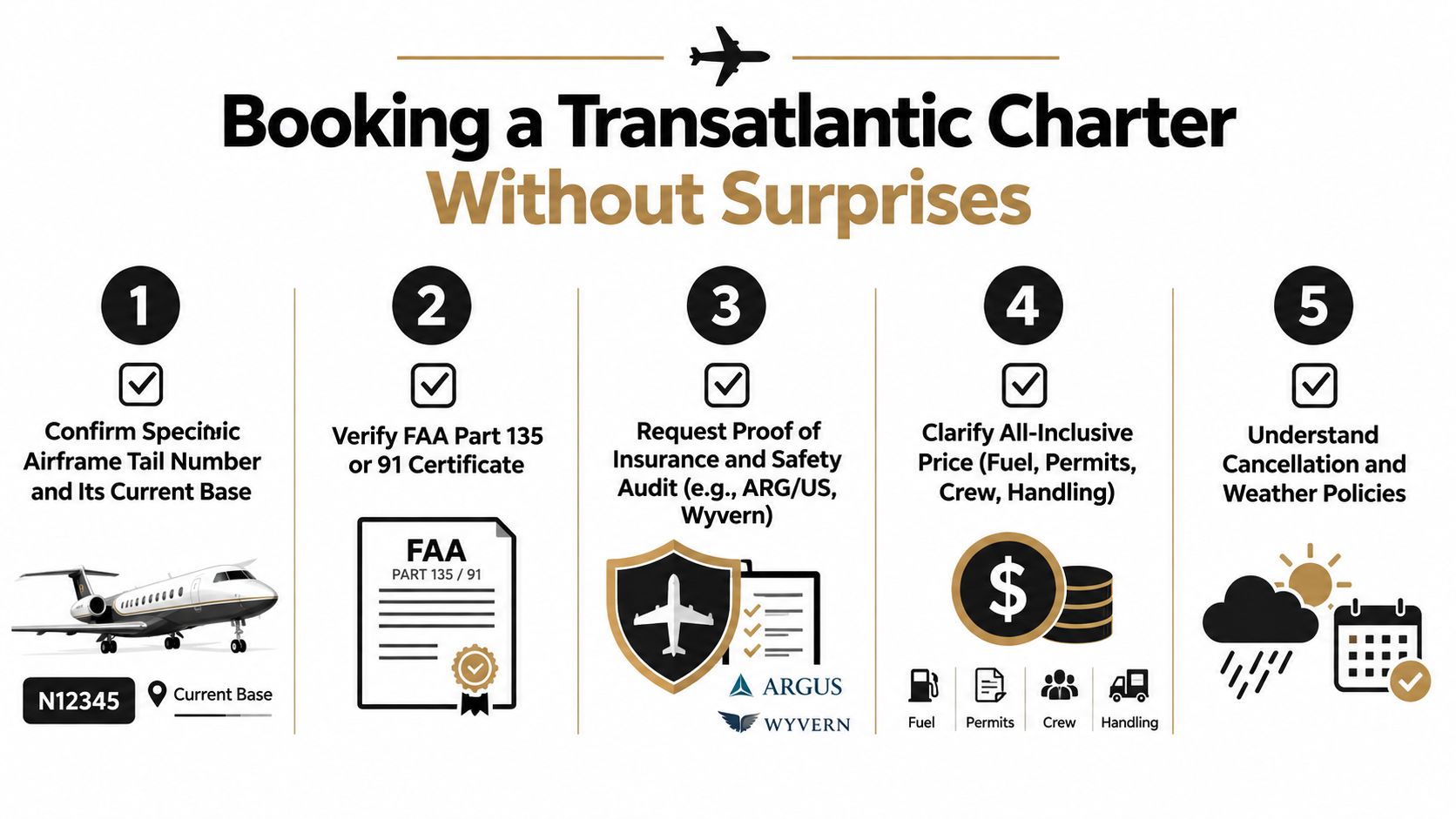
Ask for the exact aircraft, not just the category
Start with the tail number and current base. If the seller won't confirm those early, you don't yet have a real quote.
Then verify the operator standard. For charter vetting, third-party safety ratings include ARGUS Gold, ARGUS Platinum, and Wyvern Wingman. ARGUS Platinum is described as the highest rating, and Wyvern Wingman requires an on-site audit focused on pilot training, experience minimums, drug and alcohol testing, maintenance practices, and the operator's safety management system according to CheckBravo's summary of charter safety ratings.
Demand an itemized international quote
Your written quote should separate:
- Aircraft charge
- Repositioning or ferry cost
- Fuel and any SAF uplift
- Landing and handling
- Crew overnight
- Permits
- Catering
- De-icing if relevant
If those items are blended into one opaque figure, you can't compare providers intelligently.
Booking advice: If the quote isn't broken out, the conversation isn't finished.
Confirm payload, customs, and route history
Before you wire anything, ask these direct questions:
- Has this exact aircraft flown this city pair nonstop recently with a similar load?
- What is the planned arrival FBO and customs process on both ends?
- Does the payload sheet support our passenger count and baggage on this route?
- What happens if weather changes the plan?
- What are the cancellation and diversion terms in writing?
That sequence forces transparency. It also exposes weak sales process fast.
A transatlantic private jet booking should feel boring by departure day. If it still feels fuzzy, you don't have enough operational detail yet.
Haute Jets arranges on-demand transatlantic charter with owner-operator sourcing, exact aircraft selection, and safety screening built around Wyvern and ARGUS-rated operators. If you want a quote that separates aircraft fit, positioning cost, and international operating charges clearly, visit Haute Jets.