

You're probably asking this for a specific reason, not out of curiosity. You have a meeting overseas, a family itinerary with tight timing, or a last-minute charter request where “nonstop” sounds simple until someone starts talking about winds, payload, and alternate airports.
That's where most first-time charter clients get tripped up. The question isn't just how far can a private jet fly. The real question is whether a specific aircraft can fly your exact mission, on your day, with your passengers, bags, routing, and weather.
The headline answer is broad. A common industry benchmark is that most private jets fall in the roughly 2,000 to 10,000 nautical mile range, while some executive airliners can exceed 10,000 nm, and typical short-range private jets may only reach about 1,500 nm nonstop, according to Presidential Aviation's overview of private jet range. That spread is enormous. It's the difference between a short regional mission and a near-global nonstop flight.
The Billion-Dollar Question How Far Can My Jet Really Fly
Clients often expect a clean answer. They want one number, one aircraft, one yes or no. Private aviation doesn't work that way.
A jet that looks perfect on paper can become a poor choice once the mission details come into focus. The route may be technically possible but operationally tight. That matters because “tight” in charter often means reduced flexibility, higher risk of a fuel stop, or a last-minute aircraft change if conditions shift.
Why the same question has different answers
Range in business aviation is a moving target because the mission moves. A couple flying with light luggage from one long-runway airport to another gives the aircraft one performance profile. A full cabin with golf clubs, winter bags, and a hot-day departure gives it another.
Practical rule: Treat any advertised range number as a planning reference, not a promise.
That distinction becomes even more important on prestige routes. Travelers often ask whether a jet can make New York to London, London to Singapore, or Los Angeles to Tokyo nonstop. Sometimes the answer is yes. Sometimes the answer is yes, but only with the right cabin class, favorable conditions, and realistic payload assumptions.
What first-time charter clients should focus on
If you're booking your first long mission, the smartest approach is to think in priorities, not brochure specs:
- Nonstop requirement: If a fuel stop is unacceptable, say that first.
- Passenger count: A jet that works for a smaller group may not work for a full cabin.
- Luggage profile: Ski bags, golf clubs, garment bags, and hard cases all change the mission.
- Airport choice: Some airports are easier for long-range departures than others.
Clients who lead with hourly rate alone often end up comparing the wrong airplanes. The better question is whether the aircraft gives you a practical operating cushion for the trip you want to fly.
A Guide to Private Jet Classes and Their Range Capabilities
Private jets aren't one market. They're several markets stacked together. The practical gap between the smallest and largest aircraft is huge.
According to Aviapages range data by aircraft class, very light jets typically fly 1,000 to 1,500 nautical miles, light jets 1,500 to 2,500 nm, midsize jets 2,500 to 3,500 nm, super-midsize jets 3,500 to 4,500 nm, heavy jets 4,000 to 6,500 nm, and ultra-long-range jets can exceed 7,500 nm. That means nonstop capability can differ by more than 6x between the smallest and largest private jets.
For a fuller overview of cabin categories, baggage trade-offs, and typical mission fit, see Haute Jets' guide to understanding private jet types.
Private Jet Range by Aircraft Class
| Aircraft Class | Typical Range (Nautical Miles) | Typical Pax | Example Nonstop Route |
|---|---|---|---|
| Very Light Jet | 1,000 to 1,500 | 4 to 5 | Los Angeles to Las Vegas |
| Light Jet | 1,500 to 2,500 | 6 to 7 | Teterboro to Miami |
| Midsize Jet | 2,500 to 3,500 | 7 to 9 | Miami to Aspen |
| Super-Midsize Jet | 3,500 to 4,500 | 8 to 10 | New York to parts of Western Europe, depending on mission conditions |
| Heavy Jet | 4,000 to 6,500 | 10 to 16 | New York to London |
| Ultra-Long-Range Jet | 7,500+ | 12 to 19 | Los Angeles to London |
How each class is used in practice
Very light jets are built for short sectors. They work well when speed, privacy, and access to smaller airports matter more than cabin size. They're efficient for regional flying, but they're not the right tool for long nonstop missions.
Light jets are often the sweet spot for short business trips. They can cover many domestic city pairs comfortably and quickly. They start to run out of room when passengers bring bulky luggage or when the itinerary stretches into longer coast-to-coast style planning.
Midsize jets are where flexibility improves. You get more cabin comfort, better baggage handling, and enough range for many longer domestic routes. For many clients, this is the first category that feels like a true all-around business aircraft.
Where range starts to change the experience
Super-midsize jets often become the serious contender for longer overwater or transcontinental missions. They can sometimes handle routes that would force a stop in a smaller jet, though mission conditions still decide whether “sometimes” becomes “today.”
Heavy jets are the traditional transatlantic workhorses. They offer larger cabins, better endurance, and more payload capability. If your trip includes more people, more bags, or more onboard comfort requirements, this category often makes operational sense.
Ultra-long-range jets sit in a different tier. These aircraft are designed for the city pairs travelers usually think of when they picture global business aviation. That doesn't mean every mission is automatic, but it does mean they're the category built to solve true long-haul nonstop flying.
The class tells you where to start. It doesn't tell you what will work on the day of departure.
Beyond the Brochure The Factors That Reduce Real-World Range
A private jet's range works a lot like a car's fuel economy estimate. The laboratory number is useful, but your actual result depends on how you load the vehicle, how you drive it, and what conditions you face on the road.
The same applies in charter. A manufacturer's number is based on a defined performance setup, not your family ski trip, your board meeting, or your weather pattern that morning.
What the brochure number assumes
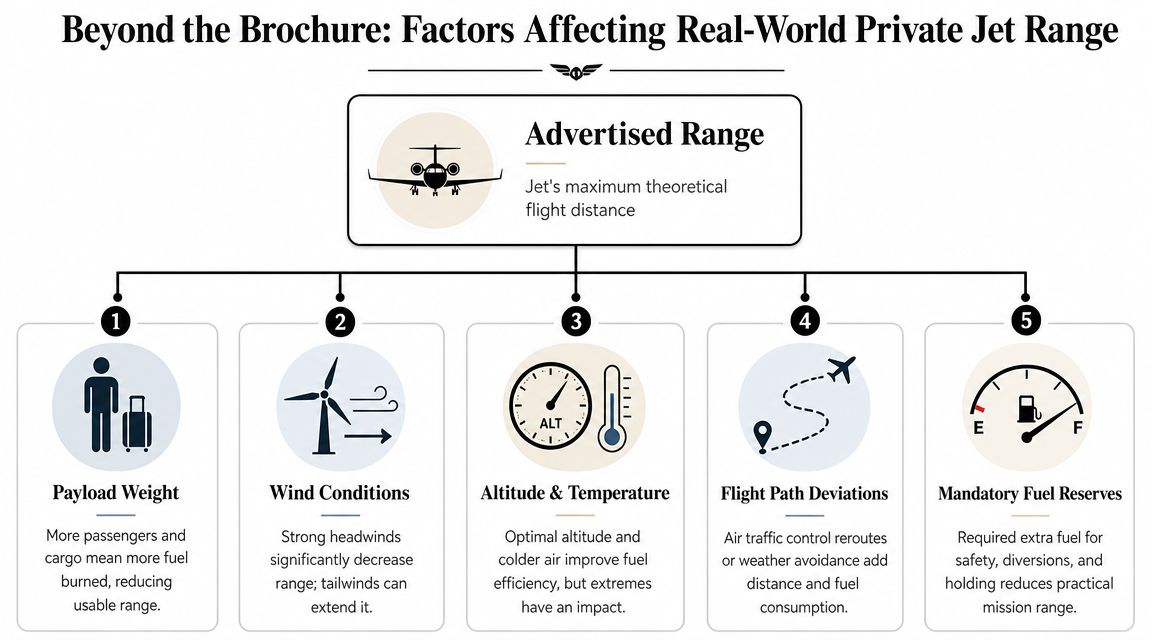
According to VistaJet's explanation of private jet range, a private jet's OEM range is published with a standard payload and ideal weather. In practice, more passengers or more baggage reduce available fuel and shorten range. The same source notes that published ranges such as 2,000 nm for midsize jets or 6,000+ nm for heavy jets should be viewed as best-case scenarios.
The four variables clients feel most often
Payload changes everything. Add passengers, checked baggage, cabin baggage, catering, and equipment, and you change the fuel trade-off. The aircraft may still make the route, but the margin gets thinner.
Weather can erase paper range. Headwinds matter on long sectors. A route that looks comfortable westbound on one day can become a close call on another, especially over oceanic or high-traffic corridors.
Fuel reserves are not optional. Crews don't plan to land with empty tanks. They carry required reserves and contingency fuel because safe dispatch requires options. That reserve planning reduces the practical distance available for the mission itself.
Airport performance matters. A runway, temperature, elevation, and departure conditions can all affect how much weight a jet can carry at takeoff. Clients often focus on the aircraft model and forget that the departure airport can be just as important.
Questions worth asking before you approve the aircraft
If you want a realistic answer instead of a sales answer, ask these:
- “Is this route comfortable for the aircraft or just technically possible?”
- “What changes if we add passengers or bags?”
- “Are you planning this on expected winds or ideal winds?”
- “What runway or airport limitations affect departure?”
- “If conditions deteriorate, what is the backup plan?”
A jet that can “usually” make the route nonstop may be the wrong jet if your schedule can't tolerate uncertainty.
That's the difference between range as marketing and range as flight planning. In real charter work, operators and brokers who understand the mission won't just quote the furthest possible number. They'll tell you how much operating room the trip has.
From New York to London Real-World Mission Examples
Route planning gets easier when you stop thinking in categories and start thinking in missions. The same range figure means very different things depending on the city pair, cabin load, and whether a stop is acceptable.
Short regional mission
Los Angeles to Las Vegas is the kind of trip where a smaller aircraft often makes perfect sense. You're not buying range. You're buying convenience, quick boarding, and efficient use of the aircraft.
A light jet is often a sensible fit for this kind of mission because the route doesn't require long endurance. Moving up to a larger cabin may still be worth it for comfort or baggage, but not because the trip demands more range.
Domestic mission with more variables
Miami to Aspen is a different conversation. The route is longer, the airport profile is more specific, and many clients on that mission carry more luggage than they first estimate. A midsize or super-midsize aircraft often enters the discussion because performance flexibility starts to matter as much as cabin comfort.
This is also where planned fuel stops can be strategic rather than inconvenient. Sometimes a stop allows the use of a more cost-efficient aircraft. Sometimes it opens up a better airport strategy. Sometimes it protects schedule reliability on a day with less favorable conditions.
Transatlantic mission
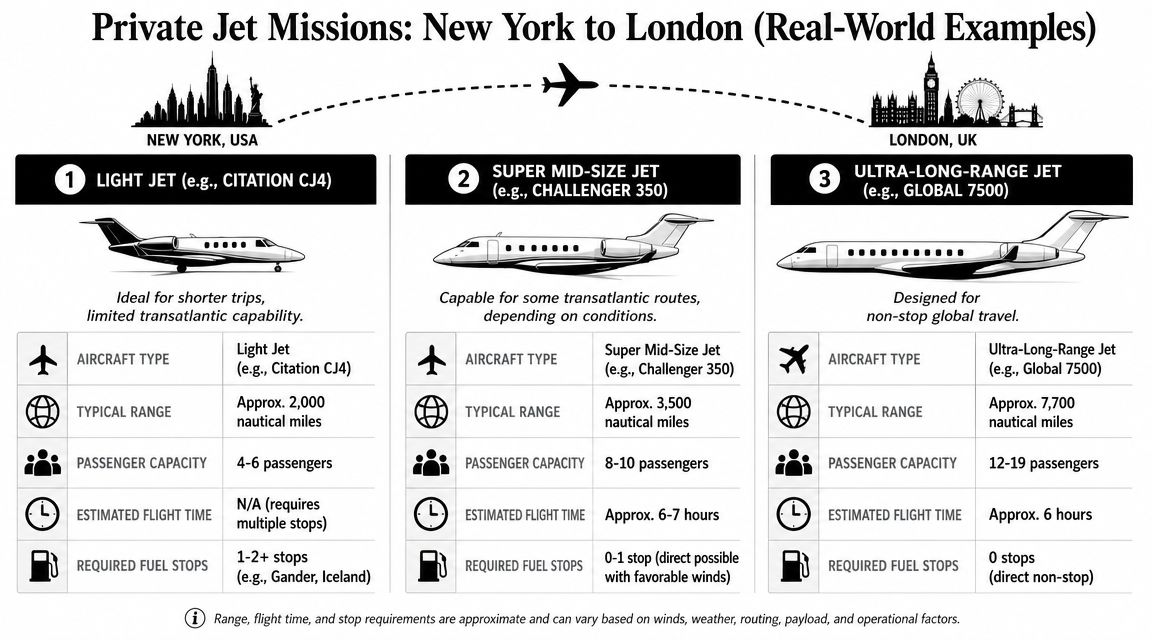
New York to London is where clients usually discover the gap between an aircraft that looks capable and one that is comfortably mission-appropriate. On paper, some aircraft can come close. In practice, this route tends to separate borderline options from purpose-built long-range cabins.
A useful route-specific reference is Haute Jets' New York to London charter page, which shows how this city pair is framed in real charter planning rather than in abstract range terms.
For this mission, the decision usually comes down to what kind of answer you want.
- If you want the lowest aircraft size that might work, the planning becomes more conditional.
- If you want a stronger nonstop probability, the aircraft category moves upward.
- If you want room for schedule changes, payload flexibility, and fewer compromises, long-range cabins become the practical choice.
On prestige routes, the cheapest suitable jet and the right jet are often not the same aircraft.
Why fuel stops aren't always a failure
First-time clients often hear “fuel stop” as bad news. It isn't automatically bad. It's a tool.
A stop can make a smaller cabin economically sensible. It can also help you depart from a preferred airport, carry a fuller load, or avoid forcing an aircraft into a narrow performance corner. The problem isn't the stop itself. The problem is discovering too late that your nonstop assumption was never realistic.
How Range Affects Your Charter Quote and Flight Plan
Range doesn't just affect whether the airplane gets there. It affects what you pay, how the itinerary is built, and how much operational risk sits inside the quote.
If an aircraft is borderline for the mission, the quote may look attractive at first. Then actual planning starts. Extra time, a possible fuel stop, repositioning complications, or a change in aircraft class can all shift the economics.
Why the lowest hourly rate can mislead
Clients often compare aircraft by hourly price and stop there. That works poorly when the mission is near the edge of the airplane's capability.
An aircraft with a lower hourly rate may still produce a less efficient overall charter if it needs a stop, limits baggage, or forces a departure workaround. A larger aircraft can look more expensive while delivering the cleaner operational plan.

What competent mission analysis looks like
According to Element Aviation's discussion of real-world mission range, payload, headwinds, and reserves can materially reduce nonstop capability, and a jet advertised with a 7,000 nm range may not achieve that on a specific charter day. That's why analysis of the exact city pair and mission variables matters.
In practice, that means a serious charter review should account for:
- Passenger and baggage profile: Not just seat count, but actual load.
- Expected operating conditions: Winds, routing, and practical dispatch assumptions.
- Airport performance: Especially when runway or departure constraints are relevant.
- Backup options: Whether the plan still works if conditions tighten.
For clients trying to understand how aircraft selection changes the total trip economics, Haute Jets' breakdown of private jet charter pricing is a useful companion resource.
What works and what usually doesn't
What works is choosing an aircraft with enough range margin that the mission still holds together when real life intervenes. That margin gives the crew options and gives the client fewer surprises.
What usually doesn't work is forcing a low-cost aircraft into a long-range mission because the brochure figure says it can “do up to” the required distance. Those flights are where assumptions fall apart. The client thought they bought certainty. What they bought was dependence on ideal conditions.
The quote should fit the mission. The mission shouldn't be bent to fit a fragile quote.
An advisor earns their keep not by repeating the published range, but by filtering out aircraft that are technically available yet operationally weak for the trip.
Choosing the Right Jet for Your Mission
The right jet is rarely the one with the biggest cabin or the furthest headline range. It's the aircraft that fits your trip with the least compromise.
For a short leisure hop, that may be a smaller cabin near your departure airport. For a business-critical overseas route, it may be a larger aircraft with stronger range margin even if the headline price is higher. Mission fit beats category prestige every time.
A practical booking checklist
Before you request quotes, get clear on these points:
How many people are flying Final headcount matters more than a rough estimate. An aircraft that works for one group size may stop working when the cabin fills up.
What is the exact city pair
“New York area” and “London area” are not specific enough for real planning. Airport selection can influence aircraft suitability.What luggage are you bringing
Soft bags, hard cases, skis, golf clubs, garment bags, pet gear, and production equipment all change the answer.Do you need true nonstop capability
If a stop is acceptable, say so. If it isn't, that should drive the short list from the start.What matters more, cost or margin
Some clients want the leanest acceptable option. Others want a wider operating cushion. Both are valid, but they produce different aircraft recommendations.
The smartest way to ask the range question
Don't ask, “Can this jet fly that far?”
Ask, “Can this jet fly this route, on this date, with this passenger load and this baggage, without relying on ideal conditions?”
That question gets you closer to the truth. It also tells your charter advisor that you understand the difference between marketing range and usable range.
If you remember one point from this guide, make it this: how far a private jet can fly depends less on the airplane in isolation and more on the mission you're asking it to perform. Once you understand that, charter decisions become much easier and a lot more accurate.
If you want help matching a route to the right aircraft, Haute Jets can source on-demand charter options based on your exact mission profile, including passenger load, baggage, airport pair, and whether nonstop capability is a requirement.