Most advice on empty legs is backward. It treats them like a secret hack for cheap private flying, when they're really a surplus inventory play with real operational risk.
Yes, the savings can be meaningful. That part is true. But discerning travelers don't just buy a lower fare. They buy reliability, timing control, airport convenience, and the ability to keep the day intact if something shifts. Empty legs weaken all four.
That's the frame for Empty Leg Flights Explained, and it's the only one that matters if you charter for business, family logistics, event timing, or privacy. The question isn't “Can I get a discount?” The question is whether the discount is worth surrendering control of the trip.
For some travelers, the answer is yes. For many high-value itineraries, it shouldn't be.
The Allure and The Gamble of Empty Leg Flights
The appeal is obvious. You see a private jet itinerary offered below standard charter pricing and assume you've found an inefficiency in the market. In reality, you've found someone else's operational leftover.
That doesn't make empty legs bad. It makes them conditional.
The promise is simple: step into a premium aircraft at a reduced rate. The catch is less glamorous. You're not booking a mission built around your schedule. You're attaching yourself to a flight that exists because an aircraft already has to move. If the underlying charter changes, your “deal” can change with it.
Why the headline discount misleads
Most empty-leg marketing leads with savings. That's understandable, because discount language sells. But private aviation isn't just a seat. It's a time-sensitive logistics product.
A lower price can lose its appeal fast if you have to:
- Leave from the wrong airport
- Arrive earlier or later than you wanted
- Accept a narrow departure window
- Rebook ground transport and meetings if the flight changes
- Scramble for a backup plan if the primary charter disappears
Empty legs are attractive when your schedule can bend. They're dangerous when your day can't.
That's why I advise clients to treat empty legs as a risk-reward decision, not a budget tactic. If you're flying for a spontaneous weekend, they can be excellent. If you're flying to a board meeting, a film set, a wedding weekend, a yacht departure, or a same-day family obligation, they're often the wrong tool.
The right question to ask
Don't ask whether the fare is lower. Ask whether the trip can absorb uncertainty.
If the answer is no, you're not comparing apples to apples. You're comparing a discounted repositioning segment to a purpose-built charter. Those are different products with different failure points.
That distinction gets lost in most consumer content. It shouldn't.
The Anatomy of a Repositioning Flight
An empty leg starts with a one-way charter. A client books an aircraft from one city to another, gets dropped off, and the plane still has to go somewhere next. Maybe it returns to base. Maybe it flies to another airport for its next booked mission. That repositioning segment is the empty leg.
Industry explanations use a few terms for the same idea. Empty leg, deadhead flight, and ferry flight all refer to a repositioning sector created by the operating schedule of the aircraft, not by consumer demand, as noted in Magellan Jets' explanation of empty legs.
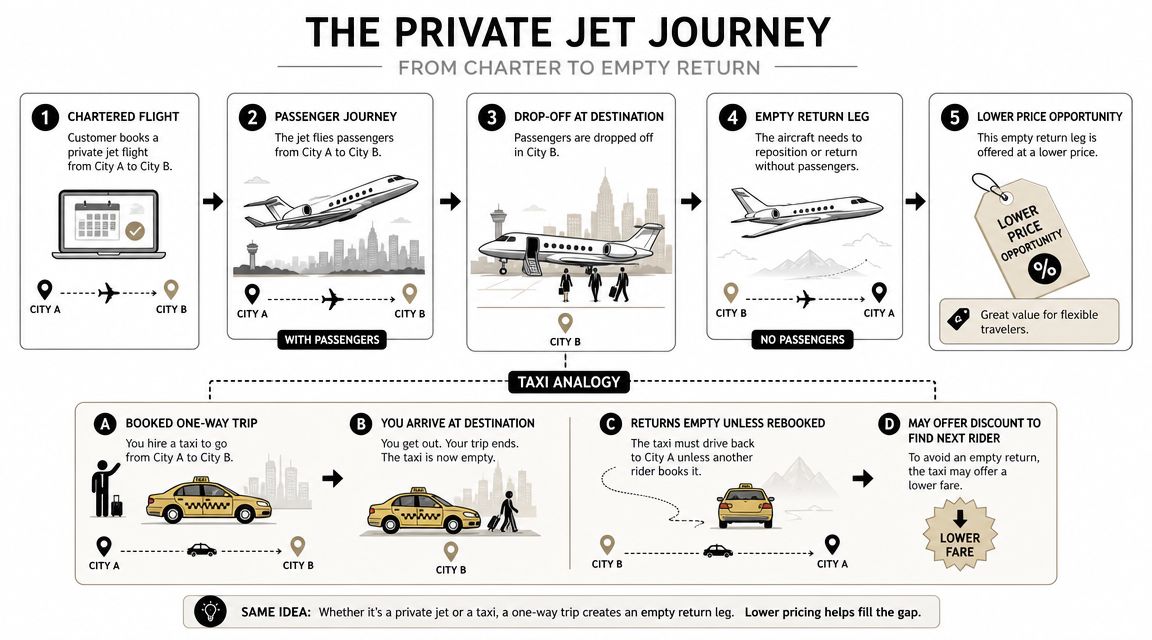
Think of it like a taxi returning empty
The cleanest analogy is a taxi. A passenger hires a car for a one-way trip from downtown to the suburbs. After the drop-off, the taxi driver doesn't magically end the workday there. The car has to reposition for the next fare or head back to a busier zone.
Private jets work the same way, except with far more complexity. Crew duty limits, airport slots, handling arrangements, next-leg scheduling, aircraft category, and client timing all influence where that aircraft must go next.
That matters because it explains a point many travelers miss: empty legs aren't a separate travel product designed for shoppers. They're a byproduct of fleet movement.
If you want a deeper primer on the terminology, Haute Jets Journal also breaks this down in its guide to deadhead flights explained.
What the customer is actually buying
When you book a standard charter, the operator is arranging the aircraft around your mission. When you book an empty leg, you're buying excess capacity on a mission the operator already has to fly.
That changes the booking logic.
| Booking Type | Who controls the route | Who controls timing | Why the flight exists |
|---|---|---|---|
| Standard on-demand charter | The client | The client, within operational limits | The client requested it |
| Empty leg | The existing aircraft schedule | The existing aircraft schedule | The aircraft must reposition |
This is why empty legs usually come with hard constraints:
- Fixed city pair
- Fixed date
- Fixed or narrow departure timing
- Limited ability to swap airports
- Higher exposure to cancellation if the underlying charter changes
You're not commissioning a flight. You're fitting yourself into an aircraft movement that was happening anyway.
Why they show up in certain markets
Empty legs tend to appear most often where one-way charter demand is heavy. Large business aviation ecosystems create more repositioning activity, which creates more opportunities for operators to try to sell those sectors rather than fly them vacant.
That's one reason you'll hear about them more often in major private aviation corridors across the U.S., Europe, and the Middle East. Dense traffic creates more mismatch between where aircraft drop passengers and where they need to be next.
For the traveler, though, the key insight is simpler. Empty legs exist because operators are solving their logistics problem first. If your plans happen to align with that movement, you may get value. If they don't, the discount won't rescue the trip.
Decoding the Price and Volatile Availability
Empty legs get marketed as a luxury hack. That framing is sloppy. The lower price is real, but it exists because you are accepting someone else's schedule risk.
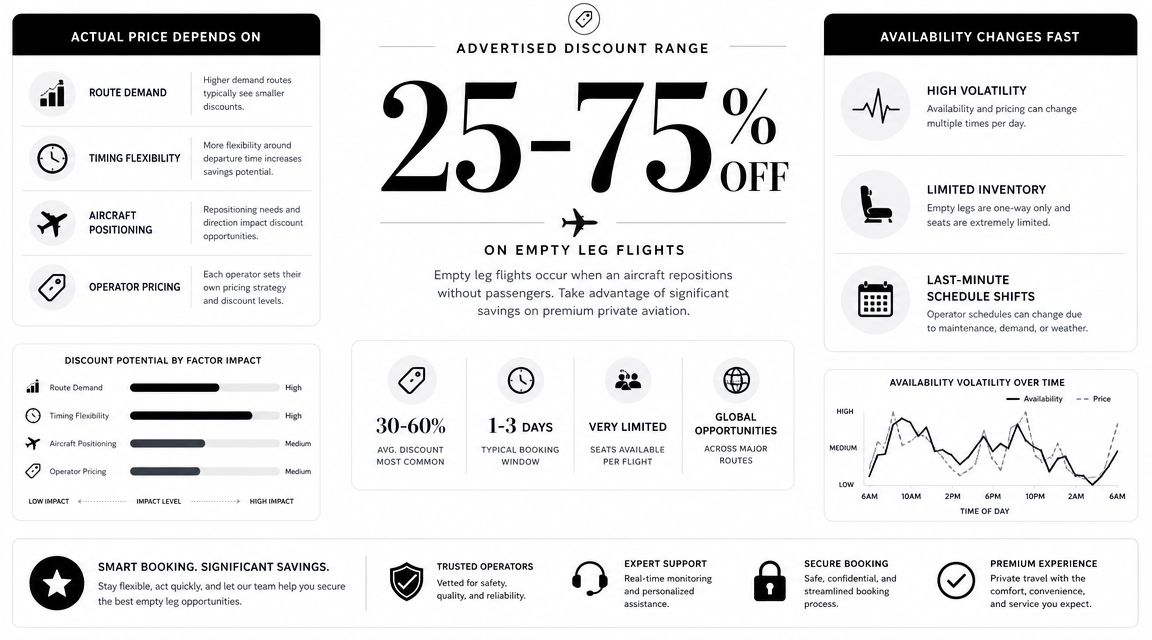
Published guidance from Eton Aviation's empty-leg pricing overview puts typical empty-leg discounts below standard charter pricing, often in a wide range depending on aircraft type, route, and timing. That sounds compelling until you apply it to the actual base cost of private aviation. A discounted private jet is still a private jet, and the bargain disappears quickly if the flight no longer fits the rest of your trip.
Why operators discount them at all
Operators are not being generous. They are trying to recover part of a cost they already have to incur.
A repositioning sector still carries real expenses. Fuel, crew duty, landing fees, handling, and catering do not vanish because the cabin would otherwise be empty. So the operator prices the leg to improve economics, not to create a flexible travel product for the buyer.
That leads to a simple conclusion. Empty-leg pricing can be attractive, but the discount is payment for giving up control.
If you want better context on why quotes vary so much between aircraft, routes, and trip structure, Haute Jets breaks it down well in this guide to private jet charter pricing and cost breakdowns.
Availability is more volatile than the price
Price gets attention. Availability decides whether the offer is usable.
The biggest mistake clients make is treating an empty leg like discounted inventory that will hold steady while they finalize the rest of the trip. It often will not. Industry guidance from Private Jet Card Comparisons on empty legs notes that these flights can appear close to departure and remain subject to the underlying charter movement that created them in the first place.
That matters more than the headline rate. A well-priced empty leg can still be the wrong deal if you are coordinating a meeting, a yacht transfer, a villa check-in, a car convoy, or a family office itinerary around it.
What actually drives the offer
The number you see and the odds of the flight surviving to wheels-up depend on a few practical variables:
- Aircraft category: A discounted heavy jet can still cost more than an on-demand light jet charter that fits the mission better.
- Route inefficiency: Some city pairs generate frequent repositioning activity, while others appear rarely and disappear fast.
- Airport cost structure: Handling, parking, and operating fees affect whether the quote is attractive.
- Time to departure: Closer-in inventory may price better, but that only helps travelers who can wait.
- Dependency on another trip: If the primary charter changes, your empty leg can change with it or vanish outright.
Advisor's rule: If the trip carries financial, social, or operational consequences for being late or canceled, price the empty leg against a properly sourced on-demand charter, not against the fantasy of a perfect discount.
That is the risk versus reward equation. Empty legs can save money. They can also force expensive adjustments on the ground that wipe out the savings. For travelers who buy private aviation for certainty and control, a well-sourced on-demand charter is often the better financial decision, even before you factor in stress.
The Traveler's Trade-Off When to Book and When to Avoid
The mistake is treating an empty leg like a normal charter. It is not. You are buying spare capacity on someone else's operational plan, and your trip sits behind that plan in priority.
That can be a smart move. It can also be an expensive one once the rest of your day is built around a flight you do not control.
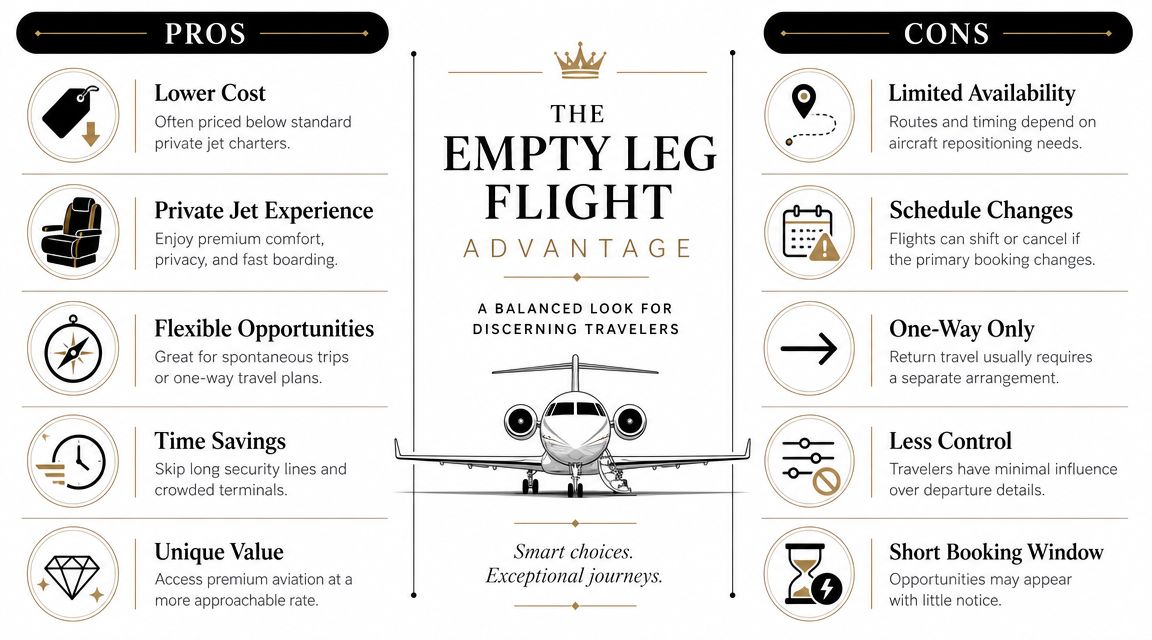
When an empty leg makes sense
Book one for a trip that can absorb disruption without creating a bigger problem on the ground.
Good use cases are straightforward:
- A discretionary leisure trip: A long weekend, a resort hop, or an add-on segment where shifting the plan by a few hours, or even a day, does not matter much.
- One-way travel with genuine flexibility: You are open on departure time, arrival airport, and even the exact routing.
- A traveler buying comfort at a lower cost, not certainty: The private terminal experience matters, but the schedule is still negotiable.
- A bonus trip, not the core trip: An empty leg works far better for the extension after the event than for the event itself.
That is the key distinction. Empty legs fit optional travel. They are a poor tool for high-consequence travel.
Here's a useful visual breakdown of how travelers think about the trade-off:
When you should avoid them
Skip empty legs when the day has to work on the first try.
I would avoid them for any itinerary with fixed handoffs, public visibility, or financial consequences for being late:
| Trip Type | Why empty legs are risky |
|---|---|
| Board meetings | A schedule change can undercut the reason for flying private in the first place |
| Major events | A lower fare is irrelevant if the arrival window is narrow |
| Cruise or yacht departures | The vessel leaves on its schedule, not yours |
| Family milestone travel | Coordinating multiple people leaves little room for flight changes |
| Celebrity, executive, or security-managed itineraries | Late aircraft changes create avoidable complexity and exposure |
Clients often focus on the headline savings and ignore the replacement costs. New car service, revised airport handling, standby staff, missed marina transfers, or a last-minute backup charter can erase the discount quickly. If certainty is the product you need, buy certainty.
That is also why many experienced flyers end up choosing on-demand private jet charters instead of jet card commitments. Comparison is not cheap versus expensive. It is flexible chance versus controlled execution.
A simple decision filter
Ask four blunt questions before you book:
- Can you accept a different departure time or airport without disrupting the day?
- If the flight changes or disappears, do you have a realistic backup plan you are willing to pay for?
- Do you need specific cabin features, baggage capacity, pet approval, or onboard Wi-Fi confirmed in advance?
- Are other people, vehicles, staff, or reservations timed around your arrival?
If the last two are yes, and the first two are no, avoid the empty leg.
My advice is simple. Use empty legs for opportunistic luxury. Use on-demand charter for obligations, deadlines, and anything you cannot afford to get wrong.
A Smarter Alternative The Haute Jets Sourcing Model
Most travelers who hunt for empty legs aren't really looking for empty legs. They're looking for a better charter outcome. Lower unnecessary cost, less wasted repositioning, and no feeling that they overpaid for an aircraft that had to come from somewhere inconvenient.
That objective is reasonable. The method is where people go wrong.
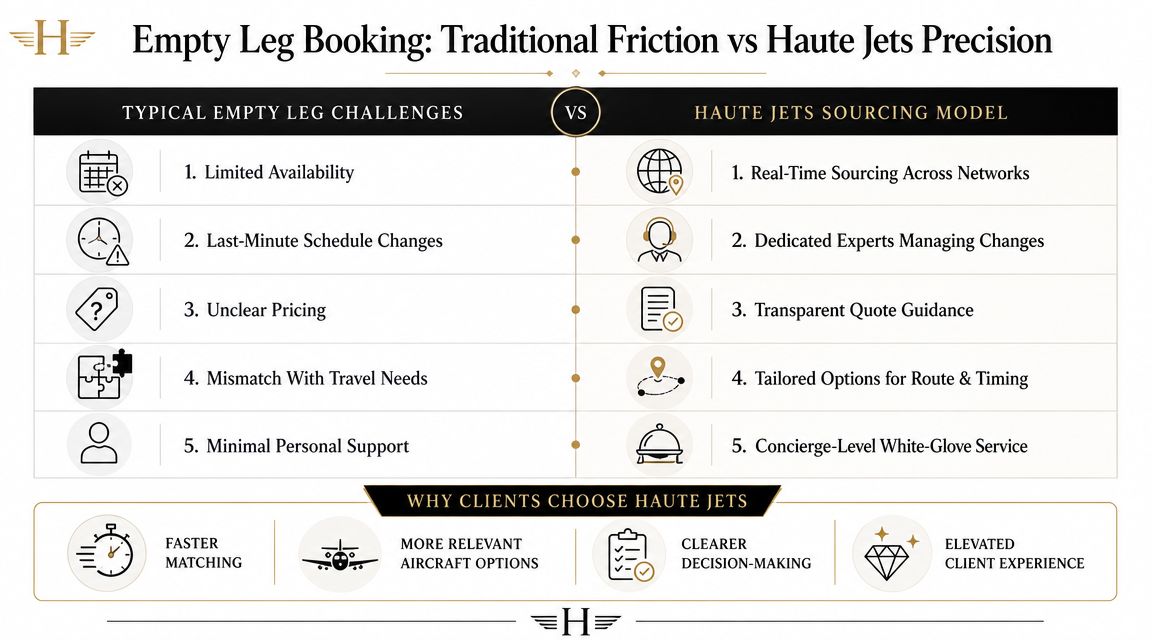
The problem with empty-leg hunting
The search process is often inefficient. You scan listings, compare airports that may not suit your real destination, wait on an aircraft that might disappear, and try to decide whether the “deal” still works after adding the inconvenience back in.
That's why the more useful comparison isn't empty leg versus full-fare charter in theory. It's empty leg versus a well-sourced, nearby, on-demand aircraft in practice.
Industry guidance makes this point clearly: empty legs can be cheaper than full-fare charter, but not necessarily cheaper than a well-sourced one-way charter from a nearby operator, especially when repositioning fees are avoided, as discussed by Element Aviation in its empty-leg comparison.
What better sourcing changes
A strong sourcing model attacks the cost driver directly. Instead of waiting for a random repositioning segment to match your life, it sources an aircraft already positioned near your departure point. That reduces or avoids the repositioning burden that often inflates one-way charter quotes.
The economics become more favorable without importing empty-leg instability.
A practical side-by-side looks like this:
Empty leg approach
- You accept the route available
- Timing is largely preset
- Aircraft choice is limited to what's moving
- Cancellation risk sits in the background
- Airport pairing may be awkward
Locally sourced on-demand charter
- You choose the route that serves the trip
- Timing aligns with the actual mission
- Aircraft selection is broader
- The quote reflects a real charter, not leftover capacity
- Ground logistics stay cleaner
A discount isn't automatically a savings if it forces bad airports, bad timing, or a backup booking.
Where the Haute Jets model fits
For travelers comparing alternatives, Haute Jets uses a sourcing model built around owner-operators rather than prepaid card structures. The practical implication is simple: source aircraft near the client's departure city, reduce avoidable repositioning, and confirm the exact aircraft details in advance instead of asking the traveler to adapt to leftover inventory.
That matters because the true luxury standard isn't just cabin quality. It's control.
A sourcing-led charter process is usually the better fit when you need:
- Exact aircraft selection: Year, make, model, and cabin configuration matter on many trips.
- Verified operator quality: Safety standards and operator credentials shouldn't be an afterthought.
- Known trip details ahead of time: Tail number, crew details, and passenger planning reduce day-of friction.
- No dependence on chance alignment: You book the trip you need, not the one the market happened to spill out.
My recommendation
If your trip has hard timing, high visibility, family complexity, or business stakes, stop shopping empty legs first. Shop smart sourcing first.
Empty legs are opportunistic. That's fine. But when people use them as a substitute for disciplined charter procurement, they often optimize the wrong variable. They chase the visible discount and ignore the hidden cost of inconvenience, uncertainty, and forced compromise.
A properly sourced on-demand charter won't always beat every empty-leg listing on paper. It often wins where it counts: usable airport pairs, schedule control, aircraft fit, and reduced disruption across the rest of the itinerary.
That's usually the better trade.
Making the Final Call On-Demand Certainty vs Empty Leg Chance
Empty legs are common enough to matter, but inconsistent enough to frustrate. Multiple industry estimates put the share of privately chartered flights operating as empty legs at roughly 30% to 50%, while some statistics say about 30% to 50% of available empty-leg flights go unfilled, which tells you exactly what they are: hit-or-miss inventory rather than dependable trip planning tools, according to Flycraft's roundup of empty-leg flight statistics.
That single point should shape the decision.
If you're flexible on airport, timing, and even the trip itself, an empty leg can be a smart opportunistic buy. If you need the aircraft to support a larger plan, it usually makes more sense to pay for control than to gamble on leftover movement.
Use this checklist before you decide
- Book an empty leg if your plans are flexible, the trip is discretionary, and you can absorb changes without consequence.
- Book on-demand charter if the itinerary is tied to business, family commitments, event timing, security coordination, or onward connections.
- Be honest about ground logistics. A flight that looks attractive can become less attractive if it pushes you into awkward surface transport. For clients balancing airport convenience with end-to-end planning, a reliable black car service airport option can help tighten the trip on the ground, but it still doesn't solve an unstable air itinerary.
- Price the whole mission, not just the flight. In private aviation, inconvenience is a cost even when it doesn't appear as a line item.
The most expensive charter mistake isn't overpaying a little. It's underpricing certainty on a day when certainty matters.
The cleanest way to think about Empty Leg Flights Explained is this: they're a niche tool, not a universal strategy. They reward adaptability. They punish rigidity. And most high-value travelers live on rigid calendars, whether they admit it or not.
If you want a chance at a deal, book the empty leg. If you want the trip to happen on your terms, book the aircraft that was sourced for your mission.
If you want a charter plan built around your actual schedule instead of leftover inventory, Haute Jets offers on-demand access to specific aircraft through its owner-operator network, with confirmed trip details before departure and no membership requirement.