If you're holding meaningful Bitcoin and looking at a private charter, you're probably not asking whether it's possible anymore. You're asking whether it can be done cleanly, quickly, and without turning a simple flight into a payments experiment.
That distinction matters.
In private aviation, the payment rail is only one part of the deal. The bigger question is whether the aircraft quote is sound, whether the operator can support the mission, and whether the crypto workflow is built for a time-sensitive booking instead of a marketing headline. A client who wants to pay for a private jet with Bitcoin usually wants three things at once: convenience, privacy, and certainty. You can get all three, but only if the transaction is structured properly.
Haute Jets Journal exists for exactly this kind of conversation. Not "can you do it?" but "how should you do it so the booking still makes sense when the wheels are up?"
From Digital Assets to Airside Access
A typical request starts the same way. A traveler has liquidity in BTC, wants to move quickly, and doesn't feel like wiring fiat around the world just to book a jet for a family trip, a board meeting, or a same-day reposition. The instinct is reasonable. If digital assets are part of your treasury or personal balance sheet, using them for private aviation is no longer unusual behavior.
That shift showed up years ago. In early 2021, PrivateFly reported that 13% of all its flights were paid for in Bitcoin in January, with crypto payments accounting for nearly 19% of sales revenue across the preceding two months, according to PrivateFly's announcement. That wasn't fringe activity. It was real demand in an active international charter market.

What clients usually get wrong first
The first mistake is treating the jet and the payment method as the same decision.
They aren't.
You can have a broker that accepts Bitcoin and still get a weak aircraft quote. You can also have an excellent aircraft solution and a clumsy crypto process that creates delay, pricing drift, or compliance friction. The smart move is to separate the two questions:
- Is this the right aircraft and routing?
- Is this the right settlement path for the flight timeline?
A crypto-native buyer should watch both.
Why market timing still matters
Bitcoin isn't static while you're deciding. Charter pricing isn't either. Aircraft availability, crew duty, positioning, and airport slots can all move while the market moves alongside them. That's why many experienced buyers keep an eye on live market context before they approve a crypto invoice. If you want a quick reference point, Current BTC statistics can help you sense-check market conditions before you lock a payment window.
Practical rule: If the flight is urgent, don't wait for a "better Bitcoin price" after the aircraft is already sourced. In private aviation, delayed approval often costs more than the market move you're trying to catch.
Private jet bookings funded with Bitcoin are workable. The challenge is operational, not conceptual. You need a clean quote, a payment flow that locks the rate for long enough to execute, and a broker or operator that understands both charter logistics and crypto settlement discipline.
Choosing Your Crypto Payment Pathway
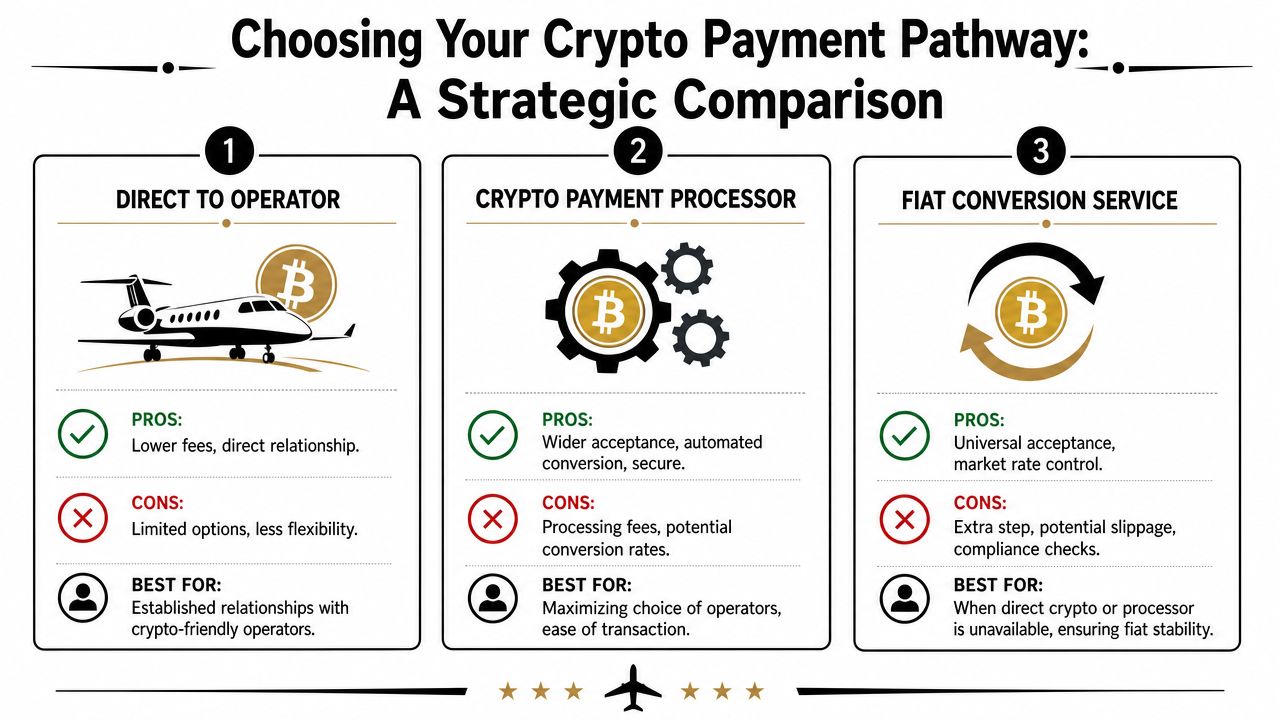
There are three realistic ways to fund a charter with digital assets. Each one solves a different problem.
Some buyers want directness. Some want operational simplicity. Some want to separate the crypto liquidation from the booking entirely. The right answer depends on speed, coin type, compliance tolerance, and how much control you want over execution.
By 2025, this had become a broader market feature rather than a novelty. Paramount Business Jets said it had seen a significant increase in crypto payments after enabling them, and cited a study finding that 20% of private jet users would prefer crypto payment options. It also highlighted acceptance of more than 120 coins, according to its 2025 release.
Direct crypto to broker or operator
This is the cleanest version in theory. You receive the quote, receive the wallet instructions or invoice, and settle the booking in Bitcoin.
The advantage is obvious. Fewer moving parts.
The limitation is also obvious. Not every operator wants to touch crypto directly, and not every broker has treasury procedures, reconciliation controls, and client communication strong enough for six-figure transactions.
- Best fit: Existing relationships with a crypto-capable charter desk.
- Upside: Fewer intermediaries and a simpler client experience.
- Watch for: Weak internal controls, vague wallet instructions, and unclear refund handling.
Crypto payment processor
This is the most common professional setup. The merchant uses a processor or API. The client pays in Bitcoin or another accepted asset. The processor handles the settlement logic, and the merchant often receives fiat or near-instant conversion after checkout.
That structure usually makes the workflow more reliable for chartering because the aircraft quote is almost always a fiat quote. It reduces treasury risk for the broker and simplifies accounting, compliance, and booking confirmation.
If you want to see how one market-facing setup is presented, Haute Jets' crypto payments page outlines a processor-based option for charter bookings.
A processor doesn't make the charter cheaper by itself. It makes the payment workflow cleaner.
Fiat conversion before payment
Some clients prefer to keep the charter outside the crypto rails entirely. They work with their exchange, private bank, or OTC desk, convert BTC to fiat, and pay the charter in the ordinary way.
This route is often best for larger or more sensitive transactions where the client wants tight execution on the asset side and zero ambiguity on the aviation side. It can also be the fallback when the broker accepts only fiat, or when an operator's compliance team would rather not accept digital assets directly.
A quick comparison makes the tradeoff easier to see:
| Path | Main strength | Main drawback | Usually best when |
|---|---|---|---|
| Direct crypto | Simple if relationship exists | Limited acceptance | You know the broker or operator already |
| Processor | Smooth booking workflow | Extra conversion layer | You want convenience and broad acceptance |
| Fiat conversion | Maximum settlement clarity | One extra step | You want fiat certainty before contract signature |
What usually works best
For most charter clients, the processor route is the most practical. It aligns with how private aviation prices flights and how reputable brokers manage compliance and receivables.
For larger treasury-style decisions, an OTC or fiat-first workflow can be cleaner.
For repeat flyers with a trusted counterparty, direct crypto can work well.
What does not work well is improvisation. If the charter desk sounds unsure about invoice expiry, confirmation policy, refunds, or wallet verification, the problem is not Bitcoin. The problem is process.
The Crypto Charter Booking Workflow in Practice
Most articles lose their utility here. They tell you crypto is accepted, then skip the mechanics that decide whether your flight gets confirmed.
In real charter operations, the clean workflow is straightforward. The trip is quoted in fiat. The client receives a time-limited crypto invoice at a locked exchange rate. The booking is only finalized after the required network confirmations come through.
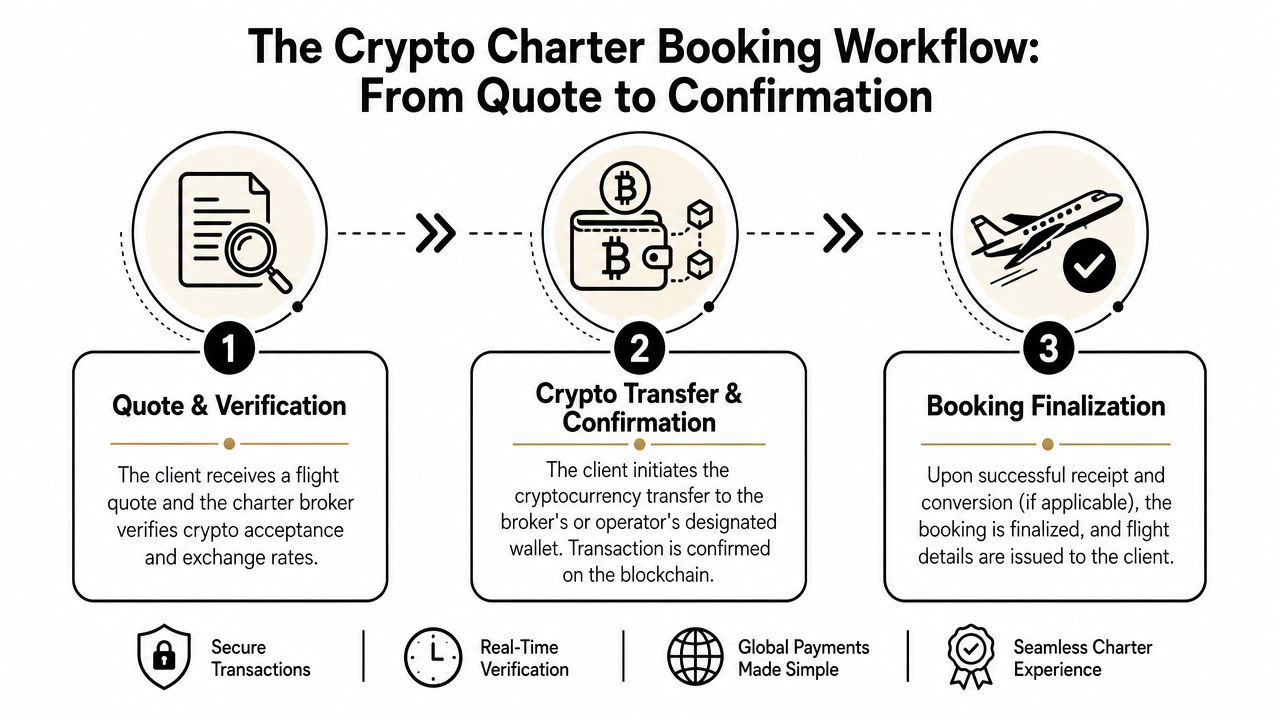
A practical benchmark from a published broker process is this: the BTC amount is often fixed for 15 to 30 minutes, settlement is confirmed after 1-3 confirmations for many charters and 3-6 confirmations for larger flights, and a booking can often be finalized in under 30 minutes if the client sends the correct amount with an adequate network fee, according to Villiers' explanation of crypto charter settlement.
Step one: quote the mission in fiat
The aircraft quote should begin exactly the same way it would for a wire client. You define the mission, the broker sources the aircraft, and you receive a charter agreement based on the underlying fiat price.
That matters because aircraft economics still sit underneath the payment method. The fuel, positioning, airport fees, and crew costs aren't denominated in Bitcoin just because you want to pay in Bitcoin.
A serious booking should settle these points before the invoice is generated:
- Aircraft identity: Exact aircraft, not a vague category.
- Commercial terms: Cancellation, waiting time, de-icing, and extras.
- Timing: How long the quote is valid before the aircraft is released.
If you are booking on demand, this is also the point where you request the flight formally through the charter desk. A standard path for that is requesting a quote.
Step two: receive the crypto invoice and lock the rate
Once the fiat quote is accepted, the crypto leg starts. You receive an invoice denominated in BTC equivalent at the current locked exchange rate for a short period.
This is the part that protects both sides from volatility.
If BTC moves after the invoice is issued but before the lock expires, the quoted BTC amount usually remains valid only during that short window. If you miss it, the invoice generally has to be reissued at a new exchange rate.
Send exactly what the invoice requires. In high-value bookings, "close enough" is not operationally acceptable.
Step three: broadcast, confirm, finalize
After the client sends funds, the broker or processor waits for the required confirmations. Only then is the payment treated as final and the flight fully confirmed.
The detail many buyers miss is that Bitcoin is irreversible once sent. That is excellent for settlement finality. It is unforgiving if you send to the wrong address, underfund the transaction, or use an insufficient network fee during congestion.
A practical pre-send checklist helps:
- Verify the destination address through the agreed channel, not a forwarded screenshot.
- Check the expiry time on the invoice.
- Confirm the network and fee settings before broadcast.
- Stay available until the booking team confirms receipt and finalization.
What causes delays in the real world
Most payment delays come from one of four things:
- Expired rate lock: The client waits too long and the invoice lapses.
- Low network fee: The transaction sits longer than expected.
- Wrong amount sent: Even a small mismatch can force manual reconciliation.
- Last-minute aircraft movement: The payment clears, but the original aircraft option has shifted while everyone waited.
That last one is why speed matters. Crypto settlement can be fast enough for chartering, but only when both the aviation side and the blockchain side are handled with discipline.
Wallet Choice and Security for High-Value Transactions
Paying for coffee in Bitcoin and paying for a private jet with Bitcoin are not the same exercise. The second one deserves treasury-level care.
The biggest risk usually isn't some dramatic technical exploit. It's basic operational error. Wrong address, wrong network, wrong amount, rushed approval, or a compromised device used at the worst possible moment.
The practical wallet hierarchy
For high-value charter payments, think in terms of custody quality.
- Exchange account: Convenient, but you don't control the keys and withdrawal processes can slow you down.
- Hot wallet: Faster and flexible, but exposed to internet-connected risk.
- Hardware wallet: Best for key control and signing security when handled properly.
If the Bitcoin is already on exchange and the flight is urgent, an exchange withdrawal may be the practical route. But if you regularly move meaningful size, a hardware wallet setup is usually the safer standard because the private keys stay offline.
The best security habit is boring
The safest payment routines are repetitive and unglamorous.
Use a clean device. Confirm the payment instructions through a trusted human channel. Check the address character by character or by approved secure workflow. Have a second person review if the amount is large enough to justify it.
A short operational routine is worth more than a long list of theoretical security tips:
- Start with identity verification: Know exactly who sent the invoice.
- Confirm the wallet address independently: Not only from the invoice PDF.
- Use a small test transaction when practical: Especially with a new counterparty.
- Do not rush the final send: The aircraft may be time-sensitive, but panic causes mistakes.
Large crypto payments should feel slow before they feel fast. Deliberate execution is part of the speed.
What doesn't work well
Two patterns create avoidable problems.
First, signing a six-figure transaction from a phone while in transit. It may work. It is not ideal.
Second, letting an assistant or family office push the payment through without a clear control framework. Delegation is fine. Ambiguous authority is not.
For charter clients, the smartest model is simple: one person sources and approves the mission, one secure workflow handles the payment, and one confirmation closes the loop. Clean lines prevent expensive confusion.
Navigating Compliance AML KYC and Tax Implications
There is still a persistent myth that paying with Bitcoin means booking anonymously. In regulated private aviation, that is not how reputable transactions work.
A serious broker or operator still has to know who is booking, where funds are coming from, and who is flying. Crypto changes the payment rail. It does not erase compliance.
What a real booking will require
Expect the same compliance posture you would see with a wire transfer, sometimes more structured because the payment is irreversible and the transaction may attract more review.
Most legitimate setups use processors or merchant infrastructure that convert crypto to fiat and keep the transaction inside ordinary compliance rails. As Swapin's guidance on aviation crypto payments notes, legitimate brokers commonly use payment processors, often convert to fiat quickly, and still face the same compliance and reporting requirements. That is also why refund policies, escrow handling, and dispute procedures matter so much.
A broker worth using should be able to answer these questions clearly:
- Who is the contracting party?
- What KYC documents are required before payment is accepted?
- How are refunds handled if the flight changes or cancels?
- If Bitcoin was converted, is the refund returned in fiat or crypto?
Tax is where many clients get sloppy
In many jurisdictions, using appreciated Bitcoin to pay for a service can create a taxable event. The flight may be luxury travel. The tax treatment is still accounting.
That means the payment decision should not stop at "the broker accepts BTC." You also need to understand your basis, your gain or loss position, and how your jurisdiction treats disposal for services. If you need a practical primer before speaking with your advisor, Allied Tax Advisors has a useful overview on how to report crypto gains.
If you're buying a charter with Bitcoin, loop in your tax advisor before the flight, not after the statement arrives.
The compliance mindset that works
Treat a crypto charter like any other regulated, high-value cross-border purchase.
Prepare identification early. Be ready to explain source of funds. Read the payment and refund language in the charter agreement. And never assume "crypto accepted" means "compliance ignored." The opposite is usually true at the professional end of the market.
Beyond Payment Method The Smartest Way to Book
The smartest Bitcoin-funded charter is not the one with the flashiest crypto badge. It's the one where the payment works smoothly and the aircraft quote still makes sense.
That is the part buyers miss most often.
A lot of Bitcoin-payment content focuses on access and convenience. Very little of it deals transparently with charter sourcing. Yet the fundamental economics of private aviation still live in aircraft positioning, trip matching, and whether the jet being sold to you is indeed the right one.

A useful reality check comes from broader charter coverage: paying with Bitcoin does not automatically improve the underlying economics of the flight. In fact, the primary differentiator remains sourcing the aircraft efficiently to avoid repositioning fees that can inflate charter prices by 20-40%, as discussed in Bitcoin Magazine's coverage of crypto private aviation.
The four questions that matter most
Before you approve any crypto invoice, ask these:
- Where is the aircraft based? A nearby jet often matters more than a crypto checkout button.
- Is this the exact aircraft or just a category placeholder? Category sales hide differences.
- What happens if the flight changes? Refund and rebooking mechanics matter more with irreversible payment.
- Who is handling the sourcing? A weak sourcing model can make a smooth payment process irrelevant.
Why the sourcing model matters more than the payment rail
If a broker starts with the wrong jet in the wrong place, you can still overpay elegantly.
That is why a sourcing-first model matters. Haute Jets' approach, as described in its overview of booking a private jet with Haute Jets, is built around finding aircraft near the departure point rather than forcing clients into repositioned inventory. For a crypto-forward traveler, that matters because it connects payment convenience to actual charter discipline.
The sequence should be:
- Source the right aircraft near the mission.
- Validate safety, operator quality, and contract terms.
- Lock the fiat quote.
- Settle in Bitcoin through a clean process.
Not the other way around.
The buyer's final framework
A smart Bitcoin charter optimizes two separate decisions at once.
The first is settlement quality. Clear invoice window, known confirmation policy, proper compliance, and secure wallet handling.
The second is charter quality. Correct aircraft, proper sourcing, minimal positioning waste, and contract terms that hold up under operational pressure.
Get only the first right, and you may still overpay. Get only the second right, and the payment process may become a headache. Get both right, and Bitcoin becomes a useful tool instead of a gimmick.
If you want a charter team that understands both aircraft sourcing and crypto-funded booking logistics, Haute Jets can help you structure the trip, verify the aircraft economics, and move from quote to confirmed flight without turning the payment process into the weak point.