
Picture this: you get to skip the chaos of the commercial terminal, fly on a schedule that revolves entirely around your business needs, and turn what used to be dead travel time into a productive, private strategy session. That’s the reality of corporate jet charter. It’s not about the expense of owning an aircraft; it’s about having access to one exactly when you need it.
This guide, brought to you by the Haute Jets Journal, will walk you through everything you need to know.
What Is Corporate Jet Charter and Who Benefits?
At its core, a corporate jet charter is an on-demand business tool. A company rents a private aircraft for a specific trip or series of trips, paying only for what they use. Think of it as the ultimate black car service for air travel—you book it for a particular mission, and it provides unmatched flexibility, privacy, and efficiency. It transforms travel from a logistical headache into a genuine strategic advantage.
The market for this service isn't just a niche; it's a massive and growing sector. The private jet charter market was valued at an estimated $32.4 billion in 2025, and it’s on track to nearly double by 2034. The engine behind this growth? Business users, who consistently account for more than half of all charter revenue.
The Key Beneficiaries
While the image might be one of luxury, the reality of corporate charter is all about productivity. The service is a lifeline for organizations where time, confidentiality, and agility are worth more than the cost of a commercial ticket.
C-Suite Executives: For leadership, the ability to hold meetings in multiple cities in a single day is a game-changer. The private cabin becomes a secure, flying boardroom where sensitive discussions can happen freely, far from public ears.
Sales and Project Teams: These teams can reach clients or job sites in locations poorly served by major airlines. By flying into smaller, more convenient airports, they can get a jump on the competition by simply being first on the ground.
Specialized Crews: When a critical piece of equipment fails or a crisis emerges, you can’t afford to wait for the next available flight. Charter allows engineering, technical, or crisis response teams to be deployed to remote sites in a matter of hours, protecting business continuity and minimizing costly downtime.
Ultimately, chartering a jet empowers a company to operate on its own schedule, not an airline's. You can read more about the strategic advantages of private charter for corporate travelers in our dedicated article on the Haute Jets Journal.
Comparing Charter Against Other Travel Options
Picking the right travel solution for your company often feels overwhelming. You're faced with a menu of options, each with its own unique price tag and operational strings attached. The simplest way to think about a corporate jet charter is to compare it to ordering a high-end car service for a specific trip. You get the exact vehicle you need, right when you need it, and your commitment ends when the ride is over.
This model is fundamentally different from other ways businesses get their people from A to B. And that's a key difference when you're weighing what really matters for your team. As we often discuss in the Haute Jets Journal, the decision isn't just about the ticket price; it’s about gaining flexibility, ensuring confidentiality, and maximizing every minute of a packed schedule. A first-class seat on a commercial flight is certainly comfortable, but you’re still bound to the airline's schedule and the public terminal experience.
On-Demand Charter vs. Ownership Models
So, what about the other private options like jet cards or fractional ownership? A jet card is essentially a prepaid debit card for flight hours, locking you into a certain type or class of aircraft. Fractional ownership takes it a step further—you actually buy a share of a specific aircraft, much like a timeshare for a vacation home.
Both of these paths demand significant upfront cash and long-term contracts. That can be a real problem when your travel needs change from one quarter to the next. On-demand charter, on the other hand, is purely transactional. This pay-as-you-go approach gives your company incredible financial agility, letting you scale your travel up or down without being chained to an expensive program.
The real power of on-demand charter is its adaptability. You can book a light jet for a quick regional meeting one week and a large-cabin aircraft for a transatlantic trip the next. You always get the right tool for the job.
This is where the true value of private aviation becomes clear, as the experience is completely different from flying commercial.
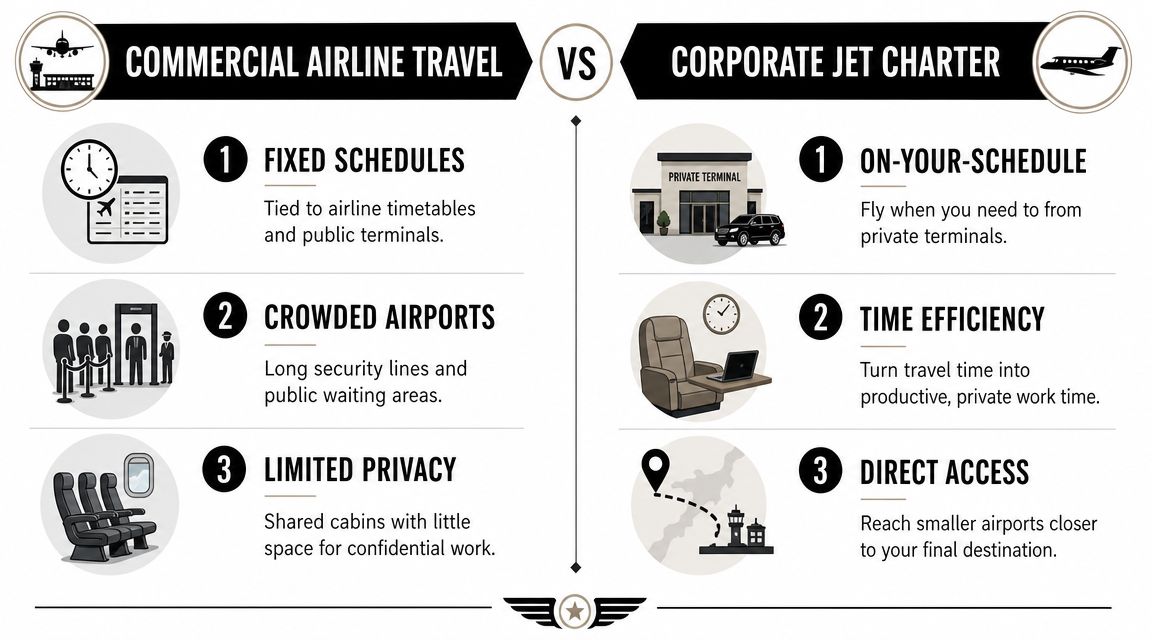
As you can see, corporate charter directly addresses the biggest headaches of commercial travel. It hands control of the schedule back to you and carves out a private, productive space for your team.
To help you see how these models stack up, here is a direct comparison across the factors that matter most to a business.
Corporate Jet Charter vs. Other Business Travel Models
| Factor | On-Demand Charter | Jet Card | Fractional Ownership | First-Class Commercial |
|---|---|---|---|---|
| Upfront Cost | None | High | Very High | Low (per trip) |
| Commitment | Per trip | 12-24 months | 3-5 years | Per trip |
| Scheduling | Fully flexible | High flexibility | High flexibility | Fixed schedule |
| Aircraft Choice | Any type, per trip | Limited to class/type | Fixed to one aircraft | Fixed by airline |
| Cost Structure | Market-based | Fixed hourly rate | Hourly rate + fees | Per ticket |
| Privacy | Complete | Complete | Complete | Minimal |
Ultimately, the best choice depends entirely on your company's travel patterns, budget, and strategic goals. On-demand charter offers unparalleled freedom, while other models provide a more structured—but also more restrictive—approach.
A Holistic View of Executive Transportation
Truly efficient travel doesn't stop when the jet lands. Just as charter flights offer privacy and productivity in the air, private ground transportation provides the same seamless experience on the ground. For executives who need to move efficiently from the tarmac to their final destination, understanding the logistics of securing your first private driver can complete the circle of high-value travel. This integrated approach ensures that no time is wasted and security is maintained from door to door.
When you look at all the options, on-demand charter consistently wins on several key points:
- Scheduling Flexibility: Fly on your own time, not the airline’s. You can even change destinations mid-trip if a meeting moves.
- Airport Access: Land at over 5,000 smaller, private airports across the U.S. alone, getting you significantly closer to your actual destination and avoiding major hubs.
- In-Flight Productivity: The private cabin becomes a flying boardroom. It's a secure, connected office where you can hold confidential discussions without worry.
To really dig into the numbers and scenarios, our detailed guide on private jet charter versus first-class travel breaks it down even further. In the end, it all comes down to a simple question: Do you see travel as a necessary expense or a strategic tool for growth?
How Corporate Jet Charter Costs Are Calculated

If you've ever looked at a private jet charter quote, you know the price is much more than a simple hourly rate. To truly understand what you're paying for, you need to look at how that final number is built. As featured in the Haute Jets Journal, a final quote is actually a blend of several distinct costs, and knowing what they are is the first step to managing your company's travel budget effectively.
The price always starts with the aircraft's hourly rate. This number can change quite a bit depending on the jet's size, age, and capabilities. But that's just the starting point. The billed flight time often includes positioning—the time it takes for the aircraft to fly empty to pick you up and then return to its home base after dropping you off.
Breaking Down the Core Costs
This empty flying, known in the industry as a ferry flight, is one of the biggest factors that can inflate a charter price. Many traditional charter brokers simply pass this expense straight to you. Beyond that, a handful of other standard charges will always be part of your quote.
- Landing and Handling Fees: Every time a jet lands, the airport charges a fee. You also pay for services at the private terminal, or FBO (Fixed-Base Operator). These costs can run from a few hundred dollars at a small regional airport to several thousand at a major international hub like LAX or JFK.
- Federal Excise Tax (FET): For any flight within the United States, the government applies a 7.5% Federal Excise Tax to the flight cost. There's also a small, per-passenger segment fee added on top.
- Crew Expenses: If your trip spans multiple days, you'll also cover the pilots' hotel accommodations, meals, and ground transportation. This is a standard part of any overnight charter.
This layered pricing is just how the industry works. If you want to get even deeper into the numbers, we break it all down in our guide on calculating the private jet cost per hour over on the Haute Jets Journal.
Sample Costs and the Haute Jets Advantage
So, what does this look like in the real world? Let’s take a popular business route like New York to Miami. A one-way trip on a light jet might run you $18,000, while a midsize jet could be closer to $25,000. For a team traveling on a heavy jet, you could be looking at $40,000 or more, all depending on the specific aircraft and its availability.
A huge chunk of that price can often be attributed to repositioning fees, which can easily swell the total cost by up to 40%. It's a massive market, with over 22,000 business jets flying 5.2 million trips every year. The U.S. is the epicenter of this activity, accounting for about 60% of all flights on these high-traffic routes.
This is exactly the problem Haute Jets was created to solve. Our model is built on sourcing aircraft locally from a vast network of over 3,500 trusted operators. By finding jets already positioned at or near your departure airport, we can dramatically reduce—or even completely eliminate—those expensive ferry fees. The result is transparent, wholesale pricing without the hidden costs.
Ensuring Safety in Corporate Aviation
When you’re responsible for your team's travel, their safety isn't just a line item—it's everything. In the world of corporate jet charter, safety is the bedrock of the entire industry, governed by strict federal oversight and verified by demanding independent audits. As we consistently emphasize in the Haute Jets Journal, every flight operates within a rigid framework where there is simply no room for compromise.
In the United States, the Federal Aviation Administration (FAA) sets the baseline for all aviation. They dictate the essential rules for maintenance, pilot qualifications, and flight operations. But for any company serious about its duty of care, simply meeting these government minimums isn't enough.
The Gold Standard of Safety Audits
This is where third-party safety auditors come into the picture. Independent, expert organizations like Wyvern and ARGUS conduct incredibly thorough, voluntary audits that go far beyond a government checklist. Their ratings have become the undisputed gold standard for verifying an operator’s commitment to safety.
Make no mistake, achieving a top-tier rating from these firms is a serious undertaking. It's a continuous process, not a one-time exam.
These audits are a top-to-bottom examination of an operator's safety culture, maintenance history, and pilot experience. A high rating signifies a proven, consistent dedication to operational excellence that far exceeds basic legal requirements.
For a corporate travel manager, this is a game-changer. Relying on these ratings takes the immense burden of vetting an operator off your shoulders. You can trust that Wyvern and ARGUS have already done the exhaustive due diligence for you.
Understanding Wyvern and ARGUS Ratings
The rating systems from Wyvern and ARGUS offer clear, reliable safety benchmarks. While their methodologies differ slightly, they both scrutinize the same core components of an aviation business. Building a travel policy that requires operators to hold these credentials is one of the most effective risk-management strategies you can implement.
Wyvern Wingman: This is one of the industry's most respected certifications. To earn the Wingman standard, an operator must pass a demanding on-site audit that proves its aircraft, crew, and company-wide procedures meet Wyvern's exceptionally high bar.
ARGUS Gold and Platinum: ARGUS provides a tiered system. A Gold rating is a strong endorsement, confirming a provider has a solid safety history and well-documented processes. The Platinum rating is the pinnacle, awarded only after a comprehensive, in-person audit verifies that the absolute highest standards are woven into every aspect of the operation.
At Haute Jets, we eliminate the guesswork completely. Every flight we arrange is sourced from our curated network of over 3,500+ operators who hold a Wyvern Wingman or ARGUS Gold/Platinum rating. This is a non-negotiable part of our sourcing model, a promise that every trip meets the most stringent safety benchmarks in private aviation. This commitment to transparent and secure travel is a cornerstone of the Haute Jets Journal.
Your Step-By-Step Charter Booking Process

Booking a private jet for your company might sound complicated, but it’s actually a straightforward process once you understand the steps. Modern booking has removed the guesswork, making the entire experience predictable and transparent. Here’s a look at how you go from a travel need to wheels up, as featured in the Haute Jets Journal.
Everything kicks off when you submit your itinerary. This is the foundational information your charter provider needs: your departure and arrival points, the dates you need to fly, and how many passengers will be on board. With these key details, they can start sourcing the perfect aircraft for the mission. For a more in-depth guide on what to expect, this article on smart private jet booking is an excellent resource.
From Options to Agreement
Once your request is in, you’ll receive a selection of available aircraft that fit your criteria. This isn't just a list of jet categories; a good provider like Haute Jets will show you specific makes and models. You can then compare your options based on cabin size, range, and amenities, putting you in full control of the final decision.
After you've picked the right jet, a charter agreement is drawn up. This is the document that locks everything in place and formalizes the details of your flight. It clearly outlines:
- Aircraft Details: The specific tail number and the certified operator of your jet.
- Trip Itinerary: Your confirmed departure and arrival times and locations.
- Cost Breakdown: An itemized list of all charges, from flight time to taxes and any extras.
- Cancellation Policy: The terms and conditions are laid out clearly, so there are no surprises.
Signing this agreement is the final step in securing your aircraft and price. It’s what turns your travel plan into a confirmed reality.
The Final Briefing and Flight Day
With the paperwork handled, your provider takes over all the logistical heavy lifting. This is where we coordinate everything from specific in-flight catering requests to ensuring your ground transportation is ready and waiting when you land. If you need something specific, like high-speed Wi-Fi for a mid-air meeting, it's all confirmed during this phase.
You'll receive a comprehensive flight brief about 24 hours before departure. This document is your go-to guide for travel day, containing your final itinerary, crew information, and your aircraft's tail number.
On the day of your flight, you simply arrive at the designated private terminal, known as an FBO. Your crew will be there to greet you and escort you directly to the aircraft. There are no lines and no delays—the booking process is complete the moment you step on board.
Best Practices for Managing Corporate Air Travel
Bringing private aviation into your company's travel program can be a game-changer, but without a plan, it can also lead to chaos and uncontrolled spending. A well-thought-out corporate jet charter policy is what separates a smart business tool from a logistical headache. It’s the framework that makes private travel a predictable, managed asset rather than a last-minute, reactive expense.
Think of it this way: your policy is the playbook. It starts by defining exactly who is authorized to book private flights and, just as importantly, when. Is it for a multi-city investor roadshow? A site visit to a remote factory? A situation where absolute confidentiality is non-negotiable? Setting these ground rules ensures you’re using charter for its highest and best purpose. You can explore more of these strategic uses on the Haute Jets Journal.
Building a Smart Charter Policy
A solid policy doesn’t need to be complicated, but it does need to be clear. By outlining the key parameters upfront, you give your team the confidence to make quick, smart decisions that align with the company’s goals.
Every effective corporate charter policy should cover these four essentials:
- Authorized Users: Clearly spell out which roles or executive levels can request and fly on chartered aircraft.
- Approval Workflow: Create a simple, transparent approval chain. This usually involves a sign-off from a department head and finance to keep budgets in check.
- Vendor Selection: This is a big one. Mandate that all flights are sourced from approved vendors who meet strict, non-negotiable safety standards, like requiring operators to be Wyvern or ARGUS-rated.
- Booking Procedures: Standardize how trips are requested. Whether it's through a designated travel manager or a central portal, this gives you a single source of truth and control.
Putting these rules in writing creates a system that gives you both accountability and the flexibility you need.
Partnering with a provider that operates without hefty upfront membership fees or jet card commitments offers maximum financial flexibility. This approach ensures your company pays transparent, market-based rates only for the flights it needs.
The Power of Centralized Booking
One of the most common missteps we see is fragmented booking. When different executives or departments book their own charter flights, the company loses out on significant negotiating power and, critically, loses oversight. Funneling all corporate jet charter activity through one point of contact—an internal travel manager or a dedicated partner—changes everything.
Centralization gives you a 30,000-foot view of your company’s private aviation spend. That data is gold when it comes to negotiating better rates and finding ways to save money. Even more importantly, it guarantees that every single flight booked on behalf of the company meets the safety and service standards you’ve worked so hard to establish.
This is precisely where the Haute Jets model fits in. We’re designed to act as that central, expert partner for corporate travel managers. Because we don't lock you into restrictive jet cards or demand large capital outlays, you can scale your private travel up or down as needed. You only pay for what you use, turning private aviation into an agile resource you can deploy exactly when and where it makes the most sense.
Frequently Asked Questions
Even the most seasoned travel managers have questions when it comes to booking a corporate jet charter. Here in the Haute Jets Journal, we're answering some of the most common things our clients ask, drawing from years of experience in arranging high-stakes corporate travel.
How Far in Advance Should I Book?
While we can absolutely pull off last-minute miracles and get a plane in the air with just a few hours' notice, that's not the ideal scenario. For the best selection of aircraft and more competitive pricing, you really want to book seven to fourteen days out.
If your travel lines up with a major event like the Super Bowl or a big industry conference, I'd push that timeline out even further. Securing your flight 30 days or more in advance is the best way to lock in the right aircraft before availability tightens up.
What About Luggage?
This is a detail that can’t be overlooked. Luggage capacity is completely dependent on the size of the jet. A light jet is perfect for a few passengers with standard roller bags, but not much more. On the other end of the spectrum, a large-cabin aircraft like a Gulfstream G450 has a cavernous hold, often exceeding 100 cubic feet of cargo space.
It’s absolutely crucial to tell your charter provider exactly what you're bringing. That includes golf bags, presentation equipment, and any oversized items.
Always get specific confirmation on the number of bags and their dimensions. A quick conversation upfront prevents a major headache on the tarmac, ensuring everything from sensitive equipment to personal luggage fits without issue.
What Happens if a Flight Is Canceled?
Cancellations in private aviation are thankfully rare, but they do happen—usually because of extreme weather or an unexpected mechanical problem. If your flight gets grounded, your provider's first job is to find a replacement aircraft, fast.
This is where working with a well-connected partner like Haute Jets really pays off. Having a massive network of vetted aircraft means we have thousands of backup options ready to go, minimizing any delay and getting your team back on track.
Can You Handle Catering and Ground Transport?
Of course. Think of your charter provider as a personal travel concierge. We can arrange everything to your exact preferences. In-flight catering can be as simple as snacks and drinks or as elaborate as a multi-course meal from your CEO's favorite restaurant.
The same goes for ground transportation. We'll have cars, SUVs, or security details waiting on the tarmac the moment you land, creating a seamless, secure transition from the aircraft to your final destination.
Ready to see how the Haute Jets local-sourcing model provides more transparency and value? Our team is on standby 24/7 to find the perfect aircraft for your next trip, all at direct-to-owner rates without any long-term commitments. Book your next corporate jet charter with us today.