
The headline number should change how you plan this trip. The 2026 FIFA World Cup is expected to draw about 6 million visitors across 16 host cities in the United States, Canada, and Mexico, and industry reporting says private jet demand could rise by 200% to 300% on key host-city routes during peak match periods according to GlobalAir's World Cup charter outlook.
If you're thinking about a private flight to one match, that's manageable. If you're planning a serious multi-city World Cup itinerary across North America, this becomes an operational exercise. Aircraft availability tightens. Preferred airports clog up. Parking gets rationed. Repositioning fees get ugly fast.
That's why 37. World Cup 2026 private jet charter planning shouldn't start with “What jet do I want?” It should start with “How do I build an itinerary that avoids unnecessary movement, deadhead exposure, and airport bottlenecks?”
Navigating the Unprecedented Demand for World Cup 2026 Flights
A normal event spikes demand in one city. The World Cup spreads pressure across a continent.
That difference matters. When fans, sponsors, families, athletes, executives, and hospitality groups all chase the same travel windows across three countries, you're no longer buying a flight. You're competing for aircraft position, crew availability, airport access, and overnight parking at the same time.
Why this tournament changes the charter equation
The 16 host cities aren't clustered into one compact region. They stretch across the United States, Canada, and Mexico. That means a charter operator might deliver you into one city, then struggle to keep the aircraft parked there, or need to move it elsewhere and bring it back later.
For clients, that creates one expensive trap. You think you're paying for your flight. In reality, you may also be paying for where the aircraft came from, where it has to wait, and where it has to go next.
Practical rule: During the World Cup, the smartest itinerary is usually the one that reduces aircraft repositioning, not the one that looks simplest on paper.
The private aviation market has seen this before in other major global events, including Olympic travel patterns covered in Haute Jets Journal's piece on private jet charters for the 2024 Olympic Games. The difference in 2026 is the geographic sprawl. Your route planning matters more than your cabin preferences.
What clients should do immediately
Start with the tournament cities you care about most, then rank them by priority. Don't build a dream itinerary first and ask for pricing later. That's backwards.
Use a planning approach like this:
- Anchor your must-attend matches: Lock the essential cities and dates first.
- Group nearby legs together: Short regional sequences usually create less operational waste than zigzagging coast to coast.
- Choose flexibility points: Decide where you can shift arrival times, alternate airports, or even move one leg to the following day.
- Separate headline matches from filler travel: Demand will bunch around the most desirable venues and knockout dates, so those flights need the earliest attention.
The real problem isn't access. It's continuity.
Many travelers will still find an airplane. The challenge is finding the right airplane, in the right place, with a schedule that doesn't collapse once airports tighten procedures or parking disappears.
That's the lens I'd use for any World Cup charter conversation. Treat this as a moving network problem, not a one-off luxury booking.
Your World Cup 2026 Booking Timeline
The tournament itself creates the pressure. The World Cup runs from 11 June to 19 July 2026, covering 39 consecutive days and 104 total matches, and a private-jet planning guide recommends booking 3 to 4 months in advance because airport slots and parking are expected to be scarce, while event pricing starts around $2,000 per flight hour for turboprops and rises to $14,000+ per flight hour for ultra-long-range jets according to Paramount Business Jets' 2026 World Cup charter guide.
That 3 to 4 month window is the minimum. For a multi-city plan, I'd move earlier.
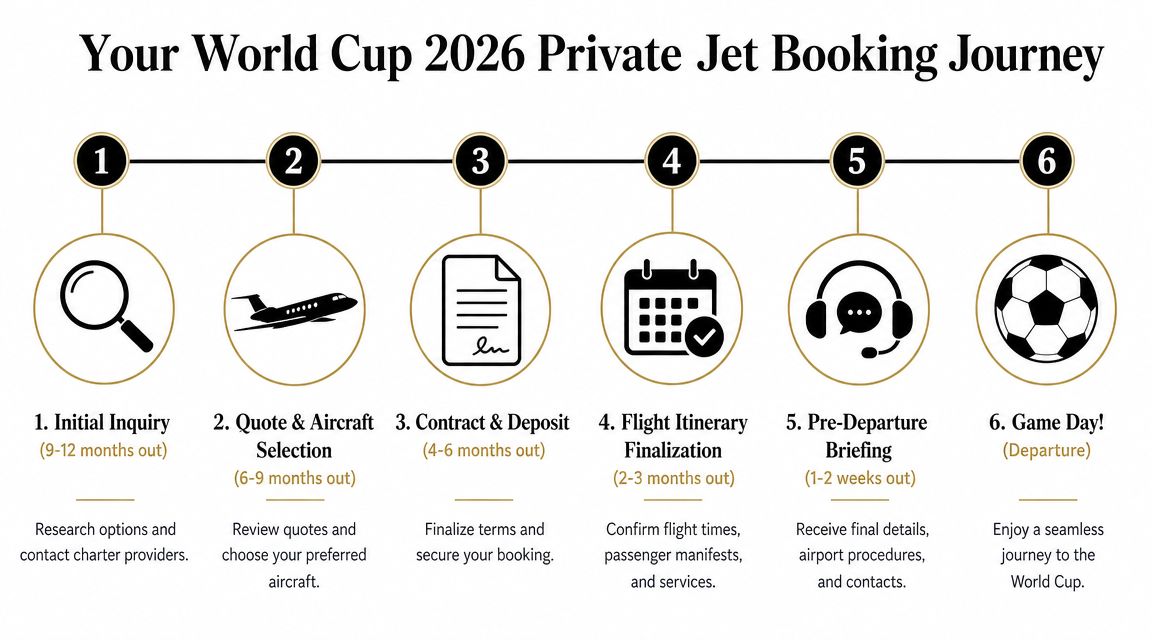
Nine to twelve months out
Start with structure, not aircraft.
Decide which matches are must-attend, which cities are optional, and whether this is a single-country trip or a three-country circuit. This is also when you define who's flying on each leg. A family attending two matches has a different aircraft profile than a corporate host moving clients between several venues.
At this stage, ask for route logic and budget framing. Don't ask for one isolated quote. Ask for a mission plan.
- Map the sequence: City order affects cost more than many first-time charter clients expect.
- Identify border crossings: U.S., Canada, and Mexico legs require tighter paperwork coordination than a domestic-only trip.
- Set your comfort threshold: Some clients want one aircraft throughout. Others are happy to switch aircraft classes by route.
Six to nine months out
Here, you shortlist aircraft categories and operating strategies.
You should be reviewing whether a turboprop or light jet works for shorter sectors, whether a midsize jet is the better compromise for repeated regional flying, or whether a heavy cabin is worth the premium for long coast-to-coast moves. If you're booking through an advisor, this is also the moment to challenge any quote padded by obvious repositioning inefficiency.
For clients who want a straightforward booking process, the practical mechanics are similar to the steps outlined in Haute Jets Journal's guide to booking a private jet with Haute Jets. The key difference here is that every leg needs to fit the larger World Cup sequence.
Four to six months out
This is commitment time.
Once your core match schedule is set, secure the aircraft strategy and contract terms. If you're waiting for perfect certainty, you'll likely lose flexibility where it matters most. During a compressed event, indecision is expensive.
The client who books earlier buys optionality. The client who waits buys whatever is left.
Review cancellation language carefully. For event travel, standard assumptions often don't hold. You also want a written process for manifest changes, airport substitutions, and timing adjustments.
Two to three months out
Finalize the operating details.
This is when your departure windows, passenger lists, baggage profile, catering preferences, pet arrangements, and ground transfers should be confirmed. It's also when your advisor should already be pushing on airport handling, parking, and alternates.
One to two weeks out
By this point, there should be no ambiguity.
You should have the flight brief, terminal instructions, contact chain, and backup plan if weather, congestion, or airport restrictions force a change. If any provider is still “working on details” at this stage, that's a warning sign.
Decoding World Cup 2026 Charter Costs
Most clients ask the wrong cost question. They ask, “What's the hourly rate?” The better question is, “What will this itinerary cost once event pressure, aircraft positioning, and schedule risk are added?”
For World Cup planning, one useful benchmark is to split pricing into base mission cost plus event-specific uplifts. Industry guides estimate hourly rates of about $2,000 to $2,300 for turboprops, $2,900 to $3,500 for light jets, $4,300 to $4,750 for midsize jets, and $16,000 to $23,000+ for VIP airliners. The same guide says one-way pricing can range from roughly $8,000 for regional light-jet hops to $90,000+ for heavy-jet international segments, while operators may apply 30% to 60% knockout-round surcharges, with total World Cup pricing rising 40% to 80% above standard market levels if aircraft are booked late, according to Airacer's World Cup 2026 charter pricing guide.
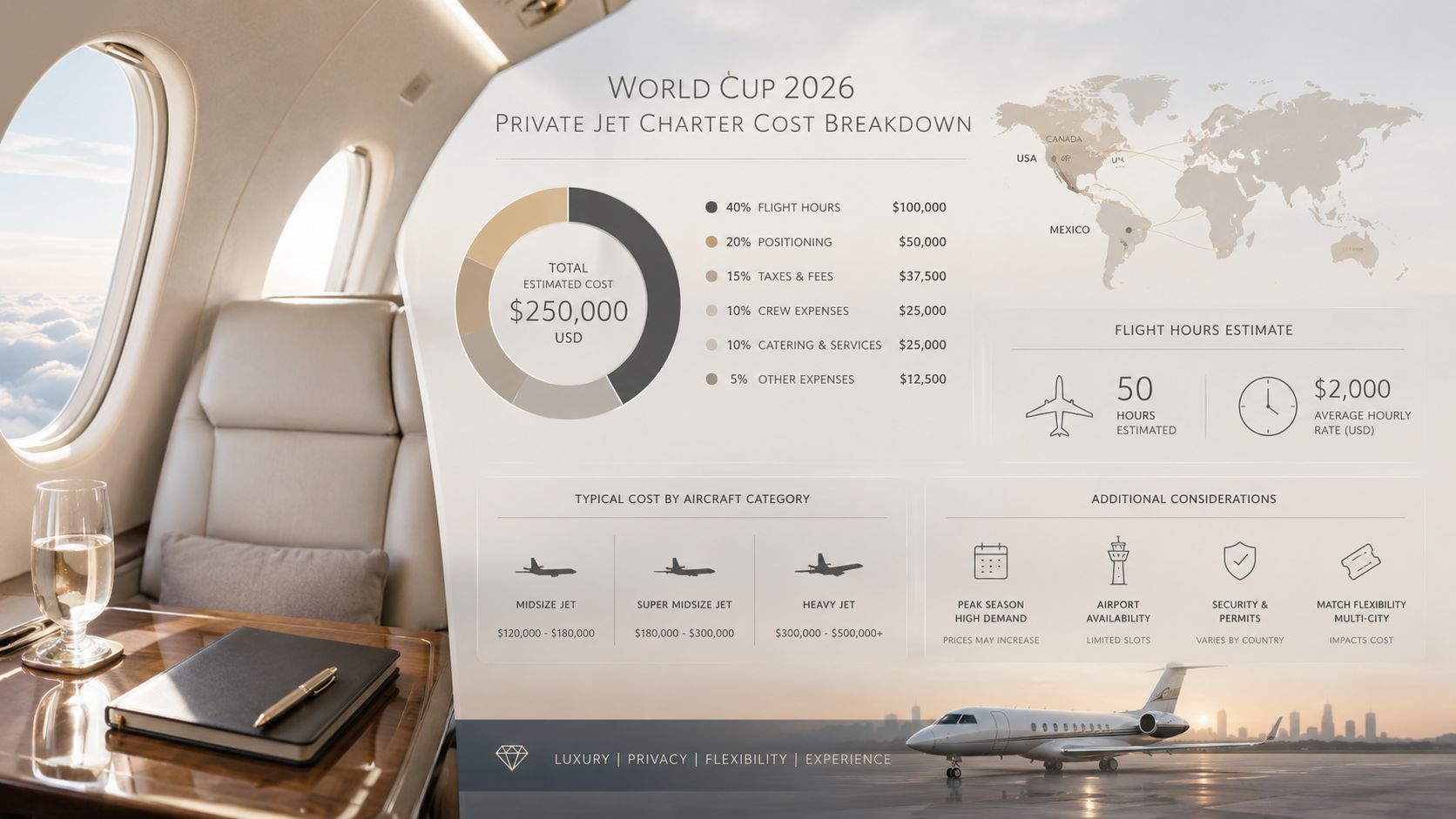
The two cost layers that matter
Base cost is the aircraft itself. That includes the category, the route length, and whether you're flying one way or round trip.
Event uplift is everything the World Cup distorts. That includes scarce aircraft, constrained airport access, timing pressure, and premium match windows.
What many clients miss is that event travel punishes inefficient routing twice. First through direct pricing pressure. Second through repositioning.
Repositioning is where budgets get lost
If your aircraft has to come from another city before your departure, or leave your destination because parking isn't available, that extra movement can become the most avoidable part of the invoice.
This is why locally based aircraft matter. A sourcing model built around nearby owner-operators can reduce unnecessary ferry legs and cut exposure to inflated event pricing. That's the practical value of using a marketplace such as Haute Jets' private jet charter cost guide when comparing quotes and understanding how the stack is built.
Don't compare two World Cup charter quotes by headline total alone. Compare where the aircraft starts, where it waits, and what happens if your schedule changes.
How to think about group economics
Some World Cup parties don't need a larger jet. They need better planning. If your wider group is splitting between a private charter core and a support team on the ground, coordinated surface transport can save money and reduce chaos on arrival. That's where practical tips for group transport can help, especially when moving staff, assistants, security, or hospitality guests from airport to venue.
A simple way to pressure-test cost decisions:
- Use the smallest aircraft that fits the mission well: Bigger isn't automatically better if the route is short and baggage is light.
- Keep aircraft near your operating path: A cheaper hourly rate can become more expensive once ferry legs are added.
- Be careful with knockout-stage planning: Those dates attract the sharpest pricing uplifts.
- Ask for alternate-airport pricing: Sometimes the best savings come from a different arrival field and a better ground transfer.
Choosing Your Jet for North American Routes
Aircraft selection for the World Cup should be route-driven. Not ego-driven.
A jet that feels ideal for one sector can be a poor fit for the next. If you're flying a short Northeast hop, one aircraft category makes sense. If you're moving from the West Coast to the Southeast with luggage for a longer stay, your priorities change quickly.
Match the cabin to the mission
For short regional sectors, a turboprop or light jet can be the right answer if runway access and timing line up. For repeated city pairs with moderate stage lengths, midsize aircraft often hit the best balance between comfort and operating logic. For long cross-continent legs or international movements with a larger party, a heavy jet or VIP airliner may be warranted.
What matters most:
- Range fit: Don't choose an aircraft that forces operational compromises on a longer leg.
- Runway flexibility: Smaller airports can improve ground time, but not every cabin category can use them comfortably.
- Cabin use: If you're sleeping, taking meetings, or flying with family, cabin layout matters more than top speed.
- Baggage profile: World Cup travelers often carry more than they expect. Matchday wardrobe, business luggage, personal staff gear, and extended-stay bags add up.
World Cup 2026 aircraft selection by route
| Route Example | Aircraft Category | Typical Models | Best For |
|---|---|---|---|
| New York to Toronto | Light jet | Phenom 300, Citation CJ3 | Fast regional travel for small groups who want efficiency over cabin size |
| Dallas to Kansas City | Turboprop or light jet | King Air 350, Citation CJ2 | Short hops where operating efficiency matters more than long-range capability |
| Los Angeles to San Francisco Bay Area | Light jet or midsize jet | Learjet 75, Citation Latitude | Quick West Coast movement with room for baggage and a more comfortable cabin |
| Miami to Mexico City | Midsize or super-midsize jet | Hawker 800XP, Challenger 350 | Cross-border flying where cabin comfort and stronger mission capability matter |
| Los Angeles to Miami | Heavy jet | Gulfstream G450, Challenger 605 | Long domestic sectors where nonstop performance and cabin comfort matter |
| New York to Mexico City | Heavy jet | Gulfstream G550, Falcon 900EX | International travel for clients who want range, cabin space, and lower compromise |
| Multi-city family itinerary across several host cities | Midsize to heavy jet | Citation Latitude, Challenger 650 | Travelers balancing comfort, luggage, and schedule flexibility |
| Sponsor or hospitality movement with a larger party | VIP airliner | ACJ or BBJ configuration | High-capacity premium transport where one aircraft moves the whole group |
My recommendation by traveler type
If you're attending one or two matches in nearby cities, stay disciplined. A light jet is often enough.
If you're doing a serious North American sequence, don't underbuy the cabin. Repeated flying gets tiring quickly. A midsize or heavy jet usually gives you the better experience and fewer operational compromises.
If you're moving executives, family office staff, security, or hospitality guests, think in layers. One aircraft for principals. Separate transport solution for the broader group. That structure is usually cleaner than trying to force everyone into one oversized charter decision.
Mastering Airport and Ground Logistics
The smoothest World Cup charter trip will be won on the ground.
Clients tend to focus on the aircraft, but the primary friction points are usually elsewhere. Terminal access. Customs timing. parking restrictions. Driver coordination. Stadium-area congestion. If those pieces are weak, even a flawless flight feels sloppy.
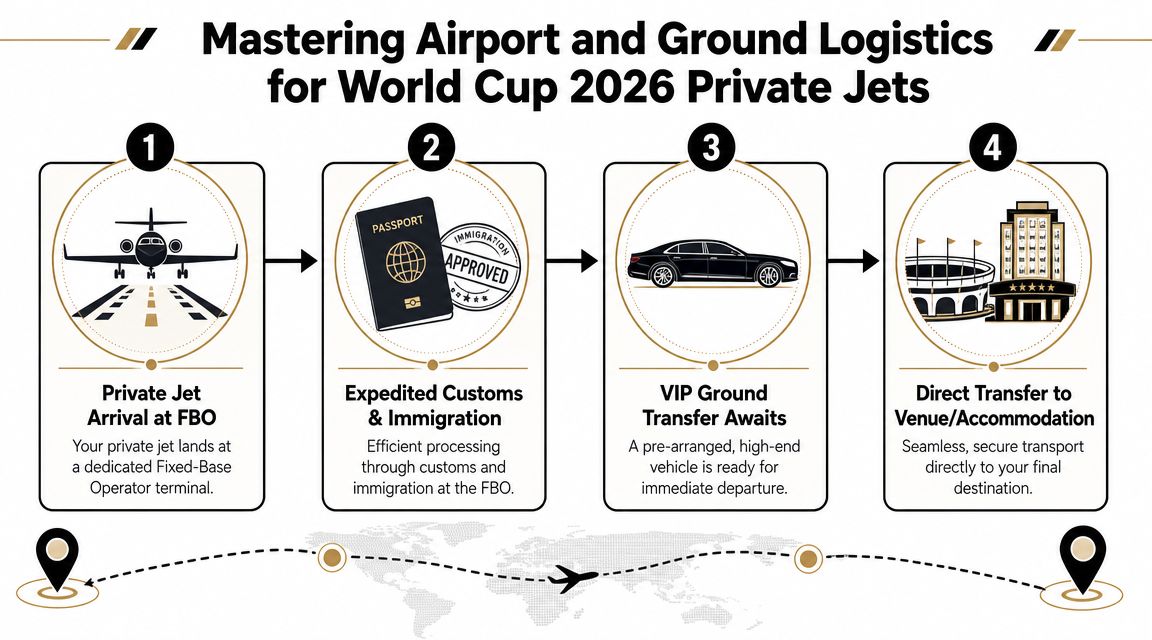
Understand the FBO experience
A Fixed-Base Operator, or FBO, is the private terminal side of the trip. That's where you arrive, clear in or out as required, meet your crew, and transfer to your vehicle.
During the World Cup, not all FBO experiences will feel equally polished. Some will be handling a surge of premium traffic while juggling parking limitations and tightly managed arrival windows. The right FBO choice isn't cosmetic. It affects your total transfer time and your margin for error.
The logistics chain that needs to be locked down
Your advisor or charter team should have every handoff pre-coordinated.
- Arrival slot: Your landing time needs to be confirmed and realistic.
- Parking outcome: The aircraft may stay, reposition, or drop and go. You need to know which.
- Customs plan: Cross-border legs between the U.S., Canada, and Mexico require precise documentation and timing.
- Vehicle placement: Your car should be staged before wheels down, not called after arrival.
- Venue routing: Stadium access can be the slowest part of the day if the route plan is generic.
A private jet saves time in the air. A disciplined ground plan saves the trip.
Cross-border travel needs more than a flight booking
Many World Cup itineraries will cross at least one border. That creates a different standard of preparation.
Passenger details need to be accurate early. Passport validity and manifest consistency matter. If your group changes late, that may be manageable, but only if the operator and handlers are already structured for it. Ad hoc changes during a high-demand event create delay risk.
For clients moving between countries during the tournament, I recommend building extra schedule cushion around international legs. Not because private aviation is slow. Because tournament conditions make rigid assumptions dangerous.
Don't chase the obvious airport by default
The closest major airport isn't always the best airport for a World Cup mission.
Sometimes the better answer is an alternate field with less congestion, easier vehicle access, and more reliable handling. That can mean a slightly longer drive and a dramatically smoother travel day. Discerning travelers accept that trade every time.
Beyond the Flight VIP Services and Risk Mitigation
For this event, concierge-level support isn't a luxury add-on. It's operational insurance.
A World Cup charter itinerary has too many moving pieces to rely on the aircraft alone. You need the cabin, the terminal, the cars, the communication chain, and the contingency plan working as one system. If one piece fails, the rest of the experience degrades quickly.
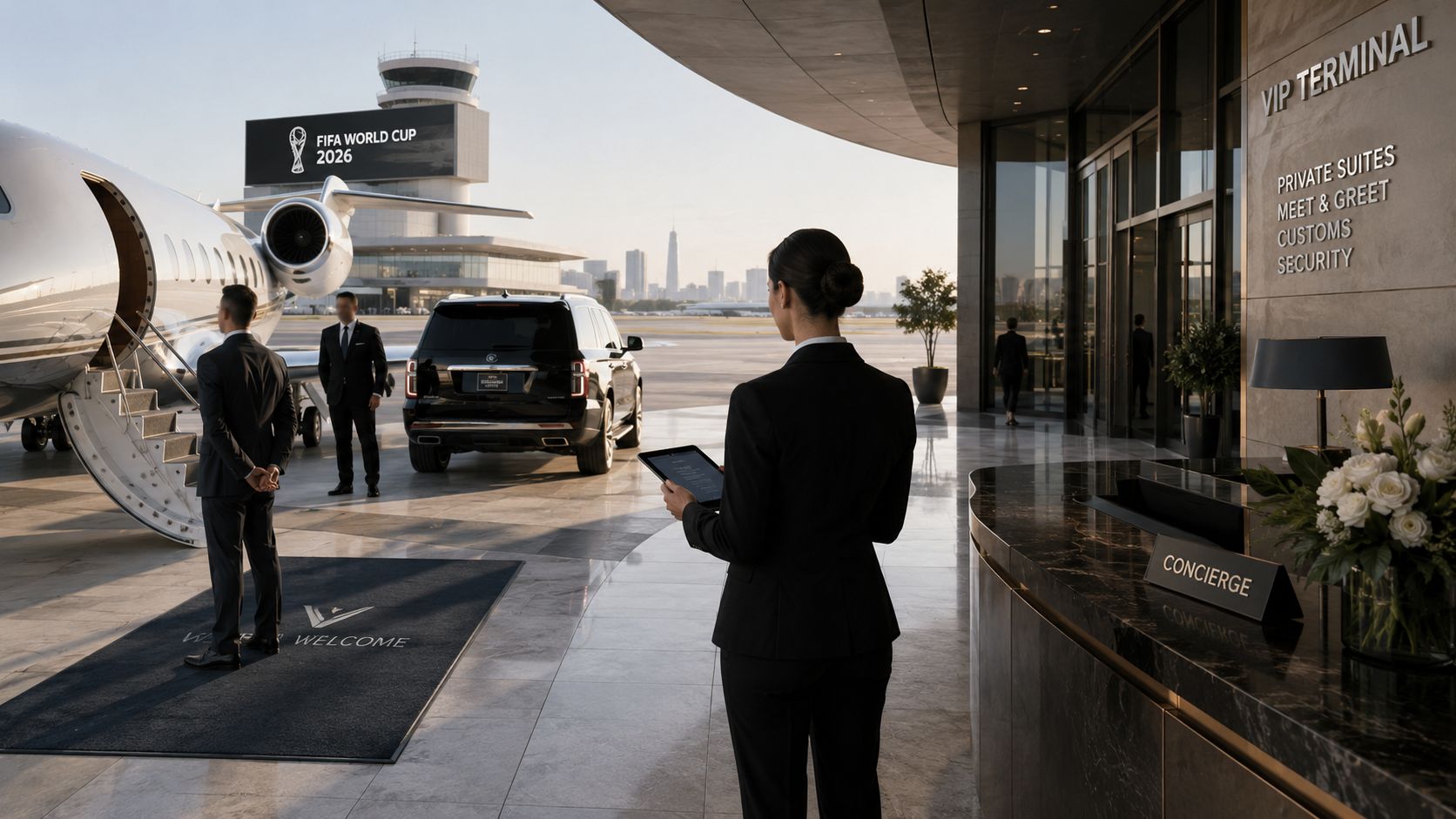
The VIP details worth paying for
Good in-flight catering matters when you're moving between matches and meetings. Reliable Wi-Fi matters if you're managing business on the way. Ground security matters if your profile, family, or guest list requires privacy.
Those aren't vanity features. They're time-protection tools.
A strong charter setup should also confirm the exact aircraft, cabin layout, pet policy if needed, and terminal procedure well before departure. Ambiguity is what creates stress.
The contingency standards I'd insist on
Ask direct questions before you sign.
- Aircraft backup: If the assigned aircraft goes tech, what's the recovery plan?
- Weather response: Who monitors rerouting and alternate-airport options in real time?
- Schedule change protocol: How are late match-driven changes handled?
- Cancellation language: What event-specific restrictions apply if plans shift?
The right charter plan doesn't assume everything goes perfectly. It assumes something will move, and prepares for it.
That's the mindset I'd bring to any World Cup 2026 private jet charter strategy. Build around flexibility. Protect against repositioning waste. Keep airport options open. Demand specifics from anyone quoting the trip.
If you're planning a multi-city World Cup itinerary and want a practical charter strategy instead of a generic quote, Haute Jets can help you structure the route, source aircraft near each departure point, and coordinate the flight details that matter most when North America's busiest event starts squeezing capacity.