
Why do 4 engine jet planes still matter when twinjets dominate most long-haul flying? The answer isn't nostalgia. Four-engine aircraft have historically solved a different problem, one built around redundancy, range, payload, and the ability to move more people or more freight on a single airframe. That trade-off still matters in private aviation, government transport, and a handful of high-capacity commercial missions.
This guide groups eight notable four-engine aircraft by role, from ultra-long-range widebody private aircraft to presidential transports and historic airliners. The point is simple. A fourth engine can add operational margin, but it also brings higher fuel exposure, more maintenance complexity, and narrower charter availability. For readers of Haute Jets Journal, the key question is not whether four engines sound impressive. It's whether the route, airport, and cabin requirement justify the machine.
1. Boeing 747-8 BBJ The Ultimate Four-Engine Private Jet | Haute Jets Journal
The Boeing 747-8 BBJ sits at the top of the four-engine private aviation hierarchy. As a private completion of the 747-8 Intercontinental, it takes a platform built for scale and turns it into a flying residence with the room for bedrooms, conference space, and multiple lounges. For ultra-long-range itineraries, that cabin volume is the reason buyers still ask for it, even when a smaller widebody could technically do the trip.
Where the fourth engine earns its keep
The 747 family helped establish the modern era of large four-engine jet travel, and Boeing delivered 1,574 747s over a 54-year manufacturing run, with the final aircraft delivered in January 2023 Boeing 747 reference. That scale matters because the BBJ version benefits from a platform that has long been associated with intercontinental missions and heavy payloads. In practice, the fourth engine is less about speed than about lifting a very large, very customized cabin across oceans with confidence.
Practical rule: For New York to London and similar transatlantic routes, a 747-class aircraft is often more jet than the mission needs. Ask for a large-cabin long-range alternative first, then compare the total trip cost, not just the aircraft size.
On the ground, the BBJ's limitation is as important as its glamour. Runway length, FBO hangar dimensions, and ramp weight limits can determine whether the aircraft is even usable at a given airport. If the itinerary includes private terminals with tighter infrastructure, a lower-footprint widebody may be the smarter answer, even when the BBJ looks like the ultimate statement aircraft.
2. Airbus A340 ACJ340 Long-Haul Four-Engine Corporate Jetliner | Haute Jets Journal
The Airbus A340 ACJ340 exists because some missions need long-range reach without compromise in cabin planning. Airbus ended A340 production after announcing the decision in 2011, and the type's remaining fleet reflects a chapter in aviation where four engines still made sense on long oceanic sectors Airbus A340 reference. For private and government travelers, the appeal was always the same, a widebody cabin that could be shaped into suites, meeting rooms, and private work zones.
The A340 also tells the market story in one frame. In 2005, airlines ordered 155 Boeing 777s but only 15 A340s, which showed how quickly the economics shifted toward twin-engine efficiency Airbus A340 reference. That doesn't make the A340 irrelevant. It means the aircraft became a specialist tool, favored where range, cabin volume, and operational flexibility mattered more than fuel economy.
What its role says about charter planning
For charter clients, the A340 is a reminder that a big cabin can be a practical solution on dense international trips. It can also be a poor fit if the mission is modest or the passenger count is low. The best use case is a group that wants one aircraft, one departure, and a widebody cabin that feels closer to a private residence than a conventional business jet.
Operational note: Older widebodies deserve a harder maintenance review than newer business jets. Ask for the aircraft's maintenance program, inspection status, and crew qualification summary before you commit.
The A340's lasting value is conceptual as much as operational. It shows how four engines once gave airlines and private operators access to long-haul routes that demanded margin, not just efficiency. Today, that margin still has a price, and the buyer has to decide whether the extra cabin and range are worth paying for.
3. Boeing VC-25A Air Force One The Most Recognized Four-Engine Jet | Haute Jets Journal
The VC-25A is the clearest example of what a four-engine jet can become when redundancy, security, and mission continuity all matter at once. It is the U.S. Air Force designation for the Boeing 747-200B modified to serve as Air Force One when the President is aboard. Its four Pratt & Whitney JT9D engines support one of the most heavily equipped aircraft in service, with communications, medical, and defensive systems integrated into the airframe.
The reason this aircraft matters to a private aviation audience is not symbolism alone. The VC-25A has been the primary presidential aircraft since 1990, and that long service life shows how a large quadjet can remain relevant when the mission is more complicated than simple point-to-point travel. Presidential itineraries involve airspace coordination, airport security, and ground handling at a level far beyond standard charter.
Redundancy as a planning philosophy
A four-engine design does not eliminate operational risk. It changes how operators manage it. FAA guidance for multi-engine extended operations states that performance planning must still account for engine failure, descent, decompression, and icing risks at lower altitude FAA advisory circular. That matters because the logic behind Air Force One, multiple layers of backup and continuity, is the same logic private operators borrow when they choose a larger, more capable aircraft for complex trips.
Practical rule: If a charter operator can't explain its safety audit status clearly, the aircraft choice is secondary. Government-grade redundancy only helps when the operator's procedures support it.
The VC-25A is also useful as a benchmark for cabin discipline. High-profile flights need advance planning, not improvisation. For corporate flight departments and private brokers, that translates into more time spent on permits, security, and airport coordination than on aircraft cosmetics.
4. Boeing 707 VIP The Pioneering Four-Engine Business Jet | Haute Jets Journal
The Boeing 707 VIP marks the moment when four-engine jet travel became part of elite private transport. The 707 was the first commercially successful jet airliner and quickly became a favorite platform for executive conversions. Its four engines under the wings gave it the transoceanic reach that governments and corporations wanted in the 1960s and 1970s, when speed and prestige often mattered as much as cabin finish.
The old conversions tell you a lot about private aviation's evolution. Many 707s were reworked with lounges, conference areas, and sleeping quarters, which turned a standard airliner into a mobile office and residence. Even though most have retired, the 707 remains a critical reference point because it helped define what a long-range VIP aircraft could look like before the modern business jet market matured.
Why it still matters to analysts
The 707 is a useful comparison case because it shows how cabin volume, not just range, drove early demand. A corporate buyer wanted enough room to work, rest, and host meetings en route. That same requirement still appears in modern charter, just with better cabin pressurization, quieter interiors, and less fuel exposure.
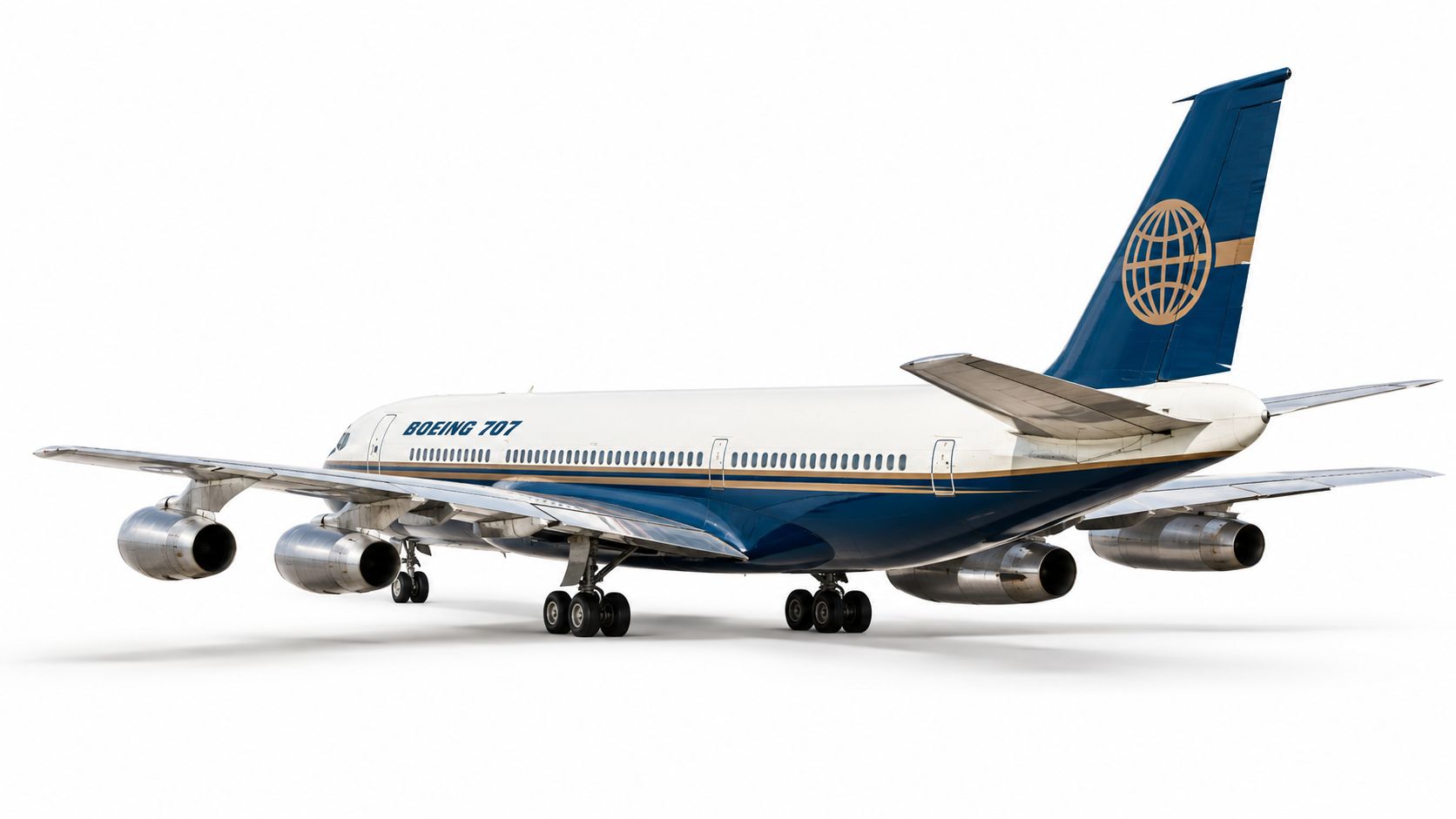
Historical reference: If you're comparing cabin volume across generations of business aviation, the 707 is a reminder that legacy size often came with very different comfort and efficiency standards.
For heritage flights or museum-linked operations, airworthiness paperwork matters more than nostalgia. The aircraft's importance is historical, but any flight booking still needs real operator credentials and a current regulatory basis to be meaningful.
5. Lockheed JetStar The Original Four-Engine Business Jet | Haute Jets Journal
The Lockheed JetStar is where the idea of a four-engine business jet stops looking like an airline adaptation and starts looking like a purpose-built executive tool. Introduced in 1961, it was one of the first purpose-built business jets and the only one in its era with four engines. That alone makes it a landmark design in the history of private aviation.
Its rear-fuselage-mounted turbojets gave it a clean wing and helped reduce cabin noise. For early corporate users, that mattered almost as much as speed. The JetStar served corporate, government, and military roles, which tells you the airframe had enough flexibility to move between executive travel, transport duties, and specialized missions without losing relevance.
The early business-jet trade-off
The JetStar highlights a question that still shapes charter buying. Is the aircraft being chosen because it can fly the mission, or because it carries a legacy reputation? In its era, four engines were part of the answer because the market had fewer efficient alternatives. Today, the aircraft is valuable mostly as a benchmark for how far the business jet cabin, noise control, and range have progressed.
Operator lesson: A legacy quadjet can be a fascinating choice, but it's rarely the most efficient one. For modern private travel, the value often sits in newer cabin layouts and more efficient mission profiles.
The JetStar also helps explain why four-engine aircraft became less common in private aviation. Once twin-engine business jets matured, the performance-per-dollar case shifted hard. That doesn't erase the JetStar's significance. It just puts it in the category of foundational aircraft that shaped the market before the market outgrew them.
6. Vickers VC10 The Long-Range Four-Engine Jet with a Distinctive Tail | Haute Jets Journal
The Vickers VC10 is one of the most distinctive four-engine aircraft ever built, and not just because of its silhouette. Designed for hot and high airports as well as long routes, it paired strong performance with rear-mounted Rolls-Royce Conway turbofans. That layout reduced cabin noise and made the aircraft a practical choice for passengers who valued comfort on long sectors.
The VC10 also became an important military and government transport, which extended its life well beyond its early civil role. Royal Air Force service gave it a second identity, and that dual-use history matters because it shows how four-engine aircraft often survive longer when a state operator values their range and mission flexibility.
Why the tail-mounted layout matters
Rear-engine placement changed the cabin experience. It moved noise away from passengers and helped define a comfort standard that many later aircraft tried to copy in different ways. For private aviation clients, the VC10 is a reminder that engine placement can matter as much as engine count.
Cabin insight: If quiet matters to your passengers, ask the operator where the engines sit, not just how many there are. The layout can change how a long flight feels.
For analysts, the VC10 matters because it shows that four-engine design was never only about brute force. It was also about airport performance, route capability, and cabin quality. Those priorities still show up in premium charter, just in more modern forms.
7. Ilyushin Il-62 The Soviet-Era Four-Engine Long-Range Jet | Haute Jets Journal
The Ilyushin Il-62 carried four-engine aviation into the Soviet long-haul network with a design that was easy to recognize and harder to ignore. Its rear-mounted engines and T-tail made it stand out on international routes, while Aeroflot and Soviet government transport used it for long-haul flights across Europe, Asia, and the Americas. That combination of range and state utility made it a key aircraft in Cold War-era aviation.
The Il-62 belongs in this list because it represents a different institutional answer to the same problem. How do you move people far, reliably, and with enough margin to support diplomatic or scheduled intercontinental service? The answer, in this case, was a long-range quadjet with a layout optimized for its operating environment.
The charter lesson
Heritage aircraft can look appealing to travelers who want something rare, but the booking question is more important than the paint scheme. Verify airworthiness status before considering any legacy aircraft for travel. For most modern missions, a current long-range business jet or widebody will offer better efficiency and a stronger operational record.
The Il-62 also underscores how four-engine aircraft were not a single global style. They were regional solutions to similar challenges, shaped by local operating conditions, maintenance systems, and route demands. That's why four-engine history matters to private aviation today. It explains why some designs lasted and others vanished.
8. Concorde The Supersonic Four-Engine Jet and the Benchmark for Premium Speed | Haute Jets Journal
Concorde is the four-engine aircraft that defined speed rather than size. Jointly developed by British Aircraft Corporation and Aérospatiale, it was powered by four Rolls-Royce/Snecma Olympus 593 turbojets with reheat and cruised at about Mach 2 Concorde reference. It carried passengers between London or Paris and New York in roughly three and a half hours, which made it the most famous high-speed premium airliner of its era.
The aircraft was retired in 2003 and is not available for private charter, but it still matters because it reset expectations. It proved that some travelers will pay for time savings if the cabin experience and schedule justify it. That lesson still applies in private aviation, where buyers compare long-range business jets not just by comfort, but by how much time they recover on a given route.
Why Concorde still shapes premium travel thinking
Concorde's four engines were not about redundancy alone. They were part of the propulsion system that made sustained supersonic travel possible. That is why the aircraft remains a benchmark even though it is gone. It shows how a four-engine jet can define an entire category, then disappear once economics and regulation change.
Travel standard: For fast transatlantic trips today, the better comparison is often a long-range business jet on a nonstop subsonic route, not a legacy supersonic profile.
For Haute Jets readers, Concorde is less a charter option than a reference point. It tells you what premium buyers have historically valued, speed, exclusivity, and the feeling of being ahead of the schedule.
Top 8 Four-Engine Jets Comparison
| Aircraft | Implementation complexity | Resource requirements | Expected outcomes | Ideal use cases | Key advantages |
|---|---|---|---|---|---|
| Boeing 747-8 BBJ | Very high, multi-year custom completions and specialized outfitting | Very large runway/hangar, high fuel burn, large crew and maintenance teams | Ultra-long-range nonstop capability with full VIP residential interiors | Heads of state, ultra-high-net-worth multi-continent travel, large delegations | Massive cabin volume, four-engine redundancy, strong residual value |
| Airbus A340 ACJ340 | High, proven completions but older airframe support varies | Large runway, high fuel consumption vs modern twins, experienced maintenance required | Exceptional nonstop range (esp. A340‑500 variants) and wide, multi-room cabin | Long-haul corporate/state missions prioritizing range | Long-range capability, lower secondary-market acquisition cost, four-engine redundancy |
| Boeing VC-25A (Air Force One) | Extremely high, bespoke government modifications, secure systems | Dedicated government support, specialized maintenance, aerial refueling and defensive systems | Unmatched secure communications, command-and-control and mission readiness | Presidential/state transport, national emergency airborne command | Top-tier security/redundancy, integrated mission systems, proven long-range performance |
| Boeing 707 VIP | Moderate to high historically; high now due to obsolescence and scarcity | High fuel burn, older systems, limited parts and specialized maintenance | Historic long-range VIP transport but outdated efficiency and systems | Heritage operations, museum displays, vintage VIP charters (rare) | Historical significance, large customizable cabin for period-accurate VIP layouts |
| Lockheed JetStar | Moderate, legacy conversions; simpler layout but limited support | Short-field capable for its era, limited range, high fuel consumption, scarce parts | Compact executive transport with limited modern-range and efficiency | Historical reference, niche vintage operations, study of early biz-jet design | Rear-mounted engines reduced cabin noise, pioneering business-jet architecture |
| Vickers VC10 | High historically; high today due to retirement and scarce support | Designed for hot/high performance, rear-engine benefits, higher ops cost vs modern twins | Quiet cabin and strong performance from challenging airports; long-range capability | Military/VIP transport historically; benchmarking cabin-noise and performance traits | Quiet rear-engine layout, strong hot/high performance, four-engine redundancy |
| Ilyushin Il-62 | High, Soviet-era systems, retired status makes operations complex | High fuel burn, limited parts and maintenance support, large airframe needs | Long-range capability historically, but outdated efficiency and supportability today | Historical/government legacy operations, museum exhibits | Four-engine redundancy, distinctive design important to Cold War aviation history |
| Concorde | Extremely high, supersonic systems and regulatory constraints; retired | Specialized maintenance and support, very high fuel and operating costs, sonic-boom restrictions | Unmatched transatlantic speed (≈Mach 2) with limited passenger capacity | Historical benchmark, museum/heritage flights (not commercial charter) | Supersonic speed, iconic engineering achievement, premium passenger experience |
Matching a Four-Engine Jet to Your Route
Start with the route, not the aircraft label. Ultra-long-range nonstop missions can justify a large widebody, especially when the cabin has to work as a meeting space, bedroom suite, or mobile office. Most transatlantic trips, though, are better served by a long-range large-cabin jet that carries fewer empty seats and avoids the cost burden of a true quadjet.
The economics are hard to ignore. A 747-400 is reported to burn about 20 to 25% more fuel per seat-mile than modern alternatives such as the Boeing 777 and 787, and its cost per available seat-mile is estimated at roughly 15 to 30% above a 777-300ER 747 fuel and cost reference. That doesn't mean four-engine aircraft are obsolete. It means their value depends on whether the mission benefits from capacity, range, or cargo volume enough to absorb the penalty.
The A380 shows the other side of the equation. Airbus reports fuel consumption of about 3.1 liters per 100 passenger-kilometers, or 0.75 U.S. gallons per 100 passenger-miles, which makes clear why cabin density and load factor matter so much on very large aircraft Airbus A380 specifications. A quadjet flying near capacity tells a very different economic story from one moving too few passengers over the same sector.
Current operational reality also matters. Passenger quadjets are becoming more concentrated around a small number of airlines and hubs, and some future schedules indicate that the A380 and Boeing 747-8 passenger aircraft will remain active on select routes rather than broadly available 2026 quadjet flight projections. For charter buyers, that means availability now matters more than reputation. Ask which exact aircraft is assigned, whether a swap is possible, and whether the origin and destination airports can handle the airframe.
Use the same discipline with safety. FAA guidance for multi-engine operations still requires planning for engine failure, diversion, and degraded performance, even on four-engine aircraft FAA extended operations guidance. Before booking, verify the aircraft's maintenance standing, the operator's audit rating, and the airport's compatibility. A four-engine jet can be the right answer, but only when the mission, the runway, and the operator all line up.
Haute Jets helps clients choose the right aircraft for the route, not just the biggest one on paper. If you're comparing four-engine jets against a long-range widebody or a more efficient twin for an upcoming trip, visit Haute Jets to request a customized charter and get the exact aircraft that fits your itinerary.