

You've picked the resort, counted the bags, and found a departure time that works from South Florida. Then someone asks the questions that determine whether the trip runs smoothly: can the aircraft land on your island, will customs be open when you arrive, and does the return require special permission? A private jet to the Bahamas is straightforward only when those details are settled before the aircraft is booked.
The Bahamas recorded more than 11 million total visitor arrivals in 2024, including more than 1.7 million foreign air arrivals. Air arrivals were 3.3% above the 2019 benchmark, which confirms sustained aviation demand, but the figure includes scheduled and private aviation rather than private jets alone. The Bahamas Ministry of Tourism's 2024 release also reinforces why Nassau, Exuma, Abaco, Eleuthera, and other island gateways deserve separate planning.
Why Bahamas Charter Trips Get Complicated Fast
Take a typical long weekend. You leave Miami in a light jet, clear into Nassau, and plan to continue to Exuma. The first decision isn't the cabin layout or the catering menu. It's whether Nassau is the correct first international landing point and whether the aircraft can legally and practically reach Exuma at the requested time.
A direct routing to the final island may look more luxurious, but it can create problems if that airport isn't an Airport of Entry, if customs staffing doesn't match the arrival time, or if the runway and operating hours don't suit the aircraft. A connection through Nassau may add a movement to the itinerary while simplifying international clearance. Sometimes the “faster” route takes longer door to door because passengers wait for a transfer, luggage is moved between aircraft, or the second airport requires a separate clearance process.
Broker's rule: Choose the arrival airport before choosing the aircraft. The island, runway, customs schedule, and fallback plan define the mission.
The Bahamas isn't one airport market. The country's geography includes hundreds of islands and cays, and air arrivals grew from 790,368 in January through May 2023 to 821,334 during the same period in 2024, an increase of 30,966 visitors, or 3.9%. The Ministry of Tourism's visitor-arrivals data.pdf) measures all foreign air arrivals, not private-jet demand, but it shows why operators must plan for several gateways rather than treating Nassau as the universal answer.
For a Miami traveler headed to Exuma, I'd want five answers in writing before accepting a quote:
- First landing point: Is the planned airport an AOE for international arrival?
- Aircraft fit: Can the selected tail operate safely with the expected fuel, payload, baggage, and weather conditions?
- Customs timing: Will customs and immigration be staffed when the aircraft lands?
- Island transfer: If Nassau is used first, who coordinates the onward flight, vehicle, boat, or helicopter?
- Return protection: Does the departure fall outside published airport hours, and if so, has approval been secured?
That is the operational difference between a polished Bahamas itinerary and a price sheet that leaves the hard work until departure day.
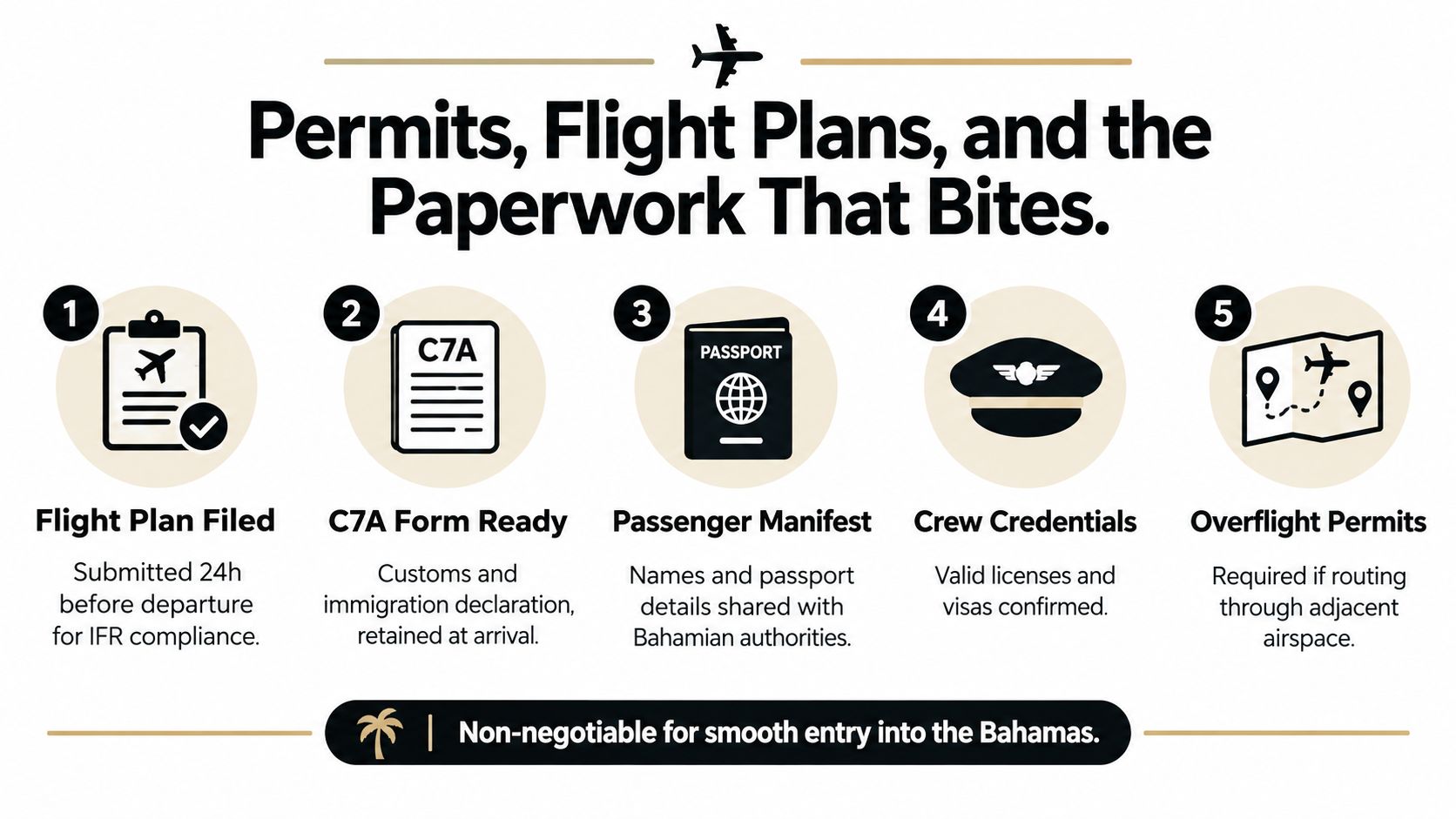
Permits, Flight Plans, and the Paperwork That Bites
A charter operator should treat entry compliance as a sequence, not as a single form. The wrong first airport or the wrong declaration can disrupt an otherwise legal flight.
Start with the route and flight plan
First, verify that the intended destination is an Airport of Entry. The first Bahamian landing point handles customs and immigration clearance, so an out-island airport shouldn't automatically be treated as the international entry point.
Next, the operator files an accepted international flight plan. The FAA's Bahamas country information states that an accepted flight plan is required for private international operations. This requirement isn't replaced by a private terminal, a familiar route, or a short flight from Florida. The FAA country information for The Bahamas also explains the additional approval issue for operations outside published airport hours.
If the movement is planned outside those hours, permission from the Director of Civil Aviation must be obtained at least 48 hours before the intended operation. Confirm the airport's published schedule, customs and immigration availability, and written after-hours authorization before finalizing the passenger departure time. A runway being physically available doesn't mean the airport is authorized or staffed for your arrival.
Select the correct declaration
The C7A pleasure-aircraft process applies only when the aircraft carries no cargo, is used strictly for pleasure or recreation, and is flown by a pilot who isn't operating for compensation or business purposes. Eligible operators submit the declaration through the Bahamas Customs Click2Clear Pleasure Aircraft Module, including voyage details, rotation number, and registration. Customs generally requires the declaration in triplicate, while Nassau, West End, and Freeport require two copies. Bahamas Customs' guidance on the ECAS process explains the distinction.
A revenue charter doesn't fit that recreational definition. Business or commercial operations use the general C7 declaration process. The official tourism guidance lists a $50 inbound US-to-Bahamas customs-processing fee per aircraft, while Customs separately publishes fees for private commercial flights and small charter aircraft. Those categories include $150 inbound and $150 outbound for private commercial aircraft, or $75 each way for a charter with four seats or fewer. Confirm the applicable category before quoting an all-in fare using the official private aviation pilot FAQs.
Keep the paperwork operational
For an eligible pleasure aircraft, retain the processed C7A until departure clearance, then surrender it to Customs at the airport of exit. Every passenger also needs an immigration card. The operator should prepare the manifest, passports, crew credentials, and aircraft details before the flight, rather than asking the FBO to reconstruct them on arrival.
The most common avoidable failures are simple: using a non-AOE as the first international landing point, applying C7A treatment to a commercial charter, and assuming after-hours approval happens automatically.
Matching Your Departure City to the Right Bahamian Airport
Departure convenience matters, but the final island usually matters more. Miami and Opa-Locka offer practical access to Nassau and Exuma, Fort Lauderdale Executive works well for northern island itineraries, and Palm Beach can suit Abaco-bound travelers. The aircraft and arrival time determine whether the most direct-looking option is the cleanest one.
| Airport (Code) | Runway | Customs & Night Ops | Best For |
|---|---|---|---|
| Lynden Pindling International, Nassau (MYNN) | Larger international gateway capability | Customs and international processing, with Nassau receiving special treatment for IFR operations after sunset | First entry, Nassau, Paradise Island, and onward island connections |
| Exuma International, Great Exuma (MYEF) | Suitable for selected private aircraft, subject to payload and operating conditions | Confirm hours and customs staffing before booking | Direct access to Great Exuma and the Exuma Cays |
| North Eleuthera (MYEH) | Aircraft suitability depends on performance, payload, and conditions | Family-island hours generally require careful daylight planning | Harbour Island and Eleuthera |
| Marsh Harbour, Abaco (MYAM) | Match aircraft performance to runway and weather requirements | Confirm published hours and clearance arrangements | Abaco resorts, marinas, and yacht itineraries |
The Haute Jets Bahamas private jet charter page is useful for comparing destination options, but don't treat a destination list as an operating approval. Ask the operator to confirm the actual airport, aircraft limitations, and clearance plan for your dates.
Miami and South Florida
Miami or Opa-Locka to Nassau is the simplest international pattern for many travelers. Nassau offers the strongest arrival infrastructure and is the safer choice when the schedule includes a late departure from the United States, a large-cabin aircraft, or uncertain weather. Miami to Exuma can be efficient when the aircraft and airport hours align, but a direct island arrival shouldn't be promised without checking customs and operational restrictions.
Fort Lauderdale Executive is particularly convenient when the group is spread across Broward or Palm Beach. It also makes sense for North Eleuthera, though the final choice should reflect whether passengers prefer direct island access or a Nassau connection with broader operating flexibility.
Palm Beach and northern islands
Palm Beach is a sensible starting point for Abaco and northern Bahamas itineraries. The decision becomes less attractive when the aircraft must reposition from elsewhere in Florida, when customs timing is uncertain, or when the group needs a larger aircraft that has limited out-island access.
For transcontinental passengers, routing through Nassau can be more dependable than forcing a large aircraft toward a smaller family-island airport. Clear internationally at the main gateway, then use an appropriate onward aircraft or ground and boat transfer. That isn't a downgrade. It's often the correct match between runway capability and passenger expectations.
What a Private Jet to the Bahamas Actually Costs in 2026
A 2026 charter quote should be treated as a mission budget, not a simple multiplication of flight time by an hourly rate. The operator may need to position the aircraft, reserve an overnight crew, coordinate FBO handling, add catering, and account for the return schedule. A short Florida flight can therefore produce a materially different total depending on where the aircraft is based and how long it remains in the Bahamas.

Build the quote in layers
Start with the aircraft category. A light jet can suit a small group traveling from South Florida with moderate baggage. A midsize aircraft earns its place when passengers need more cabin space, luggage capacity, or range. Super-midsize and heavy aircraft make sense for larger groups, longer departures, or a premium cabin requirement, but they're a poor choice if the selected island airport can't accommodate the mission comfortably.
The Haute Jets private jet charter cost guide can help frame category-level budgeting, but a route-specific quote remains essential. Ask for these line items:
- Aircraft time: The flight and any billable positioning associated with the selected tail.
- Repositioning: The cost of bringing an aircraft to the departure airport or returning it after a one-way flight.
- Airport and FBO charges: Handling, parking, landing, and private-terminal services.
- Customs category: Fees vary according to whether the movement is recreational, private commercial, or a small charter.
- Crew expenses: Overnight accommodation and related expenses when the crew remains on the island.
- Passenger services: Catering, ground transportation, pets, sports equipment, and special handling.
A nearby Phenom 300 may produce a better value than a Gulfstream G550 positioned from another region, even when the Gulfstream offers a superior cabin. The correct comparison is total mission cost and suitability, not the hourly figure alone.
Owner-operator sourcing changes the equation
Traditional broker and jet-card pricing can include layers that aren't obvious in the first number. Sourcing directly from owner-operator fleets can reduce unnecessary repositioning when an appropriate aircraft is already based near Miami, Fort Lauderdale, Palm Beach, or another useful departure point.
Empty legs can also work for flexible travelers. An empty leg is a repositioning flight without the original passengers, so the routing and departure time aren't controlled in the same way as a dedicated charter. It can be attractive when your schedule can move, but it shouldn't be the foundation of a fixed resort booking, yacht departure, or time-critical return.
For a defensible estimate, send the broker the exact departure airport, final island, passenger count, baggage profile, pets or sports equipment, preferred arrival time, and whether the aircraft must wait for the return. A quote that ignores those inputs isn't a budget. It's an invitation to discover extras later.
Customs, Immigration, and a Clean Arrival on the Island
The cabin experience ends at the aircraft door, but the arrival succeeds on the ground. Small island airports operate with fewer layers than major U.S. facilities, so passengers who arrive organized move through the process more efficiently.
Hand over the right documents
Each passenger needs a passport and an immigration card. The crew presents the applicable customs declaration, passenger manifest, and aircraft documentation to the Bahamian officials. For an eligible pleasure aircraft, the processed C7A remains with the operator during island travel and is surrendered at the airport of exit. A commercial charter follows the general C7 process instead.
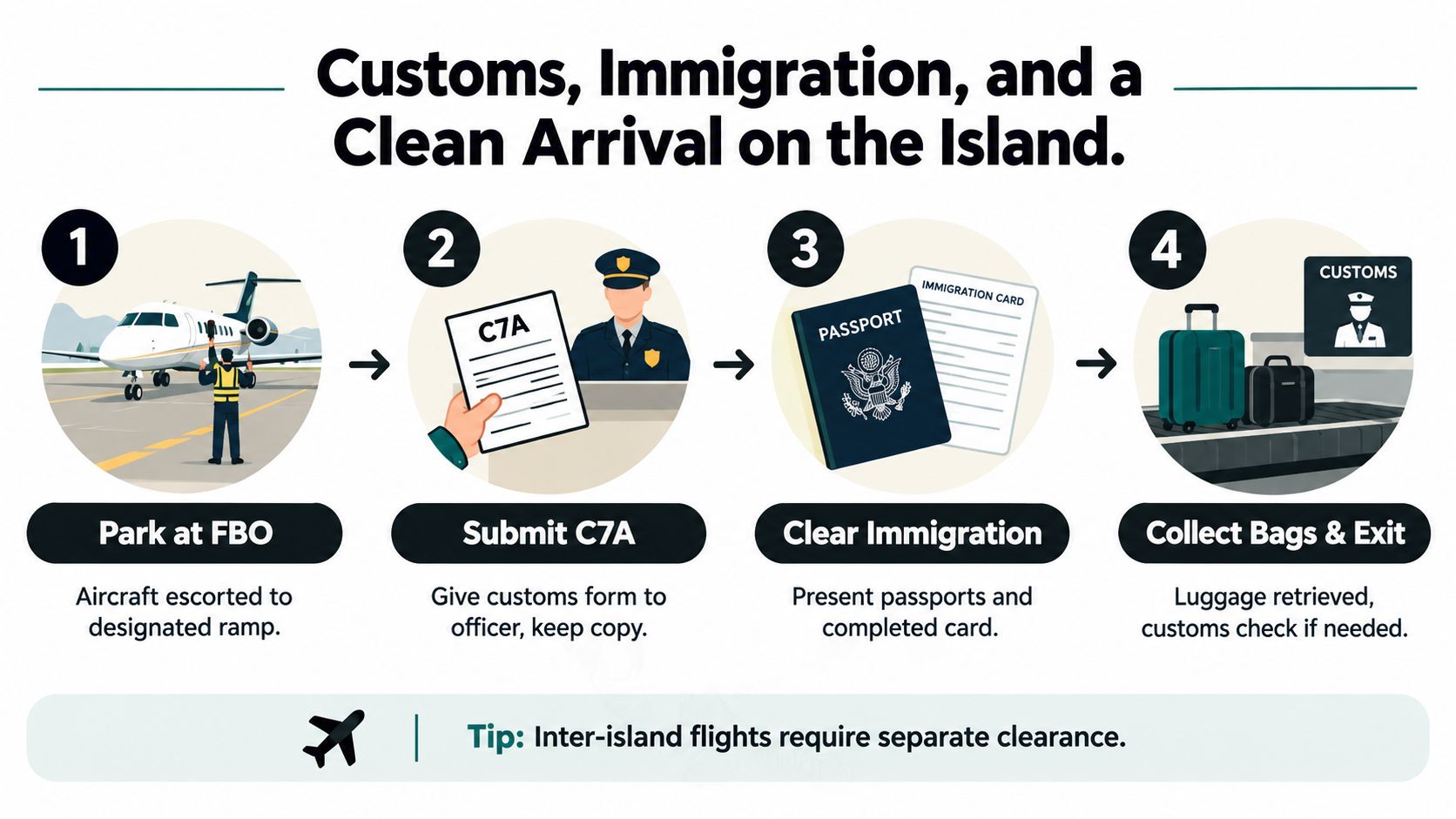
The operator should confirm the passenger manifest and crew details before departure. I also recommend a written pre-flight confirmation containing the tail number, crew bios, routing, airport contacts, and ground plan. Haute Jets' private jet customs guide provides useful background for passengers who want to understand the handoff between the flight crew, FBO, customs, and immigration.
Keep luggage and special items predictable
Tell the operator about golf clubs, fishing equipment, diving gear, oversized cases, and pets before aircraft selection. A light jet may have enough seats but insufficient baggage flexibility once every passenger brings a full island wardrobe and equipment. Pets also require advance confirmation of operator policy and Bahamian entry documentation.
At the FBO, wait for the crew or ground representative to direct baggage movement. Don't assume a small airport can process luggage exactly like a major international terminal. The cleanest arrival has one person responsible for passenger documents, another coordinating bags and vehicles, and an agreed meeting point outside the restricted area.
Inter-island travel deserves separate attention. Initial international clearance in Nassau doesn't eliminate the need to follow the local process for onward movements. Keep the cleared paperwork available, confirm the next airport's operating hours, and make sure the second aircraft or flight plan is arranged before the first landing.
Choosing the Exact Aircraft for Your Bahamas Route
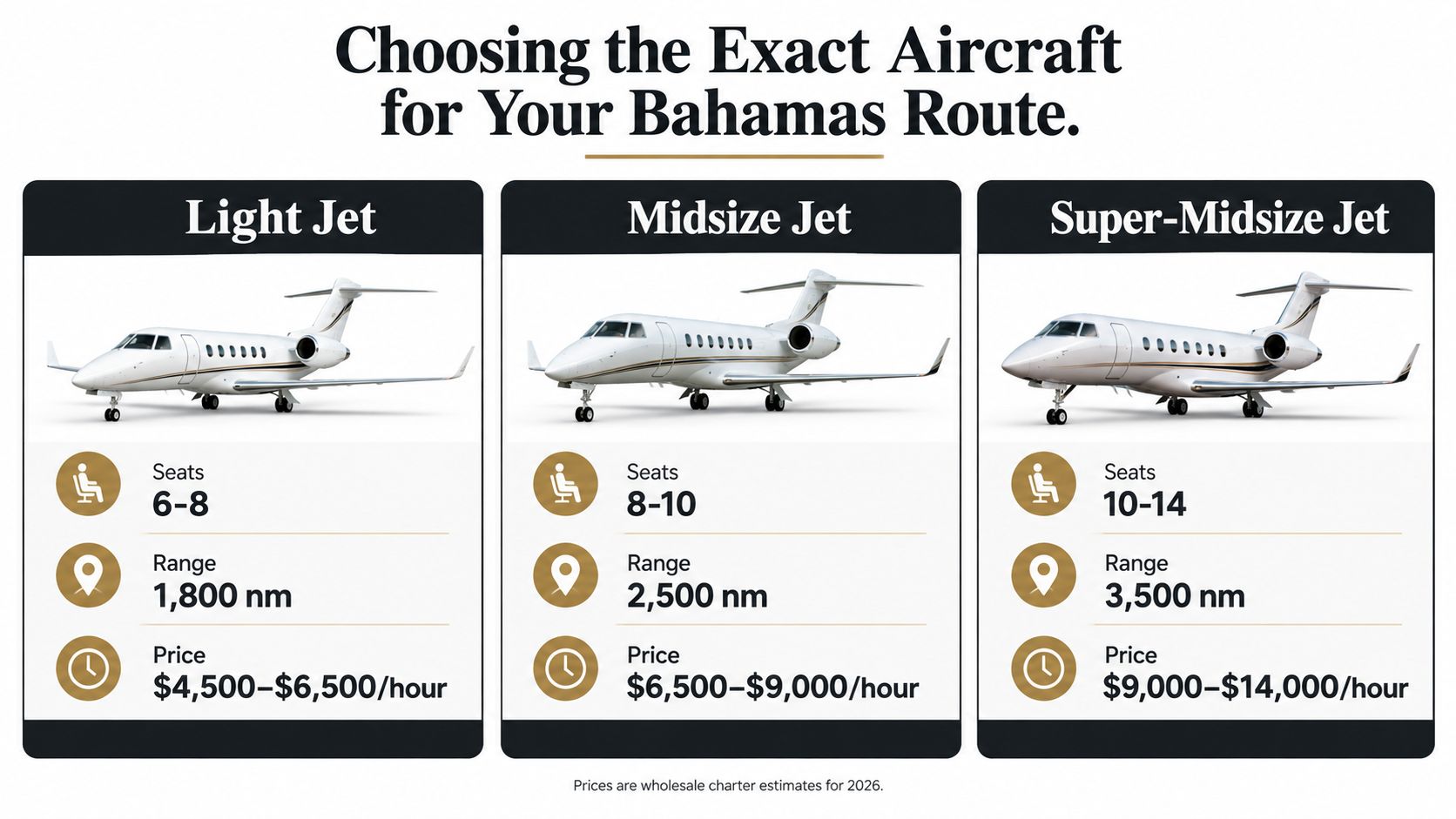
“Private jet to the Bahamas” is too broad a request for a serious quote. The useful question is which specific tail number, from which aircraft category, can reach the selected island with your passengers, bags, pets, and arrival time.
A Phenom 300 can be a sharp choice for a small group from South Florida when the destination airport and baggage profile fit. A Citation Latitude gives passengers more cabin room and can suit a group that values comfort without moving to a larger-cabin aircraft. The Challenger 350 adds space and baggage flexibility for a larger party, while a Gulfstream G550 is appropriate when the mission calls for a heavy, long-range cabin. None of those aircraft should be selected by brand reputation alone.
Match the aircraft to the island
Runway performance, payload, weather, airport hours, and customs availability matter more than an impressive cabin specification. A larger aircraft may carry more luggage and offer a better galley, yet still be the wrong choice for a family-island arrival at a late hour. Conversely, a light jet may be perfectly comfortable for Nassau but cramped for a week-long Exuma itinerary with sports equipment.
Use this decision pattern:
- Small group, South Florida, Nassau: Consider a light jet when baggage is moderate and the schedule is simple.
- More passengers or heavier luggage: Move to a midsize aircraft, especially when cabin comfort and storage matter.
- Large group or long-range departure: Evaluate a super-midsize or heavy aircraft, but confirm that the final Bahamian airport can support it.
- Remote island or constrained timing: Use Nassau as the international gateway and arrange a suitable onward movement when direct access creates unnecessary risk.
Demand the exact operating details
The operator should identify the actual aircraft, not just the model. Ask for the tail number, year, cabin layout, Wi-Fi status, catering plan, pet policy, ground transportation, and crew credentials. A model name doesn't tell you whether the particular aircraft has the cabin arrangement or equipment your itinerary requires.
Safety screening should also be specific. Haute Jets, for example, sources charter options from Wyvern Wingman and Argus Gold or Platinum-rated operators, and its service includes confirmation of the aircraft and operational details before departure. That makes it one sourcing route to evaluate, not a substitute for asking direct questions about the proposed tail.
The aircraft that is already in Florida and approved for your island is usually more useful than the aircraft with the most impressive brochure.
Your Pre-Booking Checklist for a Bahamas Charter
Before paying a deposit, ask the broker to answer these questions in writing:
- Is the first landing point an Airport of Entry? If it isn't, the itinerary needs a different international entry plan.
- What are the airport, customs, and FBO hours? Confirm them for the actual arrival and departure times, not just the daytime schedule.
- Does the movement need after-hours approval? If yes, secure permission from the Director of Civil Aviation at least 48 hours in advance, as required for applicable operations outside published hours.
- Is the flight recreational or commercial? That decision determines whether the C7A or general C7 declaration applies.
- Which tail number is operating? Confirm the aircraft's runway suitability, baggage capacity, Wi-Fi, pet policy, and catering.
- What is included in the quote? Separate aircraft time from repositioning, FBO handling, customs charges, catering, transport, and overnight crew expenses.
- What happens if the island becomes unavailable? Require a Nassau fallback, alternate airport, or onward transfer plan.
Travelers carrying fishing equipment, golf clubs, pets, or outdoor gear should also organize those details early. PADL's outdoor adventure prep guide is a practical resource for building a broader trip checklist around equipment, documents, and activities.
Request a 24-hour pre-flight confirmation with the tail number, crew bios, weather briefing, passenger manifest, airport contacts, and final routing. If the operator can't provide that level of clarity, keep calling.
Haute Jets arranges on-demand private charters by matching passengers with aircraft from owner-operators, including options for Bahamas routes, exact aircraft selection, private FBO coordination, and one-way itineraries. Visit Haute Jets with your departure city, island, passenger count, baggage needs, and preferred arrival time, and ask for a route-specific quote built around the aircraft capable of completing the mission.