
Zermatt has no commercial airport, and the best airport for Zermatt is the one that gets you through the car-free final leg with the least friction, not the one that looks closest on a map. For most long-haul travelers, that means Geneva or Zurich. For European travelers who want a smaller airport and a cleaner final handoff, Sion is the sharpest move.
You're probably trying to solve a deceptively simple problem right now. You want to land, transfer once, and arrive in Zermatt without wasting an afternoon on bad connections, baggage drag, or a pointless car transfer you can't even finish. That's the core question behind the airport for Zermatt search, and it's the one most guides get wrong.
Why Zermatt Has No Conventional Airport
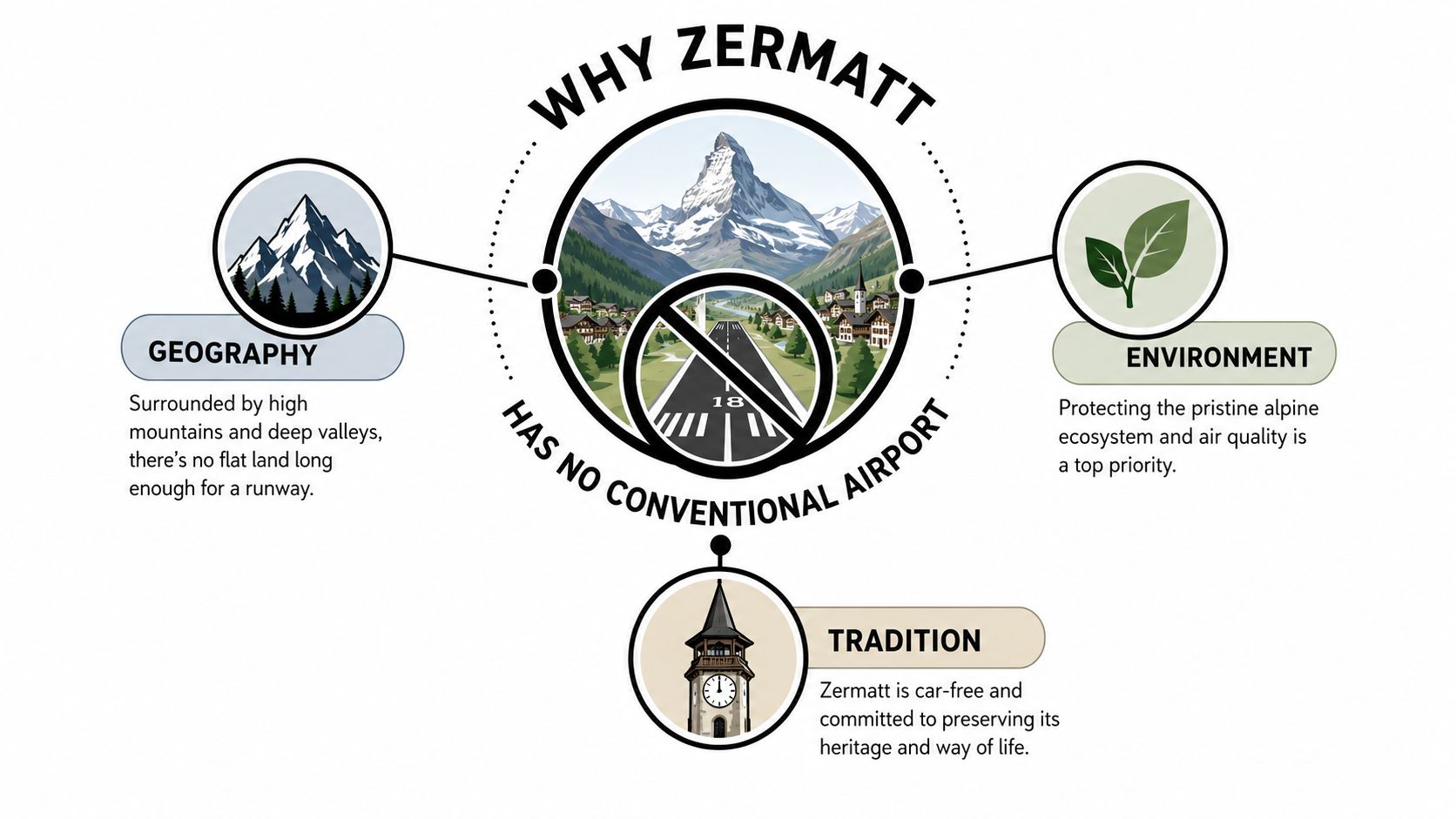
Zermatt's geography decides the answer before the traveler does. Zermatt itself does not have a conventional commercial airport, and the closest aviation facility is Zermatt Heliport (LSEZ), listed as a heliport and vertiport at 5,315 ft (1,620 m) elevation, about 24 km southeast of town (ACUKWIK airport information for LSEZ). That is not a normal scheduled-airport setup, and it's not meant to be.
What that means on the ground
The practical reality is blunt. You don't “fly into Zermatt” in the way you'd fly into Geneva or Milan. You land at a proper airport, then you finish the trip by rail or helicopter, because the resort's access model is built around the valley, the mountain, and the car-free village center.
That's why a nearest-airport lookup is only half the job. The better question is which gateway gives you the cleanest chain of transfers after landing. If you care about private travel, ski equipment, late arrivals, or family logistics, that chain matters more than raw proximity.
Practical rule: If the final leg isn't seamless, the airport isn't actually convenient.
The heliport exists, but it's not a casual fallback. Airport directories note that it's not open 24 hours, with operating hours of 08:00–12:00 and 13:30–18:00 local time (ACUKWIK airport information for LSEZ). That matters if you're trying to coordinate a same-day helicopter transfer into the resort, because the schedule has to fit inside those windows.
The result is simple. For Zermatt, the airport is never the finish line. It's the start of a multimodal move into a car-free mountain destination, and the best choice is the gateway that makes that handoff feel controlled.
The Car-Free Rule That Changes Everything
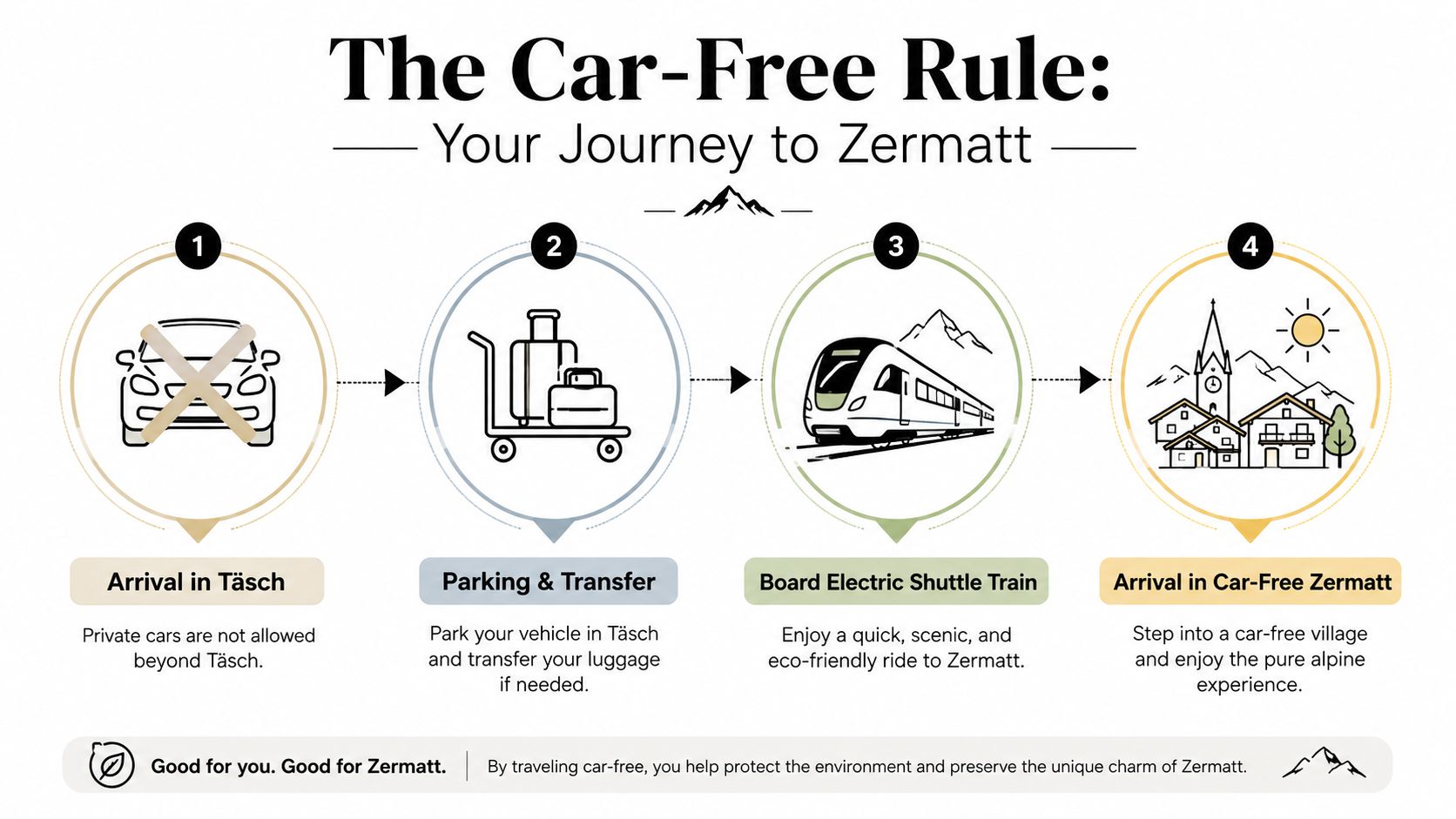
Zermatt's car-free rule changes the whole decision tree. Drivers must stop at Täsch, roughly 5 km before the village, and continue by shuttle train or approved transfer (travel access guidance). That means even the “closest airport” isn't really close unless the onward connection is clean.
Why the transfer chain matters more than mileage
A short drive from an airport can still lose to a longer arrival if the rail segment is smoother. That's the logic premium travelers need to use. Zermatt's own arrival materials point to major gateways like Zurich, Geneva, Basel, and Milan, and they frame the destination as a place reached in a few hours rather than a quick airport hop (Zermatt destination access overview).
The car-free rule also changes what luggage means. Ski bags, heavy winter coats, family strollers, and late-night check-ins all become operational issues, not minor inconveniences. If you arrive tired and then need to work through a parking stop, a shuttle, and a final mountain rail segment, the trip feels longer than the map suggested.
Direct advice: choose the gateway that gives you the fewest weak links, not the fewest kilometers.
That's why Geneva can be smarter than a closer regional airport if your train timing is better. It's also why Sion can be excellent for a private-aviation arrival even though it isn't the obvious name many travelers recognize. The airport for Zermatt question only makes sense when you include Täsch in the picture.
The tightest way to think about it is this. You're not booking a flight to Zermatt. You're booking a transfer sequence into a village that intentionally resists car access, and the quality of that sequence is the luxury variable.
Comparing Geneva, Zurich, Milan, Sion, and Bern
The five serious gateways are Geneva, Zurich, Milan Malpensa, Sion, and Bern. Travel-planning data places Sion closest at about 38.8 km, then Milan Malpensa at 86.5 km, Geneva at 128.7 km, and Zurich at 170.6 km (Zermatt destination infrastructure data). But distance is not the deciding factor. Your best airport for Zermatt depends on how you arrive, not just where you land.
Gateway Airports for Zermatt at a Glance
| Airport | Distance to Zermatt | Typical Transfer Time | Best For |
|---|---|---|---|
| Geneva | 128.7 km | About 3 to 4 hours by train | North American and French arrivals who want a clean rail handoff |
| Zurich | 170.6 km | About 3 to 4 hours by train | Long-haul travelers with the widest flight choice |
| Milan Malpensa | 86.5 km | About 3 hours by rail or drive-plus-transfer | Italy, Middle East, and Asia connections via Milan |
| Sion | 38.8 km | Short onward transfer after landing | Private aviation and travelers who want to minimize rail time |
| Bern | Not listed in the verified data | Usually used by travelers already in Switzerland | Domestic Swiss itineraries |
Geneva is the tidy answer for many international travelers. It tends to fit North American and French itineraries well because the rail connection into the Valais is straightforward, and the airport experience feels easy when you're trying to conserve energy after a long-haul flight. If you want a polished commercial-airport arrival with a predictable onward train, Geneva belongs near the top.
Zurich is the better global long-haul gateway. Zurich Airport handled 32.6 million passengers in 2025, offered 169 direct destinations in 71 countries, had 3 runways, and around 120 aircraft parking stands (Zurich Airport infrastructure overview). That matters because more flight options means better timing, and timing is everything when Zermatt is still several hours away.
Milan Malpensa is the practical play for Italy-linked trips and some long-haul routings. It can work well if your commercial itinerary naturally lands there, but it's not the default choice for Valais access. Bern is the quiet Swiss option for travelers already inside the country, but it's more of a convenience airport than a strategic international gateway.
If you're building a premium arrival plan, don't ignore wayfinding inside the airport itself. Good airport navigation can save real time, and tools like maximize ROI with airport navigation matter more than most travelers admit when a tight transfer is on the line.
For a private-aviation arrival, Geneva also has dedicated terminal options, including the Geneva airport private terminal, which is relevant if you want your commercial-airport step to feel less public and more controlled.
Bottom line: Zurich wins on flight inventory, Geneva wins on ease, Sion wins on proximity, and Milan wins only when your itinerary already points there.
Train and Ground Transfer Timings From Each Gateway
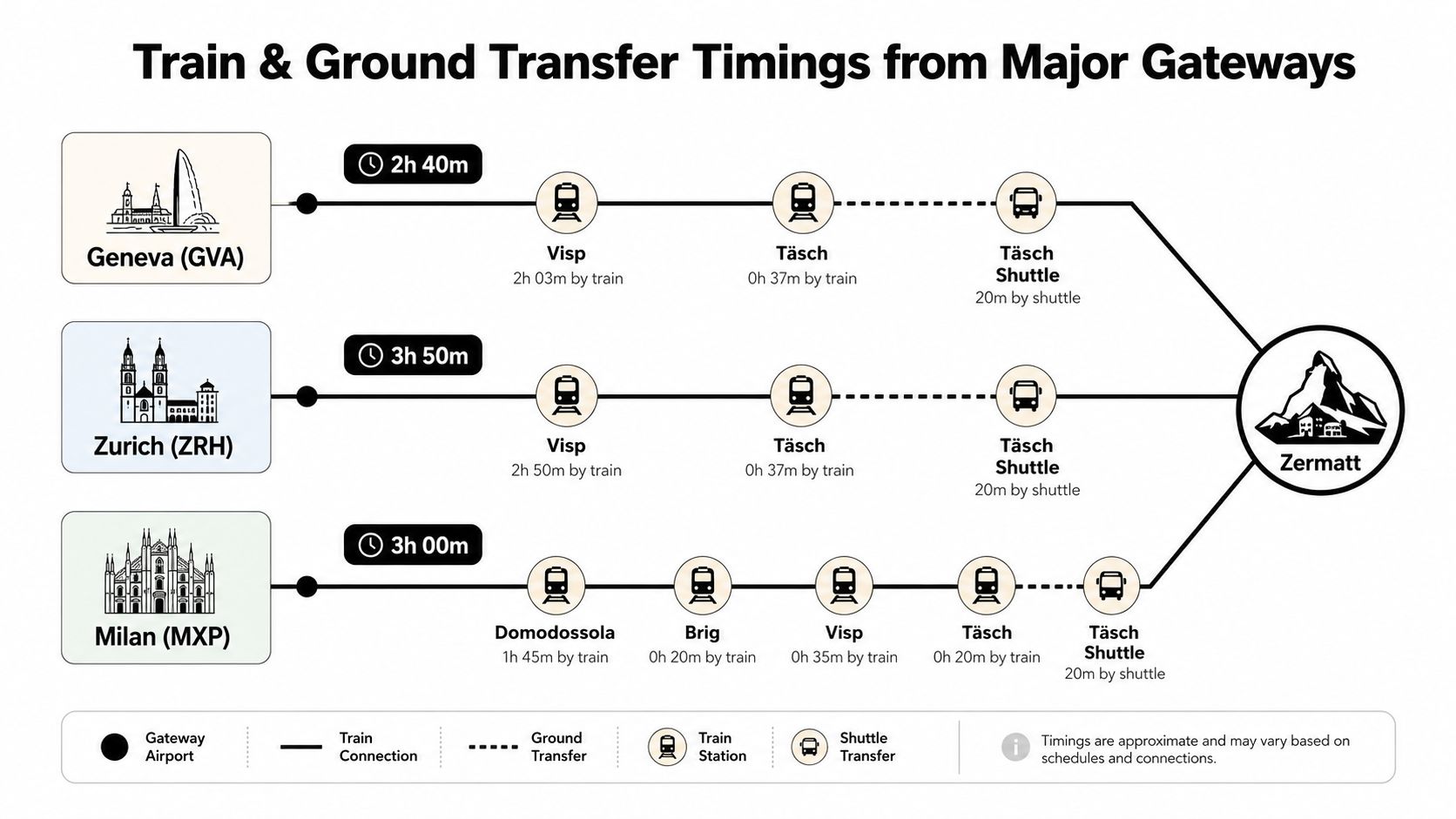
The published timing range from the major gateways is the part people should plan around. Travel guides consistently show that reaching Zermatt usually takes roughly 3 to 4 hours by train, with one route listing about 2 h 40 m from Geneva, 3 h 50 m from Zurich, and 3 h from Milan by drive and similar rail timings (Ultimate Ski Zermatt travel guide). That's the frame for decision-making.
How to read the timings correctly
Those numbers are not just train time. They sit on top of airport exit time, baggage collection, platform access, and the final switch at Täsch or Visp. A perfectly timed flight can still land you in a bad transfer slot if you ignore the way the rail schedule lines up.
Geneva is usually the cleanest rail story. One detailed route breakdown says Geneva to Zermatt by train takes 3 h 45 m to 3 h 55 m, with one transfer in Visp (MySwissAlps Geneva to Zermatt guide). That's the kind of connection luxury travelers should like, because it reduces the number of moving parts.
Zurich is longer on paper, but often stronger in practice because the flights are better. If your long-haul arrival lands at the right time, the extra rail time can be worth it for a smoother aviation leg. Milan can be competitive when your origin city naturally routes there, but it becomes less attractive if the flight choice forces awkward scheduling.
Use your rail timing as the anchor, then build backward from your landing time. If you're arriving late, don't assume any gateway will behave the same after dark. The last thing you want is to be stranded by a missed shuttle or a thin connection because you treated the airport and the mountain transfer as separate problems.
For travelers tempted to rent a car one-way and “make it flexible,” that usually creates the opposite effect. The parking stop in Täsch plus the rail switch is exactly where flexibility gets swallowed, so it helps to avoid common one way car rental mistakes before you commit to a road-based idea that doesn't really save time.
Rule of thumb: if your schedule is tight, book the transfer chain first and let the flight fit around it.
Helicopter Transfers and Private Jet Alternatives
Helicopter transfer is the premium final-mile answer, but only when the timing works. Air Zermatt publishes a transfer from Raron to Zermatt at about 12 minutes, or about 18 minutes if the route includes the Matterhorn (Air Zermatt helicopter transfer table). That is a very different experience from sitting on a train for hours, and it's the right tool for the right arrival.
When helicopter makes sense
Helicopter is the obvious move if your party values speed, discretion, and a direct landing close to the resort. It's also the cleanest answer when you're arriving by private jet and want to minimize public terminal exposure. The catch is operational, not aspirational. The Zermatt Heliport is not open all day, with operating windows of 08:00–12:00 and 13:30–18:00 local time (ACUKWIK airport information for LSEZ).
That schedule matters more than people think. If your aircraft lands too early, too late, or drifts because of weather, the helicopter chain may stop being elegant and start being awkward. Private-jet clients should treat the heliport hours as a hard constraint, not a suggestion.
The private-jet logic behind Sion and regional fields
The smarter private-aviation pattern is often simple. Land at Sion, then use helicopter or a short car transfer to bridge the final distance. That keeps the trip short enough to feel premium without forcing a tiny mountain landing to carry all the operational risk. If you need to compare air and rotor options, the private jet versus helicopter charter question comes down to total trip control, not prestige.
For lightweight packing and winter layering, the right kit makes the helicopter path easier than people expect. A good reference for streamlining bags is lightweight travel gear for 2026, because rotor and resort transfers punish overpacking faster than commercial rail does.
Haute Jets also fits naturally into this conversation because its charter network sources aircraft from owner-operators and can pair that with a helicopter finish when the itinerary calls for it. The value is not the aircraft alone, it's building the whole arrival sequence so the charter, the FBO, and the mountain leg all line up.
When Sion Is the Smart Choice
Sion is the underrated answer for the right traveler. Travel-planning data puts it at about 38.8 km from Zermatt, making it the nearest practical airport in the region (Zermatt destination infrastructure data). If your priority is cutting rail time almost entirely, Sion can beat the bigger names without apology.
Why small-airport access wins for some trips
This is the airport for Zermatt when your trip is built around private aviation, not scheduled tourism. A smaller airport can be faster at the point that matters most, getting you from aircraft to onward transfer without the traffic, queues, and long terminal walks that can make larger gateways feel sloppy. If you're flying in with skis, family gear, or a short turnaround, Sion's closer-in profile is a real advantage.
The trade-off is obvious. Scheduled service is limited compared with Zurich or Geneva, so you shouldn't choose Sion just because it's close. Choose it when your aircraft, charter timing, or European route already makes it the cleanest landing point. In that case, it's not a compromise, it's the correct airport.
For private clients, the terminal experience matters as much as the runway. The internal Sion airport page is the kind of routing reference you want when you're building a direct-to-resort plan rather than a standard airline itinerary.
My view: if you're flying private and want Zermatt with minimal fuss, Sion is the first place to look.
Who should actually use it
Use Sion if you're arriving from a nearby European city, if your aircraft is already positioned for the region, or if you're coordinating a helicopter finish. Use Geneva or Zurich if you need broader commercial schedules and better long-haul flexibility. The mistake is treating Sion as a second-tier option just because it's smaller. For the right trip, it's the most efficient gateway available.
FBO Realities, Customs, and Recommended Operators
The luxury arrival to Zermatt lives or dies on handling quality. Zurich and Geneva are the most reliable commercial gateways for private arrivals because they offer the scale, customs capability, and ground coordination that high-value itineraries depend on. Milan Malpensa works when your routing naturally passes through Italy, while Sion is best when the charter and helicopter sequence are already aligned.
What matters at the terminal
Private travelers should care about three things. First, discreet processing, so you're not standing in a public-flow bottleneck. Second, ground coordination, because the transfer to Täsch or a helicopter departure has to be ready when you arrive. Third, operator quality, because a weak FBO handoff ruins the rest of the day.
You also want to think in terms of runway and handling fit, not just city prestige. A larger airport can be easier if your schedule is complicated, because the odds of finding a workable slot are better. A smaller field can be more efficient if everything is lined up already, because less terminal complexity often means less wasted time.
Practical rule: the best private arrival is the one where customs, luggage, and the onward transfer all happen on one clock.
For charter standards, Haute Jets uses Wyvern Wingman and Argus Gold or Platinum-rated operators across its network, and that's the level you should demand for a Zermatt trip. If the plan includes a helicopter, that standard matters twice, once for the fixed-wing leg and once for the rotor segment. You don't want a premium itinerary built on a weak operator mix.
If you're arranging a regional private arrival, ask for the cleanest possible sequence. That means the aircraft should be positioned near your departure city when possible, the arrival terminal should match your customs needs, and the helicopter or ground transfer should already be waiting. For Zermatt, efficiency beats flashy every time.
Booking Tips and Seasonal Logistics for 2026
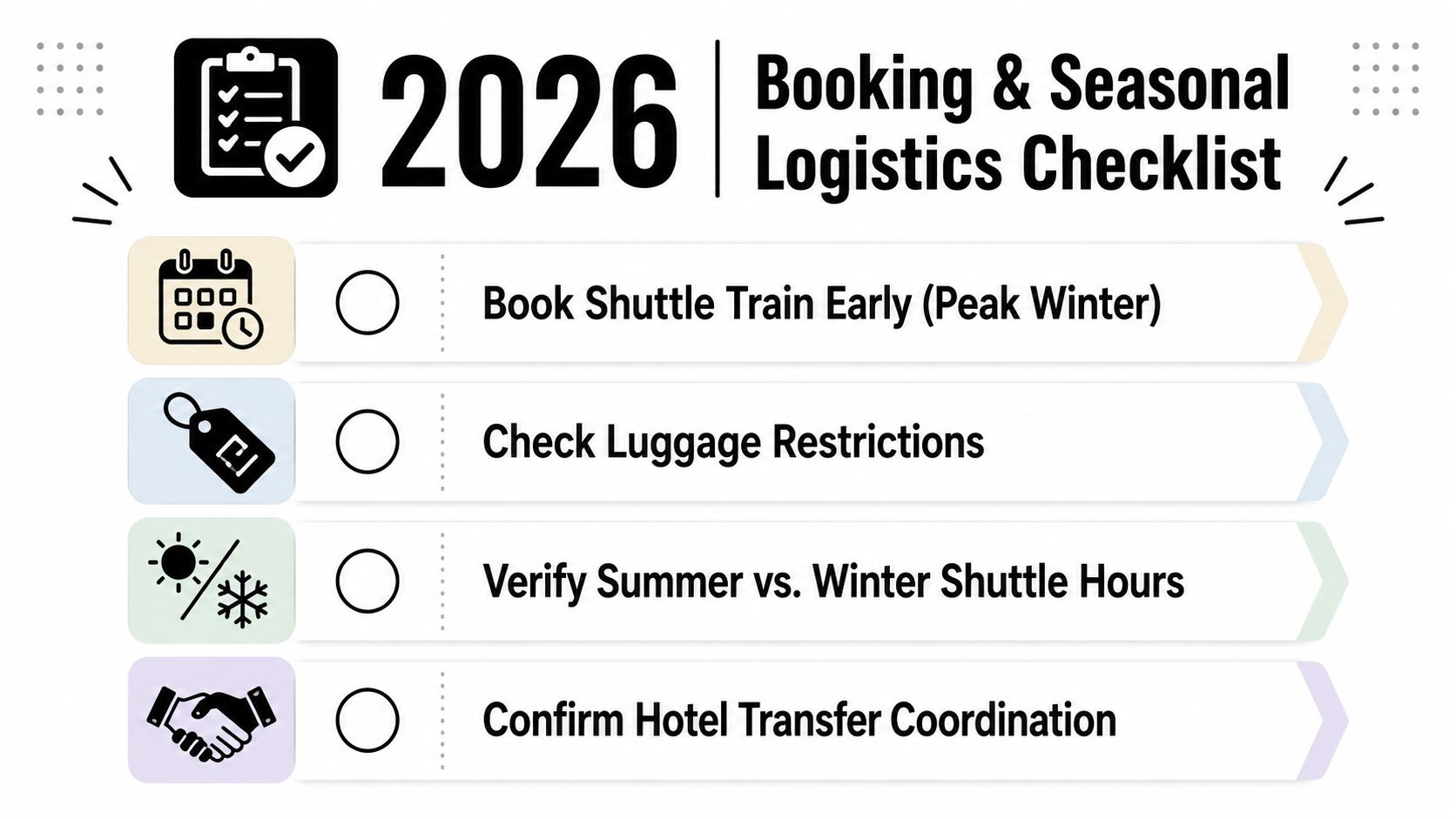
Book the shuttle train early in peak winter weeks. That's the easiest way to protect yourself from a weak final connection, because the mountain leg becomes the bottleneck when everyone else is trying to reach the resort at once. If you're bringing ski bags or bulky luggage, don't leave the platform plan to chance.
What to lock down before you fly
- Book the shuttle train early in peak winter: Secure the last public segment before you land, so you're not improvising after baggage claim.
- Check luggage restrictions: Heavy skis, poles, and oversized bags change how easy the transfer feels.
- Verify summer versus winter shuttle hours: Seasonal service affects late arrivals and same-day connections.
- Confirm hotel transfer coordination: Your hotel should already know whether you're arriving by rail, car, or helicopter.
The winter versus summer experience is not just about scenery. Winter brings more baggage, more schedule pressure, and more reason to avoid casual arrival planning. Summer is easier, but the same logic still applies, because the village is still car-free and the final move still matters.
Helicopter bookings need extra discipline around the heliport's operating windows of 08:00–12:00 and 13:30–18:00 local time (ACUKWIK airport information for LSEZ). If you want rotor transfer, don't build a plan that assumes the aircraft can wait around. Build buffer time instead.
For private aviation, the smartest approach is to coordinate the charter, the helicopter, and the hotel transfer as one itinerary. That's especially true if you're using an empty-leg repositioning opportunity or a short European hop into the region. The savings from a clever flight are wasted if the final leg is messy.
If you want Zermatt handled properly, don't start with the mountain and work backward. Start with the whole arrival chain, then choose the airport that makes each handoff cleaner. That's how you turn a complicated resort transfer into a controlled luxury arrival.
If you want a Zermatt arrival planned without guesswork, Haute Jets can source the right aircraft, coordinate the private terminal, and align the helicopter or ground transfer so the whole trip runs on one timeline. Visit Haute Jets and have the itinerary built around the gateway that fits your arrival, not just the one that looks closest on paper.