
You’re probably looking at a trip where the clock matters more than the ticket. A same-day meeting in another state. A board session that starts before the airlines can get you there comfortably. A family office move where privacy, schedule control, and airport access matter as much as cabin comfort.
That’s where the bombardier learjet 60 still earns its place. It isn’t the right answer for every mission, and experienced charter clients should be wary of anyone who presents it that way. But for the right trip, it remains one of the most purposeful midsize jets in the market: fast, high-flying, efficient for its class, and especially compelling when the mission is built around time.
What separates the Learjet 60 from a lot of midsize options is that it feels designed around urgency. It was built for clients who want to get up high quickly, stay above a lot of the weather and traffic, and cover serious ground without stepping up into a larger, more expensive cabin class. If you’re comparing aircraft for a practical trip rather than shopping by brand name, that distinction matters.
The Enduring Appeal of the Learjet 60
A common charter request goes like this: four executives need to leave the Northeast after breakfast, work in flight, land close to the meeting, and be home the same evening if the schedule holds. For that kind of mission, the Learjet 60 has long made sense because it prioritizes what matters most on business travel. Speed, climb, and enough cabin comfort to keep the day productive.
The aircraft built its reputation on being a midsize jet that behaves with more urgency than many peers. Clients often notice the result before they care about the engineering. The flight gets up quickly, settles into cruise efficiently, and feels like a machine designed to keep a schedule moving. That’s why the model still comes up in serious charter conversations, especially among travelers who know they don’t need a larger cabin to solve a transport problem.
There’s also a reason the Learjet name still carries weight. The 60 sits at the end of the classic Lear lineage, and that legacy shows in the way the airplane performs. If you want background on where it fits in the family, Haute Jets’ look at the top five Learjet models gives useful context.
Why clients still ask for it
The appeal usually comes down to a few practical points:
- Time-sensitive trips: The Learjet 60 suits missions where shaving time from climb and cruise matters more than having the tallest cabin.
- Executive groups: It fits the common charter profile well, a smaller group that wants privacy and pace rather than excess space.
- Transcontinental intent: It has the legs for many serious U.S. missions, depending on passenger load, weather, and airport conditions.
The Learjet 60 is rarely chosen by accident. People book it because they want a midsize jet that behaves like a fast business tool.
That’s the frame to keep in mind through the rest of the guide. This aircraft creates real value when the mission matches its strengths. It becomes a compromise when clients expect it to do jobs better handled by a wider-cabin or stronger short-field platform.
Understanding the Learjet 60 Performance Profile
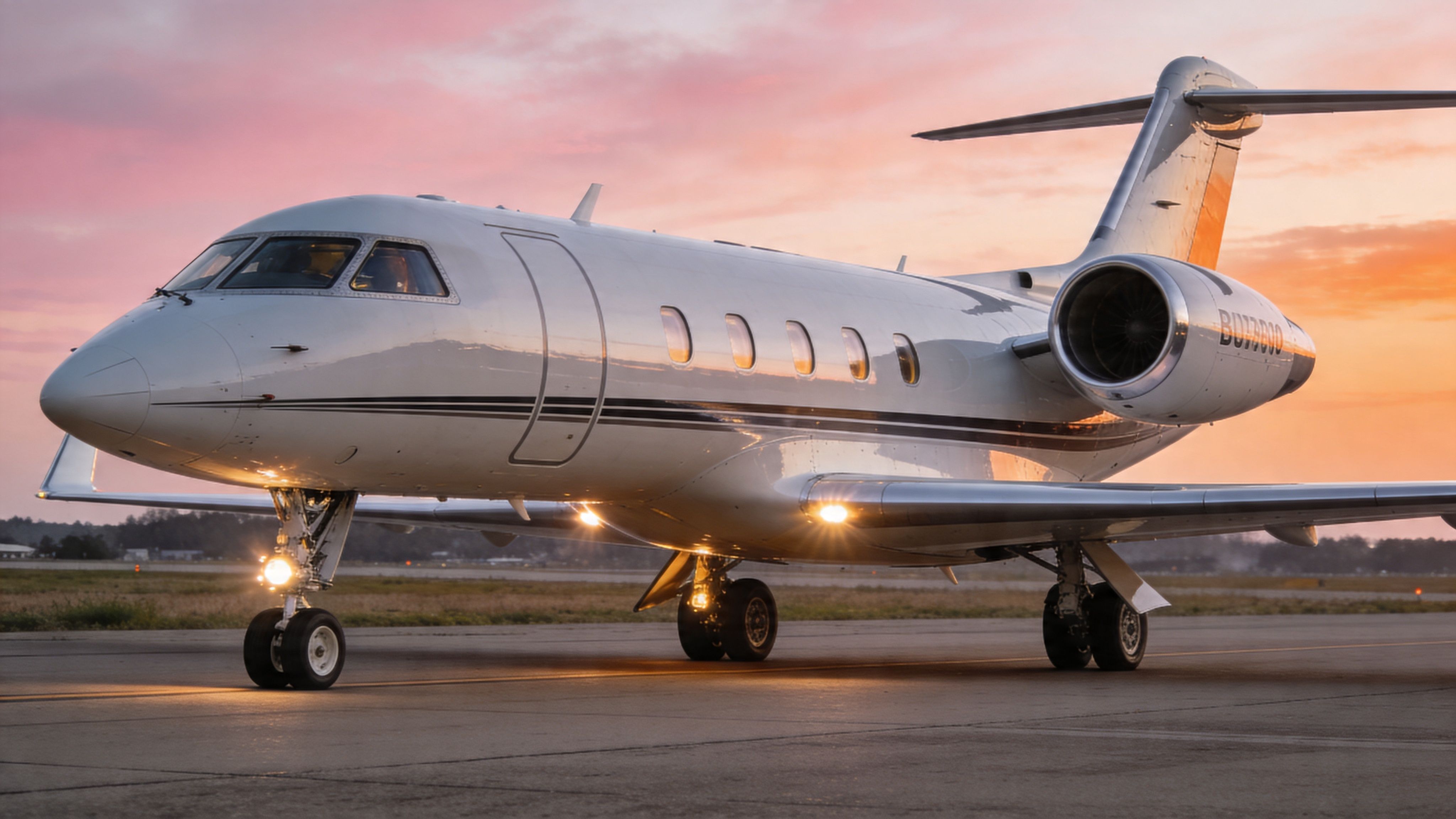
A client needs to leave Teterboro after lunch, clear weather on the East Coast is turning into summer buildup over the Midwest, and the priority is reaching a meeting with as little wasted time as possible. That is the kind of trip where the Learjet 60 earns its keep. Its design history explains why it still shows up in charter discussions years after production ended. The Learjet 60 reference profile notes that the model was announced in 1990, entered service in 1993, and finished production in 2007.
Why the design still matters
The 60 replaced the Learjet 55C, but a key aspect is how Bombardier kept the classic Lear priorities intact. This is a speed-focused airframe with aerodynamic refinements and a wing lineage tied to the old Bill Lear playbook. For charter clients, that engineering choice matters because it shapes the mission more than the brochure.
The Learjet 60 was built to climb quickly, cruise fast, and make efficient use of a midsize charter budget on trips where time matters. It was not built to be forgiving in every airport environment. That trade-off is part of the value proposition, and part of the limitation.
Engines, climb, and what passengers actually feel
Powered by two Pratt & Whitney Canada PW305A engines, the Learjet 60 is known for strong climb performance and the ability to reach the flight levels quickly. In practical terms, that usually means less time in the bumpier lower altitudes and a better chance of getting above traffic and weather sooner.
That helps on real charter days.
If a trip involves ATC congestion, summer convection, or a schedule that cannot absorb a long, inefficient climb, the Learjet 60 has an edge over slower midsize options. Passengers notice that as a shorter path to cruise and, often, a smoother ride once established.
There is a catch. High performance in cruise does not erase runway realities on hot days or at higher-elevation airports. Operators and brokers pay close attention to departure conditions because this aircraft can become weight-sensitive in places such as Aspen, Eagle, or other altitude-affected fields, especially with a full cabin, bags, and meaningful fuel onboard. In those cases, the client may face a fuel stop, a payload restriction, or a different aircraft recommendation. Good charter planning starts there, not after the quote is issued.
Broker view: The Learjet 60 works best when the mission rewards climb and cruise speed more than short-runway flexibility.
Speed in the midsize category
Speed is the reason many buyers and charter clients still care about this airplane. The published cruise figures support that reputation, and in day-to-day charter use the result is straightforward. On stage lengths where clients would otherwise spend extra time in a slower cabin-class jet, the Learjet 60 can shave meaningful time off the day.
That does not make it the automatic answer for every trip. A faster aircraft only creates value if the route, airport pair, and passenger count let it fly the mission efficiently. If the trip starts from a runway-constrained airport, or the group needs maximum bags and no compromises on fuel, some of that speed advantage can disappear in the planning stage.
What the performance profile means for mission fit
The Learjet 60 tends to make financial sense for a specific charter profile: a small executive group, a medium-to-long domestic leg, and airports that do not punish the airplane for heat, elevation, or runway limits.
| Performance trait | What it means in practice |
|---|---|
| Fast cruise | Strong fit for clients who value time saved on 2 to 4 hour sectors |
| Quick climb | Better chance of getting above weather and traffic sooner |
| High operating altitudes | Often a smoother ride and more efficient routing |
| Weight-sensitive at demanding airports | Requires careful planning on hot, high, or shorter-runway departures |
| Performance-first design | Best for clients prioritizing mission speed over cabin volume |
That is the practical read on the Learjet 60. It is a sharp tool for the right assignment. For airport-challenged departures or clients who want fewer payload trade-offs, a different midsize or super-midsize aircraft may be the smarter charter spend.
Inside the Cabin A Passenger-Focused Experience
Board a Learjet 60 for a 2.5-hour business flight with six passengers, and the cabin usually feels right-sized. Everyone has a proper seat, there is enough privacy to talk through a deal or sit undisturbed, and the aircraft still delivers the speed clients are paying for. Book it for a longer leisure trip with passengers who want a stand-up cabin and room to roam, and the compromises show up quickly.
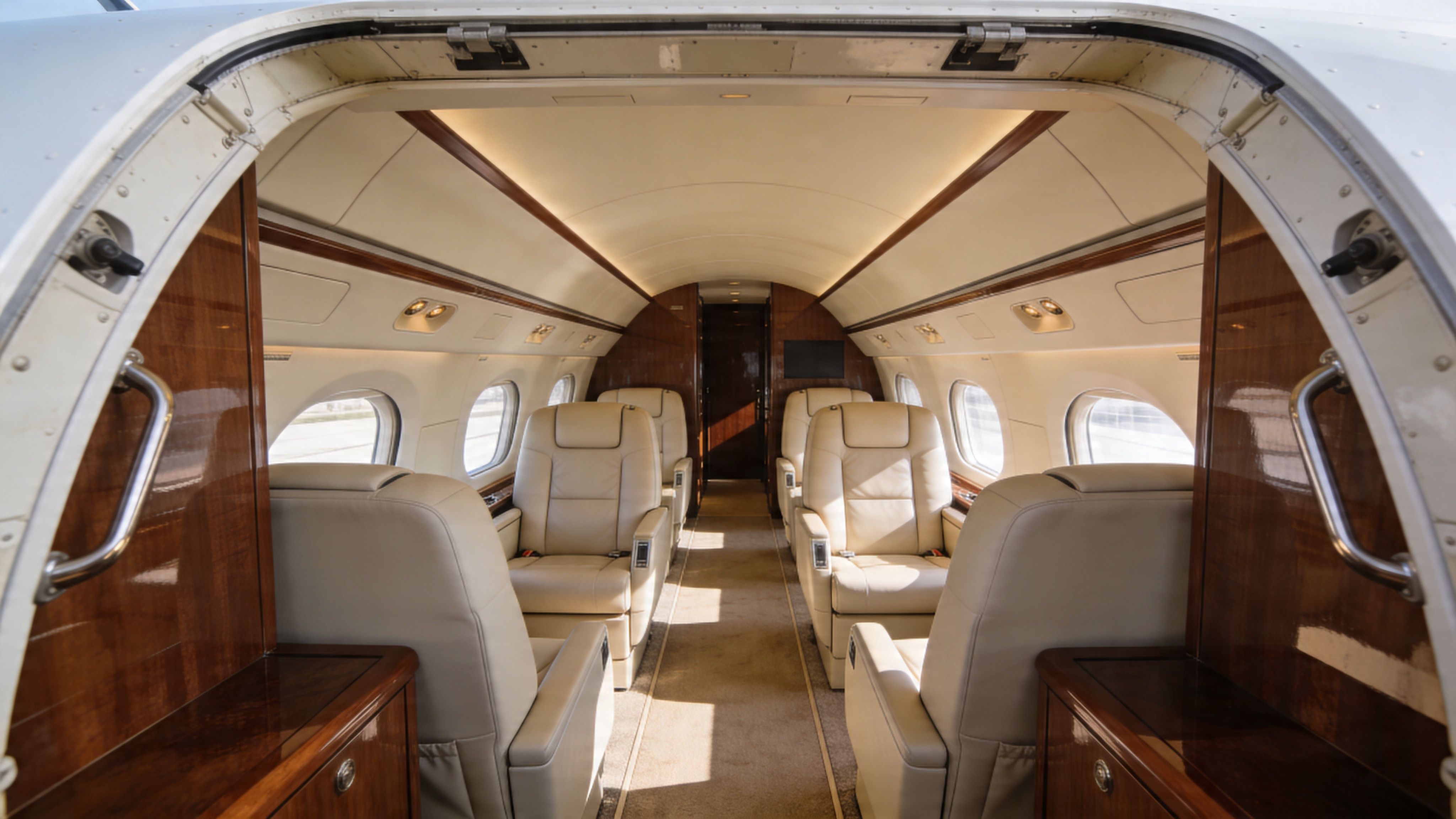
That is the right way to judge the Learjet 60 cabin. It is built for efficient executive travel, not for clients shopping primarily for cabin volume. The interior is typically arranged for a small group in club seating, with a forward galley area and an aft enclosed lavatory. For the right mission, that combination covers the basics well and avoids paying for more aircraft than the trip requires.
What passengers actually notice
Passengers usually notice three things first. The seats are comfortable enough for productive short and mid-length sectors. The cabin supports conversation naturally. The lavatory gives the airplane a level of usability that lighter jets often struggle to match on real charter legs.
The galley matters too, especially on early departures and working flights. Coffee, cold catering, and simple meal service are realistic. Full-service expectations should stay tied to the operator, catering setup, and stage length, because one Learjet 60 can present much better than another depending on refurbishment standard and crew service style.
Noise is another practical point. Some Learjet 60s feel well-kept and quiet for their class. Others show their age. I would always ask for current cabin photos, refurbishment dates, and Wi-Fi details before treating two available Lear 60s as interchangeable.
Where the cabin creates value
The Learjet 60 cabin makes the most sense for passengers who care more about getting somewhere quickly than stretching out in a taller fuselage. That usually includes:
- Executive teams on same-day trips: The cabin supports conversation, laptop work, and a professional arrival without wasted space.
- Small groups on regional or medium-length sectors: Six passengers with normal hand luggage is a comfortable use case.
- Couples or families who want privacy and speed: The aircraft feels private and purposeful without stepping up to a larger jet category.
It is a weaker fit for clients who plan to spend many hours onboard and want the cabin itself to be part of the experience. If the brief includes standing comfort, a wider cross-section, or a more relaxed long-leg leisure environment, I would usually price a midsize cabin-focused jet alongside it before making a recommendation.
The trade-off clients should understand before booking
The Learjet 60 gives you a proper business jet cabin, but it does not give you cabin abundance. That trade-off is often worth it. Charter clients who choose this aircraft well are usually buying time savings, private-terminal convenience, and enough comfort to arrive ready to work.
A walk-through helps more than any spec sheet, so if you want to get a sense of the interior experience, this cabin video is useful before comparing tail numbers:
Cabin quality on a Learjet 60 is less about the model in theory and more about the specific aircraft, year, interior refresh, and operator standards.
That is why experienced charter clients ask for tail-specific details, not just Learjet 60 availability. The model sets the baseline. The actual passenger experience depends on how that specific aircraft has been maintained, updated, and staffed.
Mission Critical Numbers Range Speed and Payload
A client asks whether the Learjet 60 can take six passengers from Teterboro to Aspen in winter, nonstop, with ski bags. That is the right way to assess this aircraft. Mission first, brochure second.
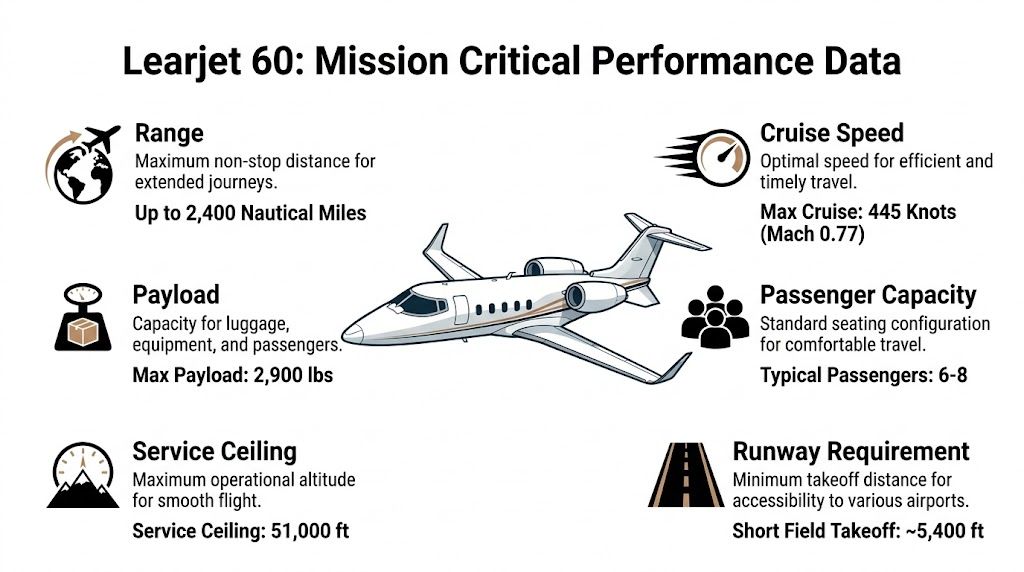
On paper, the Learjet 60 is still a fast, capable light-midsize business jet with enough range to cover many U.S. city pairs efficiently. In actual charter planning, the useful question is narrower. How much speed and range do you still have after you account for passengers, bags, temperature, runway elevation, and the reserve fuel the operator is comfortable carrying?
That answer changes by mission.
The range clients should actually plan around
Published range numbers for the Learjet 60 are respectable, and for a small passenger load they are meaningful. But I would not sell this aircraft on brochure range alone, especially for clients trying to avoid a fuel stop on a longer domestic trip.
The Learjet 60 is often a strong fit for routes like South Florida to the Northeast, Texas to either coast on the right day, or regional missions where climb and cruise speed save real time. It becomes less forgiving when you combine a full cabin, heavier baggage, adverse winds, and an airport with runway or altitude penalties. That is where clients can get caught by optimistic assumptions.
Aspen, Eagle, Telluride, Truckee, and similar destinations deserve a harder look. The Learjet 60 performs well for its class, but high-altitude airports and shorter runways can force payload restrictions or a stop you were hoping to avoid. Other guides tend to skip that part because the headline range number looks cleaner than the operational reality.
Key specifications that matter most
For charter buyers, a few numbers matter because they shape cost and flexibility, not because they look good in a table.
| Metric | Value |
|---|---|
| Maximum takeoff weight | 23,500 lb (10,659 kg) |
| Empty weight | 14,640 lb (6,641 kg) |
| Maximum payload | 2,228 lb |
| Fuel capacity | 7,910 lb |
| Best cruise speed | 465 KIAS (Mach 0.81) |
| Long-range cruise | 453 knots (839 km/h) |
| Range with 4 passengers and 2 crew | 2,405 nautical miles (4,454 km) |
| Cabin volume | 447 cubic feet |
| Typical seating | 6 to 9 passengers plus 2 crew |
| Fuel burn | 203 to 231 GPH |
Those figures are useful as a baseline. They are not a promise of what every trip will do.
How payload changes the charter quote
Payload is where the Learjet 60 separates smart bookings from expensive ones. A six-passenger executive trip with normal carry-ons is one conversation. Eight adults with hard-sided luggage, golf clubs, or ski equipment is another.
Every extra pound affects options. You may give up nonstop range. You may need to depart with less fuel and plan a tech stop. You may find that a larger midsize jet, even at a higher hourly rate, produces a cleaner total mission because it avoids the stop and carries the load without compromise. Clients who want a better sense of how these variables shape trip pricing should review this breakdown of private jet charter flight cost factors.
This is why I treat the Learjet 60 as a precision tool. Match it to the right load and route, and it offers serious value. Push it outside that envelope, and the economics can turn against you quickly.
If your trip requires every seat, meaningful baggage, and a demanding airport at either end, verify the payload-range trade before you approve the quote.
Speed and fuel use in context
The Learjet 60 keeps winning charter work because it is quick. Clients feel that in the schedule. Shorter block times can offset part of the hourly rate, especially on business itineraries with multiple legs or a same-day return.
Fuel burn is reasonable for the performance, but speed does not make it automatically cheap. Operators still have to price maintenance exposure, repositioning, airport charges, and the realities of an aging fleet. The model can be cost-effective. It is cost-effective only when the mission suits the aircraft.
Jetcraft’s Learjet 60 overview is directionally helpful on the efficiency story, especially when comparing the standard aircraft with the 60XR. For charter clients, the practical takeaway is simple:
- You are paying for fast point-to-point travel, not extra cabin volume
- The aircraft works best with a modest passenger count and disciplined baggage
- Airport environment matters more than many online guides admit
The numbers that usually decide the booking
In live trip planning, four questions usually settle it:
- How many people are flying?
- How much baggage is really going?
- Are either of the airports hot, high, short, or operationally restrictive?
- Is avoiding a fuel stop worth paying for a larger aircraft?
If those answers are favorable, the Learjet 60 is often one of the sharper charter choices in its category. If they are not, the right move is usually to change aircraft early instead of trying to force the mission to fit the jet.
The True Cost of Chartering a Learjet 60 in 2026
The hardest part of pricing a Learjet 60 charter isn’t finding a nominal hourly number. It’s explaining why that number rarely tells the whole story. Clients who buy private aviation intelligently don’t focus on an advertised rate in isolation. They focus on total mission cost, operator quality, and the probability that the flight runs exactly as planned.
That matters even more with an aging fleet type. The Learjet 60 is often described as cost-efficient, and there’s truth in that. But older airframes only stay cost-effective when the operator manages maintenance, dispatch reliability, crew standards, and parts planning properly.
What really makes up the charter price
A real charter quote usually includes several moving pieces:
- Aircraft time: The obvious base component, tied to flight duration and mission structure.
- Fuel exposure: Particularly relevant when fuel conditions shift after quote issuance.
- Airport and handling charges: These vary by airport, traffic level, and service environment.
- Crew logistics: Overnight stays, positioning, and duty planning can affect the total.
- Repositioning: Often the least understood line item by first-time charter clients.
The repositioning point is where many clients overpay. If the aircraft has to fly in empty before your departure, you’re often absorbing cost for a jet you never sat on.
Why maintenance reality matters in the quote
The Learjet 60 has real maintenance advantages, but those advantages are meaningful only in the hands of disciplined operators. One example is the brake system. The aircraft’s triple-disc brakes have a 5 to 6 times longer overhaul interval than earlier two-disc systems, as noted in the Learjet 60 operating cost discussion.
That doesn’t make every Learjet 60 cheap to operate. It means a well-run aircraft can deliver reliability benefits that show up in fewer disruptions and more predictable dispatch. That reliability is part of what you’re paying for when a quote comes from a serious operator.
A low quote on an older midsize jet can be expensive if it buys uncertainty. In charter, dispatch confidence has value.
The pricing traps discerning clients avoid
Experienced clients usually ask different questions than first-time flyers. They want to know:
- Where is the aircraft based?
- Is this tail already nearby, or am I paying to bring it in?
- What standards does the operator meet?
- What cabin condition am I buying?
- What happens if the mission changes same day?
That’s a more nuanced way to evaluate the Learjet 60 because the fleet is mature. Condition, maintenance culture, and operator discipline can vary meaningfully.
For readers comparing quote structure, Haute Jets’ guide on how much a private jet charter flight costs is a useful reference because it frames charter pricing as a full-trip calculation rather than a simplistic hourly figure.
What works and what doesn’t
What works well in Learjet 60 charter pricing is matching the aircraft to missions where its efficiency and speed offset the fact that it’s an older platform. A sensible domestic business trip for a smaller group often fits that profile.
What doesn’t work is forcing it into missions that create hidden cost. High-repositioning scenarios, runway-limited destinations, and passenger loads that push the aircraft toward operational compromises can erase the value quickly.
A prudent buyer treats the Learjet 60 the same way a good broker does. As a high-performing midsize aircraft with real strengths, and with cost discipline that depends heavily on aircraft-specific quality.
Ideal Missions and Common Aircraft Alternatives
A typical Learjet 60 win looks like this. Four executives need to get from the Northeast to South Florida, or from Chicago to the West Coast, with as little day lost to travel as possible. In that profile, the aircraft earns its keep. It is fast, it carries a small group comfortably, and it often makes more sense than paying for a larger cabin you will not fully use.
That does not make it a universal answer.

Missions where the Learjet 60 makes sense
The best Learjet 60 trips usually share the same traits. Moderate passenger count. A route long enough for speed to matter. Airports with decent operating margins.
Good examples include:
- Coast-to-coast or near transcontinental business travel for 3 to 5 passengers: In this context, the Learjet 60 justifies its charter rate. You are buying time as much as transportation.
- Regional U.S. trips where same-day productivity matters: For clients doing two meetings in two cities, its cruise speed has real value.
- Caribbean and similar premium leisure trips from suitable mainland gateways: The cabin works well for couples, families, or small executive groups who want privacy without moving into a larger category.
I usually steer clients toward the Learjet 60 when they care more about getting there quickly than having the widest cabin in the midsize field. That is the mission fit.
For shorter sectors, especially where airport flexibility matters more than outright speed, our guide to light jets for short and mid-range business travel gives a useful comparison point.
Where the Learjet 60 can become the wrong choice
The weak spot is easy to miss if you only compare brochure numbers. Hot-and-high airports can turn a good quote into a poor operating fit.
Aviation Week’s Learjet 60 operational review notes that takeoff distance rises sharply at higher-elevation airports on warm days. For charter clients, that matters in places like Aspen, Eagle, Reno, or summer departures from mountain airports. Add passengers, bags, and fuel, and the trip may require a payload compromise, a fuel stop, or a different aircraft entirely.
That is where charter cost changes in practice. A lower hourly number means little if the airplane cannot carry the mission cleanly.
Use extra care if the trip includes:
- mountain airports
- short runways
- hot-weather departures
- a full passenger load with significant baggage
In those cases, check the airport first. Then choose the aircraft.
How it compares with common alternatives
The Learjet 60 usually sits in a practical comparison set with the Citation XLS+, Hawker 800XP, and smaller super-midsize jets. Each solves a different problem.
| Aircraft type | Where it may beat the Learjet 60 | Where the Learjet 60 may still win |
|---|---|---|
| Citation XLS+ | Better airport flexibility, easier cabin access, strong fit for shorter legs | Faster cruise profile on missions where time matters more than cabin cross-section |
| Hawker 800XP | More cabin width and a roomier feel for passengers spending longer onboard | Quicker overall character for clients who prioritize speed and efficient stage lengths |
| Larger midsize or super-midsize jets | More baggage room, more cabin comfort, more operational margin on demanding missions | Lower trip cost when the mission is well within the Learjet 60’s sweet spot |
This is the trade-off clients should understand. The Learjet 60 is often the sharper tool for a small group flying a straightforward, time-sensitive mission. Once the trip starts asking for short-field performance, extra luggage volume, or more cabin comfort for six to seven passengers, the value case weakens.
A clean decision framework
Choose the Learjet 60 when these conditions line up:
- The group is small enough that cabin volume is not the main buying factor.
- The airports are operationally friendly.
- The mission does not require heavy bags, difficult runway performance, or extra payload margin.
Pass on it when the itinerary pushes into hot-and-high conditions, runway limitations, or a passenger and baggage mix that forces trade-offs. That is usually the point where another aircraft costs more on paper but works better in practice.
Booking Your Learjet 60 with Confidence and Control
A smart Learjet 60 booking starts with aircraft specificity. Not just category, not just “midsize,” and not just a price point. On a mature fleet type, the actual tail number matters. Interior condition matters. Avionics fit matters. Operator standards matter. Small details have an outsized effect on how the trip feels and whether it runs cleanly.
That means the booking process should feel less like buying a seat and more like commissioning a mission. The more control you have up front, the fewer surprises you’ll absorb later.
The booking process that protects the client
A disciplined process usually looks like this:
- Define the mission
Passenger count, baggage profile, airport pair, schedule rigidity, and whether the route includes any operational constraints. Defining the mission based on these factors avoids many poor aircraft choices.
- Review specific aircraft, not generic availability
On the Learjet 60, one aircraft may have a fresher cabin, a different interior layout, or a more current onboard setup than another.
- Confirm operator quality
For an aging midsize jet, operator discipline is part of the product. Safety standards and dispatch culture shouldn’t be assumed.
- Lock in cabin and service details
Wi-Fi expectations, catering, pet policy, baggage handling, and ground transport should all be addressed before the trip is confirmed.
Why local sourcing matters
One of the most expensive mistakes in on-demand charter is paying for aircraft repositioning that could have been avoided with better sourcing. The publisher’s operating model is relevant here because Haute Jets states that it sources aircraft locally through a network of 3,500+ vetted aircraft, with a focus on reducing repositioning and using Wyvern Wingman, Argus Gold/Platinum, or IS-BAO-rated operators. Those are product facts from the publisher background you provided, and they’re useful because they point to the right booking principle: source the right aircraft near the departure city whenever possible.
That’s especially important on a Learjet 60. A platform that can look cost-efficient on paper loses its edge fast if the tail has to travel significantly before your trip even starts.
What clients should insist on before departure
Before the flight is finalized, ask for clarity on these points:
- Exact aircraft details: Year, cabin condition, and configuration.
- Crew and operator information: Enough to assess professionalism and trip readiness.
- Airport suitability: Particularly important on any mission involving heat, elevation, or runway constraints.
- Full preflight confirmation: Tail number, schedule, and service details should be settled in writing.
The right booking process gives you operational certainty, not just a reservation.
Control matters more on older fleet types
The bombadier learjet 60 remains a strong charter aircraft because its strengths are still real. But it rewards disciplined buying. Clients who treat it like a commodity often get a commodity experience. Clients who book it with care usually get what the aircraft has always promised: a fast, efficient, purposeful private jet that can move a small group very well on the right mission.
That’s the standard to hold. Choose the aircraft for the trip, verify the details that affect the day, and don’t confuse a low headline rate with a good charter decision.
If you’re evaluating a Learjet 60 for an upcoming trip, Haute Jets offers on-demand charter access without memberships or jet cards, with aircraft-specific sourcing, local operator matching, and pre-flight confirmation details that help you compare the actual mission, not just the category.