Last updated November 20, 2026 · By Seth Semilof
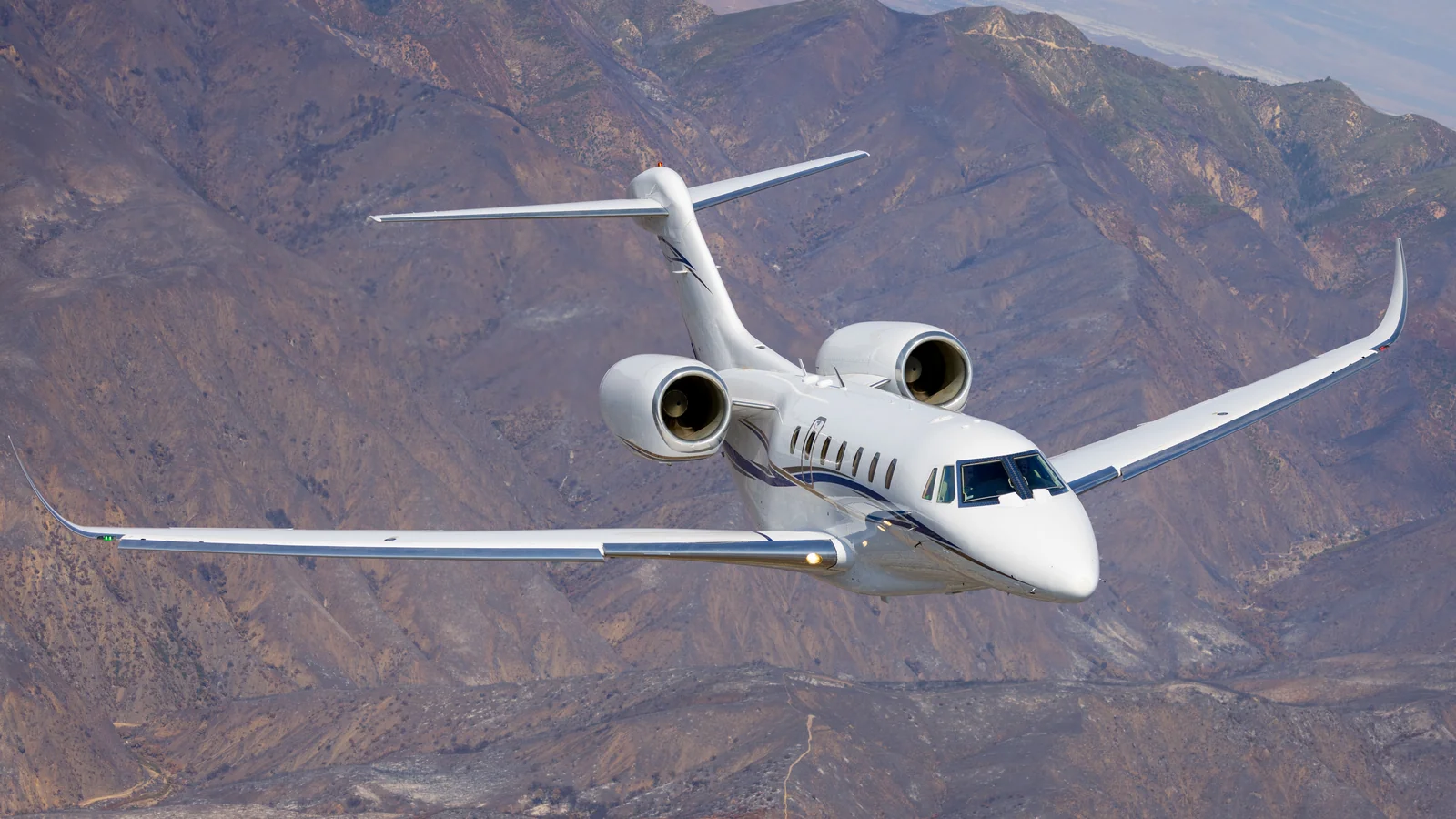
What the Learjet 75 is
The Learjet 75 is a light business jet on FAA Type Certificate Data Sheet T00008WI. The data sheet lists it as Model 45 with the commercial designation Learjet 75, serial numbers 45-456 through 45-2000, approved November 13, 2013. It is in the same type certificate as the Learjet 45, Learjet 40 and Learjet 70. Those names are commercial designations for different serial blocks of Model 45, not separate type certificates.
Two Honeywell TFE731-40BR-1B turbofan engines power the Learjet 75. The TCDS lists takeoff and automatic power reserve (APR) static thrust of 3,850 pounds each, standard day, sea level, with a five-minute limit in all-engines-operating takeoff (ten minutes with one engine inoperative). Minimum crew is two: a pilot and a copilot. Bombardier’s 2017 Learjet 75 factsheet lists Garmin G5000 avionics with three 14-inch displays. The TCDS notes that the Learjet 75 and Learjet 70 use integrated, software-based avionics (Note 16) and that the 75 is defined by Learjet engineering drawing 4500080801 for the serials above (Note 6).
Bombardier’s 2021 financial report states that the company “is ending the production of the Learjet aircraft in 2022, as announced in the beginning of 2021.” The 2022 financial report states that Bombardier “delivered its last Learjet aircraft in the first quarter of 2022.” Existing tails remain in charter. Production status does not change the certificated limits on a given airplane. Confirm the serial number and the installed interior on the aircraft in your quote.
This review uses Bombardier and FAA figures only. When a factsheet number and a TCDS limit could be confused, the TCDS is the certificated limit, and the factsheet is cited as Bombardier’s published performance, with its footnotes. For earlier Learjet models see our Learjet 45 review and our Learjet 60 charter guide. The fleet page is /aircraft/learjet-75. To compare the 75 with a Phenom 300 on a short route, see Learjet 75 vs Phenom 300. Request a quote for a specific trip.
Learjet 75 official specs
The table below separates certificated limits (TCDS T00008WI, Revision 34, June 8, 2026) from Bombardier’s 2017 factsheet. The factsheet states that specifications are approximate and subject to operating rules and assumptions. Do not treat a factsheet range as a guaranteed passenger-mission range.
| Item | FAA TCDS T00008WI (Learjet 75, Model 45) | Bombardier Learjet 75 factsheet (2017) |
|---|---|---|
| Type certificate and approval | T00008WI, Model 45 (Learjet 75), S/N 45-456 through 45-2000, approved November 13, 2013 | Not a certification document |
| Engines | Two Honeywell TFE731-40BR-1B; takeoff and APR static thrust 3,850 lb each, standard day, sea level | Honeywell TFE731-40BR, 3,850 lbf, flat rated to ISA + 23°C, sea level |
| Crew and seats | Minimum crew 2; number of seats 11 (2 pilots, 9 passengers) | Passengers: up to 9 |
| Airspeed limits | Vmo 330 KIAS, sea level to 26,756 ft; Mmo Mach 0.81 above 26,756 ft | Top speed Mach 0.81; high-speed cruise Mach 0.79; typical cruise Mach 0.76 |
| Range | Not published as a mission range on the TCDS; use the AFM for the airplane | Maximum range 2,040 nm / 3,778 km; footnote (1): theoretical range with NBAA IFR reserves, ISA, long-range cruise, 4 passengers and 2 crew. Actual range varies with speed, weather, options and other factors |
| Maximum operating altitude | 51,000 ft | 51,000 ft; initial cruise altitude at maximum takeoff weight 45,000 ft |
| Weights | Ramp 21,750 lb; takeoff 21,500 lb; landing 19,200 lb; zero fuel 16,000 lb (16,500 lb with SB75-11-01); minimum flight weight 14,000 lb. The TCDS says maximum weights vary with serial numbers and modifications; see the AFM | Maximum ramp weight 21,750 lb; maximum takeoff weight 21,500 lb; maximum landing weight 19,200 lb; maximum zero-fuel weight 16,500 lb; basic operating weight 13,890 lb; maximum fuel weight 6,062 lb |
| Fuel | Usable 905 gallons, 6,062 lb | Maximum fuel weight 6,062 lb |
| Cabin | No cabin length, width or height on the TCDS | Height 4 ft 11 in; width 5 ft 1 in; length 19 ft 10 in, footnote (2): from the cockpit divider to the aft-most cabin, without the baggage compartment |
| Airfield performance | Not published as a takeoff or landing distance on the TCDS; use the AFM | Takeoff distance 4,440 ft, sea level, ISA, maximum takeoff weight; landing distance 2,325 ft, sea level, ISA, typical |
The factsheet’s 16,500 lb maximum zero-fuel weight matches the TCDS figure for airplanes modified with SB75-11-01. Unmodified airplanes are listed on the TCDS at 16,000 lb. Ask which applies to the tail on the quote.
Range and speed: what the official numbers mean
Bombardier lists a maximum range of 2,040 nautical miles. That figure is a theoretical long-range-cruise range with four passengers, two crew, NBAA IFR reserves and ISA conditions. It is not a typical charter payload, and it is not a promise that a given trip will be nonstop. Winds, reserves, runway, passenger and baggage weight, and the installed options all move the real number. On a quote, ask the operator for a flight plan on that tail, with your passenger count and bags, not a brochure maximum.
The TCDS airspeed limits are Vmo of 330 KIAS from sea level to 26,756 feet and Mmo of Mach 0.81 above that altitude. The factsheet’s “top speed” of Mach 0.81 is the same Mach number as Mmo, which is the certificated maximum operating Mach number, not a typical cruise setting. The factsheet separately lists high-speed cruise at Mach 0.79 and typical cruise at Mach 0.76. Use those cruise figures, not Mmo, when you are thinking about a passenger trip. The AFM for the serial number is the document the crew uses for the actual limits that day.
On the factsheet basis, 2,040 nautical miles covers many East Coast–Midwest and East Coast–South routes in still air. It does not automatically cover every coast-to-coast city pair with a full cabin and a winter headwind. If the trip is long, westbound or heavy, we will say so on the quote and, if needed, compare a fuel stop or a different aircraft. Request a quote with the origin, destination, date and headcount.
Cabin, seats and baggage
Bombardier’s factsheet lists a cabin 4 feet 11 inches high, 5 feet 1 inch wide, and 19 feet 10 inches long, measured from the cockpit divider to the aft-most cabin and excluding the baggage compartment. At 4 feet 11 inches, many adults will stoop in the aisle. That is the official cabin, not a marketing comparison with other types.
The TCDS lists 11 seats: two pilots and nine passengers. The factsheet lists “up to 9” passengers. Note 13 on the same data sheet states a maximum of 10 occupants (two crew, eight passengers) and identifies an optional Learjet 40-configuration floor plan. The layout on a charter tail is often eight seats in a double-club, but that is a typical arrangement, not a TCDS mandate. Confirm the floor plan, seat count and whether there is a pocket door on the specific aircraft.
The TCDS does not publish baggage volume in cubic feet. It does publish maximum baggage weights: 170 pounds in the cabin at arm 425 inches, and 500 pounds in the tail compartment at arm 544 inches, with a floor loading density of 75 pounds per square foot. This review does not invent a cubic-foot figure. If bag count or ski or golf equipment matters, tell us on the quote and we will confirm allowance on that tail.
The 2021 financial report describes the Learjet 75 Liberty as a light business jet offered in a six- or eight-seat configuration, with a pocket door between the cockpit and cabin. The TCDS does not use the name Liberty. Treat Liberty as a Bombardier sales designation and interior/equipment specification on a Learjet 75, and confirm the actual cabin on the serial you are quoted, rather than assuming every 75 is a Liberty layout.
Learjet 75 vs Learjet 45
The Learjet 45 and Learjet 75 are both Model 45 airplanes on TCDS T00008WI. The certificated differences that identify them are the serial block, the approval date and the engines. The Learjet 40 and Learjet 70 are further serial blocks on the same data sheet (Note 6: 40 is 45-2001 through 45-2133; 70 is 45-2134 through 45-4000). This table does not invent range or cabin figures for the earlier types.
| Item | Learjet 45 | Learjet 75 |
|---|---|---|
| TCDS designation | Model 45 (Learjet 45) | Model 45 (Learjet 75) |
| Serial block (TCDS Note 6) | 45-002 through 45-455 | 45-456 through 45-2000 |
| Approval date (TCDS) | September 22, 1997 | November 13, 2013 |
| Engines (TCDS) | Honeywell TFE731-20R, TFE731-20AR or TFE731-20BR-1B, as listed for the configuration | Honeywell TFE731-40BR-1B |
Note 18 records that Learjet 45 serial 45-368 can be in the Learjet 75 configuration when modified to the listed changes, with a related note on serial 45-446. If a tail is a modified 45 rather than a 45-456-and-on production 75, that should appear in the aircraft records and on the quote.
Weights, fuel and airfield numbers
| Item | Official figure | Source and basis |
|---|---|---|
| Maximum ramp weight | 21,750 lb | TCDS T00008WI and the 2017 factsheet |
| Maximum takeoff weight | 21,500 lb | TCDS T00008WI and the 2017 factsheet |
| Maximum landing weight | 19,200 lb | TCDS T00008WI and the 2017 factsheet |
| Zero-fuel weight | 16,000 lb standard; 16,500 lb with SB75-11-01 | TCDS T00008WI; the factsheet lists 16,500 lb |
| Usable fuel | 905 gallons / 6,062 lb | TCDS T00008WI; factsheet maximum fuel weight 6,062 lb |
| Takeoff distance | 4,440 ft | Factsheet: sea level, ISA, maximum takeoff weight. Not a TCDS figure; actual distance depends on weight, temperature, elevation and runway |
| Landing distance | 2,325 ft | Factsheet: sea level, ISA, typical. Not a TCDS figure |
| Cabin baggage limit | 170 lb | TCDS T00008WI, arm 425 inches |
| Tail-compartment baggage limit | 500 lb | TCDS T00008WI, arm 544 inches |
A 4,440-foot takeoff distance at sea level, ISA and maximum takeoff weight is a published factsheet number, not a runway requirement for every airport on every day. Hot, high or shorter runways, or a heavy passenger load, can change the usable field. We confirm the departure and arrival airports against the AFM performance for the tail on the quote.
Charter notes: what to ask before you book
Because Learjet production has ended, the charter 75s you will see are in-service airplanes, not new deliveries. That is normal for this type. Ask for the serial number or year, the engine configuration (TFE731-40BR-1B on a production 75), the avionics fit, the seat count and the baggage arrangement. Ask whether the airplane is a Liberty-specification interior if that matters to you. Ask the operator to run the trip at your actual passenger and bag weight, not at the four-passenger factsheet range case.
We source aircraft from Wyvern- and ARGUS-rated operators. Every trip is quoted individually. The only call to action on this page is to request a quote. We do not publish a generic hourly rate here, because the number depends on the route, dates, positioning, airport fees and how long the airplane sits with you.
If you are comparing the 75 with a Phenom 300 or another light jet, bring both official data sheets to the same trip rather than comparing a factsheet maximum on one type with a different basis on the other. Our Learjet 75 vs Phenom 300 question page is the short comparison; this review stays with Learjet 75 official figures.
Frequently asked questions
How fast is the Learjet 75?
FAA TCDS T00008WI lists Mmo of Mach 0.81 above 26,756 feet and Vmo of 330 KIAS from sea level to that altitude. Bombardier’s 2017 factsheet lists a top speed of Mach 0.81, high-speed cruise of Mach 0.79, and typical cruise of Mach 0.76. Mmo is the certificated maximum operating Mach number, not a typical cruise setting.
What is the range of the Learjet 75?
Bombardier’s 2017 factsheet lists a maximum range of 2,040 nautical miles. The footnote describes that as a theoretical long-range-cruise range with four passengers, two crew, NBAA IFR reserves and ISA conditions. Actual range depends on payload, winds, options and other factors. The TCDS does not publish a mission range; the AFM for the airplane is the operational document.
How many passengers does the Learjet 75 seat?
The TCDS lists 11 seats: two pilots and nine passengers. The factsheet lists up to nine passengers. Note 13 on the same data sheet states a maximum of 10 occupants (two crew, eight passengers) for an optional floor plan. Confirm the layout on the aircraft in your quote.
How big is the Learjet 75 cabin?
Bombardier’s factsheet lists a cabin 4 feet 11 inches high, 5 feet 1 inch wide, and 19 feet 10 inches long, measured from the cockpit divider to the aft-most cabin and excluding the baggage compartment. The TCDS does not publish cabin dimensions.
What engines does the Learjet 75 use?
Two Honeywell TFE731-40BR-1B turbofan engines. TCDS T00008WI lists takeoff and APR static thrust of 3,850 pounds each, standard day, sea level.
Is the Learjet 75 still in production?
No. Bombardier’s 2021 financial report states that the company was ending Learjet production in 2022, and the 2022 financial report states that the last Learjet was delivered in the first quarter of 2022. Existing airplanes remain in charter. Confirm the serial and interior of the tail you are quoted.
What is the difference between a Learjet 75 and a Learjet 45?
Both are Model 45 airplanes on TCDS T00008WI. The Learjet 45 is serials 45-002 through 45-455, approved September 22, 1997, with TFE731-20-series engines as listed. The Learjet 75 is serials 45-456 through 45-2000, approved November 13, 2013, with TFE731-40BR-1B engines. Some earlier serials can be in the 75 configuration when modified, per Note 18.
How much baggage can a Learjet 75 carry?
The TCDS lists maximum baggage weights of 170 pounds in the cabin and 500 pounds in the tail compartment, with a floor loading density of 75 pounds per square foot. It does not publish a baggage volume in cubic feet. Ask for the allowance on the specific aircraft if bag count matters.
Sources
- FAA, Type Certificate Data Sheet T00008WI, Revision 34, June 8, 2026, Learjet Model 45 (Learjet 75, S/N 45-456 through 45-2000, approved November 13, 2013): engines TFE731-40BR-1B at 3,850 lb takeoff/APR static thrust; Vmo 330 KIAS to 26,756 ft and Mmo Mach 0.81 above that altitude; ramp 21,750 lb, takeoff 21,500 lb, landing 19,200 lb, zero fuel 16,000 lb (16,500 lb with SB75-11-01); usable fuel 905 gal / 6,062 lb; seats 11 (2 pilots, 9 passengers); minimum crew 2; maximum operating altitude 51,000 ft; cabin baggage 170 lb and tail-compartment baggage 500 lb; Notes 6, 13, 16 and 18. Hosted copy: openairdocs.org/tcds/T00008WI (FAA DRS is the official file).
- Bombardier, Learjet 75 factsheet, ©2017: passengers up to 9; Honeywell TFE731-40BR, 3,850 lbf, flat rated ISA + 23°C sea level; Garmin G5000 with three 14-inch displays; maximum range 2,040 nm with footnote (1) NBAA IFR reserves, ISA, long-range cruise, 4 passengers and 2 crew; top speed Mach 0.81, high-speed cruise Mach 0.79, typical cruise Mach 0.76; takeoff distance 4,440 ft sea level, ISA, MTOW; landing distance 2,325 ft sea level, ISA, typical; maximum operating altitude 51,000 ft; initial cruise at MTOW 45,000 ft; cabin 4 ft 11 in high, 5 ft 1 in wide, 19 ft 10 in long with footnote (2) from cockpit divider to aft-most cabin without the baggage compartment; exterior length 58 ft 0 in, wingspan 50 ft 11 in, height 14 ft 0 in; weights including ramp 21,750 lb, takeoff 21,500 lb, landing 19,200 lb, zero fuel 16,500 lb, basic operating weight 13,890 lb and maximum fuel 6,062 lb. Hosted copy: basjets.com Learjet 75 factsheet.
- Bombardier, Financial Report 2021, bombardier.com: “Bombardier is ending the production of the Learjet aircraft in 2022, as announced in the beginning of 2021.” Also identifies the Learjet 75 Liberty as a light business jet offered in a six- or eight-seat configuration with a pocket door. PDF: bombardier.com/en/Bombardier-Financial-Report-2021-en.pdf.
- Bombardier, Financial Report 2022, bombardier.com: “Bombardier delivered its last Learjet aircraft in the first quarter of 2022.” PDF: bombardier.com/en/Bombardier-Financial-Report-2022-en.pdf.
- Bombardier, Financial Report 2023, bombardier.com, footnote that Bombardier delivered its last Learjet aircraft in the first quarter of 2022: bombardier.com/en/Bombardier-Financial-Report-2023-en.pdf.
- FAA TCDS T00008WI, Section I, Learjet 45 serials 45-002 through 45-455, approved September 22, 1997, engines TFE731-20R / 20AR / 20BR-1B as listed — used only for the family identification table. Same data sheet as item 1: openairdocs.org/tcds/T00008WI.
- FAA TCDS T00008WI, Note 6: definition of the Learjet 45, 40, 75 and 70 serial blocks, including Learjet 75 as S/N 45-456 through 45-2000 defined by drawing 4500080801. Same data sheet as item 1.
- FAA TCDS T00008WI, Note 13: maximum number of occupants 10 (two crew, eight passengers) and the optional seating configuration reference; read alongside Section III’s listing of 11 seats (2 pilots, 9 passengers) for the Learjet 75. Same data sheet as item 1.
- FAA TCDS T00008WI, Note 16: Learjet 75 and Learjet 70 integrated avionics using software-based line-replaceable units. Same data sheet as item 1.
- FAA TCDS T00008WI, Note 18: Learjet 45 serial 45-368 modified to the Learjet 75 performance modification package, with related configuration notes for treating listed earlier serials as Learjet 75 when modified. Same data sheet as item 1.
- Honeywell engine type certificate E1NM, as referenced on TCDS T00008WI for the TFE731-40BR-1B installation on the Learjet 75. The airplane TCDS is the source for the 3,850 lb thrust rating used in this review.