
You're probably looking at a familiar problem. You need a jet that's fast enough to make private aviation feel worth it, efficient enough that you're not paying for cabin you won't use, and common enough that availability isn't a weekly battle. For a lot of short to mid-range trips, that conversation leads straight to the citation jet 3.
That's not because it's flashy. It isn't.
The CJ3 wins because it's practical. If you need to move a small executive team from New York to Miami, get family to the Bahamas without stepping up to a larger cabin, or handle a same-week business trip with minimal drama, this aircraft sits in a very useful part of the market. It's quick, it climbs well, and it doesn't punish you on cost the way larger jets often do.
That also means it's not for every mission. If you want a stand-up cabin feel, a wide-floor cabin, or a more lounge-like experience for a longer day of travel, this isn't the right tool. But if your priority is efficient private travel with real range and strong dispatch utility, the CJ3 deserves serious attention.
Your Guide to the Citation Jet 3
A client calls on a Wednesday afternoon. They need to leave the New York area the next morning, fly south for meetings, and return the following day. They want to avoid the airline mess, they don't need a giant cabin, and they don't want to pay heavy-jet money for a mission that doesn't require it. That's exactly where the citation jet 3 earns its keep.

The CJ3 is one of those aircraft that experienced charter buyers come back to for a reason. It gives you a real private jet experience without pushing you into an unnecessarily expensive category. It's fast enough to feel efficient. It's compact enough to stay sensible. For travelers who care more about mission fit than bragging rights, that matters.
Why buyers keep coming back to it
Charter clients do not typically book a jet because they want a "light jet." They book because they require a specific result. They want to depart at their chosen time, use a more convenient airport, and avoid wasting hours on the ground. The CJ3 supports that kind of trip well.
It also avoids a common mistake. Some clients automatically move up a category because they assume bigger is better. Often it isn't. On short and mid-range flights, a larger aircraft can mean higher trip cost without a meaningful improvement in the actual usefulness of the mission.
Broker's view: If your trip doesn't require a larger cabin or extra range, paying for one is just waste.
Who should shortlist the CJ3
The CJ3 makes the most sense for travelers who value:
- Efficient nonstop capability on common U.S. business and leisure routes
- A familiar charter platform with broad market presence
- Reasonable cabin comfort for a smaller group
- Better operating efficiency than larger jets on missions that don't justify them
If you're choosing based on utility, not ego, the CJ3 is one of the smartest aircraft in private aviation.
Understanding the CJ3s Market Position
The CJ3 sits in a very specific place in the charter market. It's a light jet, but not an entry-level one in the way many buyers assume. It was built as a more capable version of the CJ2, and that upgrade path is exactly why it still matters.
According to Altivation Aircraft's CJ3 overview, the Cessna Citation CJ3 entered production after its first flight in April 2003, received FAA certification in October 2004, and continued through 2015, with 415 units built. The same source notes that it's an extended version of the CJ2 with a longer cabin, wider wings, and more powerful Williams FJ44-3A engines, and that the majority remain active primarily in North America.
That last point is a big deal in charter. A jet can be excellent on paper and still be inconvenient if there aren't enough of them in active service. The CJ3 doesn't have that problem. It's a known quantity, and the market has enough familiarity with it that buyers, operators, and pilots all know what it does well.
Why the CJ3 became a staple
Cessna didn't reinvent the category with the CJ3. It refined it.
The formula was straightforward. Take a proven CitationJet platform, give it more cabin length, improve the wing, add stronger engines, and create an aircraft that can cover more missions without losing the basic virtues that made the line popular in the first place. That's why the CJ3 has lasted. It wasn't built to impress people on a ramp. It was built to work.
Here's where it fits best in the market:
| Positioning factor | What it means in practice |
|---|---|
| Citation family heritage | Familiar operating profile and broad charter acceptance |
| Light jet category | Lower trip cost than larger cabins on the right mission |
| Strong fleet presence | Better odds of finding one where and when you need it |
| Practical design philosophy | Less glamour, more repeatable utility |
What it is and what it isn't
The CJ3 is not the aircraft you pick to make a visual statement. Clients who want a more spacious cabin experience usually move toward larger Citation models or midsize jets.
But the CJ3 does something more valuable. It covers a wide range of common missions without excess. That makes it one of the most rational aircraft in the on-demand market.
The CJ3's popularity comes from balance. It gives you enough speed, enough range, enough comfort, and enough availability without pushing you into a more expensive mission profile.
That's exactly why seasoned charter buyers take it seriously.
Performance Specs and Flight Capabilities
A client wants Teterboro to Palm Beach on Friday afternoon, home Sunday, no airline friction, no wasted cabin, no oversized charter bill. That is the kind of trip where the CJ3 earns its keep.
The numbers matter because they shape what you can buy intelligently. The CJ3 uses Williams International FJ44-3A engines, offers 5,640 lbf of total thrust, climbs to 45,000 feet in under 25 minutes, carries a published maximum range of 2,040 nautical miles, and typically burns about 166 gallons per hour. In charter terms, that adds up to an aircraft with enough speed and range to cover serious missions while keeping hourly economics in check.
What those specs mean on real trips
Climb performance is one of the CJ3's biggest advantages. A jet that gets to altitude quickly spends more of the trip in its efficient cruise band and has a better chance of getting above weather and traffic. You feel that as less wasted time and fewer compromises in the flight profile.
Range is where buyers either save money or make an expensive mistake. The CJ3 covers a wide share of U.S. missions comfortably and can handle select near-international trips, but only when the route, passenger count, bags, and weather all line up. If your itinerary sits right inside that envelope, the aircraft is a smart buy. If your trip regularly pushes the edge of the range map, you should book up a category and avoid paying for a fuel stop or payload restriction later.
Citation Jet 3 Key Performance Specifications
| Metric | Value |
|---|---|
| Total thrust | 5,640 lbf |
| Service ceiling | 45,000 ft |
| Time to climb | Under 25 minutes |
| Maximum range | 2,040 nm |
| Fuel burn | Approximately 166 gallons per hour |
Where the CJ3 gives you real value
The CJ3 is at its best on trips that are long enough for speed to matter and short enough that a midsize jet would be wasteful.
That usually includes:
- Northeast to South Florida for business or weekend use
- Texas, Southeast, and Midwest regional business flying where schedule control matters more than cabin volume
- South Florida to parts of the Caribbean on the right passenger and baggage profile
- Multi-stop same-day itineraries where operating efficiency and airport access drive value
This is also why charter strategy matters. The same airplane can be a smart purchase on one route and a poor one on another. Haute Jets helps clients avoid that trap by sourcing the right CJ3 mission, not just the nearest available tail. If your route fits the aircraft well, our on-demand model keeps you from paying midsize pricing for light-jet travel. If it does not fit, we will tell you quickly and move you into the right cabin class before the trip gets inefficient.
One more point. Published specs do not tell you how an aircraft will feel against your expectations. If you want context on how cabin category changes the onboard experience, this private jet interior guide is a useful reference before you book.
Runway access, cruise efficiency, and the real tradeoff
The CJ3 has enough performance to avoid the underpowered feel that hurts some light jets in the charter market. That gives it broader day-to-day usefulness, especially for clients who care about short trip times, practical airport options, and repeatable operating cost.
My recommendation is simple. Book the CJ3 when you want efficient coast-adjacent range, fast climbs, and strong value for four to six passengers. Pass on it when you need a roomier cabin, heavier baggage load, or a mission that lives near the edge of the aircraft's range. Trying to make a light jet do a midsize jet's job is how charter buyers overpay.
The Passenger Experience Inside the Cabin
The CJ3 cabin is comfortable if you understand what you're buying. It is not a flying penthouse. It is a clean, efficient business jet cabin that works well for the kinds of trips this aircraft is built to fly.
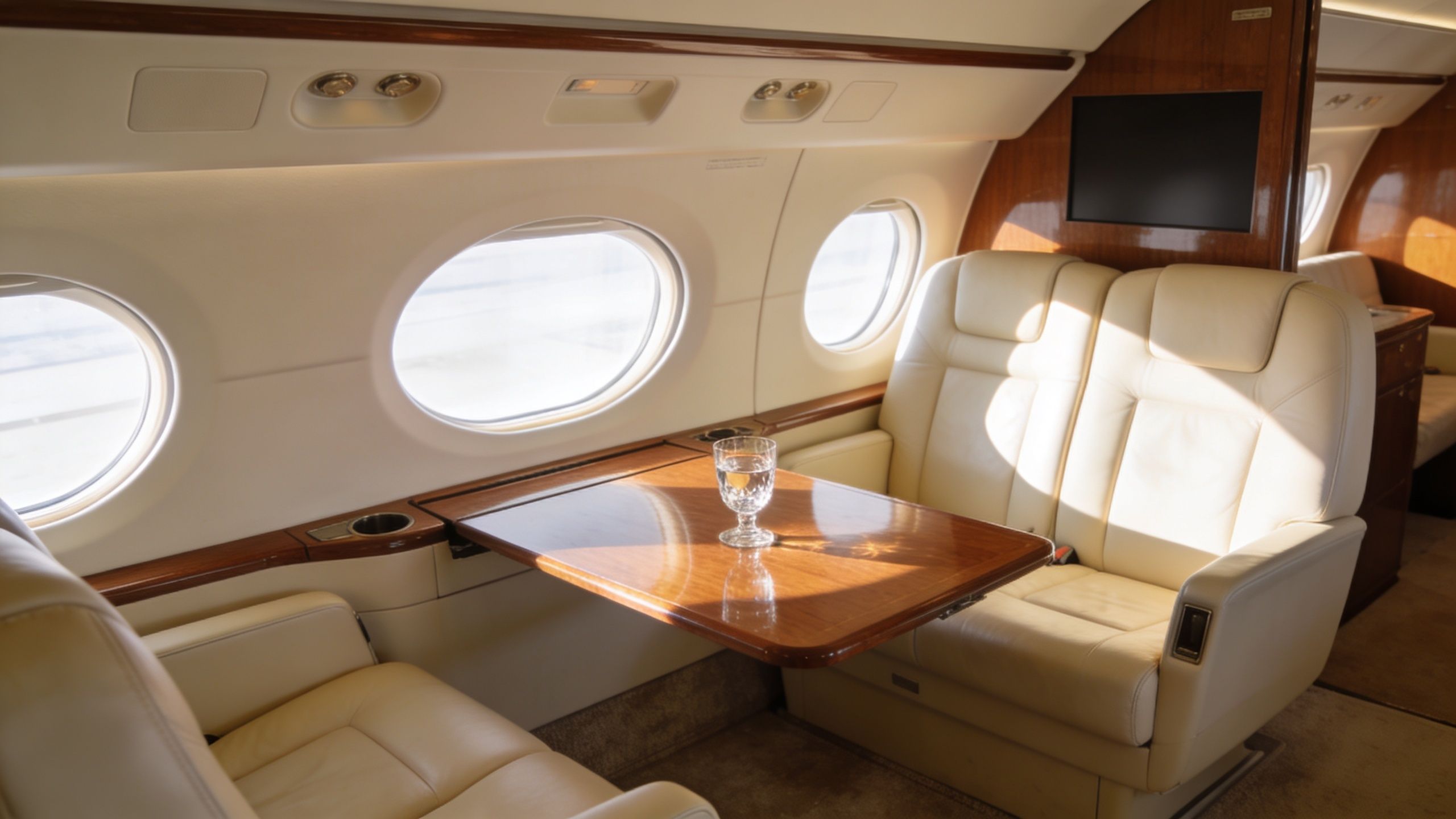
You should think of the cabin as a smart private workspace with leisure capability, not a lounge-first environment. On a shorter flight, that's a strength. It keeps the aircraft efficient and focused. On a longer leg, it means passenger expectations need to be realistic.
What the cabin feels like in practice
The CJ3 cabin works best for a smaller group that values privacy and time savings more than wide-body style comfort. Conversations are easy. A couple of travelers can work productively. Families can use it comfortably for short leisure trips.
What it doesn't offer is that easy walk-around freedom clients get used to in larger cabins. If your standard is stand-up movement, broad seating zones, and a roomier social feel, you'll notice the limits quickly.
For a broader look at what separates compact and larger cabins, this private jet interior guide gives useful context on what different categories feel like onboard.
Best way to judge the cabin
Use this checklist instead of fixating on dimensions alone:
- Trip length matters: On shorter sectors, the CJ3 feels efficient and sensible. On longer flights, cabin volume becomes more important.
- Passenger count matters more than seat count: A jet may technically seat more people than most clients want to place on a comfort-focused charter.
- Purpose changes the answer: A business day trip has different comfort requirements than a celebratory leisure itinerary.
A cabin video helps set expectations better than a brochure does:
My honest cabin verdict
For business travel, the CJ3 cabin is good. For premium leisure travel, it's good if the mission is short and the group is modest. For clients who define luxury as space first, it's the wrong aircraft category.
That isn't criticism. It's proper aircraft selection.
If you charter for efficiency, privacy, and schedule control, the CJ3 cabin does the job well. If you charter for a more expansive onboard experience, move up the market.
Ideal Missions and Competitive Landscape
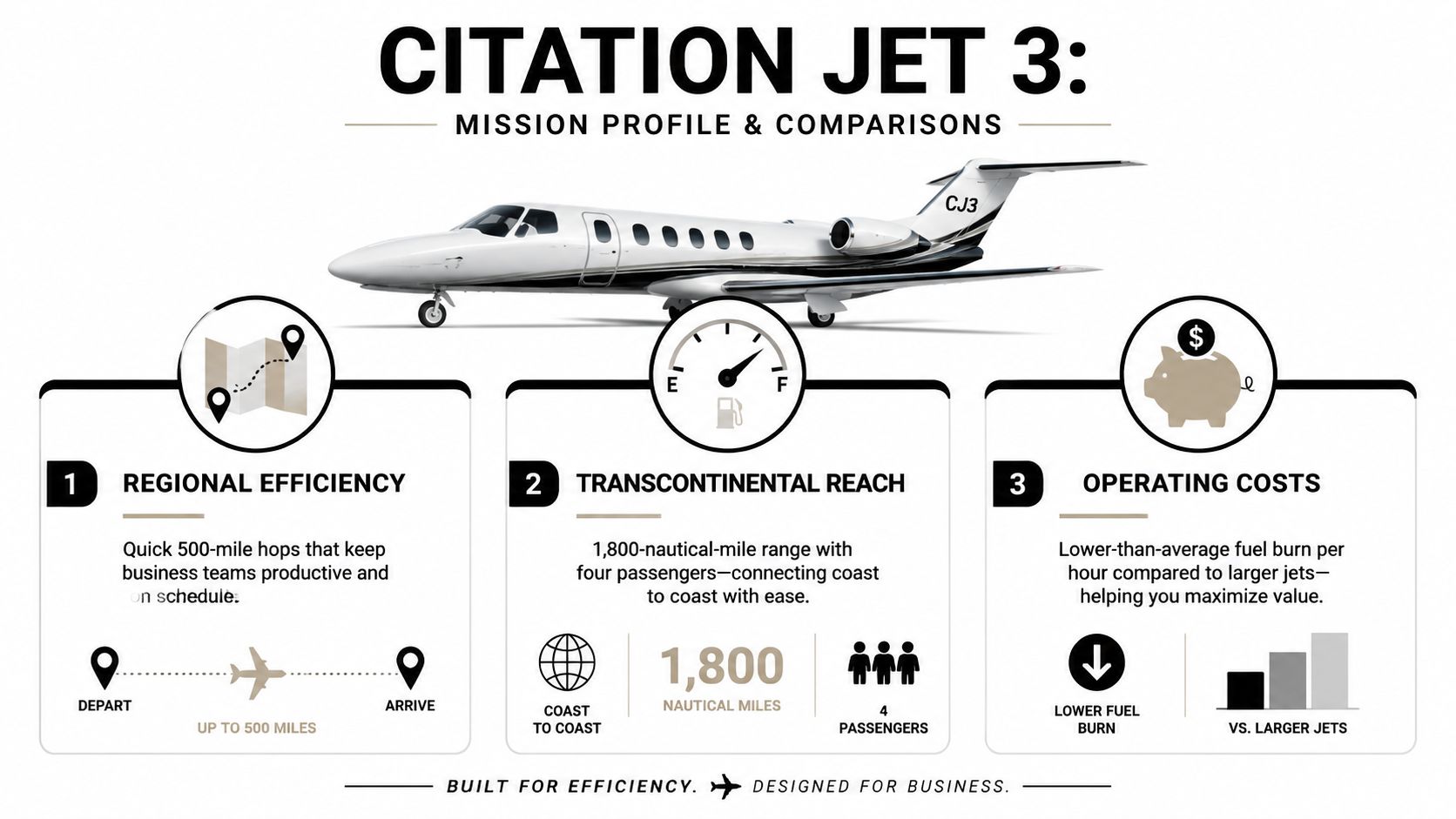
The CJ3 is at its best when the mission rewards efficiency, speed, and practical range more than cabin volume. Think executive teams, couples, families, and owner-style travelers who want to go directly where they need to go without overpaying for aircraft they don't need.
Missions where the CJ3 makes the most sense
A CJ3 is a strong fit for:
- New York to Miami when speed and efficiency both matter
- Miami to the Bahamas for leisure travel without stepping into a larger jet
- Short-notice business turns where a compact, proven aircraft is easier to source
- Airport-pair flying with smaller groups where cabin size isn't the deciding factor
The key is matching the airplane to the trip, not forcing the trip to justify a favorite airplane.
CJ3 versus the usual alternatives
The obvious comparison is often another premium light jet. In real-world buying conversations, the Phenom 300 comes up often because it appeals to many of the same clients. The Textron CJ3 Gen3 page states that, versus the Phenom 300, the CJ3 offers 200+ nm superior range at similar operating costs, which is a meaningful edge if your typical trips press the top end of light-jet range.
That doesn't automatically make the CJ3 “better.” It makes it better for some missions.
Use this framework:
| If you care most about | Better choice |
|---|---|
| Efficient range in the light jet segment | CJ3 is very compelling |
| More cabin emphasis | Consider moving beyond this category |
| Common, proven charter utility | CJ3 remains a smart option |
| Heavier luxury feel | Look at larger cabins |
For broader context inside the Citation lineup, this Citation jet family guide helps place the CJ3 against larger and smaller stablemates.
The safety piece clients should care about
The CJ3 is certified for single-pilot operations, which is common in the owner-flown world. Charter clients should care less about that label and more about operator standards. According to this operational note on CJ3 charter safety practices, vetted charter sourcing can mitigate concerns by using only Wyvern Wingman or ARGUS Gold/Platinum operators and by providing 24-hour pre-flight crew bios.
Don't confuse aircraft capability with operator quality. The airplane matters. The operating standard matters more.
That's the right way to think about risk. Aircraft selection is only half the decision. The operator behind it is the other half.
How to Charter a CJ3 at the Best Rate
Most clients overpay for CJ3 charter for one reason. They focus on the hourly rate and ignore the trip structure.
That's how you end up with a quote that looks reasonable at first glance and becomes expensive once the repositioning, routing, and aircraft sourcing realities show up. On a light jet like the CJ3, those details matter a lot because the airplane is often chosen specifically for efficient missions. If the sourcing is inefficient, you lose the whole point.
Start with the real pricing band
According to Jet Advisors' CJ3 pricing page, 2026 on-demand charter rates for a Citation CJ3+ average $4,500 to $6,000 per hour. The same source states that direct local sourcing can deliver rates 15 to 20% below traditional brokers by removing repositioning fees, and that repositioning can add over $10,000 to a flight cost.
Those numbers tell you what matters. Hourly price is only part of the equation. Positioning cost can overwhelm the apparent savings from a lower base quote.
The mistakes that drive up CJ3 charter cost
Clients usually overpay in one of three ways:
- They book by category, not by aircraft location: A CJ3 based near your departure point can price very differently from a CJ3 that has to be moved in.
- They assume jet cards guarantee value: They may guarantee convenience, but not necessarily efficient trip economics.
- They choose too much airplane: A larger cabin can feel attractive until you see the all-in number for a mission a light jet could have handled perfectly well.
Bottom line: The best CJ3 quote is usually the one built around a nearby aircraft, not the one with the prettiest hourly rate.
How I'd approach the booking
If I were advising a client on a CJ3 charter, I'd keep it simple.
First, decide whether the mission fits the aircraft. If the passenger group, baggage, and comfort expectations all line up, the CJ3 can be an excellent value.
Second, ask for the actual aircraft and routing logic, not just the category and hourly number. You want to know whether the aircraft is already near your departure city. That's where cost discipline starts.
Third, compare the all-in trip number against the mission, not against fantasy pricing you saw on a generic charter page. A charter quote should answer one question clearly: what will this exact trip cost on this exact aircraft?
If you want a stronger framework for evaluating quotes, this 2026 private jet charter guide is worth reading before you book.
My clear recommendation
Choose the CJ3 when you want a capable light jet for a short or mid-range mission and you don't need a larger cabin. Avoid it when your trip is really asking for more passenger space, more luggage flexibility, or a more premium onboard environment.
And when you book one, don't let anyone hide trip economics behind category language. Ask where the aircraft is based, how the operator is sourced, and whether repositioning is inflating the quote. That's where money is won or lost.
The CJ3 is a smart aircraft. Chartering it should be smart too.
If you want help sourcing the right Citation CJ3 without paying inflated repositioning costs, Haute Jets gives you direct access to 3,500+ owner-operators across 175 countries, with Wyvern Wingman or ARGUS Gold/Platinum-rated operators only, exact-aircraft selection, and 24-hour pre-flight confirmation. It's a cleaner way to book on-demand private aviation, especially when mission fit and price discipline both matter.