A charter jet cost calculator is your first, best tool for getting a clear picture of what your private flight will cost. Think of it as a GPS for your travel budget—it instantly maps out an estimated price for your trip by factoring in the most important variables, like flight distance and aircraft type.
How a Charter Jet Cost Calculator Works
Booking a private jet can sometimes feel like planning a road trip without knowing the cost of gas, tolls, or even what kind of car you’ll be driving. It’s an industry known for its complex pricing and last-minute surprises. A good cost calculator cuts right through that fog.
The tool works by taking the basic details of your trip and cross-referencing them against a massive database of real-time aviation data. It layers all the different costs together to give you a single, straightforward preliminary number. Its main job is to give you a solid budget estimate before you even request a formal quote.
Core Inputs That Drive Your Estimate
The accuracy of any estimate comes down to the quality of the information you provide. The calculator primarily works off of these three details:
- Departure and Arrival Airports: This is the foundation of your estimate. It determines the total flight distance, which directly impacts flight time and fuel burn—the biggest cost drivers.
- Number of Passengers: This helps narrow down the right aircraft for your mission, whether it’s a nimble light jet for a couple or a spacious heavy jet for a corporate team.
- Travel Dates: Just like with commercial airlines, pricing shifts with demand. Flying during a major event or holiday season will almost always be more expensive.
Once you plug these in, the calculator starts layering in all the other standardized industry costs. To get a deeper look at how each of these costs adds up, you can check out our guide on calculating private jet cost per hour.
Eliminating Costly Repositioning Fees
One of the biggest—and most frustrating—hidden costs in private aviation is the repositioning fee. This is what you pay to have an empty jet flown to your departure airport. Many online calculators build this expensive variable right into their estimates, which can seriously inflate the price you see.
At Haute Jets, our charter jet cost calculator is built differently. We leverage our network of over 3,500 locally sourced aircraft, which means the calculator automatically searches for a jet already near you, eliminating repositioning fees from the start.
This unique approach means you get a much more accurate and competitive estimate from the very first click. It’s a level of efficiency that clients are increasingly demanding. The global charter jet service market is set to hit $14.98 billion in 2025 and is growing at a compound annual rate of 7.63% through 2033, largely because travelers want flexibility without the hidden fees. You can read more on the charter jet service market growth on Data Insights Market.
What Goes Into a Private Jet Charter Quote?
Plugging your trip details into a charter jet cost calculator is a great first step, but the real power comes from knowing what’s behind that final number. It’s a bit like looking under the hood of a performance car—once you understand what each component does, the whole system suddenly makes perfect sense. Let's pull back the curtain and break down every line item that goes into your private flight estimate.
The biggest number you'll see is the base hourly rate. Think of this as the aircraft's sticker price for its time in the air. This rate can swing dramatically depending on the jet's size and capabilities. A nimble turboprop perfect for a short regional flight might start around $4,000 per hour. On the other hand, an ultra-long-range jet capable of crossing oceans can easily top $15,000 per hour. But this is just the starting point.
This chart shows the main ingredients that a charter jet cost calculator blends together to create your initial estimate.
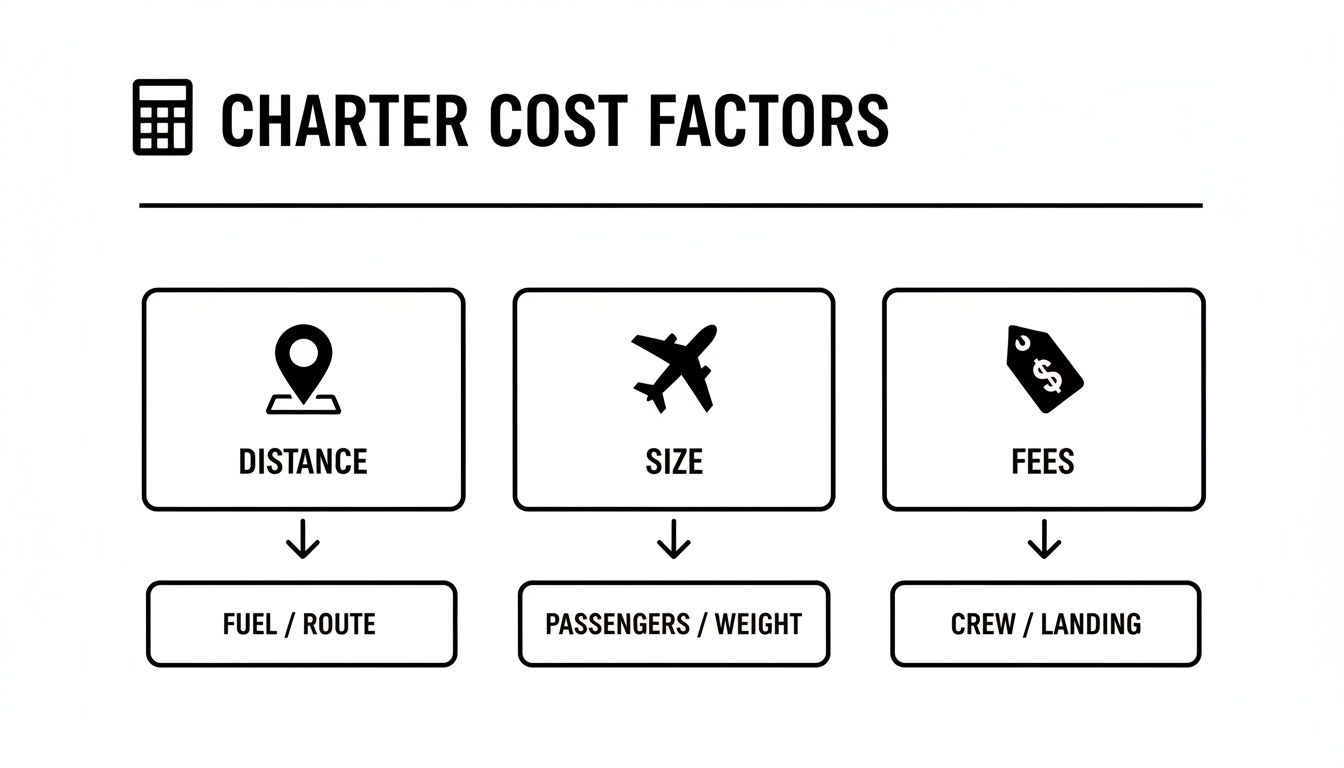
As you can see, the flight distance, the type of aircraft you need, and a handful of key fees are the three pillars that hold up the final price of your charter.
Breaking Down the Core Flight Costs
On top of the hourly rate, you’ll find several standard operational charges. These are the non-negotiable costs of getting the aircraft and its crew safely from your departure city to your destination.
- Fuel Surcharges: Jet fuel prices are always on the move. While the hourly rate bakes in a baseline fuel cost, a surcharge is often added when market prices spike. This can add $300 or more per hour to your flight.
- Airport & Handling Fees: Every airport charges landing fees, which can run anywhere from $150 to over $1,500 depending on the airport's prominence and the aircraft's weight. On top of that, private terminals, or FBOs (Fixed-Base Operators), have their own handling fees (typically $100 to $500) for services like parking and marshaling the jet.
- Crew Costs: Your professional flight crew—almost always two pilots—is a critical part of the equation. If your trip requires an overnight stay, you'll see a per diem charge of $200 to $600 per crew member to cover their hotel and meals.
These items make up the core operational expenses for any flight. But there’s one more major cost that often catches first-time flyers by surprise.
The Hidden Cost of Repositioning Fees
The single biggest budget-inflator in private aviation is the repositioning fee, sometimes called a "deadhead" flight. This is the cost of flying an empty jet from its home base to you before your trip even begins.
It’s like paying a taxi driver for their commute to your house before your ride even starts.
Repositioning flights can easily inflate a charter quote by 20% to 40%. Many traditional brokers have to do this because the aircraft they offer aren't based near you, which means you're the one stuck paying for that empty flight.
This is exactly where Haute Jets’ approach makes a huge difference. By working with a meticulously vetted network of over 3,500+ Wyvern and Argus-rated aircraft across 175 countries, we find a plane that’s already based at or very near your departure airport. Our local sourcing model eliminates repositioning fees entirely. It's a key reason our charter jet cost calculator provides a lower, more accurate estimate right from the start.
To illustrate, here's a look at how a typical quote changes when you remove repositioning from the equation.
Sample Charter Cost Breakdown: Traditional Broker vs. Haute Jets
| Cost Component | Traditional Broker (with Repositioning) | Haute Jets (Local Sourcing) | Description |
|---|---|---|---|
| Aircraft Hourly Rate | $12,000 | $12,000 | The base cost for 2 hours of flight time on a midsize jet. |
| Repositioning ("Deadhead") | $6,000 | $0 | Cost to fly the empty jet 1 hour to the departure airport. |
| Fuel Surcharge | $800 | $800 | Market-based fuel adjustment for the 2-hour flight. |
| Landing & Handling Fees | $1,200 | $1,200 | Standard fees charged by airports and FBOs. |
| Federal Excise Tax (7.5%) | $1,500 | $1,005 | Applied to the flight cost portion of the charter. |
| Estimated Total | $21,500 | $15,005 |
As the table shows, simply finding a locally based aircraft leads to a 30% savings on the exact same trip.
Other Potential Costs to Know
Finally, a few other charges might appear on your quote depending on your specific itinerary and preferences. It's good to be aware of them so there are no surprises.
Common Situational Charges:
- International Fees: Flying across borders brings on extra costs for customs, immigration, and overflight permits. These can add anywhere from $500 to $5,000+ to your total.
- Deicing: In cold weather, it's a mandatory safety step to clear snow and ice from the wings. Depending on the jet’s size and the weather, deicing can cost $1,500 to $15,000.
- Custom Catering: While standard snacks and drinks are usually included, specific dining requests are an add-on. This typically ranges from $230 to $2,000 per flight leg.
- Federal Excise Tax (FET): For all domestic flights in the U.S., a 7.5% Federal Excise Tax is applied to the total charter cost.
Once you understand these moving parts, a charter quote is no longer just an intimidating number—it’s a clear and logical summary of the services you're paying for. For an even deeper dive into these variables, check out our complete guide to unraveling private jet charter pricing. Armed with this knowledge, you can use any cost calculator with total confidence, knowing exactly what's driving the price.
Putting The Calculator to The Test: Real-World Flight Scenarios

All the theory in the world doesn't mean much until you see the numbers for yourself. This is where a charter jet cost calculator really shines—it turns abstract cost factors into a tangible estimate you can actually work with.
Let’s run through a few common flight requests to see how it all plays out. We’ll look at everything from a quick business hop to a family vacation and an intercontinental mission, showing you which aircraft makes sense and why the costs land where they do.
Corporate Trip: New York to Washington D.C.
Picture this: two executives need to get from the New York area to D.C. for a critical meeting. It's a last-minute, same-day trip. They need to be sharp, efficient, and back by evening.
- Aircraft Category: Light Jet
- Passengers: 2
- Route: Teterboro (TEB) to Dulles (IAD)
- Flight Time: About 1 hour each way
For a short jaunt like this, a light jet is the perfect tool for the job. Think of a Hawker 400XP or a Cessna Citation CJ3. They're quick, economical, and comfortable for a small group, avoiding the overhead of a larger plane.
Plugging this into a charter jet cost calculator would generate an estimated round-trip price between $10,000 and $14,000. That figure covers about two hours of flight time, plus standard landing fees and taxes at both airports.
Family Vacation: Los Angeles to Cabo San Lucas
Now for a completely different kind of trip. A family of six is escaping Los Angeles for a week-long vacation in sunny Cabo San Lucas. They're flying out of Van Nuys (VNY), a major private aviation hub, and need room for everyone and their luggage.
- Aircraft Category: Midsize Jet
- Passengers: 6
- Route: Van Nuys (VNY) to Los Cabos (SJD)
- Flight Time: Roughly 2.5 hours each way
Here, we need to step up to a midsize jet like a Hawker 900XP or a Citation Latitude. These aircraft offer more cabin space—often with a stand-up cabin—a private lavatory, and the baggage capacity needed for a week's worth of vacation gear.
The calculator chews on these details and provides a round-trip estimate in the $28,000 to $38,000 range.
This estimate accounts for the longer flight, the higher hourly rate of a midsize jet, international fees for flying into Mexico, and crew overnight expenses, since the pilots will need accommodation for the week.
As you can see, the price reflects the added comfort, range, and international logistics. For a look at how costs break down on other popular domestic routes, our guide on a private jet charter from New York to Los Angeles offers a great comparison.
Intercontinental Business: London to New York
Finally, let's look at the top tier of private aviation: a transatlantic flight. A team of eight executives is flying from London Luton (LTN) to New York's JFK for a week of high-stakes negotiations.
- Aircraft Category: Heavy or Ultra-Long-Range Jet
- Passengers: 8
- Route: London (LTN) to New York (JFK)
- Flight Time: Approximately 7-8 hours
This mission requires a serious aircraft. We're talking about a heavy jet like a Gulfstream G450 or even an ultra-long-range jet such as a Global 7500. These jets are engineered for nonstop intercontinental flights, boasting incredible range, speed, and cabins equipped for both productivity and rest.
An online charter jet cost calculator would project a one-way cost starting around $95,000 and climbing to $130,000 or more. This significant price tag is driven by the aircraft's high hourly rate (often $15,000+), the long flight duration, massive fuel consumption, and complex international fees.
By walking through these examples, what started as a list of cost variables becomes a clear picture of how flight requirements directly translate to the final price.
Estimated Charter Costs for Popular Routes by Jet Category
To give you a quick reference point, the table below outlines typical cost estimates for several common private jet trips. Keep in mind these are ballpark figures, as final pricing depends on the specific aircraft, availability, and other factors we've discussed.
| Route | Aircraft Category | Estimated Flight Time | Estimated Cost Range |
|---|---|---|---|
| New York to Miami | Light Jet | 2.5 - 3 hours | $18,000 - $25,000 |
| Los Angeles to Las Vegas | Turboprop / Light Jet | 45 min - 1 hour | $8,000 - $15,000 |
| Chicago to Aspen | Midsize Jet | 2.5 - 3 hours | $25,000 - $35,000 |
| San Francisco to New York | Super Midsize / Heavy Jet | 5 - 6 hours | $45,000 - $70,000 |
| Miami to London | Heavy / Ultra-Long-Range | 8 - 9 hours | $110,000 - $150,000+ |
These estimates provide a solid starting point for budgeting your next trip. By using a cost calculator, you can narrow down these ranges and get a much more precise quote tailored to your exact needs.
Why Your Final Quote Might Change
Think of a charter jet cost calculator as a highly accurate snapshot—it gives you a fantastic, data-backed estimate for your trip. But it's just that: an estimate. The world of private aviation is live and constantly shifting, so a few real-time variables can nudge the final price up or down. We believe in being upfront about these factors so you can plan your budget with total confidence.
The biggest driver of price changes is simple supply and demand, just like with hotels or commercial flights. If you're heading to a city hosting a major event like the Super Bowl or a global conference, the number of available jets shrinks while demand goes through the roof. Naturally, prices follow suit. Booking at the last minute also tends to cost more, as it limits our ability to find the most efficiently positioned aircraft for your trip.
Operational and Environmental Factors
Beyond market dynamics, a few things can happen on the ground that affect the final cost. These are variables that no online tool can predict with 100% certainty, but they are crucial for a safe, seamless flight.
- Weather Conditions: This is the most common wildcard. Flying in the winter might require deicing, a mandatory safety step that can cost anywhere from $1,500 to $15,000, depending on the size of the aircraft.
- Air Traffic Control (ATC): Sometimes ATC has to reroute flights for safety or traffic flow. These unexpected detours can add to your flight time, which means a bit more spent on fuel and crew hours.
- Aircraft Availability: Your initial estimate is based on a specific category of jet being available. If that exact aircraft gets booked moments before you confirm, we’ll find you a comparable alternative, but its price might be slightly different.
The global demand for private jets is surging, with market projections showing a growth of USD 9.53 billion from 2024-2029. This boom is fueled by individuals and companies who need the efficiency and flexibility of private travel. As a result, securing a jet for high-demand events like the upcoming G20 and FIFA World Cup will be more competitive, directly impacting aircraft availability and cost. You can learn more about these market trends from industry reports by Technavio.
At Haute Jets, we hate surprises as much as you do. While our charter jet cost calculator gives you a powerful starting point, we follow it up with a detailed, all-inclusive formal quote. We then reconfirm every single detail 24 hours before your flight, so the price we quote is the price you pay. No last-minute shocks.
How to Reduce Your Private Jet Charter Costs

Getting that initial cost estimate is a fantastic first step, but the real art of private flying is knowing how to make smart choices that bring the final price down. You don't have to compromise on safety or luxury to be cost-effective. With a bit of insider knowledge and planning, you can significantly reduce your expenses.
It sounds simple, but planning ahead is your best friend. Just like with commercial flights, booking your private charter well in advance gives you far more options and much more competitive pricing. Last-minute trips almost always carry a premium because aircraft availability is tight, so locking in your flight a few weeks or even months out can save you a bundle.
Get Strategic with Your Itinerary
Beyond booking early, a few small tweaks to your actual flight plan can make a surprisingly big difference in your final quote. The two biggest levers you can pull are your travel dates and your choice of airports.
Here are a few pointers:
- Be Flexible with Your Dates: If you have some wiggle room in your schedule, use it. Shifting your departure by just a day or two can help you sidestep peak travel times for holidays or major events, when prices naturally spike. Flying mid-week is almost always cheaper than flying on a Friday or Sunday.
- Choose Your Airports Wisely: Major international hubs are convenient, but they come with hefty landing and handling fees. A great way to save is by flying into smaller, regional airports. For a trip to New York City, for instance, choosing Teterboro (TEB) instead of JFK can make a real dent in your operational costs.
- Right-Size Your Aircraft: It's tempting to go big, but one of the most common mistakes is booking a larger jet than you actually need. Take a moment to ensure the aircraft truly fits your passenger count and luggage. You'll avoid paying for empty seats and a higher hourly rate.
The Single Best Way to Cut Charter Costs
Those tips will absolutely help you trim your budget, but if you want to know the secret to the most substantial savings, it all comes down to one thing: eliminating repositioning fees.
At Haute Jets, our entire business is built around this idea. We tap into a network of over 3,500 locally based aircraft, meaning we find a jet that’s already at or very near your departure point. This strategy gets rid of the costly repositioning fees that can easily inflate a charter price by 20% to 40% with other brokers.
This isn't just a small adjustment—it’s a completely different way of chartering that gives you direct access to wholesale pricing. You get the perfect jet for your trip without paying for it to fly empty just to come pick you up.
Ready to see how much you could save? Use our charter jet cost calculator for an instant, transparent estimate. Or, if you'd prefer, contact our team for a formal quote tailored specifically to your flight.
A Few Common Questions
It’s completely normal to have questions when you’re sorting through private flight options, especially around pricing and logistics. Think of a charter jet cost calculator as your starting point for clarity. Let's walk through a few of the most common things people ask so you can plan your trip with confidence.
So, how accurate is an online calculator? It's best to think of it as a very solid budgetary estimate. These tools use live market data, current aircraft positions, and standard operating costs to give you a reliable ballpark figure for your trip. While it's fantastic for planning, the final, locked-in price is only confirmed once we've secured a specific aircraft and its crew for your exact itinerary.
Are There Hidden Fees I Should Watch Out For?
This is probably the most important question for anyone new to chartering. Honestly, the answer comes down to who you book with. Some traditional brokers or jet card programs are known for quoting an appealing base price, only to tack on extra charges later for things like crew expenses, repositioning flights, or international handling.
At Haute Jets, what you see is what you get. Our quotes are always all-inclusive. Every single anticipated cost, from the Federal Excise Tax down to the landing fees, is itemized right there on the page. No surprises, no last-minute charges.
What Safety Ratings Are Most Important?
Of course, cost and convenience mean nothing without an absolute commitment to safety. When you're looking at your options, you should only fly with operators that hold the industry's highest third-party safety ratings. These aren't just badges; they represent a deep, ongoing audit of an operator's entire business.
The two seals of approval you need to look for are:
- Wyvern Wingman: This is a tough, in-depth audit that confirms an operator has an impeccable safety culture, meticulous maintenance records, and proven operational procedures.
- ARGUS Gold or Platinum: A globally respected system that grades an operator on its safety history, the experience level of its pilots, and its insurance coverage.
We have a strict policy at Haute Jets: we only work with operators who have earned these top-tier ratings. It ensures every flight we arrange meets the gold standard for safety and professionalism.
Can I Use Cryptocurrency to Pay for My Flight?
Yes, absolutely. We understand that our clients come from all over the world and work with diverse assets. That's why many forward-thinking providers are embracing digital currencies.
Haute Jets is proud to accept various cryptocurrencies for payment. It's a secure, straightforward way to book your flight, allowing you to easily turn your digital investments into incredible travel experiences.
Ready to see how our local sourcing model can get you a better value? The team at Haute Jets is standing by to build a transparent, all-inclusive quote for your next trip. Experience the peace of mind that comes from flying with a partner who prioritizes clarity and safety above all else.