

You’re likely doing what most charter clients do. You have a specific trip in mind, you’ve seen the Citation X advertised as a fast, long-range jet, and you want a simple answer to a simple question: can it do your route nonstop?
Sometimes yes. Sometimes no. The problem is that brochure range isn’t mission range.
That gap matters most when the itinerary is important. A board meeting in London. A family departure out of Aspen. A same-day coast-to-coast turn where losing time to an unexpected fuel stop ruins the point of flying private in the first place. If you’re evaluating the citation 10 range, you need more than a headline figure. You need to know what the aircraft can do with your passenger count, your bags, your route, and the day’s operating conditions.
Understanding the Citation 10 Range for Your Mission
A client asks about New York to London and assumes the answer should be straightforward. The Citation X has the reputation, the speed, and the range profile to make that sound easy. On paper, it often is. In practice, the details decide everything.

The Citation X, often called the Citation 10, became famous for being fast. That reputation is deserved. But speed creates a blind spot for buyers. People focus on the aircraft’s image and assume the range story is just as simple. It isn’t.
Why mission details matter more than the sales sheet
A private jet’s listed range tells you what the aircraft can do under a specific set of conditions. Your trip probably won’t match those conditions exactly. If you’re bringing more passengers, heavier baggage, additional catering, or routing into an airport with operational constraints, the effective range changes.
That’s why I tell clients to stop asking, “What’s the Citation X range?” and start asking, “What’s the Citation X range for my mission?”
If you want a broader technical overview of the aircraft before getting into route planning, this Citation X specifications guide is a useful companion read.
The practical question you should ask first
Ask this before you ask anything about cabin finishes or Wi-Fi.
- How many people are flying: Not “around six.” Not “maybe eight.” Exact count matters.
- How much luggage is going: Golf bags, ski gear, garment bags, pet equipment, and catering all affect the mission.
- What airport pair are you using: City pairs aren’t enough. Specific departure and arrival airports matter.
- What’s more important, nonstop or full cabin load: On some trips, you can have both. On others, you need to prioritize.
Practical rule: The right aircraft choice starts with the mission profile, not the marketing label.
That’s the difference between a smooth trip and a jet that looks perfect until dispatch starts trimming payload or adding a stop.
Official Specs vs Real-World Performance
The Citation X earned its place in business aviation by being extraordinarily quick. According to Avcon Jet’s Citation X aircraft profile, the aircraft entered service in 1996 as the world’s fastest business jet, with a maximum cruise speed of Mach 0.92 and a range of up to 3,460 nautical miles under optimal NBAA IFR conditions with 4 passengers.

Published baseline: The Citation X can reach up to 3,460 nautical miles under optimal conditions with 4 passengers.
That’s the number people remember. It’s also the number most likely to mislead a charter client when it gets stripped of context.
What the brochure number actually means
The range figure is not fake. It’s conditional.
It assumes a defined operating scenario. That includes a particular passenger load, a particular reserve standard, and favorable enough conditions for the aircraft to achieve that performance. Once your trip differs from that test profile, the result shifts.
Compare it to a performance car’s fuel economy on an open highway versus in urban traffic. The car didn’t lie. You just changed the operating environment.
For a private jet, the operating environment includes:
- Passenger load
- Baggage weight
- Winds aloft
- Air traffic control routing
- Airport performance constraints
- Required reserve fuel
A client sees a route that looks shorter than the listed range and assumes that means guaranteed nonstop capability. That’s where mistakes happen.
Why a 3,000 NM trip isn’t always a simple yes
A route near the edge of the aircraft’s practical envelope needs margin. If the mission is around the upper end of what the aircraft can do on paper, you don’t want to book based on optimism.
That matters on prestige routes. New York to London sounds like exactly the kind of trip the Citation X was built for. In the right setup, it is. But the question isn’t whether the aircraft has ever done it. The question is whether your specific flight can do it comfortably and legally without compromise.
Here’s the deeper issue. Range planning isn’t just about making it to destination. Pilots and dispatchers also plan for reserves and operational reality. If routing extends, winds worsen, or climb performance isn’t ideal, the margin narrows.
A useful visual helps, especially if you want to see how operators present the aircraft’s performance envelope:
The right way to interpret the citation 10 range
Use the official number as a screening tool, not a guarantee.
If your route is comfortably inside the aircraft’s capability, the Citation X is often a strong answer. If your route sits close to the aircraft’s limit, you need someone doing actual mission analysis, not category-level selling.
A long-range jet should give you confidence, not force a negotiation over bags, reserves, or a surprise technical stop.
That’s the distinction experienced flyers understand. The aircraft’s spec sheet opens the conversation. It doesn’t finish it.
How Passengers and Baggage Impact Your Flight
Most clients don’t lose nonstop capability because they chose the wrong jet category. They lose it because they treated payload like a minor detail.
It isn’t minor. It’s usually the deciding factor.
According to Skybrary’s C750 performance data, the Citation X can carry a maximum payload of 2,864 lbs, and at that payload its range contracts to 2,838 NM. The same source notes that with full fuel, payload capacity is 1,855 lbs. That’s the tradeoff in plain English. More weight in the cabin means less flexibility in the tanks.
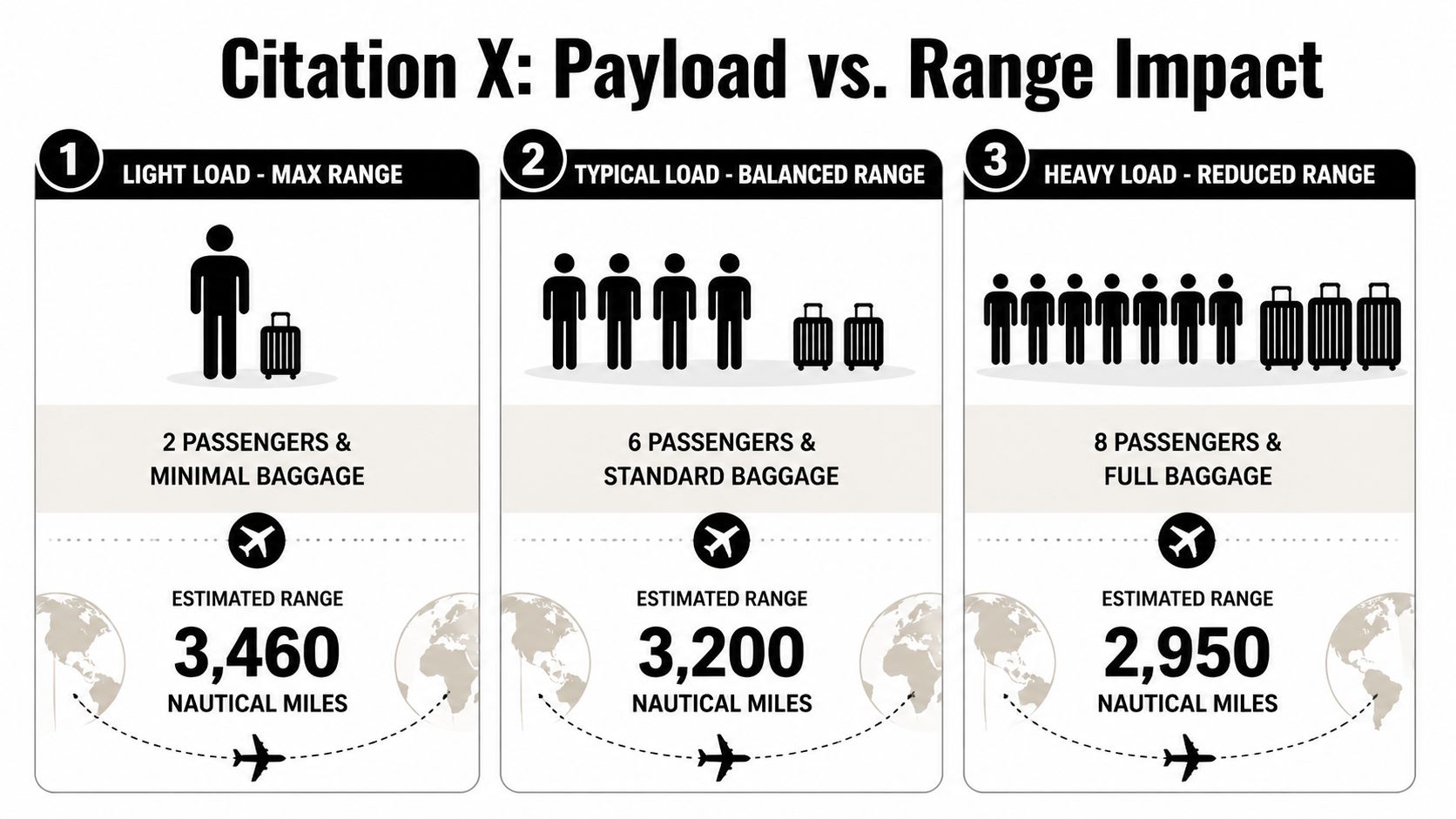
The payload rule every charter client should know
A jet has a maximum takeoff weight. Once you load passengers, bags, catering, and other onboard items, you reduce what can be allocated elsewhere. On longer sectors, that usually means fuel becomes the variable.
That’s why the same aircraft can look perfect for one New York departure and questionable for another. Four passengers with light baggage is one mission. Eight passengers with full luggage is another.
Don’t evaluate a long trip by aircraft name alone. Evaluate it by aircraft name plus payload.
What that means in practical terms
Here’s how to think about it when you’re booking:
Count people accurately
If eight seats are filled, plan as if eight seats matter operationally. Last-minute additions are one of the easiest ways to turn a clean mission into a compromised one.Treat baggage accurately “A few bags” is not useful dispatch information. Large rollers, skis, garment bags, golf clubs, pet gear, and event materials all add up fast.
Decide whether nonstop is the priority If the mission must be nonstop, payload may need to stay disciplined. If the full party and all baggage must be included, another aircraft may be the smarter answer.
Ask for route-specific validation
Generic assurances are useless. You want a mission-specific answer tied to your actual departure point, destination, and load.
If you regularly travel with larger luggage profiles, this luggage and private jet travel guide is worth reviewing before you finalize aircraft selection.
The mistake I see most often
Clients focus on passenger seats and ignore usable range under load. The Citation X cabin can accommodate a strong passenger count comfortably, but comfort and nonstop capability aren’t the same metric.
That matters because charter decisions often happen backward. Someone picks the airplane because they like the name or the speed, then tries to fit the mission into it. The smarter move is the reverse. Build the trip profile first, then choose the aircraft.
A heavy-load Citation X may still be the right answer. But if the route is long enough, you should at least test whether a different platform gives you more margin and fewer compromises.
Visualizing the Citation X Flight Map
Abstract range figures don’t help much when you’re trying to decide whether to commit to an aircraft for a real trip. Route examples do.
The Citation X+ gives a useful benchmark here. According to Jet Advisors’ Citation X+ overview, the upgraded variant extends range to 3,372 NM, supports trips like New York to London at 3,000 NM without tech stops, and has a balanced field length of 5,250 ft, which supports operations into airports such as Aspen.
Routes where the answer is usually yes
Some city pairs sit squarely inside the aircraft’s strengths.
| Route | Nonstop on Citation X | Why |
|---|---|---|
| New York to Los Angeles | Yes, typically | The route is well within the aircraft’s long-range profile in normal charter use. |
| Miami to Turks & Caicos | Yes | This is comfortably within the Citation X family’s operating footprint. |
| Los Angeles to Honolulu | Often yes, mission dependent | It can work when the payload and planning are aligned with the route. |
These are the kinds of trips where the Citation X feels exactly as advertised. Fast, efficient, and well suited to clients who care about travel time.
Routes where the answer is it depends
Clients get into trouble because “it depends” gets translated into “probably fine.”
That’s lazy advice.
- New York to London: Often viable, especially in the X+ profile, but still a mission-planning route rather than an automatic yes.
- Miami to Aspen: The runway side of the equation is favorable for the X+ at Aspen, but airport conditions and trip setup still matter.
- Westbound transatlantic sectors near the edge: These require disciplined planning, not assumptions.
If a route lives near the aircraft’s practical limit, the correct answer is never casual confidence.
Routes where I’d scrutinize the plan hard
A route can be technically possible and still be a poor charter decision. That’s especially true when the trip combines long stage length with heavy payload or less forgiving operating conditions.
For those missions, I’d ask three direct questions:
- Is the client committed to flying nonstop, or just assuming it?
- Is the luggage profile realistic, or still being guessed at?
- Would a different aircraft create more margin with less operational friction?
A lot of charter frustration comes from pretending a borderline route is a straightforward one. It isn’t. A smart advisor should say that early.
The practical value of understanding the citation 10 range isn’t just knowing where the jet can go. It’s knowing where the trip remains elegant, and where the mission starts to feel negotiated.
How the Citation X Stacks Up Against Competitors
The Citation X is not the automatic answer for every premium charter. It’s the right answer when speed is the priority and the mission fits the aircraft cleanly.
That distinction matters because buyers often compare it with jets that solve a different problem. According to Stratos Jets’ discussion of the Citation X in charter context, a baseline range figure of 3,140 nm is commonly associated with the Citation X, and cost variability versus aircraft like the Phenom 300 or Challenger 350 is an important consideration. The same source also notes that production ended in 2012, which makes access through a broad sourcing network important when you want this specific model.
Citation X vs Competitors at a Glance
| Metric | Cessna Citation X | Bombardier Challenger 350 | Embraer Praetor 600 |
|---|---|---|---|
| Core appeal | Speed-first super-midsize jet | Popular super-midsize charter choice | Strong modern super-midsize contender |
| Range profile | Strong transcontinental and selected transatlantic capability, mission dependent | Often considered for similar premium business routes | Often considered when buyers want modern long-range flexibility |
| Cabin feel | Built around performance, with a proven executive layout | Often chosen by clients who prioritize cabin experience | Often attracts buyers looking for newer-platform appeal |
| Best client fit | Travelers who hate losing time | Travelers who want a balanced cabin-and-range proposition | Travelers who want a modern competitor in the segment |
| Charter selection issue | Availability depends on sourcing the right operator and aircraft | Widely requested benchmark aircraft | Frequently cross-shopped in premium charter decisions |
That table is intentionally qualitative because the useful decision isn’t made by memorizing one more spec column. It’s made by matching priorities.
When the Citation X is the smart choice
Choose the Citation X when the mission rewards speed and the route doesn’t force you into payload compromises. It’s especially compelling for executives who value time savings and want a proven, high-performance aircraft rather than the newest badge.
It’s also a strong fit for clients who know exactly what they want. Some buyers prefer the Citation X because they understand what it does better than most aircraft in its class. They’re not shopping by trend. They’re shopping by mission result.
If you’re comparing it directly with another super-midsize option, this Citation X vs Challenger 350 comparison can help frame the tradeoffs.
When I’d look elsewhere
I’d broaden the search when the trip profile points toward margin over speed.
That usually means one of two things. Either the baggage and passenger count are pushing the mission toward the edge of the aircraft’s practical capability, or the client values cabin feel more than outright pace. In those cases, the Citation X may still work, but it stops being the obvious winner.
The best charter aircraft isn’t the one with the strongest reputation. It’s the one that fits the mission without negotiation.
That’s the right way to compare private jets. Not by fan base. By fit.
Ensuring Your Citation X Charter Meets Expectations
A bad charter experience usually starts long before the flight. It starts when someone sells the airplane first and checks the mission second.
That’s how clients end up hearing “nonstop” early in the booking process and “we need a quick fuel stop” later. The aircraft may still be excellent. The planning wasn’t.
One overlooked issue is high-altitude climb management. According to the operational nuance highlighted in this Citation X climb and AoA discussion on YouTube, at the aircraft’s maximum altitude of 51,000 ft, pilots must carefully manage climb performance, and that can affect effective speed and range on long-haul charter missions. That’s not a brochure issue. That’s a real dispatch issue.
What smart charter buyers should insist on
If you’re booking a Citation X for a meaningful trip, ask for direct answers to these points:
- Mission feasibility: Can this exact trip be flown as planned with the actual passenger and baggage load?
- Airport suitability: Are there any runway or performance constraints tied to the specific airports involved?
- Operational margin: Is the plan well-prepared, or is it relying on favorable conditions to work cleanly?
- Backup logic: If conditions shift, what’s the likely operational adjustment?
Those questions separate polished sales talk from actual trip planning.
Where clients get burned
The most common problem isn’t fraud. It’s simplification.
A generic broker may treat all super-midsize jets as interchangeable, or treat the Citation X’s best-case range as if it applies evenly across missions. That creates false confidence. Then actual details show up later, when changing course is harder and more expensive.
Here’s my blunt view. If a charter provider can’t explain why your route works on this aircraft with your actual load, they haven’t done enough work.
My recommendation
Use the Citation X when your mission rewards what it does best. Speed. Long legs. Serious executive travel. But don’t book it just because the name signals prestige or because the headline range appears to cover the route.
Book it when the mission analysis says it fits cleanly.
That means your advisor should confirm the actual aircraft, the operator quality, the route assumptions, the baggage reality, and the performance margin before you commit. If the trip is borderline, the answer shouldn’t be a hopeful yes. It should be a better aircraft recommendation.
That’s what seasoned private flyers eventually learn. Luxury in charter isn’t only about stepping onto a beautiful jet. It’s about never being surprised by a trip that should have been planned correctly from the start.
If you want that level of mission-specific planning, Haute Jets is built for it. Their team sources from 3,500+ aircraft across 175 countries through Wyvern and ARGUS-rated operators, confirms the exact aircraft, and focuses on matching the jet to the trip instead of forcing the trip to fit a category. That’s the right approach when nonstop capability, aircraft selection, and clean execution matter.