
A new Cessna Citation Longitude costs about $29.995 million, while pre-owned aircraft usually trade around $24 million to $26 million. If you want access without ownership, expect a typical charter rate of $4,000 to $6,000 per hour.
That sounds simple. It isn't. The actual citation longitude price depends on how you access the aircraft, how often you fly, and whether you're paying for the jet itself or absorbing all the waste built around it.
Most buyers fixate on the purchase number and miss the expensive part. Most charter clients do the opposite. They compare hourly quotes without understanding what's hiding inside them. That's how people overspend on a very capable aircraft that is, in my view, one of the smarter jets in the super-midsize category when priced and sourced correctly.
Understanding the Citation Longitude Price Spectrum
The top line is straightforward. A new equipped Citation Longitude sits at about $29.995 million, pre-owned aircraft generally land in the $24 million to $26 million range, and charter pricing typically runs $4,000 to $6,000 per hour, according to Simple Flying's Citation Longitude operating cost review.
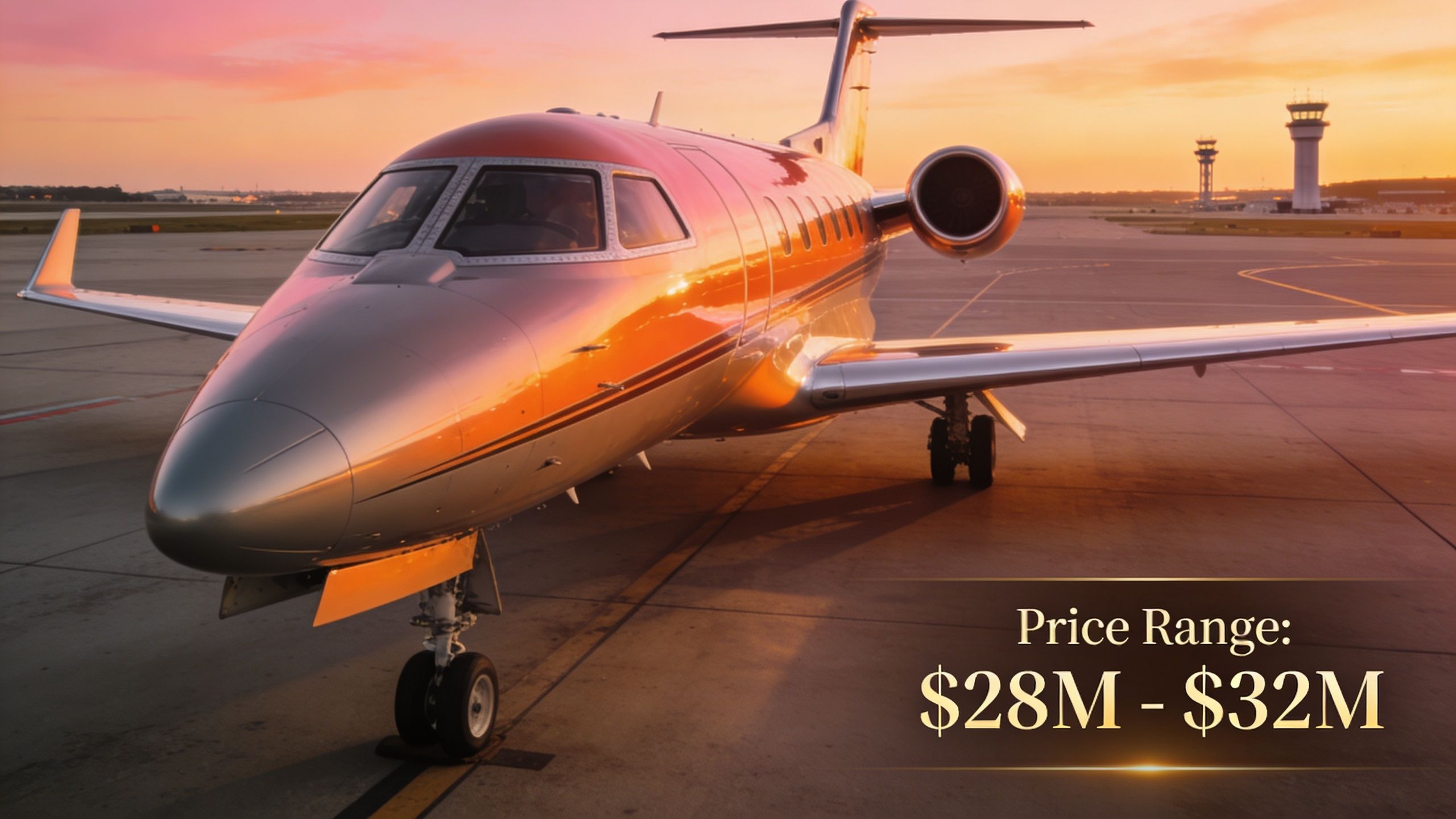
Those numbers put the Longitude in a very specific lane. It's a super-midsize business jet with transatlantic capability, a stand-up cabin, and direct operating economics that are competitive enough to make it relevant in both ownership and charter conversations. You're not buying an entry-level solution. You're buying reach, cabin comfort, and speed without stepping into the much heavier capital burn of larger cabin aircraft.
What the sticker price actually tells you
A purchase price tells you one thing only. It tells you the admission fee.
It does not tell you what you'll spend to keep the aircraft crewed, insured, housed, maintained, and flying. It also doesn't tell you whether buying is rational for your flying pattern. Plenty of clients can afford a Longitude and still shouldn't own one.
Why the charter number can mislead you
The $4,000 to $6,000 per hour charter range is useful, but only if you understand what kind of quote you're receiving. One operator may price a nearby aircraft cleanly. Another may quote the same model and factor extra positioning cost into the trip. Same jet. Different economics.
Practical rule: If you fly occasionally, the smartest question isn't "What does a Citation Longitude cost?" It's "What is my cheapest clean access to a Citation Longitude for the trips I actually take?"
The Longitude earns attention because it offers a rare mix of capability and restraint. It has the range to do serious business travel, but it doesn't force you into the kind of ownership economics that often come with bigger-cabin prestige buys. That balance is why this aircraft keeps showing up in serious charter searches and acquisition shortlists.
The True Cost of Owning a Citation Longitude
Ownership breaks into three buckets. Acquisition, fixed costs, and variable operating costs. Ignore any one of them and your budget is fiction.
The market likes this aircraft because it's efficient, and projections reflect that. The global Citation Longitude market is projected to reach $2.7 billion by 2033, with owners benefiting from 800-hour or 18-month maintenance intervals and annual fixed costs of roughly $486k to $555k for crew, hangar, and insurance, according to Market Intelo's Citation Longitude market analysis.
Acquisition is the smallest surprise
The purchase price is the visible pain. New, you're near $29.995 million. Pre-owned, you're generally in the $24 million to $26 million band. That's expensive, but it is at least obvious.
What's less obvious is that buying the aircraft only starts the meter. If you're evaluating ownership seriously, read a broader private jet purchase guide before you treat the acquisition price as the actual number.
Fixed costs are relentless
Many first-time buyers often become careless. The airplane can sit still and still cost you heavily.
Core fixed costs include:
- Crew and training: You need qualified pilots, recurrent training, and operational continuity.
- Hangar and storage: A premium aircraft needs proper shelter and support.
- Insurance and oversight: These are mandatory costs, not optional upgrades.
- Scheduled maintenance planning: The Longitude's 800-hour or 18-month intervals help, but they don't erase maintenance obligations.
The useful part is that the fixed-cost band is at least somewhat predictable. The painful part is that you pay it whether you fly often or not.
Variable costs decide whether the mission still makes sense
The Longitude's reputation for efficiency is legitimate. But "efficient" doesn't mean cheap. It means less punishing than many alternatives in its category.
Here are the ownership budget figures that matter:
| Ownership cost view | Cost figure |
|---|---|
| Cessna claimed hourly operating cost | $2,874 to $2,903 |
| Guardian Jet variable cost per hour at 300 annual hours | $4,342 |
| Guardian Jet total annual budget | $1.79 million |
| Compare Private Planes hourly cost at 200 hours | $2,577 |
| Compare Private Planes total annual budget | $1.07 million |
| Aviacost variable cost per hour | $4,330 to $4,366 |
| Aviacost annual budget at 325 hours | $1.65 million |
Those figures are compiled in Simple Flying's 2025 operating cost roundup.
Ownership only starts to look sensible when your flight volume is high enough to spread fixed costs across enough trips. If your usage is inconsistent, the airplane turns from an asset into a very elegant invoice machine.
My advice is blunt. If you want control, branding, and guaranteed availability, ownership can work. If you're trying to save money while flying sporadically, buying a Longitude is usually wasteful spending dressed up as convenience.
Deconstructing the Citation Longitude Charter Price
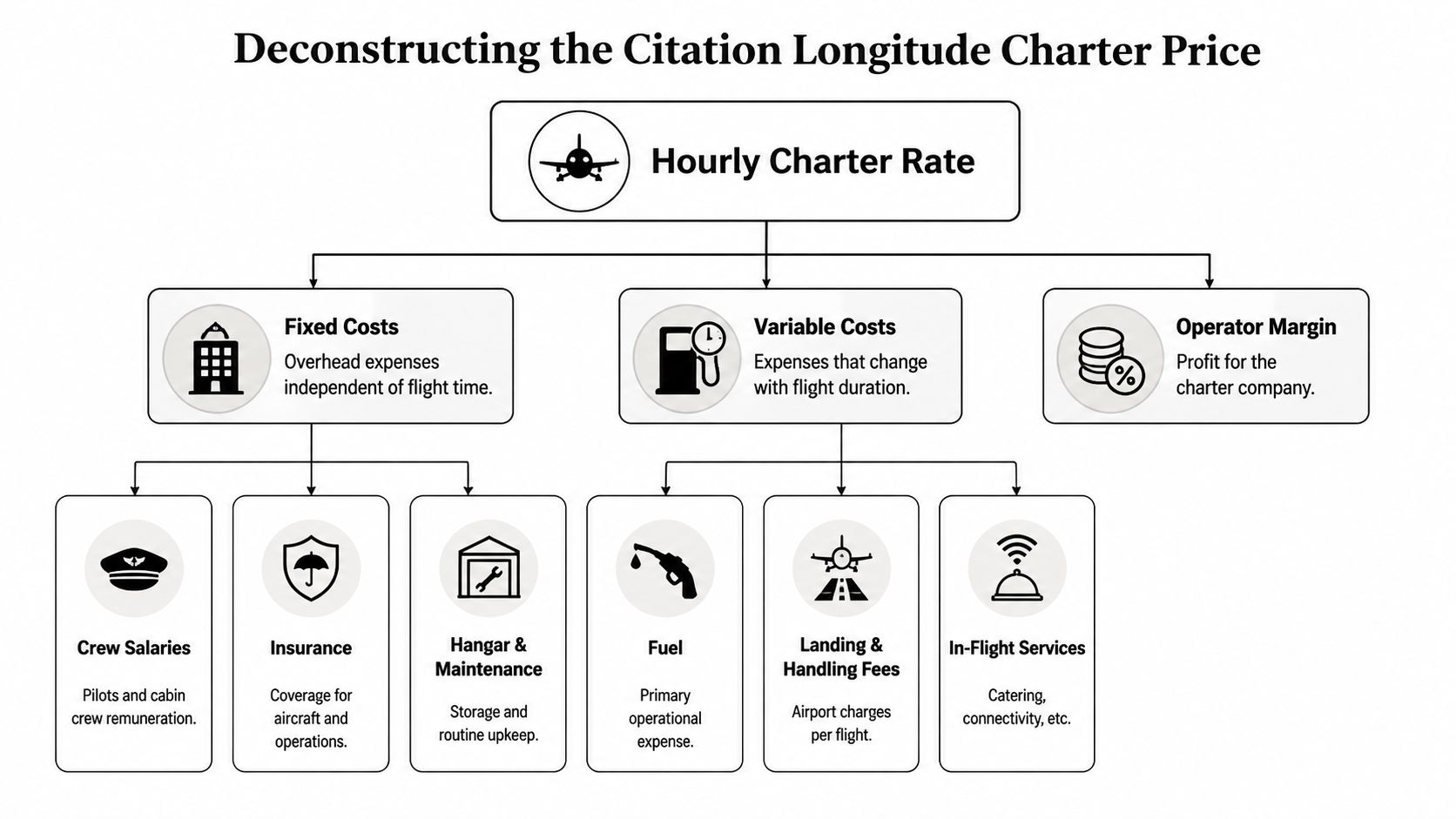
A charter quote isn't just flight time multiplied by an hourly rate. That's the retail version of the story. The actual quote is a stack of cost inputs, and some of them are reasonable while others are where pricing gets bloated.
The Longitude helps because the platform itself is efficient. It uses twin Honeywell HTF7700L engines, burns about 300 gallons per hour, and carries variable operating costs of about $4,330 to $4,366 per hour, according to Simple Flying's Citation Longitude price analysis. That efficiency is a major reason the aircraft stays competitive in the charter market.
What you're really paying for
Think of a Citation Longitude charter quote in three layers.
| Quote layer | What it covers |
|---|---|
| Aircraft time | The live flying portion tied to the jet and crew |
| Trip-specific charges | Airport handling, landing fees, crew expenses, catering, and international support when needed |
| Commercial markup | The operator or broker margin, plus any positioning inefficiency built into the quote |
That last line is where buyers get trapped. The aircraft can be a smart value. The quote can still be a bad deal.
The hidden cost most clients miss
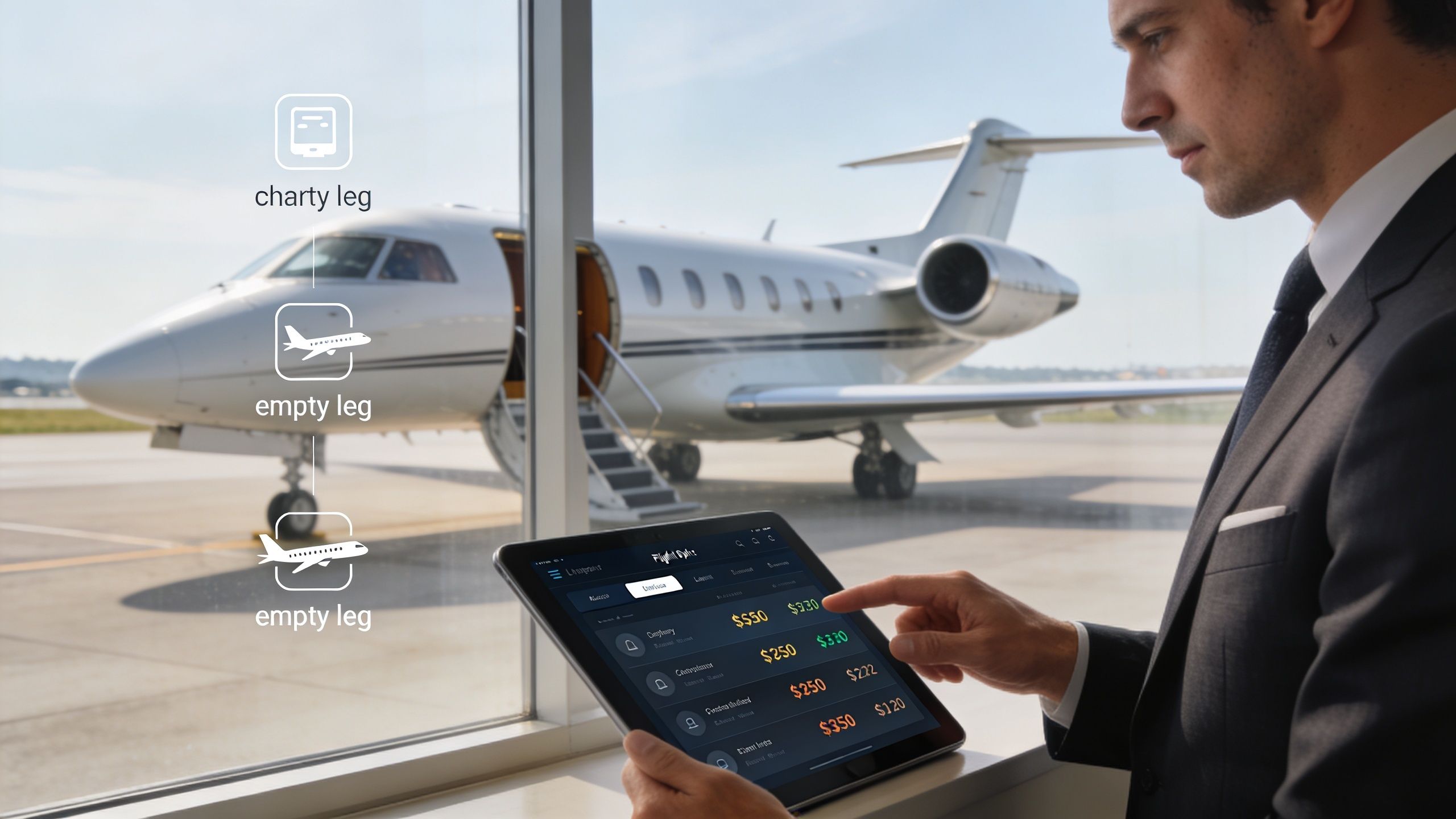
Repositioning is the classic charter leak. If the aircraft isn't already near your departure airport, somebody has to pay to move it. In many cases, that's you.
Traditional broker quotes often obscure this by blending the repositioning cost into the hourly math instead of showing it as a separate line item. The result is that clients compare two "Longitude" quotes that look close on paper but aren't priced on the same basis at all.
Here is what tends to move a final charter number up:
- Aircraft positioning: Empty-leg movement to your departure airport
- Airport and FBO charges: These vary by trip and location
- Crew overnighting: More common on multi-day or remote itineraries
- Catering and cabin requests: Reasonable when requested, wasteful when bundled without scrutiny
- International handling: Customs, permits, and support services on cross-border flights
A cheap-looking hourly rate can still produce an expensive trip if the aircraft starts in the wrong city.
How to read a Longitude quote properly
Ask for the trip total, not just the hourly figure. Then ask what assumptions sit behind it.
A clean quote should answer three things:
- Where is the aircraft based right now
- Is repositioning included
- Which extras are mandatory versus discretionary
If you don't get those answers, you aren't comparing charter options. You're comparing marketing.
The Citation Longitude is often a very good charter aircraft because its operating profile supports a sensible retail rate. But the aircraft's economics and the booking model are not the same thing. A good jet can still be sold through a bad pricing structure.
Sample Itinerary Pricing Longitude vs Competitors
Let's turn theory into booking logic. The point isn't to pretend every route has one fixed market price. It doesn't. The point is to show how the Citation Longitude tends to fit real trip profiles and why it's often a sharper buy than clients expect.
For context, the Longitude sits between midsize practicality and larger-cabin ambition. If you want a side-by-side look at where it fits in the lineup, this Citation family comparison gives useful context.
Estimated Citation Longitude charter costs
The only defensible rate range we have for charter is $4,000 to $6,000 per hour, so the table below uses that range and qualitative flight-time estimates rather than invented route-specific numbers.
| Route | Estimated Flight Time | Estimated Charter Price |
|---|---|---|
| New York to Miami | Medium-range domestic flight | Based on $4,000 to $6,000 per hour |
| Los Angeles to Las Vegas | Short domestic flight | Based on $4,000 to $6,000 per hour |
| New York to London | Long-range transatlantic flight | Based on $4,000 to $6,000 per hour |
New York to Miami
The Longitude feels right-sized. You get a large enough cabin for executives or family travelers, plus baggage flexibility and a premium onboard experience without paying for more airplane than the mission demands.
Against a competitor like the Challenger 350, the buying decision often comes down to availability, cabin preference, and quote structure. The Longitude's appeal is that its efficiency usually lets it compete well when sourced intelligently. If a quote comes in high on this route, I would suspect positioning or markup before I blame the aircraft.
Los Angeles to Las Vegas
This is the easiest place to overspend on a super-midsize jet. It's a short hop. Clients often book by habit or vanity instead of mission fit.
That said, if you specifically want a Longitude for cabin comfort, group travel, or fleet consistency, the key is not the category. It's whether the aircraft is already local. On a route this short, bad sourcing can turn a reasonable flight into an overpriced one quickly.
For short sectors, the wrong sourcing model matters more than the aircraft model.
New York to London
The Longitude justifies its reputation through its 3,500 nautical miles of range and design for serious missions, including transatlantic flying, according to the previously cited market and aircraft data. This route is the kind of mission where stepping up from a smaller jet isn't indulgent. It's practical.
Compared with peers, the Longitude gives clients a strong balance of cabin, speed, and cost discipline. If you need true long-range luxury beyond this mission profile, you move up in aircraft size and cost. If this is your typical mission, the Longitude often lands in the sweet spot.
The takeaway is simple. On short flights, sourcing discipline matters most. On medium missions, the Longitude is often an excellent value. On longer routes, it starts to show why it's one of the most commercially sensible premium aircraft in its segment.
Smart Chartering How to Save on Every Flight
Most private flyers don't need to own a Citation Longitude. They need reliable access to one when the mission justifies it.
That distinction matters because travelers flying 50 to 100 hours per year can save 30% to 50% per trip with on-demand charter versus ownership by avoiding fixed costs that average $486k+, depreciation, and the 20% to 40% broker premium tied to repositioning, according to Private Jet Card Comparisons' Longitude analysis.
The smart hierarchy of access
Not every access model deserves equal respect. Some are flexible but inconsistent. Some are convenient but overpriced.
Here's how I rank them for most clients who specifically want Citation Longitude access:
- On-demand charter: Best for flexibility and cost control when sourced well
- Empty legs: Useful only if your schedule is flexible enough to accept instability
- Jet cards: Convenient, but often padded with program economics you don't need
- Full ownership: Rational only when your usage level and control requirements clearly justify it
Where people waste money
Jet cards sell simplicity. Fractional programs sell predictability. Traditional brokers sell access. All three can work. All three can also smuggle unnecessary cost into your trip.
The most common mistakes are:
- Paying for prepaid hours you won't use: Jet cards look clean until your real flying pattern doesn't match the commitment.
- Accepting category-based selling instead of aircraft-specific pricing: You may pay premium pricing for generic access.
- Ignoring positioning: Many quotes inflate due to this consideration.
- Using ownership to solve an availability problem: That's the most expensive possible solution to the wrong problem.
What actually lowers your trip cost
The answer is boring, which is why it works. Source an aircraft that's already near your departure point. That strips out one of the biggest forms of waste in private aviation.
If you're booking intelligently, ask these questions before approving a quote:
- Is this exact aircraft local to my departure area
- Am I paying any deadhead or repositioning cost
- Can I choose the specific aircraft instead of a broad category
- Do I need this aircraft often enough to justify any prepaid structure
The best charter strategy isn't finding a magical discount. It's refusing to pay for ferry flights, unused memberships, and artificial scarcity.
Empty legs can produce value, but they are opportunistic, not strategic. If your trip has to happen on your terms, don't build your travel planning around an inventory anomaly.
My recommendation is clear. If you're a typical high-net-worth leisure flyer or an executive traveler with irregular but premium mission needs, use an on-demand sourcing model and stay away from long-term commitments unless your actual annual flying proves you need them.
Is the Citation Longitude the Right Jet for You
The Citation Longitude is the right jet for people who want real capability without stepping into a larger and more expensive ownership category. It gives you transatlantic range, a comfortable stand-up cabin, and economics that are disciplined enough to make the aircraft viable in both private ownership and premium charter.
If you want a more detailed look at why this aircraft works so well in charter use, this Longitude charter overview is worth reading.
My recommendation by flyer type
| Flyer type | Best move |
|---|---|
| Occasional flyer | Charter on demand |
| Frequent but irregular flyer | Charter on demand, aircraft-specific sourcing |
| High-utilization flyer with control needs | Evaluate ownership seriously |
| Prestige buyer chasing status more than utility | Reassess before spending |
If you fly less than what a dedicated ownership structure can support efficiently, buying a Citation Longitude is usually a lifestyle decision, not a financial one. That's fine if you know that going in. It's a bad decision if you're telling yourself ownership is the cost-efficient answer when it isn't.
For most clients, the full citation longitude price isn't the purchase number. It's the total cost of access over time. That is why the best decision usually isn't "Should I buy the airplane?" It's "How do I secure the airplane I want without paying for all the waste around it?"
The Longitude is a very good jet. That doesn't mean you should own one. It means you should use one intelligently.
If you want a transparent quote on a specific Citation Longitude, Haute Jets offers on-demand access to exact aircraft through a network of 3,500+ Wyvern and ARGUS-rated owner-operators across 175 countries, without memberships, jet cards, or the repositioning costs that often inflate traditional charter pricing.