A flight plan can be perfect and the trip can still fail on the ground.
That's the situation many luxury travel advisors and corporate planners face. The aircraft is confirmed. The passengers are briefed. The villa, boardroom, or buyout restaurant is reserved. Then the lead executive lands early, one guest's luggage misses the connection, the host property changes its access protocol, local security wants a revised manifest, and the gala florist can't load through the original entrance because a city permit changed overnight.
At that point, reservations don't help much. You need local command. That's where destination management companies become decisive.
For private jet clients, the right DMC isn't a decorative add-on to a premium itinerary. It's the operating layer that turns a fragile plan into a controlled one.
The On-Demand Architect for Complex Itineraries
A common failure point in high-touch travel happens in the handoff between air and ground. The charter team knows the flight. The hotel knows the suiteing plan. The venue knows the run of show. The transport company knows the route. But no one owns the whole picture once the wheels are down.
That gap is where a destination management company earns its place.
A DMC steps in when the itinerary has too many moving parts for remote coordination to hold. Think of a multi-city executive roadshow ending in a private coastal retreat. The jets are arranged, but the challenge is elsewhere. Someone has to manage apron access timing, discreet transfers, rooming changes, dietary requests, security choreography, local staffing, backup venues, and guest flow without making the principal feel the strain.

Why the category matters now
This isn't a niche cottage service anymore. The global Destination Management Company market was valued at USD 74.2 billion in 2024 and is projected to reach USD 191.7 billion by 2033, growing at an 11.3% CAGR, according to DataIntelo's destination management company market analysis. That scale matters because it reflects a mature sector built to support complex corporate and luxury travel in major markets.
For planners working across cities and time zones, that maturity changes the buying decision. You're no longer hiring a local fixer. You're selecting an operational partner with supplier bargaining power, staffing depth, and enough process discipline to support a board retreat, investor summit, or celebrity movement with real accountability.
One of the clearest examples shows up in multi-city business trip planning with private jet charters. Air time can be compressed. Ground time usually can't. The tighter the schedule, the more the destination-side operator matters.
A premium itinerary breaks down in the seams, not in the headline bookings.
What high-stakes clients actually need
Ultra-high-touch programs need someone on site who can do three things at once:
- Control timing: Keep vehicles, greeters, venue teams, and hosts synchronized with live arrival changes.
- Protect discretion: Limit unnecessary exposure, especially for principals who don't want public check-ins or loose supplier handling.
- Absorb disruption: Solve local problems before they move upstream and damage the client relationship.
That's why the strongest destination management companies don't behave like excursion sellers. They behave like field operators. In luxury and corporate travel, that distinction is everything.
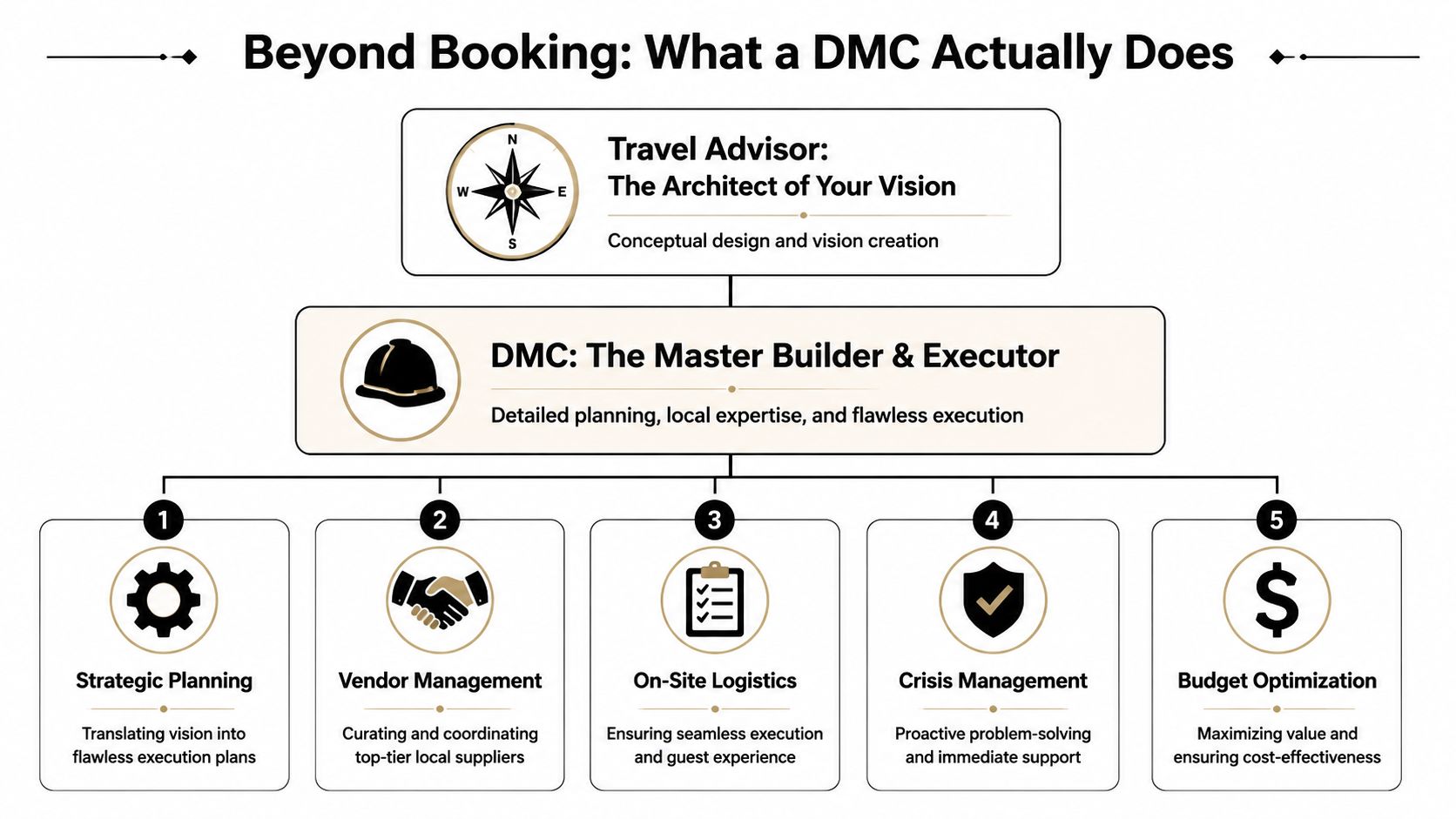
Beyond Booking What a DMC Actually Does
The simplest way to explain destination management companies is this. If the travel advisor designs the experience, the DMC builds it on site.
That difference gets missed because a lot of market language reduces DMCs to “local experts.” That phrase is too soft for what good operators do. In practice, DMCs function as on-the-ground systems integrators for MICE programs, combining venue sourcing, ground transport, VIP airport handling, entertainment, and crisis response into a single operating layer, as described in Liberty International's overview of DMC roles.
The practical distinction
A travel advisor usually owns client relationship, air, lodging strategy, and the overall shape of the journey. A tour operator generally sells pre-structured products or inventory. A DMC takes responsibility for the local execution layer where things tend to go wrong.
That means they don't just reserve a dinner. They confirm load-in timing, kitchen sequencing, dietary handling, guest arrival cadence, weather backup, staffing positions, music licensing, and the route the principal uses to enter and exit privately.
Here's a simple comparison:
| Provider | Primary role | Best for | Weak point |
|---|---|---|---|
| Travel advisor | Designs and books the broader journey | Relationship-led travel planning | Limited local operational control |
| Tour operator | Packages inventory and experiences | Standardized leisure programs | Less flexible for bespoke execution |
| DMC | Manages in-destination production and logistics | Complex, high-stakes itineraries | Only works well if integrated early |
What they coordinate that others usually don't
A serious DMC sits in the middle of local complexity and makes the program feel simple to the traveler.
- Supplier orchestration: One point of control across transport, venues, staffing, entertainment, permits, décor, and security support.
- Operational translation: They convert your brief into local instructions vendors can execute.
- Real-time re-optimization: If a jet lands late, headcount changes, or weather shifts, they reorder the ground plan fast.
- Cultural fluency: They know when a venue's “yes” means confirmed, tentative, or politically sensitive.
For luxury advisors placing clients in Los Angeles, this often extends beyond event production into curated local access. In some cases, resources like expert-guided LA tour services can complement a DMC's work when a program needs destination-specific experiences layered into a broader itinerary.
Practical rule: If three or more local vendors have to move in sequence around a VIP timeline, you're already in DMC territory.
Why this matters for private aviation
Private aviation compresses time. That's the advantage. It also increases the penalty for sloppy ground handling because passengers expect the same precision after landing that they had in the cabin.
The handoff from aircraft to vehicle, and from vehicle to property, has to be deliberate. Advisor-side planning and destination-side command must lock together at this point. A useful reference point is private jet to hotel coordination, because it highlights the exact transition where many otherwise polished itineraries lose control.
The best DMCs don't admire the itinerary. They run it.
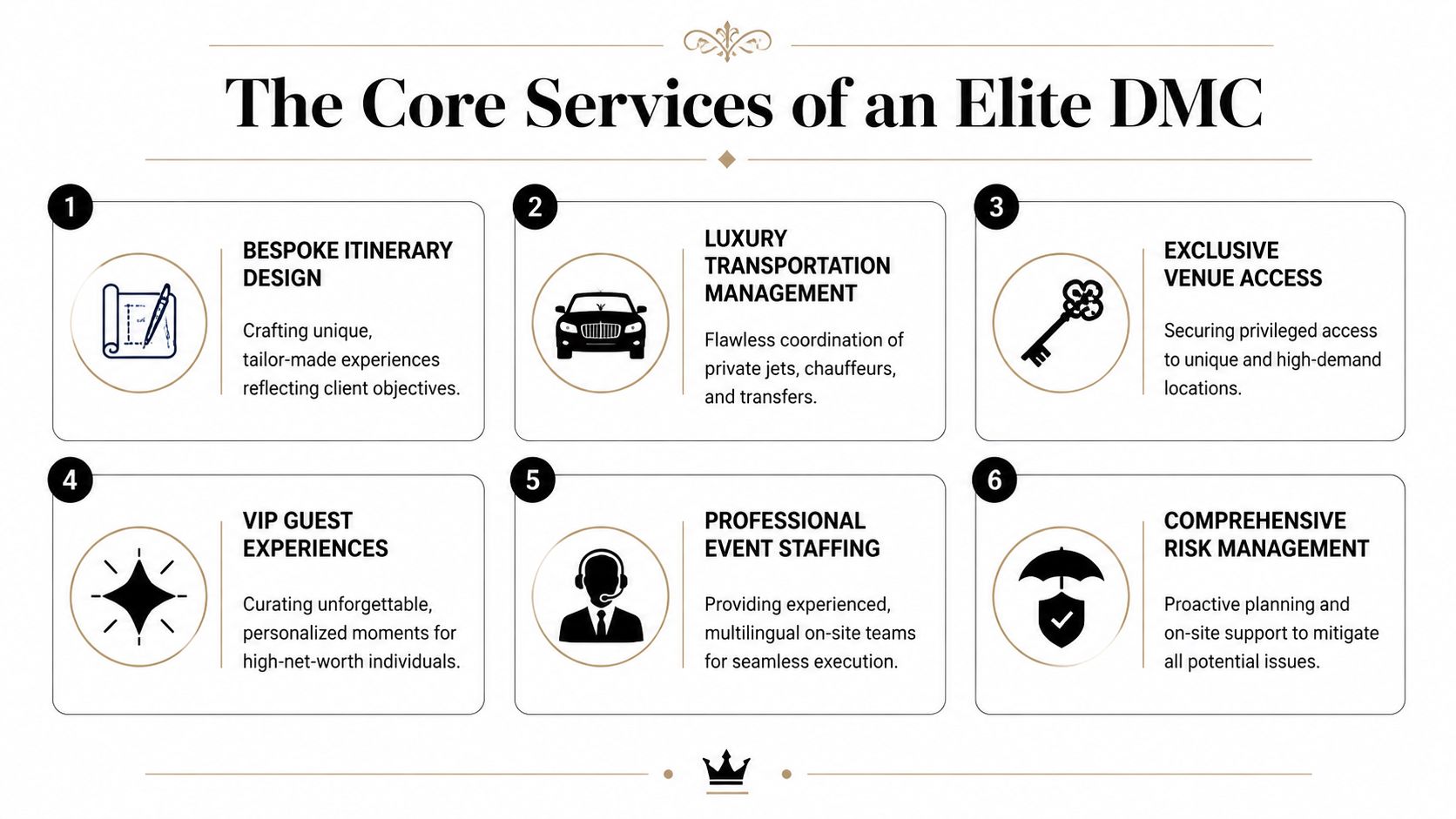
The Core Services of an Elite DMC
An elite DMC doesn't sell a list of services. It provides control across the moments clients notice most and the moments they should never notice at all.
For private jet travelers, the standard isn't convenience alone. It's continuity. The experience should feel like one uninterrupted operating environment from FBO arrival to final departure.
Transportation and arrival choreography
Here, weak operators get exposed first.
A top DMC handles vehicle dispatch against live flight status, not static schedules. It aligns chauffeurs with the correct terminal protocol, confirms name-board or no-board procedures, manages luggage segregation when multiple residences or hotels are involved, and builds alternative routing before traffic or security restrictions force the issue.
For private aviation programs, this also means understanding FBO etiquette and sequence. The principal may want to step directly from aircraft to vehicle. The family office may need one car peeled off for security. An assistant may require separate baggage handling and a later departure. None of this is difficult in isolation. It becomes difficult when it has to happen discreetly and on time.
Access and program design
The right DMC can provide access to places the public cannot readily search and book. Private estates, after-hours cultural access, discreet restaurant buyouts, non-public entrances, and destination-specific hosts often come through relationship capital rather than public inventory.
That doesn't mean every request should be framed as “exclusive.” Smart DMCs know the difference between access that impresses and access that creates operational fragility. Sometimes the better answer is the venue that loads cleanly, protects privacy, and can absorb a last-minute schedule shift without unraveling service.
A quick way to judge their quality is to ask how they would stage the same guest experience under a different weather, traffic, or timing scenario. Good operators answer with options. Weak ones repeat the original concept.
Here's a useful way to think about service categories:
- Bespoke itinerary design: Aligning destination programming with client objectives, not just aesthetics.
- VIP experience handling: Matching guest profiles to the right pacing, privacy level, and service style.
- Venue strategy: Choosing spaces for operational fit, not just visual appeal.
A short visual reference helps frame the workflow before moving deeper into execution.
Event staffing and real-time problem solving
Elite DMCs carry or coordinate multilingual hosts, production managers, transport dispatch, venue captains, and roaming troubleshooters who can make decisions quickly. The point isn't headcount. It's role clarity.
The guest experience improves when the planner stops being the person everyone calls for local fixes.
On a high-stakes program, I want the DMC team to know who can approve spend, who can reroute transport, who can escalate to venue security, and who stays attached to the VIP principal all day. If that chain isn't clear, the itinerary becomes dependent on ad hoc improvisation.
Risk mitigation as a service, not a promise
This is the capability discerning buyers should weight heavily. A polished proposal means very little if the DMC can't handle weather disruption, supplier failure, access denial, medical issues, or sudden schedule compression.
An elite DMC plans alternates in advance. It knows what can move, what can't, and what has to be protected first. In luxury travel, that usually means privacy, timing, and guest composure. If a client can sense the scramble, the operator is already behind.
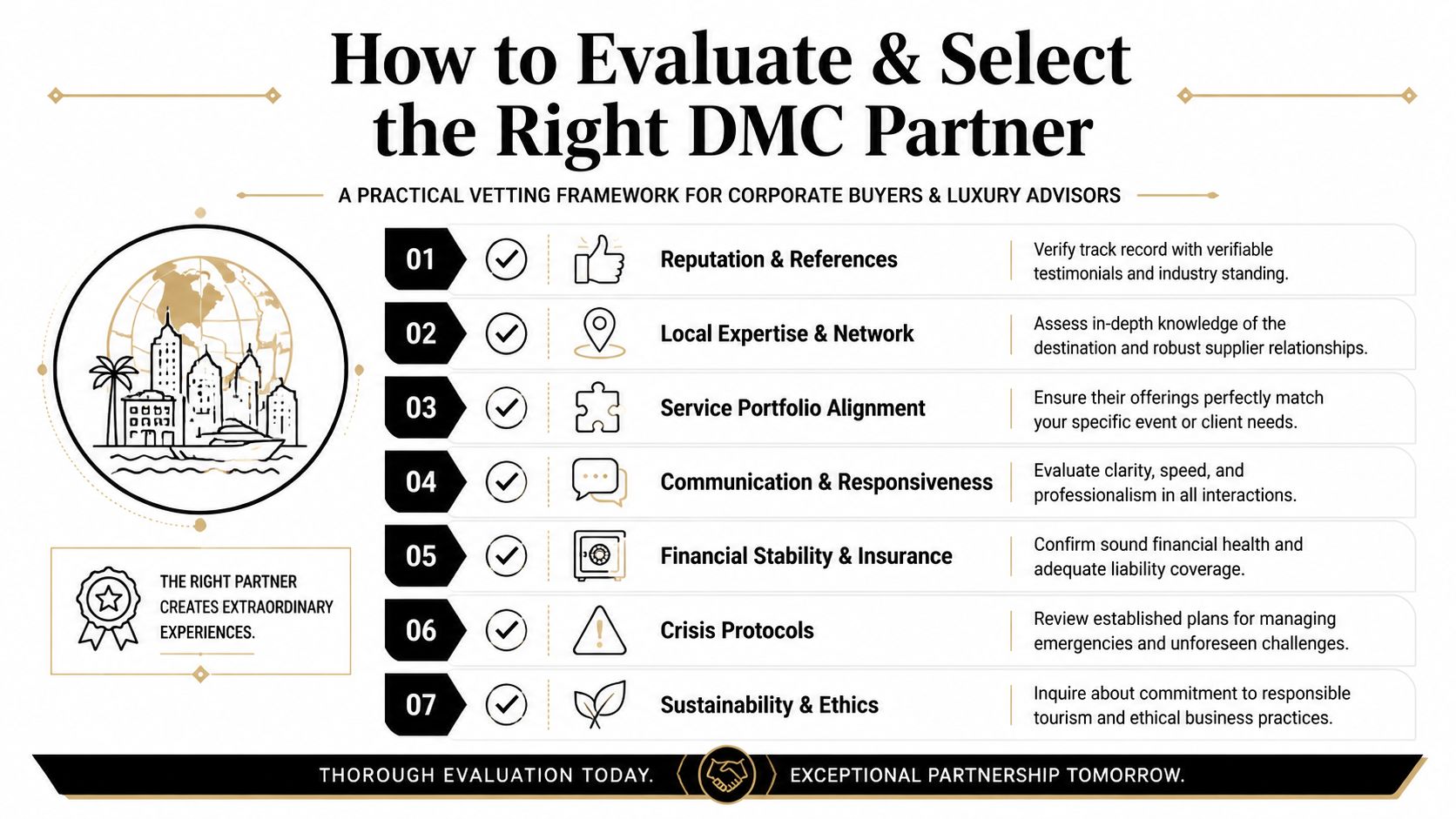
How to Evaluate and Select the Right DMC Partner
Most DMC selections go wrong for a simple reason. Buyers evaluate creativity before they evaluate control.
Beautiful decks, strong destination language, and glamorous supplier lists can hide weak operating discipline. For luxury travel advisors and corporate planners, the key question isn't whether the DMC can design a compelling program. It's whether they can execute one under pressure without creating new risk.
Start with the operating backbone
Ask direct questions early. Who owns transport dispatch on event day? What's the escalation path if a venue fails inspection? Which services are in-house and which are subcontracted? How do they manage manifest changes, VIP confidentiality, and late-notice shifts?
A DMC that answers clearly usually runs clearly. A DMC that answers with marketing language usually doesn't.
Use this shortlist when screening candidates:
- Local network quality: Ask which supplier relationships are long-term and which are opportunistic.
- Communication discipline: Watch how they handle revisions, recap calls, and written confirmations during the pitch stage.
- Staffing depth: Confirm who will be on site, not just who sells the account.
- Financial and legal controls: Request proof of liability coverage and clarity on who contracts each supplier.
- Crisis process: Ask for an example of how they would handle a same-day disruption in your destination.
Understand how the money works
One of the most practical buying questions is also the one many DMC conversations avoid. How is the quote built?
Industry guidance commonly cites a 15–20% markup on program costs for DMC services, with discerning buyers evaluating not just the fee but also financial transparency, liability insurance, and crisis response protocols, according to Sports Destination Management's guidance on DMC fee structures.
That number isn't the whole story. The model matters just as much.
| Pricing approach | What it means | Best use case | Buyer concern |
|---|---|---|---|
| Cost-plus | Supplier costs plus management fee or markup | Programs needing line-by-line visibility | Requires clean documentation |
| Inclusive package | One bundled per-person or program price | Simplicity and faster approvals | Harder to see margin layers |
Neither model is better. Cost-plus works well when procurement demands visibility. Inclusive pricing works when speed and simplicity matter more than line-level analysis. The mistake is accepting either model without understanding which services are marked up, where pass-through costs begin, and who holds cancellation exposure.
Vet them like a risk partner
A modern DMC should be evaluated the way aviation professionals evaluate operators. Process first, polish second. That's one reason many planners already think in structured safety terms when reviewing Wyvern and ARGUS private aviation safety ratings. The same mindset applies here. Documentation, accountability, and escalation planning matter.
If a DMC can't explain its crisis protocol in plain language, assume the protocol lives in the sales deck and nowhere else.
Here are the questions that separate a polished seller from a dependable operator:
- What happens if the lead executive lands early or late?
- Who has authority to spend against contingency without waiting for head-office approval?
- How are guest data, manifests, and privacy-sensitive details handled locally?
- What backup suppliers are pre-cleared for transport, staffing, and venues?
- How do you report incidents during and after the program?
Watch for fit, not just scale
Large DMCs can offer consistency across markets. Smaller destination specialists can provide tighter local command. The right choice depends on program type.
For a multi-country executive roadshow, a larger platform may simplify reporting and commercial structure. For a single-destination, high-touch celebration with privacy sensitivities, a focused local operator may outperform a global name. Don't buy scale if you need intimacy. Don't buy intimacy if you need cross-market control.
The Partnership Playbook Contracting and Operations
At 06:40, the aircraft lands 35 minutes early. The principal wants to go straight from the FBO to a secure meeting. One guest's luggage is still being offloaded. The hotel is holding rooms under a different naming convention than the manifest. If the DMC and flight side have not been aligned in advance, that minor timing gain turns into visible confusion on the ground.
That is why the contract matters less than the operating model behind it. A good proposal confirms scope and price. A good operating plan defines authority, timing, data handling, and what happens when the day moves faster than the itinerary.
Build the operating brief around control points
The brief should read like a field document, not a marketing recap. Everyone involved should be able to answer the same basic questions without checking three versions of the program.
Cover these points in the working brief or service agreement:
- Named decision authority: Identify who can approve rerouting, added vehicles, rooming changes, overtime, and guest-specific exceptions.
- Communication protocol: State which issues require a phone call, which go to an encrypted message thread, and who receives each update.
- Response standards: Set expected acknowledgment times for transport changes, venue adjustments, staffing gaps, and after-hours requests.
- Incident thresholds: Define what triggers immediate reporting, who gets notified, and what the first update must include.
- Data controls: Limit how guest names, tail numbers, manifests, security notes, and billing details are shared with local suppliers.
One point often missed in luxury and executive travel is spend authority. If a road closure forces a last-minute venue change or an aircraft delay requires extra staffing, the local team needs pre-cleared limits. Waiting for head-office approval during live movement is how small issues become guest-facing failures.
Haute Jets may also be part of that chain on the aviation side, particularly where charter sourcing, pre-flight confirmation details, and transport timing need to be aligned with the ground program. The value is practical. The DMC works from confirmed aircraft, crew, and arrival information instead of secondhand assumptions.
Tie the DMC to the flight timeline
Private aviation rarely fails in dramatic ways. It shifts in small but operationally important increments. Release time changes. Parking changes. The aircraft uses a different stand. A passenger clears ahead of the rest of the party. Ground execution has to absorb those changes quietly.
The DMC should be working from the live flight picture, not a static run sheet issued the day before. At minimum, align on:
- Wheels-down and passenger release timing
- FBO procedures, pickup location, escort rules, and vehicle staging
- Passenger grouping, baggage allocation, assistants, and security movement
- Return-leg logic, including early call-forward procedures if meetings finish ahead of schedule
Achieving high-touch travel's full potential depends on meticulous coordination. A beautiful dinner reservation does not fix a poor airport handoff.
Test the operation before arrival
Run a short pre-arrival call with the DMC, the lead planner, and the aviation contact. Keep it practical. Walk through the three disruptions most likely to affect guest experience and timing.
Use scenarios such as:
- The principal lands early and wants to depart the airport immediately.
- One passenger diverts, arrives at a different FBO, or joins later by commercial air.
- The first programmed stop has to move by an hour because the meeting runs long.
Listen to how the DMC answers. Strong operators give names, timing, alternates, and escalation paths. Weak operators give reassurance and promise to “handle it.”
The best programs are rarely the quietest behind the scenes. They are the ones where the command structure is already set, the contingencies are already priced, and the local team knows who can say yes.
One final discipline helps more than planners expect. Keep the chain of command tight. Give the DMC one accountable planning lead, one aviation contact, and one finance approver. Clear authority produces faster decisions and a calmer guest experience.
Your Strategic Asset for Flawless Execution
At 18:40, the aircraft lands early, the principal wants to skip the planned lounge hold, one guest is still delayed at another airport, and the hotel insists the suite inspection cannot move. In that moment, the DMC is not a décor vendor or a restaurant booker. It is the local operations partner that keeps the trip intact without exposing the client to the scramble behind it.
That is the standard to use.
For a luxury travel advisor, the right DMC protects the client's sense of control at every handoff. For a corporate planner, it protects schedule integrity, internal credibility, and the ability to recover quickly when executive movements change without notice.
The strongest DMCs do more than place local services. They manage pressure well. They know which supplier will hold a vehicle, which hotel contact can release a room early, which security lead will adjust a route, and how to relay changes from the aviation side to the ground team without confusion. In private aviation programs, that matters more than polished proposals. The aircraft may set the pace, but the ground operation decides whether the trip feels disciplined.
Choose a DMC the way you would choose any partner tied to principal movement. Test response time. Test judgment. Test whether the team can make clear decisions with incomplete information. Style has value, but control under pressure is what protects the itinerary.
Luxury, at this level, is consistency. It is friction removed from the airport curb to the final departure.
If you need the air side coordinated to the same operational standard, Haute Jets can support charter sourcing, aircraft matching, and flight-related coordination that helps destination partners execute cleanly from touchdown onward.