
You're on your phone at 11 p.m., staring at a transatlantic itinerary that just broke because a meeting ran long. The commercial flight won't work, the car service needs to be moved, the arrival window at the hotel is dead, and someone still has to confirm the next leg without waking up three different people. That's exactly where digital concierge services stop being a hotel feature and become an operational layer for people moving serious money, time, and talent.
For luxury travelers, corporate travel managers, event producers, and aviation teams, the question isn't whether automation is useful. It's whether the system can turn a messy, time-sensitive request into a clean outcome without losing context, safety, or discretion. If you work in private aviation or high-touch travel, this is the playbook for deciding what should be automated, what should stay human, and how to deploy the right mix without paying for software that can't carry a trip.
A Late-Night Itinerary Change and the Rise of Digital Concierge
At 11 p.m., the call is not about “service.” It is about damage control. A client's meeting in New York runs late, the outbound leg to London no longer works, and the trip now needs a different aircraft, a revised ground plan, and updated passenger details before anyone sleeps.
That is where digital concierge services earn their keep. The category started in hotels, where guests asked for dinner reservations, spa bookings, or airport transfers. It now reaches far beyond that narrow role, and market estimates show the shift is real, not theoretical. One market estimate places the global digital concierge services market at $2.1 billion in 2025, with a projection to reach $5.8 billion by 2034 at a 15.8% CAGR (MarketIntelo). The same estimate says hotel concierge is still the largest segment, but not the only relevant one, and cloud-based deployments account for most revenue, which tells you the category is now infrastructure, not novelty.
Who this matters for
This guide is for the people who feel the pain when coordination breaks. That includes luxury travelers, aviation advisors, corporate travel managers, event producers, and the operators who have to make the whole thing work in real time.
Practical rule: if a request has multiple moving parts, a deadline, and a human on the other end who expects a polished answer, a digital concierge is no longer optional.
The business case is broader than convenience. Industry data says more than 65% of concierge service requests in the United States are processed through digital channels, with mobile-based bookings for transportation and entertainment increasing 18% between 2023 and 2025 (Wifitalents). That tells you how people want to work now. They want requests handled fast, on mobile, and without repeating themselves.
By the end of this article, you should be able to judge whether a digital concierge platform fits a private jet workflow, a corporate travel program, or an event operation, and you should know exactly where automation helps and where a human still has to take the call.
What Digital Concierge Services Actually Are
A real digital concierge is not a chatbot with a branded skin. It's an orchestrated AI system that understands intent, retrieves the right context, moves work through a defined workflow, and executes actions through tools and APIs across voice, chat, and web. That distinction matters because the system isn't just answering questions. It's completing tasks.
A 24/7 personal assistant who already knows the approved vendors, the right contact numbers, the client's preferences, and the limits on what can be booked without review. If the request is routine, it moves. If the request is risky, sensitive, or out of policy, it escalates with context intact.
The core stack you should expect
A serious platform usually combines four pieces:
- Intent understanding, so the system knows whether the user wants a quote, a change, a confirmation, or a status update.
- Retrieval-augmented generation, which gives the assistant access to the right policies, records, and reference material before it responds.
- Workflow orchestration, which routes the request through the right steps instead of treating every message as a dead-end chat.
- Tool and API execution, which lets the system do the actual work, like pulling availability or creating a booking record.
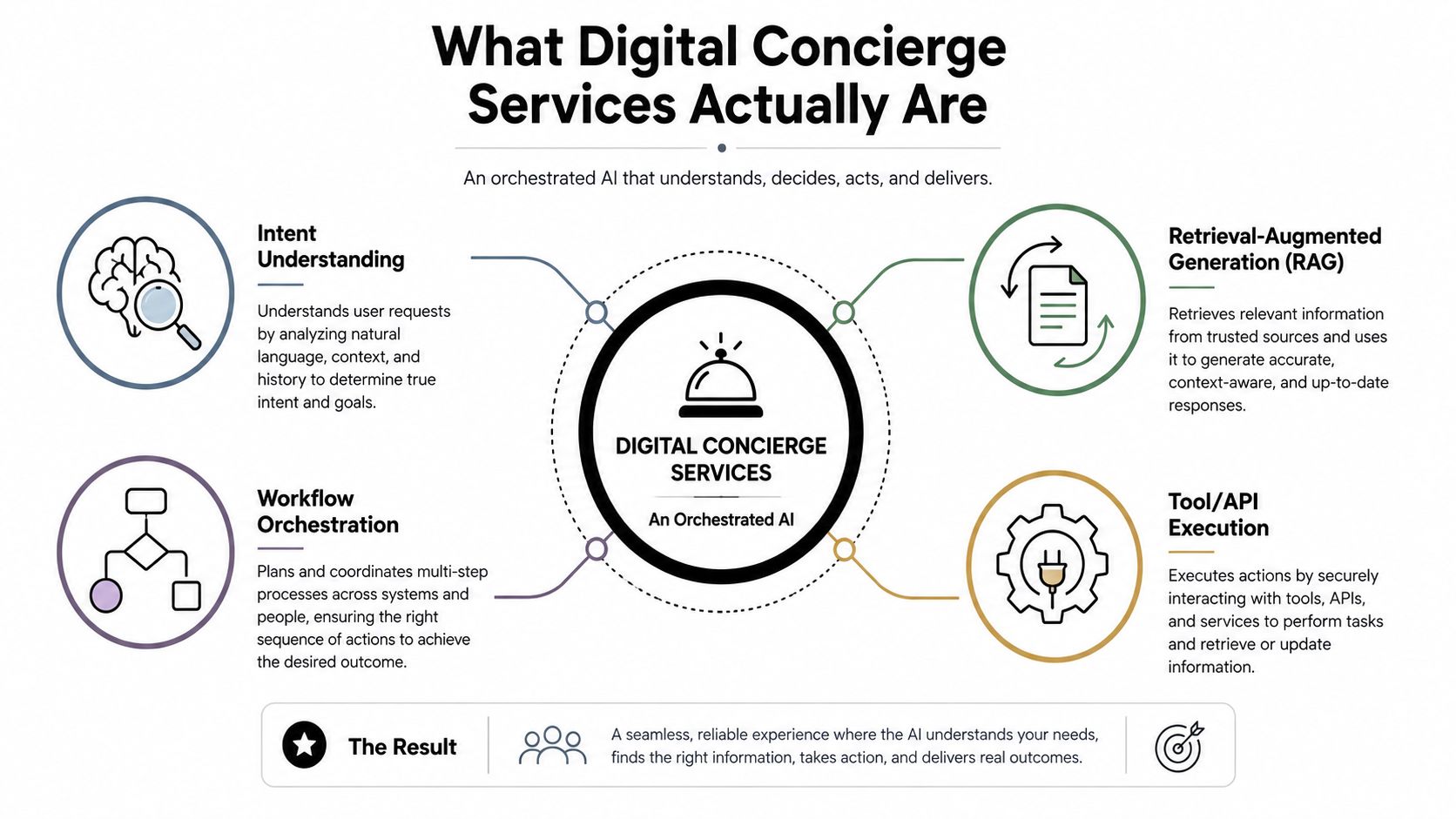
Customer Science describes the same idea as a service capability that understands intent, orchestrates knowledge and actions, completes tasks across channels, and hands off context to human agents when risk or value is high (Customer Science). That framing is the right one. A digital concierge is useful only when it knows when to stop.
How the rollout should look
The most disciplined implementations follow a staged model. First comes identity and consent, plus logging and a reference architecture. Then come connectors, core intents, and outcome analytics. Only after that should teams tune retrieval, add agent assist, and formalize an ethics review. That progression is the difference between a managed service layer and a brittle automation toy.
Bottom line: if a vendor can't explain identity, consent, audit trails, and handoff logic in plain English, they're selling surface-level convenience, not an operational concierge.
Digital Concierge Services Compared to Traditional Concierge Work
The old hotel-lobby model still has a place, but it's not the right answer for every request. Traditional concierges are strong at taste, discretion, and local relationships. Digital concierge services are better at speed, consistency, and volume. The mistake is treating them as competitors instead of layers.
The smartest luxury operations use both. Digital handles the repetitive, time-sensitive, and routine requests. Humans step in when judgment, negotiation, discretion, or recovery work is needed. That's the operating model that holds up under pressure.
| Criterion | Traditional Concierge | Digital Concierge Services |
|---|---|---|
| Response speed | Depends on staff availability and shift coverage | Immediate, especially for routine requests |
| Coverage hours | Bound to human staffing | 24/7 access across channels |
| Breadth of services | Strong but limited by manual coordination | Broad, especially for repeatable tasks and integrations |
| Personalization depth | Strong on nuance and relationship memory | Strong on preference capture and stored context |
| Escalation path | Manual, often informal | Built into the workflow when risk or value rises |
| Cost structure | Labor-heavy | More scalable, with lower marginal effort per request |
The market behavior backs this layered model. Industry metrics say 82% of concierge services have adopted AI-powered chatbots for customer support, and 65% say those chatbots increased response speed by 30% (WorldMetrics). That doesn't mean the human disappears. It means routine intake gets automated, while higher-value work stays in human hands.
In premium service, this division is the point. A digital system should collect the request, preserve the context, and clear the easy path. The human should still own the judgment call when the trip gets expensive, sensitive, or messy.
Inside the Workflow for a Private Jet Booking
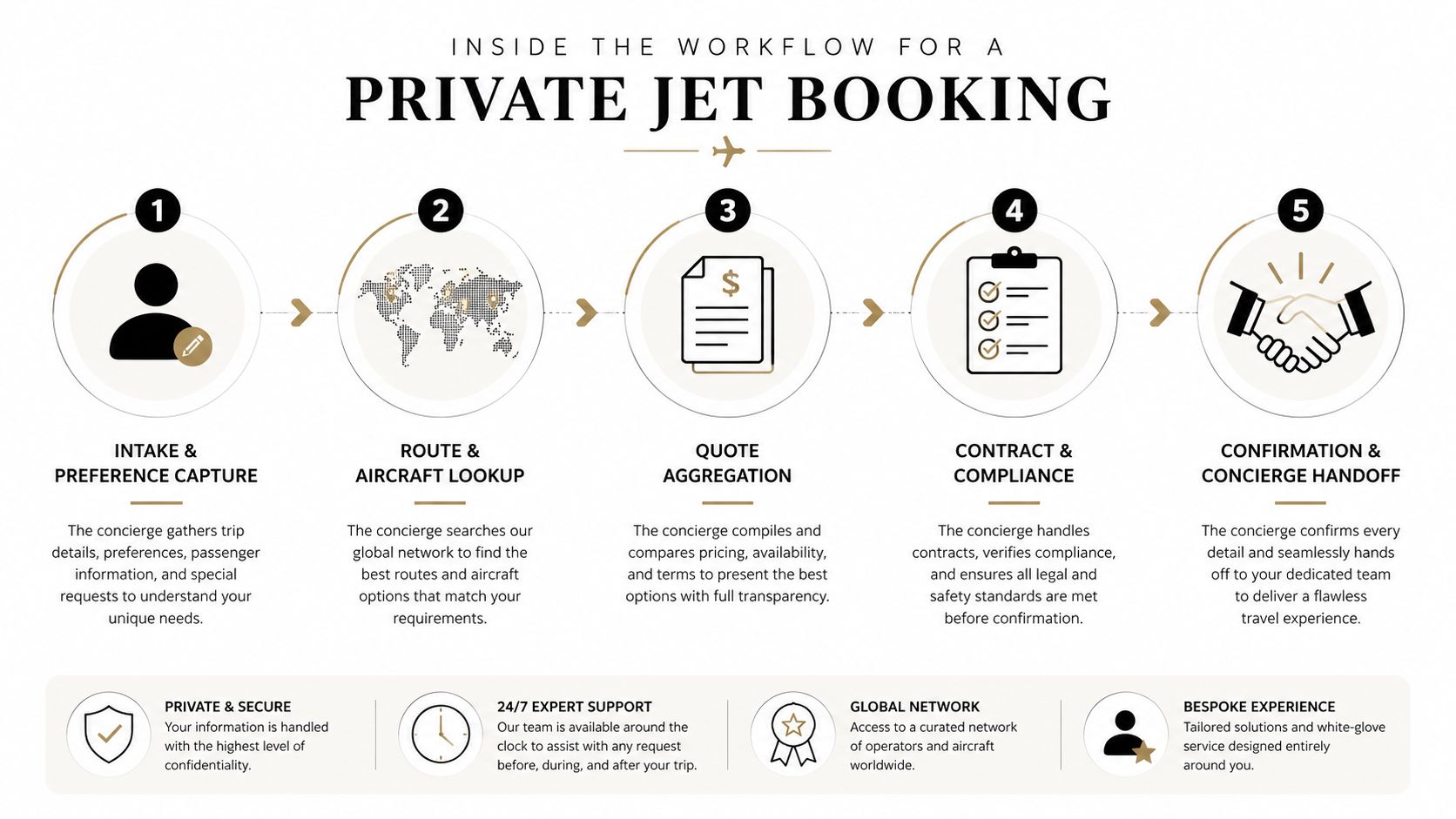
A private jet booking should not feel like six separate conversations. If it does, your workflow is too manual. A well-built digital concierge turns the trip into one thread, with the system handling the movement from inquiry to confirmation and the specialist only stepping in where judgment matters.
Here's the shape of that workflow in practice.
The booking path should be linear, not chaotic
First comes intake and preference capture. The concierge collects departure city, timing, passenger count, cabin preferences, pets, catering, ground transport, and any special constraints. Then the system moves into route and aircraft lookup, checking operator networks for suitable options.
That's where scale matters. Haute Jets sources from 3,500+ aircraft across 175 countries, which makes local sourcing and aircraft matching much more practical than forcing a client into a repositioned option. In a charter workflow, local sourcing is how you avoid paying for aircraft that have to travel empty before they can even carry your client.
Next is quote aggregation and confirmation. The system can assemble options, push the client toward the preferred aircraft, and keep the conversation moving in one place. The specialist then confirms the tail number, crew, weather, passenger manifest, and any compliance items before departure. That handoff is not a failure of automation. It's the correct boundary.
A strong operational model also pushes a 24-hour pre-flight detail update, then handles post-flight follow-up so the client isn't chasing fragments after landing. Haute Jets already publishes that kind of confirmation discipline in its charter model, and its booking page explains the workflow in more detail: booking a private jet with Haute Jets.
The right system does not hide human work. It removes the noise so the human can verify the things that matter.
Use Cases for HNW Travelers, Corporate Teams and Events
A digital concierge has to change shape by client type. A high-net-worth leisure traveler wants preference memory and family logistics handled without repetition. A corporate travel manager wants policy control and fast rebooking. An event producer wants people and gear moved on schedule, with no missed handoffs.
High-net-worth leisure travel
This traveler expects the system to remember what matters and stop asking for the same details. Pets, dietary preferences, cabin layout, preferred departure patterns, and last-minute multi-leg changes all belong in the profile, because the client should not restate them every time. A digital concierge earns its keep here by carrying context across the full itinerary and keeping the trip personal without wasting the client's time.
The useful part is not generic convenience. It is memory that affects the trip.
Corporate travel management
Corporate travel is a control problem. The concierge needs to enforce policy, support rapid rebooking, and keep travelers visible without forcing the buyer through clumsy back-and-forth. A good workflow becomes a booking control layer, not just a message relay. For a closer look at how business travel bookings get structured, see private jet charter for business corporate teams 2026.
For teams trying to fix your travel booking process, the win is fewer manual exceptions and fewer mistakes that slow approval, ticketing, or traveler changes. That matters more than polished interfaces. Corporate buyers want speed, policy compliance, and clean records that do not create extra work for finance or operations.
Events and sports productions
Event and sports work is the harshest test. Talent, crew, equipment, and timing all collide, and the schedule often changes while people are already in motion. The concierge has to coordinate movement under tight deadlines and keep updates clean when plans shift. In this setting, the system matters because it reduces the number of people chasing the same information and lowers the chance of a missed transfer or late arrival.
This is also where aircraft-specific workflows matter. Private aviation for corporate teams is a different operating problem from hotel coordination, because the booking touches passenger manifests, operator rules, ground timing, and departure windows that do not forgive drift. A digital concierge should handle the routine routing and status updates, then hand off anything that affects aircraft choice, crew timing, or compliance to a human who can make the call.
The lesson is straightforward. A digital concierge is not one product. It is a configurable layer that behaves differently depending on the traveler, the trip, and the stakes.
Where Automation Should Stop and a Human Should Take Over
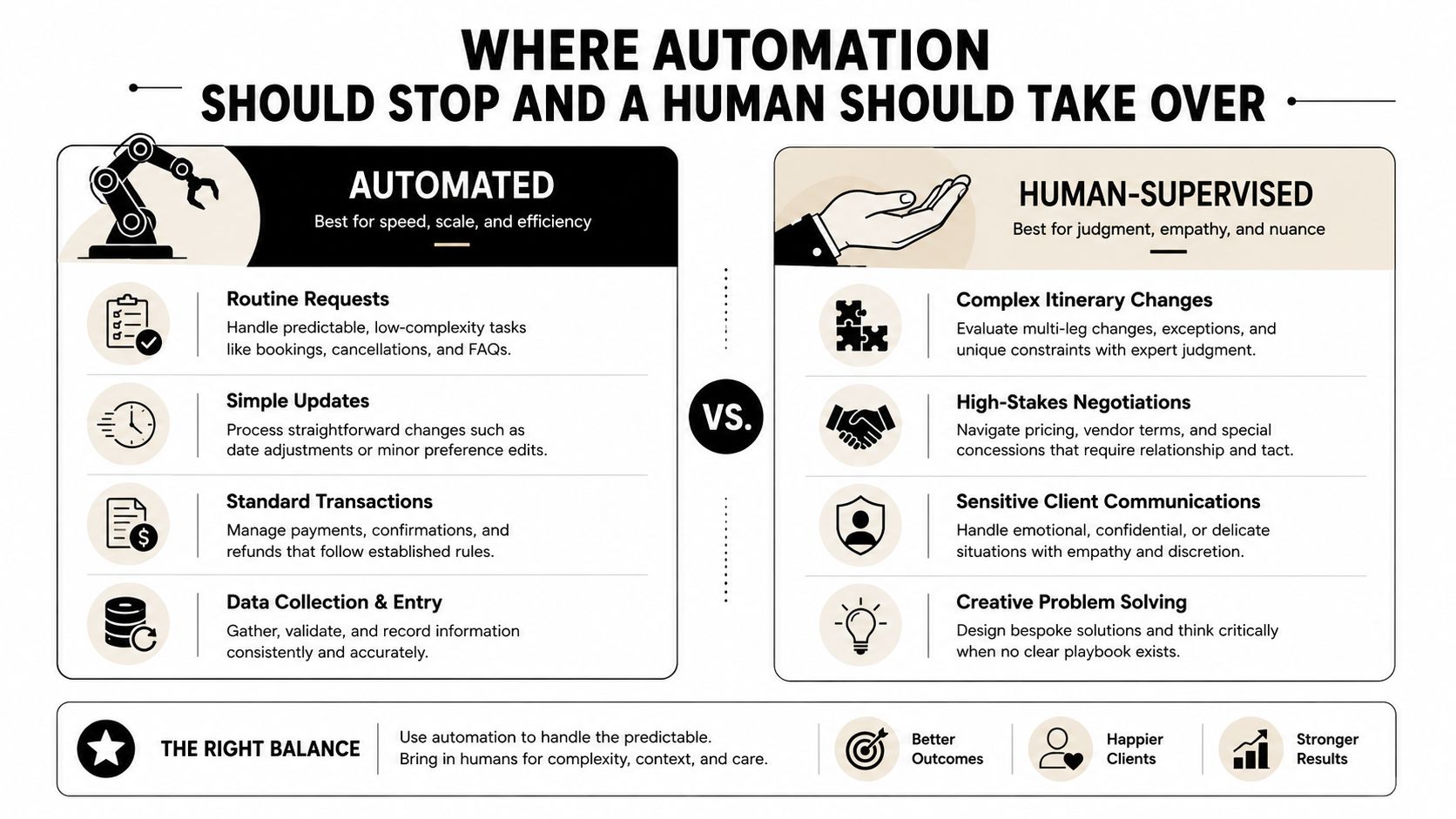
More automation is not always better. In luxury service, the line is clear, and if you blur it, you make expensive mistakes. The system should automate what is repeatable and reversible. It should stop the moment a request becomes safety-sensitive, compliance-sensitive, or reputation-sensitive.
Automate these requests
Routine FAQ-style questions belong in automation. So do quote generation, itinerary summaries, basic status updates, and standard reservations. These are high-volume, low-risk tasks, and they benefit most from speed and consistency.
That logic matches the broader market trend toward mobile and digital handling of service requests, with more than 65% of U.S. concierge requests already going through digital channels (Wifitalents). The point isn't that humans vanish. The point is that nobody should spend human time on work a system can complete accurately.
Keep these with a specialist
Anything involving aircraft substitution, operator vetting, weather disruption, pet policy exceptions, passenger manifest changes, or discretion around a sensitive client should remain human-supervised. Private aviation is too exposed to risk, timing, and judgment to let a system make the final call on edge cases.
Practical rule: if a bad decision could create a safety issue, a compliance issue, or an awkward conversation you can't unwind easily, the machine should draft, not decide.
Most vendor marketing gets lazy. It says AI can handle everything, then relies on a human team behind the curtain to clean up the hard parts. That's not a flaw if the handoff is deliberate. It's a flaw if the buyer thinks the software is doing the judgment work.
A good concierge architecture helps the human make faster, better calls. It does not replace the call.
How to Choose and Implement a Digital Concierge Service
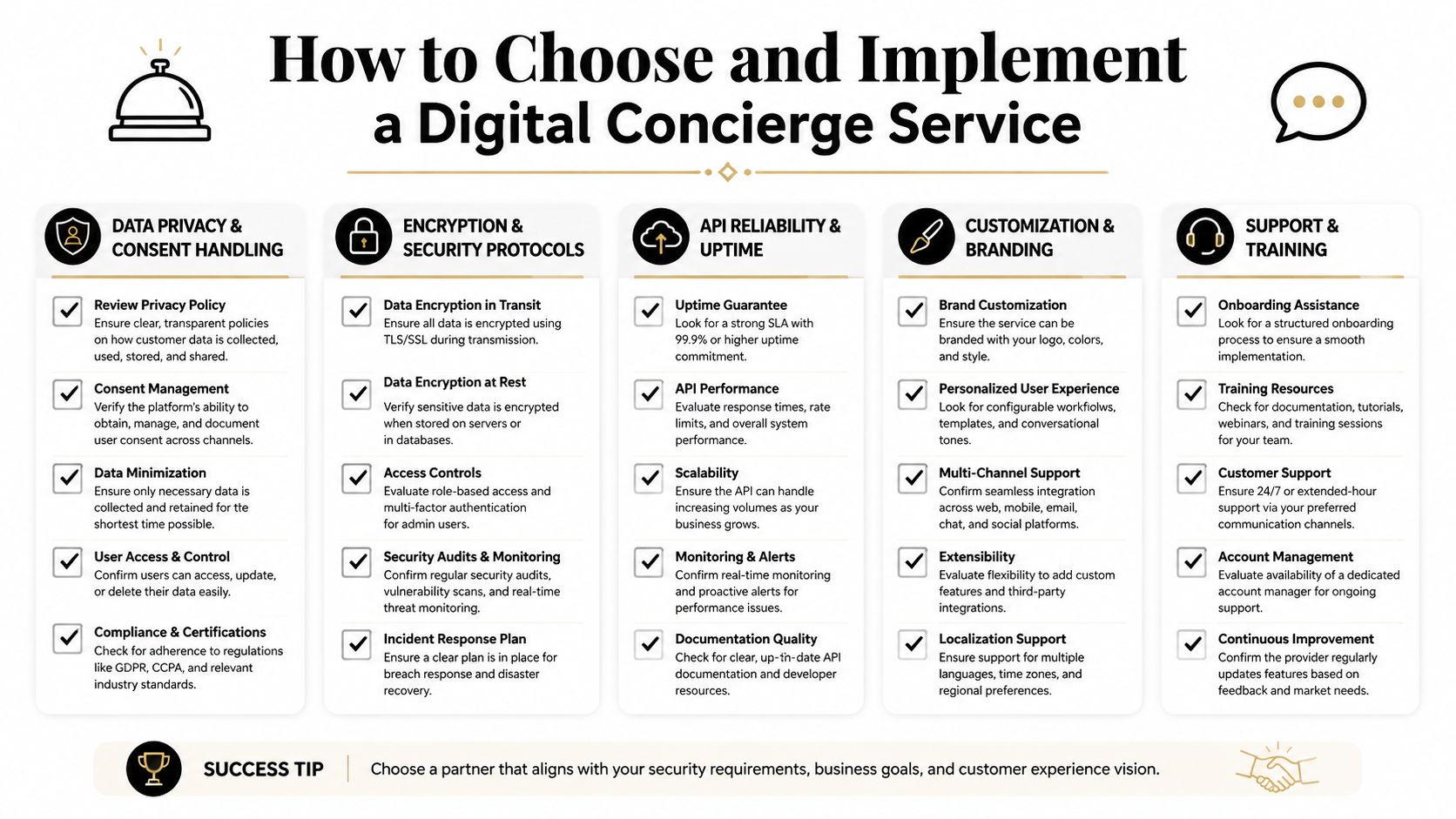
Start with controls, not features. If a platform can't handle privacy, identity, logging, and payments cleanly, don't buy it. Luxury clients won't forgive a convenience layer that creates a security or compliance mess.
What to check before you sign
Look for data privacy and consent handling, encryption and audit logs, and clean identity verification. In private aviation, also ask how the platform handles operator vetting and whether it can reflect safety standards like Wyvern Wingman and Argus Gold/Platinum in the workflow. Payment flexibility matters too, especially if your client base wants settlement options that include Bitcoin and stablecoins.
Integration is another gate. The system should fit into your existing travel and charter stack instead of forcing everyone into a separate workflow. If your team still has to copy data between systems, you've bought overhead, not efficiency.
Roll it out in phases
Start with one workflow, like inquiry intake or quote follow-up. Measure whether it reduces back-and-forth, speeds response, and keeps the human handoff cleaner. Then expand into more intents once the first use case is stable.
Haute Jets' concierge charter model is one example of a service that sits inside that kind of workflow, but the bigger point is that any provider should prove the process before it promises transformation. If calendar coordination is the pain point inside your broader travel stack, the SyncThemCalendars sync guide is a useful reference for understanding how clean sync reduces operational drag.
Don't skip the contract. Ask who owns the data, how you exit cleanly, and what happens to your service history if you switch systems. A slick demo is not a substitute for a durable operating agreement.
The Future of Digital Concierge Services in Luxury Travel
The future is not more chat. It's more completion. The best systems will move from answering requests to running entire trip workflows, with better personalization built from persistent preference graphs and cleaner integration with payments. For travelers who want to settle in digital assets, crypto-native payment rails will matter more, not less.
The category is also moving toward tighter orchestration between automation and humans, which is the only model that makes sense in premium travel. The workflows will get more agentic, but the judgment still has to live with the operator. For a look at how that broader shift is being framed in aviation, innovative technology redefining the exclusive private jet journey is worth a read.
The takeaway is blunt. Match the concierge to the use case, automate the routine, escalate the sensitive, and build privacy and payments into the structure from day one. That's not a luxury add-on anymore. It's the operating layer under modern luxury travel, including private jet charter with providers like Haute Jets.
If you want a charter workflow that already thinks in terms of speed, verification, and human handoff, visit Haute Jets and speak with the team about your next trip. They'll help you translate this playbook into an actual booking process, not just a prettier inbox.