A lot of private jet travelers judge a flight by what they can feel. An on-time departure, a calm climb, a smooth reroute around weather, a clean handoff on arrival, and a crew that seems to know what's coming before anyone asks. If you're the passenger in the cabin, or the travel manager responsible for the trip, that polish can look effortless.
It isn't.
Behind that polished experience sits an aviation support system most passengers never hear about. One of the most important parts of it is the Flight Service Station, a behind-the-scenes resource that helps pilots make better decisions before departure, during the flight, and when conditions change. That matters whether you're flying a quick business leg or coordinating a complex itinerary with multiple moving pieces.
This guide appears on Haute Jets Journal because private aviation clients should know what protects the flight they're paying for. The more you understand the systems supporting your crew, the easier it is to recognize the difference between a simple aircraft booking and a fully managed travel operation.
The Unseen Network Behind Every Flawless Flight
You leave Aspen after a winter meeting. The runway is clear, the departure is smooth, and the crew already knows about shifting weather farther south. By the time you land in Miami, the arrival feels calm and controlled. No visible scramble. No surprise delays. No uncertainty in the cockpit.
That kind of trip doesn't happen because a pilot shows up and points the aircraft in the right direction.
It happens because aviation relies on layers of support that most passengers never see. One of those layers is the Flight Service Station, often shortened to FSS. If air traffic control manages the movement of aircraft, FSS helps feed pilots the information they need to prepare, adapt, and stay ahead of trouble.
For a private charter client, that translates into three things that matter immediately:
- Safety support: Pilots get structured weather and operational information before and during the trip.
- Fewer unpleasant surprises: Airport changes, airspace restrictions, and route issues are identified earlier.
- A smoother experience: Better planning usually means fewer last-minute disruptions in the cabin.
A seamless private flight often reflects invisible coordination long before the cabin door closes.
That hidden diligence is part of what separates premium aviation service from a basic transportation transaction. It also aligns with the broader discipline behind private jet safety and reliability standards, where the best operators treat planning as seriously as flying.
Passengers don't need to work the radios or interpret weather charts. But it helps to know that your flight isn't supported by the cockpit alone. There's a quiet network behind it, and Flight Service is one of its most important safety layers.
What Is a Flight Service Station
A Flight Service Station is best understood as the pilot's advisory desk, information hub, and operational support line. It isn't there to control traffic. It's there to help pilots gather and use critical information that makes a flight safer and more predictable.
Think of it this way. Air Traffic Control tells aircraft where to go in controlled traffic flow. Flight Service helps pilots understand what they need to know before they go, and what may have changed along the way.
The simplest way to think about FSS
If you're not a pilot, aviation acronyms can blend together. The easiest distinction is this:
- FSS provides information
- ATC provides instructions
- Airport service providers handle the ground experience
That informational role is broad. Flight Service supports pilot briefings, flight plan processing, en route advisories, emergency support, and operational updates tied to weather and notices affecting the trip.
Here's a visual summary of that role:
A service with deep roots
Flight Service isn't a modern add-on. According to the FAA's history of Flight Service, Flight Service Stations were officially named by the FAA in March 1960, evolving from "air mail radio stations" established along transcontinental routes. The FAA celebrated 100 years of this vital service in 2020, marking a century of providing weather and aeronautical data to pilots.
That history matters because it explains the mission. From the beginning, Flight Service existed to get usable operational information into pilots' hands. The tools have changed, but the purpose hasn't.
A private flyer may also hear related airport terms while traveling. If you've ever wondered where passenger lounges, fueling, and ramp-side concierge support fit in, this guide to FBO meaning in aviation helps separate those ground services from the Flight Service role.
Later in the process, many pilots still use direct flight service channels such as 1-800-WX-BRIEF and 1800wxbrief.com for weather and aeronautical support, as described by the FAA and AOPA in their flight service materials.
For readers who want a quick visual explanation, this short video is useful:
Practical rule: When conditions are changing, good aviation decisions start with better information, not better guesses.
Core Services That Ensure a Safe Journey
For passengers, the phrase “flight service station” can sound abstract until you connect it to actual decisions affecting the trip. In practice, FSS supports several functions that directly shape safety, comfort, and reliability.
Pre-flight weather briefings
Before departure, pilots need a clear operational picture. That includes weather trends, airport conditions, route hazards, and any factors that could affect timing or comfort.
This isn't casual small talk about whether it might rain. It's structured decision support. If a route includes mountain weather, convective activity, low visibility, or changing winds, the crew uses that information to choose the best route, altitude, fuel planning approach, and alternates.
For the passenger, this often explains why a departure time changes slightly or why a crew chooses a routing that feels less direct but more stable.
Flight plan filing and tracking logic
Flight Service also supports the administrative backbone of a trip by helping with flight plan processing. That sounds procedural, but it carries real safety value.
According to the Flight Service Station overview on Wikipedia, in an emergency, FSS has the authority to initiate search-and-rescue for a missing VFR aircraft. Their flight plan processing protocol includes a mandatory "estimated time en route" calculation that is critical for determining when an aircraft is officially overdue and triggering this response.
That means the paperwork isn't just paperwork. It creates a timeline that becomes critical if something goes wrong.
NOTAMs and operational alerts
Another major responsibility is distributing NOTAMs, or Notices to Air Missions. These are official alerts that may affect the safety or legality of a flight.
A NOTAM may involve:
- Runway changes: A runway may be closed or shortened for maintenance.
- Airspace restrictions: A temporary flight restriction may appear around a major event or sensitive area.
- Procedure changes: An airport approach, taxiway, or lighting system may be unavailable.
For a charter passenger, that can mean a switch in arrival flow, a delay in departure, or a change to the preferred airport. Those adjustments aren't random. They're responses to official, time-sensitive information.
A polished charter experience often depends on how early the crew receives and acts on these alerts.
In-flight advisories when conditions shift
Even a strong pre-flight briefing doesn't freeze the day in place. Conditions evolve. That's where inflight support matters.
Flight Service has long helped pilots with en route weather awareness and operational updates. If conditions build along the route, pilots can use that support to reassess options rather than wait for a problem to become immediate. For passengers, this is one reason private aviation often feels proactive instead of reactive.
If you like following a trip's progress from the passenger side, practical consumer-facing tools can complement the operational systems pilots use. This overview of Maxson Transfer flight status advice is a useful example of how travelers can interpret live flight tracking without confusing it with the certified information channels crews rely on.
Search and rescue as the final safety net
The least visible role may be the most important. FSS is part of aviation's safety net when an aircraft is overdue or a pilot needs urgent help.
That function matters even if you never hear about it from the cabin. In private aviation, a lot of safety exists precisely because professionals plan for circumstances that never happen.
For travelers trying to understand the wider maintenance and operational framework around a charter flight, this explanation of MRO in aviation and its role in safety adds another useful layer. Maintenance readiness and information readiness work together. One keeps the aircraft airworthy. The other helps the crew operate it wisely.
FSS vs ATC and FBO Demystifying Aviation Acronyms
Passengers often hear three terms around the same trip: FSS, ATC, and FBO. They sound related because they all sit inside the same travel experience, but they do very different jobs.
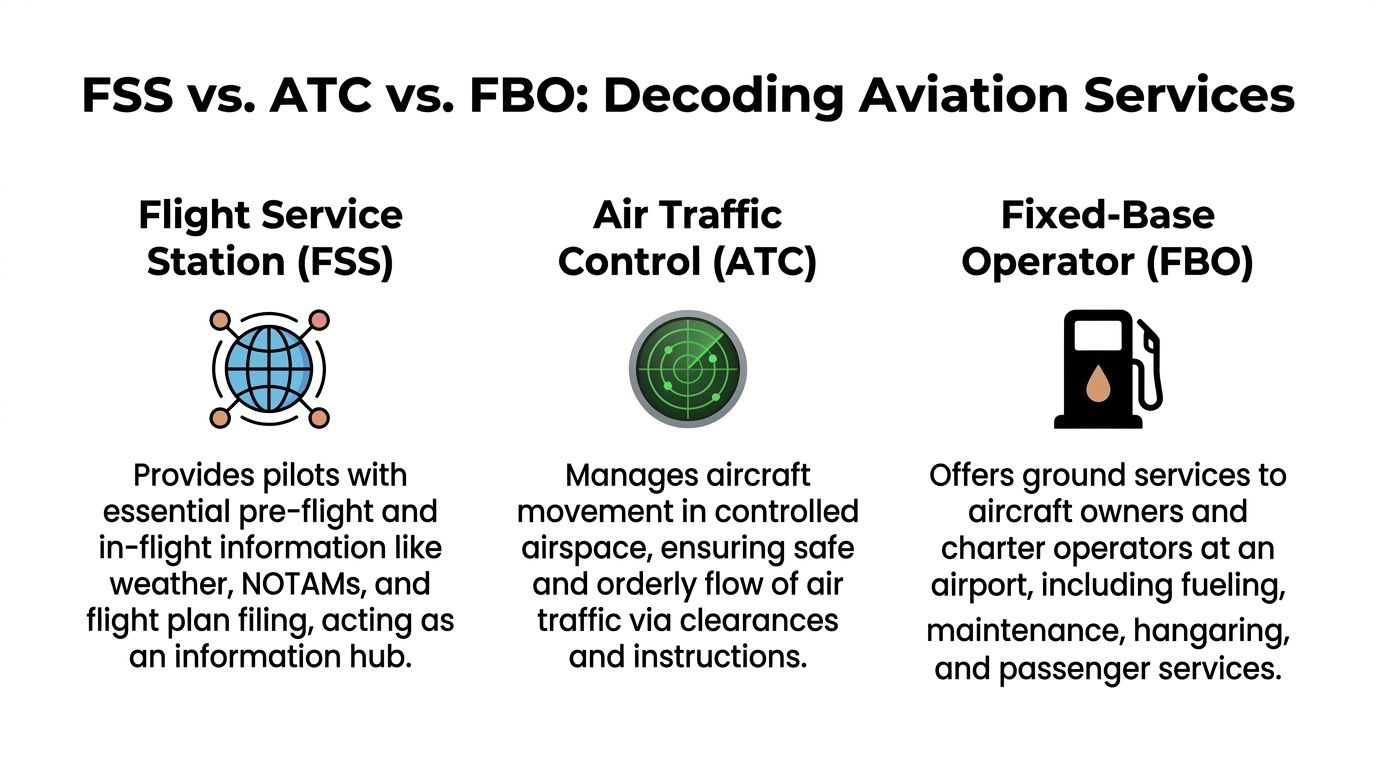
The cleanest way to separate them is by function. One informs. One directs. One serves the aircraft and passenger on the ground.
The side-by-side view
| Service | Primary role | What it means to you |
|---|---|---|
| Flight Service Station | Advisory and information support for pilots | Better pre-flight awareness and a stronger safety net |
| Air Traffic Control | Directs aircraft movement in controlled airspace | Organized departures, spacing, routing, and arrivals |
| Fixed-Base Operator | Ground handling and passenger support at the airport | Lounge access, fueling, ramp services, and car coordination |
What FSS does that ATC does not
According to the CFI Notebook explanation of Flight Service Stations, unlike ATC, Flight Service Stations do not issue separation clearances. Their primary function is informational, relaying ATC clearances and disseminating weather reports and PIREPs. The primary FSS contact frequency is 122.2 MHz, while 122.0 MHz is dedicated to en route weather advisories (Flight Watch).
That distinction clears up a common misunderstanding. If a pilot needs clearance to enter a controlled flow, that's ATC territory. If the pilot needs weather support, pilot reports, notices, or help managing a flight plan, that's where Flight Service comes in.
A practical example passengers can remember
Use this quick mental model:
- Need a weather brief before departure? Think FSS
- Need clearance to depart or land in controlled traffic? Think ATC
- Need your bags loaded and your car waiting planeside? Think FBO
FSS supports the pilot's decisions. ATC manages aircraft spacing. The FBO handles the airport-side hospitality and logistics you actually see.
Once you understand that split, private aviation becomes easier to read. What seems like one unified service is really a coordinated handoff among specialized teams, each focused on a different part of the trip.
The Role of FSS in Modern Private Jet Charters
Modern private jets carry advanced avionics, digital weather displays, data-linked tools, and high-tech planning software. That sometimes leads passengers to assume Flight Service is a legacy function that technology has replaced.
It hasn't.
What has changed is how Flight Service is delivered. The system has evolved from a heavily radio-centered model into a more integrated service environment that includes phone, web access, and contractor-supported operations. The mission remains the same: give pilots timely operational information and support sound decision-making.
Faster support, less friction
One of the clearest signs of modernization is response speed. During the shift from FAA-operated to contractor-operated stations, the U.S. Department of Transportation reported that the average pilot call wait time during peak periods was reduced from approximately eight minutes to consistently below forty-five seconds in its testimony on the Flight Service transition.
For passengers, that's more meaningful than it first appears. Faster access to flight service means pilots can resolve planning questions more efficiently, especially on busy days when weather and airspace constraints are changing.
Why it still matters in charter operations
Private charter flights often involve variables the airlines don't handle the same way. Smaller airports. Tighter schedules. More customized routing. Faster turns. Premium passenger expectations.
In that environment, a strong information chain matters because crews need to know:
- What changed at the departure airport
- Whether a route restriction affects the planned flight
- How destination conditions are developing
- What backup options remain available if the trip needs adjusting
That support can help a crew avoid turbulence-prone areas, anticipate operational issues at the destination, or make a more conservative fuel and routing decision early rather than late.
The system is changing, but not disappearing
The broader flight service environment is also shifting. The FAA has maintained these facilities as an ongoing part of the national aviation system, serving users across the contiguous United States, Hawaii, Puerto Rico, and Alaska through pilot briefings, flight planning, inflight advisory services, weather cameras, and NOTAM dissemination, as outlined on the FAA's Flight Service page.
At the same time, aviation publications have noted that traditional radio-based Flight Service frequencies are being wound down as mobile cockpit technology becomes more prominent. In some regions, especially remote ones, questions have also emerged around frequency consolidation and reliability. Reporting tied to the Department of Transportation's Essential Air Service policy notes reduced coverage in some communities and points to concern about how pilots access backup frequencies when the primary channel is less dependable, as discussed in the DOT's Essential Air Service policy material.
That mix of modernization and uneven regional access is exactly why experienced crews don't treat Flight Service as an afterthought. They treat it as one input in a broader operational discipline.
Good charter logistics don't rely on a single screen, a single call, or a single assumption. They rely on cross-checking.
For the client, the result is simple. Better support upstream usually means a calmer flight downstream.
How Haute Jets Manages Flight Logistics for You
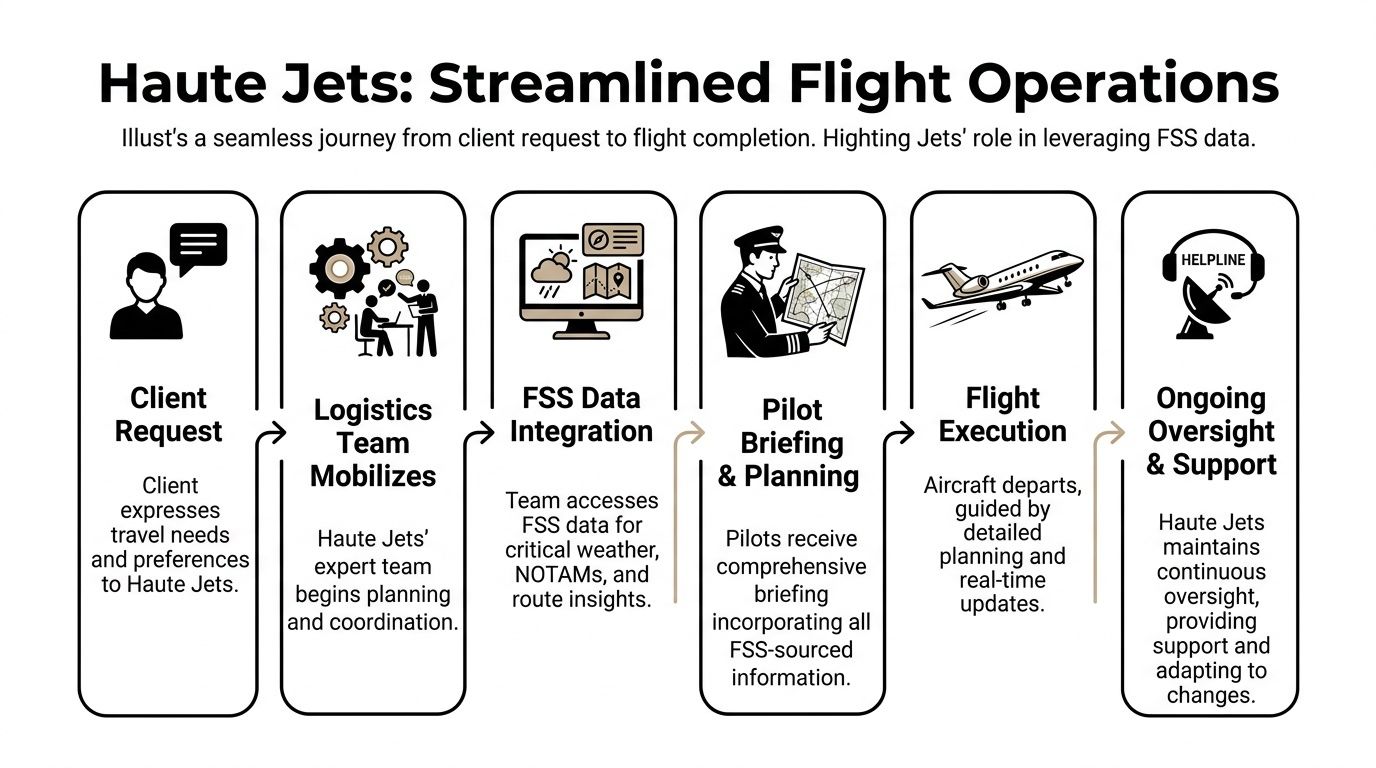
Most private charter clients don't want to learn radio frequencies, decode NOTAM language, or monitor aeronautical systems. They want confidence that the professionals handling the trip have already done it well.
That's the right instinct.
A serious charter process doesn't stop at sourcing an aircraft. It includes vetting the operator, confirming the aircraft details, aligning crew readiness, checking airport conditions, reviewing weather, and ensuring the flight's operational picture is complete before departure. Flight Service inputs are part of that wider discipline, even when the passenger never sees them directly.

That's also why the best private aviation experiences feel calm. The complexity is absorbed behind the scenes, not pushed onto the traveler. Crews and operations teams sort through changing weather, airport notices, routing considerations, and timing decisions so the client can focus on the purpose of the trip.
What that means in practical terms
For a passenger or travel manager, strong logistics management should include:
- Aircraft clarity: You know the specific aircraft being used, not just a category label.
- Crew transparency: You receive meaningful trip details before departure.
- Weather awareness: The pre-flight picture is reviewed rather than assumed.
- Operational coordination: Ground handling, timing, and airport specifics are confirmed in advance.
Haute Jets centers that kind of planning in its client process. Its model emphasizes exact aircraft selection, sourcing from 3,500+ aircraft across 175 countries, and using only operators with Wyvern Wingman or ARGUS Gold/Platinum credentials. Clients also receive a 24-hour pre-flight confirmation with flight details that include a weather briefing, which is exactly the kind of disciplined communication serious travelers should expect.
You don't need to become an expert in flight service station procedures to benefit from them. You need a charter partner that respects those systems, works with top-tier operators, and manages the details before they become your problem.
If you want private charter arranged with the kind of behind-the-scenes diligence that supports safer, smoother travel, explore Haute Jets. You can book on demand, choose the exact aircraft, and rely on a team that manages the operational details with the same care you expect in the cabin.