

Global 5000 Jet: A Charter & Buyer's Guide (2026)
A typical Global 5000 charter request starts with a strong headline rate, then gets expensive once the aircraft has to be brought in from another city. That is where clients overpay. Traditional brokers and jet cards often build in repositioning costs that can add 20 to 40 percent to the trip price, even when the aircraft itself is the right fit.
The global 5000 jet deserves serious consideration if you need a true large-cabin aircraft for long missions without paying for more jet than your schedule requires. The smarter question is not only whether the aircraft fits your route. It is whether your charter model is forcing you to subsidize empty legs, crew positioning, and inefficient sourcing.
That is the practical advantage of working with Haute Jets. The model focuses on sourcing aircraft locally whenever possible, which directly reduces the ferry expense that imperceptibly inflates many Global 5000 quotes. Same aircraft. Better trip economics.
The ownership side demands the same discipline. A Global 5000 can be an excellent asset for a company or family with frequent long-range travel, but it becomes an expensive mistake if your annual usage, routing, and flexibility needs do not justify fixed costs against high-quality charter access.
Start with mission and cost control. Then decide whether the Global 5000 is the right tool.
An Introduction to the Bombardier Global 5000
A common mission looks like this. Your team leaves New York for London for a board meeting, then needs flexibility for another stop or a changed return schedule. You want transoceanic capability, a real work cabin, and airport access that doesn't force you into the least convenient commercial-style options.
That's where the Bombardier Global 5000 has earned its place.
Bombardier announced the Global 5000 in 2001, flew the first one in March 2003, and secured FAA/JAA certification in October 2004, according to Jetcraft's Global 5000 overview. It came to market as a faster, slightly smaller derivative of the original Global Express, which had been introduced in 1997.
Why this aircraft still matters
The Global 5000 hits a sweet spot. It gives you ultra-long-range capability without the footprint and operating profile of the very largest business jets. For many clients, that's the smarter buy and the smarter charter.
It works especially well for:
- Corporate teams who need a cabin that supports meetings, privacy, and productive long sectors
- Family travelers who want a genuine long-haul aircraft without unnecessary excess
- Charter clients who care as much about airport practicality and dispatch reliability as they do about luxury
- Buyers who want a mature, highly understood platform with an active secondary market
The 2026 charter reality
If you're shopping this aircraft for charter, timing matters. The market is tightening. Amid supply shortages and changing production priorities at Bombardier, the Global 5000 charter market is getting tighter, with a global fleet retirement rate of 1.8% from 2019 to 2024 and projected hourly rates rising 15% to 25% to over $8,000 by 2026, according to AIN's Global 5000 and 6000 series coverage.
That doesn't mean you avoid the aircraft. It means you avoid lazy booking models.
Practical rule: In a tightening market, aircraft selection matters less than sourcing discipline. The same Global 5000 can be a rational charter or an overpriced one, depending on where it starts the day.
My view
If your missions regularly involve long domestic sectors, transatlantic flying, or executive teams that need to work in flight, the Global 5000 deserves to be on your shortlist. If you only fly shorter regional hops, it's often more airplane than you need.
The jet is not the trap. The pricing structure often is.
Inside the Global 5000 Cabin Experience
You feel the difference on hour six, not in the first ten minutes after boarding. That is why the Global 5000 keeps showing up on serious charter shortlists. The cabin supports work, privacy, rest, and proper service in a way smaller jets do not.
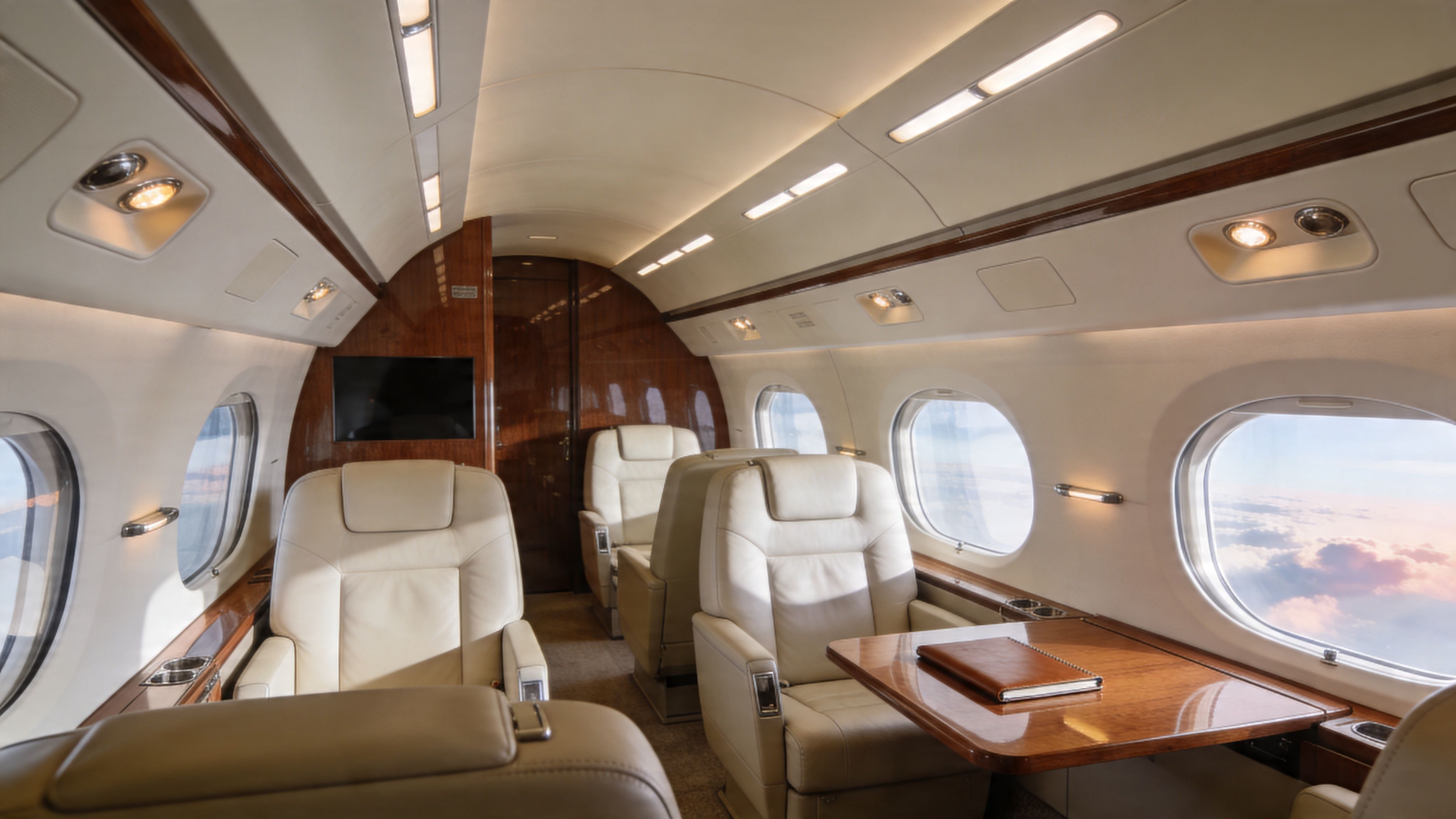
Bombardier designed the aircraft as a true large-cabin platform, with distinct living zones rather than one long seating area. That matters more than headline luxury. If you are chartering for a management team, a family office, or a principal traveling with staff, cabin separation determines whether the flight is productive or draining.
What the cabin feels like in use
The forward galley supports real meal service, which becomes important on longer sectors where a light snack setup is not enough. The main cabin typically gives you a forward club area for conversation or meetings, then a secondary zone that works for dining, quiet work, or a second social group. The aft cabin gives one traveler or couple meaningful privacy.
That layout is the point.
A Global 5000 works well for clients who need multiple functions on one flight. One group can work. Another can rest. A principal can step away for private calls without turning the whole cabin into a silent office.
If you want a broader benchmark for how cabin layouts differ by aircraft category, this private jet interior guide gives a useful comparison.
Why the layout matters economically
Cabin comfort is not only a luxury issue. It is a cost issue.
If your passengers can work and rest properly, you avoid the hidden expense of schedule padding, extra hotel nights, and flying a larger aircraft than the mission requires. The Global 5000 often hits the sweet spot. You get a cabin that feels substantial enough for long trips without paying to step up into an even bigger category just for usable space.
That same logic applies to charter sourcing. Traditional brokers and many jet card programs often build in repositioning costs that can add 20 to 40 percent to the trip. On an aircraft in this class, that premium gets expensive fast. Haute Jets counters that by sourcing locally available aircraft first, which is the smarter way to book a Global 5000 if you care about cabin quality and total trip cost.
The aft section is what repeat clients remember
Short flights flatter almost every premium jet. Longer flights expose weak layouts.
The aft section is where the Global 5000 earns its rate. Depending on the configuration, it can serve as a lounge, a sleep area, or a quiet retreat for the lead traveler. That flexibility gives the aircraft broader charter appeal and helps preserve ownership value because the cabin works for more than one type of mission.
It is a strong fit for:
- Founders and CEOs who need private call time away from colleagues
- Families who want adults and children in separate zones
- Entertainment and sports travelers who need both social space and downtime
- Ownership buyers who care about cabin versatility and resale appeal
The baggage capacity is also useful in real-world travel. This is an aircraft that can handle the luggage load that comes with longer business trips and international family travel without forcing awkward tradeoffs in the cabin.
Here's a closer visual look at the aircraft in motion and on board:
What this means for a real trip
A long mission tests more than endurance. It tests whether the aircraft lets you arrive ready to make decisions.
The Global 5000 usually does. It gives you enough separation to keep noise, work, meals, and rest from colliding. For charter clients, that means fewer compromises. For buyers, it means the cabin stays relevant across executive travel, family trips, and mixed-use missions.
Global 5000 Performance and Route Capabilities
A client needs to leave Teterboro after lunch, meet in London the next morning, and avoid paying for an aircraft repositioning from another state before the trip even starts. That is where the Global 5000 makes economic sense. It gives you true long-range capability, strong airport access, and a better chance of finding a nearby aircraft instead of absorbing the hidden ferry costs that often inflate charter quotes.
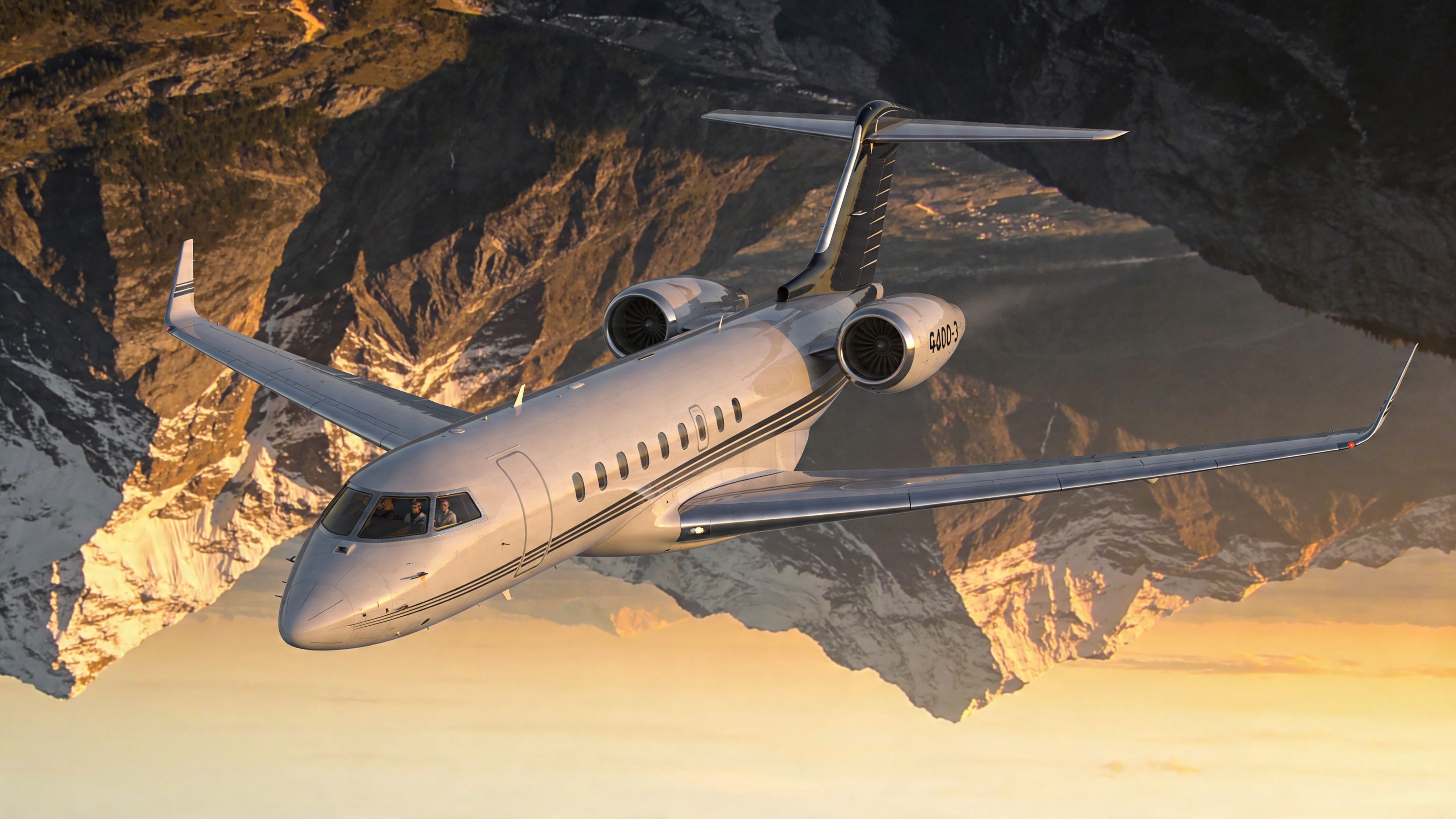
This aircraft delivers a 5,200 nautical mile range and a top speed of 513 knots, according to Liberty Jet's Global 5000 aircraft profile. Those numbers matter because they cover the missions many clients fly most often. Transatlantic business trips. Long domestic sectors. West Coast to Hawaii. You get heavy-jet capability without stepping into a larger, more expensive category unless your schedule requires it.
Range that fits real missions
The route map is strong where it counts. Bombardier positions the Global 5000 for missions such as New York to London, Miami to London, and Los Angeles to Honolulu, with the aircraft built to handle long sectors efficiently across business and leisure demand, as outlined in Bombardier's Global 5000 product page.
That matters for charter economics. A jet that can cover these city pairs nonstop or with strong range margin is easier to place on profitable missions, which supports broader market availability. More availability near your actual departure point is not a small detail. It is one of the clearest ways to avoid the 20 to 40 percent repositioning premiums that traditional brokers and jet card programs often bury inside a quote. Haute Jets' local sourcing model directly addresses that problem by searching for the right aircraft near your mission, not forcing your mission to fit a pre-sold fleet position.
Airport access affects both time and cost
The Global 5000 is also more flexible on runway performance than many clients expect from a large-cabin jet. Conklin & de Decker's aircraft operating profile notes a takeoff field length of about 5,000 feet, which expands the list of usable airports in practical terms.
That changes the trip in ways clients feel immediately.
| Practical benefit | Why it matters |
|---|---|
| Closer departure options | You can use more executive airports instead of defaulting to major hubs |
| Lower ferry exposure | More suitable airports improve the odds of sourcing an aircraft closer to where you are |
| Better schedule control | You lose less time positioning the aircraft to and from oversized airports |
| Urban access | Certain constrained business airports become realistic options for a heavy jet mission |
The aircraft is also certified for steep-approach operations, including London City, according to Bombardier. If you fly into financial centers where airport access drives the day, that certification is valuable. It can save hours on the ground and keep your itinerary tighter.
Performance matters most when the schedule is tight
Speed gets attention. Climb performance and dispatch reliability save trips.
Jet Advisors' Global 5000 specifications list the aircraft with two Rolls-Royce BR710A2-20 engines, each producing 14,750 pounds of thrust, and a climb to 43,000 feet in 23 minutes. For the client, the practical benefit is simple. The aircraft gets to efficient cruise altitudes quickly and performs like a serious business tool, not just a comfortable cabin with long legs.
Reliability matters just as much. Delays, substitutions, and last-minute ferry moves are where charter costs start to drift upward. An aircraft with a large installed fleet, proven systems, and broad operator familiarity gives you a better chance of departing on time and keeping the original quote intact.
My recommendation on mission fit
Choose the Global 5000 if your mission profile includes transatlantic sectors, long U.S. flights, or premium city pairs where airport flexibility affects the whole day. It is one of the smarter charter choices for clients who want heavy-jet range without paying for more aircraft than they need.
It is also a strong acquisition target if you value genuine mission utility over brochure theater. And if you are chartering, the economics improve even more when the aircraft is sourced locally. That is where Haute Jets has an edge, because avoiding unnecessary repositioning is often the fastest way to lower the actual trip cost without giving up cabin size, speed, or range.
How the Global 5000 Compares to Similar Jets
A client looking at the Global 5000 is usually deciding between three things. Cabin comfort. Mission range. Real charter cost after sourcing and repositioning are accounted for. That third point gets ignored too often, and it leads people toward the wrong aircraft for the wrong reason.
Where the Global 5000 makes sense against rivals
Set the marketing claims aside and compare the aircraft the way an operator or experienced charter buyer would. The Global 5000 sits in a very practical position between ultra-long-range prestige jets and large-cabin aircraft that look cheaper until the trip profile exposes their limits.
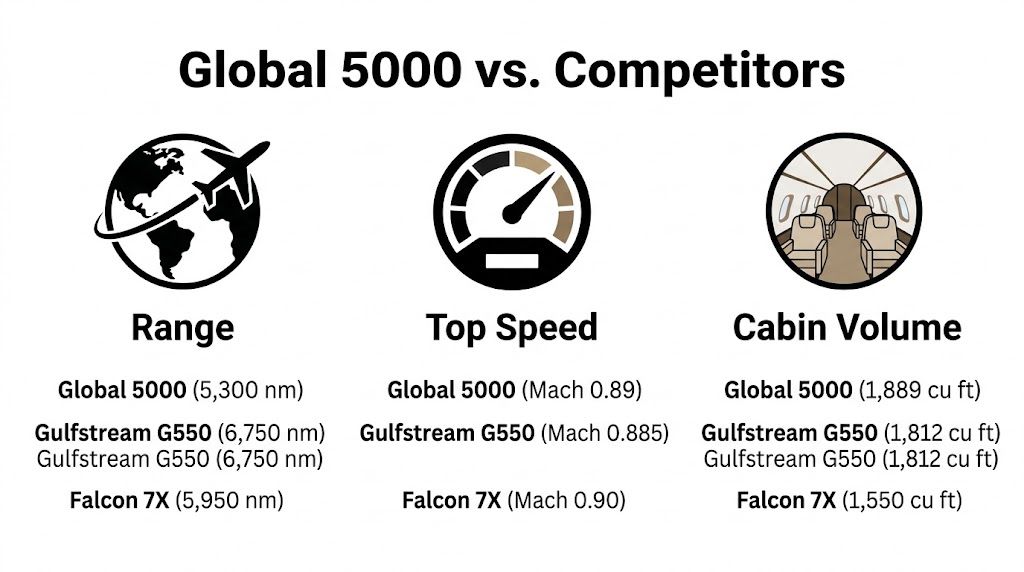
Against a Gulfstream G550 or Falcon 7X, the Global 5000 is attractive for clients who want a true heavy-jet cabin and intercontinental capability without paying for excess mission margin they will rarely use. Bombardier positions the aircraft as a long-range large-cabin jet with strong speed, airport access, and a three-zone cabin layout, which is the right lens for evaluating it against nearby competitors in the category (Bombardier Global 5000 specifications).
Compare by the factors that actually affect the trip
Cabin comfort
The Global 5000 wins with clients who care about how the cabin works in flight, not just what the brochure says. The cabin feels substantial, gives passengers room to work or rest in separate areas, and supports trips where privacy matters.
That makes it a smart choice for:
- executive teams that need to hold meetings en route
- families flying long sectors with baggage and personal staff
- principals who want a large-cabin experience without stepping into a larger operating budget than necessary
Range and mission fit
Some competitors offer more nonstop reach on paper. That only matters if your regular city pairs require it.
If your flying is built around transcontinental U.S. trips, Europe to the Middle East, or East Coast departures to much of Western Europe, the Global 5000 usually covers the mission cleanly. If your schedule regularly pushes farther and you want more cushion for weather, payload, or rerouting, compare it directly with the Global 6000 large-cabin aircraft.
Speed and schedule protection
The Global 5000 is a fast aircraft in real business use. For charter clients, that means more than prestige. It means preserving a meeting, reducing overnight exposure, and getting more utility out of the day.
Charter availability and cost discipline
In this scenario, buyers and charterers make expensive mistakes.
A jet can look cheaper on an hourly rate sheet and still cost more on the actual trip if the aircraft has to be ferried in from another market. Large-cabin competitors with thinner local availability often trigger that problem. Traditional brokers and many jet card structures fold those repositioning costs into the quote and move on.
The Global 5000 benefits from broad charter relevance, especially in North America, so it is often easier to source close to the passenger. That matters because local sourcing cuts deadhead exposure. Haute Jets uses that model to find aircraft nearer to your departure point, which directly counters the hidden 20 percent to 40 percent repositioning markup that inflates many charter quotes. If you are comparing jets and ignoring sourcing geography, you are not comparing trip cost accurately.
The honest trade-off
The Global 5000 is not the right pick for every client. If your mission is built around maximum nonstop range above all else, there are stronger answers. If your priority is the lowest headline hourly number, you can find smaller aircraft that look attractive until cabin comfort, baggage, or routing starts to suffer.
For a client who wants a serious cabin, strong intercontinental reach, and better odds of finding an aircraft without wasteful ferry expense, the Global 5000 is one of the smarter options in the market. That is why it compares well. It does not try to win every category. It covers the categories that drive actual trip value.
Understanding Global 5000 Charter Pricing and Hourly Rates
A client sees a Global 5000 quoted at a clean hourly rate, books quickly, then wonders why the final number lands far above the original estimate. The usual culprit is not the aircraft. It is positioning.
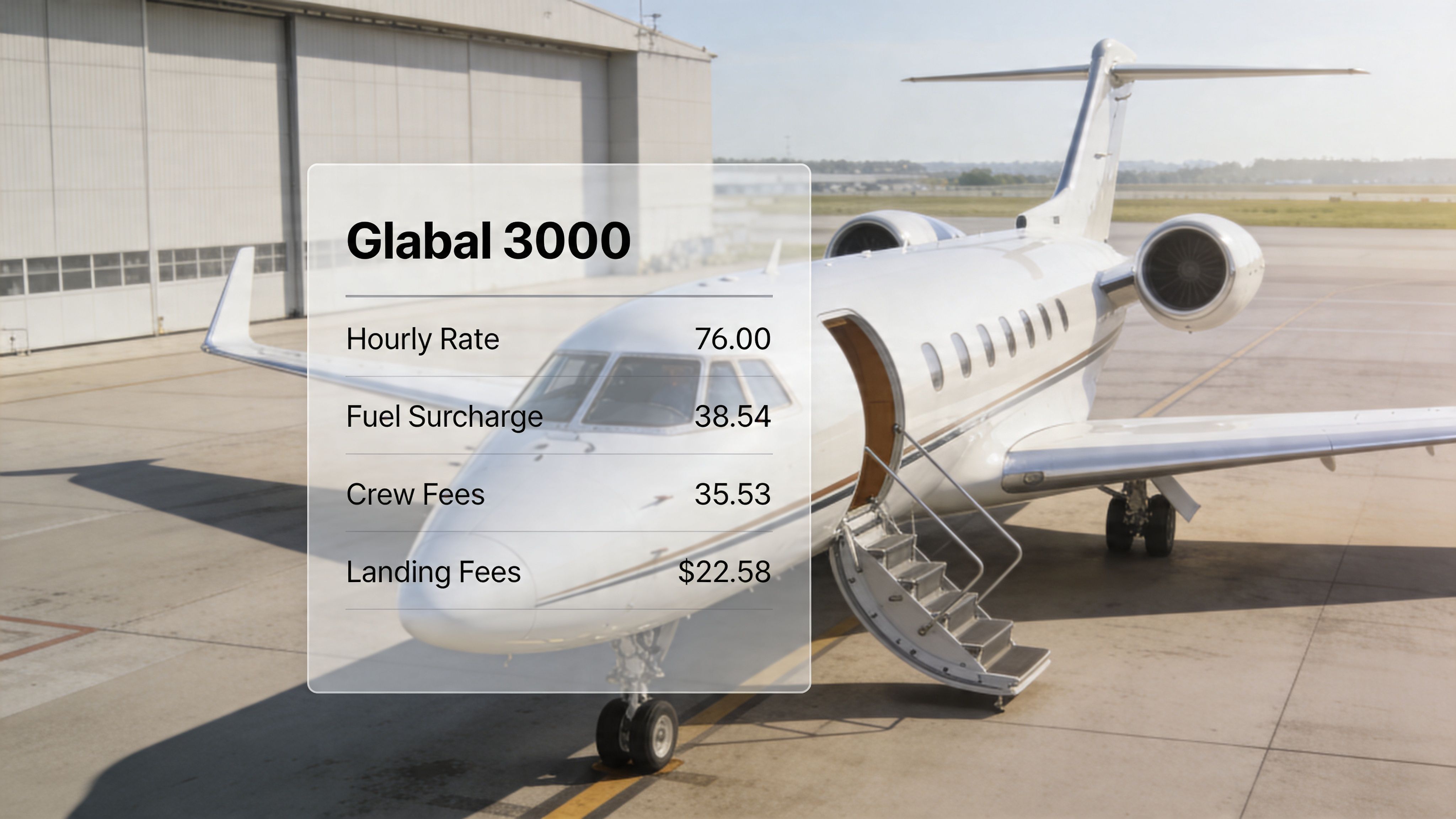
Many market guides place the Global 5000 charter rate around $6,800 to $7,800 per hour, including EvoJets' Global 5000 charter page. That figure is only the starting point. If the aircraft has to come to you from another city, actual trip cost can jump fast, and traditional broker quotes often bury that increase inside the proposal instead of isolating it clearly.
What drives the final charter quote
Hourly rate matters less than trip design.
The final quote usually reflects several layers of cost:
- Positioning legs to get the aircraft to your departure airport
- Return repositioning after drop-off
- Crew duty, overnights, and scheduling constraints
- Landing, handling, and airport fees
- Route-specific operating variables, especially on multi-leg or international trips
Many buyers overpay by comparing aircraft solely by hourly rate and disregarding the jet's location.
That mistake is expensive on large-cabin charter. A 20% to 40% repositioning premium is common enough to change the ranking of your options entirely. A jet that looks cheaper on paper can cost more on the actual mission if it has to be ferried in from a distant base.
Why Haute Jets' local sourcing model matters
The Global 5000 is a good charter aircraft partly because it is active in the markets clients use most. That gives you a better shot at finding one near your departure point.
Haute Jets builds around that reality. Instead of pushing a generic fleet category or locking you into a jet card structure that absorbs deadhead into the price, Haute Jets sources locally whenever possible. That directly attacks the hidden repositioning markup that inflates many traditional quotes.
The practical result is simple. You are paying for your trip, not for unnecessary ferry time.
The aircraft helps here. Bombardier lists the Global 5000 with strong field performance and the ability to access airports that are not realistic for every long-range large-cabin jet, according to Bombardier's Global 5000 specifications. Wider airport access gives a sourcing team more flexibility to match the airplane to your actual mission instead of forcing the mission to fit the airplane.
How to review a quote like an operator
Ask sharper questions.
-
Where is the aircraft based right now?
If the answer is far from your departure airport, assume the quote has deadhead exposure. -
What portion of the quote is occupied flight time versus positioning?
If that breakdown is missing, the proposal is incomplete. -
Which exact aircraft and operator are you quoting?
Category pricing is not enough for a serious comparison. -
Which airports are being used, and why?
The wrong airport strategy can erase any advantage in the hourly rate.
If you want the mechanics behind those line items, review this private jet charter pricing and cost breakdown guide.
Charter versus ownership economics
Ownership only makes sense if your usage pattern supports the carrying cost year after year.
Jetcraft's July 2024 Global 5000 market overview places the aircraft's new price at $50.4 million, with pre-owned pricing from $10 million to $36 million depending on year and condition, and notes average annual ownership costs of about $2.5 million, including $702,952 fixed costs, $1.8 million variable costs, and $5,613 per hour in operating expense, according to Jetcraft's Global 5000 market overview.
Those numbers should end the fantasy quickly. If your flying is irregular, or if your routes shift month to month, charter is usually the better financial decision.
| Option | Usually makes sense when |
|---|---|
| On-demand charter | Your schedule changes, your routing varies, and you want flexibility without annual carrying cost |
| Whole ownership | You fly enough to justify fixed costs and want full operational control |
| Fractional interest | You want structured access and accept program rules, interchange limits, and long-term commitments |
My advice
Do not buy a Global 5000 charter on the hourly rate alone. Buy on total mission cost.
If a broker avoids the aircraft location question, reset the conversation immediately. On this aircraft, sourcing discipline often matters more than the quoted hourly number. That is exactly why the Haute Jets model works. Local sourcing protects you from paying the hidden 20% to 40% repositioning premium that too many charter clients accept without realizing it.
Booking Your Global 5000 with Haute Jets
If you've read this far, the decision framework should be clear.
A Global 5000 is a strong aircraft for long-range charter and a credible acquisition candidate. But in the current market, the booking model matters just as much as the metal. A good jet sourced badly becomes an expensive answer.
As of July 2024, there were 227 Global 5000 jets in operation, with 52% based in North America and 14% in Europe. Of those, 213 were wholly owned, according to Jetcraft's Global 5000 market overview. That ownership profile matters because wholly owned aircraft fit the owner-operator sourcing model far better than a system built around generic fleet buckets.
Why owner-operator access matters
This aircraft is a staple of owner fleets. That's useful if you're booking intelligently.
A local sourcing model works best when:
- the aircraft type is widely distributed in the markets you use
- operators can position efficiently from nearby airports
- you can identify the exact aircraft instead of buying an abstract category
- safety standards are clear before the trip is sold
That's the practical advantage of a network-based approach rather than a jet card mindset. You're not just buying "large cabin availability." You're matching mission, airport, and actual aircraft.
What I'd tell a client doing this today
If you charter the Global 5000 regularly, do these things every time:
-
Prioritize local aircraft first The closest suitable aircraft often creates the cleanest economics.
-
Request the exact tail and layout Cabin configuration matters on this aircraft more than many clients assume.
-
Verify operator standards Safety screening should happen before pricing becomes the focus.
-
Book with flexibility in mind If your return could move, structure the charter around that early.
One model built around this logic is Haute Jets, which sources from 3,500+ aircraft in 175 countries, works with Wyvern Wingman or Argus Gold/Platinum-rated operators, confirms the exact aircraft and trip details before departure, and avoids membership or jet card structures, based on the publisher information provided.
Why this model fits the Global 5000 particularly well
The Global 5000 is well suited to local sourcing because it combines long-range mission value with airport flexibility. That's a useful mix.
A jet that can handle serious international sectors but still work from more convenient airports gives an advisor or charter client more room to optimize the booking. You're not forced into one narrow operating pattern.
That matters when:
- a principal wants to leave from a more convenient airport
- a corporate team needs a same-day shift
- a family wants to avoid unnecessary positioning delays
- a charter buyer wants to reduce hidden cost inflation
When to charter and when to buy
I'd break it down clearly.
Charter the Global 5000 if your travel is important, irregular, and varied. That gives you the strengths of the aircraft without taking on annual ownership burden.
Consider buying if the aircraft's cabin, route profile, and airport flexibility line up with your year-round travel pattern and you value control enough to justify the fixed cost structure. The pre-owned market is active, but that doesn't mean every listing is a good fit. It means you need discipline.
A poor acquisition usually comes from one of three mistakes:
- buying too much airplane for the actual mission
- overestimating annual usage
- underestimating the value of flexible charter access
Final recommendation
For most clients asking about a global 5000 jet today, I wouldn't start with ownership. I'd start with chartering the aircraft on real missions and tracking three things carefully:
- how often you need its range
- whether the cabin layout suits your passengers
- what your total trip cost looks like when aircraft location is handled properly
Do that for a meaningful run of trips and the right answer becomes obvious. Some clients will realize the aircraft is exactly right and move toward acquisition. Others will realize they want the capability only occasionally and are better served staying on demand.
Both outcomes are fine. The costly mistake is pretending they're the same decision.
If you want a Global 5000 for charter without paying for unnecessary repositioning, talk to Haute Jets. The right process is simple. Start with your route, passenger count, schedule, and airport preference. Then source the nearest qualified aircraft, confirm the exact tail, and price the actual mission instead of a marketing headline. That's how you charter this category intelligently.