
You're probably looking at a trip that commercial aviation handles badly. The meeting is overseas, the family wants privacy, the schedule can't absorb a fuel stop, and you don't want to pay a premium quote only to learn later that half the bill came from moving the aircraft into position before you ever stepped on board.
That's where a gulfstream g550 charter earns its reputation. It's one of the few aircraft that consistently solves the actual problem high-value travelers face: getting far, fast, and comfortably, without turning the trip into a logistics project.
Most articles stop at admiration. That's not useful when you're the one approving the wire. What matters is whether the G550 fits your mission, what it will cost, where quotes get padded, and how to verify the operator behind the airplane.
Why the G550 Remains an Ultra-Long-Range Icon
A nonstop New York to Dubai itinerary is where the G550 earns its keep. It was built for clients who value time, privacy, and a schedule that does not fall apart because the aircraft cannot make the trip efficiently.
The reason it still commands respect is simple. The G550 combines true intercontinental reach with the cabin size and reliability profile buyers and charter clients trust on serious missions. If you want the published performance baseline, this Gulfstream G550 aircraft profile lays out the platform clearly.

What keeps the aircraft relevant is not nostalgia. It is economic logic.
A G550 can remove a fuel stop, shorten total travel time, and make demanding city pairs realistic in one aircraft. That sounds like a pure luxury benefit until you look at charter pricing. Every added stop creates more billable flight time, more crew duty pressure, and more room for delays. On the brokerage side, the bigger trap is repositioning. A great aircraft at the wrong airport can turn a sensible quote into an inflated one.
That is why first-time charter clients should not judge a G550 by the headline hourly rate alone. Judge it by the full mission cost.
Why clients still ask for it by name
The G550 remains a named-aircraft request for practical reasons, not branding.
- It handles serious missions well: Clients booking intercontinental travel want an aircraft with a long record on demanding routes.
- It protects the schedule: Strong range and cruise performance reduce the odds that the day gets rebuilt around operational limitations.
- It holds up on long sectors: For overnight trips and long business flights, cabin comfort affects how productively you arrive.
What smart first-time charter clients should focus on
Start with the mission, then the sourcing model.
A traditional broker may show you a G550 quote that looks competitive until repositioning, crew logistics, or airport-related line items surface later. A modern sourcing approach works better because it starts with aircraft already positioned for your route and compares operators on real trip economics, not just on aircraft type. That is how you get the G550's capability without overpaying for inefficiency.
Ask three direct questions before you approve anything:
- Does this route justify a G550, or are you paying for range you will not use?
- Where is the aircraft based right now, and how much of this quote is repositioning?
- Which operator is flying the trip, and what are their credentials beyond the sales pitch?
The G550 remains an icon because it still solves expensive travel problems cleanly. The mistake is assuming every G550 quote delivers the same value.
Inside the Gulfstream G550: Range, Speed, and Cabin Comfort
You feel the difference in a G550 on the trips that would expose a weaker aircraft. A late-evening departure from New York for Dubai. An overnight sector where half the cabin needs to sleep and the other half still has calls to finish. A long mission into an important meeting where arriving tired costs real money. That is where the G550 earns its charter rate.
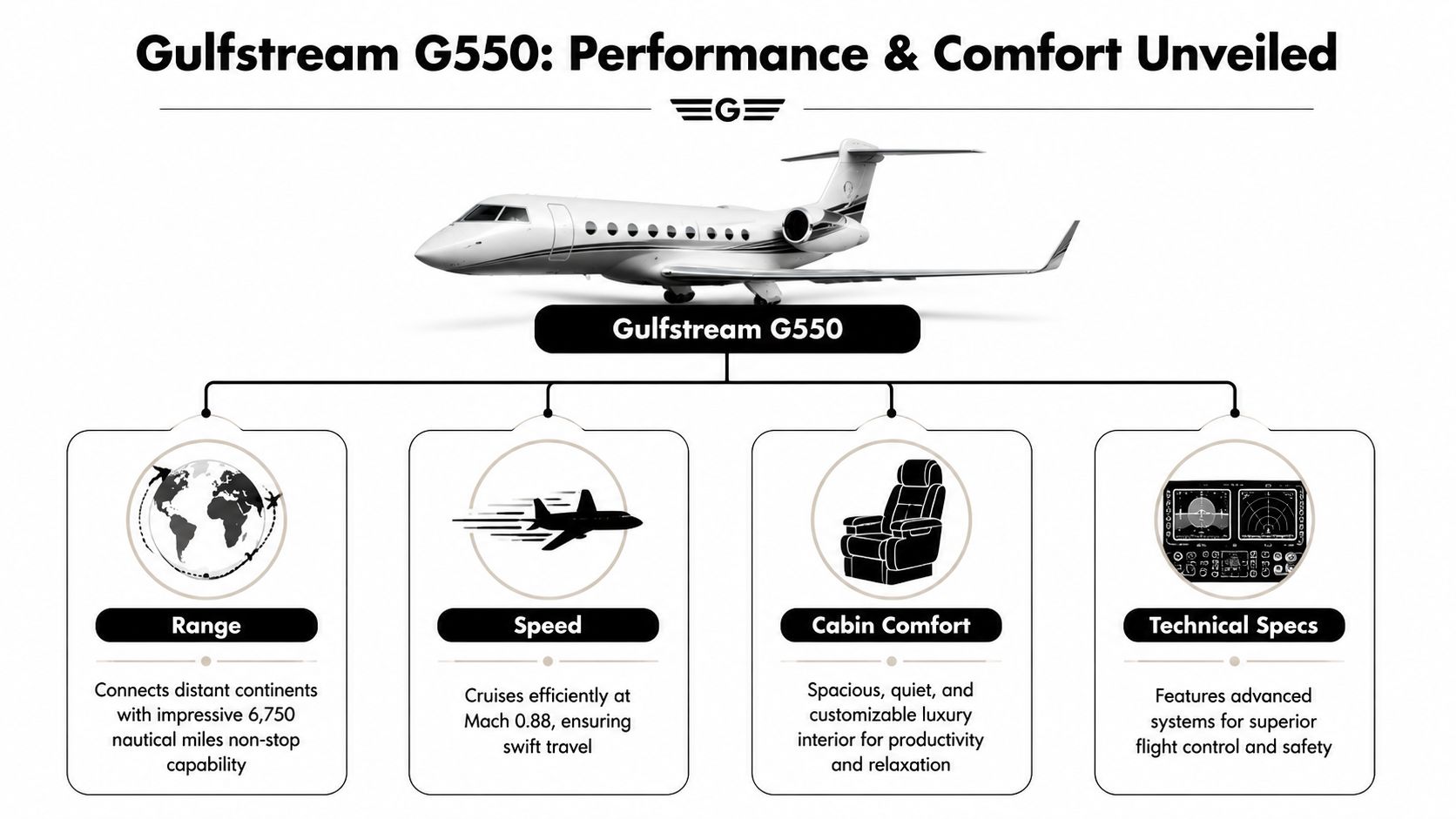
Its appeal starts with capability, but the smarter question is what that capability saves you from. The aircraft's published range of 6,750 nautical miles (12,501 km) supports city pairs that would force fuel stops or tighter planning in lesser jets, as shown in this Gulfstream G550 aircraft profile. In charter terms, that matters because every stop, delay, and operating constraint can turn into added trip cost.
What the performance means in practice
The G550 is built to cover long distances quickly and high enough to avoid much of the congestion and weather that complicate lower operating bands. That is not a brochure point. It is a scheduling advantage.
A strong long-range platform gives you better odds of keeping the itinerary intact, especially on international trips where one disruption can force new slots, crew timing issues, or a missed ground connection. That is also where charter buyers need discipline. Paying for G550 capability makes sense when the mission uses it. Paying G550 pricing for a route that could be handled by a smaller aircraft is wasteful.
The best value comes from matching the aircraft to the mission, then matching the mission to the right operator. Traditional brokers often start with aircraft type and leave the positioning problem for later. That is how a quote grows after the first call. A modern sourcing model works better because it looks for a G550 already positioned sensibly for your route, which reduces the empty-leg burden and cuts out repositioning costs that have nothing to do with your passengers.
Cabin dimensions and long-haul comfort
The cabin is one of the G550's strongest arguments. It is large enough to function as a real long-haul environment, with 43 feet 11 inches of cabin length, 7 feet 4 inches of width, 6 feet 2 inches of height, and 1,669 cubic feet of cabin volume, plus up to 14 signature oval windows, as noted earlier.
Those numbers matter less than what they allow. You can separate work from rest. You can seat senior principals away from staff. You can serve a proper meal without turning the cabin into a traffic jam. On a long crossing, that changes the quality of the trip.
Look for three things in the specific aircraft you are offered:
- Defined cabin zones: Useful if one passenger needs quiet sleep while others keep working.
- A low-noise interior: Important on overnight sectors and long business flights.
- A layout that fits your group: Conference seating, divans, and sleeping arrangements matter more than raw seat count.
Don't judge a G550 by the marketing photos. Judge it by cabin layout, sleeping practicality, and how your group will use the space.
Engines, avionics, and the part clients shouldn't ignore
The G550 is powered by two Rolls-Royce BR710-C4-11 engines, each rated at 15,385 lbf of thrust. It is also equipped with advanced avionics such as Honeywell Primus Epic PlaneView, EVS II enhanced vision, and HUD, as noted earlier.
That matters because long-range charter is an operational purchase before it is a luxury purchase. On a night departure, in weather, or on a demanding international schedule, aircraft systems and cockpit capability affect dispatch quality and trip execution. Clients new to private aviation often focus on finishes, catering, and seat maps first. Experienced buyers ask who operates the aircraft, how the trip is being sourced, and whether the quote reflects smart positioning or hidden inefficiency.
That is the right instinct. The G550 gives you serious reach, speed, and comfort. The win comes from chartering those strengths without paying extra for avoidable ferry time and lazy sourcing.
The G550's Perfect Mission Profiles
The G550 isn't the right answer for every trip. It's the right answer for trips where range, cabin flexibility, and airport access combine into one demanding mission.
The aircraft accommodates 14 to 19 passengers in configurable interiors that can include staterooms and conference areas, plus baggage capacity for 19 to 24 suitcases, according to Amalfi Jets' Gulfstream G550 charter overview. The same source notes a 5,910-foot takeoff run, which helps expand airport options for charter clients.
Corporate travel that can't afford inefficiency
A senior team heading overseas benefits from a jet that supports both privacy and productivity. The G550's cabin can separate principals from staff, support in-flight discussion, and carry enough luggage for multi-day or multi-city travel without forcing trade-offs.
That's especially useful when the passenger list includes executives, assistants, and security. A smaller aircraft may be cheaper on the quote. It can become more expensive once the trip starts failing the mission.
Family and group leisure with real baggage needs
Families often underestimate baggage until skis, formalwear, golf clubs, or children's gear enter the picture. The G550 works well when you want one aircraft, one departure, and no splitting the party.
It's also a smart choice when the route mixes long-range flying with a destination that benefits from stronger runway flexibility. That broadens your airport options and cuts some of the friction that usually comes with premium leisure travel.
Entertainment and event travel
For artists, production staff, or high-profile travelers moving internationally, the cabin's configurable layout matters as much as the range. You can use the aircraft as a private workspace, a rest environment, or both.
Here's a simple way to think about mission fit.
| Route | Estimated Flight Time | Mission Advantage |
|---|---|---|
| New York to London | Roughly 7 hours | Strong fit for executive overnights, private meetings, and arrival-ready schedules |
| Miami to Aspen | Varies by conditions and routing | Combines large-cabin comfort with airport flexibility for premium leisure travel |
| Los Angeles to Tokyo | Long-haul intercontinental mission | Suited to nonstop international travel where a fuel stop would disrupt schedule and rest |
| New York to Dubai | Ultra-long-range mission | Built for travelers who need reach, privacy, and a true long-haul cabin |
For group international travel, the G550 is often a better value than trying to “save” on a smaller jet and paying for compromises in baggage, range, or cabin function.
Decoding the Cost of a Gulfstream G550 Charter
You approve a G550 for a long-range trip because you want the right aircraft, not a pricing surprise. The problem is that many first quotes are built to look competitive, then grow once repositioning, crew overnights, handling, and international fees show up later.
Start with the baseline. In 2026, published G550 charter pricing commonly falls around $11,500 to $14,000 per hour, according to Jet Aviation's Gulfstream G550 charter page. Treat that as a reference point, not your final number.

A G550 quote rises or falls on trip design. A same-day out-and-back can price very differently from a multi-day international itinerary, even if the flight hours look similar on paper. Aircraft age, cabin condition, airport fees, crew duty limits, and where the jet sits before your departure all affect the invoice.
The hourly rate is only one line item. Your total usually includes:
- Flight time charges: The base operating cost for the aircraft.
- Landing and handling fees: Airport-specific charges that vary by destination.
- Crew costs: Hotels, meals, and scheduling costs on trips that require overnights.
- Permits and international handling: Added administrative and ground costs on cross-border missions.
- Fuel and routing variables: Wind, airspace restrictions, and alternate planning can change billed time.
If you want a plain-English explanation of how those pieces fit together, review this private jet charter pricing breakdown before comparing quotes.
The biggest pricing trap is repositioning. That is the cost of flying the aircraft empty to your departure airport, and it can turn an attractive quote into an overpriced one. It happens constantly with traditional brokerage models that sell access first and disclose aircraft positioning later.
That is why the G550's capability has to be matched with the right sourcing method. Ultra-long-range performance is valuable. Paying for empty reposition legs across the country is not. A modern sourcing model like Haute Jets checks aircraft already near your departure point across its network of 3,500+ owner-operators in 175 countries, which can reduce or remove the markup that often distorts G550 pricing.
A useful reminder before you watch the cabin video:
My recommendation on evaluating value
Choose the clearest quote, not the lowest one.
Ask these questions every time:
- Is this a quote for a specific tail, or a generic G550 estimate?
- Where is the aircraft positioned right now?
- Does the price include repositioning, or will that appear later?
- Are crew overnights, handling, and permits already included?
- Will you receive the tail number and operator details before you wire funds?
If a broker avoids a line-item explanation, assume the quote will get more expensive.
Ensuring Safety: Wyvern, ARGUS, and Operator Credentials
You can approve a beautiful G550, wire a large deposit, and still end up with the wrong charter if the operator is weak. First-time clients often focus on cabin photos, range, and price. The better filter is simpler. Start with the operator, then judge the aircraft.
That matters even more on a G550 because the charter bill is high enough that cutting corners can hide behind polished presentation. A traditional broker can show you an attractive quote on a premium aircraft and still avoid a clear discussion about the company maintaining it, crewing it, and flying it under Part 135. That is a mistake. Safety standards and cost discipline should be checked together.
Why operator quality matters more than aircraft branding
A Gulfstream badge does not tell you how seriously an operator handles training, maintenance tracking, internal oversight, or trip risk review. Two G550 charters can look similar on paper and be very different in practice.
Ask for the operator name and the tail number before you approve anything. Then verify whether that operator holds a current third-party safety rating and whether the aircraft is being flown by the same company that issued the quote. If a broker delays that information, walk away.
The ratings you should require
For a gulfstream g550 charter, these are the baseline credentials I recommend:
- Wyvern Wingman: Confirms the operator has passed an independent review of operating procedures, training, maintenance, and safety management.
- ARGUS Gold or Platinum: Signals the operator has been vetted against established charter safety criteria.
- Current Part 135 certificate: Confirms the flight is being conducted legally under U.S. charter rules, if your itinerary falls under that framework.
If you want a clearer explanation of how those standards differ, this analysis of Wyvern and ARGUS private aviation safety ratings is worth reading before you compare operators.
What to confirm before you release funds
Do not settle for a general assurance that the flight is safe. Get specific answers.
- Who is the actual operator? Broker name and operator name are not the same thing.
- What is the exact tail number? The aircraft you review should be the aircraft you fly.
- What rating does the operator currently hold? Ask for Wyvern Wingman or ARGUS Gold/Platinum status.
- Who controls the aircraft today? Confirm the operator has legal operational control for your trip.
- Are crew and maintenance records current? You do not need every internal file, but you should receive clear confirmation before departure.
Here is the practical connection many clients miss. The same opaque process that hides repositioning costs can also blur operator details. A modern sourcing model such as Haute Jets helps by showing specific aircraft and operator information earlier in the process, which makes it easier to compare both safety credentials and true trip cost before you commit.
A luxury cabin proves nothing. A clearly identified aircraft, a properly rated operator, and transparent documentation are what you should require.
Your Step-by-Step Guide to Booking the Right G550
The booking process should give you control, not force you to accept a generic heavy jet and hope for the best. If you're spending this kind of money, you should know exactly what you're getting.
Step 1. Define the mission properly
Start with the route, passenger count, baggage reality, and whether anyone needs to sleep or work on board. A good request also includes catering expectations, pet travel, ground transfers, and any hard timing constraints.
If you leave those details vague, you invite vague quotes.
Step 2. Review specific aircraft, not just category names
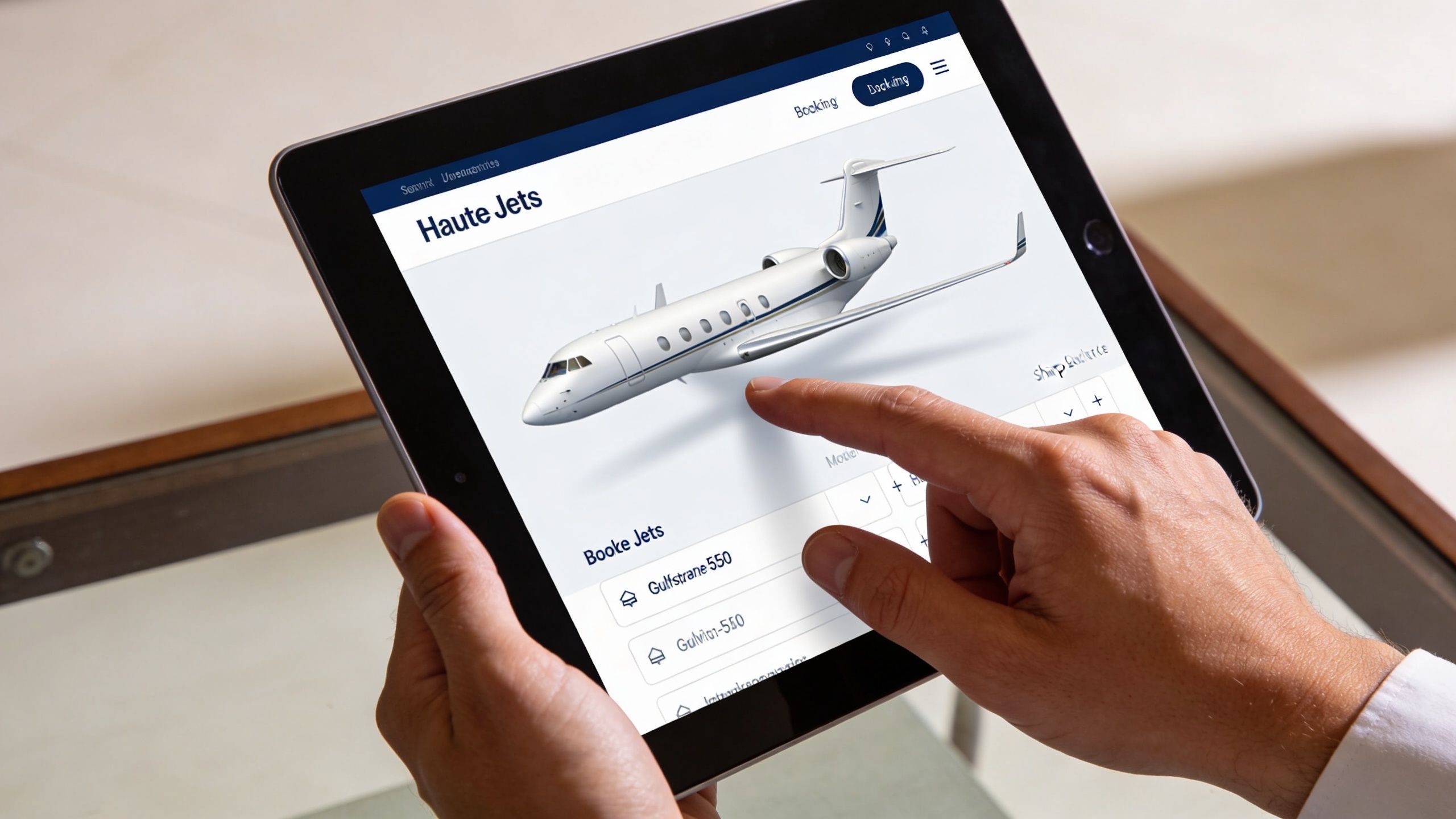
A serious charter process should show you the actual G550 options available for your dates. You want to compare the aircraft year, interior photos, cabin layout, and where the jet is positioned.
Many first-time clients lose an advantage. They approve “a heavy jet” instead of selecting the aircraft itself.
Step 3. Confirm the trip details that affect experience
This part sounds small until it isn't. Check:
- Wi-Fi availability: Don't assume every cabin setup offers the same connectivity.
- Cabin configuration: Conference setup, sleeping arrangement, and privacy zones matter.
- Pet and catering rules: They vary by operator and aircraft.
- Baggage practicality: Capacity is one thing. Access and shape matter too.
Step 4. Ask for the final operating details before departure
You should receive a pre-flight confirmation package that removes surprises. The most useful version includes the tail number, crew information, timing, and a clear operating summary.
That's the point where a trip becomes real instead of theoretical.
Good chartering means choosing the exact aircraft, then verifying the operating details. Anything less is guesswork dressed up as service.
Step 5. Keep payment flexible
Some clients want a conventional invoice and wire. Others want more flexibility, including digital asset payment options. That's a practical convenience, especially for clients who already manage international assets that way.
The broader principle is simple: your booking process should fit your life, not the operator's administrative habits.
Chartering a G550 on Your Terms
The G550 still earns its place because it solves a specific problem better than most aircraft can. It gives you true long-range capability, a large-cabin environment that works on serious missions, and the flexibility to move a demanding group without turning the itinerary into a compromise.
But capability alone isn't enough. You need the right pricing structure, the right operator credentials, and a booking process that lets you approve the actual aircraft rather than a vague category. That's where experienced clients separate polished charters from overpriced ones.
My advice is straightforward. Choose the G550 when your mission justifies it. Demand quote transparency. Treat repositioning as a cost item that must be explained. Insist on Wyvern or ARGUS-level operator standards. And never approve a flight until you know exactly which aircraft is showing up.
That approach gives you what private aviation is supposed to provide: control, efficiency, privacy, and a trip built around your schedule instead of someone else's sales script.
If you want a clear, no-membership quote for your next Haute Jets flight, request a Gulfstream G550 option built around your exact route, passenger list, and timing, then compare the aircraft location, operator credentials, and full trip pricing before you commit.