Most chartered jets price between roughly $2,300 and $17,000 per flight hour, and a typical 3-hour domestic trip often lands between $9,000 and $25,000 before repositioning and fees. If you're comparing quotes, that's the number to anchor on, because the sticker rate is only the starting point.
The answer to how much does a private jet charter cost is that the final bill depends far more on aircraft class, where the jet is based, and how the operator structures the quote than on the route name alone. A light jet on a short domestic run can look affordable until repositioning, airport handling, and minimum billable hours get added back in.
The Actual Price Range for Chartering a Private Jet
A private jet charter usually falls within $2,300 to $17,000 per flight hour, while VIP airliners can reach $18,000 to $23,000 per hour as shown in current market guides. Those figures describe the aircraft's operating rate, not necessarily the amount charged to your card.
A short domestic trip on a light or very light jet often begins in the low-to-mid $3,000s per hour. Midsize through large-cabin aircraft commonly run around $4,000 to $9,500 per hour as outlined in market rate guides. Two quotes for the same city pair can still differ sharply because aircraft availability, positioning, and the operator's pricing model matter more than the route name alone.
Four factors determine the invoice
Aircraft class sets the base rate. Larger cabins cost more because they carry more passengers, use more fuel, and require higher-cost crews and maintenance. Trip length also changes the effective price because charter companies bill occupied flight time rather than treating the aircraft as a simple flat-fee rental.
Repositioning is the surcharge travelers miss most often. If the aircraft must fly empty to collect you or return to its base afterward, those legs can add 20–40% to a broker's quote. Local sourcing can reduce that increase when a suitable aircraft is already based near your departure airport. FBO handling, landing charges, taxes, and overnight expenses add further line items the pricing structure is summarized here.
Practical rule: an hourly rate alone does not reveal the full price.
Most operators also apply a minimum booking window of about 2 flight hours. A 45-minute shuttle can therefore carry a surprisingly high effective hourly cost because the minimum billable block absorbs much of the apparent saving.
For a useful benchmark, review the published hourly figures on the Haute Jets pricing page, then request an itemized quote. Ask specifically whether repositioning, crew expenses, handling, taxes, and overnight charges are included. That check exposes inflated broker margins before you commit.
Hourly Rates by Aircraft Class
The rate ladder is simple once you stop treating “private jet” as one product. Charter pricing in 2026 still falls into clear class bands, and the pricing ladder is reflected in current guides. That ladder sets the starting point for your quote before catering, ground transport, or route-specific charges enter the picture.
Aircraft class sets the ceiling before the route does
Turboprops are the lowest-cost option for short hops, usually around $2,300 to $3,500 per hour for 4 to 6 passengers on trips under 1,000 nm. Very light jets generally sit around $2,800 to $4,000 per hour for 4 to 5 passengers on regional trips. Light jets move into the $3,500 to $5,500 range for 6 to 8 passengers on domestic legs.
Midsize jets are where many business travelers land, with published rates around $4,500 to $7,500 per hour for 7 to 9 passengers on coast-to-coast U.S. missions. Super-midsize jets rise to roughly $6,000 to $9,500 per hour for 8 to 10 passengers on transcontinental and Caribbean runs. Heavy jets usually span $8,000 to $13,000 per hour for 10 to 14 passengers on longer international missions. Ultra-long-range jets top the chart at about $11,000 to $17,000 per hour for 13 to 18 passengers on nonstop global routes.
Use the cabin size, not the prestige, to make the decision. A larger jet is the right answer only when the mission needs range, cabin volume, or baggage capacity.
| Aircraft Class | Hourly Rate (USD) | Passenger Capacity | Typical Mission |
|---|---|---|---|
| Turboprop | $2,300 to $3,500 | 4 to 6 | Short hops under 1,000 nm |
| Very Light Jet | $2,800 to $4,000 | 4 to 5 | Regional trips |
| Light Jet | $3,500 to $5,500 | 6 to 8 | Domestic legs |
| Midsize Jet | $4,500 to $7,500 | 7 to 9 | Coast-to-coast U.S. |
| Super-Midsize Jet | $6,000 to $9,500 | 8 to 10 | Transcontinental, Caribbean |
| Heavy Jet | $8,000 to $13,000 | 10 to 14 | Long international missions |
| Ultra-Long-Range Jet | $11,000 to $17,000 | 13 to 18 | Nonstop global routes |
These are base rates only. They exclude repositioning, Federal Excise Tax, and FBO handling, so the invoice still moves if the aircraft is not locally based or the trip needs extra ground support. For a clean benchmark on aircraft-class pricing, use Haute Jets' calculating private jet cost per hour page.
What Popular Routes Cost in 2026
Route pricing gets clearer once you stop quoting averages and look at city pairs. The same departure and destination can produce very different totals depending on aircraft class, trip timing, and whether the operator already has a jet nearby. Hourly rate matters, but it is only one line in the invoice.
New York to Miami, Los Angeles to Aspen, New York to London
For New York to Miami, a light jet typically runs around $14,000 to $18,000, while a midsize jet often lands around $20,000 to $26,000 for the full trip. Flight time is usually around 2.5 to 3 hours each way, so the base math only gets you partway there. If the aircraft needs to reposition or the operator adds standard FBO handling, the quote climbs fast market route examples are widely used in charter pricing guides.
Los Angeles to Aspen is where buyers overpay if they pick the wrong cabin. A midsize jet commonly comes in around $22,000 to $28,000, while a super-midsize jet can run $30,000 to $38,000. That route is sensitive to aircraft capability because mountain access can affect the jet you need, and sometimes the trip requires a fuel stop. Pay for the airplane that can do the mission cleanly, not the one that sounds impressive.
For New York to London, a heavy jet often lands between $95,000 and $130,000, while an ultra-long-range jet can reach $130,000 to $180,000. Transatlantic time is near 7 hours, which is why the hourly gap starts to matter much more on long-haul trips the same market context is reflected in current guide ranges.
Why the same route swings so hard
The quiet driver is positioning. A trip can look reasonable on paper and still move up sharply if the aircraft is not already staged near departure. FBO handling also adds up, and those costs are usually treated as separate line items in charter pricing models route-cost variables are commonly itemized in charter pricing models.
| Route | Light Jet | Midsize | Super-Midsize | Heavy / ULR |
|---|---|---|---|---|
| New York to Miami | $14,000 to $18,000 | $20,000 to $26,000 | Not typical | Not typical |
| Los Angeles to Aspen | Not typical | $22,000 to $28,000 | $30,000 to $38,000 | Not typical |
| New York to London | Not typical | Not typical | Not typical | $95,000 to $180,000 |
The lesson is simple. The same city pair can move a lot in price without changing the passenger list or the departure airport. The savings come from matching the mission to the right jet, then sourcing the aircraft locally whenever possible.
The Hidden Cost Most Quotes Don't Show
The biggest line item brokers hide inside a clean-looking trip quote is aircraft repositioning. If the jet is not already near your departure airport, the operator has to move it empty, and that empty leg gets paid for one way or another. In practice, that can add 20% to 40% to a charter quote.
What deadhead time does to the bill
A three-hour mission can need 1 to 3 additional positioning hours at the same hourly rate, depending on where the aircraft starts and ends. Your occupied flight time stays the same. The invoice grows because the airplane is being paid to move, not because the cabin changes.
Take a $4,500 per hour light jet. On paper, a 3-hour trip looks like $13,500 before extras. Add positioning and the same trip can jump into the $18,000 to $22,500 range before taxes or handling. That is where travelers overpay, because the quote starts to look normal while the true cost has already moved.
Ask one question every time, where is the aircraft based right now?
All-inclusive operators handle this better. They publish a single trip price and absorb positioning internally when they can, which often produces a lower combined number than a broker who stacks every component separately. The quote may look cleaner, but the issue is local sourcing. If the jet is already staged near departure, the number stays closer to market. If it is not, you are paying for someone else's logistics.
For readers who want a plain answer on fee creep, Haute Jets has a separate guide on are there hidden fees in private jet charter. Keep that question in your back pocket. It is the fastest way to spot an inflated quote.
| Scenario | Base Hourly Rate | Flight Hours | Positioning Hours | Total Flight Hours | Total Quote |
|---|---|---|---|---|---|
| Base trip only | $4,500 | 3 | 0 | 3 | $13,500 |
| Near-home aircraft | $4,500 | 3 | 1 | 4 | $18,000 |
| Out-of-market aircraft | $4,500 | 3 | 3 | 6 | $27,000 |
How the Same Trip Can Cost Two Very Different Prices
Miami to Aspen is a useful stress test because it's short enough to compare cleanly, but complicated enough to expose bad pricing. A national broker can quote the same mid-size mission very differently from a local operator, and the aircraft itself doesn't change. The sourcing channel does.
Two models, same airplane class
Model A is the standard broker play. A national broker quotes a mid-size jet at roughly $6,500 per hour, then layers in positioning, Federal Excise Tax, and segment fees until the total ends up near $42,000. Model B is the local operator model. The same aircraft class is already based in the region, so the trip is priced closer to $28,000 to $32,000 because repositioning is minimal and overhead is lower.
That gap is the story. On domestic routes, the source of the aircraft often matters more than the brand name on the quote. If the jet is already near the departure airport, the operator can keep the number close to published market rates. If it isn't, you're paying for someone else's logistics problem.
Why the difference persists
National brokers often shop a wider network, but that doesn't guarantee a lower total. In practice, they can quote from farther away inventory, then add back the deadhead and service layers later. Local operators usually have less room to hide those costs because they know the aircraft's home base and can price the flight as a direct mission.
The cheapest hourly rate is often the worst deal once the aircraft has to be moved into position.
That logic applies across most U.S. city pairs under 1,500 nautical miles, especially when the trip is time-sensitive or the airport is not a major private-aviation base. The aircraft class matters, but the sourcing channel usually decides whether the quote stays sane. For a live example of a membership-free model that quotes direct-to-operator pricing, Haute Jets is one option to compare alongside brokers and card programs.
| Scenario | Quoted Rate | Positioning | Taxes and Segment Fees | Final Trip Price |
|---|---|---|---|---|
| National broker | $6,500/hr | Added | Added | About $42,000 |
| Local operator | Lower effective rate | Minimal | Lower stack | About $28,000 to $32,000 |
Practical Ways to Lower Your Charter Quote
If you want the bill down, focus on the parts that inflate it. Don't waste time negotiating cabin extras before you know where the aircraft sits. The biggest savings come from sourcing, timing, and quote structure, not from trying to price a heavy jet like a turboprop.
The levers that matter
Source locally first. Operators based near your departure airport usually avoid the deadhead leg, which is why local sourcing often prices below national aggregators. Look at empty-leg inventory if your schedule can flex, because discount inventory is commonly below standard charter when the aircraft is already moving market coverage on empty-leg pricing is here. Keep the itinerary simple, because custom catering, overnight crew needs, and frequent changes all raise the final bill.
Use all-inclusive quoting. Membership-free operators that publish all-in pricing remove the game of adding line items one after another. That matters because brokers can make a quote look lean by leaving positioning and service costs out until late in the process.
Eight questions to ask before you book
- Where is the aircraft based? This tells you whether positioning is likely to appear.
- Is repositioning included or billed separately? Get that in writing.
- How is Federal Excise Tax handled? Domestic flights get taxed, and you should see it clearly.
- Are segment fees included? Per-passenger charges can still appear on domestic legs.
- What are the crew overnight charges? Long itineraries often trigger them.
- Is there a daily minimum? Short missions can get padded by operator minimums.
- What are the cancellation terms? A flexible itinerary only helps if the terms are clear.
- What airport and FBO fees are expected? Handling costs vary by airport and aircraft size.
Bottom line: ask for a flat all-inclusive total before you compare two quotes.
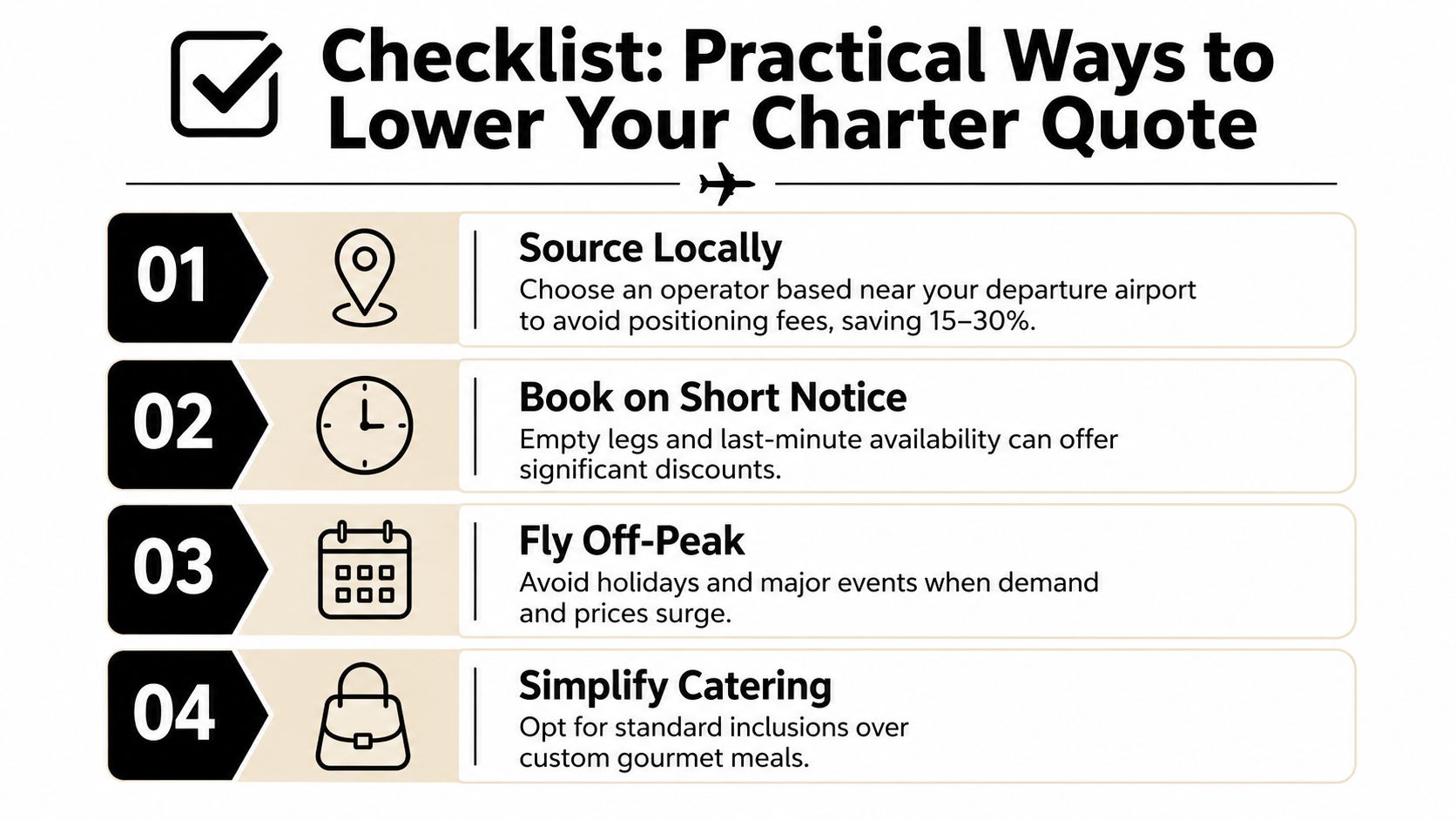
| Tactic | Cost Effect | Trade-Off |
|---|---|---|
| Source locally | Often lower total | Smaller inventory |
| Empty-leg flight | Deep discount | Fixed timing |
| All-inclusive quote | Fewer surprises | Less room to negotiate |
| Simplify services | Lower extras | Less customization |
Matching Your Mission to the Right Jet and Pricing Model
The right aircraft is the one that fits the trip. Short leisure hops under 3 hours usually belong in turboprops or light jets, especially if you can source locally or catch an empty leg. Mid-range business travel of 3 to 6 hours fits midsize or super-midsize jets, where regional operators usually quote cleaner than large broker networks. Long-haul transcontinental or international travel belongs in heavy or ultra-long-range aircraft, where range, cabin size, and operator reach matter more than chasing the lowest hourly headline.
Pick the model that protects the all-in total
If the route is short and your timing is flexible, choose the sourcing model with the least deadhead and the fewest add-ons. If the trip is a longer business mission with a fixed departure window, work with operators that already have aircraft in market. If you are crossing oceans, pay for the right range and stop trying to force the wrong cabin to do the job.
The hourly band still matters, but locality matters more. A jet that looks cheap on paper can turn expensive once ferry time, segment fees, and service charges are added. A cleaner quote with a nearby aircraft usually beats a lower headline rate that shows up with surprises.
| Traveler Profile | Recommended Aircraft Class | Typical Mission Length | Hourly Rate Band (USD) | Best Sourcing Model |
|---|---|---|---|---|
| Short-haul leisure flyer | Turboprop or Light Jet | Under 3 hours | $2,300 to $5,500 | Empty-leg or local on-demand |
| Mid-range business traveler | Midsize or Super-Midsize Jet | 3 to 6 hours | $4,500 to $9,500 | Regional fleet operator |
| Long-haul international traveler | Heavy or Ultra-Long-Range Jet | 6 hours and up | $8,000 to $17,000 | Established global operator |
Haute Jets publishes charter pricing, route examples, and direct aircraft-class benchmarks on its main site, so it is a useful comparison point if you want a flat quote instead of a layered broker estimate. If you want a real answer for your route, ask for an all-inclusive number on the exact trip you plan to fly.