
Private jet charter typically runs $4,000 to $18,500 per hour, depending on the aircraft category. Buying is a different league entirely, with new jets ranging from $5 million to over $80 million and annual operating costs that can run from $400,000 to over $1.5 million for 200 flight hours.
The typical question misses the mark. They ask, “How much does a private jet cost?” when they should ask, “What am I paying for, and where do charter quotes get padded?”
That distinction matters because the base hourly rate is only the starting point. A clean quote on the right aircraft can make private flying feel rational. A bloated quote with unnecessary repositioning can add 20 to 40 percent to the trip total, which is where many first-time charter clients get burned.
Haute Jets Journal exists for exactly this kind of decision. If you're new to private aviation but you think like an investor, this guide will help you read the numbers correctly, choose the right access model, and avoid paying retail for an aircraft that had to fly in empty just to pick you up.
Why "How Much Does a Private Jet Cost" Is a Complex Question
The simplest honest answer is this: charter pricing starts with aircraft category, but your real cost depends on mission fit, how often you fly, and whether your quote includes unnecessary ferry time.
A turboprop works for a short regional trip. A light jet covers quick business travel efficiently. A heavy jet is built for long-range flying and larger cabins, but it comes with a very different operating profile. If you use the wrong aircraft for the mission, you pay for range, cabin volume, and fuel burn you don't need.
Private aviation also isn't one product. It's three separate financial decisions.
- On-demand charter: You pay only when you fly.
- Fractional ownership: You buy access through a share structure and accept ongoing commitments.
- Full ownership: You buy the aircraft and take on fixed and variable operating costs.
That last point is where discerning buyers usually sharpen their thinking. A person who flies selectively often doesn't need an owned aircraft. They need predictable access, transparent sourcing, and a quote that isn't loaded with hidden movement costs.
There's another reason the sticker shock conversation is often misleading. For groups, private flying can look very different on a per-seat basis. For 6 to 8 passengers on a light or midsize jet, per-person cost can fall to $500 to $1,200 per hour, which is why private travel can compete with premium commercial travel for families, deal teams, and executive groups when privacy and schedule control matter most, according to Ventura Jet's cost breakdown.
Private aviation is expensive. Overpaying for the wrong aircraft, or for an aircraft that isn't even based near you, is optional.
If you want a useful answer to how much does a private jet cost, stop looking for one universal number. Start with the aircraft category, then pressure-test the quote structure.
Typical Private Jet Charter Prices by Aircraft Category
The hourly range tells you what kind of trip you're buying. It also tells you what mistakes to avoid. If you charter too much airplane, the invoice will remind you.
According to Sherpa Report's 2026 charter pricing breakdown, hourly rates typically fall into these bands: turboprops at $4,000 to $5,000, light jets at $5,000 to $7,000, midsize jets at $8,000 to $12,000, super-midsize jets at $10,000 to $15,000, and heavy jets at $15,200 to $18,500.

Turboprops and light jets
If you're flying short sectors and you care about efficiency, these are usually the first aircraft classes to review.
A turboprop is the practical choice for short regional missions, especially where runway access matters more than cabin glamour. It keeps hourly cost at the low end of the market.
A light jet is where many first-time charter clients land. It offers speed, privacy, and a proper private jet experience without the cost profile of larger cabins. For a short business hop or weekend leisure trip, light jets often hit the sweet spot.
Midsize and super-midsize jets
Comfort materially improves, providing more cabin room, stronger baggage capability, and better nonstop range for serious domestic missions.
A midsize jet fits clients who want enough cabin to work, relax, and arrive fresh without stepping into heavy-jet pricing. It's a strong category for coast-to-coast style domestic travel, depending on route and payload.
A super-midsize jet is often the smartest premium buy for clients who want range and speed but don't need an ultra-long-range flagship. It carries itself like a big-cabin aircraft without always charging like one.
| Aircraft category | Typical hourly rate | Best use case |
|---|---|---|
| Turboprop | $4,000 to $5,000 | Short regional flights |
| Light jet | $5,000 to $7,000 | Fast short-to-medium trips |
| Midsize jet | $8,000 to $12,000 | Longer domestic missions |
| Super-midsize jet | $10,000 to $15,000 | Premium domestic and some longer-range flying |
| Heavy jet | $15,200 to $18,500 | Long-haul and large-cabin travel |
Heavy jets
Heavy jets are built for clients who need true long-range capability, larger cabins, and a more residential onboard experience.
They make sense for transcontinental and international trips, especially when the schedule, passenger count, or baggage profile rules out smaller aircraft. They do not make sense for a short flight solely on the basis of an impressive-looking cabin on paper.
Practical rule: Choose the smallest aircraft that comfortably handles your route, passenger count, luggage, and reserve margin. That's usually where the value is.
The Anatomy of Your Private Jet Bill
The base hourly rate is visible. The rest of the invoice is where experience shows.
A charter quote reflects the operator's fixed costs, flight-specific variable costs, and trip extras. If you don't understand those buckets, you can't tell whether a quote is fair.
A good reference point is the operator economics behind large-cabin aircraft. A Gulfstream G450 can carry approximately $4 million in fixed annual costs before it even flies, which is why $9,000 to $13,000 per hour charter pricing is necessary just to cover expense, depreciation, and profit, as explained in BlackJet's private plane rates analysis.
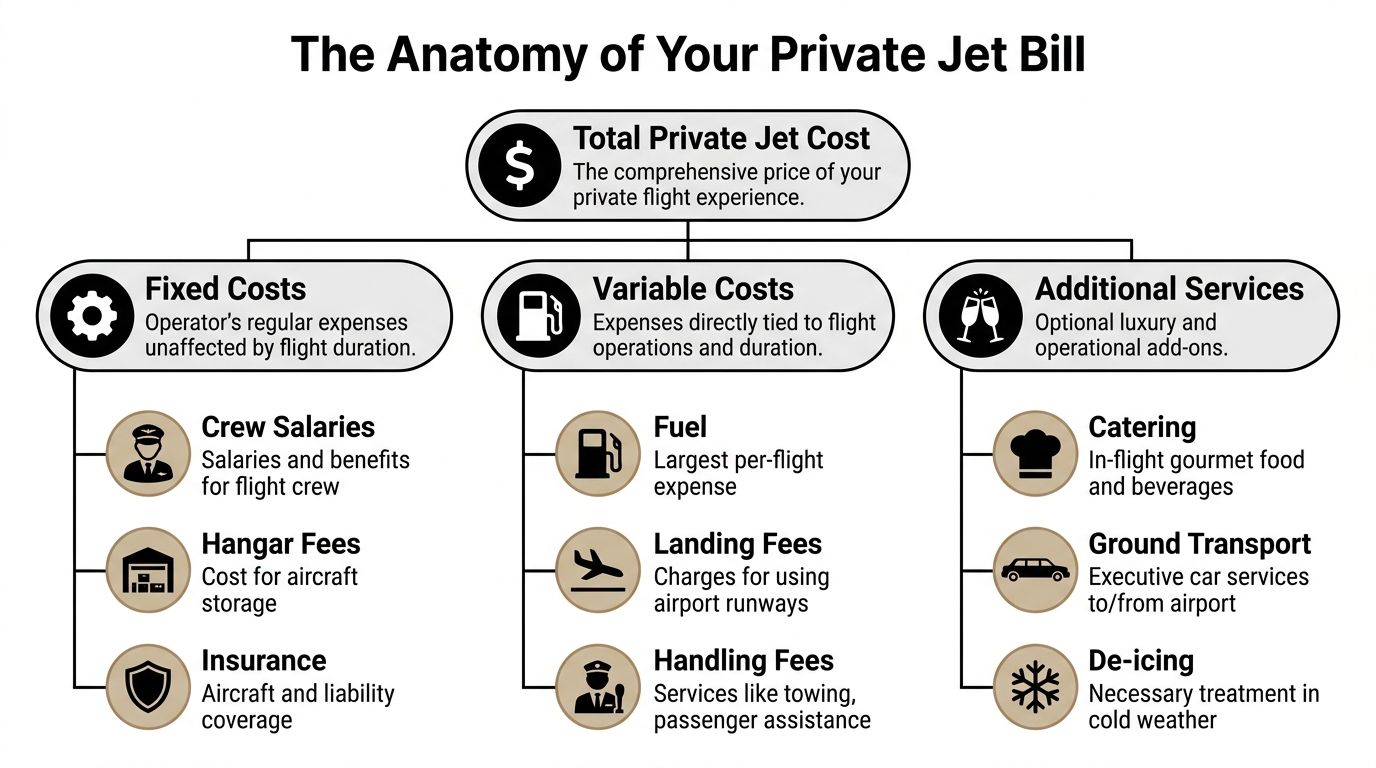
Fixed costs baked into the hourly rate
These costs exist whether the airplane flies or sits.
- Crew salaries: Pilots and cabin crew must be retained and trained.
- Hangar and storage: Aircraft need protected, compliant storage.
- Insurance: Hull and liability coverage are mandatory.
- Training and compliance: Operators carry recurrent costs to keep crews and aircraft current.
This is why private jet pricing doesn't work like booking a hotel room. You're not just renting a seat or a cabin. You're stepping into an expensive operating platform that has to be ready before you make the call.
Variable costs that move with your trip
These costs change with flight duration, route, weather, airport choice, and passenger requests.
- Fuel: Usually the biggest moving part in the trip economics.
- Maintenance reserves: More flight time means more wear.
- Landing and handling fees: Airports and FBOs charge for use and service.
- Crew overnight costs: If the crew waits for your return, that lands on the quote.
- Catering and transport: Convenience costs money when you ask for precision.
If you want a deeper look at fuel's role in private aviation pricing, Haute Jets' analysis of jet fuel costs for private jets is worth reading.
The line item clients miss
The least understood charge in private aviation is repositioning. That's the cost of moving the aircraft to you before your trip starts, and often moving it again afterward.
If the aircraft is based somewhere else, you may be paying for someone else's empty flight time before you ever board.
That isn't always improper. Sometimes it's unavoidable. But too many quotes hide it inside a total number that looks market-normal until you compare it with a locally based aircraft.
When I review charter proposals, I want to know four things immediately:
- Where is the aircraft based
- How many billable flight hours are actual passenger hours
- What airport and handling fees are included
- Whether crew overnights or repositioning are being passed through
If your provider can't answer those cleanly, the quote isn't transparent.
Comparing Your Options Charter vs Fractional vs Ownership
Not every private flyer should own an aircraft. In fact, most shouldn't.
The right model depends on how frequently you fly, how much control you need, and whether you want a balance-sheet asset or access to lift when required. That's why I advise clients to separate ego from usage. Aircraft ownership is a mobility decision, not a trophy decision.
Three ways to access private aviation
On-demand charter is the cleanest option for most clients. You book trip by trip, match the aircraft to each mission, and avoid the fixed burdens of ownership.
Fractional ownership gives you a defined share in an aircraft program. It can suit clients who want predictable access and are comfortable with structured commitments, but it's not casual. You are signing up for more than flight time.
Full ownership is exactly what it sounds like. Total control, total responsibility, and a very expensive asset to maintain.
According to Stratos Jets' 2025 private jet pricing guide, a new private jet ranges from $5 million to over $80 million, and annual operating costs for 200 flight hours range from $400,000 to over $1.5 million. Those numbers should reset any simplistic ownership fantasy quickly.
Private Aviation Models Compared
For first-time buyers or frequent charter clients, this is the comparison that matters most.
| Attribute | On-Demand Charter | Fractional Ownership | Full Ownership |
|---|---|---|---|
| Upfront commitment | Low. Pay per trip | Moderate to high. Share purchase and program commitment | Very high. Full aircraft acquisition |
| Flexibility | High. Choose aircraft by mission | Moderate. Bound by program structure | High operational control, low financial flexibility |
| Ongoing costs | Trip-based only | Ongoing program and usage obligations | Full annual operating burden |
| Aircraft choice | Broad, if sourced well | Usually tied to program fleet | Limited to owned aircraft unless you add lift externally |
| Best for | Clients with variable flying patterns | Regular users who value guaranteed access | Very frequent flyers who want full control |
A practical way to think about it is this: charter buys optionality, fractional buys structured access, and ownership buys control.
For clients evaluating service models before they commit, Haute Jets' guide on how to charter a private jet in 2026 gives a useful operational view of what a booking process should look like.
My recommendation
If your flying pattern changes month to month, don't force yourself into a fixed program. Charter.
If you insist on guaranteed access and can justify a standing commitment, evaluate fractional carefully and read the service terms line by line.
If you're considering full ownership, assume the purchase price is the opening bid, not the total cost. It only makes sense when control matters enough to justify constant fixed expense, asset management, maintenance exposure, and depreciation risk.
The smartest private aviation clients don't buy the most airplane. They buy the access model that fits the way they actually travel.
Sample Itineraries and Estimated Costs in 2026
Abstract hourly numbers are useful. Real trip examples are better.
A quote becomes easier to judge when you tie the aircraft to a specific route. That's how clients should think. Start with mission, then aircraft, then quote quality.
New York to Miami
This is one of the most common charter requests in the market, and it's a useful benchmark because it attracts a wide range of aircraft options.
A light jet from New York to Miami typically costs $25,000 to $40,000 total, according to Sherpa Report's route pricing data. That range is broad for a reason. Aircraft availability, airport choice, seasonality, and quote structure all matter.
If you're traveling with a small group and light luggage, a light jet can work well. If the passenger list grows or you want more cabin comfort, operators may steer you toward a midsize category.
Los Angeles to Las Vegas
This route usually falls into the short-hop logic that tempts people to overspend. They book too much airplane for a quick flight.
For this mission, a turboprop or light jet is often the rational choice. The key isn't chasing the flashiest tail number. It's avoiding an aircraft that has to reposition from another market just to cover a short sector.
That matters more on short flights because any added ferry time can distort the quote fast.
Here’s a useful visual if you're trying to understand how operators present aircraft and cabin categories in the market:
New York to London
At this stage, aircraft selection stops being cosmetic and becomes technical. Range, payload, crew duty, and cabin endurance all matter.
A heavy jet such as a Gulfstream G550 from New York to London typically runs $100,000 to $150,000 total, as noted in the same Sherpa data above. At this level, the quote should be detailed and clean. International handling, catering requests, and weather-related operational items can all shape the final invoice qualitatively, so vague proposals are unacceptable.
| Route | Likely aircraft class | Estimated cost |
|---|---|---|
| New York to Miami | Light jet | $25,000 to $40,000 |
| Los Angeles to Las Vegas | Turboprop or light jet | Request-specific |
| New York to London | Heavy jet | $100,000 to $150,000 |
The lesson from these examples is simple. Route distance tells you part of the story. The sourcing method tells you the rest.
How to Reduce Your Private Jet Costs
Most charter advice is too soft. It tells you to be flexible, book earlier, and watch for empty legs. That's all fine. It's not where the significant financial impact lies.
The biggest savings usually come from eliminating unnecessary repositioning.
According to Paramount Business Jets' analysis of hidden charter fees, repositioning and similar hidden charges inflate total charter costs by 20 to 40 percent, and those fees can be completely eliminated by sourcing jets based near your departure city.
What actually lowers the bill
Use these filters when you're pricing a trip:
- Ask where the aircraft is based: A nearby aircraft usually produces a cleaner quote than one flying in from another city.
- Match the plane to the mission: A heavier cabin than you need is the fastest legal way to overspend.
- Review round-trip logic carefully: Sometimes keeping the aircraft in place makes sense. Sometimes it doesn't.
- Stay flexible on exact departure windows: Even modest timing flexibility can improve aircraft matching qualitatively.
- Read every fee line: Ground handling, crew waits, and positioning should never be buried.
What doesn't deserve blind trust
Jet cards and fixed programs can work for some travelers, but they often trade convenience for embedded premiums and reduced flexibility. If you want a fuller comparison, this look at private jet cards vs charters lays out the tradeoffs clearly.
I prefer on-demand sourcing for most clients because it forces the conversation back to the specific trip. Which aircraft. Which operator. Which airport pair. Which real movement cost.
My advice: Don't negotiate the hourly rate first. Negotiate the quote structure first. A lower hourly number on a repositioned aircraft can still be the more expensive trip.
One factual example from the market is the local-sourcing model used by Haute Jets. The company sources from owner-operators near the departure city, which is designed to avoid the repositioning fees that often push quotes above market. That's the right logic, whether you use that platform or any other provider. Ask for local aircraft first.
The cost-control mindset that works
The goal isn't to chase the cheapest plane in the category. Cheap can become expensive quickly if the aircraft is out of position, poorly matched to the route, or bundled with avoidable extras.
The goal is transparent efficiency. You want the right aircraft, based in the right place, with a quote that shows you exactly what you're paying for.
Clients who do that consistently don't just spend less. They buy better lift.
The Smartest Way to Fly Private
The right answer to how much does a private jet cost isn't one number. It's a decision framework.
Start with the mission. Then choose the aircraft category that fits the route, passenger count, baggage profile, and comfort requirement. Then look at the quote structure hard enough to see whether you're paying for your trip or for an airplane's empty commute.
What smart clients prioritize
The most disciplined private flyers tend to focus on three things:
- Transparency: They want to know what is included and what is being passed through.
- Flexibility: They don't want to be boxed into one aircraft or one program structure.
- Operational quality: They care about aircraft sourcing, operator standards, and clean pre-flight communication.
Ownership has its place. Fractional can serve a narrow profile well. But for those flying selectively, on-demand charter remains the strongest balance of luxury, control, and financial discipline.
The recommendation I give most often
If you don't need an aircraft sitting on your balance sheet, don't put one there.
Book on demand. Source locally. Insist on a quote that identifies real trip cost instead of hiding ferry time inside a convenient total. Choose operators with credible third-party safety standards. Ask to see the exact aircraft, not just the category label.
You're not buying exclusivity for its own sake. You're buying time, privacy, schedule control, and efficiency. The cost should reflect that, not somebody else's weak sourcing.
Private aviation gets expensive when clients outsource judgment. It gets much more rational when they treat chartering like any other serious procurement decision.
If you're evaluating your next trip and want a cleaner way to price it, Haute Jets gives you an on-demand charter model built around locally sourced aircraft, exact-aircraft selection, and no membership requirement. For clients who want private aviation without hidden repositioning costs, that's the right place to start.