
You're at the point of decision. The aircraft is available, the itinerary is moving, and the window to confirm the charter is narrow. Your bank may be closed, your wire desk may need another approval, and the operator still wants cleared funds before wheels-up. In this situation, cryptocurrency stops being a novelty and becomes a payment tool.
For luxury travel, especially private aviation, the question isn't whether digital assets are fashionable. It's whether they let you move capital quickly, discreetly, and with enough operational control to close a time-sensitive booking without creating a mess for your family office, CFO, or accountant afterward.
That's the only frame that matters. If you're learning how to pay with cryptocurrency for a high-value service, you need a process built around execution risk, not internet hype.
The Modern Executive's Case for Crypto Payments
A last-minute charter to Miami, Aspen, or London doesn't wait for retail banking hours. The seller wants certainty. You want speed, privacy, and final settlement. Crypto can deliver all three, but only when the payee is ready to accept it and your assets are prepared correctly.
That point is more significant than commonly understood. In the U.S., crypto still isn't a mainstream consumer payment method. The Kansas City Fed found that overall consumer crypto use for payments fell to less than 2% in 2024, and the primary reason people used it shifted toward payee preference, cited by more than 35% of users, according to the Kansas City Fed's research on U.S. consumers using cryptocurrency for payments.
That aligns with what I see in high-value transactions. Clients rarely insist on paying with crypto for ideological reasons. They use it when the recipient accepts it, when the timing is tight, or when moving fiat is less efficient than moving digital assets.
Practical rule: Use crypto when it solves a real settlement problem. Don't use it just to prove you can.
Where crypto fits in luxury travel
Private aviation is one of the clearest use cases because the transaction profile is unusual:
- Time pressure: Aircraft availability changes quickly.
- Cross-border complexity: Parties may sit in different jurisdictions.
- Large ticket size: Payment errors become expensive immediately.
- Discretion needs: Clients often want fewer moving parts than a chain of banking approvals.
What crypto does well is remove some of the friction between agreement and settlement. What it doesn't do is eliminate the need for discipline. In fact, it raises the standard. Once sent, the funds don't come back through a card dispute process.
The right mindset
Treat crypto like a specialized settlement rail. That's all.
If the charter company or broker requests digital assets, and if your treasury setup supports it, crypto can be efficient. If neither is true, forcing it into the transaction usually creates more risk than value.
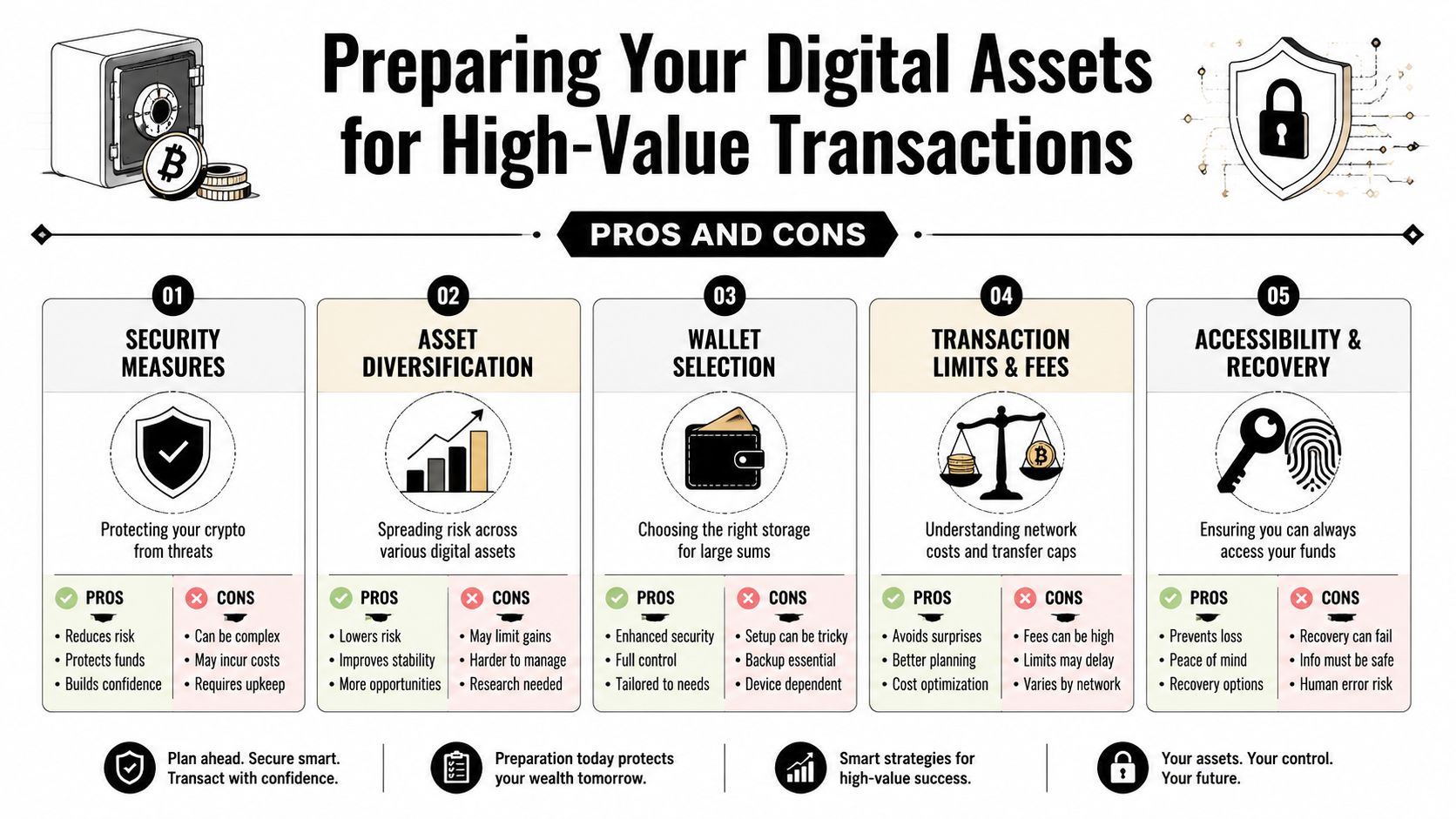
Preparing Your Digital Assets for High-Value Transactions
A client approves a six-figure charter. The aircraft is available now. The payment window is short. Then the main problem appears. The crypto is sitting on the wrong venue, withdrawal controls are still active, and no one has confirmed whether the recipient wants USDC on Ethereum, Solana, or another network.
That is how expensive delays happen.
Choose the right wallet structure
For high-value transfers, use a two-layer wallet setup.
A custodial wallet at a regulated exchange or institutional platform gives you trading access, conversion speed, and operational convenience. A non-custodial wallet gives you direct control of the private keys through a hardware device or another secure self-custody arrangement. Serious clients need both. One is for access. The other is for control.
Here's the practical comparison:
| Wallet type | Best use | Main advantage | Main risk |
|---|---|---|---|
| Custodial | Funding, trading, fast conversion | Easier access and execution | You depend on the platform |
| Non-custodial | Holding significant balances, direct control | You control the assets | You carry the security burden |
Do not keep the full payment balance on an exchange because it is convenient. Hold strategic reserves in self-custody. Keep only the amount needed for near-term execution in a vetted custodial environment with tested withdrawal access.
That balance matters more with private aviation payments, where timing is tight and invoice terms can change quickly.
Fund before you need to move
Preparation starts well before the invoice arrives. If you wait for the charter contract to land in your inbox, you are already late.
Use this checklist:
- Pre-fund the sending account. Decide in advance whether the payment will leave from an exchange wallet, a processor-linked wallet, or a dedicated treasury wallet.
- Hold extra for fees. The payment amount is not the full requirement. The wallet also needs enough native token or balance to cover network costs.
- Clear access controls early. Test device access, approval flows, authentication methods, and backup credentials before the payment date.
- Match the destination asset exactly. If the recipient requires USDC on a specific network, hold that asset on that network before any invoice is issued.
- Confirm withdrawal limits and review triggers. Large transfers often prompt extra checks from exchanges and custodians. Resolve those thresholds in advance, not during a live booking.
- Assign internal authority. One person should approve, one should execute, and one should verify destination details for any material transfer.
At this level, basic operational discipline becomes treasury discipline. Verify address format. Confirm network compatibility. Make sure the sending wallet can cover both the payment and the fee. Track the transaction on-chain after release. These are simple controls, but they prevent the kind of mistake that turns a fast settlement rail into an expensive problem.
Learn the asset before using it
If someone on your team still needs a clean primer on wallet basics, blockchain mechanics, and custody trade-offs, a concise starting point is these trusted insights into cryptocurrency from EndureGo Tax.
For aviation-specific payment context, Haute Jets outlines its crypto payment options for private jet charter, which is useful for confirming how a charter provider may structure acceptance, coordination, and settlement.
Keep the payment rail boring. In high-value crypto transfers, routine preparation is what protects speed, privacy, and control.
Executing the Payment with Precision and Confidence
Your aircraft is on standby, the operator wants funds released now, and one wrong character in a wallet address can send six figures to the wrong destination. At this level, payment execution is not a clerical task. It is a controlled settlement event.
Processor checkout versus direct wallet transfer
You have two practical options.
A processor-managed checkout gives you a payment link, one-time address, or QR code tied to a specific invoice. The quoted amount is usually locked for a short window, and the merchant's system records what was requested, what was sent, and when it settled.
A direct wallet-to-wallet transfer is simpler on paper and riskier in practice. You receive an address and network instruction, then your team sends the funds manually.
For large travel payments, use the processor route whenever the provider offers it. It gives you cleaner audit records, less address reuse, tighter invoice control, and fewer opportunities for a last-minute messaging error or spoofed payment instruction. That discipline matters more for a private charter payment than it does for a small retail transaction.
If you want a quick example of QR-based payment acceptance in practice, this overview of Bitcoin and Ethereum payments via QR is useful context.
The execution sequence I recommend
Treat the payment like a wire transfer with better visibility and less room for reversal.
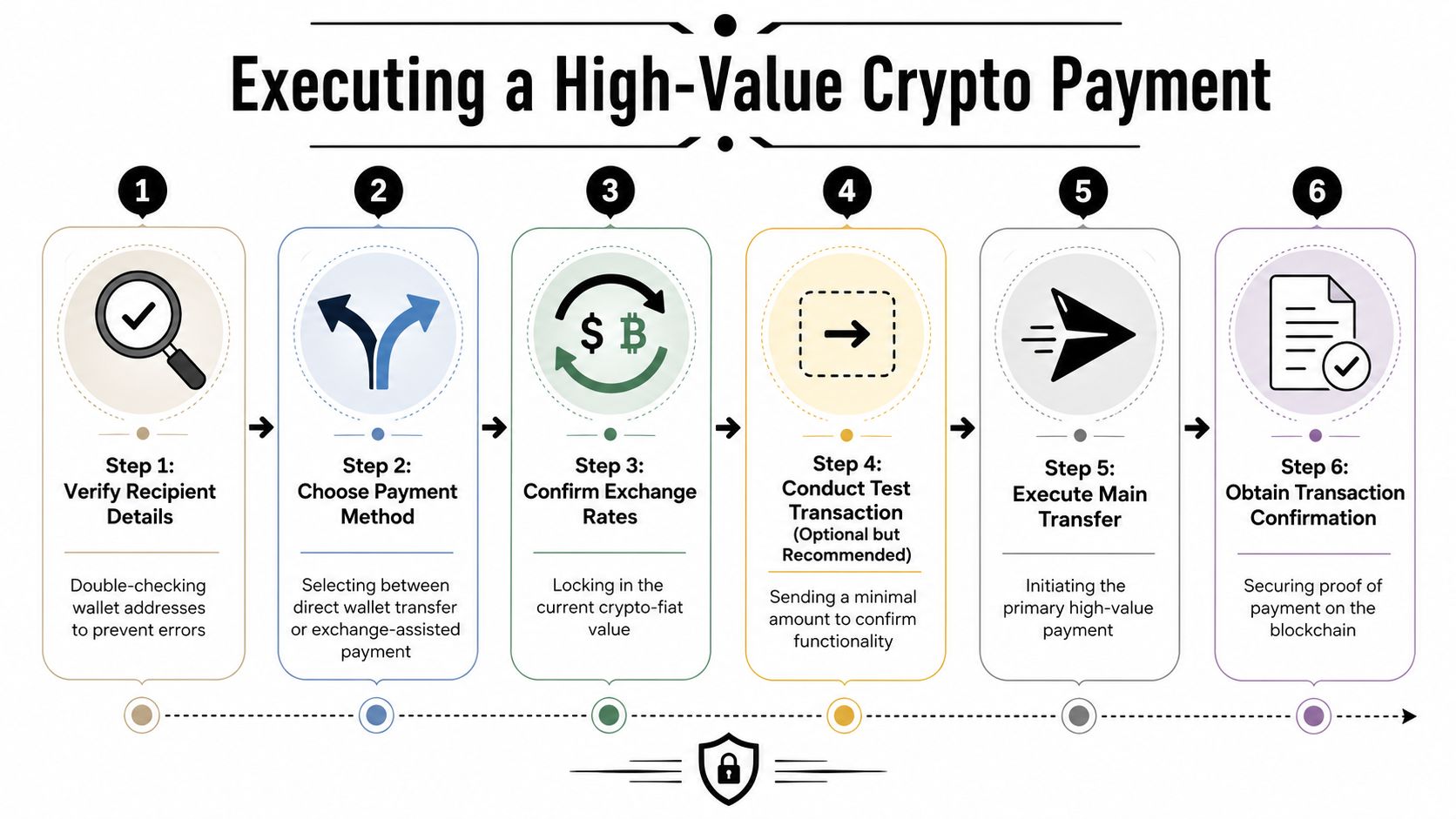
Use this order:
- Confirm the payee through an authenticated channel. Verify the legal entity, invoice reference, and settlement contact before anyone opens a wallet.
- Match the asset to the invoice exactly. If the operator requests USDC, do not substitute BTC, ETH, or a different stablecoin unless they approve it in writing.
- Match the network exactly. USDC on Ethereum, Solana, and Polygon are different settlement rails. Sending on the wrong one creates recovery risk and delays.
- Validate the amount and expiry window. If the quote is time-limited, fund it inside that window or request a refreshed invoice.
- Send a test payment to any new recipient. A small confirmation transfer is cheap insurance on a six- or seven-figure movement.
- Release the full amount only after the test is received and acknowledged.
- Save every record immediately. Keep the invoice, wallet screenshots, transaction hash, approval log, and final confirmation from the merchant or processor.
Reliable payment operations follow this same sequence. Fund the correct wallet, confirm the recipient details, submit the transaction with the right fee settings, and watch the transfer on-chain until it is confirmed. For a first payment to a new charter provider or broker, the test transfer is the control I insist on.
Speed helps only if the payment is right
Crypto works well for urgent bookings because settlement can happen quickly and transparently. That advantage disappears if your team sends the wrong asset, uses the wrong network, or misses the invoice window by ten minutes.
The right standard is simple. Fast execution, slow verification.
Send money only after the process makes a wrong payment unlikely.
For a travel-specific example, this explainer on how crypto payments work for private jet charter gives a practical view of how these transactions are typically coordinated.
A visual overview helps if your assistant, CFO, or travel manager is coordinating the process with you.
What to monitor after sending
A wallet status of “sent” proves very little. Your team should monitor the transaction on-chain until the recipient confirms receipt against the invoice.
Check these points:
- Transaction hash
- Destination address
- Selected network
- Confirmation count or finality status
- Merchant or processor acknowledgment
- Any shortfall caused by fees, timing, or quote expiry
This step gets overlooked during urgent travel arrangements. It should not. A high-value crypto payment is complete only when the blockchain shows final settlement and the payee confirms the funds have been matched to your booking.
Managing Volatility and Sourcing Large Crypto Positions
If you're paying for a private charter with crypto, the two real financial issues are price movement and liquidity access. Both are manageable. Both are often mishandled by people who treat a large transaction like a retail trade.

Use stablecoins for payment, not conviction assets
If the invoice is denominated in dollars, the cleanest settlement asset is usually a high-liquidity stablecoin, not Bitcoin or Ether.
That isn't because Bitcoin or Ether are “bad.” It's because payment and speculation should be separated. Stripe's business guidance is clear on the key principle: invoice precision matters, so professional systems generate a time-limited crypto amount from real-time pricing, and starting with high-liquidity assets and stablecoins such as USDC or USDT is the recommended practice to reduce slippage and ensure the exact amount settles, as outlined in Stripe's guidance on accepting crypto payments.
Here's the decision framework:
| Asset choice | When it makes sense | Main concern |
|---|---|---|
| Bitcoin or Ether | You already hold it and the recipient accepts it | Price can move between quote and payment |
| USDC or USDT | You want cleaner invoice matching | You still need correct network and wallet controls |
Don't build a large position on the fly
Many affluent clients make the same avoidable mistake. They decide to pay with crypto, then try to source a substantial amount quickly through a standard retail exchange interface.
That can create three problems at once:
- Execution friction: Account checks, funding holds, or withdrawal reviews.
- Market impact: Your own buying activity may worsen your fill.
- Operational noise: Too many steps between purchase and settlement.
For larger payments, use institutional-style access if it's available to you. That may mean an OTC desk, a prime broker, or a private digital asset desk through a trusted financial intermediary. The point isn't sophistication for its own sake. The point is controlled execution and cleaner pricing.
A better timing sequence
For a planned high-value travel payment, this is the order I recommend:
- Decide the settlement asset first. Usually a stablecoin if the quote is linked to USD.
- Source liquidity before final payment instructions arrive.
- Move the payment amount into the sending environment close to execution time.
- Avoid holding a speculative asset unnecessarily if the objective is to pay an invoice.
The professional move is simple. Hold the asset you want for investing. Hold the asset you need for paying.
That distinction prevents a lot of accidental risk. It also makes reconciliation cleaner because your treasury team can map the outgoing payment to a stable invoice amount rather than to a volatile asset value that moved during the process.
Navigating Compliance and Financial Housekeeping
A high-value crypto payment is never just a payment. It's also a compliance event, a record-keeping event, and often a tax event. If you ignore that, you turn a fast transaction into a slow administrative problem.

Expect scrutiny on large transfers
When meaningful sums move through exchanges, OTC desks, or payment processors, enhanced review shouldn't surprise you. It's normal.
Your counterparties may ask for:
- Identity verification
- Entity documentation if a company is paying
- Source of funds support
- Source of wealth context
- Invoice or contract evidence tied to the transfer
That isn't bureaucracy for its own sake. It's part of using digital assets responsibly at scale. The clients who get through this smoothly are the ones who prepare documents before anyone requests them.
Treat records as part of the transaction
If you're serious about learning how to pay with cryptocurrency for luxury travel, build a paper trail that would satisfy your accountant without another phone call.
Keep these items together in one file set:
| Record | Why it matters |
|---|---|
| Invoice or charter agreement | Links the payment to the service |
| Wallet address and network used | Supports reconciliation |
| Transaction hash | Proves on-chain transfer |
| Fiat value at the time of payment | Supports accounting and tax reporting |
| Internal approvals | Protects against governance disputes |
This discipline matters more in travel than many people think. Itineraries shift. Deposits get rebooked. Passenger names change. If the records are weak, your operations team will spend more time reconstructing the transaction than managing the actual trip.
The tax point people overlook
Paying for a service with crypto often has consequences beyond the payment itself. In many jurisdictions, disposing of crypto to buy something can trigger tax analysis because you've used an asset rather than spent cash.
That means your team should record:
- the asset used,
- the quantity sent,
- the fiat-equivalent value at the time of payment,
- and the purpose of the payment.
You don't need drama here. You need organization.
For clients considering aviation-specific crypto bookings, this practical FAQ on whether you can pay for a private jet with crypto is a helpful operational reference.
Good compliance isn't friction. It's what lets you keep using the rail without interruptions.
My recommendation for HNW clients
Delegate preparation, not responsibility.
Have your family office, controller, or legal team preassemble the documentation stack. But keep direct visibility into the wallet, the recipient, and the final approval. Large crypto payments should never be so delegated that the principal no longer understands where the money is going.
The Aftermath Refunds Disputes and Ultimate Security
The most important question in crypto payments isn't “How do I send it?” It's “What happens if the booking changes after I send it?”
That's where inexperienced users get caught. Crypto transfers are irreversible, so the post-payment workflow matters more than in a credit card transaction. ACI Worldwide's business-side guidance is blunt on this point: the hardest part of paying with crypto is often post-payment operations, and businesses need strong controls around refunds, security, and reconciliation, especially for services that may change after booking, as discussed in ACI Worldwide's guidance on staying safe with crypto payments.
Refunds need a new process
For private aviation, itinerary adjustments are normal. Aircraft swaps happen. Departure times shift. A route may need to be rebooked.
With crypto, there is no native chargeback. A refund usually means the merchant or processor initiates a new outbound transaction back to you, subject to its controls and verification standards.
That leads to three essential rules:
- Use established counterparties. If a provider has no clear refund process, don't pay in crypto.
- Never change refund wallet instructions casually. Any change should be verified through a secure channel.
- Preserve the full payment trail. Original invoice, transaction hash, and refund authorization should live in one record set.
Security after payment still matters
The risk doesn't end when the funds arrive. Phishing attempts often appear after a legitimate transaction, especially when counterparties know a large payment just moved.
Keep your defenses simple and strict:
- Verify every wallet address through a second channel.
- Store long-term balances in hardware-backed or otherwise tightly controlled environments.
- Limit who can approve, initiate, and confirm payments.
- Reject urgency as a substitute for verification.
If someone pressures you to skip address verification because the flight is urgent, treat that as a warning sign, not a reason to move faster.
The final principle
Crypto works well for high-value travel when it sits inside a disciplined process. That means secure wallet management, precise invoicing, controlled execution, complete records, and a clear refund path.
Used that way, it's efficient. Used casually, it's expensive.
If you're arranging a time-sensitive charter and want a structured crypto payment workflow, Haute Jets offers private jet booking with digital asset payment options and can coordinate the payment side alongside the flight logistics.