You're comparing two quotes for the same private flight. One promises fixed hourly pricing if you commit to a block of time. The other lets you pay only for the trip you're booking today. The jet card looks safer because the rate feels predictable, but the on-demand quote leaves your capital untouched if your travel schedule changes.
That's the jet card membership decision. It isn't about finding the lowest hourly rate. It's about choosing between predictability and flexibility, then accepting the restrictions that come with your choice. Peak-day calendars, daily minimums, booking notice, aircraft availability, cancellation rules, and the risk attached to prepaid funds can matter more than the number printed beside an aircraft category.
This guide is written for Haute Jets Journal readers who want a practical answer, not a brochure summary. You'll see how jet cards work, what the published pricing means, which fees alter the final bill, and where on-demand charter or fractional ownership fits better. Haute Jets' no-membership, pay-per-flight model provides a useful control case throughout because it removes the prepaid commitment from the comparison.
The short recommendation is straightforward. A jet card can suit a traveler with repeatable routes, steady annual usage, and a strong need for defined access. On-demand charter usually wins when plans change, aircraft requirements vary, or annual flying remains irregular. Fractional ownership belongs in a different conversation, one based on sustained usage and a willingness to accept ownership obligations.
Introduction Why Jet Card Membership Still Confuses Smart Flyers
A frequent business traveler may know roughly how much private aviation he or she expects to use, but “roughly” isn't enough when a program asks for a substantial upfront commitment. The traveler may need several short domestic flights, a holiday trip, and an occasional larger aircraft for a group. A card can make the first few bookings feel simple, yet the same card may become awkward when dates move or the required aircraft category changes.
The sales pitch usually emphasizes three ideas: prepaid flight hours, fixed or capped rates, and availability. Those benefits are real when the contract delivers them on the dates and routes that matter. They're less compelling when the traveler pays for unused hours, faces stricter rules during peak periods, or discovers that taxes and trip-specific charges sit outside the advertised hourly rate.
The practical question: Are you buying cheaper travel, or are you buying a more predictable way to access travel?
Jet card membership has a clear place in private aviation. It was created to simplify the purchase of flight time for people who wanted something between aircraft ownership and one-off charter. But the category now includes many different contract structures, from straightforward hourly blocks to membership programs with availability promises, aircraft limitations, and changing peak-day policies.
This guide focuses on the points that determine actual value:
- Commitment: How much money and flight time must you purchase before using the program?
- Access: What does “guaranteed availability” mean in the written agreement?
- Total cost: Which taxes, minimums, surcharges, and service fees sit outside the base rate?
- Flexibility: What happens when your itinerary, aircraft needs, or annual flying pattern changes?
- Alternatives: When does trip-by-trip charter or fractional ownership make more sense?
The answer won't be the same for every flyer. A predictable executive travel calendar can justify a card, while an irregular family schedule can make prepaid hours a costly inconvenience. The right choice starts with the contract and ends with your actual travel behavior.
What Jet Card Membership Means Today
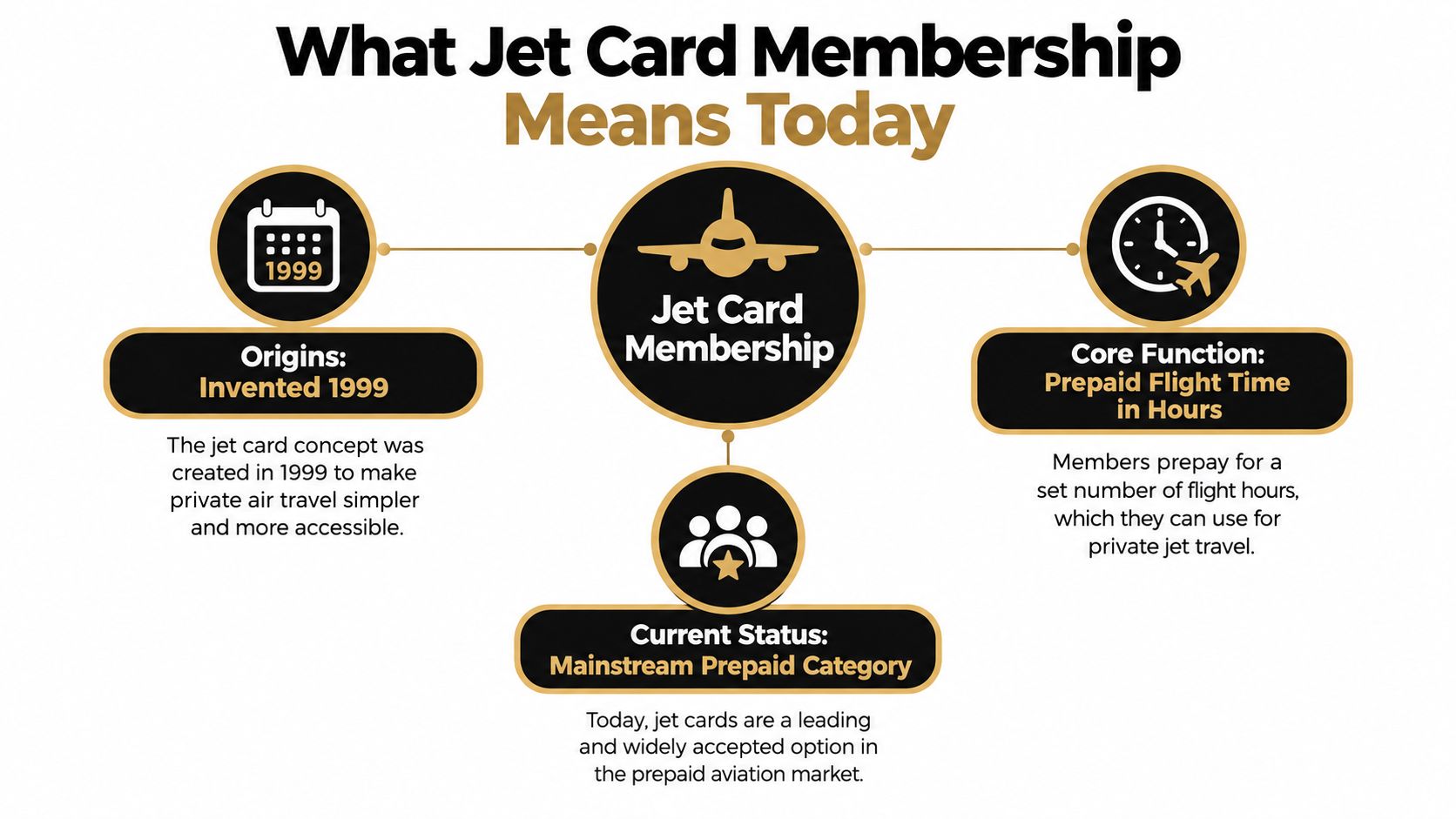
Sentient Jet introduced the first private jet card in 1999 and marked the product's 25th anniversary in 2024. The original model let travelers buy private flight time in hourly increments instead of purchasing an aircraft, taking a fractional share, or arranging each trip through on-demand charter. Elite Traveler's account of the jet card's origin places the product within aviation's shift from ownership toward access.
Today, a jet card usually assigns prepaid hours to an aircraft category, such as light, midsize, super-midsize, or heavy. You are buying a defined cabin size, range, passenger capacity, and performance level, not necessarily a specific tail number. The provider's fleet and operating rules determine which aircraft can fulfill the trip.
That distinction affects value more than the advertised hourly rate. A light jet may fit a small group on a shorter route, while a heavy jet provides more cabin space and longer range. Category upgrades may be available, but the contract controls both pricing and confirmation.
How the operating mechanics work
Programs commonly sell a block of prepaid hours, beginning at 25 flight hours. The provider deducts occupied flight time from that balance, usually under a defined primary service area. Before comparing rates, confirm the airports and regions included in that area, then check what pricing and billing rules apply outside it. Those boundaries can change the economics of a trip.
Some programs advertise 24/7 availability with no blackout dates, while the agreement sets the actual booking windows, aircraft guarantees, and peak-day rules. Jets.com's jet card FAQ describes always-on access as a defining feature of the category.
Availability promises still require close reading. Industry guidance cites marketed annual access windows of roughly 275 to 355 days, so “guaranteed availability” may exclude certain dates, aircraft categories, or request types. The exact wording determines whether the card delivers predictable access or only a narrower promise.
A jet card standardizes purchasing, while on-demand charter keeps each trip open to aircraft, operator, and routing choices. Ownership offers direct control but adds operating responsibility, and fractional ownership provides a share with structured usage rights. For travelers comparing a card with Haute Jets on-demand, the practical test is flexibility versus predictability: buy the card when consistent access and repeatable terms justify prepaid commitment, and choose on-demand when changing routes, aircraft needs, or flying patterns matter more.
How Jet Card Pricing and Fees Actually Work
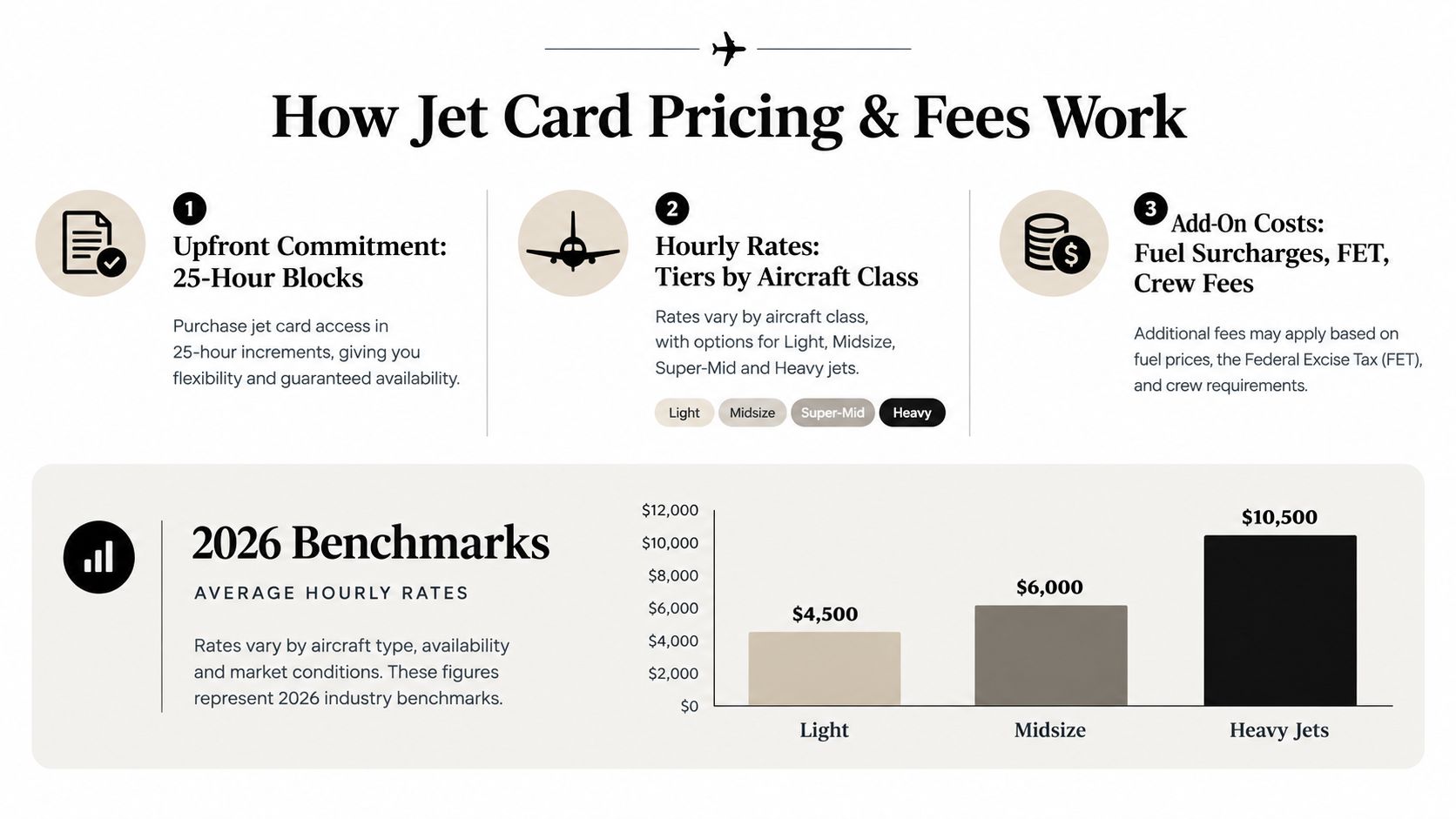
Start with the commitment, not the hourly rate. Jet card programs generally ask the buyer to purchase about 25 flight hours upfront, and a 2026 benchmark places a light-jet card at roughly $125,000 to $170,000 for that block, a midsize card at about $220,000 to $300,000, and a heavy-jet card above $400,000 in some cases. The Flying Engineer's private jet membership benchmarks provides those category-level ranges.
Those figures are not a universal price list. Aircraft type, geography, service area, provider, taxes, and contract terms can move the final number. A separate comparison guide places 25-hour programs from roughly $130,000 to more than $350,000, reinforcing the point that aircraft class and program design materially affect the entry cost. Stirling Access' jet card comparison also notes that guaranteed availability may require 24 to 48 hours' notice and can still involve peak-day surcharges.
The hourly rate itself may be presented in a much wider market range. Occupied one-way flight time can run from about $6,500 for a very light jet to $20,000 for an ultra-long-haul private jet, according to Private Jet Card Comparisons' FAQ. Those numbers help frame the category, but they don't tell you what your invoice will look like.
The billing detail that matters: Most programs bill occupied hours inside a primary service area rather than charging repositioning legs separately. Confirm the exact service-area definition before treating that promise as all-in pricing.
Costs outside the headline rate
A credible comparison should account for more than occupied time. Ask whether the quoted rate includes or excludes:
- Federal Excise Tax: Determine whether tax is included in the displayed hourly price or added at booking.
- Peak-day pricing: Check whether holidays, major events, or other high-demand periods trigger surcharges.
- Daily minimums: A short flight can consume more billable time if the contract requires a minimum daily charge.
- Notice windows: A card may promise access, but late booking can reduce aircraft choice or affect eligibility.
- Aircraft upgrades: Moving from a light category to a midsize or heavy aircraft usually changes the rate.
- Service charges: Review fuel, de-icing, catering, crew, handling, and international fees in the agreement.
The most useful calculation is trip-specific. Multiply the billable occupied time by the applicable category rate, then add taxes and every charge that applies to the route and date. Compare that total with an on-demand quote for the same aircraft class, schedule, passenger count, and service requirements.
For a traveler who flies repeatedly on stable routes, a fixed or capped rate can make budgeting easier. For someone who flies sporadically, the upfront balance can become the dominant cost. The card doesn't create value merely because the hourly price stays stable. It creates value when the access rules match the way you travel.
For a deeper breakdown of the broader membership expense, compare Haute Jets' private jet membership cost guide alongside the provider's actual contract. Use the guide to frame questions, then use the agreement to confirm what you'll pay.
Jet Card vs On Demand Charter vs Fractional Ownership Compared
The right model depends less on the advertised hourly rate than on how much flexibility you need and how much predictability you are willing to purchase. A jet card commits cash before the trip. On-demand charter keeps each mission open for a new aircraft, route, and schedule. Fractional ownership adds a continuing interest in an aircraft or fleet, along with ownership costs and obligations.
| Criteria | Jet Card Membership | On-Demand Charter | Fractional Ownership |
|---|---|---|---|
| Commitment | Upfront flight-hour purchase, commonly a 25-hour block | No prepaid hours, pay for each trip | Share purchase plus ongoing ownership-related costs |
| Pricing model | Fixed or capped hourly pricing within contract rules | Trip-specific quote based on aircraft, route, and timing | Ownership, management, and usage costs under the share agreement |
| Availability | Defined guarantee or access window, subject to notice and peak rules | Provider sources an aircraft for each request | Structured access tied to the ownership program |
| Aircraft choice | Category-based access, sometimes with upgrades | Choose the aircraft that fits each mission | More consistent access to a defined fleet or category |
| Flexibility | Moderate, reduced by prepaid funds and contract rules | Highest for changing routes, dates, and aircraft needs | Lower flexibility, higher continuity |
| Best fit | Frequent flyers with repeatable needs and budget predictability | Irregular or highly varied travel | Sustained usage and preference for an ownership structure |
A jet card becomes more compelling around 25 to 30 annual flight hours when predictable budgeting and short-notice access matter, according to NetJets' jet card cost comparison. Treat that range as a decision point, not a rule. If your travel reaches that level but routes, dates, and aircraft requirements change constantly, on-demand charter may still produce the better result.
The tradeoff in plain terms
Jet card membership suits travelers who can forecast their flying. You commit funds in exchange for a more standardized experience, defined aircraft categories, and pricing intended to reduce surprises. The cost is flexibility. Peak-day rules, notice requirements, minimums, upgrade charges, and an unused balance can matter more than the nominal hourly rate. Review those terms before deciding that predictability equals value.
On-demand charter fits trips that vary from one mission to the next. You can select a light jet for one route, a midsize aircraft for another, or a larger cabin for a group without maintaining a prepaid balance. Market pricing can change with demand, and availability must be solved for every flight. That trade-off is often worthwhile when preserving cash and aircraft choice matters more than rate consistency. Haute Jets on-demand provides the useful control case: price the actual itinerary first, then compare the card's committed funds and operating rules against that quote.
Fractional ownership suits travelers seeking a continuing aviation arrangement. It may fit sustained, predictable demand and a willingness to evaluate acquisition, management, scheduling, and exit terms. It is excessive for someone who wants private transportation without ownership exposure.
For broader context on private aviation and executive travel planning, this guide to premium transportation for flyers adds useful context. For a direct examination of the membership and charter trade-offs, read Haute Jets' guide to private jet cards versus charters.
Real World Use Cases That Reveal the Better Fit
The right model becomes obvious when you look at the itinerary instead of the marketing language.
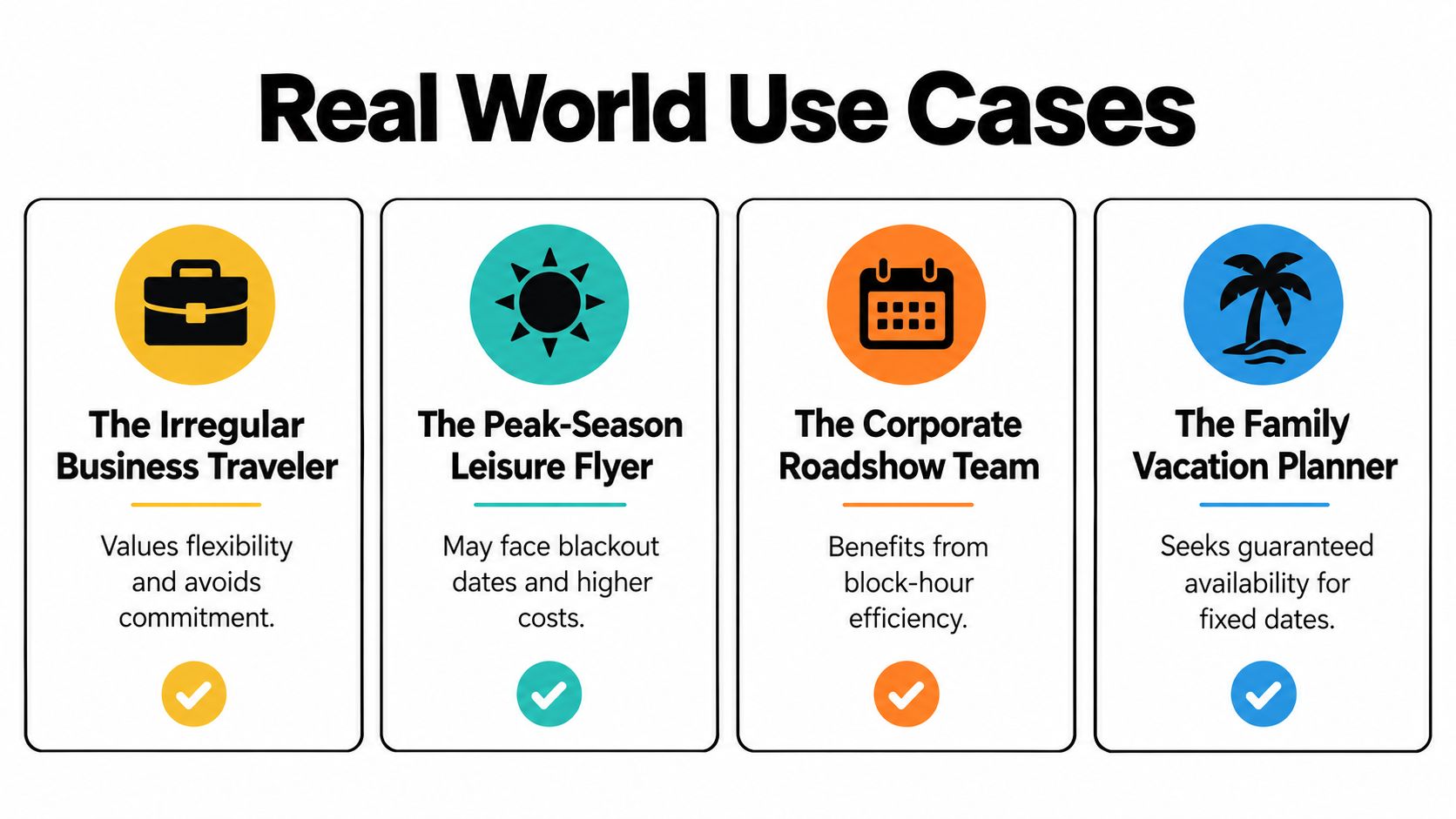
The irregular business traveler may fly heavily during one quarter and barely at all during the next. Routes can change with client demands, and bookings may shift from a small aircraft to a larger cabin with little warning. That traveler should start with on-demand charter, because preserving cash and aircraft choice matters more than a stable prepaid rate.
The peak-season leisure flyer has a different problem. The dates may be fixed, but the dates are also the ones when everyone wants to fly. A jet card can offer useful access, yet the buyer must read the peak calendar, notice rules, aircraft limitations, and surcharge language before assuming the card guarantees the desired trip.
The corporate roadshow team often has the strongest case for a card. Multiple cities, recurring travel, and a need to move people efficiently can make block-hour planning attractive. If the schedule is repeatable, the administrative simplicity may justify the commitment. If the roadshow changes weekly, on-demand sourcing can preserve the flexibility the team needs.
Match the aircraft to the mission
The occasional long-haul flyer shouldn't buy a card solely because one future trip requires a heavy jet. That approach can strand capital in a category the traveler rarely uses. On-demand charter lets the buyer select the aircraft needed for the specific route, passenger group, luggage profile, and cabin expectations.
Haute Jets' on-demand approach also allows travelers to choose the exact year, make, model, and cabin layout, rather than stopping at a broad aircraft category. That distinction matters when Wi-Fi, sleeping arrangements, pets, catering, or a particular seating plan affects the trip.
Use this checklist before committing:
- Usage pattern: Is your annual flying steady enough to consume the prepaid hours?
- Date behavior: Do you travel on fixed dates, or do meetings and family plans move?
- Peak exposure: Will you regularly fly during holidays or major events?
- Aircraft variation: Do your missions require different categories?
- Capital preference: Are you comfortable leaving funds with one provider?
- Access priority: Do you value a contractual availability window more than open choice?
If most answers point toward stable demand and repeatable travel, examine jet cards. If most point toward changing plans and varied aircraft needs, request on-demand quotes first.
Hidden Limitations and Risks Most Brochures Skip
A fixed hourly rate can be predictable while the trip remains unpredictable. That happens when the provider changes the number of peak days, applies daily minimums, limits aircraft choice, or requires more notice for the dates you care about.
Recent industry coverage describes providers easing some peak-day rules and lowering daily minimums. The same reporting placed average peak-day designations at 35.4 days in early 2025, suggesting that access restrictions are an active point of customer friction rather than a settled feature of the market. William Blair's 2025 aviation services update gives that market context.

Contract restrictions deserve more attention than sales language
Read the agreement for five items before you compare rates:
- Peak calendar: Identify every restricted date and the booking rules attached to it.
- Daily minimum: Find out how a short flight is billed when the aircraft must remain available for your itinerary.
- Notice requirement: Confirm the minimum notice for ordinary days, peak days, and last-minute changes.
- Refund terms: Some programs describe the commitment as non-refundable. Luxaviation's jet card terms state a 25-hour minimum commitment, a non-refundable commitment, and a 72-hour booking notice requirement.
- Provider failure: Independent coverage notes that prepaid jet-card funds are generally not federally insured against provider bankruptcy or financial failure. Resident's discussion of jet cards and buyer risk also warns that a base hourly rate can obscure taxes, notice rules, and other trip costs.
Headline pricing can also create a false sense of savings. One 2026 analysis reported that jet-card pricing lagged inflation in 2025, but a lower base rate doesn't guarantee a lower total trip cost once the contract's rules and add-ons enter the calculation.
A prepaid card transfers some risk from the provider to the buyer. You gain budgeting structure, but you also give up liquidity and may carry the consequences if your travel pattern changes or the provider struggles financially.
The operational promise matters just as much as the financial one. Ask who operates the aircraft, what happens during maintenance or weather disruption, whether a substitute aircraft must match the promised category, and whether “guaranteed” means a contractual obligation or a best-efforts statement.
The following video can help frame the contract-review mindset, but it shouldn't replace independent review of the agreement and a trip-specific quote.
Choosing Wisely and When On Demand Makes More Sense
Consider jet card membership if you fly frequently enough to use the hours, repeat similar missions, and place a high value on defined access and budget consistency. Consider fractional ownership only if private aviation is a sustained part of your operating model and you're prepared to evaluate ownership economics rather than just buying transportation.
Stay on-demand if your dates move, your routes vary, your aircraft needs change, or you don't want prepaid funds tied to one provider. The strongest case for on-demand is often not a lower advertised hourly rate. It's the ability to buy exactly what each trip requires.
Before signing any card agreement, verify:
- The full peak calendar, including surcharges and aircraft limitations.
- The daily minimum, occupied-hour definition, and service-area boundaries.
- The exact notice windows for booking, changing, and canceling.
- Refund and expiration terms for unused hours.
- Provider financial protections and the treatment of prepaid funds.
- Every tax and trip fee that sits outside the quoted rate.
For travelers who want private aviation without a prepaid commitment, Haute Jets' private jet charter without membership uses a pay-per-flight model with access to 3,500+ Wyvern and Argus rated aircraft across 175 countries, with local sourcing intended to reduce repositioning costs. That structure fits flyers who want to choose the aircraft and itinerary for each mission rather than purchase hours in advance.
The decision is simple once you stop treating predictability as the same thing as savings. Buy a card for dependable, repeatable usage. Book on demand when flexibility and control over each trip matter more.
Haute Jets arranges on-demand private flights at wholesale rates without memberships, prepaid hours, or blackout dates, sourcing from Wyvern and Argus rated operators across 175 countries. Visit Haute Jets to request a trip quote for your next itinerary and compare the trip cost before committing to a jet card.