
Booking a last-minute private jet used to be a logistical nightmare, often with a hefty price tag to match. Not anymore. With today’s on-demand charter networks, securing a private aircraft on short notice has become a surprisingly straightforward and smart move. You can now tap into a massive network of local aircraft, effectively sidestepping the steep repositioning fees that once penalized spontaneous travel.
Why Spontaneous Private Travel Is The New Normal
Let's clear the air on a common misconception: booking last minute doesn't mean you have to compromise on quality or price. For busy executives needing to close a deal across the country or families looking to seize a weekend getaway, on-demand private flights are a powerful tool. This isn't just a fleeting trend—it’s a real shift in how we approach air travel.
The secret sauce is the modern brokerage model. In the past, if you needed a jet and the closest one was in another state, you paid for it to fly empty to your location. These repositioning fees could easily inflate your charter cost by 20-40%. Today, smart, tech-driven systems find aircraft already parked at or near your departure airport, which completely removes that deadhead cost.
What this really means is that the market has flipped to prioritize efficiency. Instead of paying a premium for urgency, you're tapping into an existing, localized supply of fully-vetted, safety-audited aircraft. This makes a last-minute charter far more cost-effective than you might think.
A Market Shift Driven By Demand
This evolution isn't happening in a vacuum; it’s fueled by incredible growth. The private aviation market exploded from $25.87 billion in 2021 and is projected to climb to $39.84 billion by 2025. A huge part of this is the rebound in global travel and a new wave of flyers who demand more flexibility and control over their journeys.
In North America alone, private flight hours have jumped by over 20%, bringing a flood of first-time charter clients into the market. This surge has pushed the industry to adopt faster, more agile booking platforms.
What once took weeks of phone calls and planning can now be handled in just a few hours. The advantages driving this new normal are clear:
- Unmatched Speed: In major hubs, you can go from an initial request to wheels-up in as little as two to four hours.
- Cost Efficiency: Finding a local aircraft means no repositioning fees, leading to transparent and highly competitive pricing.
- Complete Control: You get to pick the exact aircraft. Want a specific model year or certain amenities? No problem. No surprises on the tarmac.
- Ultimate Flexibility: If your plans change, a good broker can pivot in ways commercial airlines simply can't.
The industry has evolved. Spontaneity and luxury are no longer at odds. The innovations shaping the private jet industry are making on-demand travel more accessible than ever. It's about having access to a fleet of thousands of aircraft without the heavy financial commitment of ownership or restrictive jet card programs.
Mastering the On-Demand Booking Process
Booking a private jet on short notice might seem daunting, but it’s a remarkably fast and transparent process when you know what information to have ready. Your success in getting airborne quickly comes down to one thing: providing precise details right from the start. This allows your broker to immediately dive into the live network of available aircraft and pull actionable, real-time quotes.
Think of it this way—if you’re vague with your request, you’ll get a lot of follow-up questions. That back-and-forth eats up precious time you just don't have. Specificity is speed.
The way we book has evolved dramatically, moving away from slow, traditional methods toward a smarter, on-demand model that works at the speed of business.
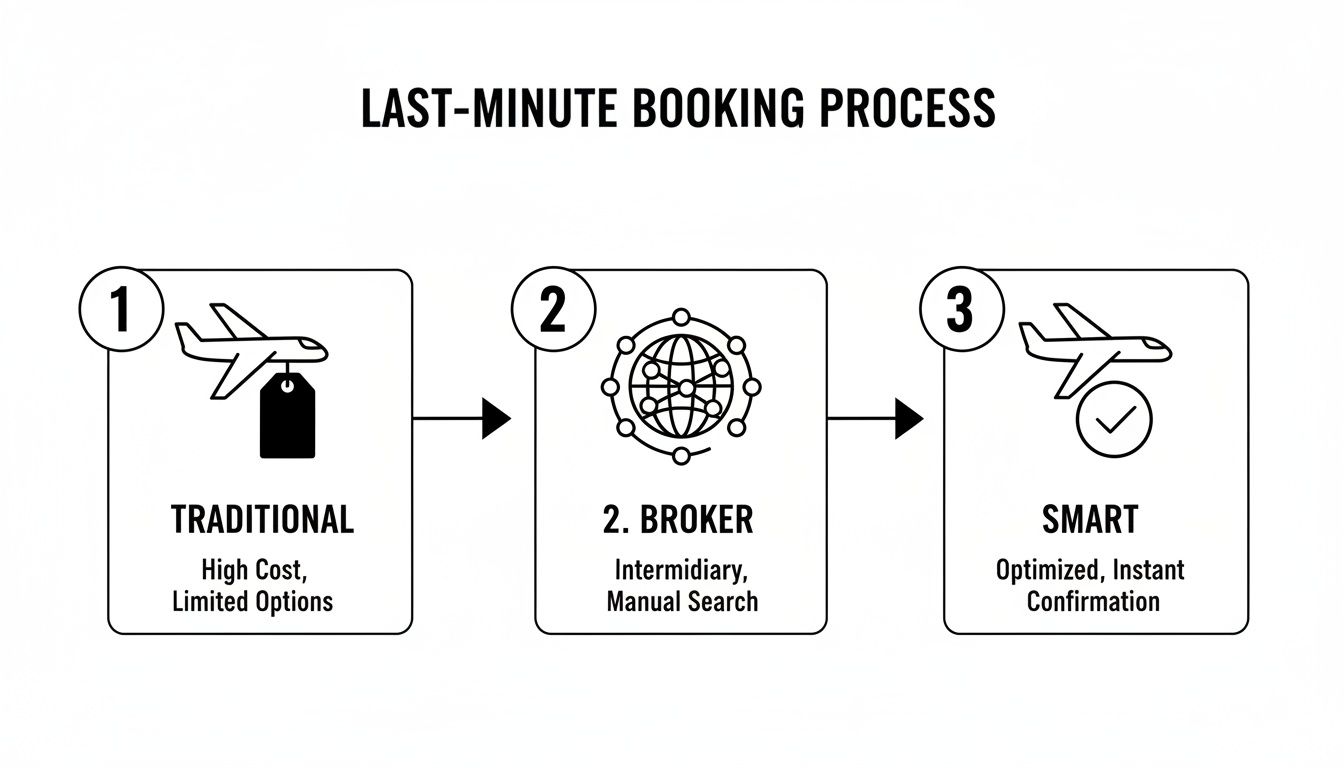
This modern approach gives you access to a huge network of aircraft, ensuring you find the right fit, right now, without the old-school limitations and high costs.
Your Initial Request: The Details That Drive the Deal
When you first reach out, your broker is ready to spring into action. But they can only move as fast as the information you give them. Having these details locked down can shrink a booking process that used to take days into just a couple of hours.
Here's exactly what you need to provide to get the ball rolling:
- Passenger Count: This is the first filter. It instantly tells us whether we’re looking at a light jet for four or a heavy jet for a dozen.
- Departure and Arrival Cities: Be specific. "New York to Florida" isn't enough. "Teterboro (TEB) to Miami-Opa Locka (OPF)" is what we need. This precision is critical for checking aircraft availability and accurate pricing.
- Travel Dates and Times: Give your ideal departure, but also share any flexibility you have. "Friday, wheels up between 4 PM and 7 PM" opens up far more options than a rigid "Friday at 5 PM sharp."
- Luggage Needs: Don't just say "a few bags." Are we talking carry-ons or a mountain of oversized hard-shell cases, golf clubs, and skis? A light jet might fit the passengers, but it won't fit their gear. This detail prevents a major headache at the FBO.
Getting this information right from the start is half the battle. You can dive deeper into the nuances in our full guide on booking a private jet with Haute Jets.
This level of detail is more important than ever. We're seeing a huge shift in the industry, with some analysts pointing to 2026 as a year for record global departures. While fractional ownership has boomed, the on-demand charter market has become all about efficiency. At Haute Jets, we tap into this by sourcing Wyvern and Argus-rated aircraft that are already positioned near you, which can cut repositioning fees by 20-40% and makes same-day departures a reality.
From Quotes to Contract
Once your broker has your specs, they’ll query a wholesale network of certified operators. Gone are the days of getting a vague quote for a generic "midsize jet." Today, you’ll receive options for specific aircraft—the exact make, model, year of manufacture, and even interior and exterior photos.
This empowers you to choose based on what matters to you. Maybe you want the newer jet with faster Wi-Fi, or perhaps one with a cabin layout better suited for a business meeting.
Key Takeaway: You aren't just booking a category; you're selecting a specific tail number. This complete transparency is the mark of a quality broker and ensures there are no surprises when you pull up to the tarmac.
After you’ve picked your aircraft, you'll get a charter agreement. The entire process is now digital. You can review and e-sign the contract from your phone in minutes. Payment is just as quick. While wire transfers are still common, we and other forward-thinking brokers now accept cryptocurrencies like Bitcoin and Ethereum, allowing for even faster and more discreet transactions.
The Final Confirmation and Your Flight Brief
Once the contract is signed and payment is sent, the aircraft is officially yours. But the service doesn't stop there. About 24 hours before your flight, you'll receive a complete pre-flight brief containing every last detail of your trip.
This flight brief confirms everything is in place and includes:
- Aircraft Tail Number: The specific registration of your jet.
- Crew Information: The names of your pilots.
- FBO Details: The address and contact info for the private terminal you'll be departing from.
- Catering Confirmation: Verification of your food and drink order.
- Ground Transportation: Confirmation that your car service will be waiting for you planeside upon arrival.
This final document is your peace of mind, assuring you that every single element of your journey has been meticulously arranged and is ready for you.
Choosing the Right Aircraft for Your Mission

When you're booking a last-minute private jet, picking the aircraft isn't just another detail—it's the decision that can make or break your trip. The right jet gets you there comfortably and on schedule. The wrong one can mean cramped legs, an unexpected fuel stop, or the frustrating discovery that your luggage simply won't fit. I've seen it happen.
The trick is to match the jet's capabilities to your specific "mission." This is about more than just a headcount. You need to think about range, speed, onboard amenities, and especially baggage space. With a modern broker, you can get incredibly specific, choosing the exact make, model, and even the year of manufacture. This gives you complete control.
This level of detail is crucial. For example, knowing you’ve secured a 2022 Citation Latitude with Gogo AVANCE L5 Wi-Fi means no unwelcome surprises when you step on board. You're getting the performance and technology you paid for, which is exactly what you need when every minute counts.
Aligning the Jet to the Journey
The best way to choose is to think through your trip's practical needs. Your mission profile will quickly narrow down the thousands of available aircraft to just a handful of ideal options. Let’s walk through a few real-world scenarios to see how different needs point to specific aircraft classes.
Imagine a corporate team of five that needs to visit three cities in one day—let's say they're flying from New York to D.C. for a morning meeting, then to Boston for a site visit, and back to New York by evening.
- The Mission: A fast-paced, multi-leg business trip.
- The Need: Raw speed, efficiency, and the ability to use smaller regional airports to get closer to their meetings.
- The Aircraft: A Light Jet is the clear winner here. Think of a Hawker 400XP or a Citation CJ3. These are the workhorses of the industry, perfect for short hops. They provide a comfortable cabin for working between flights and can land on shorter runways that larger jets can't access.
Now, picture a family of six deciding on a spontaneous ski trip from Los Angeles to Aspen.
- The Mission: A leisure trip with lots of bulky gear.
- The Need: Serious baggage capacity for skis, boots, and winter clothing, plus a comfortable cabin for a longer flight.
- The Aircraft: You'd want to look at a Midsize or Super-Midsize Jet, like a Hawker 900XP or a Citation Latitude. These jets hit the sweet spot, offering both the necessary range and a much larger baggage hold. The walk-around cabin also adds a layer of comfort that makes all the difference on a family trip.
Choosing an aircraft is like picking the right tool for a job. You wouldn't use a hammer to turn a screw. In the same way, putting a corporate team on a heavy jet for a 300-mile flight is wasteful, and trying to cram six sets of skis into a light jet is a recipe for disaster.
Heavy Jets for Global Reach and Ultimate Comfort
Finally, let’s consider a scenario that demands the most capability: an artist and their team flying from Miami to London for a gallery opening.
- The Mission: A long-haul international flight where staying connected and rested is non-negotiable.
- The Need: Transatlantic range, high-speed Wi-Fi, and a spacious cabin with amenities for both work and sleep.
- The Aircraft: This mission calls for a Heavy Jet. A Gulfstream G450 or a Bombardier Global 6000 is built for exactly this kind of intercontinental travel. They feature stand-up cabins, separate living areas, beds, and powerful connectivity suites. On a flight that’s seven to eight hours long, these aren’t just luxuries; they are essential for arriving refreshed and ready to go.
Understanding these differences is empowering. It turns the booking process from a guessing game into a series of strategic choices. By defining your mission first, you can confidently select the perfect aircraft for your last minute private jet charter and ensure your journey is as seamless as it is spontaneous.
Decoding Charter Costs and Avoiding Hidden Fees
When you're booking a last minute private jet, the final price can often feel like a mystery. But getting a handle on the costs is the key to making a smart, informed decision. The price you see on a quote is never just one number; it's a combination of the aircraft’s hourly rate, flight time, and a few standard fees that are part of every charter.
The biggest factor, of course, is the aircraft's hourly rate. This can start around $4,000 per hour for a nimble turboprop and climb north of $15,000 per hour for a spacious, ultra-long-range heavy jet. That rate gets multiplied by your total flight time to create the base cost of your trip.
On top of the hourly cost, you'll see a few other mandatory line items. These aren't exactly "hidden," but they are essential parts of any flight. Think of the 7.5% Federal Excise Tax for domestic travel, airport landing fees, and small per-passenger segment fees. Any transparent broker will break these down for you, so there’s no guesswork involved.
The Biggest Hidden Cost: Repositioning Fees
The one charge that has traditionally bloated private charter costs is the repositioning fee—what we in the industry call a "deadhead" flight. This is what you pay to have an empty aircraft fly to your departure airport just to pick you up. It’s a huge expense, often adding a staggering 20-40% to your total charter cost.
Let's say you need a jet in Aspen, but the nearest suitable aircraft is parked in Denver. The old charter model would bill you for that empty flight from Denver to Aspen. It's an outdated system that punishes travelers who need to fly on short notice or from less common airports. You’re essentially paying for two flights: yours and the empty one.
The Modern Solution: Today, technology and a smarter, local-sourcing model have made this fee obsolete. By accessing a live network of thousands of aircraft, a good broker can instantly find a jet that is already parked at or very near your departure airport. This simple but powerful shift in logistics is what makes last-minute private travel both affordable and incredibly efficient.
This approach doesn't just save you a ton of money; it also shaves critical hours off the booking process. Instead of hunting for an operator willing to move their plane for you, you're just hopping on an aircraft that's already in position and ready to fly.
Sample Last Minute Charter Pricing Scenarios
To give you a better idea of how this looks in the real world, here are a few common one-way trips. The prices below are based on sourcing a local aircraft, which means there are no repositioning fees baked in. This is the kind of straightforward, what-you-see-is-what-you-get pricing you should always look for.
| Route | Aircraft Category | Estimated Price Range | Flight Time |
|---|---|---|---|
| Teterboro (TEB) to Miami (OPF) | Light Jet | $18,000 - $25,000 | ~2.5 Hours |
| Los Angeles (VNY) to Las Vegas (LAS) | Very Light Jet | $12,000 - $18,000 | ~1 Hour |
| Chicago (MDW) to Aspen (ASE) | Midsize Jet | $25,000 - $35,000 | ~2.5 Hours |
| San Francisco (OAK) to Teterboro (TEB) | Heavy Jet | $55,000 - $70,000 | ~5 Hours |
As you can see, the aircraft size and the distance of the trip are the main drivers of the final cost. If you want to get even more granular, we have a complete guide that’s perfect for unraveling private jet charter pricing and all its moving parts.
Other Potential Costs to Keep in Mind
Even the most inclusive quote can have a few variables. While these aren't hidden fees, they are situation-dependent charges that are good to know about ahead of time.
Here are the most common ones you might run into:
- De-icing: This is a non-negotiable safety step when flying out of cold climates. Depending on the aircraft size and the amount of ice or snow, de-icing can cost anywhere from $1,500 to $15,000.
- Custom Catering: While standard snacks and a stocked bar are almost always complimentary, specific requests for multi-course meals from a favorite restaurant or bottles of premium champagne will be an additional charge.
- Crew Overnights: If your trip requires the crew to stay overnight, a per diem to cover their hotel and meals is standard. This typically runs $200 to $600 per crew member per night.
A trustworthy charter provider will always be upfront about these potential costs during the booking process. The entire goal is transparency, so the price you agree to is the price you pay. Understanding these cost dynamics gives you the power to make the best choice for your next on-demand flight.
Your Seamless Experience from Tarmac to Touchdown
Flying on a last minute private jet isn't just about getting there faster. The real value is in the seamless, entirely stress-free journey from the moment you leave your car to the second you step out at your destination. It’s an experience where every detail is anticipated, turning what is often a travel headache into a genuine pleasure.
It all starts on the ground. Forget the chaos of the main commercial terminal. You'll be directed to a private facility called a Fixed-Base Operator, or FBO. Here, the usual airport anxieties simply don't exist—no long security queues, no crowded gates, and absolutely no sprinting to your flight.
You can show up just 15 to 20 minutes before departure, hand your luggage to the ground crew, and walk straight to your aircraft. In many cases, your car can drive directly onto the tarmac, pulling up right beside the jet's stairs. It’s the definition of efficiency and privacy.

The FBO Experience
The best way to think of an FBO is as your own private terminal. These buildings are designed from the ground up for comfort and discretion, with amenities that feel more like a five-star hotel lobby than an airport.
Even if you’re only there for a few minutes, you’ll find:
- Private Lounges: Quiet, beautifully appointed spaces to relax or make a quick call before you board.
- Concierge Services: Dedicated staff are on hand to handle any last-minute requests.
- Refreshments: You can always count on finding complimentary premium coffee, drinks, and snacks.
The whole process revolves around your schedule, not an airline’s. It’s a fundamental change that gives you back complete control of your time.
A Bespoke In-Flight Environment
Once on board, the aircraft is your private domain. Every detail, from the catering to the Wi-Fi password, has been set up based on the preferences you shared during the booking process. The cabin truly becomes whatever you need it to be—a boardroom in the sky, a dining room, or just a quiet place to unwind.
This isn't just about comfort; it's about confidence. It’s the assurance that comes from knowing every element of your journey is confirmed and customized specifically for you, even on a short-notice flight.
Your charter broker is the one who makes it all happen. If you need to stay productive, they'll confirm the jet has high-speed Wi-Fi capable of handling video calls and large file transfers. If you're a wine enthusiast, they'll make sure your preferred vintage is sourced and waiting for you.
This focus on personalization covers everything:
- Custom Catering: From a specific brand of sparkling water to a multi-course meal catered by your favorite local restaurant, your requests are handled.
- Pet Accommodations: Your pets can travel right beside you in the cabin, not in the cargo hold. It’s a far more comfortable and humane way for them to fly.
- Entertainment: The latest movies, music, or magazines can be ready and waiting for you.
Seamless Arrival and Ground Connection
The effortless experience continues right through to your arrival. While the jet taxis to the private FBO, your pre-arranged car will be pulling up on the tarmac. You can step directly from the aircraft into your vehicle within minutes, completely bypassing the main terminal. Your luggage is transferred for you.
To guarantee your arrival is as smooth as the flight itself, it pays to book high-quality ground transport in advance. Finding reliable and dedicated services, like those offering Faro Airport Private Transfers, completes the loop. It’s the final piece of the puzzle that ensures your door-to-door journey is one smooth, uninterrupted motion.
Your Pressing Last-Minute Charter Questions, Answered
When you're up against the clock, you need clear, fast answers. No fluff. Here's what our clients most often ask when they need to book a jet on short notice.
Can I Really Book a Jet for Today?
Absolutely. We handle same-day requests all the time, and it's one of the core strengths of private aviation. In major markets like New York, Los Angeles, or London, where aircraft are plentiful, we can often have you in the air within two to four hours of your initial call.
The speed really comes down to being prepared. Once you give us your passenger count and route, we can tap into a live network of available jets almost instantly. The process moves incredibly fast from there.
Here's a pro tip: The real bottleneck isn't finding the plane; it's completing the paperwork and payment. If you're ready to act on a quote, a same-day departure is completely achievable.
How Is Aircraft Safety Verified on Short Notice?
This is the most important question, and the answer is simple: safety standards are never, ever compromised for speed. We only partner with operators who hold the industry's top third-party safety ratings from organizations like Wyvern and ARGUS.
Think of these ratings as a continuous, rigorous audit of an operator's entire business. They verify crucial details, including:
- Pilot Experience and Training: Crews must meet strict flight-hour minimums and undergo constant recurrent training.
- Maintenance History: The aircraft's maintenance records must be flawless and fully documented.
- Operational Procedures: The operator's safety management systems (SMS) are regularly audited.
When we present you with an aircraft option, it has already passed these non-negotiable safety benchmarks. You're only ever shown jets from a pre-vetted, elite network.
What If My Plans Suddenly Change?
Flexibility is the name of the game in on-demand charter. If a meeting runs late or an opportunity pops up in another city, your itinerary can adapt in a way a commercial flight never could. Your first move should always be to call your broker immediately.
We handle changes on a case-by-case basis. A minor timing tweak? If the crew and aircraft schedule allows, it's often a seamless adjustment. If you need to change your destination or add a leg to the trip, we'll quickly recalculate the flight plan and provide an updated quote. While changes can sometimes add to the cost, the power to pivot on a dime is often priceless.
What Are My Payment Options?
For last-minute trips, payment has to be fast and confirmed to lock in the aircraft. Wire transfers can be a problem, especially on nights or weekends when banks are closed.
To get around this, we've made sure our payment options are as agile as our aircraft:
- Credit Cards: Great for immediate payment to secure a jet, though they sometimes come with processing fees or have limits.
- Cryptocurrency: Increasingly popular for its speed and security. Paying with assets like Bitcoin (BTC) or Ethereum (ETH) allows for near-instant transactions anytime, day or night. It's the perfect solution for those after-hours or weekend departures.
Having these options ensures a bank's schedule won't keep you on the ground. You can use whatever method works for you to get the aircraft secured without a hitch.
At Haute Jets, we've built our entire model around streamlining the on-demand charter process. With our direct-to-owner network and transparent pricing, you get the right aircraft at the right price, every single time. Discover the difference of flying on-demand with us.