

Light jet charter costs typically range from $2,500 to $5,000 per flight hour, and that's only the starting point. Your final trip price can swing by 20% to 40% or more once hidden variables, especially repositioning, get added.
You're probably here because you've requested two quotes for the same route and got two very different answers. That's normal in private aviation, but it shouldn't be accepted blindly. Most first-time charter clients fixate on the hourly rate, when the key question is simpler: What will this trip cost me, door to door, on the aircraft I want, with the safety standard I expect?
That's the right way to think about light jet charter cost. A Citation CJ3 or Phenom 300 may look attractively priced on paper, and light jets are often the most practical entry point into private aviation. But the quote only makes sense after you understand what's inside it, what's missing from it, and who sourced the aircraft in the first place.
Understanding Your Light Jet Charter Quote
You request a light jet for a simple regional trip and get two quotes back within an hour. Same route. Same date. Same passenger count. One looks like a bargain. The other is thousands higher. If you judge them by the top-line number alone, you are guessing.
A charter quote is only useful once you know how the aircraft was sourced and which cost layers are inside it. That is the part new clients miss.
Light jets remain one of the best value categories in private aviation for short to mid-range trips. The trap is assuming there is such a thing as a clean all-in market price for a route. There is not. Price moves with aircraft position, operator terms, airport pair, and the way your provider accesses lift. A broker shopping the open market can produce one answer. A firm drawing from a tighter operator network can produce another. That sourcing model creates the widest gap in quoted price, and repositioning is usually the reason.
Why the same route gets different prices
Start with a simple question. Is the aircraft already near your departure airport, or does it need to be brought in first?
If the jet is sitting nearby, your trip can price cleanly. If it has to ferry in from another airport, you may pay for that empty leg before your passengers arrive at the terminal. Some quotes show that clearly. Some bury it inside flight time. Some keep it out of the first number and add it later.
The source of the aircraft matters just as much. A retail broker may blast your trip to a wide list of operators and mark up the option that comes back. A provider with direct operator relationships or network inventory can sometimes avoid unnecessary repositioning or reduce markup because the aircraft is already in the right region. That is why two legitimate quotes for the same mission can be far apart.
Ask these questions before you compare price:
- What exact aircraft is quoted? "Light jet" is a category, not a final answer.
- Where is that aircraft right now? You want the tail's current position, not a vague assurance.
- Is any ferry or repositioning flight included in this total? If yes, ask how much.
- Are taxes, landing fees, and overnight crew charges already built in?
- Is this sourced from a direct operator relationship, a network, or the open broker market?
That last question gets ignored too often. It should not.
The number that matters is total trip cost
Hourly rate is a starting reference. It is not a buying decision.
A low hourly figure can still produce an expensive trip once ferry time, airport fees, taxes, deicing, and minimum daily charges hit the quote. A higher hourly figure can still be the better buy if the aircraft is local and the quote is clean. Clients who focus on hourly rate alone tend to compare the wrong thing.
You want the trip total tied to a specific aircraft, a specific operator, and a clear list of inclusions. If you need a baseline for how hourly pricing is built, Haute Jets explains the mechanics in this guide to calculating private jet cost per hour. Then come back to the only number that matters for booking: your full trip total.
One more point. Good advisors explain pricing in plain language. Weak ones hide behind category averages.
If a provider cannot show you where the airplane starts, what is included, and whether repositioning is baked into the quote, keep shopping. Price clarity beats a cheap-looking number every time. Clear trip pricing works the same way smart travelers compare full vacation spend, not one teaser line item. The habit is no different from reviewing a Disneyland Paris food cost breakdown for travelers before setting a real trip budget.
Deconstructing the Total Charter Cost
You approve a quote for a light jet because the hourly rate looks fair. Then the invoice grows once fuel, crew, airport charges, taxes, and overnight costs are added. That happens because an "all-in" number means very little unless you know what is variable, what is fixed, and how the aircraft was sourced in the first place.
A charter quote is only useful if it shows the full trip math. The base aircraft rate is one line. The total you pay depends on flight time, airports, timing, operating constraints, and whether the seller found a local aircraft or dragged one in from somewhere else. That sourcing decision creates wider price swings than most first-time buyers expect.
If you want a clear primer on the base hourly side of the math, Haute Jets breaks it down in this guide to calculating private jet cost per hour. Use that as background, then bring the conversation back to total trip cost.
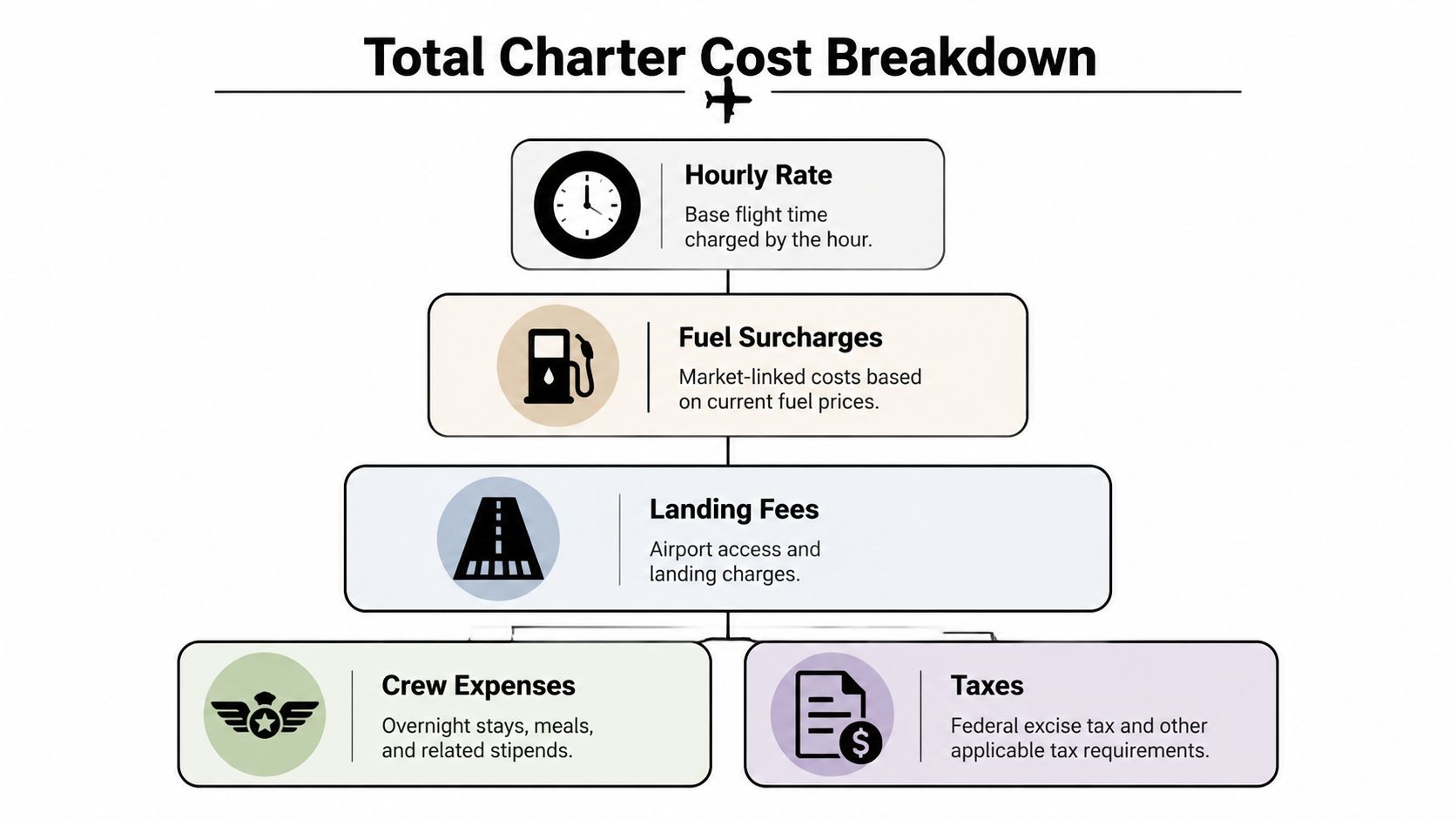
The charges that change your final number
Some costs are straightforward. Others move based on the mission.
- Billable flight time: The operator charges for the flying tied to your trip, subject to minimums and routing assumptions.
- Fuel surcharge: Some quotes bake fuel into the rate. Others separate it, which can change the total materially.
- Crew expenses: Early departures, late returns, or overnight stays can trigger crew hotels, meals, and transport.
- Landing, handling, and parking fees: FBOs and airports charge for ramp access, ground support, and aircraft parking.
- Federal Excise Tax: U.S. domestic charter flights include the required 7.5% Federal Excise Tax.
- Deicing and weather-related services: Winter departures can add a meaningful charge with little notice.
- Peak-day pricing: Holiday weekends, major events, and high-demand ski or beach periods push quotes up.
That list still does not tell the whole story. Two quotes can show the same categories and still land far apart because one seller sourced a nearby aircraft and the other sourced a distant one. Clients miss that point all the time.
Why quote totals vary so much
The biggest pricing gap in light jet charter is not cabin size or even hourly rate. It is sourcing model.
A broker pulling from a thin or poorly matched pool may present an aircraft that looks cheap by the hour but starts the day in another city. The empty legs required to get that aircraft into position feed extra cost into the quote. A stronger network, or a provider with better live access to based aircraft near your departure point, can cut that waste fast.
That is why "all-in" is marketing language unless the seller also shows aircraft position, billable time assumptions, and included fees. Without that context, you are comparing paperwork, not trips.
A better way to review the quote
Ask for the quote in itemized form and review it in this order:
- Aircraft base and operator
- Aircraft current location
- Billable flight hours
- Fuel treatment
- Airport and handling charges
- Crew overnight charges
- Taxes
- Weather or peak-date notes
If a provider will not show where the aircraft starts, treat the quote as incomplete.
The discipline is no different from reviewing a full travel budget instead of a teaser price. A simple example is this Disneyland Paris food cost breakdown for travelers. Smart buyers look at the whole spend before they commit. Private aviation should be handled the same way, except the mistakes are much more expensive.
What I recommend
Do not ask, "What is your hourly rate?"
Ask, "What is my total trip cost, what is included, where is the aircraft based, and what can still change?"
That question gets cleaner answers. It also exposes weak quotes fast.
The Single Biggest Hidden Fee Repositioning
If you only learn one thing about light jet charter cost, learn this: repositioning is where many clients get unexpectedly overcharged.
A repositioning flight is the empty segment flown before your trip starts, or after it ends, because the aircraft wasn't already where you needed it. You're not onboard. You still pay for it.

Why brokers create this problem
Traditional brokers often quote from a limited pool of aircraft or from whichever operator answers first. If that aircraft is based far from your departure city, the plane has to ferry in empty. That empty movement gets billed into your charter.
This is exactly why two quotes for the same trip can feel irrationally far apart.
According to Flying Mag's private jet charter cost calculator discussion, traditional brokers often rely on distant aircraft, adding repositioning fees that can inflate a New York to Miami light jet charter by $2,000 to $5,000. That cost can surge over 50% during peak seasons, which is why “same route, different quote” happens so often.
What it looks like in practice
Say you want a light jet for a straightforward trip. One seller finds an aircraft already near your departure airport. Another pulls one from a different market because that's what they have easy access to. On paper, both are quoting a similar category.
In reality, one quote is for your trip. The other quote is for your trip plus the aircraft's commute.
If you want a clean explanation of the mechanics behind this, read deadhead flights explained. It's the same issue, just with a term the industry likes to soften.
The aircraft's location matters almost as much as the aircraft itself.
My recommendation
Treat repositioning as a negotiation point, not a mystery charge.
When you review a quote, ask these questions directly:
- Where is the aircraft based right now?
- Is there any ferry or deadhead time included in the price?
- If yes, how much of the quote is tied to repositioning?
- Can you source a local alternative in the same aircraft class?
If you don't ask, you may never see the answer. Some quotes hide the cost inside a total. Others bury it in flight-time assumptions. Either way, you're funding inefficiency you didn't choose.
For cost-conscious clients, the sourcing model is often the deciding factor. Not the cabin photo. Not the sales pitch. Not the category label.
Sample Light Jet Trip Costs in 2026
Abstract pricing advice is useful. Actual route examples are better.
The fastest way to judge a light jet charter cost is to compare your mission against common trip profiles. Short regional sectors are often where light jets make the most sense because they balance speed, comfort, and cost better than larger categories.
Regional routes where light jets shine
For shorter flights, fixed costs matter a lot. That's why route length alone doesn't tell the full story. A light jet can be highly efficient on regional missions where you want jet speed without stepping up to midsize pricing.
According to EVO Jets' charter cost pricing basics, a Miami to Bahamas light jet flight of about 45 minutes typically costs $4,000 to $6,000 all-in, while Los Angeles to Las Vegas at about 1 hour typically runs $5,000 to $7,000 all-in. Those figures include base rate, fees, and taxes.
A practical benchmark table
| Route | Est. Flight Time | Est. All-In Cost Range |
|---|---|---|
| Miami to Bahamas | 45 min | $4,000 to $6,000 |
| Los Angeles to Las Vegas | 1 hr | $5,000 to $7,000 |
| New York to Miami | 2.5 billable hours | Qualitative only. Route pricing varies materially based on sourcing and whether repositioning is included |
The New York to Miami route deserves special caution. It's a common route, but it's also one where quote quality varies sharply because sourcing quality varies sharply. That makes it a poor route for trusting headline prices.
How to use these examples correctly
Don't use route examples as fixed offers. Use them as filters.
If your quote for a short regional hop lands far outside what's normal for that type of mission, stop and ask why. Sometimes the reason is legitimate. A specific airport pair may carry expensive handling. A winter departure may require de-icing. A premium operator may price differently.
Sometimes the reason is that the aircraft is coming from the wrong place.
A route estimate is only useful when the aircraft assignment and the fee structure make sense together.
My view on trip matching
For leisure hops, family weekends, and regional business travel, light jets are often the cleanest option. You avoid the slower profile of a turboprop and skip the excess cost of a larger cabin you don't need.
But the economics only hold if the quote is built around the mission. If the aircraft is badly sourced, even a short flight can become a bad purchase.
Comparing Light Jets to Other Private Aircraft
You approve a light jet quote, then a second quote comes in for a midsize jet at nearly the same total. That usually means one thing. You are not comparing aircraft categories. You are comparing sourcing quality.
A light jet is not the default choice. It is the right choice when the mission fits the aircraft and the aircraft is sourced well. If either piece is wrong, the “cheaper” category can end up costing more than the larger jet you were trying to avoid.

Turboprop versus light jet
For short sectors, a turboprop can be the better buy. If you are flying a brief regional leg, do not dismiss the category just because it is not a jet. A good turboprop can lower the total trip cost and still get the job done comfortably.
The tradeoff is straightforward. You give up some speed and some of the cabin feel clients expect from private jet travel. In return, you may save real money on the right route.
Light jets win when time, image, and a more familiar jet experience matter. They also tend to make more sense when the trip length starts pushing beyond the range where a turboprop feels like a compromise.
Light jet versus midsize jet
New buyers are often misled at this stage.
On paper, the light jet should cost less. In practice, a badly sourced light jet with heavy repositioning can come in close to a well-placed midsize aircraft. The category matters, but the sourcing model matters more. A broker pulling from a thin set of options may show you a low hourly rate and bury the inefficiency in ferry costs. A stronger operator network can produce a higher headline hourly number and still deliver the lower trip total because the aircraft is already where you need it.
That is why “all-in” means very little without context.
If you want model-level context before you choose a category, review these light jets for short and mid-range business travel.
Use this framework instead of shopping by hourly rate alone:
- Choose a turboprop for short hops where cost control matters more than jet speed.
- Choose a light jet for regional business or leisure trips where you want the best balance of cabin comfort, speed, and trip economics.
- Choose a midsize jet when passenger count, baggage load, stand-up cabin expectations, or longer nonstop range justify paying more.
A quick visual can help if you're narrowing aircraft categories by mission profile.
The real sweet spot for new charter clients
For many first-time charter clients, light jets sit in the middle for a reason. They cover a large share of regional missions without pushing you into the higher operating cost of a bigger cabin aircraft.
But do not treat that as a rule. Treat it as a starting point.
If you are flying a compact group on a typical domestic route, a light jet is usually the most sensible category to price first. If the quote looks surprisingly high, do not assume the market moved. Ask where the aircraft is coming from, whether repositioning is included, and whether a nearby midsize or turboprop would produce a better total.
My advice is simple. Buy the aircraft that fits the mission, then judge the quote by the full trip logic. Category alone does not determine value. Sourcing does.
Fly Smarter How to Secure Wholesale Charter Prices
The myth in this market is the “all-in” quote. Not because all-in pricing doesn't exist, but because many sellers use the phrase before they've explained what the number includes.
A smart buyer pushes past that.
What you should insist on
At minimum, ask for these five things before you approve a charter:
- The exact aircraft, not just the category
- A clear statement on repositioning
- An itemized fee structure
- The operator's safety rating
- Confirmation of trip-specific details like Wi-Fi, catering, and pet policy if they matter to you
That process removes most of the noise. It also exposes weak quoting fast.
What a better sourcing model looks like
On-demand charter has shifted buyer expectations. Clients want flexibility, not memberships. They want safety, not vague assurances. They want access to the right aircraft without paying for unnecessary repositioning.
Verified market data shows that sourcing from a network of 3,500+ Wyvern/Argus rated operators can deliver top-tier safety without a premium, while also supporting options like Bitcoin payments and Sustainable Aviation Fuel that many standard brokers don't handle well, according to Paramount Business Jets' private jet rental cost discussion.
One factual example in that model is Haute Jets, which sources from 3,500+ owner-operators across 175 countries and focuses on local aircraft sourcing to reduce the repositioning problem that drives so much quote variance.
Don't shop for the cheapest hourly number. Shop for the cleanest aircraft sourcing and the clearest quote.
My closing recommendation
If you're new to private aviation, start with a light jet when the route fits. Then judge every quote by total trip logic, not marketing language.
The right light jet charter cost is the one that gives you the right aircraft, from the right location, with the right safety standard, at a transparent total. Everything else is noise.
If you want a transparent quote built around the actual aircraft and routing, request a trip review from Haute Jets. You'll see the exact plane, the total fee structure, and whether repositioning is affecting the number before you commit.