
A CEO calls at 6 a.m. with a simple brief, get the board team from New York to London nonstop, keep the cabin quiet enough for work, and don't waste half the day on a fuel stop that turns into an overnight delay. That's where long range aircraft stop being an aviation category and start becoming a business decision. The right jet protects executive time, avoids repositioning waste, and keeps the mission on schedule when the route is unforgiving.
For charter buyers, range is never just about bragging rights. It decides whether a trip is nonstop, whether the aircraft can carry the people and bags you need, and whether you're paying for extra legs, extra crew time, or extra disruption. A lot of glossy brochures hide that reality. A serious charter plan doesn't.
Introduction to Long Range Aircraft
A travel manager gets the call again, this time for a transcontinental trip with tight meeting windows and a return the same night. The easy mistake is to shop for the biggest cabin first and the longest published range second. That's backwards. The correct sequence is route, payload, runway performance, then cabin comfort.
Long range aircraft exist to solve a specific problem, moving people across oceans or continents without stops that chew up time and money. That shift in aviation mattered historically because it moved the industry away from hub-and-stop thinking and toward true point-to-point global travel, especially for premium and time-sensitive missions, as the 747SP, 777-200LR, and A340-500 milestones show in the historical record of range growth (Simple Flying). Once nonstop became practical, charter clients stopped buying just transportation and started buying schedule control.
Why charter clients care first about mission fit
The most expensive aircraft is the one that misses the mission. If a jet can't handle the route with the actual passenger count, baggage load, fuel reserve, and weather profile, the “range” on paper is irrelevant. That's why serious operators look at the whole trip, not a single brochure number.
A private flight that would need a fuel stop on paper can still be a bad charter decision even if the cabin is beautiful. The stop introduces crew timing risk, ground handling risk, and often a separate cost layer that never shows up in the headline quote. Buyers don't need romance. They need certainty.
Practical rule: choose the aircraft for the route first, then choose the cabin for the passengers.
That mindset keeps the trip clean. It also keeps the invoice honest.
Understanding Range Categories
Range categories are useful only if you treat them as mission bands, not marketing labels. Short range usually fits regional flying, mid range fits domestic cross-country missions, long range fits transcontinental and some ocean-crossing city pairs, and ultra-long range is where nonstop intercontinental travel becomes routine. The historic benchmark matters here, because the Boeing 747SP brought about 6,650 nautical miles of range and made nonstop intercontinental flying commercially practical at scale (Simple Flying).
That milestone still helps buyers think clearly today. If an aircraft sits below the mission distance once you account for real-world operating margins, it doesn't belong in the quote comparison. If it sits well above it, you may be paying for unused capability.
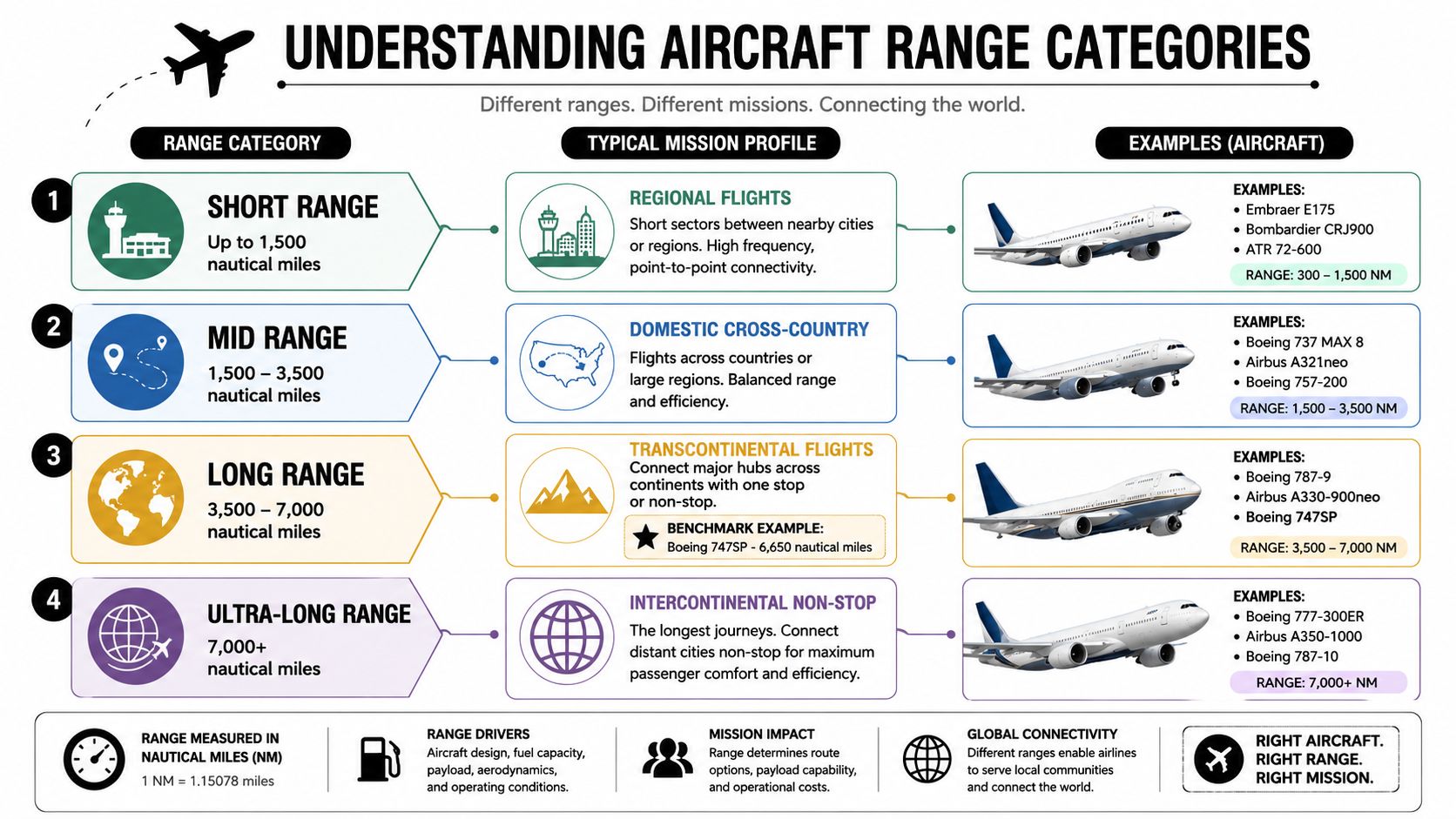
The range tiers that matter in charter planning
Short Range, think regional links where speed of access matters more than endurance.
Mid Range, think domestic cross-country missions where one-stop convenience matters less than schedule alignment.
Long Range, think transcontinental travel and the kind of sectors where the old hub model starts to fail.
Ultra-Long Range, think nonstop intercontinental flying where the aircraft can cover extreme sectors without forcing a stop.
That's the practical map, and it keeps charter teams from ordering too much airplane or too little. A long-haul mission with the wrong category often looks cheap until the repositioning, delay, or fuel stop shows up.
A benchmark that still teaches the market
The 747SP benchmark matters because it marked the point where long-range flying became commercially normal, not exceptional (Simple Flying). Modern long-range business jets typically exceed 4,000 nm, which places them far above the regional category and squarely into cross-border mission territory (Simple Flying).
For readers who want a sharper definition of the ultra-long end of the scale, this Haute Jets guide on ultra-long-range private jets gives a useful mission-based reference point. Use it as a planning tool, not a sales pitch.
Key Factors That Affect Range
Published range figures look precise, but they're only a starting point. Actual mission depends on fuel fraction, lift-to-drag ratio, payload, routing, and reserves, which is why two aircraft with similar brochure numbers can deliver very different actual reliability on the same city pair (Virginia Tech aerodynamics text). Charter buyers should care about what the jet can do on the day of the flight, not just in an idealized chart.
The engineering side
The Breguet equation ties range to the relationship between fuel carried and aerodynamic efficiency, so designers spend serious effort balancing structure, wing efficiency, and propulsion. Recent research on highly efficient long-range aircraft also focuses on wing aspect ratio optimization, because wing geometry remains a major lever on fuel burn and endurance (DLR ICAS paper). That's the engineering truth most charter brochures skip.
Payload changes the picture fast. If passengers, bags, and catering are heavy, less weight is left for fuel, and the aircraft's practical range can tighten. That's why the same jet can look perfect for one itinerary and marginal for another.
The operational side
Wind matters. Routing matters. Reserves matter. Alternate airports matter. The theory doesn't fly the plane, dispatch does.
Bottom line: ideal range numbers are brochure numbers. Real trips are built around payload, reserves, wind, and routing.
That's not a flaw in aviation, it's the whole game. Once you accept that, you stop comparing jets by fantasy range and start comparing them by mission reliability.
Comparing Long Range Business Jets
The best comparison is blunt. Some aircraft buy you cabin presence, some buy you route flexibility, and some do both. For long-haul charter, range has to be matched with the trip profile, because the wrong fit turns into a repositioning bill or a compromised schedule.
A useful working table for charter managers is below. It keeps the conversation grounded in the mission, not the brochure.
Comparison of Common Long Range Business Jets
| Model | Range (nm) | Cabin Length (ft) | Typical Missions |
|---|---|---|---|
| Gulfstream G550 | N/A | N/A | Transcontinental business travel, North America to Europe on many city pairs |
| Bombardier Global 7500 | N/A | N/A | Long-haul private travel, premium nonstop missions across major intercontinental routes |
| Dassault Falcon 8X | N/A | N/A | Efficient long-range charter, Europe-to-US East Coast type missions |
| Boeing 777-200LR | up to 8,500 (Boeing) | N/A | Extreme long-haul missions where range and payload balance matter |
| Airbus A350-900ULR | up to 9,800 (Airbus) | N/A | Ultra-long-haul nonstop intercontinental travel |
The table makes one thing obvious. Range alone doesn't decide the winner. The mission does.
What the big numbers really tell you
The Boeing 777-200LR combines 347,450 kg MTOW, 2 × GE90-115B engines, and a published range of up to 8,500 nmi, well above the 777-200ER's 7,500 nmi ceiling (Boeing). The Airbus A350-900ULR is published at up to 9,800 nautical miles, about 18,000 km, and Airbus says that's equivalent to 19+ hours in the air (Airbus). Those figures matter because they show how far the market has moved into true extreme endurance.
For earlier long-range widebodies, the Boeing 747-400 was published at 7,285 nm, and the 747-400ER at 7,585 nm, a 300 nm difference that pushed the airplane into a different mission category (Boeing 747-400 reference). That's a reminder that small changes in fuel capacity or design can change the route map in a real way.
The internal logic of model selection
If the route is borderline, choose the jet with room to spare. If the route is clear, don't overpay for unused range. That's where this comparison of Gulfstream, Bombardier, and Dassault options is useful, because it keeps the decision anchored in mission fit rather than brand loyalty.
Don't buy range you can't use. Buy the aircraft that solves the trip cleanly.
Charter Considerations for Long Range Aircraft
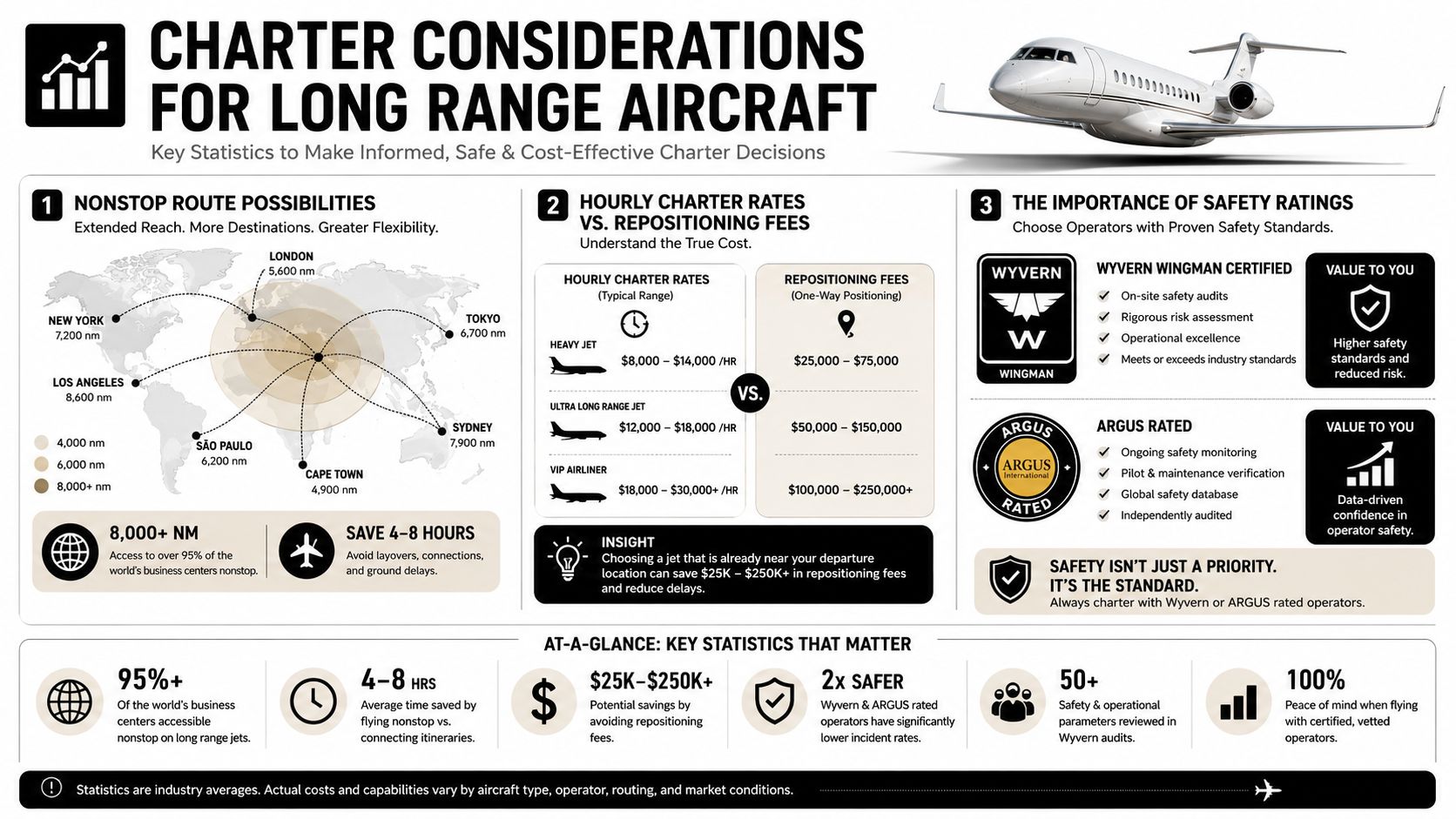
Long-range charter is where cost mistakes get expensive fast. A quote that looks reasonable can become less attractive once you add repositioning, crew timing, ground handling, and any schedule penalty from a fuel stop. The smartest buyers compare the total mission cost, not just the hourly rate.
Why nonstop capability changes the invoice
If the aircraft can fly the mission nonstop, the charter stays simpler. There's less ground time, less chance of a missed connection, and less chance of a surprise stop that forces a second crew cycle. That's where long-range aircraft often save money in ways that aren't obvious at booking time.
The operational logic is similar to the efficiency shift seen in cargo aviation, where new aircraft designs are being built around payload, fuel burn, and route economics instead of raw size alone. For private aviation buyers, the lesson is direct. The right aircraft is the one that carries the mission efficiently, not the one that looks most impressive on the ramp.
Safety and sustainability now sit in the same decision
Charter clients should still verify third-party safety oversight. In the Haute Jets network model, that means operator screening against Wyvern or ARGUS ratings, which is the kind of discipline serious buyers should expect from any broker or platform. I'd treat that as baseline, not a bonus.
Wing design also matters more than most buyers realize. Recent technical work on highly efficient long-range aircraft emphasizes wing-aspect-ratio optimization as a major driver of fuel burn and sustainability performance (DLR ICAS paper). That's the right framing for post-2025 charter conversations. Range isn't just a comfort feature, it's part of the emissions and efficiency equation.
For a broader look at how heavy jets and ultra-long-range aircraft fit charter missions, this Haute Jets overview is a useful companion read.
Booking Tips for High Net Worth Travelers
Start with the departure city, not the aircraft brand. If the jet is already based near you, you reduce the odds of paying for repositioning, which is one of the fastest ways charter prices get bloated. The whole point of on-demand aviation is control, so don't let a distant tail number erase that advantage.
What to ask before you confirm
- Ask for the exact tail number: The aircraft you quote on paper should be the aircraft that shows up.
- Confirm the cabin layout: Sleeping seats, conference seating, and baggage space change the value of the trip.
- Verify safety oversight: Request the operator's Wyvern or ARGUS status before you pay.
- Check Wi-Fi, catering, and ground transport: These details matter more than generic cabin marketing.
- Get a full pre-flight confirmation: Tail number, crew details, weather, and passenger manifest should all be clear before departure.
That last point is where disciplined charter sourcing pays off. In practice, better operators remove friction before the client ever reaches the terminal.
If you're also comparing broader international trip logistics, expert tips for booking international flights is a solid planning reference because the same discipline applies, even though private aviation removes most airline-style pain points.
What high net worth travelers should avoid
Don't buy into membership pressure if you fly irregularly. Don't accept vague aircraft descriptions. And don't let a broker steer you toward a farther-away aircraft when a nearer one can do the job just as well. The right booking process is simple, specific, and fully disclosed.
Conclusion and Next Steps
Long-range aircraft are a route-planning tool, a cost-control tool, and a safety decision all at once. The categories matter, the engineering factors matter, and the charter math matters even more. Once you understand how range translates into nonstop reach, you stop paying for unnecessary stops and start booking trips that work.
The best charter decisions come from matching the mission to the machine. That means checking the actual route, not just the brochure range, then choosing the aircraft that fits the payload, timing, and cabin needs without waste.
If you're moving executives, family, or clients across continents, use that standard every time. It saves time, preserves flexibility, and keeps the trip cleaner from takeoff to arrival.
Haute Jets sources aircraft across a wide operator network, matches the jet to the route, and gives you a direct way to compare long-range options without guessing. Visit Haute Jets to review available aircraft and request a charter that fits the mission, the cabin, and the budget.