
You're arranging a regional charter for a small group. The destination isn't far enough to justify a heavy offshore helicopter, but a compact cabin feels cramped once passengers, bags, and fuel enter the calculation. That's where the Bell 206L LongRanger, often called the Long Ranger helicopter, keeps appearing in charter discussions.
The appeal is easy to understand. It's a stretched, seven-seat light helicopter with a long service history, a relatively simple mechanical layout, and enough range for many regional point-to-point missions. The harder question is whether it remains the right value when the route demands more payload, altitude performance, or operational redundancy.
This guide, prepared for Haute Jets Journal, focuses on that decision rather than treating the aircraft as a collection of brochure figures. You'll learn what separates the LongRanger from the JetRanger, how to interpret its range in real operating conditions, and when a twin-engine helicopter makes more sense.
Introduction to the Long Ranger Helicopter
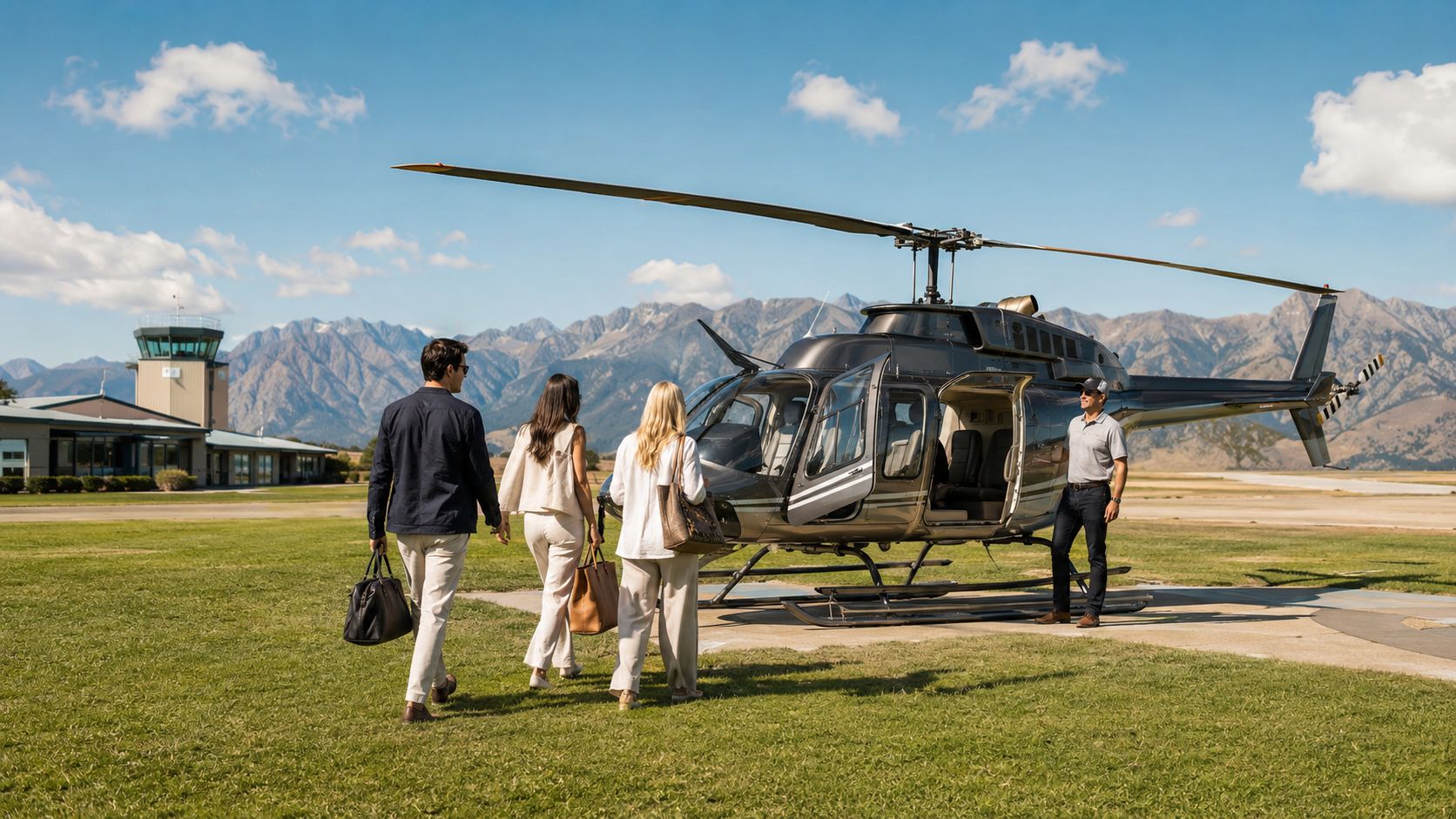
The first thing a buyer notices is usually the cabin. A LongRanger gives a small party more flexibility than a standard two-seat or compact light helicopter, and that matters when the flight involves colleagues, family members, or a pilot plus several passengers. The aircraft's stretched fuselage creates a practical middle ground, more useful than a smaller sightseeing machine without moving immediately into the cost and complexity of a twin-engine platform.
That middle ground explains the model's staying power. The LongRanger isn't designed to compete with the Airbus H225 or Airbus H215 on extreme distance, offshore capacity, or heavy utility work. It's built for missions where a light helicopter can complete the route efficiently, with a cabin that supports passenger transport, patrol work, medical missions, and utility operations.
A buyer should therefore ask a different question from “How far can it fly?” The useful question is, “How much passenger, baggage, and fuel can it carry for my actual route, under the expected weather and altitude conditions?” Published figures are starting points, not guarantees of a full cabin at maximum range.
The practical charter decision
Suppose four passengers need a direct regional transfer. The LongRanger may offer the right balance of cabin access, operating simplicity, and moderate-range capability. If the same group needs substantial baggage, a high-altitude landing, or a longer leg with comfortable reserves, the operator may recommend a different aircraft.
That recommendation isn't a rejection of the LongRanger. It reflects the way helicopters trade payload against fuel. Every passenger and bag occupies part of the aircraft's useful load, while fuel occupies another part. The operator must also account for density altitude, wind, reserve policy, and the performance of the specific aircraft in the fleet.
The LongRanger's reputation as a workhorse is justified, but reputation alone shouldn't determine a charter booking. The right aircraft depends on the route, the load, the departure elevation, the destination landing site, and the operational standards of the provider.
What Makes the Bell 206L LongRanger Different
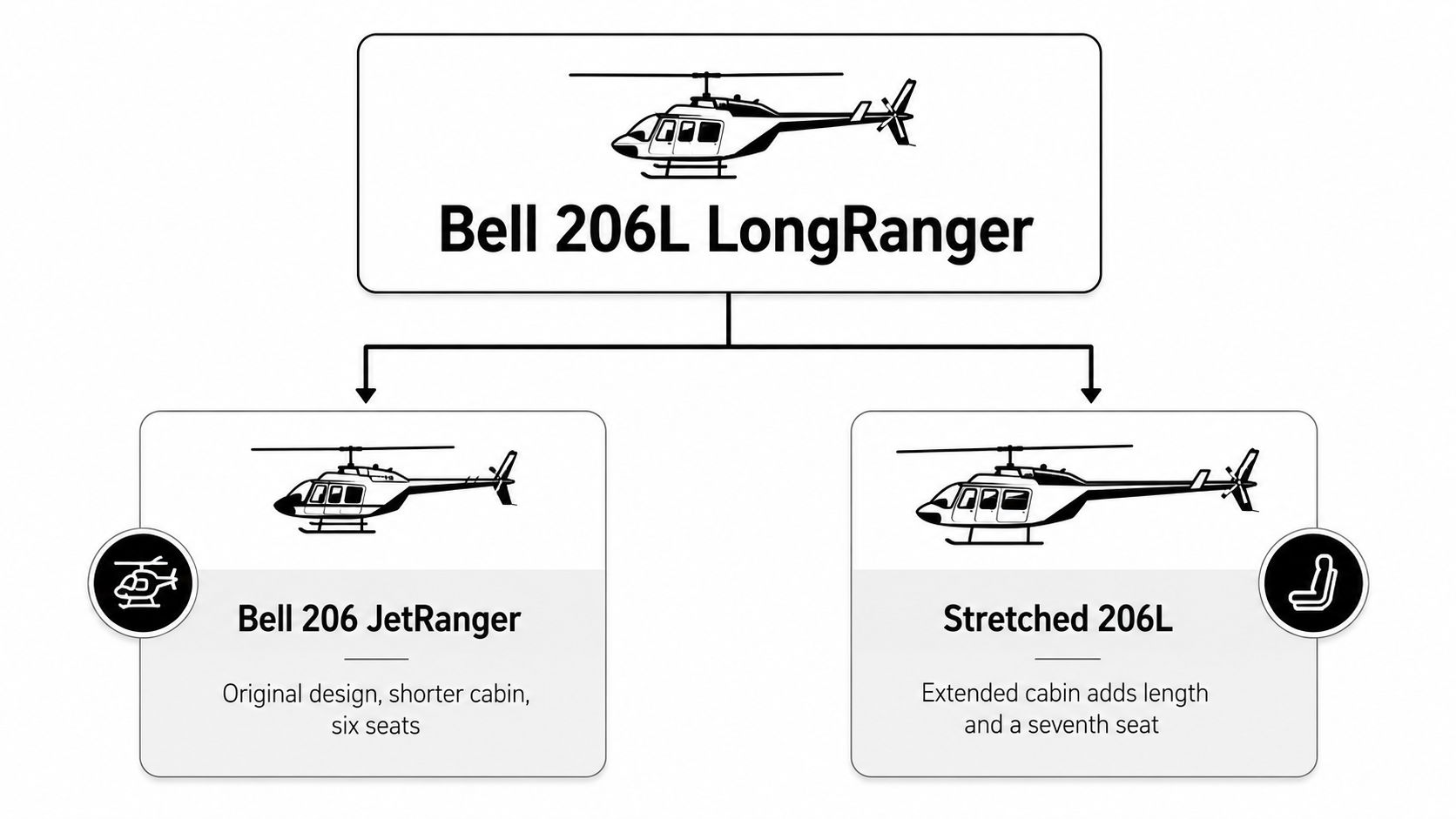
The easiest way to understand the LongRanger is to start with the Bell 206 JetRanger. Bell didn't create a completely unrelated aircraft. The 206L extended the established design, much as a manufacturer might stretch a proven vehicle to create more interior space while preserving its basic engineering logic.
The result is a seven-seat light helicopter with a larger fuselage than the JetRanger. The extra cabin length improves passenger utility, but the aircraft retains a relatively straightforward configuration, including a two-bladed teetering main rotor and a single Allison 250-C20B/C30P turboshaft engine. That combination helps explain why the model became widely used for passenger transport, patrol, and utility missions. (Bell 206 family overview)
A stretched design with a clear purpose
The LongRanger's 11.28-metre, or 37-foot, main rotor diameter gives the aircraft the lifting system associated with the 206 family. Its maximum takeoff weight is approximately 1,814 to 1,882 kilograms, or 4,000 to 4,150 pounds, depending on the variant. (Bell 206 specifications)
Those figures matter because they frame the aircraft's role. The LongRanger is light enough to remain practical for many regional and utility operations, yet its extended cabin makes it more flexible than the shorter JetRanger. The design doesn't try to solve every mission. It solves a common one, carrying a small group or a mixed passenger-and-equipment load without requiring a larger twin-engine helicopter.
The two-bladed rotor also contributes to mechanical simplicity and lower structural complexity compared with more elaborate rotor systems. That doesn't mean every operator has identical costs or that maintenance is trivial. It means the aircraft's architecture is familiar, established, and well suited to operators who value a straightforward light helicopter platform.
For buyers, maintenance discipline still matters more than a simple reputation for ruggedness. Ask how the operator tracks inspections, component life, and airworthiness records, and review what MRO means in aviation and why it matters for flight safety before treating a low quote as a complete comparison.
Why the cabin changes the mission
The added seat isn't just a marketing detail. It gives operators more ways to configure the aircraft for corporate transfers, aerial observation, police work, tourism, and utility support. Yet seven seats don't guarantee seven passengers with full fuel and baggage on every route. The aircraft's weight limit remains the controlling factor.
That is the LongRanger's central identity. It's a stretched, practical light helicopter that gains cabin utility without becoming a heavy transport machine.
Performance and Range You Can Actually Plan Around
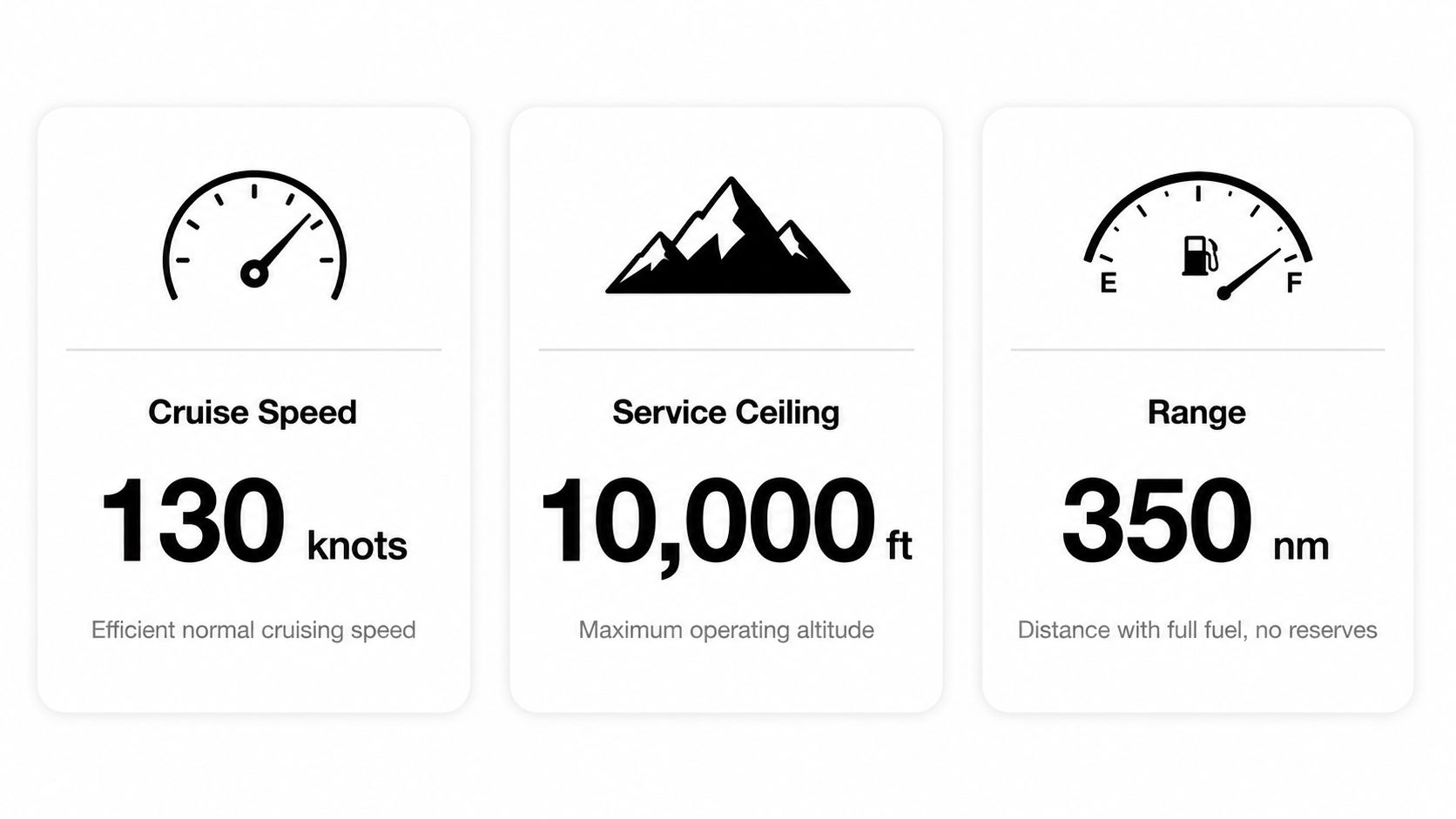
The LongRanger's published performance sits in the light-helicopter category. Depending on the variant and source, normal cruise speed is roughly 113 to 130 knots, service ceiling is around 12,900 to 13,500 feet, and full-fuel range is near 304 to 340 nautical miles. Some configurations report up to approximately 430 miles under optimized cruise conditions. (LongRanger performance data)
Those numbers are useful only when read as planning boundaries. A cruise figure tells you how the aircraft may travel efficiently in suitable conditions. A service ceiling describes an operating limit, not a promise that the helicopter will carry a full cabin comfortably at that altitude. Range with full fuel also says nothing about the payload remaining after fuel, or the reserves required by the operator.
Brochure range versus mission range
A helicopter's usable range changes with fuel load, payload, wind, altitude, temperature, and cruise speed. Manufacturer and published figures generally assume standardized conditions, while a real charter involves people, bags, weather, reserves, and an actual landing site. Independent flight guidance also distinguishes long-range cruise from maximum-range operation, describing long-range cruise as a speed above maximum range that reduces fuel mileage by 1%. (Operational range guidance)
That distinction is easy to miss. Flying faster can save time, but it may consume fuel less efficiently. Carrying more fuel can extend endurance, but fuel itself adds weight. Adding passengers can make the cabin more useful, but it reduces the margin available for fuel or baggage.
Practical rule: Treat published range as a reference point. Ask the operator for the planned payload, fuel uplift, reserve policy, weather assumptions, and whether the route needs a fuel stop.
Why hot-and-high operations change the answer
Density altitude combines elevation, temperature, and atmospheric pressure into a practical measure of how the aircraft performs. Hot air and high terrain reduce the rotor system's available margin, particularly during hover and takeoff. A heavier aircraft faces the same environment with less flexibility.
The LongRanger may be entirely suitable for a moderate-range city transfer at lower altitude, then become a less comfortable choice for a full-load departure from a hot, high landing site. Operators may reduce the passenger load, limit baggage, adjust fuel, or recommend a twin-engine helicopter with more capability for that mission.
The correct booking conversation is therefore specific. Give the operator passenger weights, baggage dimensions, departure and destination sites, preferred departure time, and any high-altitude or warm-weather concerns. A careful charter provider should respond with a route-specific assessment rather than repeating the aircraft's maximum range.
How Helicopter Range Has Evolved Over Time
A buyer comparing a LongRanger with a larger twin-engine helicopter is really comparing mission profiles, not just fuel capacity. Long-range capability began developing well before modern turbine aircraft. On 17 September 1952, Bell test pilot E.J. Smith flew a modified Bell Model 47D-1 from Hurst, Texas, to Niagara Falls, New York. The flight set an FAI world record for distance without landing at 1,958.80 kilometres, or 1,217.14 miles. (Historical Bell distance record)
That record demonstrated what a rotary-wing aircraft could accomplish on one continuous cross-country flight while helicopter design was still maturing. Operational experience showed a different form of endurance. A Coast Guard HO3S-1G covered 3,750 miles over 57.6 flight hours and 10.5 days, using staged transport rather than a single uninterrupted record attempt. The distinction matters for charter planning: distance can come from one long leg, or from a mission built around refueling and repositioning.
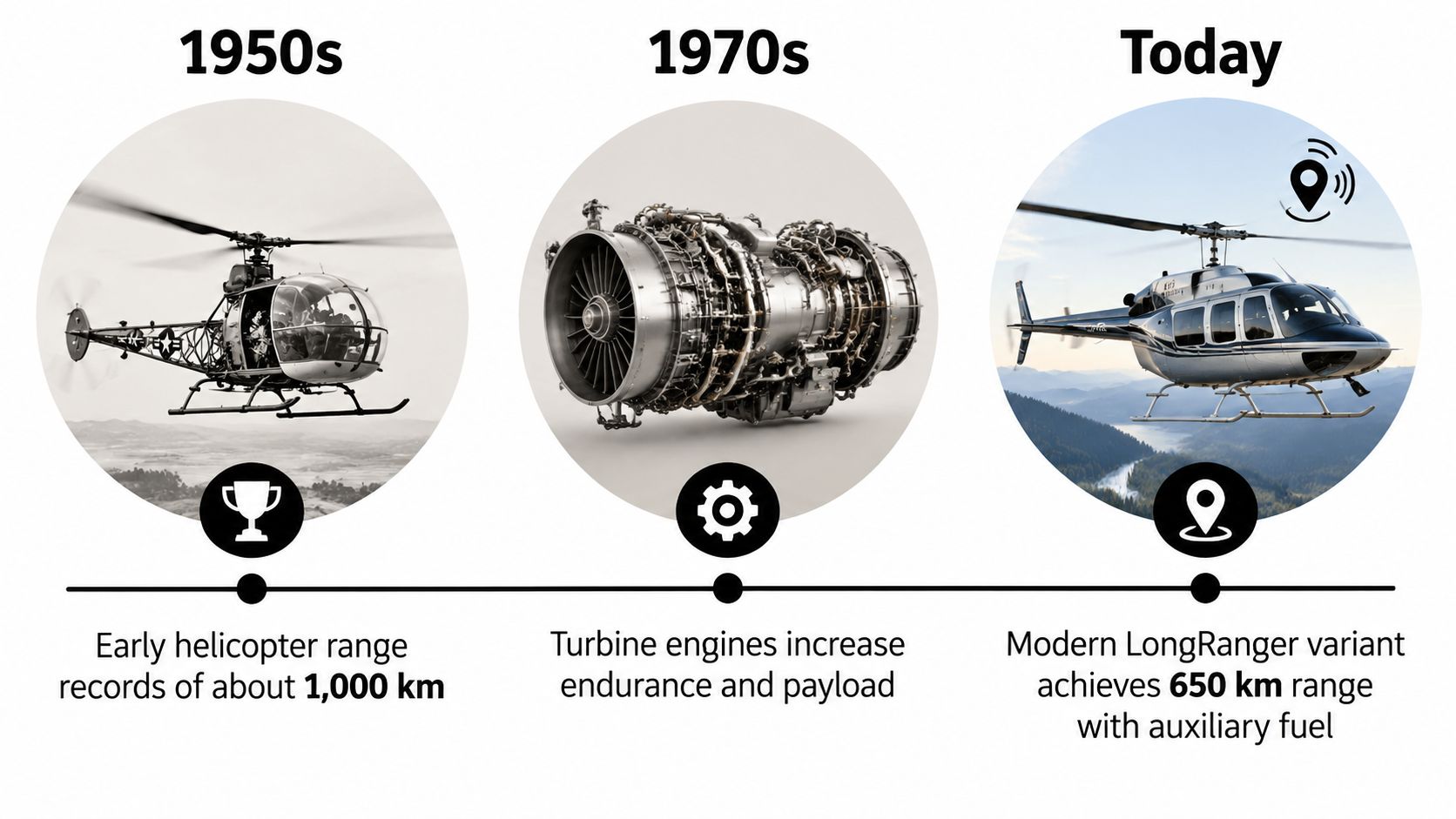
Where the LongRanger fits
Independent industry summaries place the average civilian helicopter's range at roughly 250 to 500 miles, or 400 to 800 kilometres. Long-range special-operations helicopters can reach up to about 1,200 miles, or 1,930 kilometres, in favorable configurations. (Helicopter range overview)
Those figures describe different operating classes. Aircraft size, fuel capacity, payload, auxiliary tanks, cruise profile, and mission priorities all change the result. A light single-engine helicopter and a heavy special-mission aircraft may both be called helicopters, yet their practical range and payload decisions differ sharply.
The Airbus H225 illustrates the upper end of civilian capability, with a published maximum range of up to 620 nautical miles, or 1,150 kilometres, a top speed of 175 knots, and a maximum takeoff weight of 11,200 kilograms. (Airbus H225 specifications) The Airbus H215 is listed with a range of 670 nautical miles, approximately 1,241 kilometres. (Long-range civilian helicopter comparison)
The LongRanger sits below these heavy long-range aircraft, which can make it the smarter value choice for a regional transfer with a modest passenger load. A twin-engine helicopter becomes more persuasive when the same trip also demands substantial payload, high-altitude performance, longer endurance, or twin-engine redundancy.
A historical benchmark reinforces how much configuration matters. On 6 April 1966, Robert Ferry flew a Hughes YOH-6A from Culver City, California, to Ormond Beach, Florida, without refueling. The flight covered 3,561.6 kilometres, or 2,213.1 miles, and Guinness World Records recognizes it under FAI rules. (Hughes YOH-6A distance record)
Cabin Capacity and Real World Missions
The LongRanger's cabin makes the most sense when the mission needs flexibility rather than maximum lift. A corporate operator might use it for a small executive transfer, while a tour operator may value the additional seat for sightseeing. Police and utility organizations can configure the larger fuselage around observation, patrol, or equipment requirements.
The seven-seat description needs careful interpretation. Passenger seating, fuel, baggage, and equipment all compete for the aircraft's useful load. A full cabin may require lighter baggage or a shorter route, while a longer flight may make a smaller passenger group more practical.
Matching the cabin to the work
For a corporate shuttle, the aircraft's value lies in direct access between nearby landing sites and the ability to move a small group without a ground transfer. For patrol work, the cabin and visibility can support observation tasks. For utility missions, the operator may prioritize equipment, cameras, or specialist personnel instead of filling every seat.
Medical missions require even more careful configuration. A patient, medical crew, equipment, and fuel plan must fit within the aircraft's limitations, and the operator must confirm that the cabin arrangement supports the specific care requirements. “Seven seats” is therefore a maximum seating description, not a universal mission promise.
Tourism creates a similar tradeoff. Passengers want clear views and comfortable seating, but the aircraft still needs a safe loading plan. Operators balance passenger distribution because the helicopter's center of gravity affects controllability and handling.
Load planning is part of the service. A professional operator should ask about people, bags, equipment, and landing conditions before confirming the aircraft.
The role of communications and route planning
Remote missions add another layer. If the route crosses isolated terrain, clients may want a separate communication and safety plan, including buying satellite devices for bush safety for situations where ordinary mobile coverage isn't dependable. That equipment doesn't increase the helicopter's range, but it can improve coordination when the aircraft operates away from populated areas.
The LongRanger works well when the mission is moderate in distance, light in payload, and supported by suitable landing infrastructure. A route involving a remote island or a time-sensitive transfer may also require careful ground coordination. For example, a helicopter connection through Monaco Heliport needs more than an aircraft selection. The booking team must align the arrival point, transfer timing, passenger handling, and onward travel.
Where the aircraft feels stretched
The LongRanger becomes less attractive when a buyer wants every seat occupied, substantial luggage, high-altitude performance, and a long leg at the same time. It may still complete the mission with adjustments, but a larger helicopter could offer a more comfortable payload and fuel solution.
That's the practical distinction. The LongRanger is a flexible light platform, not a substitute for a heavy utility helicopter.
Long Ranger Versus Twin Engine Alternatives in 2026
A buyer comparing helicopters for a regional transfer may find that the single-engine LongRanger is the smarter value. Its advantage is not maximum range or power. It is the ability to carry a modest load on a straightforward route without paying for capability the mission rarely uses.
A twin-engine helicopter becomes more persuasive when the flight regularly demands greater payload, longer range, stronger hot-and-high performance, or engine redundancy. Those benefits also bring more systems, maintenance considerations, and operating complexity. The choice should begin with the mission, much like choosing a vehicle for the terrain and load rather than choosing the largest vehicle available.
Market direction provides context, but it does not settle an individual purchase. Fortune Business Insights identifies the twin-engine segment as the fastest-growing helicopter market segment, associated with demand for long-range rotor-wing aircraft. (Helicopter market segment analysis) That trend shows where demand is increasing. It does not make a twin the right answer for every charter or ownership profile.
A decision matrix for buyers
| Decision Factor | LongRanger Single Engine | Twin Engine Light Helicopter |
|---|---|---|
| Range | Works for moderate regional missions when payload, fuel, and reserves are planned carefully. | Better for longer routes where extra fuel and payload margin matter. |
| Payload | Practical for small groups, light baggage, patrol, and utility configurations. | Better when passengers, equipment, and baggage must travel together. |
| Altitude and temperature | Hot-and-high conditions can restrict performance, especially with a heavy load. | Often better suited to demanding altitude and temperature profiles, depending on the model. |
| Engine redundancy | A single turboshaft requires careful assessment of route, terrain, procedures, and operating rules. | A second engine can suit demanding routes and passenger expectations, but it does not replace disciplined operation. |
| Operating economics | Lower mechanical complexity can support value-focused charter work. | More systems and components create a more involved operating and maintenance picture. |
| Mission fit | Strong for moderate transfers, patrol, sightseeing, and light utility work. | Better for longer-range, heavier, higher-altitude, offshore, or redundancy-sensitive missions. |
The LongRanger earns its place through mission fit. If the route is moderate, the load is light, and the landing sites are straightforward, a twin may add expense without adding useful capability. Two engines do not improve the trip if the passengers, baggage, and distance never use the additional margin.
A twin can justify that added complexity when the mission combines several demands. A group carrying substantial baggage may need to depart from a high-elevation site in warm weather and reach a remote destination without refuelling. In that case, the extra payload and performance margin may matter more than the LongRanger's lower operating burden. The operator still needs to evaluate the specific aircraft, route, weather, reserves, and landing limitations.
Safety conversations should remain specific
Engine count is only one safety consideration. Operator training, maintenance control, pilot experience, weather judgment, route planning, and aircraft condition also shape the risk profile. A second engine provides redundancy, not immunity from poor planning or weak maintenance.
Buyers should ask who operates the aircraft, how maintenance is controlled, and how the provider calculates payload and fuel reserves. They should also clarify whether the quoted aircraft can complete the planned route with the stated passenger and baggage load, rather than relying on a brochure range.
For 2026 buyers, the LongRanger is a sensible value choice when moderate capacity and uncomplicated regional missions match the route. A twin becomes rational when the mission repeatedly requires more range, payload, altitude margin, or redundancy than the single-engine platform can provide comfortably.
Choosing the Right Rotorcraft for Your Next Flight
The LongRanger remains relevant because it occupies a useful middle position. It offers more cabin utility than a smaller light helicopter while avoiding the size and complexity of a heavy twin-engine aircraft. For regional passenger transfers, patrol, sightseeing, and light utility work, that balance can be more valuable than a larger specification sheet.
Lifecycle planning deserves attention. Bell ended production of the Bell 206L4 LongRanger in 2017, yet the model still appears in operator FAQs as a seven-place, day-and-night VFR helicopter used for corporate transport, police, and medical missions. (Bell 206 lifecycle and operator guide) An aircraft that remains in service can still be useful, but buyers should ask about fleet age, component support, maintenance records, and charter availability.
A practical booking checklist
- Confirm the exact aircraft: Ask for the model variant, seating arrangement, and whether the quoted helicopter is a LongRanger or another Bell 206 configuration.
- Share payload: Provide passenger count, approximate weights, baggage quantity, and any equipment before the operator confirms the aircraft.
- Test the route assumptions: Ask about fuel stops, reserves, density altitude, expected winds, and destination landing limitations.
- Compare mission fit: Stay with the LongRanger when the route is moderate and the load is light. Request a twin-engine comparison when altitude, distance, payload, or redundancy is central to the trip.
- Review the operator: Check maintenance practices, pilot qualifications, aircraft history, and the provider's ability to explain the operational plan in plain language.
A helicopter ride can also be a useful way to introduce clients or team members to rotorcraft before a more demanding charter. For training, events, or familiarization, an immersive helicopter ride hire offers a controlled setting without pretending that a simulator replaces operational planning.
For a broader aircraft choice, compare the mission directly rather than assuming a helicopter is always the answer. Haute Jets can also help clients assess private jet versus helicopter charter when the route, passenger count, or onward ground transfer makes a fixed-wing aircraft more suitable.
The LongRanger is a smart value choice when it carries the people and baggage you have, reaches the destination with appropriate reserves, and operates within comfortable performance margins. Step up to a twin when the mission repeatedly demands more range, payload, altitude capability, or engine redundancy than a light single can provide.
Haute Jets can source the exact helicopter or a suitable twin-engine alternative through its owner-operator network, then compare payload, route planning, aircraft age, and repositioning requirements before you book. Visit Haute Jets to request an on-demand charter quote built around your passengers, baggage, landing sites, and actual mission profile.