

You're in Miami, your bags are packed, and the Caribbean should be easy. On paper, it is. In practice, even a premium commercial booking can turn into a slow, crowded process with terminal congestion, fixed departure times, gate changes, and a long list of small irritations that add up before you ever leave South Florida.
The alternative is simple. You drive to a private terminal, clear the formalities without the airport circus, and board an aircraft that leaves on your schedule. That changes the entire calculation for Miami to Caribbean flights. At a certain level of urgency, privacy, or trip complexity, private aviation stops being indulgence and starts being the rational option.
If you're weighing that decision, don't reduce it to the ticket price alone. The better question is what the trip costs in time, control, and friction. If you want a broader look at elite island access, exclusive access to private air charters to top Caribbean destinations is a useful companion read.
Your Caribbean Escape Starts Here
Miami spoils travelers with options. That's exactly why it also creates confusion. Many people assume abundant service means a smooth trip. It often means the opposite. More traffic, more terminal activity, more variables.
For commercial travelers, even in first class, the pain points are predictable. You still work around the airline's timing. You still deal with airport flow, boarding process, baggage rules, and limited recovery options if something slips. That's manageable for a casual vacation. It's inefficient for a family moving with pets, a principal protecting privacy, or an executive trying to salvage a weekend that starts late on Friday.
Private travel changes the rhythm immediately. You arrive closer to departure, board quickly, and avoid the public terminal experience almost entirely. The value isn't abstract luxury. It's fewer decision points, fewer bottlenecks, and more control over how the day unfolds.
Private aviation makes the most sense when the schedule matters more than the seat map.
That's especially true on short Caribbean sectors, where wasted ground time can rival a meaningful share of the actual flight.
Why Miami Is the Ultimate Caribbean Gateway
Miami isn't just a departure city. It's the operating center of gravity for Caribbean air travel in the United States. That matters whether you fly commercial or private.
In 2024, Miami International Airport handled 55.93 million passengers, including about 25.17 million international travelers, or roughly 45% of all traffic, according to Miami airport traffic data compiled here. That scale explains why Miami to Caribbean flights are so firmly established in the market. The airport has the volume, airline presence, and international orientation to support dense island connectivity.
What scale actually gives you
Big hubs produce practical advantages, not just impressive numbers.
- More route depth: More commercial frequencies create more demand visibility. That helps charter operators and brokers position aircraft more intelligently in South Florida.
- Better aircraft availability: In a market this active, you're more likely to find the right cabin category for the mission instead of settling for whatever happens to be nearby.
- Stronger support infrastructure: Maintenance access, crew availability, and experienced ground handling are part of the Miami advantage, even if you never step foot into the commercial terminal.
Those are the reasons serious travelers keep coming back to Miami as a Caribbean launch point. Not because it's glamorous. Because it works.
Why this matters for private clients
The irony is that Miami's size is both its strength and its headache. Massive passenger volume supports reliable Caribbean connectivity, but it also creates congestion and complexity inside the commercial ecosystem.
That's why private aviation performs so well here. You get to use Miami's density without absorbing all of its friction. You benefit from the aircraft supply, routing options, and international support network while bypassing the crowds that come with a major hub.
If I were advising a client with regular island travel, I'd tell them to treat Miami as an asset, not just a city on the map. Base your planning around South Florida. Source locally when possible. Stay flexible on airport choice. That's where the operational edge lives.
Practical rule: The stronger the hub, the more valuable it becomes to avoid the public terminal and use the surrounding private aviation network instead.
Commercial First Class vs Private Jet Charter A Direct Comparison
Commercial first class and private charter aren't interchangeable products. They solve different problems. If all you want is a decent seat to a major island and your timing is flexible, commercial can be perfectly fine. If you care about schedule control, privacy, and low-friction travel, charter wins quickly.
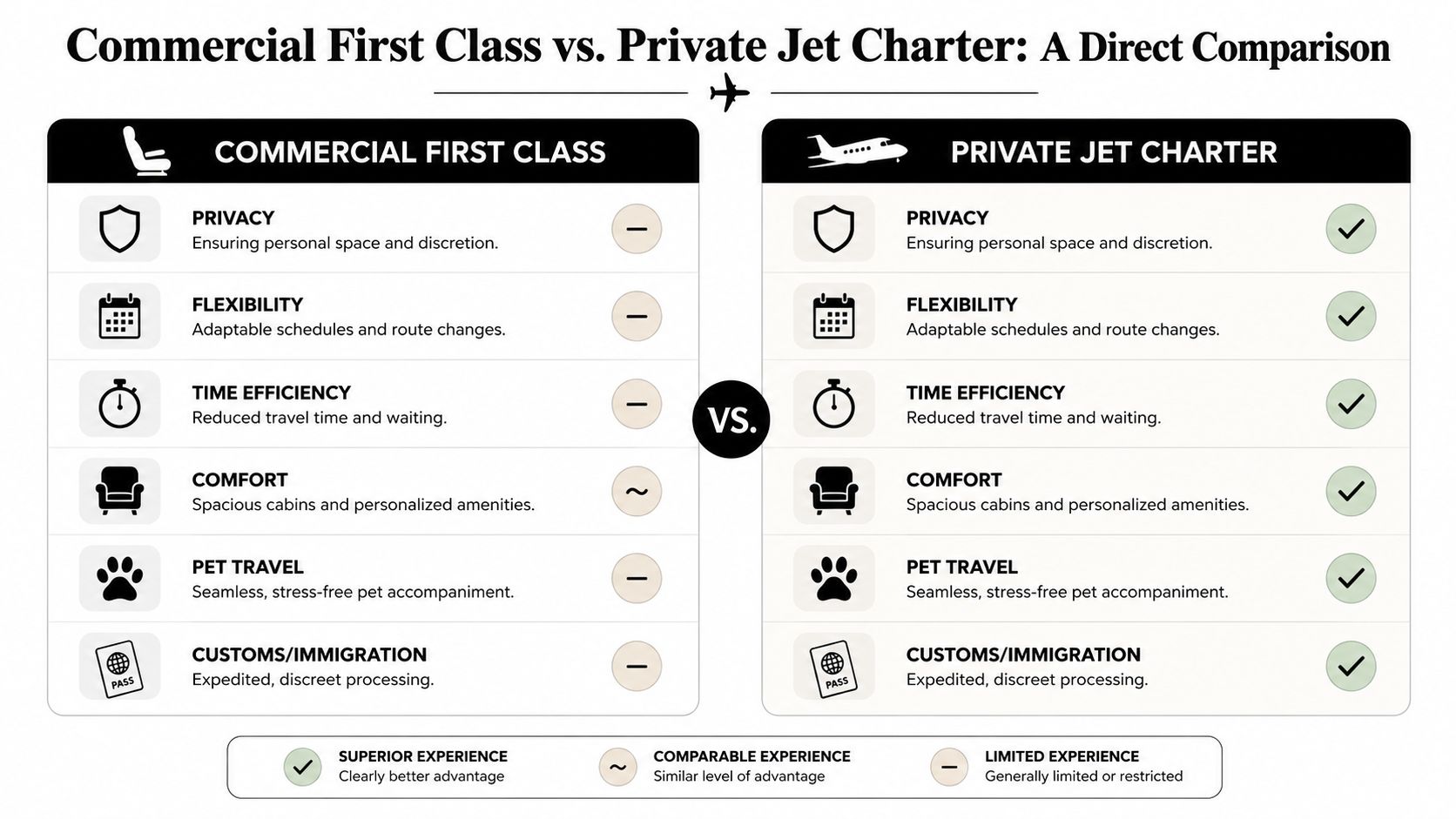
A commercial baseline is useful. A route summary for Miami to the Caribbean reported an average of 29 direct flights per day with a typical nonstop time of 2 hours 26 minutes, while fare tracking cited a cheapest recently found round-trip to San Juan at $124, with average fares around $336 in September and $509 in December, as summarized in this Miami to Caribbean fare and frequency overview. That tells you two things. Commercial service is frequent, and price sensitivity is real.
Time efficiency
Commercial passengers tend to compare flight time only. That's the wrong metric. Door-to-door time is what matters.
A short Caribbean flight can still consume most of a day once you add terminal arrival buffer, parking or transfers, security, boarding, deplaning, and baggage retrieval. Private aviation strips out most of that dead time. On a short island route, that's often the biggest gain.
Flexibility and disruption recovery
Commercial airlines sell published inventory on fixed schedules. If your meeting runs late, your villa check-in changes, or weather disrupts the network, you work around the airline.
Private charter flips that. The aircraft works around you.
That distinction becomes even sharper when your plans involve multiple islands, a yacht connection, or a villa arrival with narrow timing. If your schedule is dynamic, flexibility isn't a perk. It's the point. For a broader luxury travel breakdown, this analysis of choosing between private jets and first class flights for luxury travel is worth reading.
Here's a concise side-by-side view:
| Criterion | Commercial first class | Private jet charter |
|---|---|---|
| Schedule | Fixed by airline | Set around your itinerary |
| Airport process | Public terminal flow | Private terminal process |
| Privacy | Limited | High |
| Route freedom | Best on dense island routes | Strong for both dense and thin routes |
| Trip changes | Often restrictive | Far easier to adjust |
| Group travel | Split across fare classes and seats | Entire cabin under one booking |
A short visual helps if you're comparing options with a family office or assistant.
Privacy and comfort
First class gives you a better commercial experience. It does not give you privacy. You're still in a shared environment with other passengers, public boarding, and limited discretion.
Private charter gives you cabin control. You decide who's onboard, what's served, how the cabin is set, and whether the flight is quiet, productive, family-focused, or all three.
Cost and value
People often get lazy. They compare a single airline seat to an entire aircraft and conclude private is irrational. That misses the true economics.
The right comparison depends on party size, urgency, destination, and the cost of schedule failure. Once you price in lost time, hotel knock-on costs, missed yacht departures, split bookings, pet logistics, or the need to recover from a cancelled segment, charter can look far more sensible than the headline suggests.
Mapping Your Itinerary From Miami's Private Airports
Most travelers start with destination. Smart travelers start with the right departure airport. In South Florida, that choice shapes everything from drive time to congestion exposure to the kind of trip you can comfortably build.
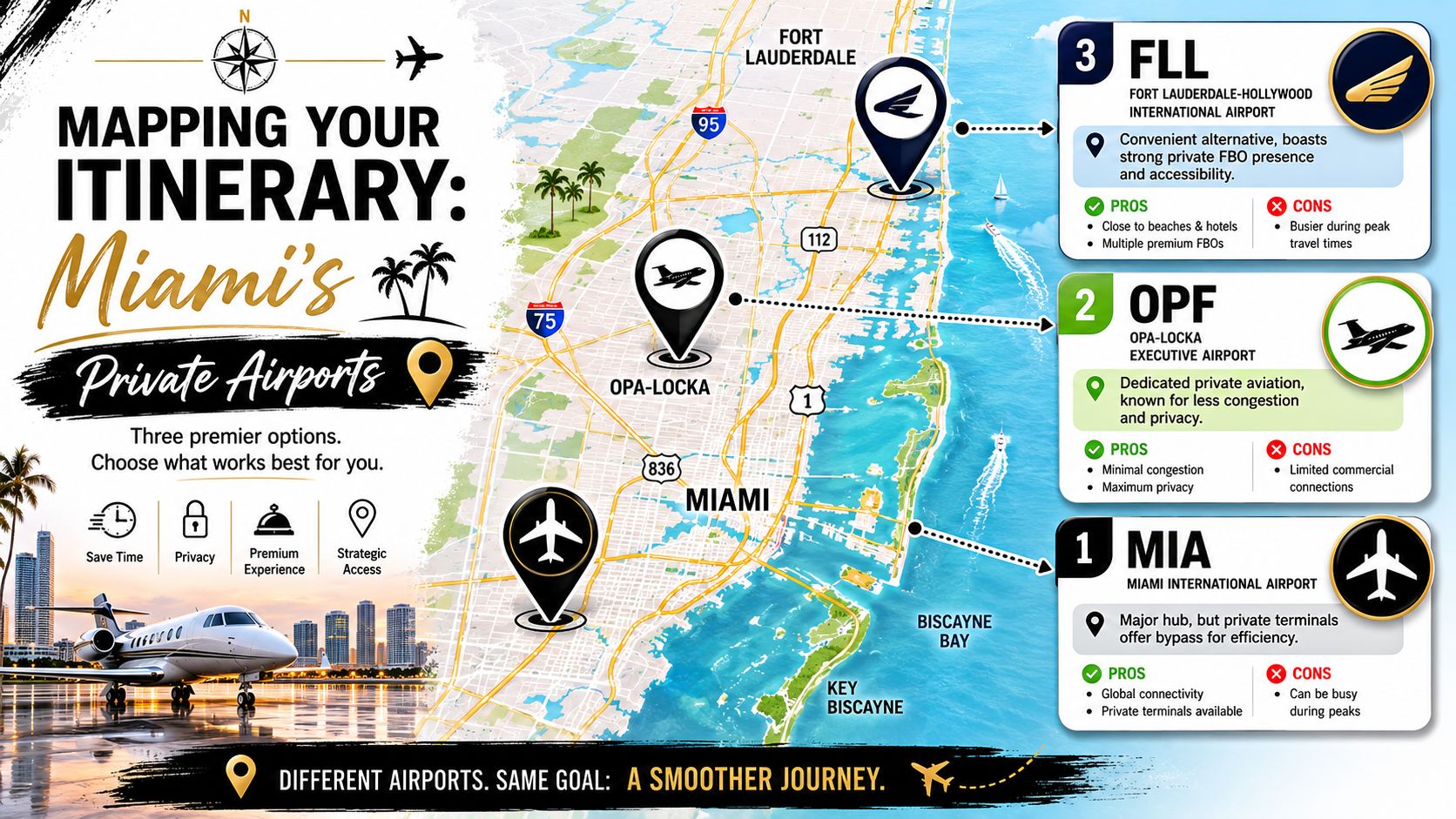
Miami to Caribbean flights aren't one single market. They split sharply between dense, heavily served island routes and thinner destinations where flexibility is limited. American's holiday network expansion covered 73 destinations across the Caribbean, Mexico, and Latin America, with frequencies including seven daily to San Juan and four daily to Kingston, while thinner routes such as Miami to South Caicos operated only twice weekly, as noted in this Caribbean route coverage summary. That split is exactly why airport and aircraft choice matter.
Choosing where to depart
Three South Florida airports usually dominate the conversation for private travelers.
- MIA: Best when your wider itinerary touches the commercial network, international services, or tight city-center access. It's a major hub, but private terminal use can shield you from the main terminal experience.
- OPF: Often the cleanest private aviation play. Opa-locka Executive is built around business aviation and usually suits travelers who value discretion and a less crowded operating environment.
- FLL: A practical alternative for clients north of Miami or those looking for strong FBO infrastructure without pushing all traffic through MIA.
If your residence, hotel, or office is closer to one of these fields, don't underestimate the value of a shorter ground transfer. For many clients, that's the difference between a smooth departure and a rushed one. If you want a sharper look at local private terminals, flying privately into Miami through Opa-locka's premier FBOs is useful reading.
Match the aircraft to the island
Aircraft selection should follow mission profile, not ego.
For short hops to nearby islands, turboprops can be a very efficient choice when runway constraints or light luggage loads make them sensible. For longer sectors deeper into the Caribbean, light and midsize jets are usually the sweet spot. They give you speed, comfort, and enough range for nonstop efficiency without paying for excess cabin you won't use.
Here's a practical consideration:
Short leisure hop
Bahamas-style missions often reward simplicity. Fast turnaround matters more than a huge cabin.Mid-range island weekend
A light jet can work well when you want better pace and comfort for a couple, family, or small executive group.Longer or more complex itinerary
Midsize aircraft become more attractive if luggage volume, passenger count, or onward plans require more flexibility.
The best aircraft for a Caribbean trip is the one that fits the runway, the baggage, and the schedule. Not the one with the most impressive brochure.
Dense routes vs thin routes
If you're flying to a heavily served island, private charter competes less on raw access and more on convenience, privacy, and schedule control.
If you're flying to a thinner market, private charter often becomes the cleaner solution outright. Sparse commercial frequencies leave very little room for error. Miss the scheduled service and the itinerary can unravel fast.
The Haute Jets Advantage On-Demand Charter Done Right
The private charter market has no shortage of noise. Jet cards promise simplicity. Fractional models promise consistency. Traditional brokers often promise access while steering clients into whatever aircraft produces the easiest margin. That's not a system designed for a sharp buyer.
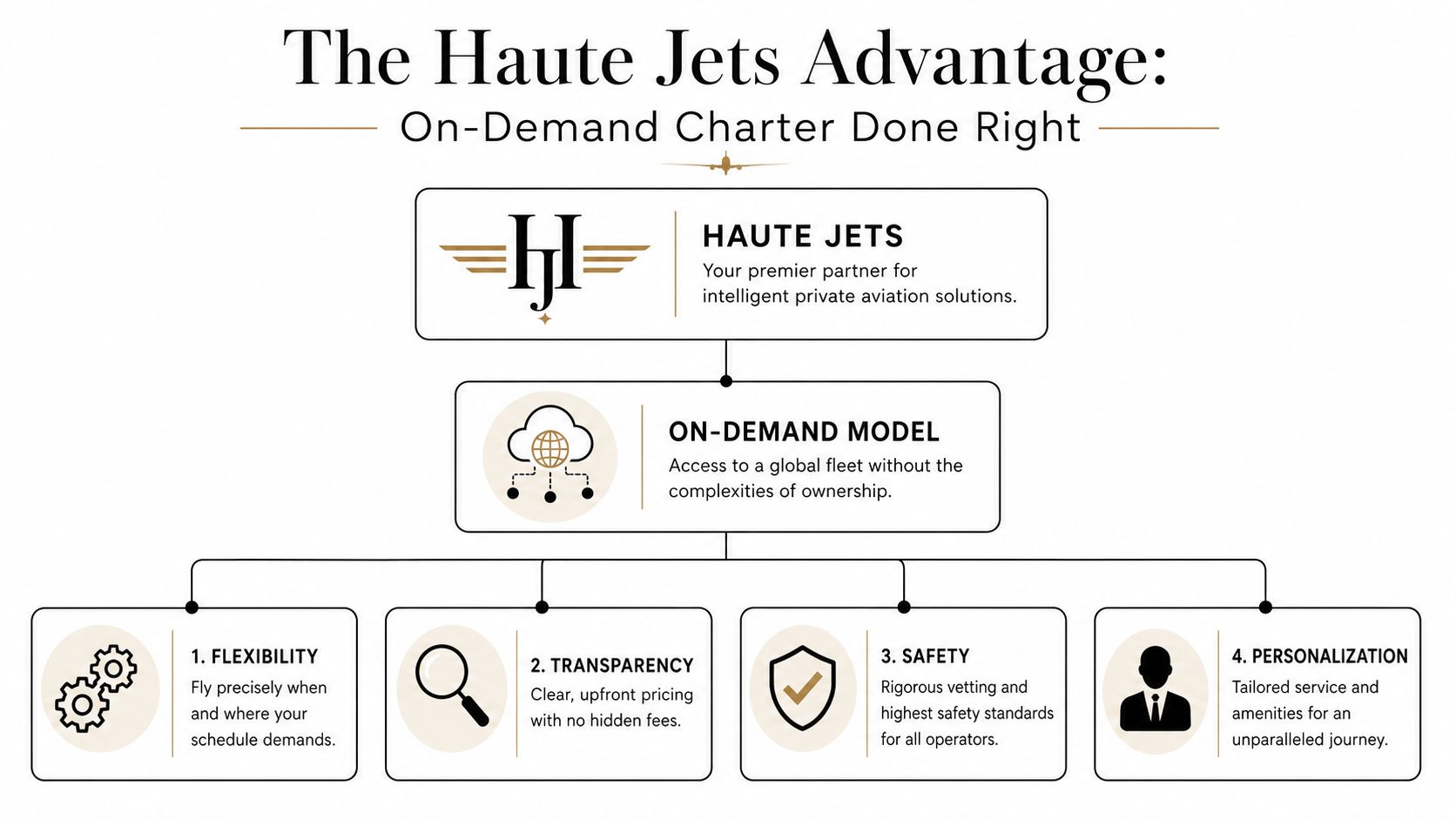
On-demand charter is the cleaner model when you want flexibility without ownership baggage. You pay for the specific mission. No prepaid block. No annual fee structure. No pressure to keep using a program that no longer suits your travel pattern.
Why on-demand matters on Caribbean routes
Caribbean flying exposes weakness in rigid programs. Weather changes. Island schedules shift. Return dates move. Guests join late. Boats clear customs later than expected. You need a booking structure that can absorb movement.
That's even more obvious when the commercial network gets stressed. After a 2026 Caribbean disruption, American said it added more than 50 extra flights and more than 8,000 additional seats from Miami, yet the earliest rebookable departures were still days away, according to this American Airlines disruption update. That's the commercial system doing its best and still leaving high-value travelers exposed.
What to demand from any charter provider
Use this as a filter before you book with anyone.
- Aircraft transparency: You should know the exact aircraft, not just a vague category.
- Safety standards: Insist on operators with recognized third-party audit credentials such as Wyvern or ARGUS.
- Local sourcing discipline: The provider should look for aircraft near your departure point, not automatically drag a jet in from elsewhere.
- Pre-flight clarity: You want full confirmation before departure, including operator details, crew information, and handling notes.
One practical example is Haute Jets, which works on an on-demand model, sources from owner-operators, limits bookings to Wyvern and ARGUS-rated operators, and provides aircraft-specific confirmation rather than category-only selling. That's the right direction for Miami-origin charter because local sourcing can reduce unnecessary repositioning and give the client more control over the booking.
If a charter quote looks vague, assume the process behind it is vague too.
A serious traveler should reject opacity immediately. In this corridor, there are too many aircraft and too many operating variables to accept lazy sourcing.
Navigating Customs Pets and Luggage with Ease
The most annoying parts of island travel usually aren't in the air. They happen around the flight. Customs, pet handling, and luggage rules create far more friction than travelers anticipate.
Customs and immigration
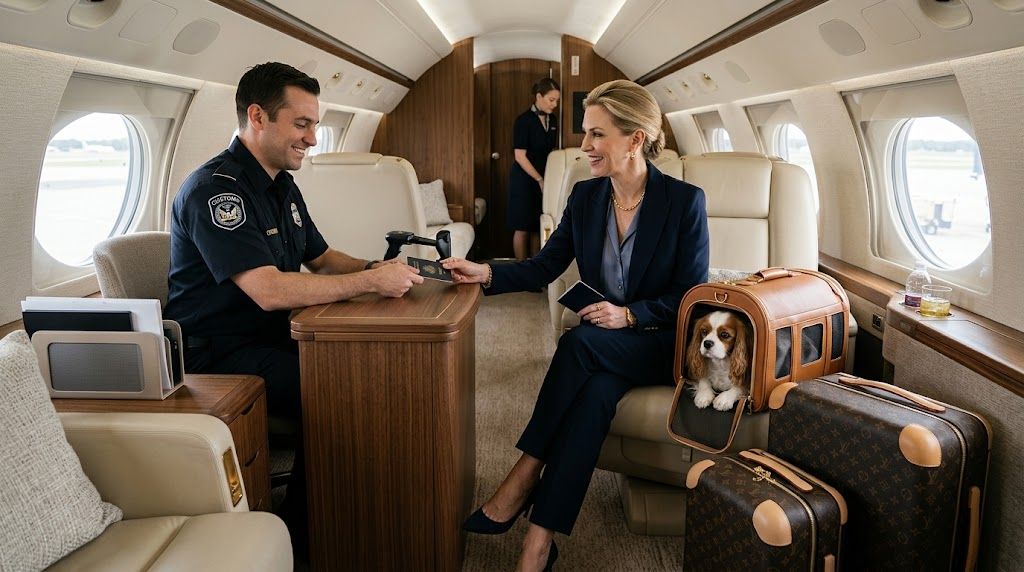
Private travel doesn't eliminate border formalities. It does make them more manageable. You're typically handling the process in a calmer environment with less crowd pressure and less waiting around for a mass of passengers to move through the same channel.
That matters on the return to the United States as well. For many clients, the difference isn't paperwork volume. It's the fact that the process feels controlled instead of chaotic.
Pets onboard, not in the system
If you travel with dogs, private aviation changes the entire experience. Your pet stays with you in the cabin instead of being treated like a special cargo problem to be processed and restricted.
That doesn't mean you can ignore paperwork. Island entry requirements, health documents, and timing still matter. If you want a practical companion resource before you travel, this paws in paradise pet travel guide is worth reviewing.
Luggage without the usual nonsense
Private charter also simplifies baggage planning. You're not building your trip around the same rigid commercial luggage constraints. That's a major advantage if you're carrying golf clubs, dive gear, resort wear for multiple stops, children's items, or pet equipment.
Keep it organized anyway. I recommend giving your charter provider a clear luggage manifest early, especially if the itinerary involves smaller islands or shorter runways where aircraft choice can become more sensitive to payload and bag shape.
A practical checklist:
- Documents first: Passports, customs forms, and pet paperwork should be reviewed before departure day.
- List unusual baggage: Golf bags, dive equipment, strollers, and soft-sided luggage should all be disclosed in advance.
- Confirm arrival handling: Ground transport, catering leftovers, and pet arrival support should be arranged before wheels up.
Small details decide whether the trip feels elegant or improvised.
Unlocking Value with Empty Legs and Smart Booking
Empty legs are real opportunities, but they are often misunderstood. They aren't magic discounts floating around the market waiting to be claimed. They're repositioning flights that exist because an aircraft needs to move for its next assignment.
In the Miami to Caribbean corridor, that matters because the market is operationally active and geographically efficient. The Miami to Port of Spain route covers 1,633 miles in roughly 4 hours 10 minutes, a stage length that suits many midsize jets and supports efficient positioning, as outlined in this Miami to Port of Spain route summary. Efficient positioning tends to reduce long ferry requirements, which in turn can support more competitive charter opportunities and a healthier pool of empty legs.
How to use empty legs intelligently
The mistake is chasing them as if they're standard retail inventory. They're not. They work best for travelers who already understand the trade-off.
- Be flexible on timing: The best empty leg client can shift departure by a bit and still win.
- Stay open on airport choice: OPF instead of MIA, or FLL instead of OPF, can provide better options.
- Use them on simpler trips: They're ideal when the route is straightforward and the consequences of minor timing changes are manageable.
Smart booking beats last-minute panic
Even if you're not booking an empty leg, the same discipline applies.
Ask for the exact aircraft. Verify baggage suitability. Make sure the airport pair matches your ground logistics, not just the headline route. If you're traveling during a busy holiday window, lock in earlier rather than assuming South Florida's aircraft supply will always bail you out at the last minute.
Savvy charter clients don't just shop price. They shop mission fit.
That's the right mindset for Miami to Caribbean flights. The value is rarely about finding the absolute lowest quote. It's about avoiding avoidable costs, including repositioning, poor airport selection, and aircraft mismatch.
The Ultimate Choice for Your Caribbean Travel
The right answer depends on what you value. If your trip is simple, your schedule is fixed, and you're heading to a major island with no special baggage, pet, or privacy demands, commercial can do the job. If you want control, discretion, and a cleaner travel day, private charter is the sharper choice.
Miami offers a unique advantage because it combines dense Caribbean connectivity with deep private aviation infrastructure. Used well, that means faster departures, better aircraft matching, and more resilient travel when plans move.
My advice is simple. Stop judging the trip by fare alone. Judge it by how much friction you remove, how much time you protect, and how well the itinerary holds together when conditions change. That's how experienced travelers evaluate Miami to Caribbean flights.
If you want a customized quote for your route, schedule, and passenger needs, contact Haute Jets and compare charter options against your commercial alternative before you book.