You're choosing a private jet for convenience, privacy, and control. Yet the most important part of that decision usually isn't the leather seats, the quiet cabin, or even the route flexibility. It's the unseen maintenance work that determined whether that aircraft should be flying that day at all.
That's the part experienced fliers eventually start asking about. Who maintains the aircraft? How are inspections tracked? What happens between flights? Those questions matter because luxury in aviation only means something when it rests on disciplined airworthiness.
This article appears in Haute Jets Journal because discerning charter clients deserve a clear explanation of what preventive maintenance aviation means in real life. Not as mechanic jargon. As the system that protects your schedule, your family, your executives, and your peace of mind.
Why Your Flight's Safety Begins Long Before Takeoff
A client books a morning charter for an important meeting. The itinerary is efficient, the aircraft is exactly right for the mission, and everything looks polished at the terminal. From the passenger side, the experience feels effortless.
But safe flying never starts at the terminal.
It starts days, weeks, and months earlier with routine inspections, component checks, fluid servicing, logbook entries, and decisions made by technicians and operators who know that small omissions can grow into major risks. In private aviation, the smoothness you feel on departure is often the visible result of invisible discipline.
What the passenger never sees
Most passengers judge an aircraft by what they can observe. Clean cabin. Professional crew. On-time departure. Those things matter, but they're outcomes, not root causes.
The deeper question is whether the aircraft has been cared for methodically. Preventive maintenance aviation means addressing ordinary wear before it becomes abnormal. It's the aviation equivalent of servicing a high-performance car before a warning light appears, except the stakes are far higher.
According to the FAA's Human Factors Guide for Aviation Maintenance and Inspection, maintenance errors are estimated to be the root cause of 20% of all aviation accidents. That single fact should change how anyone thinks about operator quality. Maintenance isn't a back-office function. It sits at the center of flight safety.
Practical rule: When you evaluate a charter operator, you're not only choosing a jet. You're choosing the maintenance culture behind it.
Why this matters for high-value travel
For a private charter client, safety and reliability are closely linked. A poorly maintained aircraft can create far more than an inconvenience. It can trigger delays, substitutions, canceled departures, or worse, an avoidable safety event.
That's why rigorous maintenance creates peace of mind in two ways:
- Safety protection: Routine upkeep helps catch wear, leaks, contamination, and component deterioration before they threaten airworthiness.
- Trip continuity: Well-maintained aircraft are less likely to be removed from service unexpectedly.
- Operator credibility: The strongest operators don't treat maintenance as a last-minute checklist item. They treat it as part of daily decision-making.
If you've ever wondered why top-tier charter operators invest so heavily in inspections, documentation, and technician oversight, this is the answer. They know that every uneventful takeoff is earned on the ground first.
Understanding Aviation Maintenance Philosophies
The easiest way to understand maintenance is to compare it to ownership of a finely engineered automobile. If you wait until the engine fails on the highway, you're in corrective mode. If you service the car on schedule, you're using preventive care. If sensors warn you a part is degrading before failure, you're using predictive insight.
Aircraft operators think in those same three categories.
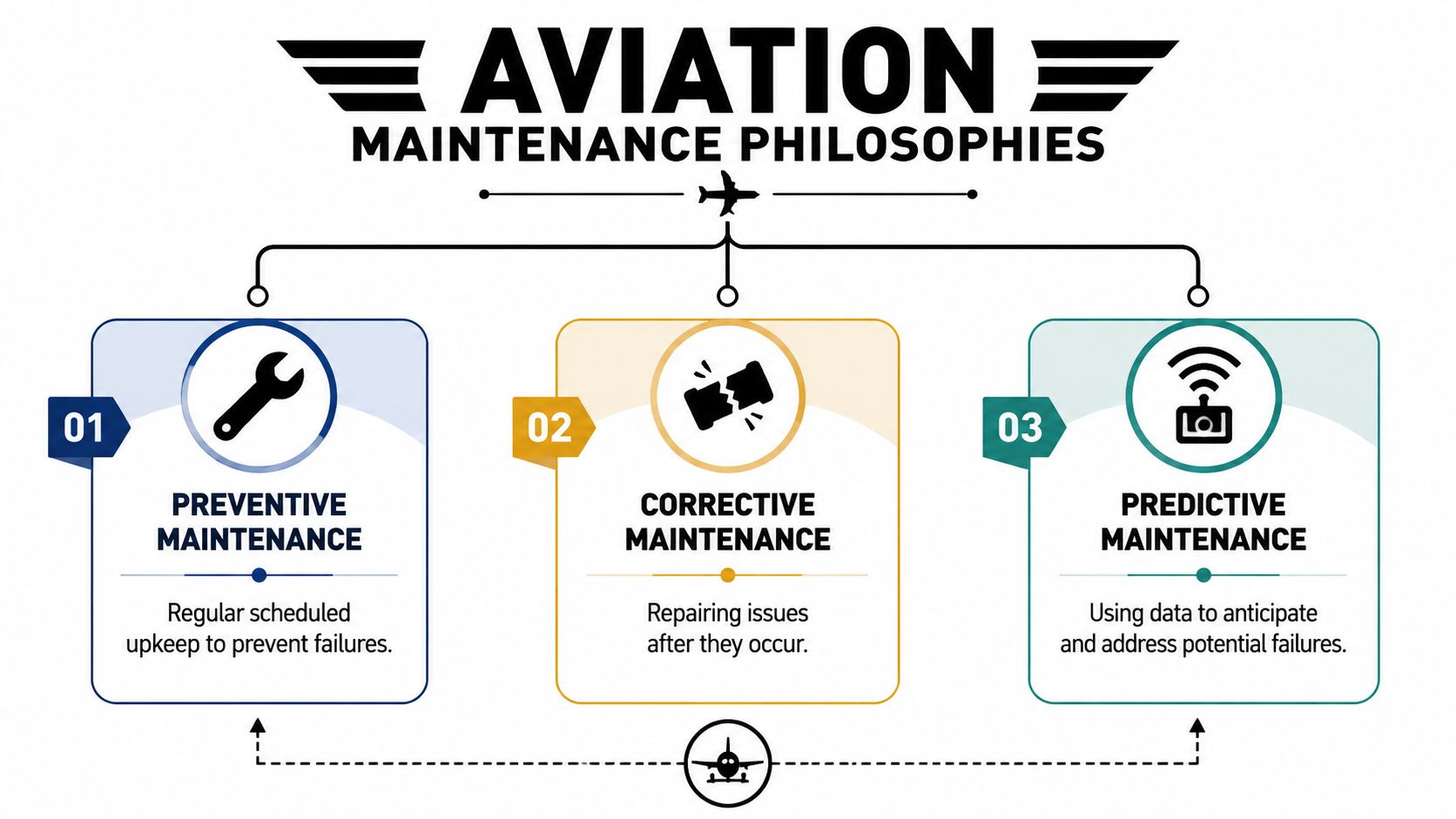
Preventive, corrective, and predictive
Preventive maintenance is scheduled upkeep. The work happens because the aircraft has reached a time, flight-hour, or calendar threshold, or because routine care is required to preserve safe operation.
Corrective maintenance happens after something is found broken, malfunctioning, or out of tolerance. It's necessary, but nobody wants to live in this mode. In aviation, relying too heavily on corrective work means you're letting faults present themselves before acting.
Predictive maintenance uses trend monitoring, onboard data, and system health indicators to spot likely trouble early. Advanced operators are gravitating towards this, but it still depends on the discipline of preventive programs underneath it.
What the FAA means by preventive maintenance
The term sounds broad, but the FAA gives it a specific legal meaning. In this overview of the FAA framework, 14 CFR Part 43, Appendix A, Paragraph (c) defines preventive maintenance as 31 simple tasks that do not involve complex assembly operations, such as replacing spark plugs, changing oil filters, and servicing batteries. Those tasks are legally restricted to authorized certified personnel to preserve airworthiness.
That matters because clients often assume “minor maintenance” is informal. It isn't. Aviation law draws bright lines around what's simple, who may perform it, and how it must be documented.
A useful companion outside aviation is this proactive maintenance strategy resource, which explains the broader logic of scheduled upkeep. The core principle is the same. Planned attention protects reliability better than emergency response.
Where readers often get confused
People mix up “preventive” with “routine” and assume all routine work is casual. That's not how aviation works. Even simple tasks sit inside a regulatory framework, and even small actions can affect the aircraft's legal airworthiness status.
If you want a deeper explanation of the broader maintenance ecosystem around repair stations and fleet support, this guide to MRO in aviation is helpful.
Preventive maintenance aviation isn't just about fixing less. It's about deciding early, documenting carefully, and preserving airworthiness before a fault reaches the passenger.
The Anatomy of a Private Jet Maintenance Schedule
Private aircraft don't move from one big inspection to the next in a simple straight line. They live inside an overlapping maintenance calendar. Some checks happen around daily operations. Others are deeper events that require more downtime, more disassembly, and more planning.
That's why a well-run maintenance schedule looks less like a checklist and more like a layered program.
The rhythm of ongoing checks
At the lighter end, operators perform line checks and routine service actions around normal use. These include visual inspections, fluid status reviews, tire condition checks, and any obvious discrepancies reported by crew or technicians.
Then come the heavier scheduled checks often referred to in broad industry language as A, B, and C checks. Exact tasks and intervals vary by aircraft type, manufacturer program, and operating environment, but the pattern is consistent. Each deeper check expands the inspection scope and typically requires more downtime.
Comparison of Standard Aviation Maintenance Checks
| Check Type | Frequency | Typical Downtime | Scope of Work |
|---|---|---|---|
| Line Check | Around daily operations or between flights | Minimal | Visual condition review, fluid servicing, tire and brake look-over, discrepancy follow-up |
| A Check | At regular scheduled intervals | Short planned downtime | Focused inspection of key systems, routine servicing, targeted component review |
| B Check | Less frequent than A checks | Moderate planned downtime | Broader systems review, more access panels opened, additional functional inspections |
| C Check | Major scheduled event | Extended downtime | Deep structural and systems inspection, extensive access, component evaluation, corrective findings as needed |
Why schedules need flexibility
Aircraft don't always land at the ideal moment for a maintenance event. Weather shifts. Missions extend. A trip may conclude at an airport better suited for servicing than the original destination.
That's where the FAA's 10% rule becomes practical. The FAA allows approved preventive tasks to be performed within 10% of their scheduled interval, whether the trigger is flight hours or calendar days. That buffer helps operators maintain continuity without compromising safety.
This shouldn't be read as permission to drift. It's a controlled tolerance, not a casual delay. Strong operators use it to plan maintenance intelligently, not to postpone responsibility.
What a serious schedule looks like in practice
A disciplined operator usually manages maintenance through several parallel lenses:
- Calendar items: Some tasks come due because time passes, even if the aircraft hasn't flown much.
- Usage items: Others are tied to hours, cycles, or specific operational exposure.
- Condition findings: Routine checks may uncover wear that needs attention before the next scheduled event.
- Record status: Every action has to be traceable in the aircraft records so the next technician knows exactly what was done.
A private jet isn't “maintained” by a single annual event. It stays airworthy through a chain of recurring decisions that build on each other over the life of the aircraft.
This is one reason proactive operators tend to look calm under pressure. Their maintenance planning was already working long before the passenger called for the trip.
How Elite Operators Build a Culture of Safety
Compliance is the floor. Elite operators build above it.
The difference shows up in habits that passengers rarely see. Maintenance discrepancies are logged precisely. Technicians are trained continuously. Flight crews communicate small irregularities early. Leadership treats documentation as a safety instrument, not paperwork.

Beyond minimum compliance
An operator can technically comply with rules and still fall short of excellence. The best flight departments create systems that reduce ambiguity. They don't want maintenance decisions living in memory, scattered emails, or incomplete notes.
A real safety culture usually includes:
- Detailed documentation: Work descriptions, signatures, dates, and airworthiness return-to-service records are handled with discipline.
- Technician consistency: The maintenance team follows repeatable procedures instead of improvised shortcuts.
- Operational feedback: Pilots report even subtle changes in aircraft behavior so maintenance teams can investigate early.
- Audit readiness: Records are maintained in a way that stands up to third-party review, not just internal convenience.
Why Wyvern and ARGUS matter
For charter clients, third-party safety ratings offer a practical shortcut. They don't replace due diligence, but they do signal that the operator has undergone serious scrutiny.
That scrutiny becomes especially important in the area many owners misunderstand. There is a documented liability gap where owner-performed maintenance may be legal under FAA 14 CFR Part 43, yet still undermine a commercial charter operator's audit standing if it isn't documented to Part 135 standards. A 2024 AOPA study found nearly 40% of owner-operators misunderstand these documentation requirements.
For a client, that means an aircraft can appear acceptable on the surface while carrying recordkeeping problems that affect charter eligibility and safety-audit confidence.
If you want to understand why those ratings carry weight in the market, this deep dive into Wyvern and ARGUS safety ratings lays out how they function.
Strong operators don't just maintain aircraft well. They prove it in records that can survive external review.
The hidden mark of a premium operator
The finest operators don't become respected because they advertise safety. They become respected because their internal behavior is boring in the best sense of the word. The logs are complete. The inspections happen on time. The handoffs between crew, maintenance control, and technicians are clear.
That consistency is what protects both the aircraft and the client experience. Safety ratings are the visible badge. Maintenance discipline is the reason the badge exists.
The Technology Powering Modern Aircraft Maintenance
Modern maintenance still depends on human judgment, but the tools have changed. Operators no longer have to rely only on paper schedules, manual reminders, and after-the-fact troubleshooting. Software systems, digital records, and onboard data now help maintenance teams see problems earlier and plan work more intelligently.

From calendar tracking to real-time awareness
A Computerized Maintenance Management System, often called a CMMS, helps an operator track due items, work orders, component histories, and recurring inspection requirements. Instead of depending on someone to remember what's coming due, the system creates structure around the maintenance program.
Onboard monitoring adds another layer. Sensors and digital aircraft systems can flag unusual trends in temperatures, pressures, vibration, or system performance. That doesn't eliminate preventive maintenance. It sharpens it.
Predictive analysis becomes useful when maintenance teams combine three things:
- Scheduled tasks that preserve baseline reliability
- Operational data that highlights unusual behavior
- Technician interpretation that turns data into action
That blend moves the operation closer to anticipation and farther from surprise.
New fuels create new questions
Technology doesn't only add tools. It also introduces new maintenance variables.
A 2025 IATA report highlighted that Sustainable Aviation Fuel can contain different contaminants than traditional jet fuel, which may accelerate wear in fuel systems if preventive schedules and inspection protocols for lines, tanks, and injectors aren't adjusted accordingly. For operators adopting SAF, the message is straightforward. Sustainability goals can't be separated from maintenance planning.
Clients increasingly want lower-impact travel options, yet they still expect uncompromised reliability and safety. Consequently, operators must adapt their inspection thinking as fuel chemistry evolves.
A similar mindset appears in adjacent protective technologies. For example, this explanation of what is graphene coatings is useful because it shows how advanced surface-protection ideas are changing maintenance conversations in other asset-intensive industries. In aviation, the lesson is broader than any single product. New materials and new processes always require maintenance teams to ask how care standards should change.
A short overview of how modern inspection tools support technicians is worth watching:
Technology is only as good as the people using it
A dashboard can alert. A sensor can trend. Software can schedule. None of those tools can replace disciplined interpretation.
The best maintenance teams use technology the way a skilled physician uses diagnostic equipment. The machine provides signals. The professional decides what those signals mean, what requires action, and what should be watched more closely next time.
Measuring Maintenance The Metrics of Airworthiness
Clients often hear that an operator is “safe” or “well maintained,” but those descriptions are too soft on their own. Good operators measure outcomes. They watch how often aircraft leave on time without maintenance issues, how long aircraft remain unavailable for maintenance, and how frequently components fail between service events.
Those measurements translate maintenance effort into operational reality.
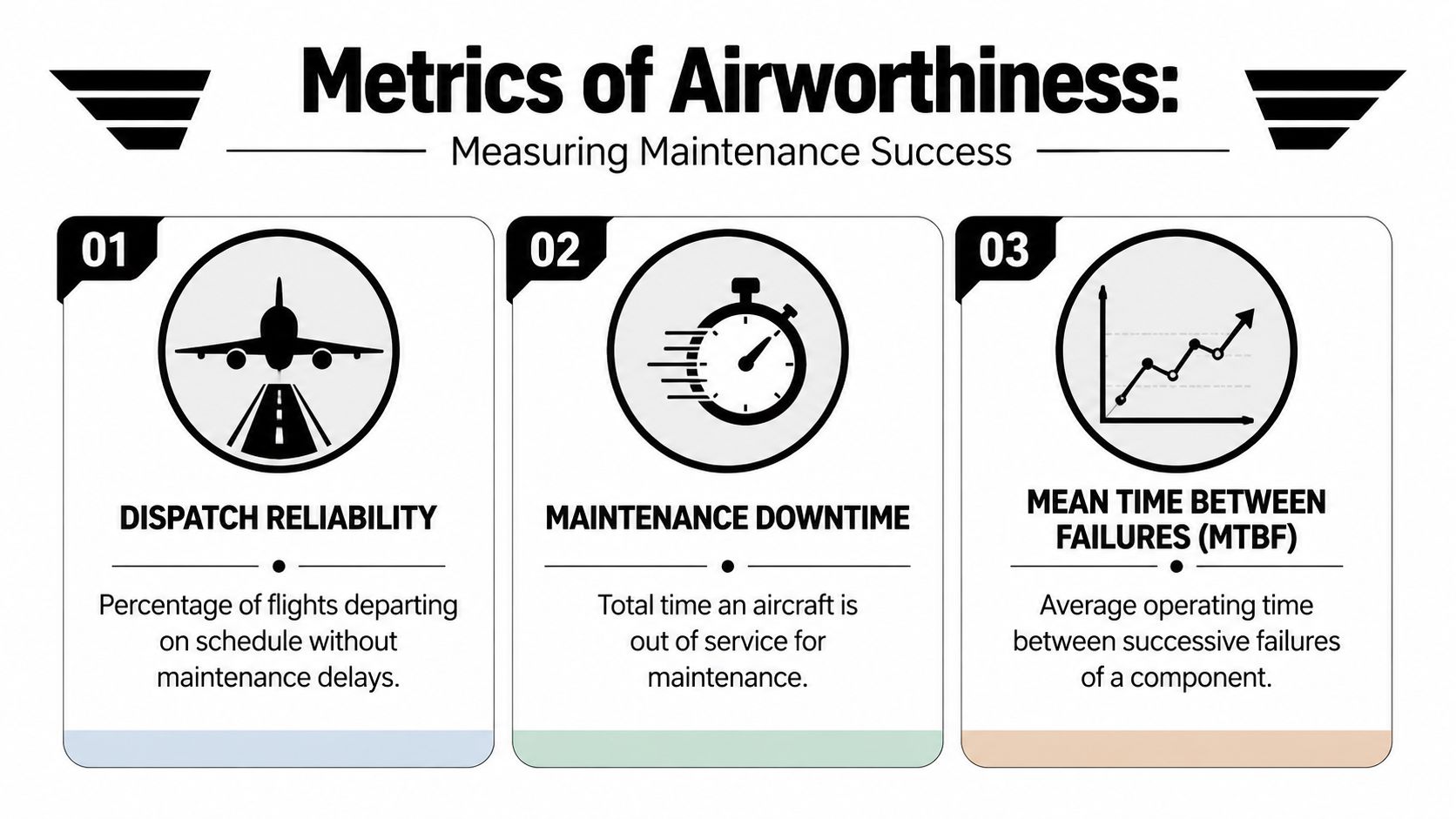
Three metrics clients should understand
Dispatch reliability answers a simple question. Does the aircraft depart as planned, without a maintenance-caused interruption? For a passenger, that metric is the closest thing to a maintenance report card.
Maintenance downtime reflects how long the aircraft is unavailable because it's in inspection, repair, or follow-up work. Downtime isn't automatically bad. Planned downtime is often a sign of responsible scheduling. What matters is whether the operator manages it intelligently instead of being surprised by it.
Mean Time Between Failures, often shortened to MTBF, tracks the average operating time between successive component failures. Clients don't need to memorize the term. They only need to understand what it implies. More stability between failures usually means better predictability for the aircraft and the travel schedule.
Why these metrics matter to passengers
These are not engineering vanity numbers. They affect real trips in practical ways:
- Schedule confidence: Better dispatch reliability lowers the chance of a maintenance-driven disruption on departure day.
- Fleet planning: Well-managed downtime helps operators avoid last-minute aircraft substitutions.
- Component insight: MTBF helps maintenance teams identify weak points before they become recurring operational headaches.
When maintenance is measured properly, reliability stops being a marketing promise and becomes an observable operating pattern.
Records matter as much as the aircraft
Passengers sometimes ask whether they can review maintenance history. That's a smart question. An aircraft's records tell a story that the cabin cannot.
This guide on whether you can see aircraft maintenance records is a useful starting point because it frames what clients can reasonably ask and how to interpret the answer. The key isn't reading every technical entry yourself. It's confirming that the operator has orderly, complete, reviewable records and can discuss them confidently.
Third-party audits gain importance here as well. Serious audits don't just ask whether policies exist. They look for evidence that the operator's maintenance and operational systems are functioning consistently over time.
Your Peace of Mind Is the Ultimate Destination
For most passengers, preventive maintenance aviation begins as an abstract phrase. By the time you understand how it works, it becomes something much more personal. It's the reason an aircraft is ready when promised. It's the reason a crew can trust the machine they're flying. It's the reason a high-value trip feels calm instead of uncertain.
The mechanics of maintenance are technical. The benefit is simple. Confidence.
What rigorous maintenance really delivers
A disciplined maintenance program does several jobs at once. It protects airworthiness. It supports schedule reliability. It creates records that can withstand scrutiny. It also gives operators a framework for adapting to new realities, whether that means digital monitoring tools, changing fuel considerations, or stricter audit expectations.
For the client, all of that complexity translates into a very human outcome. You don't have to wonder whether the aircraft was “probably fine.” You can board knowing the aircraft was cared for through a repeatable process.
The luxury that matters most
In private aviation, people often define luxury by comfort and convenience. Those matter, but they sit downstream from something more valuable. The highest form of luxury is the absence of doubt.
That absence doesn't happen by accident. It comes from technicians doing routine work well. It comes from operators respecting procedures when nobody is watching. It comes from records, audits, training, and a refusal to treat maintenance as an afterthought.
Peace of mind in aviation isn't created by appearances. It's created by disciplined work on the ground.
When clients choose carefully, they're not merely selecting a route, a cabin, or a departure time. They're choosing the quality of the maintenance culture that supports the entire journey.
If you want charter options backed by operators that meet the highest third-party safety standards, explore Haute Jets. You can review aircraft options, choose the exact jet that fits your mission, and fly with confidence knowing the trip is built around audited safety, operational rigor, and a better standard of private aviation.