

A lot of people start in private aviation the same way. They see a sleek jet push back from the ramp, the cabin door closes, the engines spool, and everything looks effortless. What they don't see is the crew scheduler solving a timing problem, the line team fueling under pressure, the charter advisor renegotiating an aircraft change, the maintenance staff clearing a discrepancy, and the pilots making conservative decisions that keep the trip safe and smooth.
That hidden coordination is exactly why private jet charter careers attract ambitious people. The work sits at the intersection of aviation, hospitality, logistics, and sales. It can be rewarding, fast-moving, and highly professional. It can also be unforgiving if you come in with glamorous assumptions and no respect for operations.
The people who do well in this business usually understand one thing early. Luxury is the product the client sees, but discipline is the product the company sells. If you want a career in this space, you need to know how the business works, how the roles fit together, and where the trade-offs are.
Your Takeoff into a Career in Private Aviation
A newcomer usually notices the visible roles first. Pilot. Flight attendant. Maybe a sharply dressed charter sales advisor taking a client call near the lounge. Those jobs are real, but they're only part of the machine.
Private aviation runs on coordinated specialists who work in very different environments. Some are on the ramp in heat, wind, or rain. Some are in operations rooms tracking aircraft and crew duty issues. Some are in sales, handling high-value bookings where one small mistake can damage a client relationship fast. Others are in safety and compliance, where the quiet work matters most because problems prevented never become headlines.
Practical rule: If you're drawn only to the image of private aviation, you probably won't last. If you're drawn to precision, service, and problem-solving, you might build a serious career here.
What makes private jet charter careers appealing is the range. You can build a cockpit path, a maintenance path, a dispatch path, a client-facing commercial path, or a ground-operations path. You can also move laterally if you learn the business well enough. Some strong salespeople started in trip support. Some respected managers started on the ramp. Some of the best brokers understand aircraft because they spent years around operators, not because they learned a few model names from a brochure.
That's the right way to approach this field. Not as an exclusive club, but as a professional ecosystem with real entry points for people who prepare properly.
The Landscape of the Private Charter Industry
A charter trip can look simple from the cabin. A client asks for wheels up at 7:00 a.m., catering is onboard, the crew is ready, and the aircraft departs on time. Behind that one departure is a business model with several players, different revenue pressures, and very different career paths.
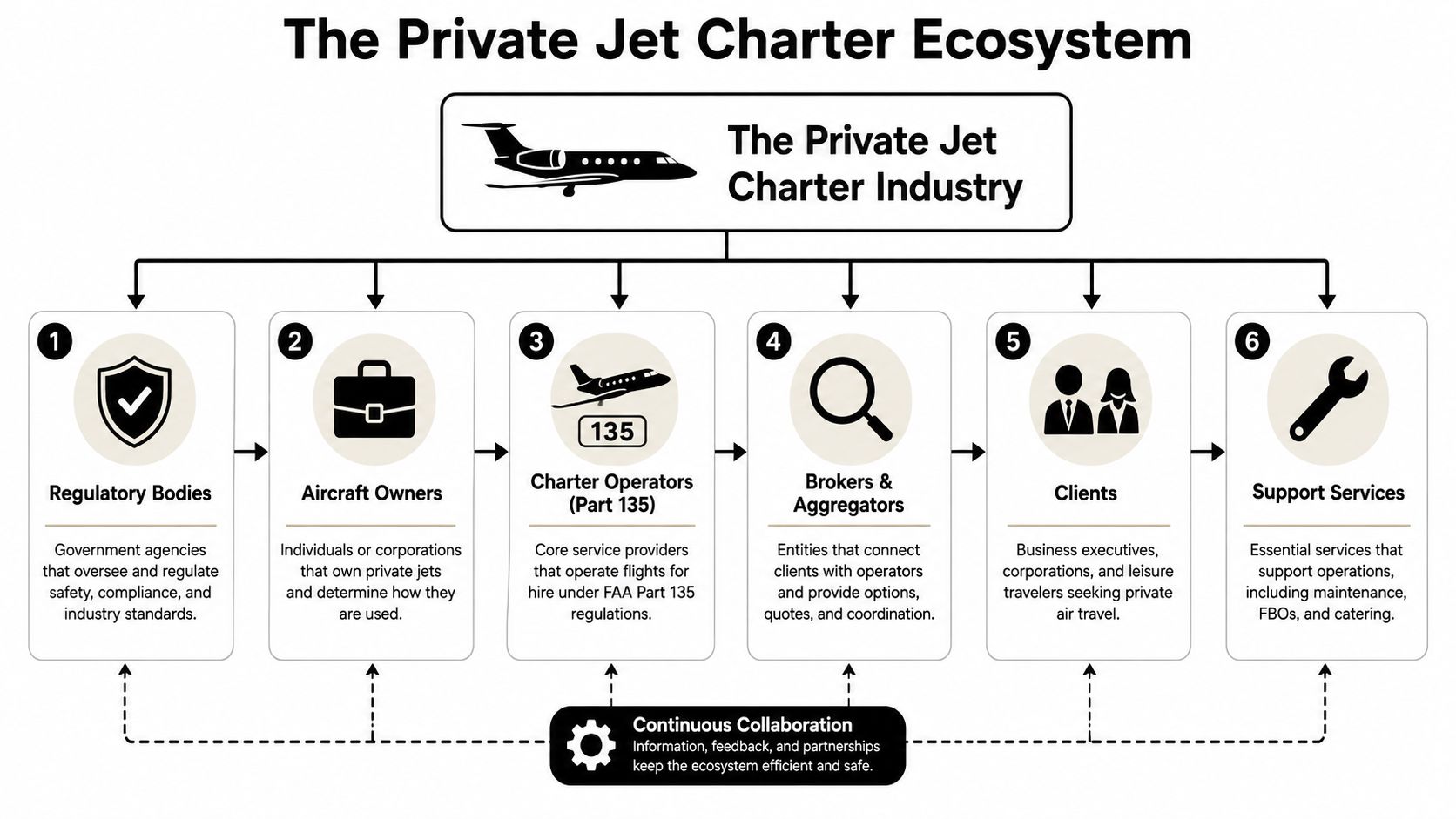
Operators, brokers, and support companies each own a different part of the trip
A Part 135 operator owns or manages the flying side. That includes aircraft availability, crew assignment, maintenance coordination, operational control, compliance, and day-of-flight execution. If you work inside an operator, your performance usually ties to safety, legality, reliability, and on-time delivery.
A charter broker sits on the client side of the transaction. Brokers source aircraft, compare operator options, confirm trip fit, manage price and expectations, and coordinate details that passengers still judge as part of the charter experience. In a strong brokerage, sales and trip management are tied together. A rep who sells a trip without understanding aircraft limits, crew duty, airport constraints, or recovery options creates problems for everyone else.
Then there are the companies around the flight. FBOs, maintenance providers, fuel vendors, caterers, ground transportation teams, and trip support staff all affect the final result. New entrants often miss this point. Private aviation is a service business built on operations discipline.
The market structure creates openings, but it also creates uneven employers
Private charter is fragmented. That matters for hiring.
Jobs are spread across small and midsize operators, management companies, brokerages, and service businesses rather than concentrated with one dominant employer. For someone trying to break in, that creates more entry points. It also means training quality, management standards, and promotion paths vary sharply from company to company.
Some firms build talent carefully. They teach quoting discipline, client communication, scheduling logic, vendor management, and safety reporting from day one. Others hire fast, undertrain, and expect junior staff to absorb pressure without guidance. A polished brand does not guarantee a well-run operation.
Ask practical questions before you accept an offer. Who owns operational control. How are after-hours calls handled. What does onboarding look like. How does the company evaluate vendors and operators. Those answers tell you far more than office décor or social media.
Money, safety, and service are tied together
Charter is not scheduled airline travel with nicer seats. Every trip is a custom transaction with real cost, real client sensitivity, and very little tolerance for avoidable mistakes. That shapes the careers inside it.
Sales cannot work in isolation from operations. Operations cannot ignore the client standard. Safety cannot sit in a binder and appear only during audits. The best employers build these functions to work together because one weak handoff can turn into a missed departure, a duty-time issue, an unhappy client, or a safety exposure.
This is also where serious operators separate themselves from weak ones. Clients, brokers, and corporate flight departments often look beyond price to third-party safety benchmarks such as Wyvern and ARGUS, because those ratings speak to oversight, procedures, and operating discipline. If you want a long career in this field, learn what those standards mean. Even if your first job is in sales, scheduling, or customer support, understanding how safety credentials affect buying decisions will make you more useful.
Anyone considering a cockpit path should also understand the business they are flying in, not just the aircraft they want to fly. This overview of private jet pilot career paths is a good place to connect the flying job with the operator environment around it.
The private charter market rewards people who can handle detail, pressure, and accountability at the same time. That is the fundamental structure of the business, and it is why good people can build strong careers in it.
Core Roles On and Off the Tarmac
A charter trip can look effortless from the cabin. Ten people may have touched it before the client steps onto the aircraft. That is the right way to judge careers in this business. Every role exists to protect three things at once: safety, legality, and a client experience that holds together under pressure.
Flight crew and cabin professionals
Pilots carry more than flight duties. They handle planning, weather, aircraft systems, fuel decisions, alternates, and cockpit coordination, then deliver all of it in front of passengers who may be flying for business, family, or urgent personal reasons. In charter, good flying matters, but judgment and composure matter just as much. A captain who communicates clearly with operations and keeps clients informed without oversharing problems is worth a great deal to an operator.
Anyone evaluating the cockpit path should understand the operator side as well as the flying side. This guide to private jet pilot career paths gives useful context on how pilots fit into the wider charter business.
Cabin crew and private flight attendants work in a narrower space with very high expectations. Their job includes safety briefings, cabin security, service timing, special requests, and discretion. The strongest cabin professionals know how to read a passenger quickly. Some clients want warm interaction. Others want privacy, speed, and no unnecessary conversation.
Operations is the control center
New entrants often underestimate dispatch and flight support. That is a mistake. These roles sit in the middle of almost every operational handoff: routing, permits, weather updates, handling requests, slot issues, catering changes, crew logistics, and real-time communication with vendors and clients. The work can be repetitive for hours and then urgent all at once.
The schedule is part of the trade-off. Nights, weekends, and holiday coverage are common because aircraft move when clients need them, not when an office calendar says they should.
Operations managers carry the broader picture. They weigh crew legality, maintenance status, airport constraints, aircraft availability, client expectations, and revenue pressure on the same trip. In a healthy charter company, operations has the authority to say no when a request creates safety or compliance risk. If that authority is weak, problems spread fast.
Strong operations teams protect the trip before it starts, not after it starts to unravel.
Commercial roles drive revenue, but they do not work alone
Charter sales advisors and brokers bring in business, price trips, source lift, and manage client relationships. The job rewards speed, persistence, and a calm phone manner, but sales performance in this sector depends heavily on operational credibility. A salesperson who promises an aircraft that ops cannot support creates rework, client frustration, and exposure for the company. The best salespeople understand aircraft fit, airport limitations, crew duty constraints, and the difference between a good quote and an executable one.
That business context matters for career decisions. Sales can be lucrative. It can also be unforgiving. You may spend your day quoting trips that never close, then spend your evening fixing one that did.
Technical and oversight roles keep standards intact
Aircraft maintenance technicians keep the fleet airworthy through inspections, troubleshooting, repairs, and documentation. In charter, maintenance affects both safety and dispatch reliability. A technician who writes clean records and spots a developing issue early saves far more than a delayed departure. That person protects the operator's reputation and prevents pressure from building around a bad decision.
Safety and compliance managers are often overlooked by outsiders, even though serious operators depend on them. They manage training records, manuals, internal reporting, audit preparation, and procedural discipline across departments. They also shape how an operator is viewed by clients, brokers, and corporate flight departments that pay attention to third-party oversight such as Wyvern and ARGUS. If you want a long-term career in charter, learn how those standards affect sales conversations, operator selection, and internal accountability.
Key roles in private jet charter
| Role | Core Responsibility | Work Environment |
|---|---|---|
| Pilot | Conduct safe, legal flight operations and manage cockpit decision-making | Aircraft cockpit, preflight planning spaces, FBOs |
| Cabin Crew | Handle cabin safety, service, and passenger experience | Aircraft cabin, catering and preflight prep environments |
| Dispatcher or Flight Support | Coordinate trip details, communications, and operational changes | Operations office, scheduling desk, remote support setting |
| Operations Manager | Oversee execution across crew, aircraft, timing, and service delivery | Operations center, cross-functional office environment |
| Charter Sales Advisor or Broker | Source aircraft, build client relationships, quote and close trips | Office, phone and email-driven sales environment, sometimes hybrid |
| Aircraft Maintenance Technician | Maintain airworthiness through inspection, repair, and documentation | Hangar, maintenance facility, ramp |
| Safety or Compliance Manager | Manage standards, records, audits, and procedural discipline | Office, audit setting, operator support environment |
Ground roles are a real entry point
Line service and ramp staff often get the least attention from career guides and some of the best practical exposure to how the business works. These teams marshal aircraft, fuel them, tow them, stage equipment, coordinate arrivals and departures, and keep the ramp safe while clients, crew, and service providers move around them. It is physical work. It is also one of the fastest ways to learn aircraft types, turnaround discipline, and airport rhythm.
People who do ramp work well tend to develop useful habits early: urgency without panic, attention to detail, and respect for procedure. Those habits transfer well into dispatch, fleet support, maintenance coordination, and airport management.
Required Certifications and Qualifications
A charter flight can look polished from the cabin and still be unforgiving behind the scenes. An owner wants a 6 a.m. wheels-up, weather is shifting, the destination has tight handling rules, and the aircraft cannot leave with a paperwork gap or an underqualified crew member. That is why hiring standards in this business are tied to risk, not image.
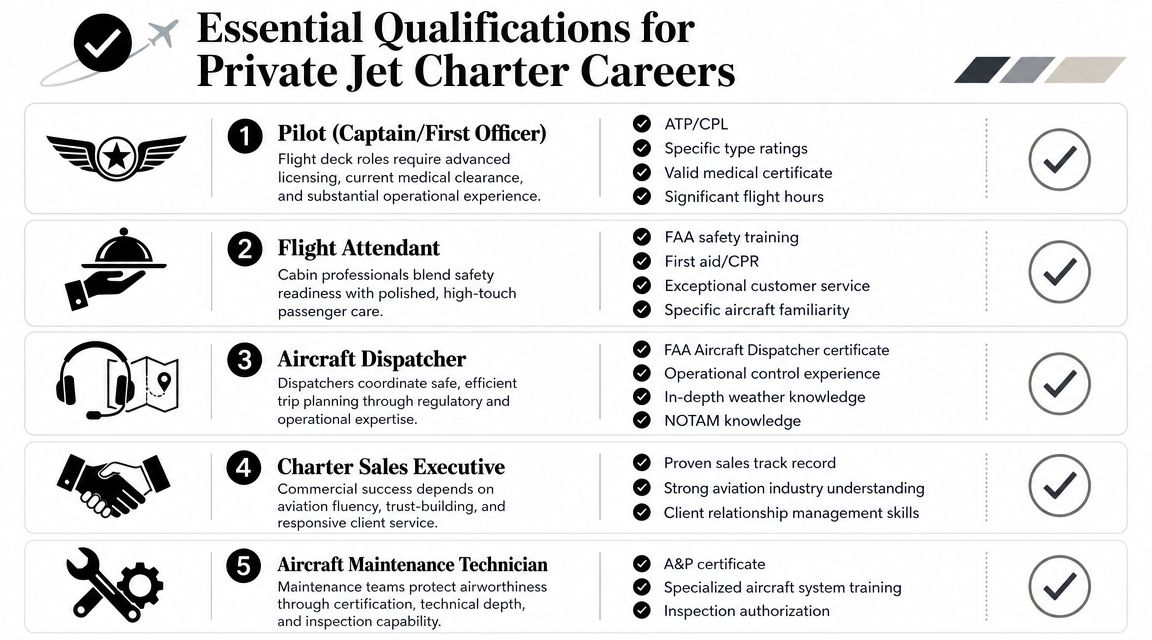
Pilot qualifications set the tone
Pilot hiring is usually the clearest example of how private charter companies assess readiness. Operators often want advanced certificates, a current FAA first-class medical, and flight time that shows real progression into multi-engine, turbine, and instrument environments, as noted earlier in the article. On larger aircraft or more demanding accounts, an ATP and type-specific training may also be part of the baseline.
Those requirements reflect the business model. A charter operator is not only buying flight skill. It is buying judgment under schedule pressure, CRM discipline, clean recordkeeping, and the ability to protect the trip when conditions change. Early-career pilots should read that correctly. Build time in places that sharpen procedures and decision-making, not just logbook totals.
Qualifications by role
Outside the cockpit, standards vary by employer, aircraft, and operating certificate, but the pattern is consistent. The stronger companies hire for technical competence first, then test whether you can perform in a service-driven operation.
- Dispatch and flight support: An FAA aircraft dispatcher certificate helps for true dispatch roles. Even without it, employers look for people who can read weather, interpret NOTAMs, catch routing problems, and communicate clearly with crew, handlers, and clients.
- Maintenance: An A&P certificate is the normal starting point for technician roles. Beyond that, strong operators value careful troubleshooting, clean logbook practices, and familiarity with the aircraft they support.
- Cabin crew: Private aviation cabin attendants need safety training, first aid, CPR, and service discipline that fits a small-cabin environment. Airline experience helps, but private charter expects more discretion and more self-direction.
- Sales and brokerage: There is no universal license for charter sales. The primary qualification is commercial judgment. Good advisors understand aircraft capability, crew duty limits, airport constraints, and the operational cost of promising the wrong trip.
That last point gets missed in a lot of career advice. In charter, sales does not succeed by working around operations. It succeeds by selling trips the operation can deliver safely and profitably.
Safety literacy separates stronger candidates
Candidates who understand how business aviation safety is vetted tend to interview better and ramp faster once hired. Learn the basics of audits, operator history, SMS discipline, and client screening standards. A practical starting point is this analysis of Wyvern and ARGUS safety ratings, because those ratings shape how many operators market themselves and how many clients evaluate risk.
This matters even if you are applying for sales, scheduling, or customer support. Serious charter companies do not treat safety as a department issue. They treat it as a company-wide filter on what gets quoted, approved, flown, and documented.
Professional habits matter as much as the credential
The industry can teach a new hire its software and service standards. It has a much harder time teaching steadiness.
Private aviation rewards people who stay composed, protect confidential information, speak clearly when plans change, and escalate problems before they turn into expensive ones. Clients may be calm, impatient, distracted, or demanding. Crew may be legal but close on duty time. Weather may be technically flyable but operationally messy. Employers notice the candidate who stays precise and useful in those conditions.
The mistake I see most often is chasing polish while neglecting discipline. In this field, calm judgment travels further than charm.
Salary Expectations and Career Progression
Compensation in private aviation varies widely by role, aircraft, company quality, market, and schedule. The mistake is assuming every job pays like a senior cockpit position or a top-producing broker. It is more uneven. Some paths start modestly and scale well. Others look attractive on paper but come with unstable schedules or commission pressure.

What the verified pay data tells you
The strongest compensation benchmark in this field comes from the broader pilot labor market. The U.S. Bureau of Labor Statistics projects about 18,200 openings each year, on average, for airline and commercial pilots from 2024 to 2034, and it projects 4% employment growth over that period. For pay context, the BLS reports a median annual wage of $226,600 for airline pilots, copilots, and flight engineers in May 2024, compared with $122,670 for commercial pilots, in the BLS occupational outlook for airline and commercial pilots.
That doesn't mean every charter pilot earns those figures. It does show the broader labor market charter employers compete within. It also highlights a real progression point. Many private aviation careers, especially on the pilot side, are built by moving from lower-paid commercial roles into stronger captain, training, fleet, or management positions over time.
How pay structures differ by role
Aviation compensation isn't one-size-fits-all. In private charter, you'll usually see a few distinct models:
- Pilots: salary-based, sometimes influenced by aircraft type, captain versus first officer status, and schedule structure
- Sales advisors and brokers: base salary plus commission, or in some firms a low base with heavy reliance on closed business
- Operations staff: salary or hourly structures, often with the trade-off of irregular schedules
- Maintenance and line service: hourly or salary depending on employer, shift patterns, and facility setup
That structure matters as much as the headline number. A role with lower guaranteed pay but excellent training and upward mobility may beat a role with a better starting offer and no real ladder.
Here's a useful career perspective from a neutral industry video:
Progression is usually earned in stages
On the pilot side, a common route is first officer to captain, then potentially to training captain, chief pilot, or director of flight operations. On the business side, a junior charter coordinator might grow into a senior advisor, account lead, or team manager. In operations, people often move from support desks into dispatch leadership, fleet planning, or operational management.
The people who advance fastest usually become reliable before they become impressive.
That's especially true in charter. The company remembers who handled the difficult weekend recovery, not who sounded polished in the Monday meeting.
Your Strategy for Landing a Top-Tier Job
Most applicants make the same mistake. They apply broadly, use a generic aviation resume, and hope the company fills in the blanks. That approach rarely works in private jet charter careers because employers aren't just hiring credentials. They're hiring trust.
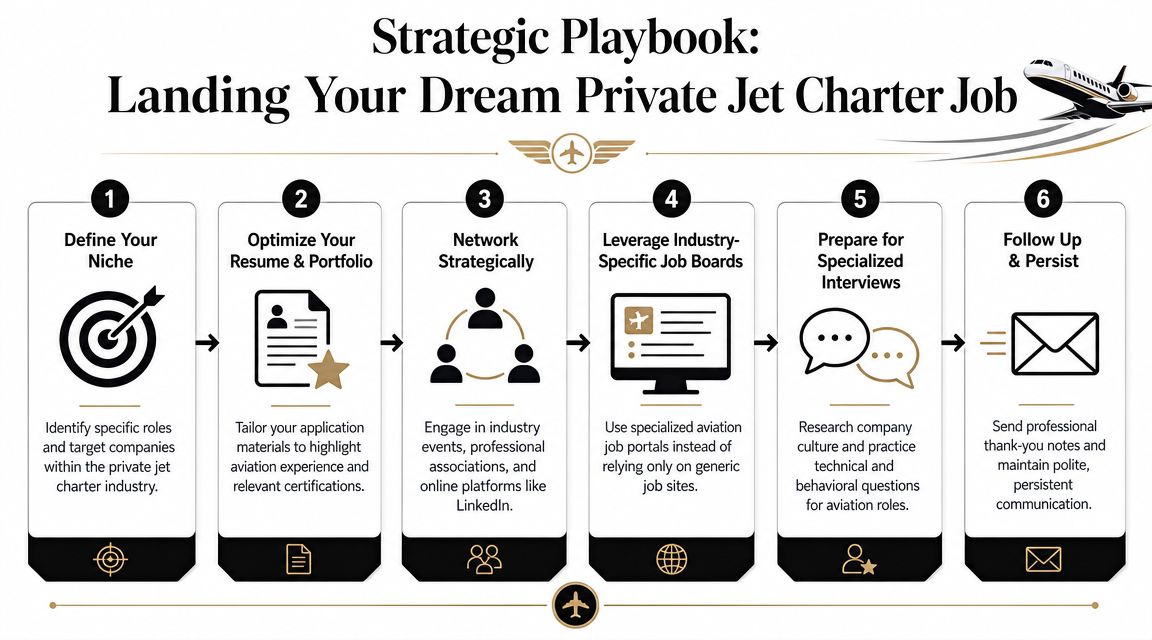
Start with a narrow target
Don't say you're open to “anything in private aviation.” Pick a lane first.
If you want cockpit work, identify the experience gap between where you are and where charter operators hire. If you want brokerage or charter sales, learn the booking process, trip terminology, and how client requests become aircraft sourcing decisions. If you want operations, show that you can handle time-sensitive coordination without dropping details.
Then build a target list of companies by business model. Operator. Broker. FBO. Maintenance-focused employer. You'll write better applications once you know what each business does.
Tailor your resume to the job you want
In this sector, generic resumes read as risk. Hiring managers want signs of fit. They look for safety mindset, schedule flexibility, professionalism, and experience handling responsibility without drama.
Use specifics from your actual background. Highlight regulated work, customer-facing pressure, after-hours responsibility, confidential client interaction, or complex logistics. If you're entering from another industry, make the transfer obvious. Luxury hospitality, logistics, military operations, and technical service environments all translate well if you explain them properly.
If you want help tightening your materials before applying, AI-powered job search solutions can be useful for resume refinement and application workflow support, especially when you're targeting multiple aviation employers with role-specific versions.
Network like a working professional, not a fan
Networking in private aviation isn't about asking strangers to “help you break in.” It's about proving you understand the business and can hold a useful conversation.
Use industry events, LinkedIn, operator career pages, aviation associations, and company websites. Study who handles what. If you're exploring commercial roles, review actual company team pages to understand structure, such as the Haute Jets team, where you can see how a charter organization presents client-facing and operational expertise.
For broker roles in particular, realism matters. Some entry paths are commission-heavy, relationship-driven, and may begin with a low base salary, as described in Pacific Coast Jet's charter advisor career overview. That's not a reason to avoid the path. It's a reason to ask better questions before accepting an offer.
Prepare for interviews that test judgment
Expect behavioral questions, not just technical ones. A hiring manager may ask how you handled a demanding customer, a last-minute change, a safety concern, or a communication breakdown. They want to know whether you get flustered, pass blame, or think clearly.
Good answers usually include these elements:
- The situation: what happened and why it mattered
- Your action: what you did personally, not what the team did in general
- The principle: safety, discretion, coordination, customer care, or compliance
- The result: resolved, escalated properly, or prevented from getting worse
The strongest candidates sound calm, specific, and accountable.
Insider Knowledge for Industry Success
The trip looks polished to the client because several teams are doing hard, time-sensitive work at once. A broker is confirming the operator. Operations is watching duty limits, weather, airport hours, and ground handling. Crew is preparing for a flight that may change twice before departure. If you understand that chain, you will sound different in interviews and perform better once you are in the job.
Safety ratings affect real buying decisions
Learn how third-party safety screening fits into charter sales and trip execution. Wyvern and ARGUS matter because brokers, flight departments, and many experienced clients use them to vet operators before they approve a trip. That does not replace an operator's own compliance, training, or SMS. It does tell you how the market often sorts trusted providers from questionable ones.
This is where business judgment shows. A strong charter professional does not treat safety ratings as a logo on a website. They understand how those ratings influence sourcing, client confidence, and which operators even make it into the conversation.
Know the products well enough to explain the catch
Empty legs are a good example. They can offer value, but they come with constraints. Repositioning flights can change or disappear if the primary trip moves, so selling one like a fixed airline seat creates problems for the client and headaches for operations.
The same principle applies to newer client questions, including crypto payments or sustainable aviation fuel. You do not need a speech about trends. You need to explain what is possible, what adds cost, what adds complexity, and what requires extra coordination behind the scenes.
Respect the ground side of the business
Private aviation has no “small” jobs. The ramp, dispatch desk, maintenance control function, and client-facing teams all affect the same trip outcome.
Ground roles are physically demanding and tightly timed, as noted earlier in the article. Aircraft still need parking, towing, fueling, stocking, cleaning, and paperwork done correctly, often under pressure and outside normal office hours. People who overlook that reality usually misunderstand the business. People who respect it tend to make better decisions, especially in sales and operations, because they know every promise has to be carried out by someone.
Commercial awareness gives you an edge
Hiring managers can tell when a candidate only likes jets. They pay attention when a candidate understands margins, sourcing pressure, client expectations, and why one delay can ripple through crew duty, airport services, and the next leg of the aircraft schedule.
That kind of judgment also comes through in how you present yourself. If you want to sharpen that part of your preparation, this guide for interview success is a useful refresher on explaining your value clearly without sounding scripted.
Private charter rewards people who think in systems. Sales, safety, operations, maintenance, and service are tied together every day. Once you understand how those pieces support each other, you stop sounding like someone chasing the image of private aviation and start sounding like someone ready to carry responsibility.
Conclusion Your Future in the Sky
A career in private aviation can be demanding, and that's part of the appeal. The work asks for precision, discretion, flexibility, and professional maturity. In return, it offers a path into a business where strong people can build real expertise and long-term value.
The smartest way to enter is with clear eyes. Learn the difference between operators and brokers. Respect the ground and operations side as much as the visible client-facing roles. Build credentials that match the job. Ask hard questions about pay structure, schedules, and standards before you accept an offer.
Private jet charter careers aren't reserved for insiders. They're built by people who prepare well, stay steady under pressure, and keep learning once they're in. If that sounds like you, the runway is there.
If you want a clearer picture of how the charter side of the business operates, explore Haute Jets to see how an on-demand brokerage model, aircraft sourcing, and safety-focused operator standards come together in real-world private aviation.