

You're comparing two private jet quotes for the same trip. One looks attractive because the hourly rate is low. The other is higher, but the aircraft is already near your departure airport, the schedule is firm, and the quote includes the operational costs that matter. The cheaper-looking option may become the expensive one before departure.
That's the central problem behind private jet charter cheap searches in 2026. Real savings rarely come from a coupon or a flashy last-minute offer. They come from sourcing an aircraft close to where you are, choosing the smallest suitable cabin, and checking the complete landed cost before signing.
What Cheap Private Jet Charter Actually Means in 2026
Cheap charter is a sourcing problem, not a discount problem. The operator must get an aircraft, crew, and compliant itinerary to your departure airport. If the aircraft is already nearby and the mission suits its range, the quote can be efficient. If the aircraft has to fly empty from another region, the advertised hourly rate tells you very little.
Private jet pricing varies sharply by category. Current market guidance places typical hourly rates at about $2,000 to $4,000 for ultra-light jets, $3,000 to $5,000 for light jets, $5,500 to $10,500 for midsize and super-midsize jets, and $9,000 to $22,000 for long-range heavy jets. Large VIP airliners can reach $20,000 to $45,000 per flight hour. These ranges are summarized in 2026 private jet cost guidance.
Start with the mission, not the aircraft
Define four things before requesting a quote:
- Passengers and baggage: A smaller group with modest luggage may fit a very light or light jet. Golf bags, ski equipment, pets, or bulky cases can change the aircraft requirement.
- Range: A regional route doesn't justify a long-range cabin. International missions may require a larger aircraft because of fuel, weather, and payload requirements.
- Runway and airport: Smaller aircraft can often use regional airports that are more convenient and may offer better local availability.
- Cabin needs: A stand-up cabin, sleeping arrangement, lavatory configuration, or onboard connectivity can justify moving up a category.
A four-person group on a heavy jet pays for capacity it isn't using. The aircraft's hourly rate covers fuel, crew, maintenance, hangar, insurance, and other fixed operating obligations. Larger aircraft absorb those costs across a bigger cabin, while shorter regional missions often reward a smaller aircraft.
For practical planning, a light jet may be appropriate for a short domestic mission, while a midsize aircraft makes more sense when luggage, cabin space, or range becomes important. Super-midsize jets serve longer domestic and international missions, and heavy aircraft suit long-range travel. The correct choice is the smallest compliant aircraft, not the smallest aircraft at any cost.
The hidden cost is often positioning
Suppose a light jet is quoted at $3,500 per hour, but it must fly empty to your departure airport. The aircraft may still charge for the ferry leg, crew movement, and related handling. Your effective hourly cost can become far higher than the headline number.
Industry reporting estimates that 30% to 40% of private jet flight hours are empty or repositioning legs. Operators may discount that inventory because the aircraft has to fly anyway, but the economics only work when your itinerary matches the aircraft's existing route. Empty-leg market reporting explains why local aircraft availability matters more than a generic advertised rate.
Advisor's rule: Ask where the aircraft is based, where it will be immediately before your departure, and who pays to bring it to you.
A broker or marketplace with limited local inventory may quote an aircraft that isn't the best operational match. That quote can carry a positioning premium. The responsible comparison is not hourly rate versus hourly rate. Compare total flight time billed, repositioning, taxes, airport charges, crew costs, and schedule conditions.
You can use Haute Jets' private jet charter cost guide to frame the discussion, but the decisive information must come from the itinerary-specific quote.
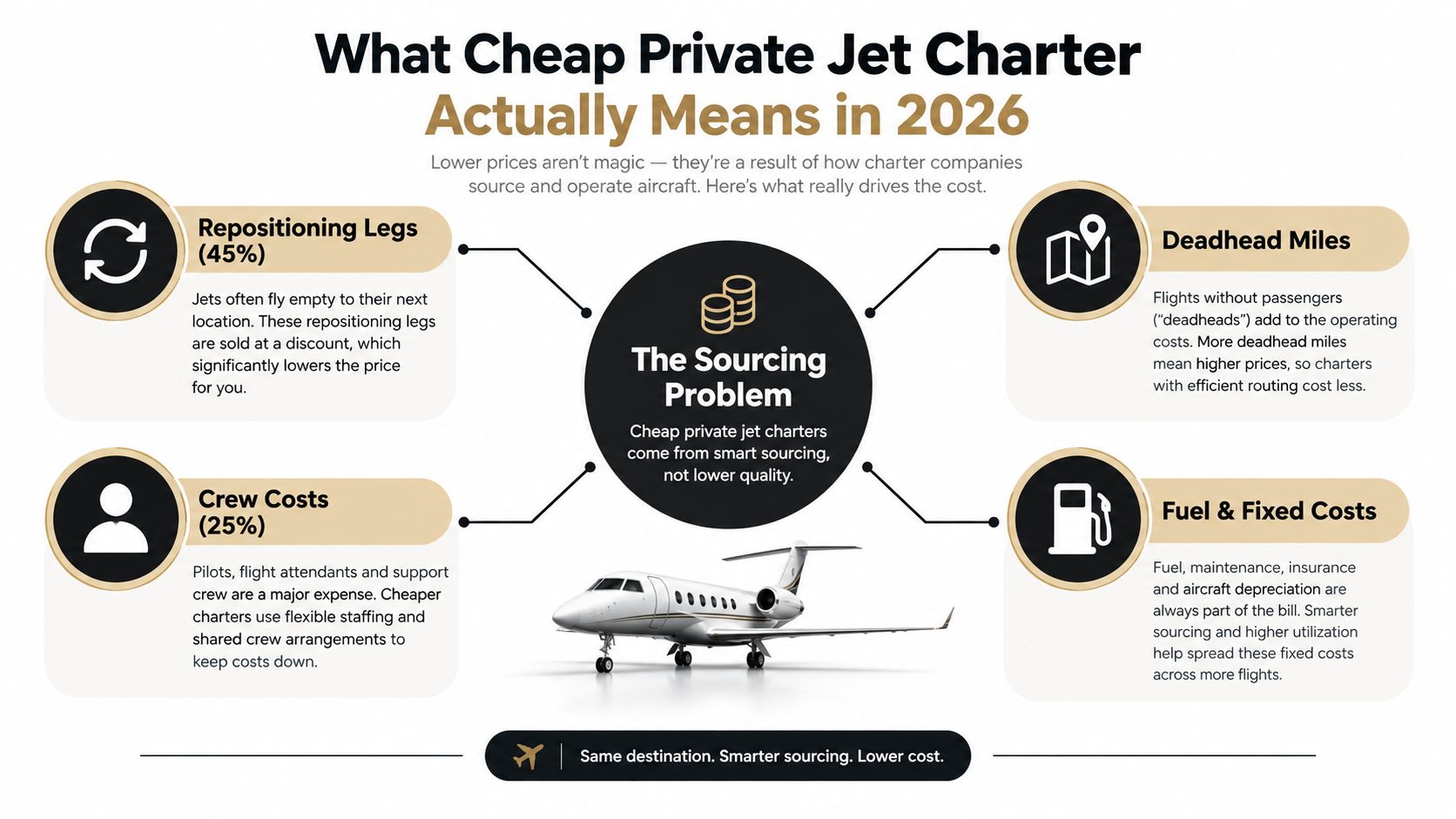
The cheapest credible option usually combines local sourcing, efficient routing, suitable cabin size, and flexible timing. It doesn't need to be the oldest aircraft, the least comfortable aircraft, or an unverified operator. It needs to be the aircraft that fits the mission without forcing you to pay for unnecessary repositioning.
How to Use Empty Legs Without Getting Burned
An empty leg is a repositioning flight the operator must perform without booked passengers. Rather than fly the aircraft empty with no passenger revenue, the operator may offer the seat or whole aircraft at a substantial discount. Industry sources commonly describe discounts of 25% to 75% below standard charter rates, while the aircraft still carries fuel, crew, and airport-handling costs. See this empty-leg flight explanation for the basic operating model.
The bargain is real only when the route works for you.
Search by departure and flexibility
Set alerts with several operators and brokers. No single source reliably displays every available repositioning leg. Filter by:
- Departure city and nearby airports
- Date range
- Aircraft category
- One-way route
- Latest acceptable departure time
Destination-only searches waste time because empty-leg inventory follows the operator's needs, not the traveler's preferred route.
Booking windows are often short, commonly 48 to 72 hours before departure, and some opportunities appear even closer to takeoff. The trade-off is a fixed route, limited schedule control, and a greater possibility that the underlying paid charter changes. Empty-leg pricing guidance for 2026 notes that some advertised whole-aircraft offers can begin around €990, but headline access doesn't mean the itinerary will match your needs.
Before paying, confirm the aircraft, passenger count, baggage allowance, departure airport, cancellation terms, and whether ground transportation or overnight crew costs are included. A non-refundable deposit can erase the benefit if the schedule doesn't work. An aircraft substitution may also turn a promising light-jet offer into a cabin that can't carry your passengers or bags.
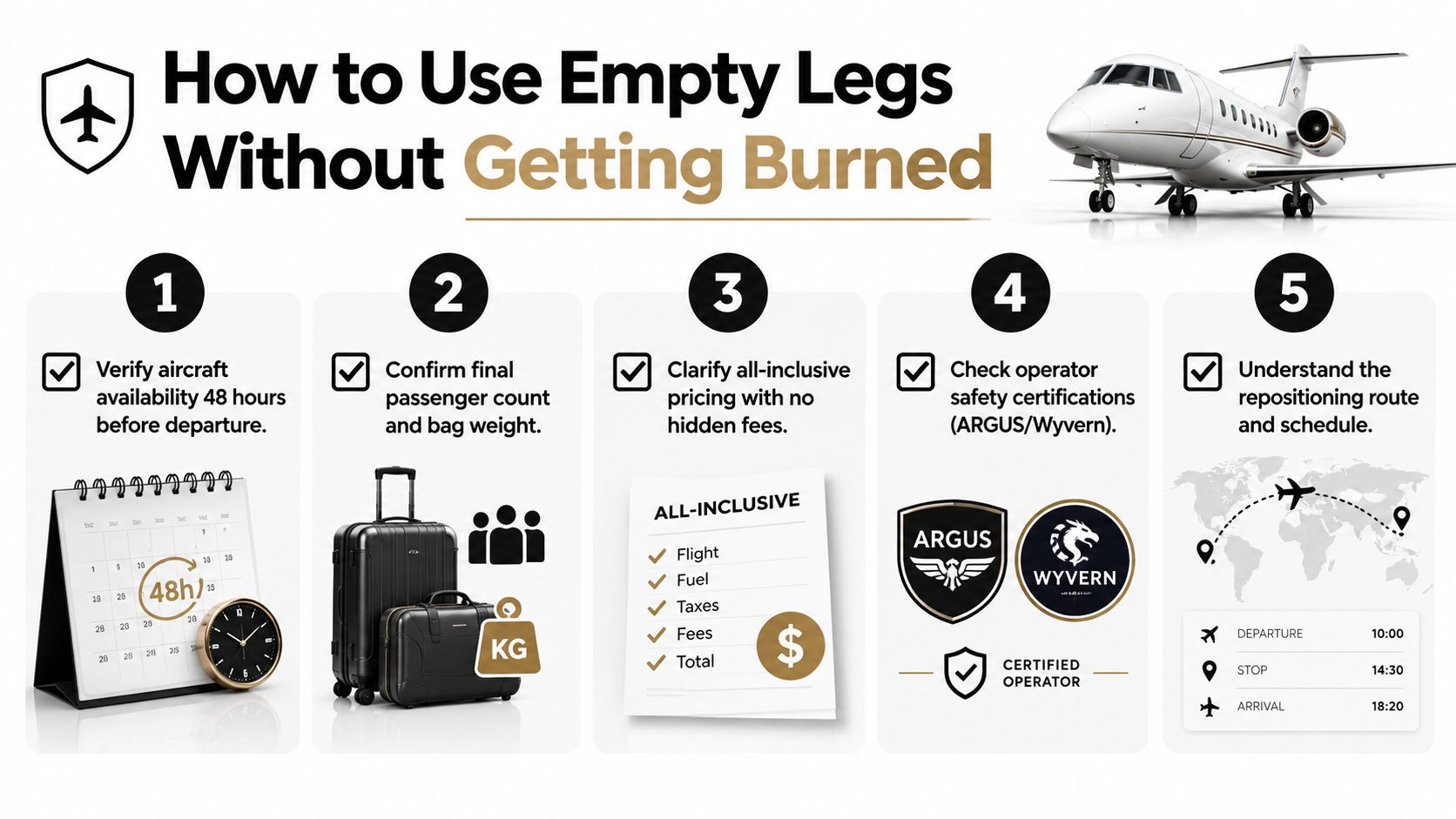
Practical rule: Evaluate an empty leg as a complete trip, not a discounted flight segment.
Ask for an all-in number and a written explanation of what happens if the underlying flight moves or cancels. Empty legs suit flexible leisure travel. They're a poor choice for a board meeting, production call, wedding arrival, or any itinerary where a missed departure creates a larger financial loss.
For a deeper operational explanation, read what an empty-leg flight is.
The Repositioning Trap Most Buyers Miss
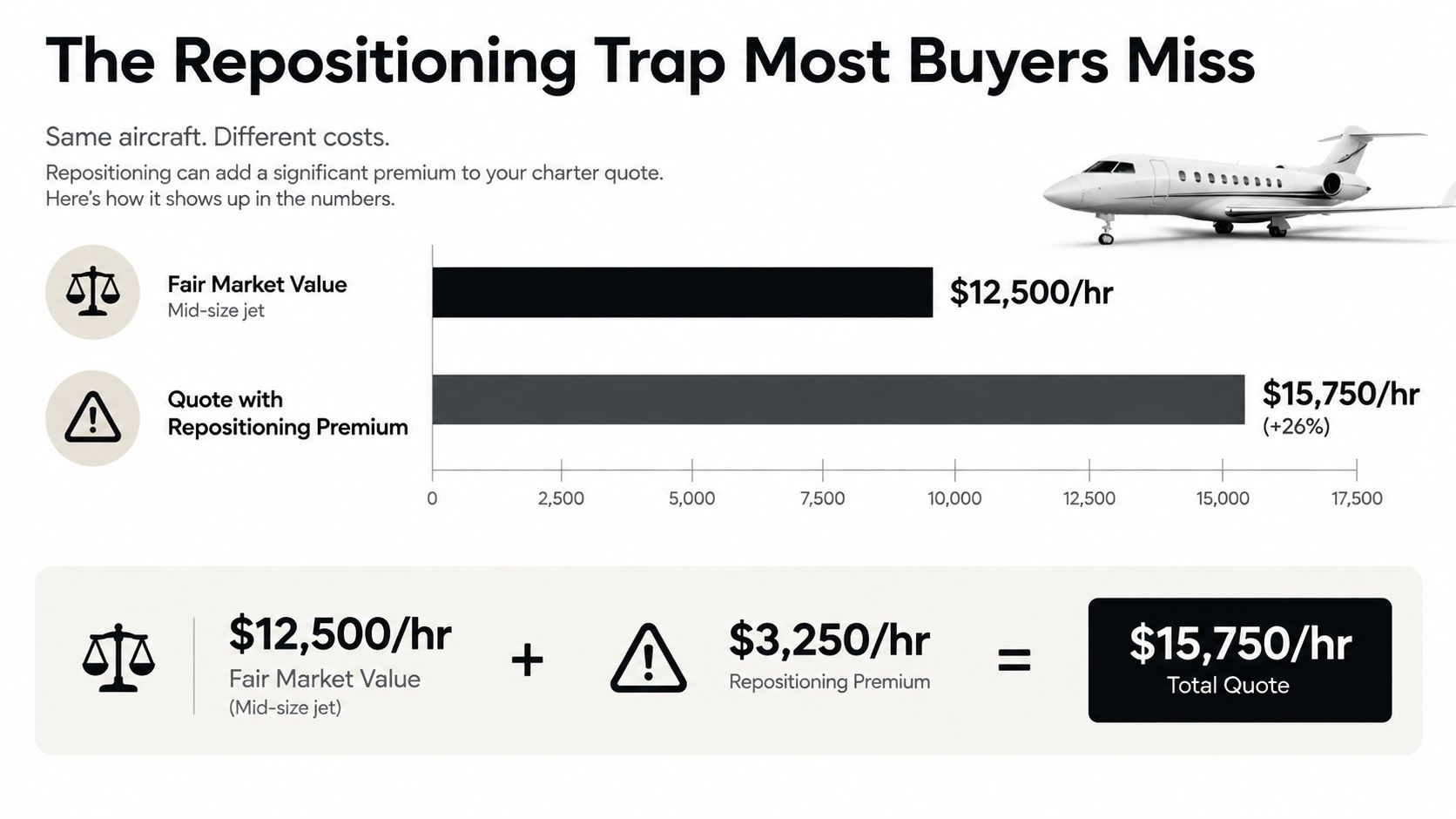
A quote can show a low passenger-leg rate while hiding the aircraft's expensive trip to your airport. Evaluate both movements: the flight carrying you and the repositioning required before departure.
Positioning fees can add 20% to 40% to a charter price, especially when the aircraft is not near your origin. Operators may bill the empty movement at the same hourly rate as your passenger flight because fuel, crew, maintenance, and airport services still apply. This explanation of positioning fees explains how an attractive passenger-leg rate can conceal a costly ferry requirement.
Trace the aircraft before comparing prices
Start with the aircraft's current base and recent position. Ask the sourcing team for the nearest available tail, not only a cabin category. Require the ferry cost as a separate line item, and ask whether the operator will cap that amount in writing.
Read the quote for these details:
- Aircraft origin: Where the tail starts before your trip
- Ferry time: Empty hours needed to reach your departure airport
- Crew movement: Whether pilots must travel or stay overnight
- Return positioning: Whether the aircraft must move again after your flight
- Cancellation exposure: What happens if the positioning plan changes
A remote departure, specific cabin layout, limited local fleet density, or strict nonstop range requirement can make repositioning unavoidable. Still, the first quote is not automatically the best sourcing result. A schedule change may align your trip with an aircraft already nearby. Ask for nearby departure airports and alternate times before accepting it.
Ask one direct question: “What would this itinerary cost if you sourced the aircraft from the closest available base?”
That question makes the supplier show the sourcing economics instead of presenting one blended total. Read what a private jet repositioning fee is before comparing offers. Then separate the passenger flight from every aircraft movement required to operate it.
Booking Windows and Timing Tricks That Lower the Quote
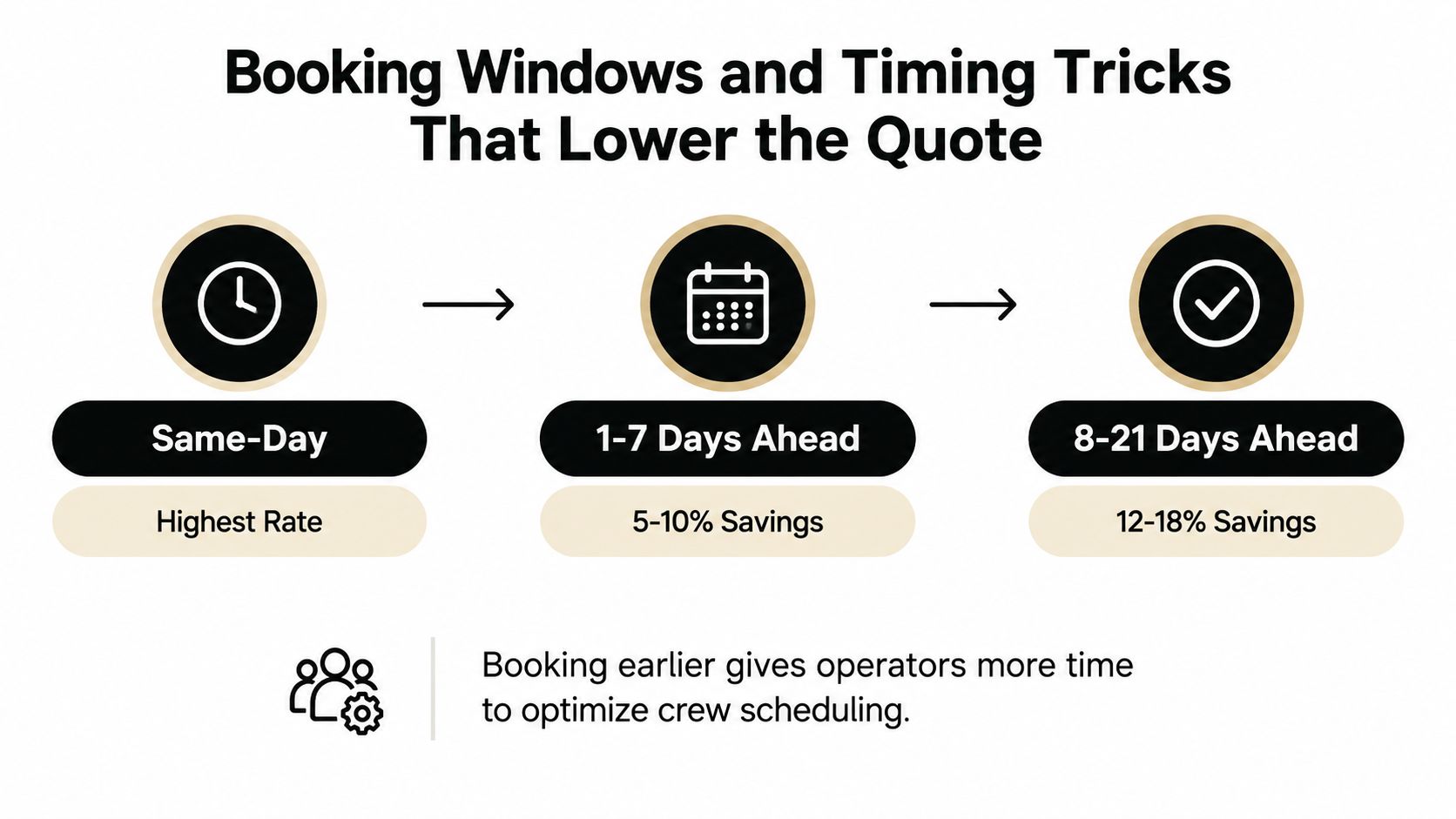
A same-day request can leave you paying for urgency rather than transportation. The operator may need to accept an inefficient aircraft position, rush crew arrangements, or assign a larger cabin because a better local option has already gone. Planning time gives the sourcing team more ways to match your route with an aircraft already aligned to another schedule.
Target 7 to 21 days ahead whenever possible. This window allows comparisons across nearby aircraft, crew schedules, and repositioning opportunities. It does not guarantee the lowest quote, but it improves the chance that the price reflects an efficient operation instead of a last-minute fix.
Give the operator room to solve the sourcing problem. Send your ideal plan with workable options:
- Preferred departure: Your ideal date and time
- Acceptable alternatives: Earlier or later departures
- Nearby airports: Primary and secondary fields
- Aircraft preference: Minimum cabin and range requirements
- Return flexibility: Whether the return can shift
Midweek travel, particularly Tuesday through Thursday, can provide more usable inventory than peak leisure periods. Shoulder-season travel may also simplify sourcing because operators can have more aircraft available for regional missions.
Departure time affects more than your schedule. If the trip forces the crew to reposition or remain overnight, those arrangements can raise the quote even when the passenger flight is short. Ask whether an earlier or later departure lets the aircraft and crew complete the mission without another movement or overnight stay.
Use this wording in the request: “Please price the preferred itinerary, the nearest workable airport, and the closest alternatives on date and time. Break out all positioning and crew charges.” It forces the supplier to show the operational choices behind the total instead of defaulting to one expensive assumption.
Why Your Sourcing Channel Changes the Price
The sourcing channel affects what you see, what you can negotiate, and how clearly the quote exposes positioning. A broker can search broadly but may add a service margin. A jet card can simplify booking and stabilize access, but the fixed structure may obscure segment charges, peak conditions, or other trip-specific costs. Direct operator sourcing can provide clearer access to the aircraft owner or certificate holder, but it requires more diligence from the buyer.
Don't accept an invented “average markup” as a universal rule. Ask each provider to state its fee, whether it is included in the hourly rate, and whether the quoted aircraft is operated by the supplier or sourced from a third party.
| Sourcing Channel | Avg Hourly Markup | Price Transparency | Aircraft Choice |
|---|---|---|---|
| Traditional broker | Ask for the fee in writing | Can vary by quote format | Broad network, dependent on supplier access |
| Jet card program | Embedded in program terms | Fixed structure, review surcharges and segment charges | Category-based or program fleet |
| Direct operator | Usually disclosed in the operator quote | Often clearer on aircraft and operational charges | Limited to that operator's available fleet |
| Multi-operator sourcing | Compare the stated fees side by side | Strong when every line item is separated | Wider choice across local aircraft |
The right comparison is not broker versus operator. It's same aircraft category, same airports, same passenger profile, same date, and same inclusions. A direct operator can be cheaper when it owns or manages a nearby aircraft. A broker can be useful when the local operator lacks the right cabin or schedule.
Safety screening remains essential. ARGUS Gold, Gold Plus, and Platinum are tiered operator checks, and Platinum requires an on-site audit plus a verified Safety Management System. Wyvern Wingman involves a full on-site audit covering procedures, pilot training records, maintenance, and risk management, as explained in this ARGUS and Wyvern overview.
Request the operator certificate, the applicable safety rating, the exact aircraft, and an all-in quote before comparing the number.
Negotiation Tactics That Operators Actually Respond To
A lower charter quote comes from solving an operator's positioning problem, not from asking for a generic discount. Operators schedule aircraft, crews, ferry movements, and empty inventory. Offer a change that improves that plan, then ask for part of the saving.
Begin with an itemized quote separating passenger flight time from repositioning. If the aircraft is already near your departure city, request a ferry cost cap or a waiver. The operator has a practical reason to agree when your itinerary replaces a movement that would otherwise generate no revenue.
Trade flexibility for a more efficient aircraft plan
Give the operator a departure window rather than one fixed time. A few hours can make an aircraft already nearby workable or prevent an inefficient crew arrangement. Ask which nearby airports fit the operator's base. A secondary field may reduce ferry distance and lower the total without changing the aircraft category you need.
Several trips within a defined period can also be priced together. Present the routes, dates, and timing options in one request, then ask for a package rate. Repeat revenue gives the operator a clearer commercial opportunity, particularly when the legs fit its existing network.
Use specific trades rather than vague requests:
- Catering trade: On a short flight, remove customized catering if doing so offsets another service charge.
- Departure flexibility: Accept an earlier or later time that helps the crew complete its rotation.
- Aircraft substitution: Accept a comparable model only when the cabin, baggage capacity, safety standard, and onboard equipment meet your requirements.
- Deadhead availability: Ask whether an empty seat on an associated movement can be used without a separate passenger charge.
- Payment certainty: Offer prompt payment or a signed contract in return for a revised total.
Keep the negotiation tied to the sourcing facts. Compare two operator quotes with one broker quote only after normalizing aircraft category, airports, timing, passenger needs, and inclusions. Then identify whether the difference comes from ferry distance, crew positioning, aircraft availability, or fee structure. This prevents a low headline figure from hiding a longer repositioning leg or excluded service.
Ask for a specific concession: “If I approve promptly and accept the flexible departure window, what is the lowest all-in price you can authorize?” Require the revised amount in writing, including cancellation terms, aircraft-substitution language, and every included charge. The aim is an efficient trip that the operator can execute, not a discount that creates an unsafe or impossible commitment.
Putting It Together on Your Next Charter Quote
Use this workflow whenever a trip enters the calendar.
- Define the mission. Record passenger count, baggage, pets, airports, preferred timing, return needs, and the minimum acceptable cabin.
- Request comparable quotes. Obtain two operator quotes and one broker quote on the same day, using identical itinerary details.
- Ask for empty-leg matching. Request alerts and ask whether a repositioning aircraft already overlaps your route and date.
- Demand a complete breakdown. The quote should identify hourly rate, repositioning, FET, segment fees, catering, airport charges, and crew overnight costs.
- Test alternatives. Price nearby airports, flexible departure times, a smaller compliant aircraft, and a return schedule that reduces ferry movement.
- Negotiate from facts. Ask for a ferry cap, a repositioning waiver, a package rate, or a lower total in exchange for prompt approval and flexibility.
- Book with enough lead time. Aim for the 7-to-21-day planning window when the mission allows, while recognizing that an empty leg may require much shorter notice.
The final decision should balance price with operational certainty. An empty leg can be excellent for flexible leisure travel. A direct, locally sourced charter is usually the better value when a meeting, event, production, or family connection makes the schedule more important than the headline discount.
Request a sample quote from a direct operator using this framework, then compare it with a broker's number for the identical itinerary. The difference will show whether the saving comes from genuine aircraft sourcing or merely from a low hourly rate that hides positioning.
Haute Jets offers on-demand charter sourcing across a broad network of owner-operators, with access to empty-leg opportunities and aircraft matched to the departure city. Visit Haute Jets to request a quote, compare the full landed cost, and see whether local positioning can lower the price of your next flight.