
Light jets from Dallas in 2026 typically run $3,500 to $4,500 per billable flight hour, midsize jets usually land at $4,000 to $6,000 per hour, and super-midsize or heavy jets can reach $6,000 to $14,000+ per hour. Those numbers matter, but they don't tell the full story, because the final quote often climbs well above the advertised hourly rate once taxes, airport charges, and repositioning are added.
That's where most advice on private jet charter Dallas rates goes wrong. It tells you to compare hourly prices as if they were apples-to-apples. They aren't. Two quotes can show similar aircraft categories and wildly different final totals because one aircraft is already near Dallas and the other has to be flown in first. If you're not asking that question early, you're not shopping intelligently.
Haute Jets Journal exists to cut through that kind of pricing fog. If you're chartering out of Dallas for business, family travel, or a last-minute long weekend, the smartest move isn't chasing the lowest hourly rate. It's understanding which costs are unavoidable and which costs are baked in because someone sourced the wrong aircraft.
Understanding Private Jet Charter Dallas Rates in 2026
The biggest mistake in Dallas private aviation is trusting the hourly rate. That number is often the bait.
A charter quote starts with aircraft class, but your real cost is set by sourcing. If the operator or broker pulls an aircraft from outside Dallas, you can end up paying for empty repositioning legs before your trip even begins. That is where charter buyers unknowingly lose 20 to 40 percent. The quote may still look competitive on the surface.
Why hourly rates mislead buyers
Hourly pricing is a starting point, not a decision tool. Two providers can quote the same cabin category for the same route and still deliver very different totals because one aircraft is already based nearby and the other has to be ferried in.
That distinction matters more in Dallas than many buyers realize. DFW is a busy charter market with strong aircraft availability, but availability is not the same as local availability. A jet can be marketed into Dallas while sitting in Houston, Scottsdale, or South Florida. You pay for that mistake if you do not catch it early.
Practical rule: If the quote does not clearly show where the aircraft is coming from, you do not have a clean price.
What decides whether you overpay
The major cost drivers are simple. Aircraft category, routing, trip length, airport fees, federal excise tax, crew costs, and repositioning. One of those items is far more negotiable than the others.
Repositioning is the hidden margin center in many Dallas charter quotes. The aircraft has to get to you, then get home or move to its next mission. If that movement is not local, your invoice rises fast. That is why a quote with an attractive hourly rate can still be the expensive option.
Smart buyers ask one question before discussing cabin finishes, Wi-Fi, or catering. Where is the aircraft based right now?
If the answer is vague, keep looking.
Haute Jets takes a different approach by prioritizing locally sourced aircraft for Dallas departures, which helps reduce unnecessary ferry costs and gives clients a clearer view of the actual trip price. If you want to compare options by cabin size and range before requesting a quote, review the available private jet fleet options.
The right way to judge private jet charter Dallas rates in 2026 is simple. Do not compare headline hourly prices. Compare fully loaded trip costs, starting with whether the aircraft is already near Dallas.
Dallas Charter Rates by Aircraft Category
Aircraft category sets the cost ceiling fast. If you book too much airplane for the mission, you will overpay before taxes, handling, or catering ever hit the quote.
Published U.S. charter pricing benchmarks place turboprops and very light jets at the bottom of the market, light and midsize jets in the middle, and super-midsize, heavy, and ultra-long-range aircraft at progressively higher hourly rates, with VIP airliners in a separate tier altogether, as outlined by Jettly's private jet pricing guide. Use those bands as a starting point only. In Dallas, the actual number changes with aircraft availability near your departure airport, and that is where many quotes get inflated by 20 to 40 percent.
2026 Dallas Private Jet Charter Rates by Aircraft Type
| Aircraft Category | Typical Hourly Rate | Passengers | Best For (Routes from Dallas) |
|---|---|---|---|
| Turboprop / Very Light Jet | Lower entry-level charter pricing | Smaller groups | Short regional hops from Dallas |
| Light Jet | Lower to mid-tier hourly pricing | Small groups | Regional business trips and short leisure flights |
| Midsize Jet | Mid-tier hourly pricing | Mid-size groups | Comfortable regional and cross-country travel |
| Super-Midsize Jet | Upper mid-tier hourly pricing | Mid-size groups | Dallas to Aspen, New York, or Los Angeles |
| Heavy / Ultra-Long-Range Jet | Premium hourly pricing | Larger groups | Long domestic sectors and international missions |
| VIP Airliner | Highest charter tier | Large groups | Group charter and high-capacity missions |
The smart move is simple. Match cabin class to trip profile, not status.
For short Texas and nearby regional flights, turboprops, very light jets, and light jets usually make the most financial sense. They cost less to operate, and you are not paying for range or cabin volume you will not use.
For longer domestic trips, midsize and super-midsize aircraft are usually the sweet spot. They handle Dallas to both coasts well, offer better baggage capacity, and avoid the unnecessary jump into heavy-jet pricing for missions that do not need it.
Heavy jets should be booked with intent. They make sense for larger groups, true coast-to-coast comfort demands, or international flying. They do not make sense for a five-person domestic trip just because the cabin looks better in photos.
A few clear rules help:
- Use turboprops or very light jets for short sectors where efficiency matters more than cabin size.
- Choose light jets for small-group regional business travel.
- Book midsize or super-midsize aircraft for longer domestic missions where comfort and nonstop range matter.
- Reserve heavy or ultra-long-range jets for trips that require their payload, range, or cabin footprint.
Model selection still matters inside each category, but category discipline matters more. A client who picks the right class on a locally sourced aircraft will usually beat the client who chases a lower headline hourly rate on a jet ferrying in from another market.
That is the Dallas pricing trap competitors gloss over. The aircraft category affects hourly cost. The aircraft location affects total trip cost. Haute Jets focuses on sourcing aircraft close to Dallas departures, which helps keep category-appropriate bookings from turning into overpriced invoices. If you want to compare real options by cabin size, range, and mission fit, review the current private jet fleet options.
Choose the aircraft for the mission. Then confirm it is already near Dallas. That is how you control charter spend.
Decoding the Hidden Fees in Your Charter Quote
The headline hourly rate is rarely the actual price. In Dallas charter, the gap usually comes from one place. Repositioning.
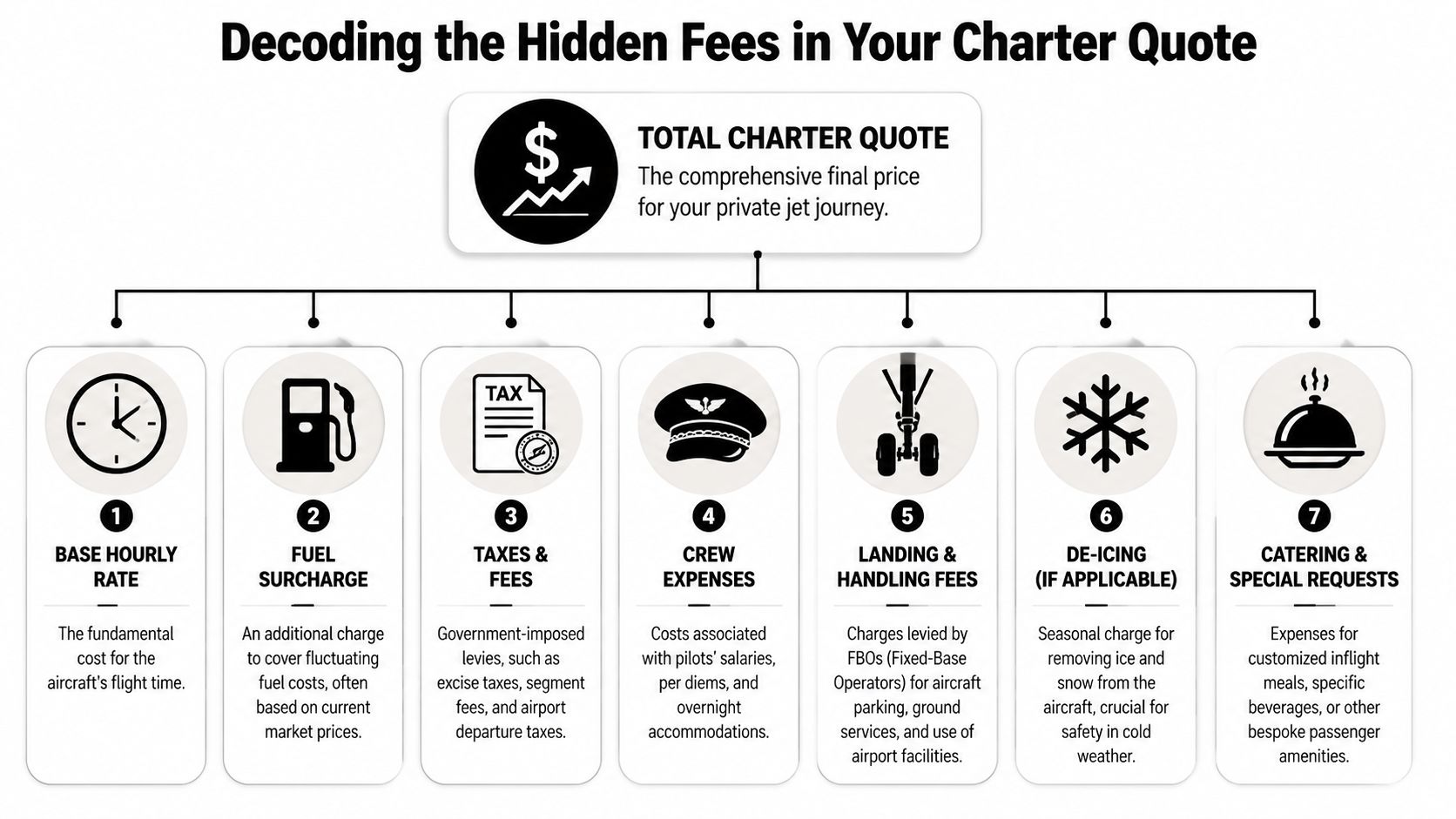
A serious quote should separate fixed tax obligations from trip-specific operating charges. Domestic charters generally include Federal Excise Tax and per-passenger segment fees, then add airport, fuel, crew, and aircraft-positioning costs where applicable. The problem is not that these charges exist. The problem is that too many quotes bury the expensive ones inside a single total.
Start with the charges that are normal and easy to justify. Taxes, landing fees, handling fees, and crew overnights are part of private aviation. They vary by airport, aircraft size, schedule, and whether your itinerary keeps the crew on the road. Catering and other passenger requests belong in the quote too, but they are usually minor compared with aircraft movement costs.
The fee that deserves real scrutiny is repositioning.
According to this Dallas charter cost FAQ, repositioning can inflate total pricing by 20 to 40%, and some quotes can hide more than $10,000 in ferry cost when the aircraft is not already based near the departure point. That is the Dallas pricing trap. A quote can look competitive on hourly rate and still be overpriced in total because you are paying for the jet to come to Dallas before your trip even starts.
At this point, experienced buyers separate marketing from math. If the aircraft is sitting in Houston, Scottsdale, or South Florida, you may be billed for that inbound leg, your occupied leg, and sometimes part of the aircraft's next move after drop-off. The invoice reflects aircraft logistics, not just your itinerary.
Ask for the quote in line items. If a provider resists, move on.
A clean charter quote should show:
- Base flight time for your occupied itinerary
- Federal taxes and segment fees on domestic charter
- Landing and handling charges by airport
- Fuel surcharges if they apply
- Crew expenses for overnight stays or extended duty
- Repositioning or ferry time if the aircraft is not already near Dallas
- Optional services such as catering, ground transport coordination, or special onboard requests
That last line item matters more than clients expect. Repositioning is often the difference between a fair quote and a quote padded by 20 to 40%.
The smart move is simple. Match the aircraft to the mission, then confirm the aircraft is already close to your departure airport. Haute Jets centers that local-sourcing discipline because it reduces avoidable ferry cost and makes quote comparisons cleaner. If you want a clearer breakdown of how these charges are typically structured, review this private jet charter cost breakdown.
Sample Private Jet Trip Costs from Dallas
Hourly rates are useful for orientation. Trip examples are better because they force the math into practical application.
The cleanest external cost anchors available here come from one-way flights to Dallas. Those numbers work well as directional benchmarks for similar Dallas-origin missions on comparable aircraft categories, assuming similar operating conditions.
Useful route anchors
According to private jet charter flights to Dallas pricing examples, a flight from San Antonio to Dallas costs approximately $6,900 on an Executive Turboprop, a trip from Miami to Dallas averages $20,500 on a Light Jet, and a flight from Nassau to Dallas reaches $26,000 on a Midsize Jet.
Those examples tell you something important. Aircraft category changes price sharply, but route length and mission profile do too. A short Texas segment on a turboprop behaves very differently from a Florida mission on a light jet or a Caribbean flight on a midsize aircraft.
How I'd frame Dallas-origin planning
If you're flying out of Dallas, use route examples like these as a cost basis, not a guaranteed mirror image. Then pressure-test the quote against three practical questions:
Is the aircraft category appropriate?
A light jet may be perfectly suitable for one mission and the wrong tool for another once baggage, passenger comfort, or nonstop range enter the picture.Is the one-way quote hiding aircraft movement?
A fair route benchmark can still become a bad deal if the airplane has to reposition.Does the itinerary trigger overnight or airport-specific charges?
Those costs aren't exotic. They're normal. What matters is whether they're explained.
If a quoted trip cost feels high relative to a similar published route example, ask where the aircraft starts the day. That question usually gets to the truth quickly.
A practical way to read trip pricing
For Dallas clients, route budgeting works best when you think in bands, not fantasy precision. Start with aircraft category, compare against a real route example, then verify whether the quote includes taxes, airport charges, and aircraft movement. If any of that is vague, the number isn't ready for approval.
How to Strategically Lower Your Dallas Charter Rate
Lower Dallas charter pricing starts before anyone quotes an hourly number. Savings come from controlling aircraft positioning.
Repositioning is where buyers overpay. A quote can look competitive on paper, then climb fast once ferry time is added from another city. Analysts at Haute Jets note that charter costs can rise because of aircraft movement and broker markups, as explained in this analysis of private jet charter cost inflation.

Focus on aircraft location first
Start with one question. Where is the aircraft based today?
That answer shapes the quote more than the advertised hourly rate. If the jet is already in Dallas or nearby, your pricing usually starts on solid ground. If it is coming from another market, you need to see the ferry segment and its cost spelled out clearly.
This is the gap many buyers miss. They compare cabin category, hourly rate, and tail number, but fail to check whether they are paying to bring the airplane to them first.
Haute Jets uses a local-sourcing approach that prioritizes aircraft near the departure city instead of defaulting to a repositioned option. That approach keeps the focus on total trip cost, not a headline rate that looks low until the full invoice arrives.
Other ways to keep rates in check
After you control sourcing, these decisions matter:
Match the aircraft to the trip
A larger cabin is not a smarter buy if a light jet or midsize jet covers the route, passengers, and baggage without compromise.Keep timing flexible where possible
Even a modest departure window can open up better nearby aircraft options and reduce avoidable movement costs.Use empty legs selectively
They can lower cost on the right itinerary, but they work only when your schedule can tolerate fixed timing and routing constraints.Cut itinerary inefficiency
Extra stops, long ground waits, and out-of-the-way airports tend to push the quote higher for reasons that have nothing to do with the jet category.
What disciplined buyers require
A smart review process is simple:
- Define the mission first, including route, passenger count, baggage, and cabin expectations.
- Verify aircraft location early, before you spend time negotiating a flawed quote.
- Ask for all-in pricing, not an hourly teaser that hides movement, taxes, and airport charges.
- Price more than one category when the trip could work on either side of a cabin break.
You do not reduce cost by arguing over the last line item. You reduce cost by refusing a quote structure that was overpriced from the start.
On-Demand Charter vs Jet Cards and Fractional Ownership
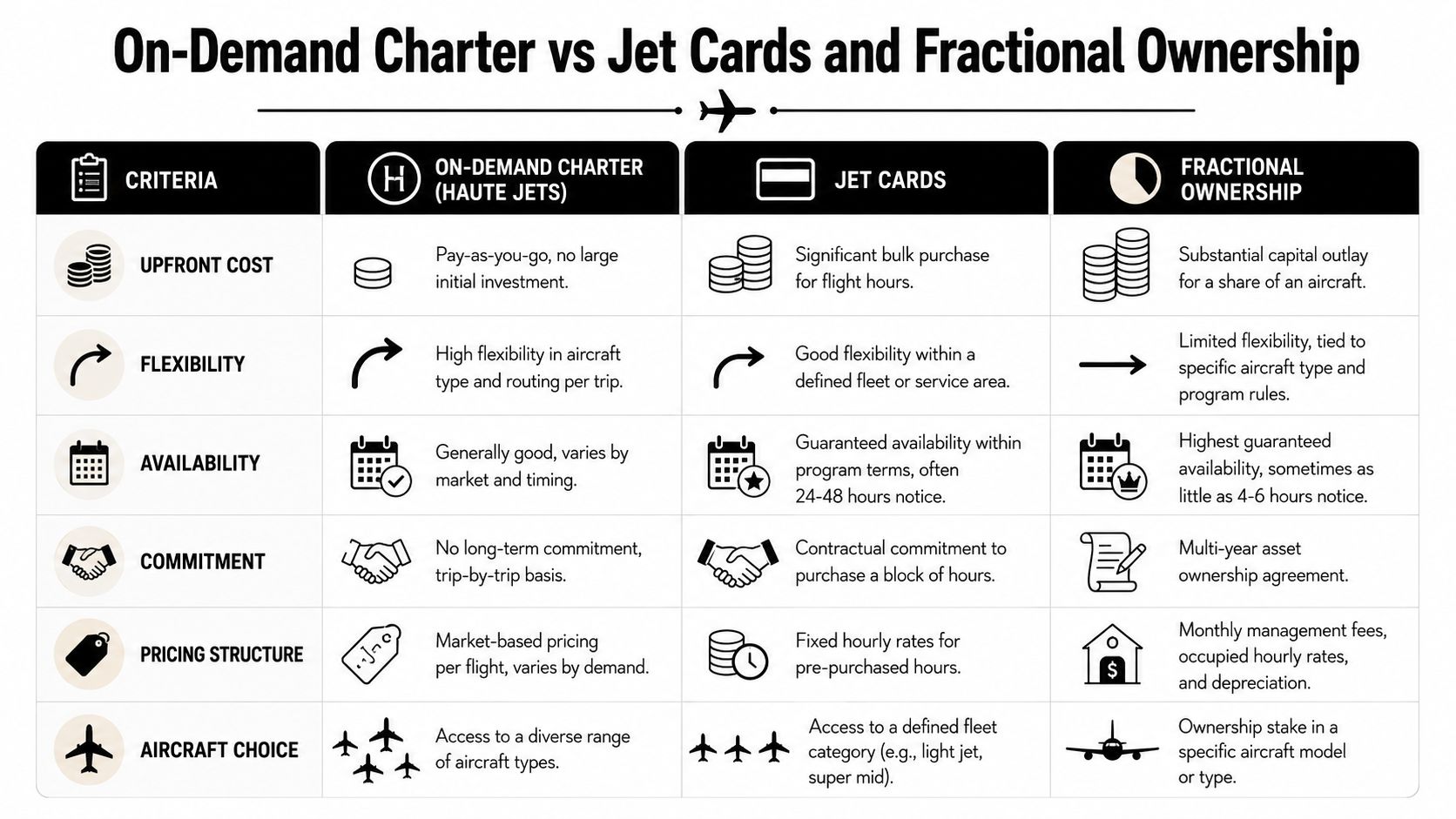
Prepaid aviation programs are often sold as a pricing shortcut. In Dallas, they often do the opposite. If you are not flying enough to justify the commitment, a jet card or fractional structure can hide higher real trip costs behind tidy program terms.
On-demand charter gives you a cleaner buying position because you can price each mission on its own merits. That matters more than a fixed hourly promise when aircraft location, airport choice, and schedule all affect the invoice. The biggest miss I see is simple. Buyers compare program rates and ignore repositioning. That mistake can inflate the trip by 20 to 40 percent before the aircraft even departs with passengers onboard.
Where on-demand charter wins
On-demand is the right fit for clients who want control. You choose the aircraft for the trip, not the one tied to a membership structure or ownership program. If one mission calls for a light jet and the next calls for a super-midsize cabin, you buy exactly that.
The financial advantage is transparency. A disciplined on-demand quote shows what you are paying for, including sourcing and movement. Haute Jets pushes that further by sourcing locally whenever possible, which helps cut the repositioning waste that bloats many Dallas charter quotes.
Where jet cards and fractional programs fit
Jet cards work for travelers who value preset access and are comfortable prepaying for it. The tradeoff is that the headline simplicity can mask weak economics on individual trips, especially when a program aircraft is not already close to your departure airport.
Fractional ownership is a capital decision, not just a travel decision. You are buying into an asset structure with ongoing fees, operational rules, and a longer financial horizon. That can make sense for very heavy flyers with highly predictable usage. It is excessive for many buyers who want reliable lift without carrying the costs and constraints of ownership.
A practical comparison
On-demand charter
Best for trip-by-trip buyers who want market pricing, aircraft flexibility, and no prepaid commitment.Jet cards
Best for clients who prioritize standardized access and can accept that some flights will price above what an efficiently sourced on-demand trip would cost.Fractional ownership
Best for flyers with consistent, high annual usage who are willing to absorb acquisition costs, management fees, and resale risk.
One more point gets overlooked. Airport experience can also affect the value of any program or trip structure, especially in a market with multiple strong departure options. If you want to pair aircraft economics with the right ground experience, review these top FBOs in Dallas for private flyers.
Buy commitment only when your flight volume justifies it. For many Dallas clients, on-demand charter remains the smarter financial choice because it exposes the true trip cost instead of burying it inside a program.
Fly Smarter from Dallas with Haute Jets
Dallas is an excellent private aviation market. That doesn't mean every quote is fair.
The most important takeaway is simple. Hourly rate is only the starting point. The smarter decision is built around aircraft category, quote transparency, and whether the jet is already positioned near your departure airport. That's where unnecessary cost enters or disappears.
Haute Jets Journal focuses on that distinction because it's where discerning buyers protect margin. The publisher's model is straightforward: source from a network of 3,500+ aircraft across 175 countries, work only with Wyvern Wingman or Argus Gold/Platinum-rated operators, and let clients choose the exact aircraft rather than accepting whatever a broker needs to move. Just as important, there are no memberships, no jet cards, and no annual fees. The structure stays pay-per-flight.
For Dallas travelers, that model fits the market well. Some trips call for a light jet. Others need a Challenger 350, Citation Latitude, Gulfstream G550, or another specific aircraft with the right cabin and range. If you care about airport experience as much as aircraft economics, it also helps to know the top FBOs in Dallas for private flyers.
The right next step is not requesting five vague quotes and hoping one looks reasonable. It's requesting one detailed, all-in quote that identifies the aircraft, confirms where it's positioned, and itemizes what you're paying for.
If you want a transparent quote for your next Dallas departure, speak with Haute Jets. Share your route, dates, passenger count, and aircraft preferences, then review the all-in options before you commit.