
Most advice about private jet charter deals points travelers in the wrong direction.
The industry loves to sell the fantasy of the empty leg bargain. It sounds exciting. It also gives away your control. You inherit someone else's routing, someone else's timing, and sometimes someone else's last-minute schedule change. If your trip matters, that is not smart buying.
A genuine deal in private aviation is a trip priced intelligently from the start. The right aircraft is sourced close to your departure point, unnecessary repositioning is reduced or removed, and the quote is built around your schedule instead of a random ferry segment. That is how experienced charter buyers keep costs in line without accepting compromise on safety, service, or cabin quality.
This is the part many first-time charter clients miss. The biggest savings usually do not come from chasing a heavily advertised one-off flight. They come from disciplined sourcing, strong operator relationships, and knowing where fees get buried. Repositioning cost is one of the easiest places for brokers to hide waste. Remove that waste, and you usually get better overall value with far more control.
At Haute Jets, that is the standard I would use. Buy the trip that fits your mission and protects your time. Ignore the headline discount if it forces you into a bad aircraft position, a rigid departure window, or an avoidable operational risk.
The Smart Way to Secure a Private Jet Deal
Start with a better definition of value.
If you're shopping private jet charter deals by headline hourly rate alone, you're looking at the least useful number in the quote. The number that matters is the total trip cost attached to an aircraft that fits your mission. Passenger count, baggage, runway limits, and nonstop range decide what should even be in consideration. Everything else comes after that.
The sharpest buyers think like dispatchers, not bargain hunters. They ask where the aircraft is based, whether it needs to reposition, what fees are included, and whether the cabin, range, and airport performance match the trip. That approach protects both your budget and your schedule.
What a real deal looks like
A strong charter deal usually has four traits:
- Transparent pricing: You can see the flight charge and the trip-specific fees clearly enough to spot padding.
- Operational fit: The aircraft can fly the route properly, with the baggage and passenger profile you have.
- Control: You choose the departure window and the aircraft standard, rather than inheriting leftovers.
- Safety discipline: The operator clears your safety filters before price even enters the conversation.
Practical rule: If a quote looks cheap before you ask where the aircraft is coming from, it probably isn't cheap yet.
What to do first
Before you ask for pricing, define the mission in plain terms:
- List the travelers and bags. Don't approximate. A golf trip and a same-day board meeting are different missions.
- Name your preferred airports. Nearby alternates can improve options, but the right alternate depends on ground logistics.
- Set your real schedule. If you can move by part of a day, say so upfront.
- Decide what isn't negotiable. Cabin size, Wi-Fi, pet access, and nonstop capability all affect sourcing.
That is how experienced clients secure private jet charter deals that hold up after the invoice arrives.
Rethinking Deals Beyond Empty Leg Flights
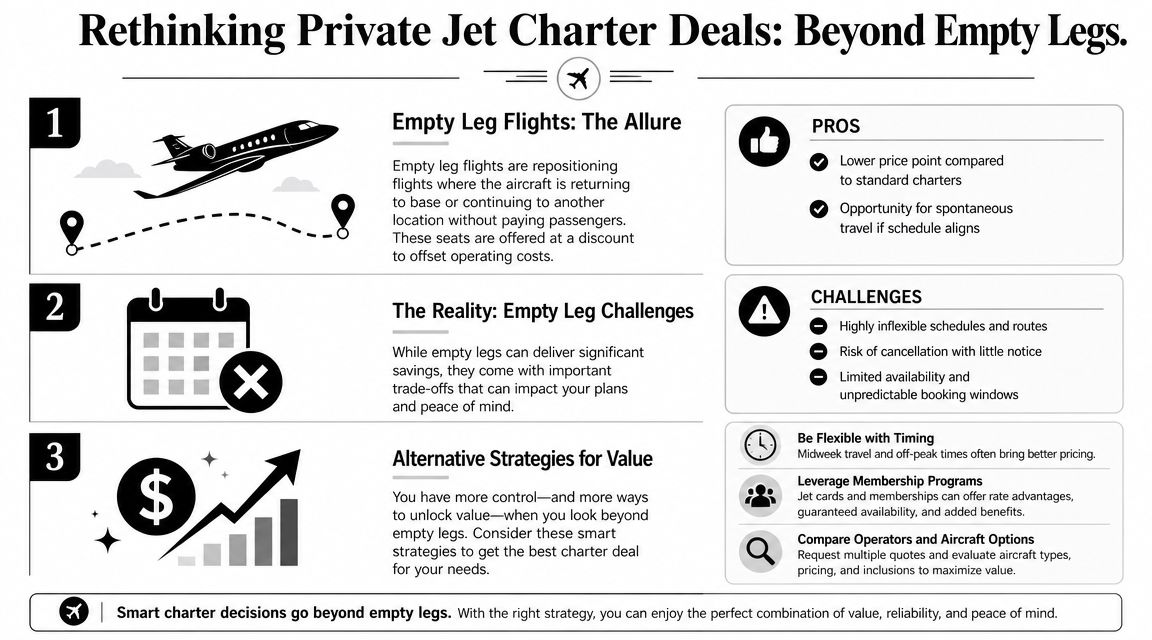
Empty legs get attention because the pitch is seductive. You hear about discounted private flying and assume you've found the industry's hidden door. In reality, empty legs are useful only in a narrow set of trips.
Most content explains empty legs as a way to save 25% to 75%, but the primary issue is predictability. Industry guidance notes that empty legs are pre-scheduled repositioning flights available only when an aircraft must return to base, so the discount depends on a narrow combination of route, timing, and aircraft availability, not just demand, as outlined in this explanation of empty leg flights.
Why empty legs disappoint buyers
An empty leg is a byproduct of someone else's trip. That's the first problem. You're not buying a mission built for you. You're trying to fit yourself into a pre-existing repositioning movement.
That creates three practical limitations:
- Fixed routing: The aircraft is going where it already needs to go.
- Weak schedule control: Departure timing serves the original charter's needs first.
- Aircraft compromise: You take what's available, not what fits your group best.
If your plans line up perfectly, fine. But most premium travelers don't want to move a family itinerary, executive meeting, or event transfer around a repositioning segment that can shift.
Intelligent sourcing beats discount chasing
The stronger play is simple. Source an aircraft that's already close to your departure point and suitable for the route. That doesn't sound as flashy as "discounted empty leg," but it usually creates better economics and far more control.
This is what clients miss when they obsess over promotional savings language. Avoiding unnecessary repositioning is often more valuable than grabbing a one-off discount on the wrong flight. You keep your schedule, your aircraft standards, and your negotiating power.
The best charter deal is usually the aircraft that was already nearby, not the aircraft that happened to be empty.
If you want a deeper look at where empty legs make sense and where they don't, read Haute Jets' guide to booking empty leg flights.
The Art of Wholesale Pricing and Negotiation
Hourly rate shopping is how buyers get overcharged.
The ultimate cost is trip cost, and trip cost gets inflated when the aircraft has to travel to you, wait on you, or recover from a routing mismatch after you land. That is why sharp charter sourcing starts with aircraft position, operator quality, and mission fit before anyone talks price. A broker who skips that work is not finding a deal. They are packaging waste inside a polished quote.
A good quote makes the economics visible. A weak quote blends everything together and hopes you focus on the cabin photos.
Read the quote like an operator
I look for one thing first. How much of this invoice pays for your flight, and how much pays for the provider's inefficiency?
Ask for plain answers to these questions:
- Where is the aircraft right now, and where is it based? Those are not always the same, and both affect cost.
- What line items are included? Taxes, landing fees, handling, crew overnight charges, deicing, catering, and Wi-Fi should be spelled out.
- Is this a named tail or a category estimate? Category quotes can hide older cabins, weaker baggage access, and inferior onboard standards.
- What is the billable flight time for the passenger leg versus the non-passenger leg? That is how you spot repositioning buried inside the total.
- Can you quote a second aircraft already closer to departure? Serious sourcing always gives you a comparison set.
If you want a cleaner framework for evaluating line items, Haute Jets breaks down the mechanics in its private jet charter pricing guide.
Negotiate with specifics, not with hope
"Can you do better?" is amateur language. It tells the seller you have not identified what is overpriced.
Use pressure where it works:
- Ask for a side-by-side option with a nearer aircraft. That is the fastest way to remove avoidable ferry cost.
- Challenge blended pricing. Require itemized fees so padded charges cannot hide inside one all-in number.
- Match the cabin to the mission. If the trip does not require extra range, stand-up cabin height, or oversized baggage volume, do not pay for them.
- Ask about minimums and waiting time. Short sectors and same-day returns often trigger billing rules that matter more than the headline hourly rate.
- Negotiate the total, not the vanity metric. A lower hourly figure can still produce a worse invoice once repositioning and operational extras are added.
Experience matters. Wholesale access is useful, but only if the person sourcing the trip knows which operator quotes are efficient and which ones are cheap on the first line and expensive everywhere else.
The strongest negotiation move is not demanding a discount. It is removing the cost that never belonged in the quote to begin with.
Clients who understand this usually get better value and better control at the same time. They are not chasing an unpredictable one-off opportunity. They are buying the right aircraft, in the right place, on terms they can verify.
Using Timing and Flexibility as Your Secret Weapons
Timing matters, but not in the simplistic way it's commonly assumed.
Yes, booking earlier helps. One industry guide recommends booking at least two weeks ahead when possible to reduce pricing and availability risk, and it also stresses mission profiling plus comparing the quoted hourly rate with all trip-specific fees in this practical booking workflow. That's the baseline.

Flexibility that actually lowers cost
The useful kind of flexibility isn't random. It's targeted.
- Move the departure window: If you can depart earlier or later in the day, sourcing gets easier.
- Stay open to alternate airports: A less congested airport can simplify operations and reduce trip friction.
- Shift by a day when possible: That can secure a better-positioned aircraft without gambling on an empty leg.
- Consider reverse routing: Sometimes the favorable quote appears when your trip aligns with where aircraft naturally need to flow next.
Reverse routing is one of the quiet advantages in this market. You're not taking a formal empty leg. You're aligning your mission with likely fleet movement while still booking a proper on-demand charter. That preserves control.
Use the calendar strategically
Experienced charter clients don't just ask, "What's available?" They ask, "What timing makes this mission easier to source cleanly?"
That means avoiding self-inflicted pressure. If your meeting is fixed on Friday afternoon, don't wait until Thursday evening and expect perfect aircraft selection. If your leisure trip can start a day earlier, use that flexibility as a bargaining chip instead of demanding a last-minute miracle.
Small schedule flexibility often buys you better aircraft choice, cleaner routing, and a calmer departure day.
Private jet charter deals improve when your timeline helps the sourcing team remove friction from the mission.
Verifying Safety and Quality for True Peace of Mind
The fastest way to overpay for a charter is to focus on the quote and ignore the operator behind it.
Clients get distracted by cabin photos, brand-name aircraft, and the promise of a dramatic discount. None of that tells you whether the flight is being run with disciplined maintenance, current training, and proper operational oversight. A real deal starts with a clean sourcing strategy that strips out waste like unnecessary repositioning. It also starts with an operator you would trust with your family.
What to verify before you book
You do not need to audit the aircraft yourself. You do need a broker or advisor who checks the right records before presenting options.
Start with these five points:
- Operator certification: Confirm current Part 135 authority, or the relevant equivalent in the country of operation.
- Third-party safety rating: Look for Wyvern Wingman or ARGUS Gold/Platinum.
- Maintenance status: Ask whether inspections, maintenance tracking, and aircraft records are current.
- Pilot qualification: Confirm recent training, currency, and suitability for the specific aircraft, route, and conditions.
- Insurance clarity: Verify that coverage is current and appropriate for the mission.
If you want a clearer explanation of what those ratings mean, read this close look at Wyvern and ARGUS safety ratings.
Why disciplined vetting protects value
Cheap trips get expensive fast when the aircraft is sourced badly. A low headline price can hide weak operator standards, loose documentation, or a last-minute swap that leaves you with fewer guarantees and more stress.
That is why experienced charter buyers do not chase random availability and call it savings. They source intelligently. The goal is to secure an aircraft that is already a smart fit for the mission, with fewer operational complications and fewer chances for ugly surprises.
Haute Jets states that every operator in its network holds a Wyvern Wingman or ARGUS Gold/Platinum rating. That is the right filter to apply before discussing price. Safety screening first. Aircraft selection second. Negotiation after that.
Payment preferences matter too, but they should never outrank operator quality. If a client asks about accepting digital assets at checkout, the payment method should be handled after the aircraft, crew, and operator pass review.
This short video is a useful companion if you want a practical safety overview before your next booking.
Safety should be screened before the first quote goes out, not justified after the cheapest one appears.
Finalizing Your Charter From Payment to Takeoff
Once you've accepted a quote, the process should get simpler, not murkier.
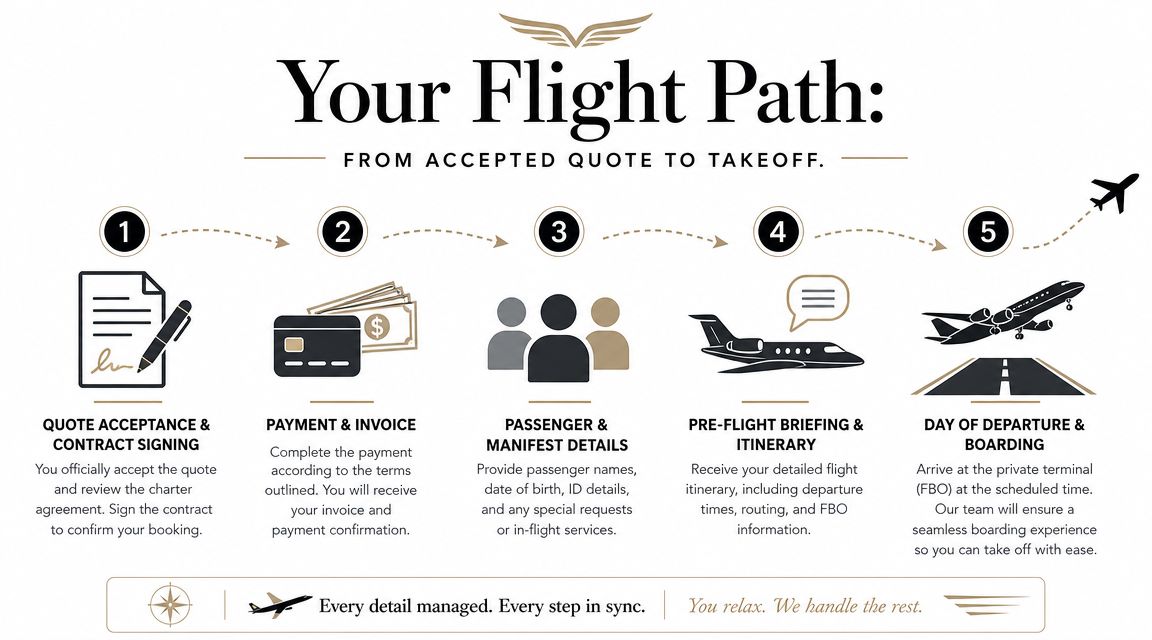
A professional booking flow has a clear sequence. You approve the aircraft and terms, sign the charter agreement, submit passenger details, settle payment, and receive a final pre-flight package. Confusion at this stage usually means the provider wasn't organized at the sourcing stage either.
Understand the invoice before you pay
One standard industry example is straightforward. A 3-hour flight at $3,500 per hour produces a base charter cost of $10,500 before catering, landing fees, taxes, and other add-ons, as shown in this private jet charter cost example. That's useful because it reminds clients that the base flight charge is only one part of the trip total.
Review these items carefully:
- Base charter charge: The aircraft flight cost.
- Trip-specific fees: Airport charges, handling, crew-related costs, and other operational items.
- Taxes and extras: Catering, ground transport, and special requests if applicable.
If a provider can't explain the invoice in clean language, don't wire funds yet.
Payment options and pre-flight confirmation
Discerning clients increasingly expect payment flexibility. That can include wire transfers, major cards, and, in some cases, digital assets. If you're evaluating the operational side of accepting digital assets at checkout, that resource gives useful context for how crypto payment workflows are typically handled.
Before departure, you should receive a proper pre-flight confirmation package. That should include the tail number, crew details, itinerary, departure terminal or FBO instructions, and final passenger manifest review. Haute Jets notes a 24-hour pre-flight confirmation process with those details, which is the standard serious travelers should expect.
Frequently Asked Questions About Charter Deals
Can I pay for a private jet charter with cryptocurrency
Yes, sometimes. The key question is whether the operator or broker has a clear compliance process for invoicing, settlement, and identity checks. If crypto is accepted, treat it like any other high-value aviation payment. Get the wire instructions or wallet details in writing, confirm timing, and make sure the funds can be matched cleanly to your contract.
Are on-demand charters better than jet cards for value
Usually, yes, if you do not fly on a fixed pattern.
Jet cards can work for travelers who want one program, one rate structure, and fewer booking decisions. But many clients pay for that simplicity through higher fixed pricing, limited aircraft flexibility, or terms that do not fit every trip. On-demand charter gives you more control over the actual mission. You can source the right cabin, the right operator, and the right departure point instead of forcing every trip into a prepaid program.
That matters because the best deal rarely comes from chasing a headline discount. It comes from sourcing aircraft that are already positioned close to your trip so you are not indirectly paying for unnecessary ferry time.
Can I bring pets on a private charter
Usually, yes. Ask at the start of the booking process.
Pet approval affects aircraft choice, cleaning fees, cabin rules, and, on some trips, paperwork for domestic or international entry. A good advisor clears that before the contract goes out. If someone says, "We will sort it out later," expect avoidable cost and friction.
What's the biggest mistake people make when chasing private jet charter deals
They chase empty leg marketing instead of controlling the full trip cost.
Empty legs can be useful, but they are unpredictable by design. They work when your schedule is flexible and the routing happens to match. That is not a strategy for serious travel. The smarter approach is to source from the live market, target aircraft already near your departure airport, and reduce repositioning fees before they ever hit the quote. That gives you better schedule control, clearer pricing, and stronger value than a flashy discount that disappears the moment your plans change.
If you want a cleaner way to book private aviation, start with Haute Jets. Their model focuses on sourcing aircraft near your departure city, offering on-demand access without memberships or jet cards, and confirming exact aircraft and pre-flight details before departure.