
A short-haul light jet charter in Europe typically costs €8,000 to €16,000. Move up to a midsize jet and you're usually looking at €12,000 to €18,000, while a heavy jet can reach €28,000 per flight.
Those numbers are the right starting point, but they're not the whole story. Most travelers don't overpay because they chose the wrong category. They overpay because they never see the hidden mechanics inside the quote, especially repositioning fees, airport charges, and the cost of sourcing the wrong aircraft from the wrong place. That's where private jet charter Europe prices get distorted.
This guide on Haute Jets Journal is for people who want a straight answer, not a vague hourly-rate teaser. If you want to know what you should budget for flights around Europe, what drives the final number, and where brokers add hidden costs, read on.
Understanding Private Jet Prices in Europe
Private aviation pricing confuses people for one reason. The advertised hourly rate looks clean, but the quote you receive rarely does.
A traveler sees a light jet benchmark online, assumes the route will be simple, then gets a price that feels disconnected from the headline number. That gap is where frustration starts. It's also why so many articles about private jet charter Europe prices miss the point. They list categories, but they don't explain the cost structure well enough for a client to judge whether the quote is fair.
Why the quote feels opaque
Private jet pricing in Europe is shaped by three practical realities. First, aircraft categories are broad, and two jets in the same class can be priced differently. Second, the route matters more than commonly assumed. Third, the sourcing method behind the quote changes the total.
That last point matters beyond aviation. If you've ever compared merchant fees, you've seen the same problem in other industries. Suby's guide to payment pricing is useful because it shows how “simple” pricing often hides layered charges underneath. Charter works the same way.
What you should focus on first
Don't start by asking, “What's the hourly rate?” Start by asking:
- Which aircraft is being offered: Category alone isn't enough.
- Where that aircraft is based: If it's far away, your quote can climb fast.
- What is and isn't included: Ground transport and premium service items often sit outside the core quote.
- Whether the route is quoted as a full flight price: In practice, that's usually the number that matters most.
If you want a baseline before you compare offers, review a practical breakdown of private jet charter costs in Europe. Use that as a reference point, not as the final answer.
A charter quote isn't mysterious. It's just often presented in a way that hides the expensive parts until the client stops asking questions.
The smart buyer treats a quote like an acquisition review. You're not just buying a seat. You're buying an aircraft position, a crew schedule, airport access, and operating time. Once you look at it that way, the pricing starts to make sense.
What Really Determines Your Final Charter Price
One empty repositioning leg can add thousands to a European charter. In many quotes, that hidden movement cost matters more than the published hourly rate.
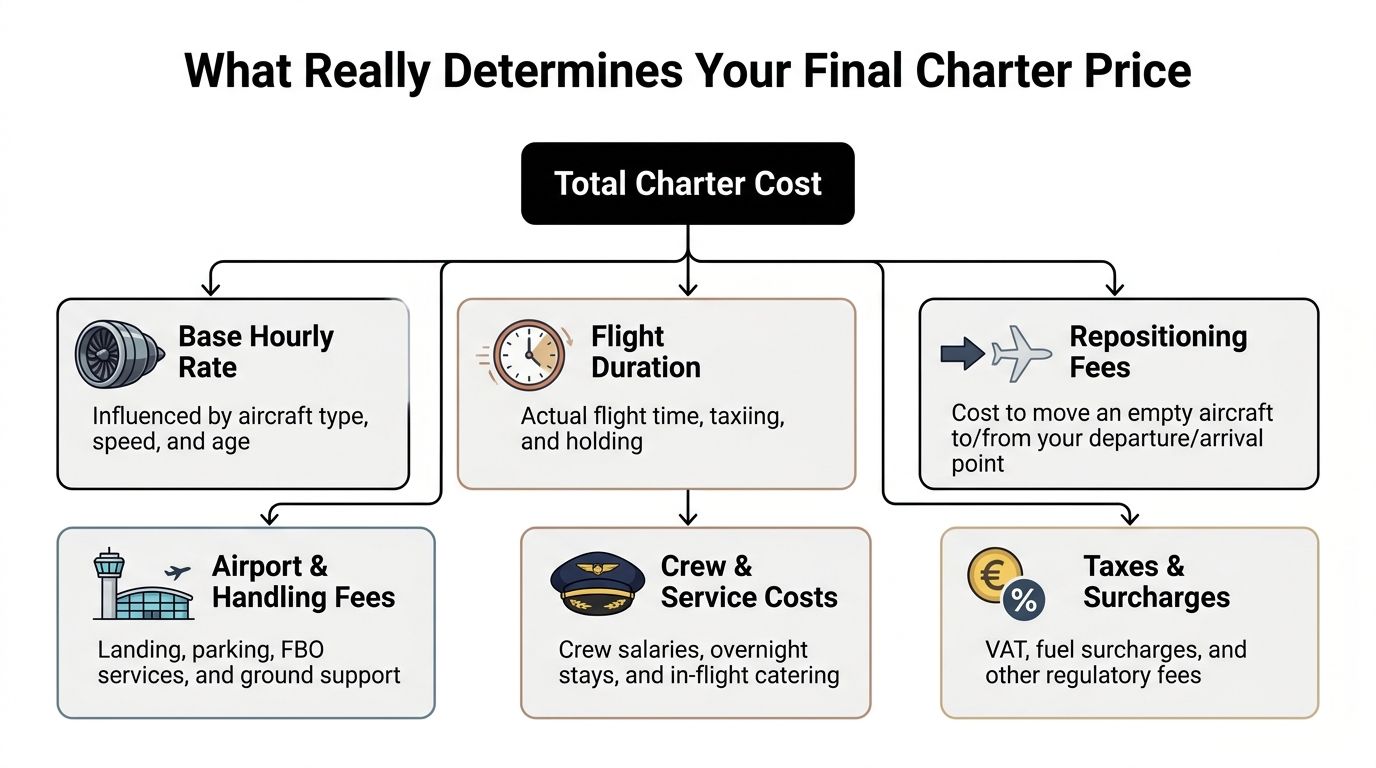
The quoted rate is only one layer
Aircraft type and flight time set the starting point. A light jet on a short sector will usually price lower than a super midsize or heavy jet on the same day. Everyone understands that part.
What changes the final invoice is aircraft position, airport choice, crew logistics, and trip-specific extras. This is why two quotes for the same city pair can be far apart. One aircraft may already be near your departure airport. The other may need to fly in empty from another country before your trip even starts.
That empty movement is where buyers lose money.
The charges that usually change the total
Final pricing in Europe usually shifts because of five variables:
- Repositioning flights: If the aircraft is not local, you may pay for the jet to come to you, then sometimes to return to base or continue to its next required position.
- Airport and handling fees: Major airports and premium terminals charge more, and those costs vary sharply by airport.
- Crew expenses: Multi-day itineraries can add hotels, ground transport, and crew duty-related planning costs.
- Catering and special requests: Standard service is one thing. Customized catering, specific vintages, and last-minute requests cost more.
- Taxes and permits: These depend on the route, the countries involved, and the operating structure behind the flight.
Ask one question early: is the quote built around a local aircraft or a convenient aircraft for the broker?
Repositioning is the real price driver
Repositioning is the most misunderstood cost in European private aviation. It is also the easiest fee to hide inside a polished quote.
A broker can show a competitive hourly rate while sourcing an aircraft based far from your departure point. The client then pays for empty flying that adds no value to the trip. You do not get a better cabin, a safer operation, or a better arrival time. You get a larger invoice.
Sourcing discipline holds significant importance. Haute Jets focuses on local aircraft availability first. That changes the pricing equation because it cuts unnecessary ferry sectors before they hit the quote. On many Europe itineraries, that local sourcing model can reduce total charter cost by 20 to 40% compared with traditional sourcing that starts with broker inventory instead of aircraft position.
If you are comparing aircraft categories, this guide to light, midsize, and heavy private jets helps, but category alone never tells you what the trip will cost.
How to read a quote like a broker
Review every proposal in this order:
Exact aircraft and operator
Get the make, model, and operator. Generic labels such as "light jet" hide too much.Aircraft base
Ask where the aircraft sits before your departure. If it is not local, ask what the empty leg cost is.Included items
Confirm whether handling, standard catering, permits, and taxes are already included.Variable charges
Ask which items can still move after booking, especially de-icing, overnight crew costs, schedule changes, and airport swaps.Total trip price
Focus on the full mission cost, not the hourly rate.
A clean quote is specific. A weak quote is built to look cheap at the top and expensive at the bottom.
Typical Charter Costs by Aircraft Size
Most European charter clients overspend in one of two places. They book more aircraft than the trip requires, or they accept a category quote without asking what repositioning is doing to the total.
Aircraft size still gives you a useful pricing framework. Use it as a starting point, not a buying decision. A light jet is usually the lowest-cost option for short sectors with a small group. A midsize jet adds cabin comfort, baggage room, and better nonstop capability on longer intra-Europe routes. A heavy jet sits in a different price bracket because you are paying for cabin volume, range, and group capacity.
A practical pricing ladder
| Aircraft category | Typical Europe pricing | Best fit |
|---|---|---|
| Light jet | Lower total charter cost on short sectors | Short hops, smaller travel parties, efficient business trips |
| Midsize jet | Mid-range pricing for longer or more comfortable missions | More cabin comfort, more luggage, longer intra-Europe missions |
| Heavy jet | Highest total trip cost | Larger groups, longer routes, premium cabin expectations |
That table is directionally right. It is not enough to approve a quote.
A local light jet can beat a badly sourced midsize quote by a wide margin. A non-local light jet can end up costing more than a properly positioned midsize aircraft. Category matters, but aircraft position matters more than many first-time buyers realize.
When a light jet is the right answer
For short city pairs, light jets usually deliver the best value. You get speed, privacy, and terminal convenience without paying for cabin space you will not use.
That is the category many clients should book first.
The mistake is assuming a bigger cabin is automatically smarter. On a brief European mission, it often is not. If you are comparing cabin size, range, and baggage tradeoffs, this guide to light, midsize, and heavy private jets gives a clear mission-based comparison.
When to move up
Step into a midsize jet when the route is longer, the luggage load is heavier, or the passengers will benefit from the extra cabin space. Move to heavy only when the mission demands it. Group size, long nonstop sectors, or a true premium cabin requirement justify the jump. Image does not.
Clients waste money when they charter for ego instead of itinerary.
What these category ranges leave out
Published category averages create false confidence because they hide the cost driver that changes quotes the most. Repositioning.
If the aircraft has to ferry in from another airport or another country, the invoice climbs fast. That extra flying time does not improve your trip. It just covers the operator's cost to get the aircraft to you. This is exactly why two quotes for the same route and the same aircraft class can be far apart.
A disciplined sourcing model fixes that problem. Haute Jets prioritizes local aircraft first, which cuts unnecessary ferry sectors before they hit the proposal. On many European itineraries, that approach changes the ultimate buying decision more than the cabin category itself.
Ignore hourly chatter. Buy the mission.
Hourly rates are sales shorthand. Serious buyers should focus on total trip cost by aircraft, operator, and starting position.
Match the aircraft to the route. Then make sure the aircraft is already close to the route. That is how you control spend in Europe.
How Much Are Flights to Nice Geneva or Ibiza
On popular European leisure and business routes, the same trip can price 20 to 40% higher for one reason alone. The aircraft is not where you need it.
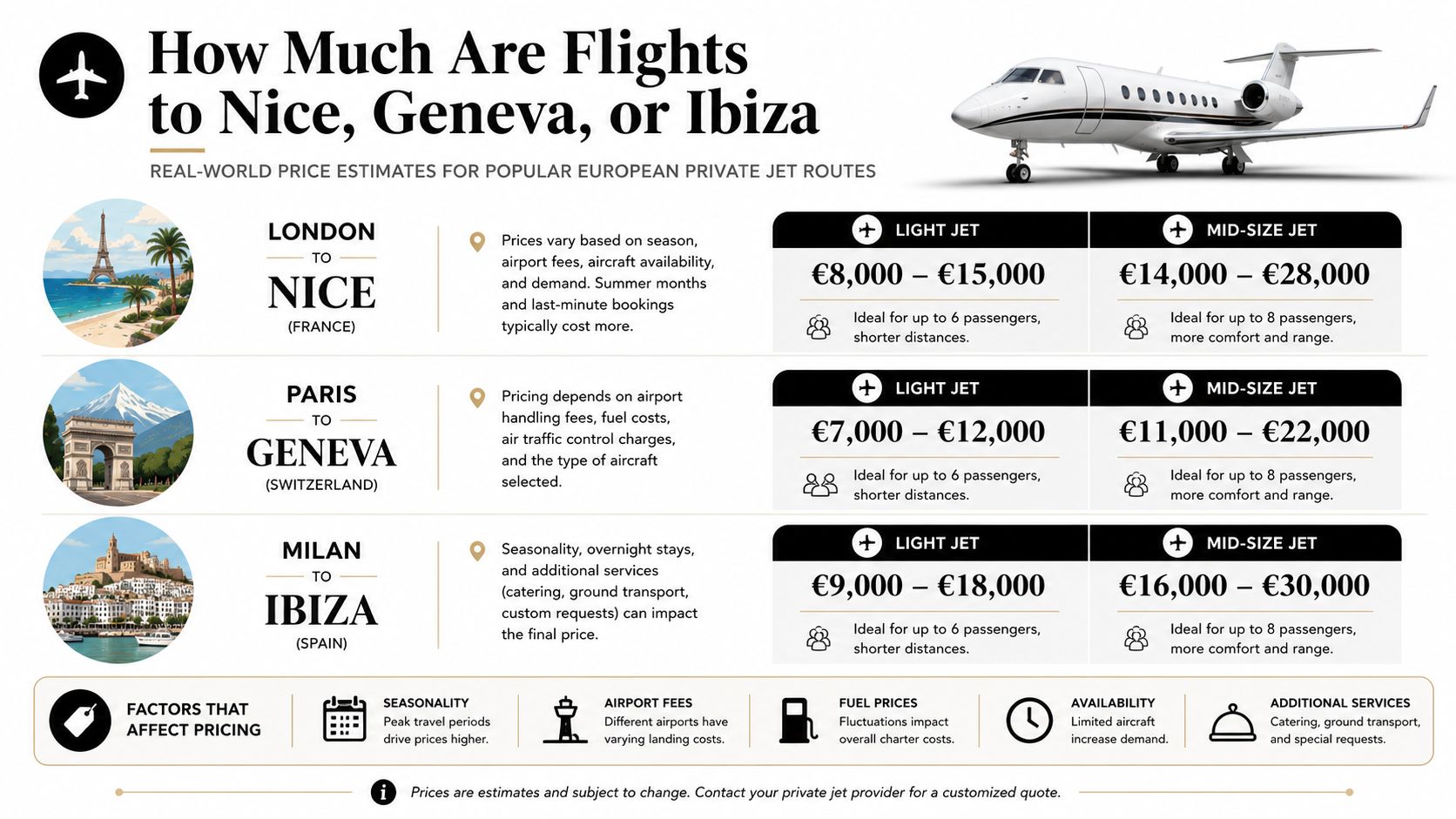
Published route examples help, but they also mislead buyers if they treat them as fixed prices. A Paris to Geneva shuttle, a London to Nice weekend departure, and a summer run into Ibiza all sit in different supply conditions. The route matters. The starting position of the aircraft matters more.
Paris to Geneva
Paris to Geneva is short, efficient, and easy to overpay for. Buyers see a quick sector and assume the quote should be simple. It rarely is.
If the jet is already near Paris, this is a clean light jet mission for a small group. If the operator has to bring the aircraft in from southern France, northern Italy, or another UK base, you start paying for flying you never asked for. That is the trap. Repositioning can distort a short route more than cabin category.
This route rewards disciplined sourcing. You want an aircraft already sitting close to departure, not a prettier brochure and a longer invoice.
London to Nice
London to Nice is one of the clearest examples of how airport choice, day of week, and season change the quote fast. Summer Fridays and Sundays are expensive because demand is concentrated. Add an aircraft that needs to ferry in, and the number climbs again.
Cabin choice still matters, but buyers often focus on the wrong variable. A light jet can work well for a smaller party. A midsize aircraft often becomes the better buy when luggage, golf bags, family travel, or a longer airport transfer day are part of the plan. The smart move is to compare total trip cost, not just aircraft label.
If you are planning a Côte d'Azur arrival, review these Nice private jet charter options with the aircraft's starting point in mind.
Ibiza and similar leisure routes
Ibiza is where weak sourcing gets exposed. Summer demand is dense, parking can tighten, and many operators quote the island as if every client will absorb repositioning without question.
That is bad buying.
A quote to Ibiza should be examined line by line. Ask where the aircraft is based. Ask whether crew overnight, parking, and ferry sectors are included. Ask what changes if you depart a few hours earlier or use a nearby mainland pickup point. Clients who skip those questions usually pay the highest number.
Analysts tracking airfare volatility have long shown that timing pressure pushes prices up across travel categories, a point also reflected in CoraTravels' flight pricing guide. Private charter behaves the same way, but with one extra penalty. Aircraft positioning cost.
Here is the practical takeaway:
- Paris to Geneva should price like a short transfer only if the aircraft is already local.
- London to Nice can swing sharply based on weekend demand and departure airport.
- Ibiza quotes deserve extra scrutiny because ferry cost, parking, and seasonality hit harder there.
Haute Jets improves the equation by sourcing local aircraft first. That cuts unnecessary repositioning and often changes the quote more than moving up or down one cabin class. On many Nice, Geneva, and Ibiza itineraries, that is where clients save real money.
Smart Strategies for Reducing Charter Costs
You can cut private aviation costs without lowering your standards. Most savings come from discipline, not luck.
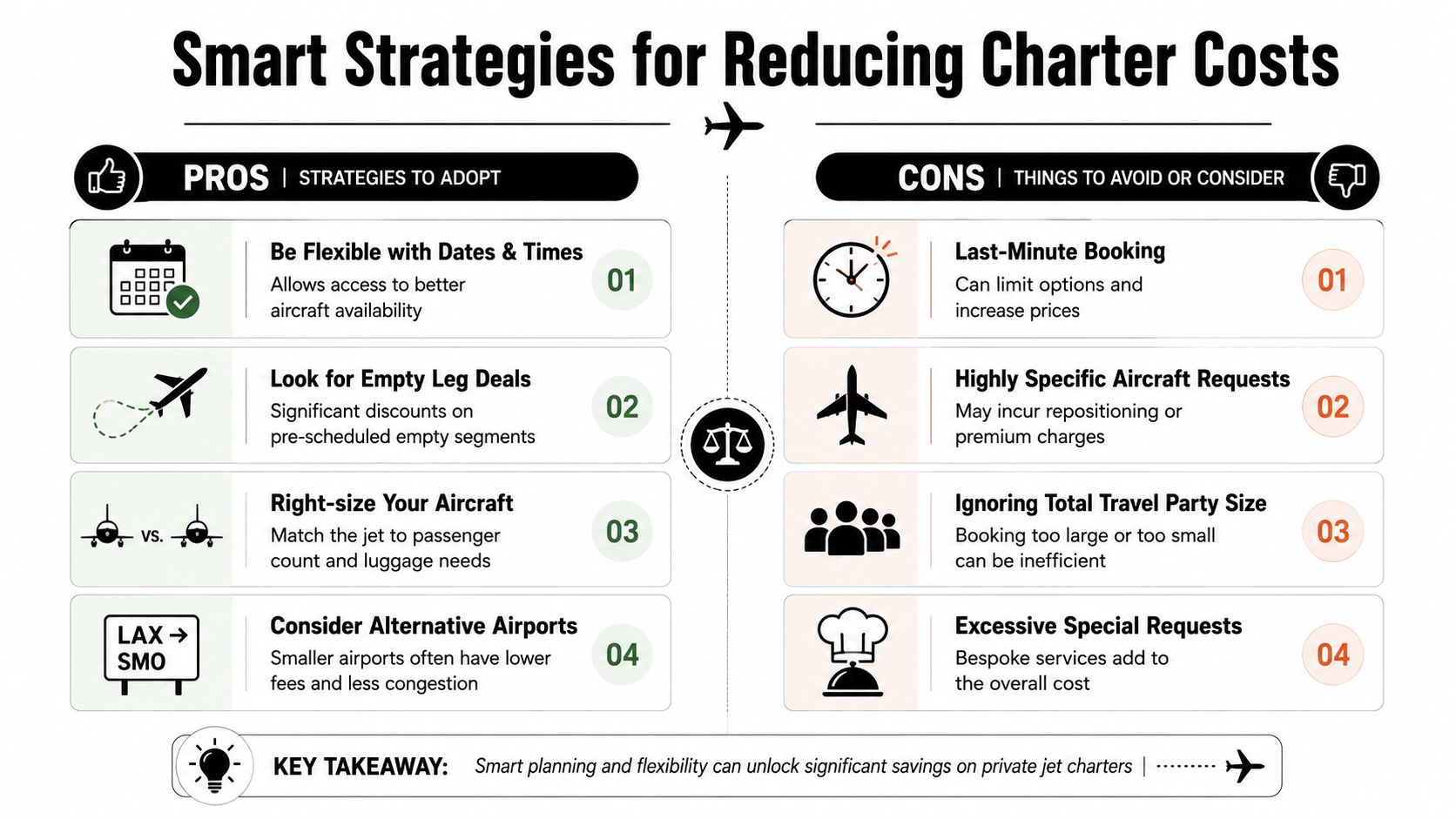
The fastest win is flexibility. If your departure window has room to move, your options improve. If your aircraft requirement is rigid and your timing is last-minute, expect the market to charge you for it.
Empty legs are real savings, but only if they fit your trip
Empty leg flights in Europe typically offer 50 to 80% discounts compared with standard charter pricing. A London to Nice flight that normally costs $40,000 can drop to $10,000, according to ACC Aviation's explanation of empty leg pricing.
That's not a gimmick. It's a distressed inventory model. The aircraft was already going to fly empty, so the operator would rather recover part of the cost than none of it.
The tradeoff is obvious. You don't control the route in the same way, and you usually don't control the timing in the same way either.
The strategies that actually work
- Stay flexible on departure windows: Small timing adjustments can open better aircraft availability.
- Right-size the cabin: Don't book a heavy jet for a route that clearly suits a light or midsize aircraft.
- Use alternative airports where practical: Smaller airports can simplify the trip and reduce operating friction.
- Ask for empty leg matches: Not every itinerary will qualify, but when one does, the savings can be meaningful.
A broader consumer angle on timing psychology is covered in CoraTravels' flight pricing guide, which is useful because it reinforces a simple point: flexibility changes price discovery in almost every travel market.
Here's a short explainer worth watching before you book:
What to avoid
The expensive mistakes are predictable:
Booking too late
Late bookings narrow the field and weaken your negotiating position.Requesting one exact aircraft model without a reason
If that model isn't already nearby, the quote can bloat quickly.Ignoring luggage reality
Too-small aircraft create operational problems. Too-large aircraft create financial ones.
Empty legs are excellent when they match your mission. They're useless when you force your mission to match them.
The smartest charter clients treat cost reduction as a sourcing exercise. They don't chase random discounts. They remove unnecessary cost drivers before the quote is built.
The Haute Jets Advantage Local Sourcing for Better Prices
A large share of avoidable charter overspend in Europe comes from one place: repositioning. The aircraft is not where you are, so you pay to bring it to you before your trip even starts.
Traditional brokerage versus local sourcing
Many quotes are built around what is easy for the seller to offer, not what is cheapest for the client to operate. A broker finds an available aircraft somewhere in the network, adds the ferry sectors, and presents the total as if it were the natural cost of the mission.
Local sourcing flips that logic. Start with aircraft already based near the departure point, then price the trip from that operational reality. That one decision often changes the quote more than small differences in hourly rate, catering, or cabin extras.
This is the part many buyers miss.
Two aircraft can look similar on paper and still produce very different totals. If one is parked nearby and the other has to fly in empty from another country, the cheaper-looking option can become the expensive one fast.
Why this matters so much in Europe
Europe punishes lazy sourcing. Airport slots, short sectors, crew duty limits, parking restrictions, and cross-border positioning all make deadhead time expensive. A jet coming in empty from far away is not just a line item. It can affect timing, airport choice, and overnight cost as well.
That is why asking where the aircraft is based matters so much. The answer tells you whether you are paying for your itinerary or for the broker's supply problem.
A local sourcing model usually produces better economics and cleaner execution.
What the buyer should look for
The practical test is simple:
- Ask where the aircraft is currently based: Nearby aircraft usually mean a cleaner quote.
- Ask whether the price includes ferry sectors: If the answer is vague, expect padding.
- Ask why that exact aircraft was selected: A good reason is cabin, range, runway performance, or luggage fit. "Availability" on its own is not enough.
- Compare total mission cost, not hourly rate: Hourly pricing hides repositioning better than almost anything else in this business.
Haute Jets is one example of this approach. It sources aircraft with local positioning in mind rather than pushing clients toward prepaid structures that can mask real trip economics. That matters because local sourcing can materially reduce deadhead exposure, and in many cases that changes the total by far more than clients expect.
The same buying logic appears in other premium travel categories. Passport Premiere's premium cabin deal success shows the broader point clearly. Smart buyers focus on sourcing quality first, because procurement mistakes are usually more expensive than the advertised headline price.
If the aircraft has to travel a long distance before you board, the quote should explain exactly why.
For European charters, local sourcing is not a minor detail. It is one of the clearest ways to cut waste out of the quote before you ever negotiate the trip.
Booking Your European Jet Charter with Confidence
A good charter decision comes down to a short checklist. Most pricing mistakes happen because travelers skip one of these steps.
The checklist that protects your budget
- Verify the safety standard: Ask for a Wyvern Wingman or ARGUS Gold/Platinum operator.
- Demand a transparent quote: If a charge is vague, make them define it.
- Ask where the aircraft is based: This is the fastest way to expose hidden repositioning cost.
- Choose the actual aircraft carefully: Category matters, but the exact aircraft matters more.
The standard I'd use
Don't accept a quote that feels polished but unclear. A serious charter advisor should be able to tell you what you're flying, where it's based, what is included, and which costs could still move.
That's how experienced buyers approach private aviation. They don't just ask what the flight costs. They ask why it costs that amount.
If you do that consistently, you'll make better decisions on every European trip. You'll avoid paying for unnecessary lift, avoid paying for hidden ferry time, and avoid the false economy of a quote that looks cheap until the details arrive.
European charter pricing isn't random. It's structural. Once you understand the structure, you stop buying blindly.
If you want a transparent quote for your next European itinerary, Haute Jets lets you compare on-demand charter options without jet cards or annual membership fees, with exact-aircraft sourcing and a pricing approach built around local availability rather than hidden repositioning.