
The most popular advice about private jet charter flight attendant jobs is also the least useful: start with luxury service, polish your appearance, and expect a glamorous version of airline work. That framing misses the hiring reality. Private aviation recruits cabin professionals for a narrow technical service specialty, often tied to a specific aircraft, a specific base, and an operator's own safety and client-service system.
The cabin may be elegant, but the work is demanding. You'll prepare for individual passengers, manage catering and privacy, coordinate closely with the pilot in command, and respond correctly when smoke, fire, illness, turbulence, or an operational disruption changes the plan. ICAO describes cabin crew as safety professionals responsible for detecting and containing hazards, reporting abnormal aircraft conditions, and managing security threats, not merely serving drinks (ICAO cabin safety guidance).
This guide takes a candid look at the role through seven practical lenses: what the job is, the duty cycle, credentials, compensation, job search strategy, interview performance, and the first 90 days of reputation building. It's written for candidates who want to understand the work before they accept the lifestyle.
What Private Jet Charter Flight Attendant Jobs Actually Are
A private-jet flight attendant is a safety professional with a highly individualized hospitality brief. On a charter sector, you may be the only cabin crew member responsible for emergency equipment, passenger briefings, service execution, cabin security, catering, and post-flight records. The smaller passenger count doesn't make the job easier. It makes your decisions more visible.
The regulatory context matters. Part 91 generally covers owner-operated and corporate flight activity, while Part 135 governs many on-demand charter operations. The distinction affects operational control, documentation, scheduling, training, and service consistency. An owner may have personal preferences that change from trip to trip. A charter operator must also deliver a repeatable product within a regulated commercial framework.
Aircraft type changes the job
Hiring isn't organized around one universal private aviation cabin ladder. Operators recruit against their fleets and client profiles. Common platforms include:
- Large-cabin aircraft: Gulfstream G450, G550, and G650; Bombardier Global 6000 and Global 7500; and Dassault Falcon 7X and 8X.
- Midsize aircraft: Challenger 350 and Challenger 650.
- Light jets: Embraer Phenom 300 and comparable aircraft with limited cabin space and different service expectations.
Crew size stays lean compared with airlines. A light jet may operate with one or two flight attendants, while an ultra-long-range aircraft may carry two or three, depending on the operator, aircraft configuration, mission, and client requirements. You'll have less separation between service, safety, inventory, and client communication than you would in a commercial cabin.
Base flexibility is another screening issue, not an administrative footnote. Many listings require candidates to live close enough to report promptly to a designated airport, and some roles demand a two-hour readiness window or reserve periods lasting seven to fourteen days, as described in the current market guidance provided for this role. If you can't meet the commute or reserve requirement, polished service experience won't rescue the application.
The work also overlaps with luxury hospitality. A candidate from a fine hotel or club lounge can bring useful instincts, especially around discretion and anticipation. For example, an IHG club lounge attendant Abu Dhabi role can help someone understand the standards of quiet, personalized guest care, but aviation still requires regulated safety competence. Candidates should also answer the basic question of whether private jets have flight attendants with nuance, because staffing depends on aircraft, operation, and mission.
Day-to-Day Duties From Preflight to Post-Flight
A polished departure is the visible part of the job. The professional standard is established before passengers arrive and tested when the itinerary stops behaving normally. SKYbrary's operational overview includes briefing, emergency-equipment checks, boarding oversight, door procedures, safety demonstrations, food and beverage service, first aid, fire response, evacuation, and unruly-passenger management (SKYbrary cabin crew workload).
The five phases of a duty day
Preflight starts with information, not flowers and glassware. Review the passenger manifest and preference records, verify catering, inspect the cabin and galley, check emergency equipment, and coordinate with the PIC. Depending on the aircraft and route, that may include personal protective breathing equipment, an AED, flotation or ditching equipment for overwater operations, fire extinguishers, oxygen systems, and other required items. CCOHS similarly identifies passenger safety, boarding, luggage stowage, demonstrations, service, and first aid as core cabin-crew responsibilities (CCOHS flight crew guidance).
The commonly used planning assumption for a preflight window is 90 minutes, but the actual requirement depends on the operator and trip. Use the time to reconcile catering against allergies and dietary requirements, review weight-and-balance information with the flight crew, and load the galley for the planned service and cabin temperature. A missing beverage is inconvenient. An unchecked emergency item is a safety failure.
Boarding is a controlled handoff. Confirm preferences without making the passenger repeat private information, manage pets and allergen risks carefully, and keep the welcome warm but unobtrusive. VIP protocol means understanding who wants conversation, who wants silence, and who expects the crew to solve problems without announcing them.
Service is only one part of the flight
In flight, the strongest attendants establish a quiet service rhythm. They monitor the cabin, communicate with the cockpit, adapt the sequence when passengers change plans, and protect rest requirements on long sectors. On flights lasting 12 or more hours, service planning and crew-rest management become operational matters, not personal preferences.
Post-flight work includes cabin reset, inventory checks, catering reconciliation, expense records, lost-property handling, and a concise report for the next trip or next-day brief. A turnaround compresses those tasks into a short window, often while the aircraft is being refueled, cleaned, catered, and prepared for another departure.
Practical rule: New hires rarely fail because they can't arrange a beautiful tray. They fail because they miss a preference detail, skip a check, lose control of inventory, or become visibly disorganized during an irregular operation.
Credentials and Training Employers Expect
Private aviation hiring works best as a credential stack, screened in a practical order. Hospitality polish may get attention, but safety documentation and relevant experience determine whether a recruiter can move your application forward.
Build the foundation before adding luxury credentials
Start with the basics an employer can verify: legal work and travel eligibility, a valid passport, education, medical fitness, and a clean professional record. Many job descriptions also prefer candidates who are at least 21, hold a high school diploma, and maintain passport validity of 18 months or more, but requirements vary by operator and jurisdiction. Don't assume a luxury certificate can compensate for missing documentation.
The most important experience benchmark is usually two to three years in commercial cabin service, business-class aviation, corporate aviation, or luxury hospitality. VistaJet's career guidance describes the pathway from relevant cabin or hospitality experience into specialized corporate training, and some employers require a four-week initial training program with emergency training completed within 90 days of hire (VistaJet private jet flight attendant careers).
Then add safety credentials that match the market you're targeting:
- Emergency procedures: FAA-approved flight-attendant emergency procedures training, aircraft fire and cabin emergency instruction, evacuation practice, and security awareness.
- Medical response: Current CPR, first aid, and AED certification.
- Water operations: Water-survival and ditching drills where the employer or route profile requires them.
- Aircraft qualification: Initial training on the assigned type, followed by recurrent training and competency checks.
FAA cabin-safety material emphasizes initial and recurrent instruction covering aircraft type, emergency procedures, first aid, and contamination awareness (FAA Cabin Safety Index). That means training isn't a badge you collect once. Operators may also require recurrent checks, drug screening, background screening, and employer-specific safety or service programs.
Add service credentials with a purpose
Luxury qualifications are useful when they reinforce the job. Silver-service training, WSET Level 2, sommelier education, food-safety handling, fine dining, and strong allergen knowledge can strengthen a profile, particularly for large-cabin roles. They shouldn't dominate the resume. Put aircraft, safety, and operational experience where recruiters can see them first.
Your resume should show what you handled, such as solo cabin responsibility, international catering coordination, emergency training, inventory control, or service recovery. The StoryCV flight attendant guide can help with structure, while Haute Jets' discussion of Wyvern and ARGUS private aviation safety ratings provides useful context for the safety language employers and clients recognize.
Compensation, Contract Types, and Base Realities
Private-jet compensation isn't a single luxury number. It depends on aircraft size, experience, base, duty model, client expectations, employment status, and whether the role includes substantial ground or household service. Public postings illustrate the spread: some senior charter positions list $120,000 to $140,000 annually, while others list $145,000 to $155,000 for specific assignments (Business Insider's private-jet flight-attendant compensation coverage). Industry summaries also place some large-cabin corporate roles in the $100,000 to $150,000 annual range when experience and aircraft size are factored in.
For context, the U.S. Bureau of Labor Statistics reported 126,020 flight attendants in May 2023, with a median annual wage of $68,370 and a mean annual wage of $70,980 (BLS flight-attendant employment and wage data). Scheduled air transportation employed 122,080 of those workers, which shows how specialized private aviation remains. A public job-board example also lists about $47,079 in average annual pay for a flexible private-jet flight-attendant role, so high compensation isn't guaranteed.
Compare the offer, not just the headline
| Employer Type | Pay Structure | Annual Range | Contract | Benefits |
|---|---|---|---|---|
| Large charter or fractional operator | Salary, per diem, possible premium assignments | Can exceed $100,000 for senior roles | Often direct employment | May include health coverage, retirement options, paid training, and travel privileges |
| Owner-operator flight department | Salary or day rate tied to the aircraft and principal | Varies widely by aircraft, schedule, and client expectations | Usually direct employment or management-company employment | Depends on the owner or management company |
| Charter management company | Salary, day rate, or mixed compensation | May range from below market average to senior large-cabin bands | Direct hire, contract, or roster-based | Must be reviewed line by line |
| Broker or freelance network | Per-day or per-trip payment | No reliable annual figure without guaranteed work | Often independent contractor | Benefits are commonly limited or absent |
Ask whether deadhead travel is paid, how positioning works, whether hotels and meals are covered, how reserve availability is compensated, and whether the schedule includes non-flying estate or hospitality duties. A role advertising a high salary may still be a poor fit if the base commute, reserve expectations, or unpaid preparation consume your time.
Aircraft type can influence the income tier, but it doesn't determine it alone. Gulfstream G650 and G550, Global 6000 and 7500, Falcon 7X, Challenger 350 and 650, and Phenom 300 assignments all carry different service and staffing profiles. Review the operator's private jet charter cost factors to understand why aircraft category, routing, and operating model affect the client experience you're being hired to deliver.
Where to Find Openings and How to Apply
Generic airline searches produce generic results. Candidates targeting private jet charter flight attendant jobs should search by operator, aircraft type, regulation, and base, because many roles are narrow assignments rather than broad cabin-crew vacancies.
Start with operator career portals. Review NetJets, Flexjet, VistaJet, Jet Aviation, Wheels Up, and comparable management and charter companies directly. Then examine Part 135 operators and aircraft-management firms near the airports where you can realistically report. The right question isn't only “Who is hiring?” It's “Which operators run the aircraft and bases that fit my availability?”
Build a targeted search system
Use several channels at once:
- Operator portals: Save career pages and check them routinely. Job titles may include corporate flight attendant, VIP flight attendant, cabin attendant, lead cabin attendant, or inflight service specialist.
- Aviation job boards: Search specialist boards rather than relying only on mass-market airline sites. Filter by aircraft, region, and Part 135 experience.
- LinkedIn: Use combinations such as “Gulfstream G650 flight attendant,” “Global 7500 cabin attendant,” “corporate flight attendant Part 135,” and “private aviation cabin crew.”
- Recruiter networks: Contact aviation recruiters with a concise profile, current certifications, base location, aircraft experience, and availability.
- FAA research: Use the FAA's Part 135 certificate information to identify active operators, then check their own career pages and company contacts.
Set Google Alerts for an operator name combined with “flight attendant,” “cabin crew,” “VIP,” or the aircraft platform you know. Track every application in a simple spreadsheet with the operator, aircraft, base, contract model, recruiter, date contacted, and follow-up date.
Tailor the resume to the aircraft
A mass application says you want a job. A targeted application shows you understand the operation. Put aircraft experience, emergency training, international documentation, languages, catering capability, and discretion near the top. Describe outcomes without exposing passenger identities. “Managed bespoke catering and allergen controls for executive travel” is stronger than “provided excellent service.”
Current listings can require three to five years on large-cabin private or corporate jets and may name aircraft such as the Gulfstream G650ER or Global 8000. Some also specify base proximity, bilingual capability, or an EU passport. Treat those requirements as operational filters, not suggestions.
Interview Strategies That Win Premium-Cabin Offers
A strong private-aviation interview feels less like a personality audition and more like a risk-and-service assessment. The recruiter wants to know whether you can report when required, work independently, and stay composed around confidential clients. The chief pilot wants evidence that you understand safety authority. The client-services team wants to know whether your service feels natural rather than theatrical.
A realistic assessment sequence
The first contact is usually a recruiter screen. Expect questions about base location, availability, travel documents, aircraft experience, training currency, and willingness to work reserve or irregular schedules. Answer directly. If you need relocation, say so. If your experience is limited to commercial first class or luxury hospitality, explain the transferable skills without pretending you've worked on a Gulfstream.
A video interview often tests discretion and service judgment. You may be asked how you'd handle a principal who changes the menu after takeoff, a guest who brings an undeclared pet, an allergen concern, or a passenger who wants complete silence while another expects attention. The best answer shows calm sequencing: protect safety, clarify the requirement, coordinate with the PIC or operations team, and communicate only what the passenger needs to know.
The practical stage may include emergency procedures, equipment identification, safety-briefing delivery, table setup, beverage service, and a cabin-flow exercise. FAA guidance treats recurrent competence as part of the safety system, so interviewers may care more about disciplined procedure than theatrical confidence. Bring current training records, medical documentation where appropriate, passport information, references, and a clean summary of aircraft exposure.
A useful answer pattern: State the risk, describe the immediate action, identify who you'll notify, and explain how you'll document the outcome.
The final meeting may involve chief pilots, cabin-service leadership, or a client-services representative. Grooming should be conservative and immaculate, but don't confuse luxury presentation with excessive styling. Common rejection signals include vague availability, weak aircraft knowledge, casual treatment of confidentiality, defensiveness about safety checks, and stories that describe service without showing judgment.
Practice aloud with structured talking points for job interviews, then adapt the wording to aviation. A recruiter isn't looking for memorized charm. They're listening for reliability, situational awareness, and the ability to make a premium cabin feel effortless without compromising procedure.
Building a Premium-Client Reputation and Your 90-Day Plan
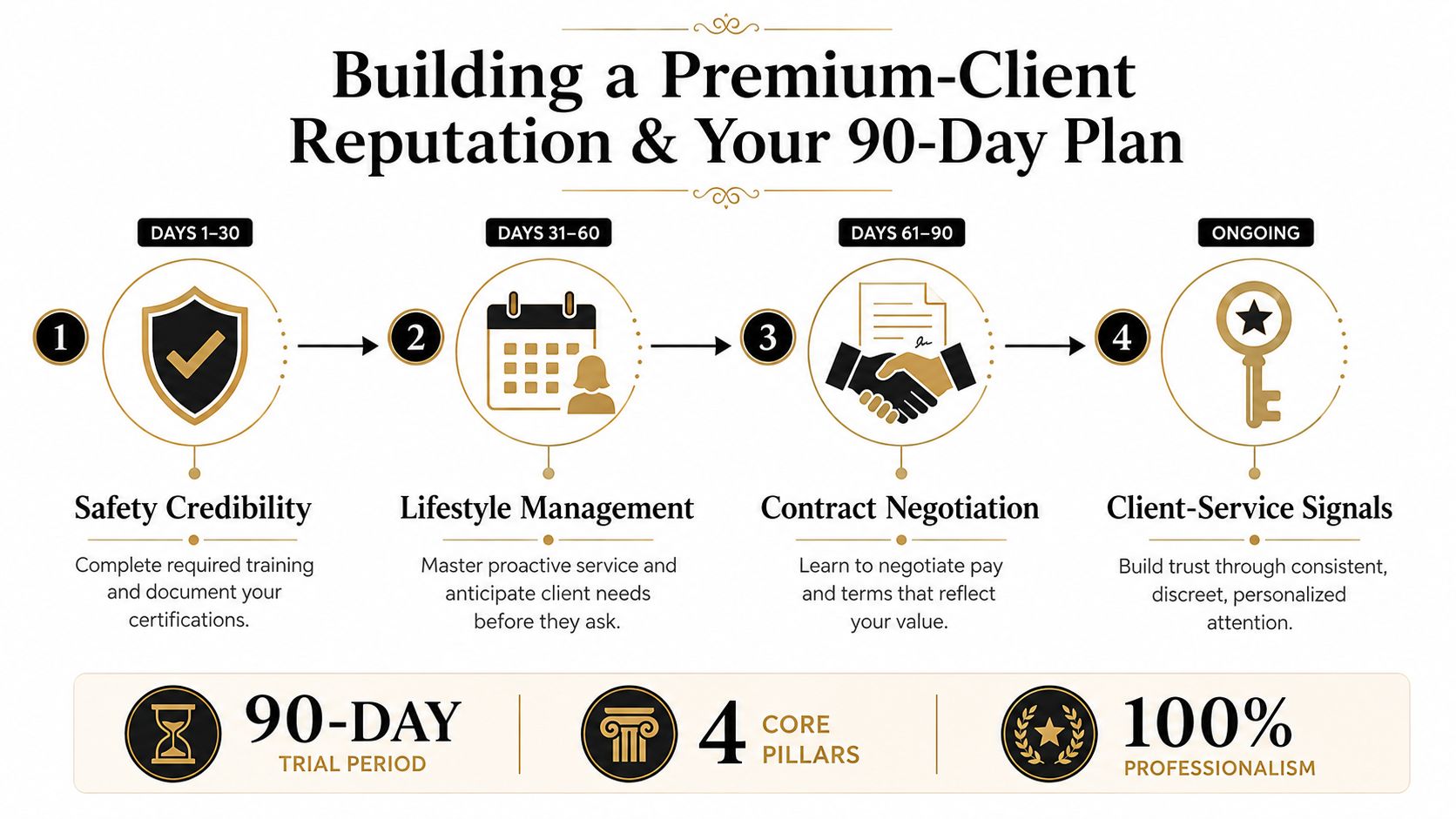
Reputation in private aviation is built through repeatable details. Four pillars matter most: discreet service habits, dietary and allergen proficiency, technical fluency on assigned aircraft, and reliable post-flight follow-through. A candidate who can demonstrate all four is more credible than someone who lists luxury adjectives without operational evidence.
Four pillars worth documenting
Discretion means controlling information, conversation, devices, photographs, and records. It also means not using a client's identity as a career story. Your service dossier should describe the situation, action, and result without naming passengers.
Dietary competence goes beyond asking whether someone has an allergy. Record how you verify ingredients, prevent cross-contact, brief catering vendors, and coordinate with the cockpit when a meal change affects timing or cabin workflow.
Technical fluency means knowing the assigned aircraft's emergency equipment, cabin configuration, exits, galley systems, seating limitations, and service constraints. Study the aircraft before the trip, not while the passenger is boarding.
Follow-through creates trust with operators and brokers. Submit accurate expense records, report discrepancies, close the inventory loop, and send useful feedback without turning every minor issue into a complaint.
A practical 90-day sequence
- Weeks 1–2: Identify credential gaps, confirm training currency, update passport and medical documentation, and prepare references. Create a personal service dossier with aircraft exposure, safety credentials, hospitality strengths, languages, and availability.
- Weeks 3–6: Apply selectively to operators and aircraft-specific roles. Contact recruiters with a short, customized message. Log each interaction and follow-up in a feedback template that records the question, your answer, the recruiter's response, and the improvement required.
- Weeks 7–10: Rehearse emergency explanations, safety briefings, client scenarios, and service flow. Review aircraft manuals or approved training materials for the platforms named in your target roles. Practice answering without revealing confidential information.
- Weeks 11–12: Compare offers by guaranteed compensation, contract status, benefits, reserve, commute, positioning, training, and non-flying duties. Decide whether the base works in real life, not just on a map.
- Week 13: Approach onboarding as the first reputation test. Arrive prepared, learn the operator's documentation system, ask precise questions, and keep a daily feedback log after every trip.
Use a quarterly self-audit checklist with four questions: Was my safety documentation current? Did I prevent or resolve a service risk? Did I improve aircraft knowledge? Did my post-flight records help the next crew? Those answers will tell you more about career progress than a glamorous title.
If you're evaluating the passenger experience that cabin crews are expected to support, review how the operator confirms aircraft, crew, catering, and ground logistics before departure. Haute Jets connects clients with owner-operators and provides on-demand charter coordination, so visit Haute Jets to explore the operational standards and booking details that shape premium private aviation.