
Most advice on Private Jet Charter Glasgow is wrong at the point that matters most. It fixates on the headline hourly rate, then leaves you to discover the actual bill after the aircraft has been sourced, positioned, staffed, and cleared for your trip.
That's sloppy buying.
The smart way to charter from Glasgow is to treat the quote like a transaction sheet, not a lifestyle brochure. The most common blind spot is repositioning. Existing content around this market leans on hourly ranges and ignores the hidden 20 to 40 percent repositioning fees that can hit flights originating outside the UK, according to PVJets' Glasgow charter overview. If you're flying in from Europe or crossing the Atlantic, that omission can turn an apparently competitive quote into an expensive mistake.
This guide appears on Haute Jets Journal for readers who care less about marketing language and more about getting the right aircraft, from the right airport, at the right price.
Beyond the Brochure Price
Brokers love a tidy hourly rate because it keeps the conversation superficial. Serious buyers ask for the movement plan behind the quote.
For a Glasgow departure, price should be shown as a flight schedule with costs attached. I want to see where the aircraft is sitting now, how it gets to your departure airport, whether it stays with you or drops and returns, and which line items can still move. If that detail is missing, the quote is incomplete.
A Glasgow quote, broken down properly
Here is the smarter way to read a charter proposal.
A jet based near Glasgow or elsewhere in the UK usually gives you a cleaner cost structure. A jet sourced from continental Europe can look competitive on the headline number, then become expensive once ferry time, crew duty, parking, and airport charges are added. That is where weak brokerage habits show up. Some firms quote the mission you asked for. Better brokers quote the mission plus the aircraft movement required to operate it.
That distinction matters more on one way trips and short sectors. On a brief Glasgow itinerary, a long aircraft positioning leg can distort the economics fast. You are no longer paying mainly for your flight. You are paying for the operator's logistics problem.
Practical rule: If a broker cannot tell you the aircraft's origin before your flight, you do not yet have the final price.
What to demand before you approve anything
Do not buy by aircraft category alone. Buy by sourcing logic.
Ask these questions and insist on direct answers:
- Where is the aircraft based today? “UK based” is too vague. You want the actual origin airport.
- What repositioning legs are being billed? There may be one before departure, one after drop off, or both.
- Is this aircraft staying with me or dropping and returning later? That decision changes parking, crew, and ferry costs.
- Are airport, handling, crew overnight, and de icing charges shown separately? If they are buried, comparison shopping becomes useless.
- Is there a better local option? A slightly different aircraft sourced closer to Glasgow often wins on total cost.
The smart move is simple. Prioritize locally sourced lift first, then compare aircraft quality. That approach strips out unnecessary ferry hours, makes the quote easier to audit, and reduces the chance of a cheap looking offer turning into an inflated invoice.
Luxury matters. Cost discipline matters more.
Choosing Your Glasgow Gateway and Aircraft
Start with the airport, not the cabin photos. In Glasgow, that choice can save hours on the ground and a meaningful amount on the invoice.
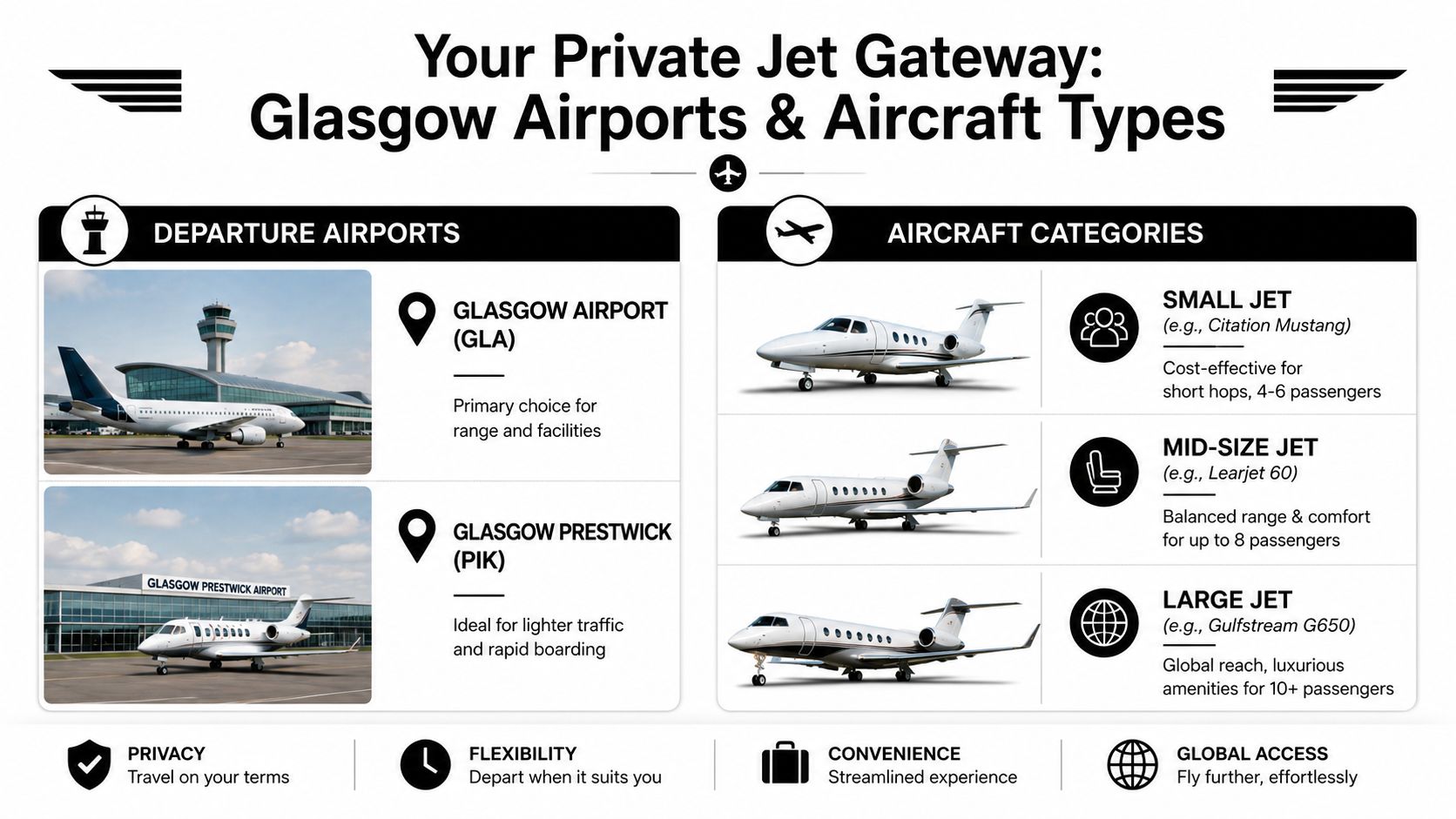
Glasgow gives you two serious private aviation gateways. Glasgow International Airport is about 10 miles from central Glasgow, while Prestwick sits about 32 miles out, according to BBC reporting on Scottish private jet activity. The same report notes rising private jet traffic at Prestwick. That matters because demand tends to follow operational convenience. Brokers use airports that help them place aircraft efficiently.
EGPF or EGPK. Choose based on trip economics
EGPF, Glasgow International, is the right call for most city-based departures. If you have meetings in the centre, family at home, or limited tolerance for transfers, use it. The airport is closer, familiar to executive travellers, and easier to justify when your day is tightly scheduled.
EGPK, Glasgow Prestwick, deserves a price check on every trip. It is farther from the city, but distance by car is only one cost. If the aircraft is already positioned at Prestwick, the total charter can come in lower even after ground transport is added. That is the kind of trade-off smart buyers make.
Use this filter:
| Airport | Best for | Watch for |
|---|---|---|
| Glasgow International EGPF | Central Glasgow access, same-day business, tighter itineraries | Higher total cost if the aircraft has to reposition in |
| Glasgow Prestwick EGPK | Flexible schedules, aircraft already nearby, cleaner operating logic | Longer drive, which only makes sense if the sourcing saves real money |
My advice is simple. Ask for quotes from both airports before you approve anything. A broker who only prices the airport you named is leaving money on the table, or hiding where the aircraft sits.
Match the aircraft to the route, not your ego
Clients waste money in Glasgow by over-ordering aircraft for short sectors. A bigger cabin often looks better on paper and performs worse on cost once you add ferry time, handling, and minimum flight charges. If you want a sharper framework for auditing those line items, read our guide on what private jet charter actually costs.
Here is the practical way to choose.
Short regional trips and island access
Use a turboprop first. For short Scottish sectors and utility flying, it is usually the smartest tool. You get strong short-runway performance, lower hourly cost, and less waste paying for jet capability you will not use.
London and short European business sectors
Use a light jet for small groups when speed and cabin privacy matter. For Glasgow departures, market references place turboprops at roughly $2,000 per hour, light jets around $4,000 to $6,000, midsize jets around $6,000 to $8,000, and larger long-range aircraft well above that, based on published Glasgow and UK charter pricing from Air Charter Advisors and Air Charter Service UK. Treat those as orientation only, not buying guidance.
The key question is whether the aircraft is local.
A light jet sourced near Glasgow often beats a cheaper-looking midsize quote that starts the day in southern England. That is where hidden repositioning charges add 20 to 40 percent to the trip. If you want to compare private jet expenses, do it against total trip cost, not advertised hourly rate.
Longer European sectors and larger groups
Choose a midsize jet when baggage, stand-up cabin comfort, or range improve the trip. That means routes where you would otherwise compromise on luggage, fuel stops, or passenger comfort. It does not mean booking more aircraft than the mission requires.
Long-range and flagship trips
Heavy jets and long-range cabins belong on transatlantic routes, larger party movements, and itineraries where cabin time is part of the experience. They do not belong on a short Glasgow sector unless there is a clear operational reason, such as onward long-haul continuation or a full passenger load.
The smart buying rule is blunt. Pick the airport that reduces total trip friction. Pick the aircraft that fits the route. Then make the broker prove the aircraft is sourced locally enough to avoid waste. That is how you charter well in Glasgow.
Decoding Charter Prices and Finding Value
Hourly rate is the wrong place to start.
The number that matters is total mission cost. A quote can look competitive on paper, then swell once empty repositioning legs, airport handling, crew charges, and overnight costs appear. In Glasgow, that problem is common because many aircraft sold as available for Scotland are sitting somewhere else in the UK or mainland Europe.
A one way quote from London, Paris, or Milan can be perfectly reasonable. It can also be padded by aircraft movement you did not ask for. If the broker does not show where the jet starts the day, assume you are paying for inefficiency.
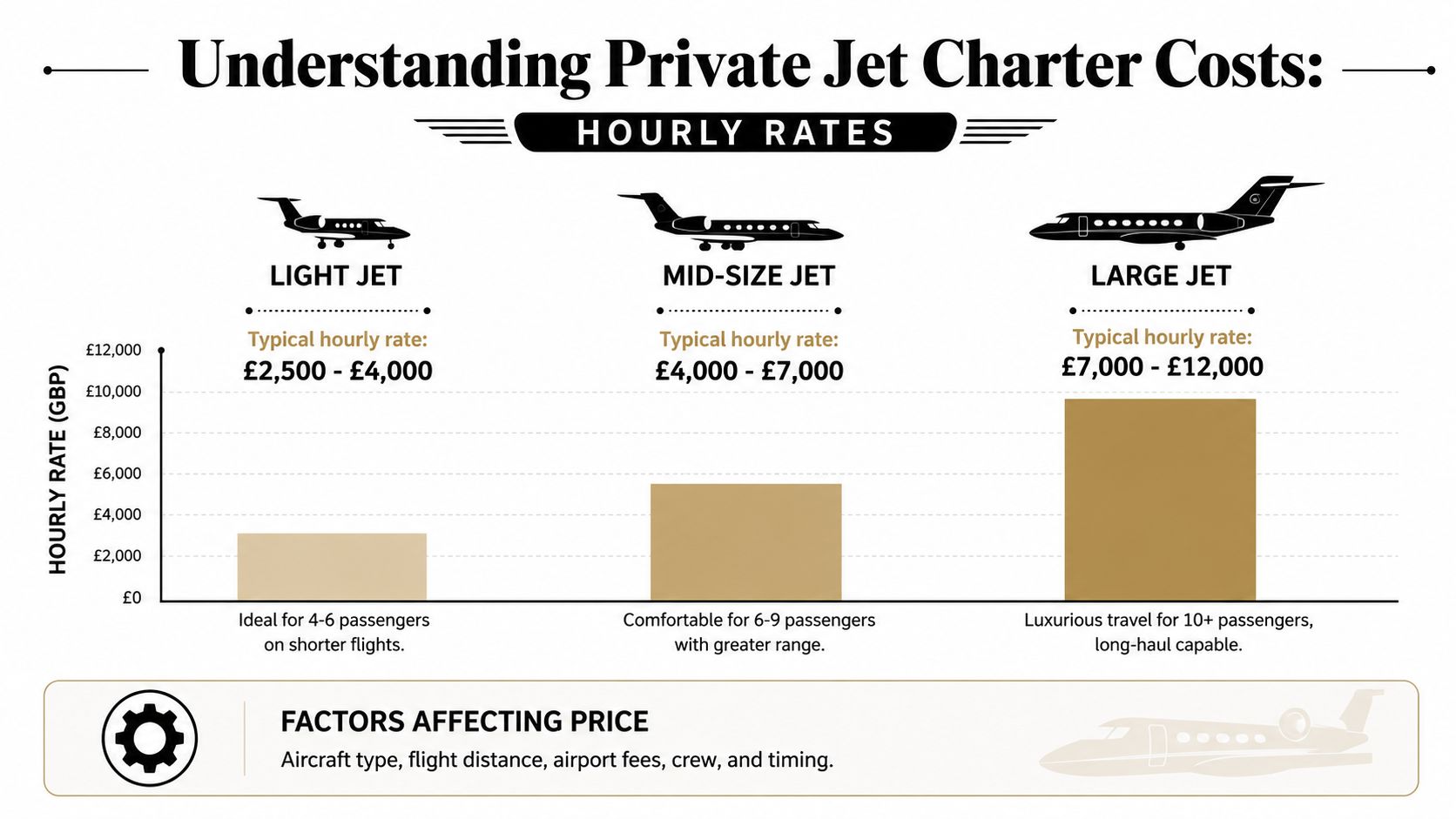
What a useful quote should tell you
A proper quote explains the price, not just the aircraft type.
Look for these items:
- Aircraft class and route fit: A light jet on a short UK sector is normal. A larger cabin needs an operational reason or a passenger comfort reason you can defend.
- Starting position of the aircraft: Ask where the jet is based the night before and whether any empty sectors are billable to you.
- Line-item transparency: You want flight time, repositioning, landing fees, handling, crew expenses, de-icing exposure, and tax treatment separated clearly.
- Comparable fixed-trip context: Monarch Air Group's Glasgow charter page gives rough trip examples that can help you sanity-check a quote, but they are still reference points, not buying guidance.
If you want an outside consumer reference before reviewing broker quotes, use it to compare private jet expenses. Then come back to the broker and challenge every line item.
The repositioning fee trap
At this stage, buyers either save money or waste a lot of it.
Repositioning fees are the quiet markup many brokers gloss over. An aircraft may need to fly into Glasgow empty before your departure, then leave empty again after drop-off. Those extra sectors can push the actual trip cost up by 20 to 40 percent, especially on short flights where the ferry time is a large share of the total billing.
My advice is simple. Ask one question early. “Is this aircraft local to my departure point?” If the answer is vague, the quote is weak.
A broker who sources locally will often beat a lower advertised hourly rate from a distant operator. That is the smart way to buy charter in Glasgow. Cut waste first. Choose glamour second.
A quote without aircraft sourcing is not a serious quote.
Empty legs can help, but they are not a strategy
Empty legs work for flexible schedules and opportunistic trips. They are unreliable for business travel, events, and any departure that cannot move. Times change. Routing changes. The aircraft can disappear if the primary charter shifts.
Use empty legs as a bonus, not as the backbone of your plan.
If you want a sharper framework for auditing quotes, read this guide on what it costs to fly private before you sign anything.
The Booking Process Demystified
A clean booking process saves money. A sloppy one invites surprise fees, weak operator disclosure, and last-minute aircraft swaps.
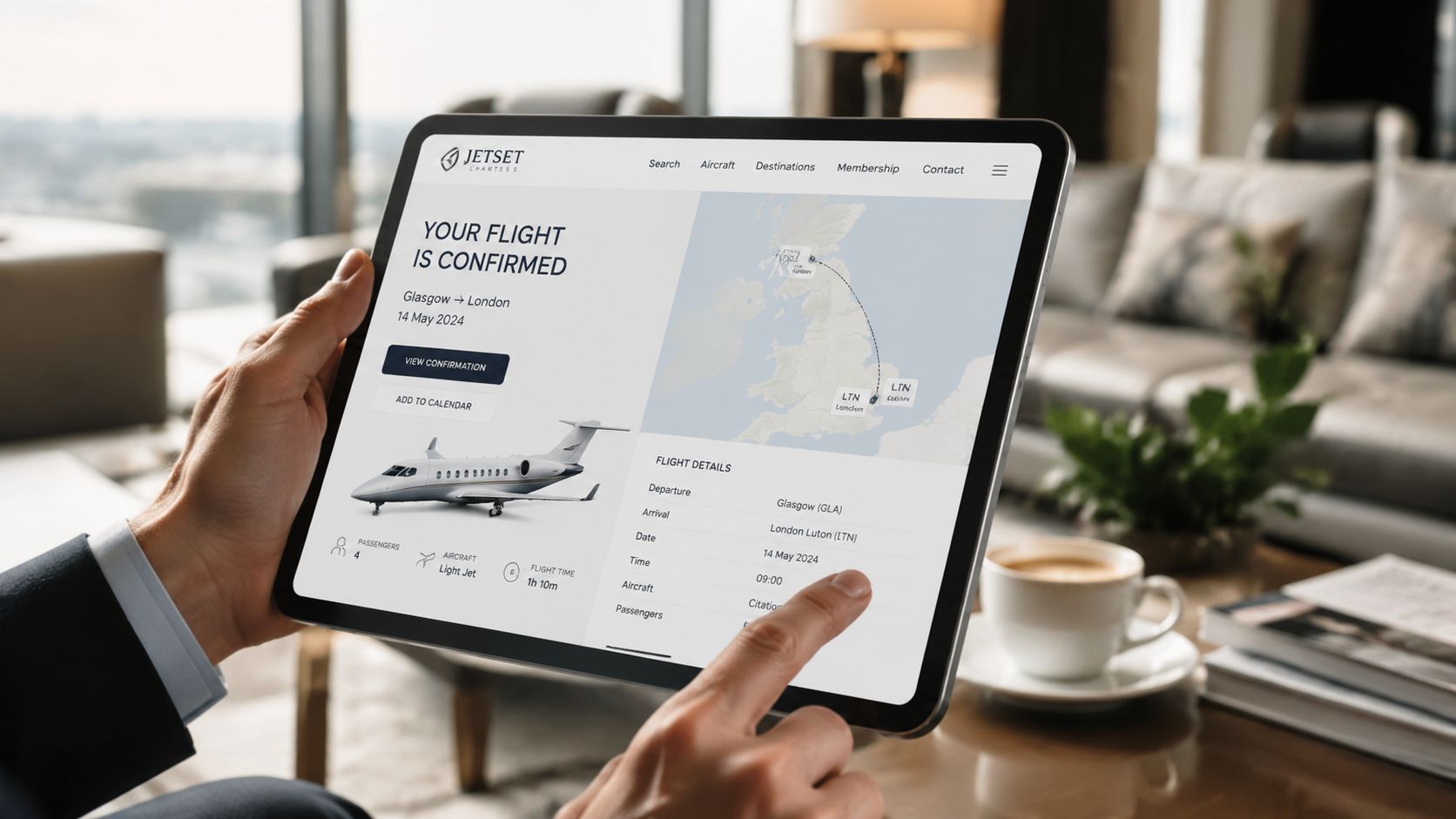
Step one, brief the trip like a buyer, not a browser
Give the broker the details that drive price and aircraft choice. Name the departure airport, destination, date, preferred departure window, passenger count, baggage load, and any operational needs such as pets, skis, golf clubs, special catering, or late-night returns. If your brief is loose, your quote will be padded.
Then ask the question many clients miss. Is the aircraft already positioned in or near Glasgow? That answer matters more than a polished proposal. If the aircraft is coming in empty from another city, your real cost climbs fast, even if the hourly rate looks attractive.
Read the line items before you read the branding. You are buying aircraft access, crew time, airport handling, and positioning. The smart buyer also leaves room in the budget for operational extras such as de-icing, schedule creep, and airport-driven charges that can appear on winter and peak-period flights.
Step two, verify the operator before you send funds
Do not rely on the broker's tone. Verify the operator.
I would only book with an operator that can clearly show a current Wyvern Wingman or ARGUS Gold or Platinum standing, along with the AOC details for the flight. If that answer comes back vague or delayed, move on. Good operators are used to serious scrutiny.
Check these points before signing:
- Operator identity: Get the legal name of the company operating the aircraft.
- Safety standing: Confirm current Wyvern or ARGUS status if claimed.
- Aircraft details: Ask for the exact aircraft, registration, age, and planned cabin configuration.
- Operational fit: Confirm Wi-Fi, baggage capacity, enclosed lavatory, galley capability, and pet approval if needed.
- Substitution rules: Get the replacement policy in writing before payment.
- Cancellation terms: Read the percentages, deadlines, and refund mechanics closely.
One more point. Ask who holds your money. If funds are going to the broker rather than the operator or a clearly documented escrow structure, get that explained properly.
Step three, control the contract, payment flow, and change risk
The contract should state the aircraft booked, or spell out narrow substitution conditions with equal or better category language. Broad wording gives too much room for downgrades disguised as operational necessity.
Payment timing matters. So does the trigger for full payment, the treatment of weather delays, and the procedure if slots, crew duty limits, or technical issues force a change. Clients lose money when they skim this section.
Many high-net-worth flyers now ask for alternatives to a bank wire, including cryptocurrency such as Bitcoin. Fine. Payment method is secondary. Documentation comes first, and it needs to be clear.
A practical walkthrough helps if you have not booked recently:
For a sharper step-by-step framework, read this guide on how to charter a private jet in 2026.
Mastering Day-of-Departure Logistics
The luxury of private aviation isn't the leather seat. It's control over your time.
On departure day, you're not entering the main commercial terminal. You're typically using an FBO, or Fixed-Base Operator, which is the private side of the airport. That means a quieter arrival, a private lounge, direct interaction with the crew, and a much faster path from curb to aircraft.
What the best departure day looks like
A well-run private jet charter Glasgow experience feels simple because someone has already handled the complexity. You arrive at the FBO, your identification is checked, bags are loaded, the crew confirms the route and flight time, and then you walk to the aircraft.
Expect these details to be settled before you arrive:
- Ground transport: Car to FBO, and if needed, onward car service on arrival
- Cabin requests: Catering, preferred drinks, newspapers, child seats, blankets
- Connectivity: Wi-Fi confirmation if you need to work in flight
- Pet handling: Approved in advance, not improvised at the terminal
Ask for the final passenger manifest and tail number before departure day. Good operators don't leave identity details ambiguous.
Glasgow-specific operational caution
There's one Glasgow detail that matters more than glossy marketing suggests. Glasgow Airport EGPF can face FBO access limitations for ultra-long-range jets during peak summer turbulence or winter icing, and those conditions can require expert planning or even aircraft substitutions on certain routes, according to Private Jets Connect's Glasgow destination analysis.
That doesn't mean you shouldn't use EGPF. It means your flight plan should be built by someone who understands Scottish operating conditions, not by someone pasting in a generic “yes, your jet can land there.”
The 24-hour confirmation separates professionals from amateurs
The final confirmation should arrive the day before departure and include the aircraft tail number, crew details, timing, and any weather-related notes that affect the trip. That document is your last quality-control checkpoint.
Review it carefully. If the aircraft changed, ask why. If the departure airport changed, ask why. If the catering or ground transfer isn't listed, it hasn't been confirmed.
For a more detailed look at the private terminal experience, this guide on what a private jet airport process looks like is a useful reference.
Your Essential Glasgow Charter Checklist
The smartest charter clients from Glasgow do a few things differently. They don't chase the lowest advertised hourly number. They don't choose the biggest aircraft by default. And they don't approve quotes until sourcing and operational details are visible.
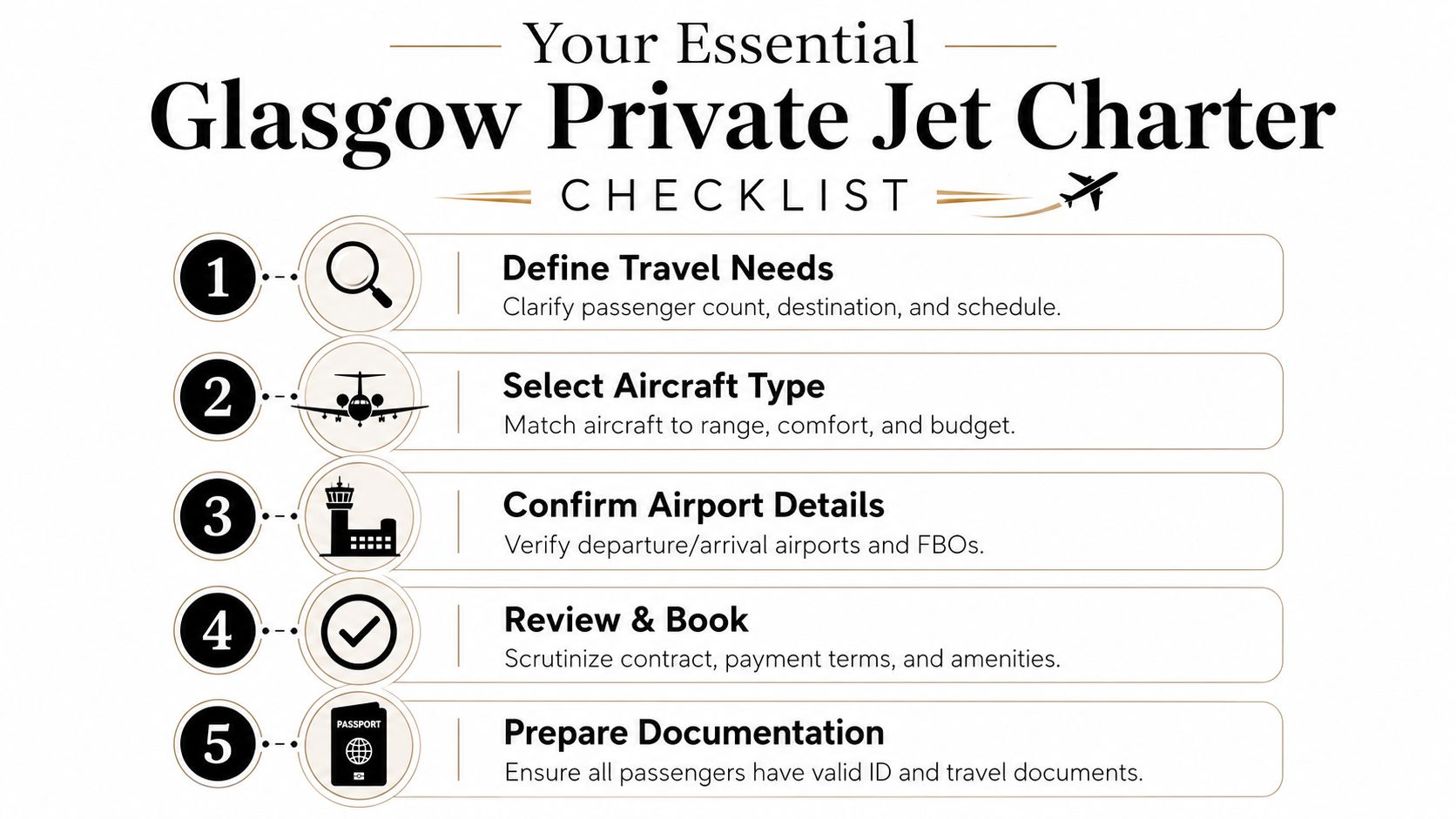
The short list that saves money and headaches
- Start with airport logic: Compare EGPF and EGPK before you compare cabins.
- Buy the mission, not the fantasy: Use turboprops for short practical sectors, light jets for efficient business routes, and larger cabins only when range or group comfort requires them.
- Interrogate sourcing: The right first question is not “what's your hourly rate?” It's “where is the aircraft coming from?”
- Build weather tolerance into the plan: Scottish operations can shift with icing and seasonal conditions.
- Read every quote line by line: If a fee isn't broken out, ask whether it's included or deferred.
A better way to think about value
Value in private aviation isn't just a lower number. It's a cleaner mission. The best charter choice is the one that gives you the right airport, the right aircraft, clear operator credentials, and no nasty invoice surprise at the end.
That matters even more if Glasgow is only one part of a wider Scotland itinerary. If you're combining a private arrival with overland touring, flexible self-drive tours in Scotland can help you plan the ground side with the same level of control you expect in the air.
The most expensive charter mistake isn't overpaying for cabin size. It's paying hidden positioning cost for an aircraft that should never have been sourced for your trip.
One final rule. If a broker cannot explain the total mission cost in plain English, don't book with them.
If you want a cleaner way to fly from Glasgow, Haute Jets is built for exactly that. You get access to 3,500+ aircraft across 175 countries, sourced through owner-operators instead of padded jet card pricing. Every flight is operated by Wyvern Wingman or ARGUS Gold/Platinum-rated providers, with the exact aircraft details, cabin features, and 24-hour pre-flight confirmation delivered before departure. No memberships. No prepaid hours. No vague category selling. Just transparent on-demand charter done properly.