

It's Wednesday morning in Kansas City, and you need to be in Dallas by lunch. You call for a private jet charter Kansas City quote, specify your passengers and departure time, and receive an attractive hourly rate for a Citation Excel or Phenom 300. Then someone mentions that the aircraft has to fly empty from Dallas or Chicago before your trip begins.
That ferry leg is where many Kansas City charter quotes go wrong. The aircraft category may look right, but the jet's location, departure airport, runway requirements, and return schedule can matter more than the advertised hourly price. A repositioning aircraft can add thousands of dollars before catering, ground transportation, or cabin preferences enter the discussion.
Kansas City has a strong and varied aviation network. The BTS summary for June 2025 through May 2026 recorded 5,571,000 departing passengers and 5,572,000 arriving passengers at MCI, placing the airport at rank 40 in the United States for both arrivals and departures (Bureau of Transportation Statistics airport data). That scale supports more aircraft movement, FBO infrastructure, crew positioning, and same-day options than a generic city-average quote suggests.
Why Kansas City Charter Decisions Start on the Ground
A Kansas City charter quote can look attractive until you ask where the aircraft is sitting. The first option a broker presents often comes from a light jet in Dallas, Chicago, or another hub. That aircraft must reach Kansas City before your passengers board, and the empty positioning flight can reshape the final invoice.
The aircraft category and hourly rate show only part of the cost. The operator may bill the repositioning leg at the aircraft's hourly rate, depending on the trip structure, as explained in this breakdown of private jet pricing mechanics. A lower advertised rate can still produce a higher total price once positioning, crew, handling, catering, and ground arrangements are included.
Practical rule: Ask where the aircraft is based, where it will be immediately before departure, and who pays for the empty leg.
Airport choice changes the economics as well as the travel time. A traveler near downtown Kansas City may find MKC more practical than MCI. A full cabin on a longer-range mission may require MCI's runway environment and private aviation facilities. A passenger in Overland Park may reduce ground time through OJC or IXD, if the aircraft can meet the field's runway and payload requirements.
The quote starts before the cabin class
Aircraft basing shows whether the operator must fly empty to Kansas City. Runway performance determines whether the chosen airport can handle the required fuel, passengers, and baggage. FBO location affects how quickly passengers move from the vehicle to the aircraft.
These details must be priced together. A midsize jet may look right in a search result yet face payload or runway limits at a regional field. A light jet already positioned at MKC can cost less overall than a lower-rate aircraft ferried from another city. Compare the total trip price for the exact aircraft and airport, not the headline hourly rate.
Kansas City supports a local-first booking strategy. MCI provides commercial scale, MKC has established business aviation activity, and several public and private airports serve the surrounding metro. The National Air Transportation Association's 2026 business aviation dataset lists 21,007 business-aviation operations at MKC, including 3,149 jet operations and 1,749 turbine operations. That operating base gives brokers and operators more opportunities to source an aircraft locally instead of building every quote around a repositioning flight.
The right airport and exact aircraft can change the final quote by tens of thousands of dollars. Start there, then evaluate the cabin.
Choosing the Right Kansas City Airport for Your Mission
Kansas City charter travelers shouldn't choose an airport based only on the address in the search result. They should choose it based on aircraft capability, passenger location, runway requirements, FBO handling, and the next leg on the aircraft's schedule.
MCI is the right starting point for heavier aircraft, longer missions, and trips requiring a full-service private aviation environment. It offers dedicated private aviation facilities and continuous FBO coverage, while its longer runways support aircraft that may not be practical at smaller regional fields. Signature Flight Support and Atlantic Aviation serve the private aviation operation on the west side of the airport. Travelers can also review Haute Jets' Kansas City International charter information when evaluating KMCI departures.
MKC is the insider choice for many executive trips. Its downtown position reduces ground time for travelers near the central business district, the Plaza, and nearby hotels. Light and midsize jets often fit the mission well for regional and domestic routes, and the airport's business aviation activity supports short-notice departures. The Jet Center at MKC FBO is a practical handling option for travelers who value a quick curb-to-aircraft transfer.
South and southwest metro options
OJC serves the southwest metro, including travelers near Olathe and Overland Park. It's a useful choice for turboprops and light jets heading toward the Ozarks, Wichita, Des Moines, and similar regional destinations. IXD, New Century AirCenter, extends that southern and southwestern coverage and can work well when the traveler, aircraft, or next flight is already positioned in that part of the metro.
Basewell at 3GV in Grain Valley is more relevant for smaller charter operations and travelers on the eastern side of the area. It shouldn't be treated as a universal substitute for MCI or MKC. Airport suitability depends on the aircraft's performance, runway conditions, passenger load, fuel plan, and operator approval.
The Kansas City area includes 14 airports overall, with 10 publicly owned and four privately owned, according to the airport-system information summarized in the NATA dataset cited above. That airport diversity gives a charter team more routing and repositioning choices than a single-airport market.
| Airport | Code | FBO(s) | Best Aircraft Class | Recommended Mission |
|---|---|---|---|---|
| Kansas City International | MCI, KMCI | Signature Flight Support, Atlantic Aviation | Midsize, super-midsize, heavy, long-range | Longer domestic, international, and higher-payload missions |
| Charles B. Wheeler Downtown | MKC, KMKC | Jet Center at MKC FBO | Light and midsize jets | Executive trips from central Kansas City and regional destinations |
| Johnson County Executive | OJC, KOJC | Local business aviation FBO services | Turboprops and light jets | South-metro departures and shorter regional routes |
| New Century AirCenter | IXD, KIXD | Local business aviation FBO services | Light and midsize aircraft | Southwest-metro access, staging, and regional missions |
| Basewell | 3GV | Local general aviation handling | Smaller charter aircraft | Eastern-metro departures and smaller aircraft |
The field should be selected before the quote is finalized, not after the aircraft is already assigned. A good charter team will price at least two viable airports when both can handle the aircraft.
How to Book a Private Jet Charter in Kansas City
A Kansas City charter quote can change by tens of thousands of dollars when the aircraft must be repositioned from another market. Start with the exact mission, then make the broker show locally sourced aircraft before you compare headline hourly rates.
1. Define the mission
Give the charter team your preferred departure airport or metro area, destination, passenger count, baggage volume, pets, departure time, return schedule, and flexibility. State whether the itinerary includes multiple stops or an overnight stay. Precision helps the team search for an aircraft already near Kansas City instead of building a quote around a distant aircraft.
2. Request locally positioned aircraft
Ask for aircraft based at or near MKC, MCI, OJC, IXD, or another suitable regional field. Request the aircraft's current location and planned movement before departure. A locally positioned aircraft can remove ferry time and reduce the final quote, even when its published hourly rate is not the lowest.
3. Compare the complete price
The hourly rate is only one part of the bill. Compare the total, including repositioning, federal excise tax, segment charges, landing or handling fees, catering, ground transportation, and overnight crew costs where applicable. Require the quote to identify included fees, estimated fees, and charges that may change.
4. Verify the aircraft and operator
Confirm the aircraft tail number, year, model, cabin layout, Wi-Fi, baggage capacity, pet policy, crew, and certificate holder. The operator flying the aircraft should be identifiable before funds are sent. A category label such as “midsize jet” does not confirm the aircraft you will receive.
5. Review and fund the trip
Before departure, review and sign the Charter Operator Agreement, approve the passenger manifest, and acknowledge the flight confirmation or itinerary. Pay the deposit or full balance under the agreement's terms. Read cancellation, substitution, and refund provisions before approving payment.

Within 24 hours before departure, request the confirmed FBO address, tail number, crew information, departure instructions, passenger manifest, and current operational details. Haute Jets describes pre-flight confirmation as including the tail number, crew bios, weather briefing, and passenger manifest. Use that level of detail as the standard, not an optional courtesy.
Aircraft Options and Price Ranges from Kansas City
Kansas City charter pricing starts with local aircraft sourcing, not the headline hourly rate. Select the aircraft for the mission, then check where it is based and which metro airport can support the trip. A turboprop may fit a short Midwest route, while a heavy jet wastes money for a small regional group. The reverse applies when baggage, runway requirements, or nonstop range rule out a smaller aircraft.
Published Kansas City pricing runs from approximately $2,000 to $3,500 per hour at the low end to $18,000 or more per hour for larger aircraft. Some guides list ranges as high as $30,000 per hour for VIP airliners, as shown in these Kansas City charter pricing ranges. Treat those figures as market bands, not quotes. Availability, airport, routing, positioning, crew requirements, taxes, and schedule determine the final price.
| Cabin Class | Example Aircraft | Typical Hourly Range | Passengers | Best KC Mission |
|---|---|---|---|---|
| Turboprop | King Air 350, PC-12 | About $2,000 to $3,500 | Match to aircraft configuration | Short Midwest hops and regional destinations |
| Light jet | Citation CJ3, Phenom 300 | Broad published market range | Match to aircraft configuration | Regional missions with a small group and limited baggage |
| Midsize jet | Citation XLS+, Learjet 60 | Broad published market range | Match to aircraft configuration | Longer domestic routes requiring a stand-up cabin |
| Super-midsize or heavy jet | Challenger 350, Falcon 900, Gulfstream G450 or G550 | Up to $18,000 or more, with broader VIP-airliner ranges | Match to aircraft configuration | Coast-to-coast, high-baggage, and international missions |
Match the cabin to the actual itinerary
Choose a turboprop for a short trip when schedule flexibility and operating efficiency matter more than jet speed. A light jet suits a regional business trip with a small group, limited baggage, and a compact cabin.
A midsize jet earns its premium when passengers need additional cabin space, baggage capacity, or a longer nonstop stage. Super-midsize and heavy aircraft fit coast-to-coast travel, international routing, larger groups, substantial luggage, or a more spacious cabin.
The aircraft's location can change the economics by tens of thousands of dollars. A repositioned Citation and a Phenom 300 already based near Kansas City may serve the same itinerary, yet the total can differ by more than $8,000, according to the local-sourcing comparison in the Kansas City charter pricing analysis. Positioning, availability, and trip structure create that difference, not the aircraft name alone. Ask for the aircraft's current base, the departure airport, and every repositioning segment before comparing quotes. A wholesale charter should show those operating costs clearly, while a broker markup can obscure them inside a broad category price.
Safety Ratings That Actually Matter for Kansas City Charters
“Safe operator” is not a sufficient answer. Part 135 certification establishes the regulatory baseline, but a serious charter buyer should ask who operates the aircraft, which certificate covers the flight, and what independent audit applies to the specific tail number.
ARGUS and Wyvern evaluate operators through different audit frameworks. ARGUS Platinum requires an on-site audit, a mature safety management system, and emergency response capability. Wyvern Wingman requires documentation review and an on-site audit by a Wyvern auditor, as described in this comparison of ARGUS and Wyvern safety ratings.
Ask about the actual aircraft
Request the operator's current ARGUS or Wyvern status for the exact aircraft assigned to your trip. Don't accept a rating attached to a broker, fleet brand, or unrelated aircraft. The certificate holder matters just as much. A broker may arrange the flight, but the certificate holder and operating entity carry the operational responsibility.
IS-BAO status can add useful context, but the label needs to be identified accurately. Ask which stage applies, whether the audit is current, and whether the aircraft is being operated under the same organization represented in the quote.
The two questions to put in writing: Which company operates this exact tail number, and what current ARGUS or Wyvern rating applies to that operator and aircraft?
A broker that refuses to name the operator, avoids providing the tail number, or presents a Wingman-rated aircraft operated under an unexplained different certificate deserves scrutiny. Before payment, request the operator identity, safety documentation, aircraft details, and cancellation terms in the same written record.
For a deeper explanation of the audit distinctions, review Haute Jets' guide to Wyvern and ARGUS aviation safety ratings.
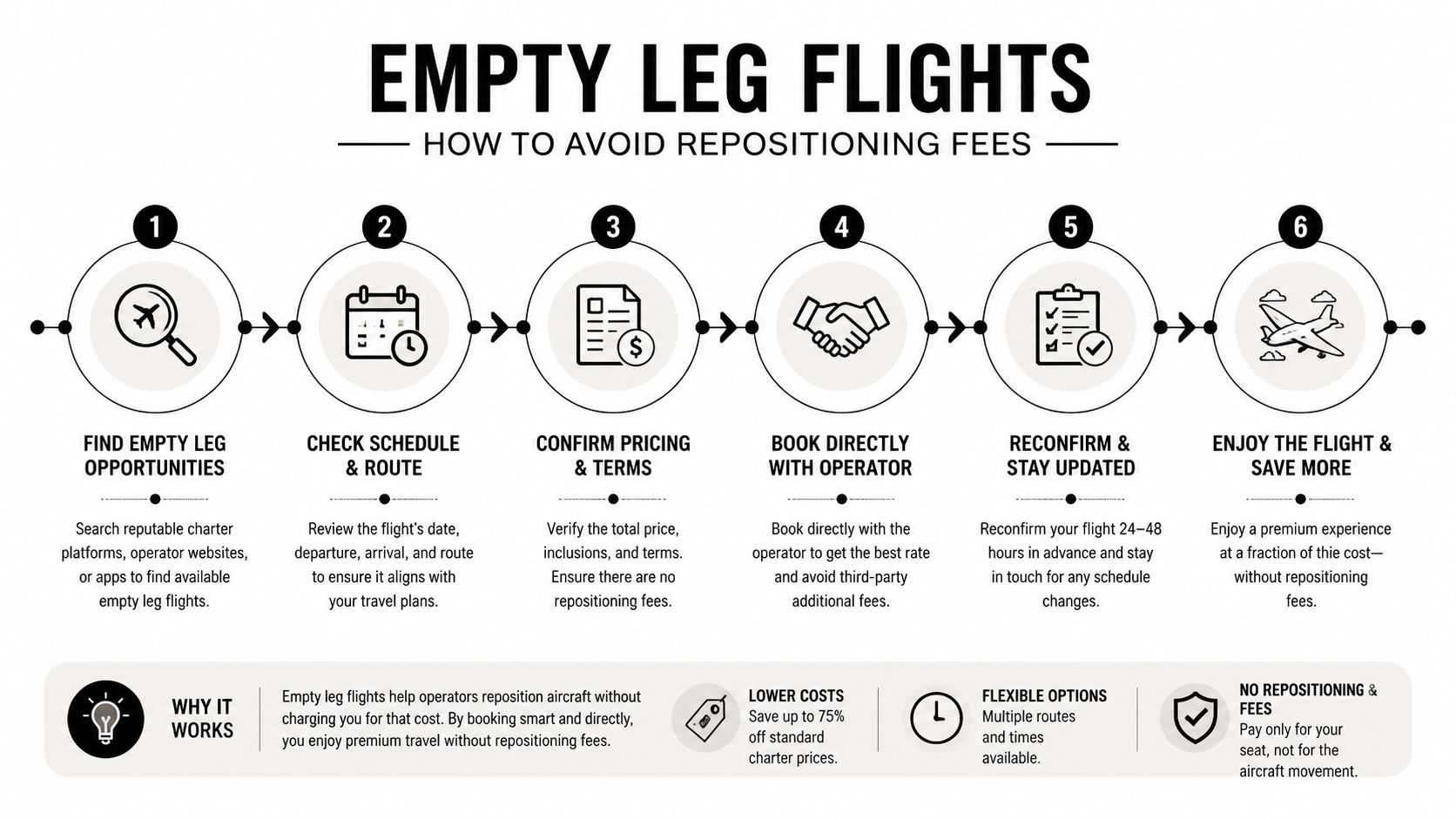
Empty Leg Flights and How to Avoid Repositioning Fees
An empty leg flies without charter passengers to return home, reach its next revenue flight, or travel to maintenance. That movement can lower the fare, but it also limits control. The route and timing already exist, so travelers must fit their plans around the aircraft.
Operators offer these flights because they are seeking revenue from a movement that would otherwise carry no passengers. Expect a one-way itinerary, a fixed departure window, or cancellation if a full-price charter books the aircraft. Do not build a critical business meeting around an empty leg without a backup.
Separate empty-leg savings from local sourcing
An empty leg can reduce the cost of an existing repositioning flight. Local sourcing prevents that ferry movement from being created.
Kansas City quotes often include deadhead time when a broker sources an aircraft in Dallas, Chicago, or Denver. The aircraft then flies to Kansas City, carries the passengers, and may reposition again afterward. An aircraft already available near MKC, MCI, IXD, or Johnson County can remove those segments and materially change the final quote.
The savings depend on the aircraft, route, timing, and operator. The billing mechanics are outlined in this explanation of repositioning costs. For a broader explanation, review this guide to empty-leg flights and their booking considerations.
Do not accept a vague “delivery fee.” Request the aircraft's current location, ferry routing, occupied flight time, and post-trip positioning plan. Those details show whether the quote reflects a genuine empty-leg opportunity or a broker markup layered onto local sourcing costs.
A practical empty-leg playbook
- Offer flexible dates: A wider departure window creates more chances to match an existing movement.
- Keep a backup aircraft: If the empty leg disappears, a second option prevents a last-minute scramble.
- Monitor matching routes: Ask for alerts when an aircraft is already moving between Kansas City and your destination.
- Confirm cancellation protection: Read the contract terms covering operator cancellation, replacement aircraft, and refunds.
- Compare local sourcing: A dependable Kansas City aircraft may provide better value than a cheaper empty leg with added ferry risk.
The right broker should explain that trade-off plainly. Cheap works only when the schedule, aircraft, and cancellation terms fit the mission.
Corporate, Celebrity, and Event Charter Considerations
Kansas City charter works best when the airport and aircraft are chosen around the traveler's operating problem. Corporate travelers usually care about schedule control and repeated same-day movements. High-profile travelers care about privacy, access, and controlled handling. Event travelers care about availability when the entire metro is competing for aircraft.
Corporate travel
For executive trips to Chicago, Dallas, or Denver, MKC can reduce ground time for central Kansas City travelers, while MCI may be more appropriate for a larger cabin or longer-range aircraft. A light jet can be the better choice when a team needs a faster regional itinerary and a compact aircraft can meet the baggage and runway requirements.
Multi-leg corporate days need special attention. The aircraft must remain available between meetings, crew duty must be legal, and the quote must account for waiting or repositioning. A low one-way figure can become irrelevant when the aircraft needs to stay with the passengers.
Celebrity and high-profile travel
Privacy depends on the entire movement, not just the cabin. MKC or OJC may offer a quieter ramp experience for a suitable aircraft, while the FBO team can coordinate vehicles, luggage, security, and passenger movement away from an airline terminal.
The charter coordinator should communicate directly with the traveler's security advance team. That includes passenger names, arrival timing, vehicle access, preferred FBO procedures, and any restrictions on photography or public handling. The aircraft's exact tail number should be confirmed before the itinerary is released to the broader travel team.
Event travel
Chiefs and Royals game-day demand, the Big 12 tournament, and concerts at GEHA Field at Arrowhead Stadium can compress aircraft availability around the same arrival and departure windows. Post-event repositioning can influence pricing sharply, especially when aircraft leave Kansas City for another market soon afterward.
| Profile | Recommended Airport | Cabin Class | Booking Lead Time | Key Consideration |
|---|---|---|---|---|
| Corporate executive | MKC or MCI | Light or midsize jet | As early as practical | Protect the schedule across multiple legs |
| Celebrity or high-profile traveler | MKC or OJC, subject to aircraft | Light through heavy jet | As early as practical | Coordinate privacy, security, vehicles, and FBO handling |
| Sports or event traveler | MKC or MCI | Match group size and baggage | Before peak event demand | Expect aircraft positioning to shape the total quote |
Haute Jets' wholesale, no-membership model fits these use cases when the team searches for the exact aircraft and departure field instead of selling a generic category. The buyer should still compare the operating certificate, tail number, total price, and cancellation terms before committing.
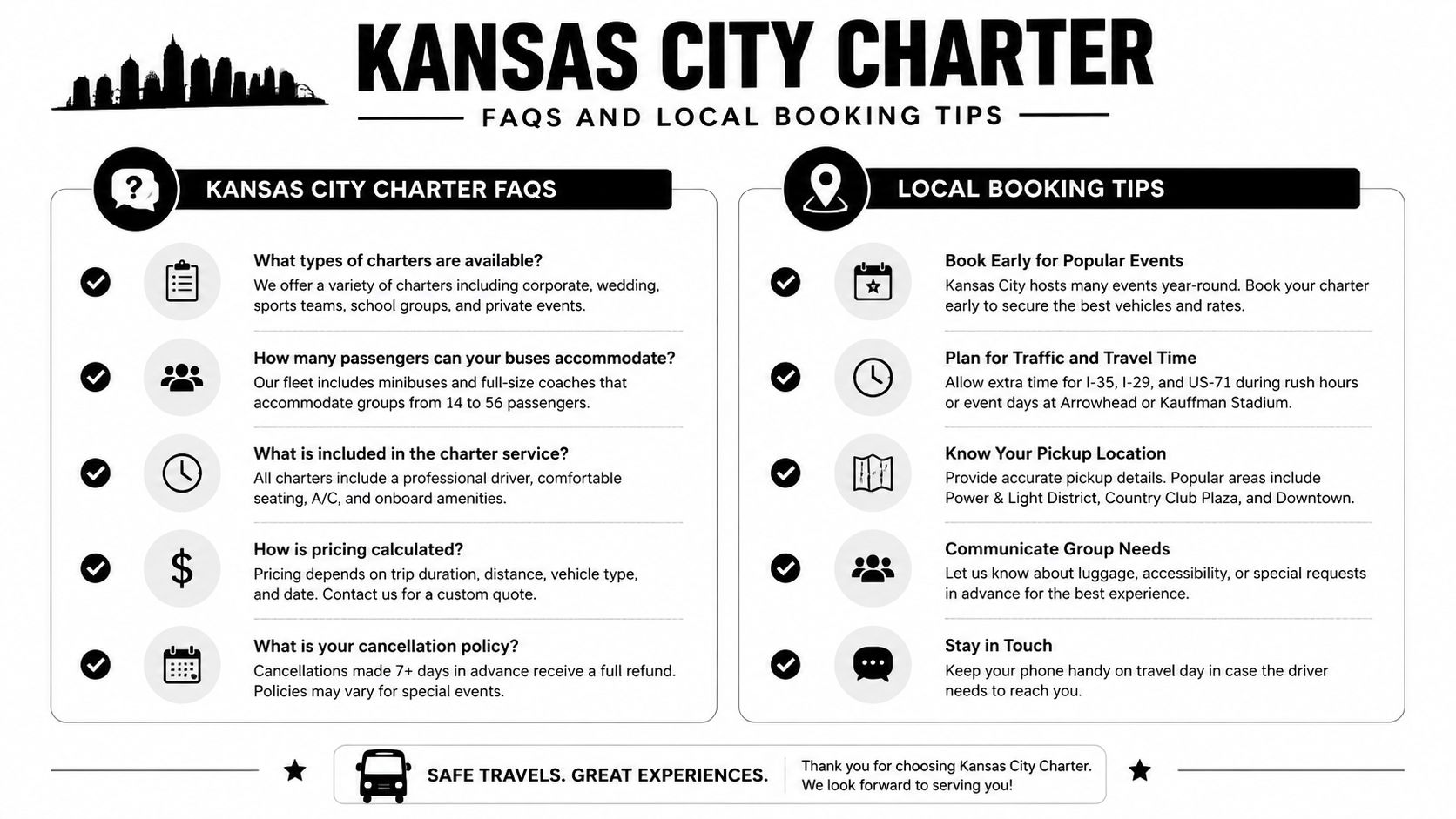
Kansas City Charter FAQs and Local Booking Tips
How much lead time should I allow? A locally positioned light jet may be available on short notice, while super-midsize and heavy aircraft generally require more coordination. Availability depends on the aircraft, crew, maintenance status, airport, and route, so ask for a confirmed tail number rather than relying on a category promise.
Can I bring a pet? Many operators allow pets in the cabin with advance notice, but policies vary by aircraft and operator. Service animals require appropriate accommodation, and the charter team should record the animal's size, carrier needs, and any documentation before issuing the final confirmation.
How can I pay? Charter providers commonly accept ACH, wire transfer, and major cards. Card processing terms can vary, and some providers may apply an additional charge for American Express. The contract should state the payment method, timing, refund treatment, and cancellation schedule.
Local checks that protect the budget
- Request both MKC and MCI: Price both airports even if one appears more convenient from your home or office.
- Avoid rigid peak windows: Friday evening departures can create tighter aircraft positioning, so ask about alternate times.
- Lock the tail number: A named aircraft is more meaningful than a promise of “a light jet.”
- Confirm the operator: Match the certificate holder to the aircraft flying.
- Inspect safety records: Verify the current ARGUS or Wyvern status directly in writing.
- Read cancellation language: Check what happens if the operator changes the aircraft or cancels the trip.
- Get the FBO address: Confirm the terminal, vehicle instructions, parking, and passenger arrival process.
The most useful question isn't “What's your cheapest jet?” Ask, “Which suitable aircraft is already positioned near Kansas City, which airport will it use, and what is the complete price for my itinerary?” That question exposes the cost mechanics most headline-rate pages leave out.
Haute Jets arranges on-demand Kansas City charters from MCI, MKC, OJC, and other suitable regional airports, with access to safety-rated aircraft sourced from owner-operators rather than membership-only inventory. Request an exact-aircraft, all-in quote through Haute Jets, and ask the team to compare local positioning before you approve the flight.