
You're probably dealing with one of two situations right now. Either you need to leave London on short notice and want the fastest, cleanest option without paying for someone else's inefficiency, or you're arriving in London and already know that “London” is not one airport, one price, or one operating reality.
That's where most charter buyers get burned.
They ask for a jet to or from London, get a polished quote, and assume the job is done. It isn't. In this market, the two decisions that matter most are which airport you use and whether the aircraft is positioned sensibly for your mission. Get those right and the trip feels effortless. Get them wrong and you lose time on the ground, absorb unnecessary repositioning cost, and wonder why a premium experience feels clumsy.
Welcome to London Your Global Aviation Crossroads
London isn't a simple charter market. It's one of the busiest and most operationally nuanced private aviation systems in Europe. That matters because private jet charter in London isn't just about booking an aircraft. It's about fitting the aircraft, airport, and timing to a city that runs through multiple airports, tight ground logistics, and heavy international demand.
The demand tells you everything. The UK recorded over 90,000 private jet flights in 2022, and private jet flights in the UK had quadrupled since the start of COVID-19, according to Simple Flying's UK private aviation statistics. The same report notes that London to Paris was the busiest private jet route in the UK, which is exactly what you'd expect from a city serving finance, diplomacy, entertainment, and short-haul European travel at the same time.
That scale creates opportunity, but it also creates noise. There are plenty of aircraft. There are also plenty of lazy quotes.
What serious clients should care about
If you're flying for a board meeting in Mayfair, a performance at the O2, or a family departure to the Med, your priorities are usually the same:
- Time control: You want the shortest total travel day, not just the shortest flight.
- Operational flexibility: You need an airport that can support your schedule.
- Transparent pricing: You want to know what you're paying for, especially on one-way and long-haul trips.
- Verified safety: You want the operator vetted before the quote ever reaches you.
Practical rule: In London, the closest airport on a map often isn't the smartest airport for the mission.
That's the key to this market. Most buyers focus on the jet first. Seasoned charter buyers focus on the airport and the aircraft positioning first, then select the aircraft that fits the mission.
Choosing Your London Gateway The Airport Decision
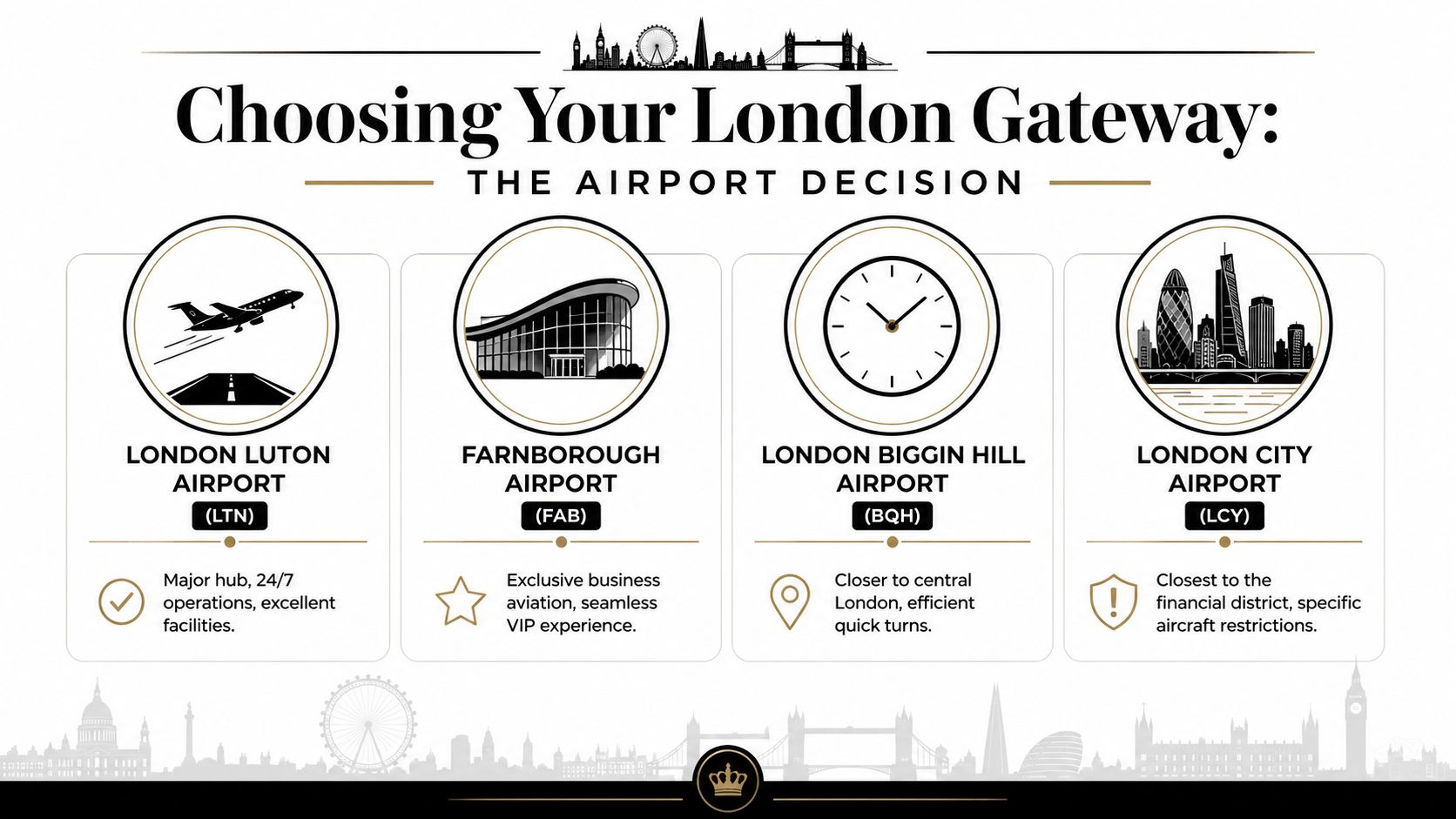
Airport choice decides whether your day runs cleanly or starts with friction. London is a multi-airport private aviation market, and broad charter pages often fail to explain the trade-offs. As Mercury Jets' London charter overview makes clear, the closer airport isn't always the better one if slot restrictions, congestion, or handling delays work against you.
Farnborough for pure business aviation efficiency
Farnborough is the cleanest choice for many corporate itineraries. It is built around business aviation, not squeezed around airline traffic. The passenger experience is usually smoother, the environment is more controlled, and crews know the field well.
If you're weighing it for a departure or arrival, review Farnborough Airport details on Haute Jets. It's often the right answer when the mission calls for discretion, polished handling, and a business-first ground experience.
Luton for flexibility and long-haul practicality
Luton is often the workhorse option. It's a major private aviation hub with broad operating capability and strong infrastructure. For travelers coming in from New York or heading out on a demanding international itinerary, Luton frequently makes operational sense because it can absorb more complexity than some of the tighter London fields.
Choose Luton when schedule flexibility matters more than prestige, or when the aircraft category and routing make a larger, more established hub the practical answer.
Biggin Hill for fast business turns
Biggin Hill works well for executives who want a business-focused airport with efficient handling and a strong private aviation identity. It can be an excellent middle ground. You get a dedicated private aviation environment without some of the trade-offs associated with larger mixed-traffic airports.
It's especially useful when your team wants quick access and a straightforward departure process without overcomplicating the ground leg.
London City for proximity, with caveats
London City is attractive for one obvious reason. It puts you closest to the financial district. If your destination is Canary Wharf or the City, that proximity is hard to ignore.
But proximity alone doesn't decide the mission. Aircraft restrictions and operating constraints can limit your options. That means London City is often ideal for specific trips, but not for every trip.
If your meeting is in central London, don't default to London City. Ask which airport gets you from car door to wheels up, or from touchdown to office, with the least friction.
Stansted for space and separation
Stansted can be very effective when you want VIP handling away from commercial terminal chaos and need an airport that can support larger or more complex missions. It may sit farther out for some itineraries, but distance on the map doesn't always equal slower total journey time.
That's the trap many first-time charter clients miss. A farther field can win if it avoids slot pressure, ramp congestion, or a longer repositioning chain.
Decoding London Private Jet Charter Costs
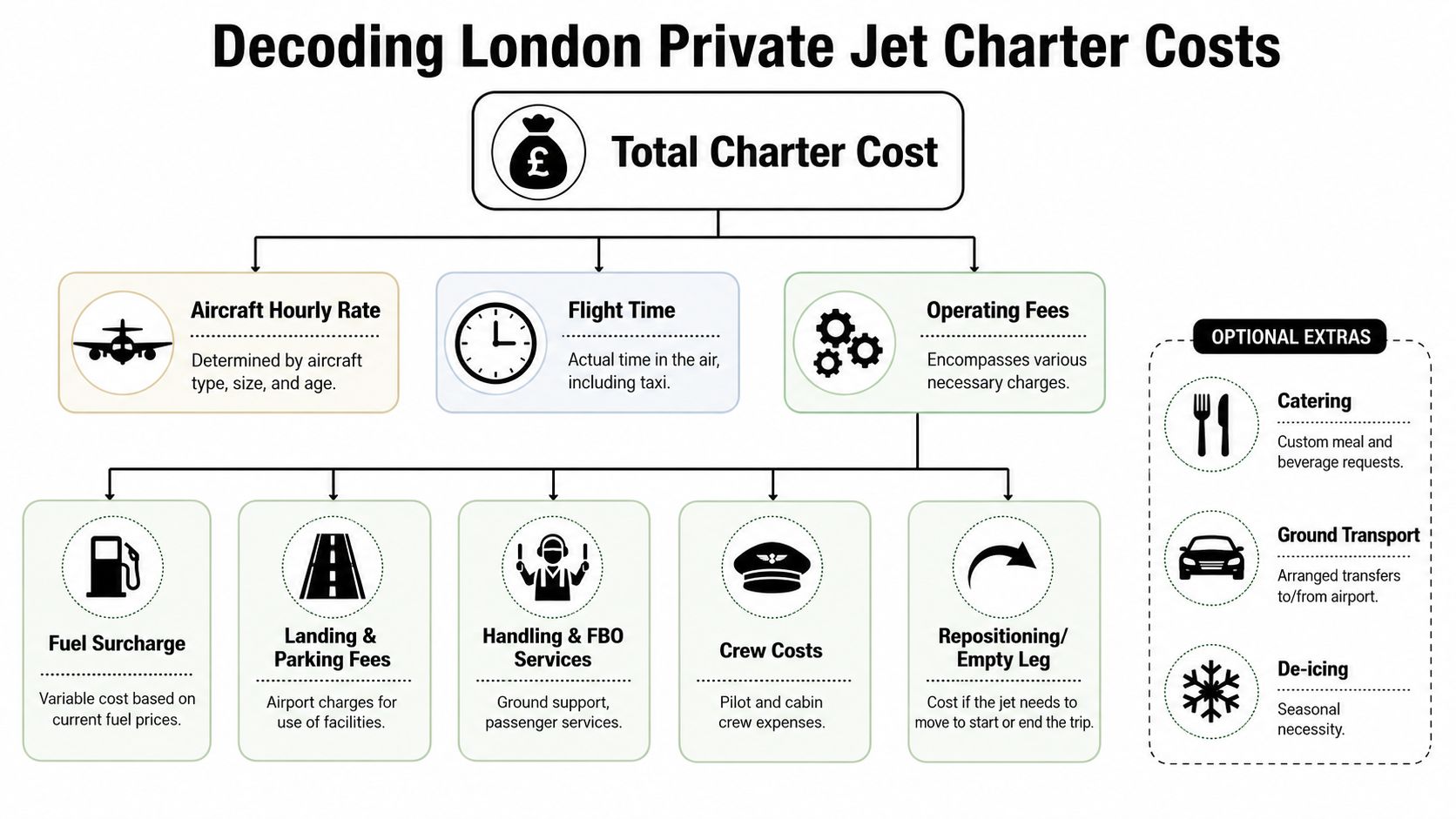
Most London charter quotes look simple until you ask the right question: what's included? A private jet charter quote is more like a restaurant bill than a sticker price. The aircraft is the entrée. Everything else determines whether the final total feels fair or inflated.
The broad rate range is real. London private jet charter pricing can run from $2,000 per hour for a light jet to over $17,000 per hour for an ultra-long-range aircraft, based on the aircraft category benchmark cited in the verified WikiJets study provided in your brief. That spread is why “starting from” pricing tells you very little on its own.
The aircraft sets the pricing lane
Aircraft size and range drive the first major cost difference.
A light jet works for short European sectors and keeps the hourly rate down. A large-cabin aircraft changes the economics entirely, especially once you move into nonstop intercontinental flying. For example, the verified data in your brief notes that for a non-stop London to Singapore mission, only specific aircraft such as the Gulfstream G650 ER, Boeing BBJ787, and Challenger 605 ER meet the range requirement. That's why long-haul pricing jumps sharply when the mission demands true range, not just cabin comfort.
The quote should break down like this
A serious charter quote should separate the major cost drivers so you can see what's structural and what's avoidable.
- Aircraft hourly rate: This is the base operating band tied to aircraft type and range.
- Flight time: The longer the mission, the more the hourly rate matters.
- Airport and handling charges: These vary by airport and service level.
- Crew and operational items: Overnight crew logistics, waiting time, and mission-specific operating requirements can move the total.
- Repositioning: Many buyers often overpay.
For a clearer framework, review Haute Jets' private jet charter cost guide. The important point is simple: don't compare quotes unless you know whether they're built on the same mission assumptions.
A quick visual helps if you're comparing proposals from multiple brokers.
Why route headlines can mislead you
Long-haul examples prove the point. JetFinder's private aviation market data reports 3.3 million private flights worldwide in 2021, rising to almost 5 million in 2022, with the United States accounting for 3.3 million departures in 2022. That same source estimates a New York to London private trip at around $60,000 to $75,000 for a heavy jet and $85,000 to $100,000 for an ultra-long-range jet, which gives you a benchmark for the high-cost end of the market on a major corridor, according to JetFinder's private jet statistics.
But benchmark numbers aren't final numbers. The final bill changes with cabin configuration, where the aircraft starts, whether it waits, and how the operator structures the return.
A London quote that looks cheap at first glance often gets expensive once the aircraft positioning and mission logistics are exposed.
That's why experienced buyers don't ask, “What's the hourly rate?” They ask, “Where is the aircraft based, what does the mission require, and what exactly turns this quote into the final invoice?”
The Smart Way to Save Local Sourcing and Empty Legs
If you want to control cost in London, stop negotiating around the edges. The biggest avoidable mistake is paying for the wrong aircraft to get to your aircraft.
The strongest cost lever is local sourcing. Verified data in your brief states that sourcing aircraft from outside the M25 corridor can inflate charter costs by 20 to 40 percent, while using a local aircraft removes those repositioning charges and improves on-time performance by 35 percent, based on the cited Eurasian Aviation 2024 analysis. That's not a minor adjustment. It's the difference between paying for your trip and paying for somebody else's ferry leg.
Where the waste usually happens
Many brokers shop by availability first, not proximity first. That sounds harmless until you see the invoice. If the aircraft is based well outside your departure area, you may be billed for the empty repositioning sector needed to bring it into London before your trip even begins.
The same verified data notes that, on a typical light jet charter from Farnborough or Luton to a European destination, local sourcing can eliminate $1,500 to $3,000 per flight leg in tail-up costs and reduce the billable hourly rate by 15 to 25 percent. For frequent flyers, that's not a rounding error. It's a recurring leak.
Sample London charter route estimates
The table below uses only verified route examples and verified market ranges from your brief. Flight times are described qualitatively because no verified flight-time figures were provided for these specific London routes.
| Route | Aircraft Category | Estimated Flight Time | Estimated Cost (USD) |
|---|---|---|---|
| London to Paris | Light jet | Short-haul European sector | From the lower end of London light-jet pricing, subject to airport and repositioning costs |
| New York to London | Heavy jet | Transatlantic | $60,000 to $75,000 |
| New York to London | Ultra-long-range jet | Transatlantic | $85,000 to $100,000 |
| London to Los Angeles | Long-haul jet | Long-haul | $123,500 to $145,600 |
| London to Singapore | Ultra-long-range aircraft | Ultra-long-haul | Premium mission pricing based on aircraft capability |
Empty legs can work, but only if your schedule can bend
An empty leg is a repositioning flight an operator is already planning to fly. If your timing and routing match it closely enough, you may secure better value than a standard bespoke charter. The catch is that empty legs work on the aircraft's schedule first and yours second.
If that's a strategy you want to understand properly, read this empty leg flight guide from Haute Jets Journal. It's useful, but only for flexible travelers. If your meeting, event call time, or family departure window is fixed, local sourcing usually matters more than chasing an empty leg that may not align cleanly.
The smart client shops for operational fit first, discount opportunities second.
Navigating the Booking Process from Quote to Takeoff
A well-run charter booking should feel controlled from the first call. If it feels vague, rushed, or incomplete, that's a warning sign.
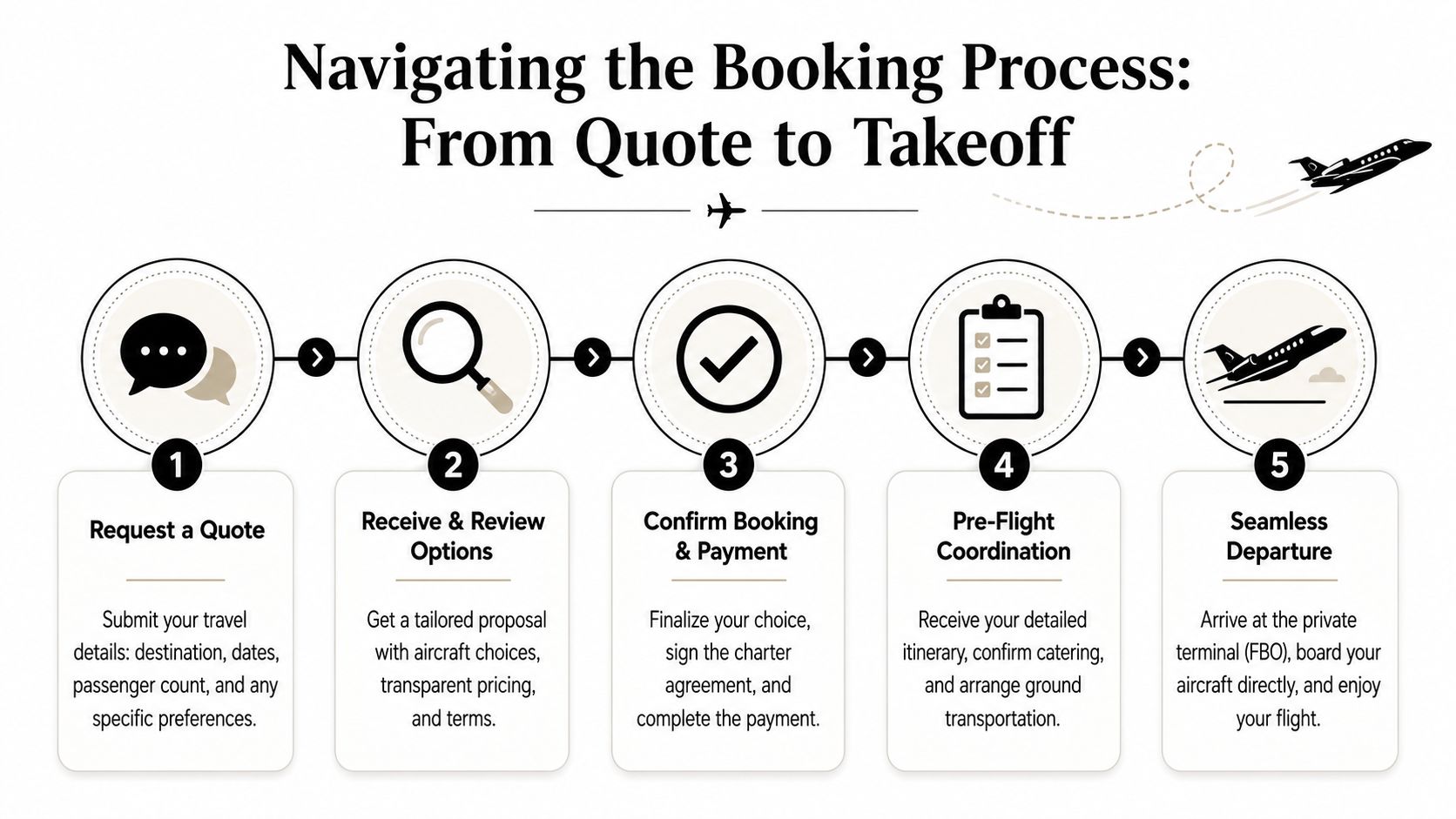
The process starts with your mission details. Not just departure city and destination, but your preferred airport, passenger count, luggage profile, schedule rigidity, and any onboard requirements that matter. Pets, Wi-Fi, sleeper configuration, specific catering, and ground transfer timing should be established early, not patched in later.
What a clean booking flow looks like
Request and mission brief
You provide the itinerary, preferred timing, passenger names, and special requirements.Aircraft options and quote review
The broker should return with a curated set of aircraft, not an undifferentiated list. You want to see the exact aircraft details, operator credentials, airport plan, and pricing logic.Agreement and payment
Once you approve the aircraft and terms, you receive the charter agreement. Read it. Confirm cancellation terms, waiting time assumptions, and whether the quote reflects the airport plan you approved.Pre-flight coordination
Catering, ground transport, passport details for international travel, and any final manifest items are confirmed.Departure through the FBO
You don't use the airline terminal. You arrive at a Fixed-Base Operator, or FBO, which is the private terminal handling your departure.
The FBO is part of the service, not a side detail
First-time clients often underestimate how much the FBO changes the day. You arrive to a private terminal, clear formalities in a controlled environment, wait in a lounge rather than a gate area, and board directly. That's one of the reasons private aviation works so well when every minute matters.
A serious provider also sends a proper pre-flight brief before departure. You should receive the itinerary, aircraft tail number, crew information, and the final operating details in advance. If you're still asking basic questions on departure day, the booking wasn't handled tightly enough.
Your Assurance of Safety Wyvern and ARGUS Standards
This is the simplest part of the decision, and buyers still get it wrong. Safety is not where you compromise to save money.
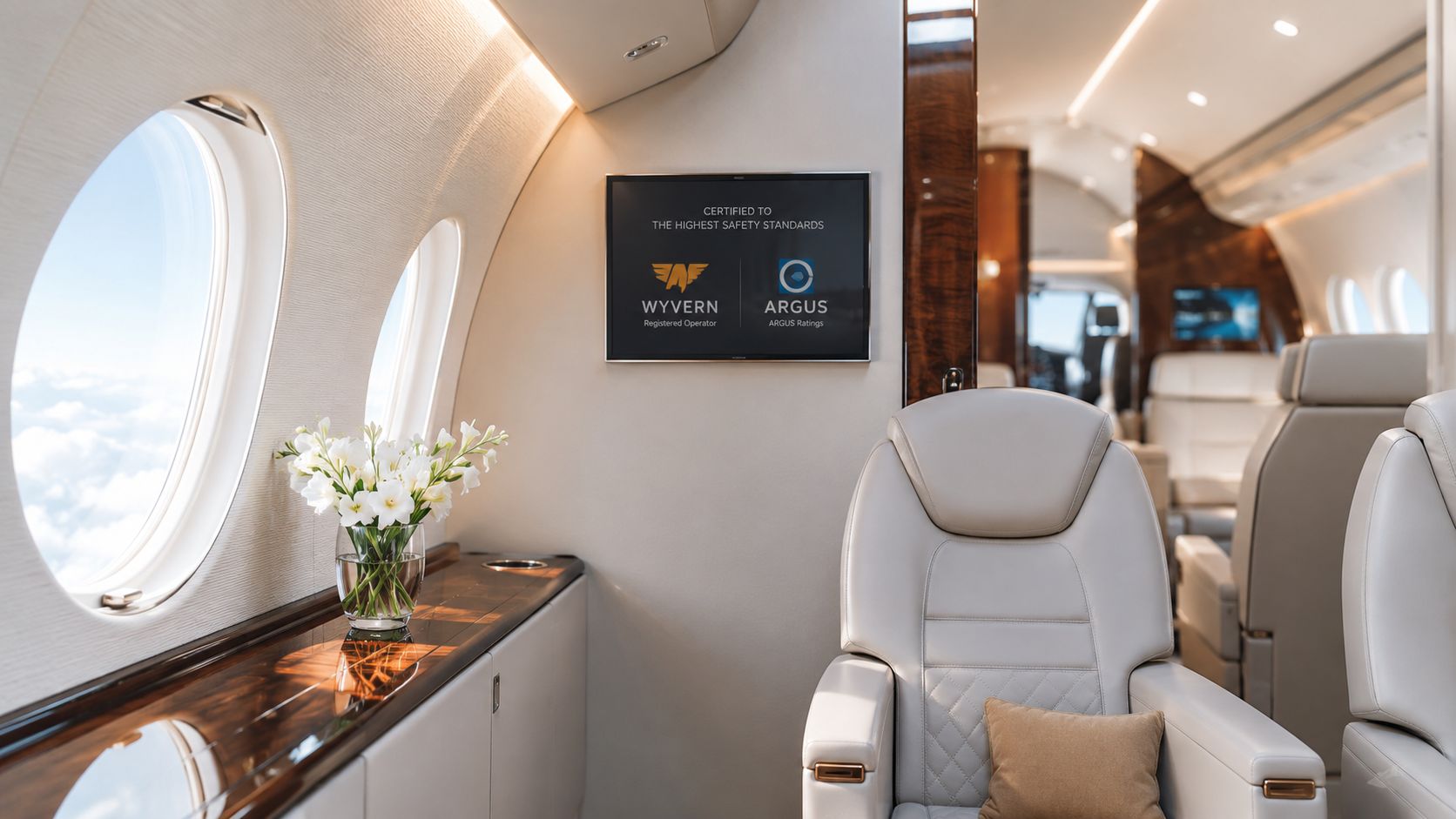
Every legal charter operator must meet regulatory requirements. That's the floor. It is not the standard you should be shopping to. A key filter is whether the operator also carries respected third-party safety oversight such as Wyvern Wingman or ARGUS Gold or Platinum.
Why those ratings matter
These standards tell you that someone independent has reviewed more than the aircraft registration. They examine operational discipline, pilot qualifications, training history, maintenance oversight, and safety systems.
That matters even more on long-haul bookings, where the invoice can rise sharply depending on aircraft and mission structure. A London to New York all-in trip can range from £62,000 for a Gulfstream IV to more than £255,000 for a Boeing Business Jet, according to PrivateFly's London to New York route guide. When the spend is that significant, the operator standard should be explicit, not assumed.
The right question to ask
Don't ask whether the flight is “safe.” Every broker will say yes.
Ask these instead:
- Which operator is flying this mission
- Does that operator hold Wyvern Wingman or ARGUS Gold/Platinum
- Will I receive the aircraft and crew details before departure
- Has this quote been built around a properly vetted operator, or around price first
Safety due diligence should happen before the quote reaches your inbox, not after you've fallen in love with the cabin photos.
Fly Smarter Your London Charter with Haute Jets
You leave Mayfair at 7:00 a.m. for what looks like a simple departure. By 7:40, the day is already off track because the aircraft was quoted from the wrong London airport and priced with avoidable positioning baked in. That is how expensive charter mistakes happen. Not in the air, but in the planning.
Smart private jet charter London clients focus on two decisions first. They choose the airport that cuts total journey time, not the one with the strongest name recognition. They read the quote as a full mission, including aircraft position, crew duty, parking, and timing pressure, rather than chasing the lowest headline number.
Get those two calls right and the rest of the trip usually falls into place.
If you want a practical option for that approach, Haute Jets says it sources from a global fleet network, uses Wyvern and ARGUS-rated operators, lets clients approve the specific aircraft, and offers on-demand charter pricing without memberships or prepaid programs. In London, that matters because airport choice and local aircraft availability often have more impact on value than the cabin brochure.
Use a simple standard before you book. Ask which airport saves the most door-to-door time. Ask whether the aircraft is already positioned logically for your route. Ask for the complete trip cost, not a teaser rate that grows after scheduling, handling, and repositioning are added.
Serious travelers buy time, control, and operator quality. If a quote misses any of those, reject it.