

A nonstop Los Angeles to New York private jet typically takes about 5 hours eastbound and 5 hours 15 minutes to 6 hours westbound, with one-way pricing commonly landing between roughly $28,000 and $60,000, depending on aircraft category and date. If you're comparing quotes today, the biggest question isn't which jet you can buy, but which aircraft is already positioned close enough to avoid paying for someone else's empty repositioning leg.
You may be planning a board meeting in Manhattan after breakfast in Los Angeles, coordinating an entertainment production, or moving a small executive team across the country without losing a full travel day. The route is long enough to expose weak aircraft choices, inconvenient airport selections, and inflated broker pricing, but it's still short enough for a nonstop private flight to remain operationally practical.
The sourcing decision matters. A locally positioned owner-operator aircraft can produce a materially different quote from a similar jet that must first cross the country to collect you. Legacy brokers and jet-card programs may pass those repositioning costs back to the client, often without making the line item obvious.
Why Los Angeles to New York Is a Signature Transcontinental Charter Route
Los Angeles to New York is a serious domestic mission, not an extended short-haul flight. Published route data place the corridor at about 2,129 nautical miles, or roughly 2,450 to 2,475 statute miles, equivalent to about 3,940 to 3,944 kilometers (route distance and timing data). The distance explains why aircraft choice, payload, reserves, and wind conditions matter before anyone discusses cabin finishes or catering.
Eastbound flights commonly benefit from prevailing winds and can complete the nonstop sector in roughly 4 hours 44 minutes to 5 hours 30 minutes. Westbound returns usually take longer, with route guidance placing a direct flight at approximately 5 hours 15 minutes, and operational estimates extending toward 6 hours when conditions and aircraft performance require it (neutral route timing guide). That difference affects more than the arrival time. It can determine whether a lighter aircraft preserves legal reserves, accepts the full passenger and baggage load, or needs a technical fuel stop.
Start with the mission, not the aircraft brochure
Use a simple order of decisions:
- Confirm the passenger and baggage load. Four passengers with soft luggage create a different mission from four passengers carrying golf equipment, pets, or production cases.
- Choose the nonstop standard. If a fuel stop is unacceptable, ask the operator to evaluate the westbound leg first. Advertised maximum range isn't the same as practical range with payload, winds, reserves, and crew requirements.
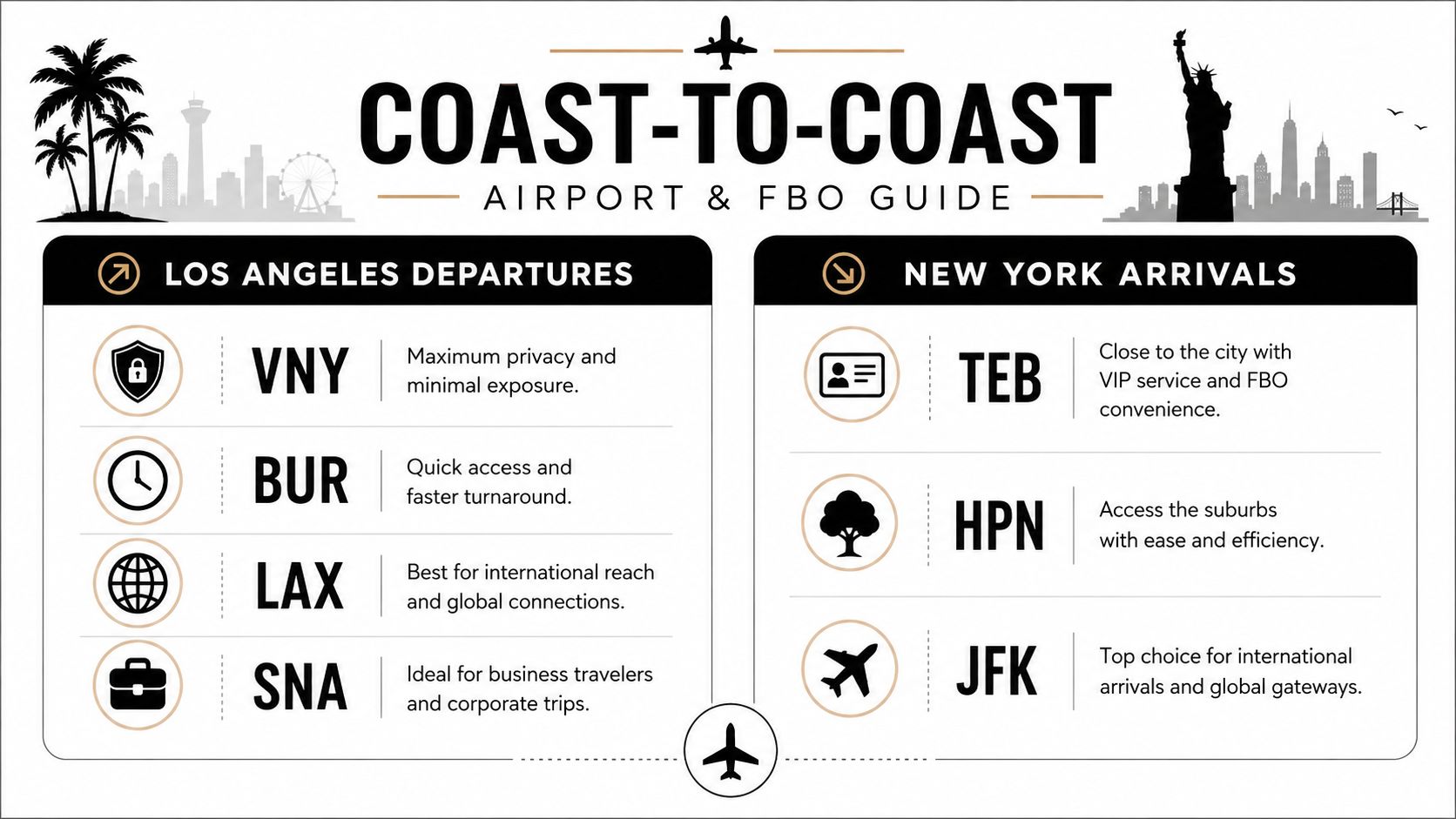
- Select airports around the ground itinerary. VNY to TEB may work for a Manhattan meeting, while SNA to HPN may be better for Orange County and suburban Connecticut.
- Price the date against availability. A technically suitable jet isn't useful if it must reposition from another region or carries a peak-date premium.
This corridor stays heavily quoted because it connects major finance, entertainment, and technology centers. The commercial value isn't only speed. A nonstop private flight can turn a fragmented commercial travel day into a controlled itinerary with a departure time, airport, cabin, and arrival plan built around the traveler.
Practical rule: Treat the route as three linked purchases, aircraft capability, airport convenience, and positioning efficiency. The cheapest hourly rate can lose on the final invoice if the aircraft starts far from Los Angeles.
Aircraft Categories That Can Actually Fly This Route Nonstop
The LA to New York distance sits at or beyond the practical range envelope of many light and midsize aircraft when the cabin is full. Route-specific guidance places a Challenger 350-class super-midsize jet near 4 hours 58 minutes for the sector, while category benchmarks put super-midsize aircraft around 4 hours 45 minutes to 5 hours 15 minutes, heavy jets around 4 hours 30 minutes to 5 hours, and ultra-long-range aircraft as low as 4 hours 10 minutes to 4 hours 40 minutes on favorable eastbound profiles (aircraft timing benchmarks).
The right category depends on range margin, not just the number printed in a marketing specification. A light jet may appear capable under ideal assumptions, but full passengers, baggage, westbound winds, and reserve requirements can force a stop or payload restriction. A super-midsize jet usually gives the cleanest balance between nonstop performance, cabin comfort, and cost.
| Category | Example Aircraft | Typical Pax | Nonstop Eastbound | Nonstop Westbound | Position vs. Light |
|---|---|---|---|---|---|
| Light | Citation CJ4, Phenom 300 | Small group | Possible with tradeoffs | Often requires a stop or payload limits | Lowest cabin and operating-cost profile |
| Midsize | Citation Latitude, Challenger 350 | Small team | Generally practical | Practical on many days, subject to reserves | More range and cabin space |
| Super-midsize | Citation Sovereign+, Challenger 3500 | Six to eight | Strong fit | Strong fit with useful reserve margin | Recommended balance for most nonstop missions |
| Heavy | Gulfstream G450/G550, Global Express | Larger group | Comfortable | Comfortable | Higher cost, more cabin and baggage capacity |
| Ultra-long-range | Gulfstream G650ER, Global 7500 | Larger VIP group | Excellent | Excellent | Maximum range, space, and global connectivity |
Light aircraft are the category where travelers most often underestimate the tradeoff. A fuel stop can add substantial ground time and disrupt a same-day itinerary, even if the initial charter estimate looks attractive. Midsize aircraft improve the proposition, but operators still need to validate the westbound profile rather than promise nonstop service from a generic range chart.
Why super-midsize is usually the rational choice
For many clients, the super-midsize cabin is the practical center of the market. It can support a nonstop coast-to-coast mission in both directions, offers a stand-up cabin on many models, and provides enough room for work, meals, and normal luggage without paying for a heavy jet's additional capacity.
Heavy and ultra-long-range aircraft make sense when the cabin itself is part of the mission. Choose them for larger groups, sleeping arrangements, oversized baggage, multiple cabin zones, or an onward international itinerary. Travelers comparing those flagships can review ultra-long-range jet options, but don't assume the largest aircraft is automatically the best value for a small party.
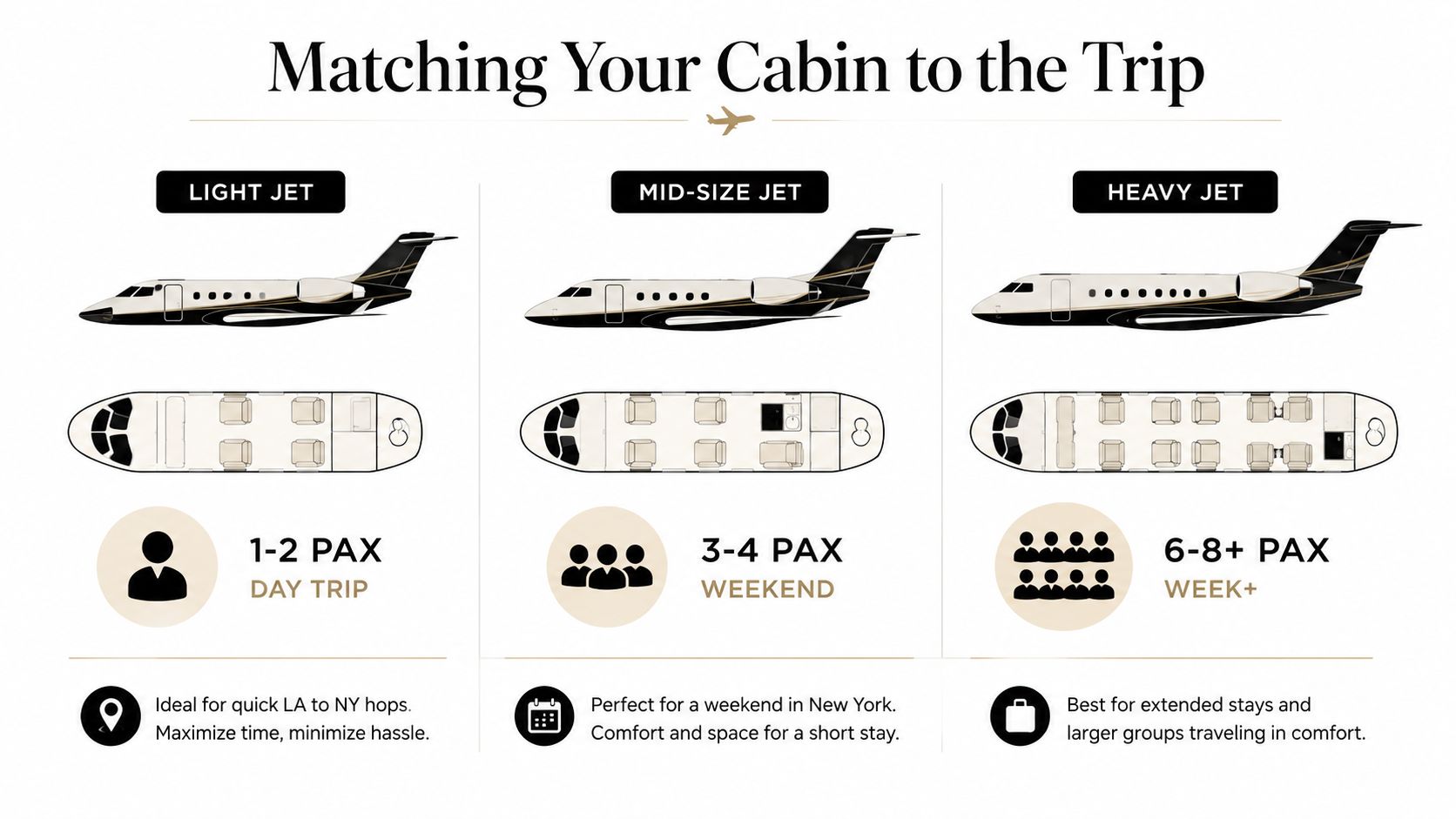
Matching the Right Cabin Size to Your Trip
Passenger count is only the starting point. Trip behavior determines whether a smaller aircraft remains comfortable after luggage, work materials, pets, and schedule pressure enter the picture.
A solo executive or two-person team making a rapid turnaround may favor a light or midsize aircraft if the operator confirms the range profile and the passengers accept a tighter cabin. That approach can reduce exposure to the higher operating costs associated with larger equipment, but it shouldn't override the nonstop requirement.
Use the cabin as a working tool
A group of four to seven passengers generally fits a super-midsize jet particularly well. The flat floor, useful baggage area, and seating arrangement support a working meeting without forcing everyone into a compact cabin. Add a pet, golf bags, or bulky cases, and the super-midsize category becomes more compelling even when the passenger count stays modest.
Eight or more travelers, families requiring a bedroom, or teams carrying substantial equipment should start with a heavy jet. The extra cabin zones let some passengers work while others rest, and the additional baggage capacity reduces the risk that the operator must remove items to satisfy weight and balance requirements.
A useful self-selection test looks like this:
- Day trip for one or two executives: Consider light or midsize, but verify westbound nonstop performance and baggage limits.
- Four to seven travelers with luggage: Choose super-midsize unless the quote difference is unusually wide and the itinerary tolerates compromise.
- Eight-plus passengers or a sleep-focused mission: Request heavy aircraft first.
- Production, conference, or onward travel: Start with the equipment and itinerary, then select the cabin around them.
The private jet seating guide is useful when the advertised passenger count doesn't describe how people will occupy the cabin. A seat count can conceal a poor layout, limited baggage access, or inadequate space for a meeting.
How Pricing Works and What Quietly Moves the Quote
A realistic one-way planning range for this corridor is roughly $28,000 to $60,000, but that range isn't a route average. Independent route estimates show lighter categories around $28,421 to $43,725, while heavier cabins can reach approximately $37,554 to $59,013 (route pricing benchmarks). Another guide places tailwind-favored itineraries around $35,000 to $40,000, with larger or peak-date missions reaching $70,000 to $95,000 or more under different assumptions (additional route pricing context).
The same route can therefore produce two very different quotes without either provider making a mistake. The aircraft may be based in different places, the dates may fall into different demand periods, or one proposal may include a return ferry, crew overnight, or airport cost that the other treats differently.
| Pricing Lever | Typical Dollar Impact | Notes |
|---|---|---|
| Aircraft category | Varies by cabin and mission | Larger aircraft bring more space, range margin, and operating cost |
| Repositioning or deadhead | Can be substantial | The aircraft may need to fly empty to Los Angeles before pickup |
| Peak-date demand | Varies by date | Fashion Week, Thanksgiving week, UN General Assembly, and major award shows can tighten availability |
| Payload or fuel stop | Varies by aircraft | A lighter aircraft may require a stop or limit baggage |
| Crew overnight | Varies by itinerary | Round trips with a long stay can create hotel and duty-related charges |
| Winter operations | Varies by conditions | De-icing and weather-related handling may affect New York departures |
| Quoted versus flown time | Varies by operator method | Ask whether the proposal reflects block time, flight time, or an estimate |
Read the quote line by line
Repositioning is the quietest major variable. If a West Coast operator has a suitable aircraft nearby, you may pay for the mission you requested. If a broker sources a tail from elsewhere, the empty collection leg and subsequent return positioning can enter the economics.
Peak dates create a different problem. New York Fashion Week, Thanksgiving week, the UN General Assembly, and major award shows can compress availability across the relevant airports and aircraft categories. A client who waits until the schedule is fixed may have fewer choices and less bargaining power.
The private jet charter cost guide offers a useful framework for separating aircraft cost from trip assumptions. Ask for an all-in proposal that identifies aircraft, airports, positioning, catering, ground transportation, crew expenses, and cancellation terms.
Ask this before signing: “Which charges remain if the aircraft is already positioned locally, and which charges appear only because of this specific tail?”
Early booking and a flexible one-day positioning window can reduce the final quote in some circumstances, but no fixed savings percentage should be assumed. The correct comparison is between two complete proposals with the same aircraft category, passenger load, airports, service level, and cancellation terms.
Airport and FBO Choices on Both Coasts
Airport selection can change the practical value of a private jet charter los angeles to new york more than a premium cabin amenity. On the Los Angeles side, Van Nuys Airport, Hollywood Burbank Airport, LAX, and SNA serve different ground itineraries and operational needs.
VNY is often the default for private aviation in the Los Angeles basin because it supports a broad range of business aircraft and has established FBO infrastructure. BUR can be attractive for studio and Burbank-area travel, while LAX may suit an international connection or a passenger whose final destination makes its commercial access worthwhile. SNA can work well for Orange County, although airport operating constraints and local noise considerations must be checked against the departure plan.
Select the arrival airport around the meeting
On the New York side, Teterboro, Westchester County, and Republic Airport serve different destinations. TEB is usually the logical starting point for Manhattan business travel. HPN may be more efficient for Westchester, Connecticut, or northern suburban destinations, while FRG can help travelers bound for Long Island.
JFK enters the discussion when international connectivity or a specific itinerary requires it, but a commercial-heavy airport can introduce more congestion and ground complexity than a dedicated business aviation field. Ask the operator to evaluate ramp access, operating hours, slot or congestion conditions, customs requirements for any international continuation, and the actual car route to the destination.
FBO ground time can range from approximately 10 minutes at a quiet Signature ramp to more than 40 minutes at JFK during peak periods, according to the operational comparison in the route brief. Airport choice alone can shift the itinerary by 30 to 60 minutes, and it can reshape the bill through landing fees, handling, parking, and ground transportation requirements.
Don't choose an airport solely because it appears closest on a map. Give the charter team your actual destination, arrival deadline, luggage profile, and preferred ground transfer. A slightly less obvious airport can produce the better door-to-door result.
Booking a Los Angeles to New York Charter With Haute Jets
The booking process should begin with the mission, not a request for “the cheapest jet.” Provide the date, preferred departure window, passenger names when available, baggage details, pets, airport preferences, return plans, and any onward connection. Ultra-long-range operators may require a longer planning window, while lighter-cabin availability can appear much closer to departure, but aircraft quality and local positioning become harder to control as the date approaches.
Haute Jets maintains a journal for charter guides and aviation news at its private aviation journal, and its route-specific process centers on sourcing the aircraft around the client's actual departure city. The important distinction is local supply. Rather than defaulting to a distant national-fleet tail, the team can compare owner-operator aircraft near Los Angeles, which may remove repositioning line items that legacy broker and jet-card models pass to the traveler.
What to expect after the inquiry
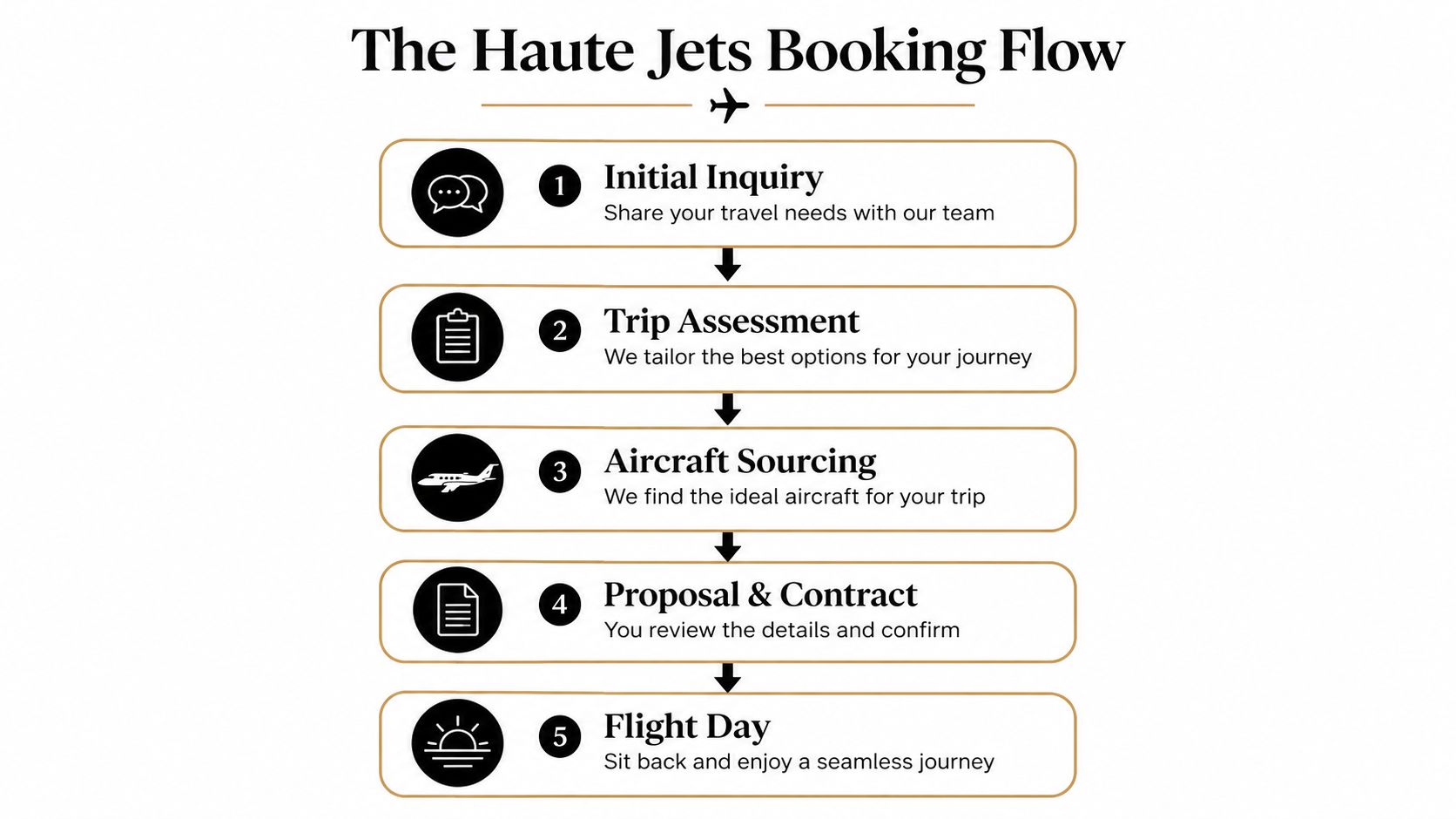
A disciplined booking flow should include:
- Trip assessment: The advisor confirms passenger load, baggage, pets, timing, airport pair, and whether nonstop capability is mandatory.
- Aircraft sourcing: The team checks suitable aircraft by category, location, range margin, cabin layout, operator credentials, and availability.
- Quote review: You receive the aircraft identity and an all-in proposal, with positioning, airport, crew, catering, and ground costs clearly addressed.
- Contract and payment: The selected itinerary moves into the charter agreement and payment or escrow process under the provider's terms.
- Operational confirmation: Before departure, the team reconfirms the tail number, crew, weather, manifest, FBO, catering, and transportation.
A locally positioned aircraft can outperform a nominally cheaper hourly rate. A jet with the right cabin but the wrong base may carry empty-leg costs that erase the initial price advantage. Ask for the location of the proposed aircraft and request a comparison with a locally available alternative.
Departure day should be straightforward. Arrive at the selected FBO with enough time for passenger processing and security procedures, then let the crew manage the operational details. Changes are possible only within the aircraft's crew duty, airport, weather, and availability limits, so communicate changes as early as possible rather than treating flexibility as unlimited.
Putting It All Together for Your 2026 Coast-to-Coast Flight
Take a realistic planning case: four executives traveling on a Tuesday in mid-March 2026. They need to work in the air, carry standard luggage, and reach Manhattan without a fuel stop. The sensible first comparison is a super-midsize aircraft against a heavy jet, not a light jet against every aircraft in the market.
The super-midsize option is usually the starting point because it offers an efficient cabin for four passengers and the range profile needed for a serious nonstop evaluation. A heavy jet becomes justified if the group needs sleeping space, multiple cabin zones, substantial baggage volume, or a more spacious work environment. The correct choice depends on the mission, not prestige.
Build the itinerary from the ground outward
For Los Angeles, compare VNY and LAX based on the passengers' origin, FBO availability, operating requirements, and the aircraft's current position. For New York, compare TEB and HPN against the meeting location and ground route. The best airport pair is the one that minimizes total travel friction while keeping the aircraft and crew plan clean.
Then request two fully comparable quotes:
- Local aircraft proposal: Aircraft already positioned near the selected Los Angeles departure airport.
- Non-local aircraft proposal: Similar category and cabin, with every repositioning and return leg disclosed.
- Airport-adjusted proposal: Same aircraft category, but alternate LA and New York airports where practical.
- Date-flexible proposal: The preferred date plus an acceptable nearby departure window.
Haute Jets' published pricing page uses $30,000 for a New York to Los Angeles one-way example and states that private charter prices start from $3,500 per hour, which provides a route-specific reference point rather than a guaranteed quote (Haute Jets pricing page). Independent route estimates also show that one-way pricing can span approximately $33,661 to more than $61,793 when cabin size and assumptions change (route aircraft and pricing comparison).
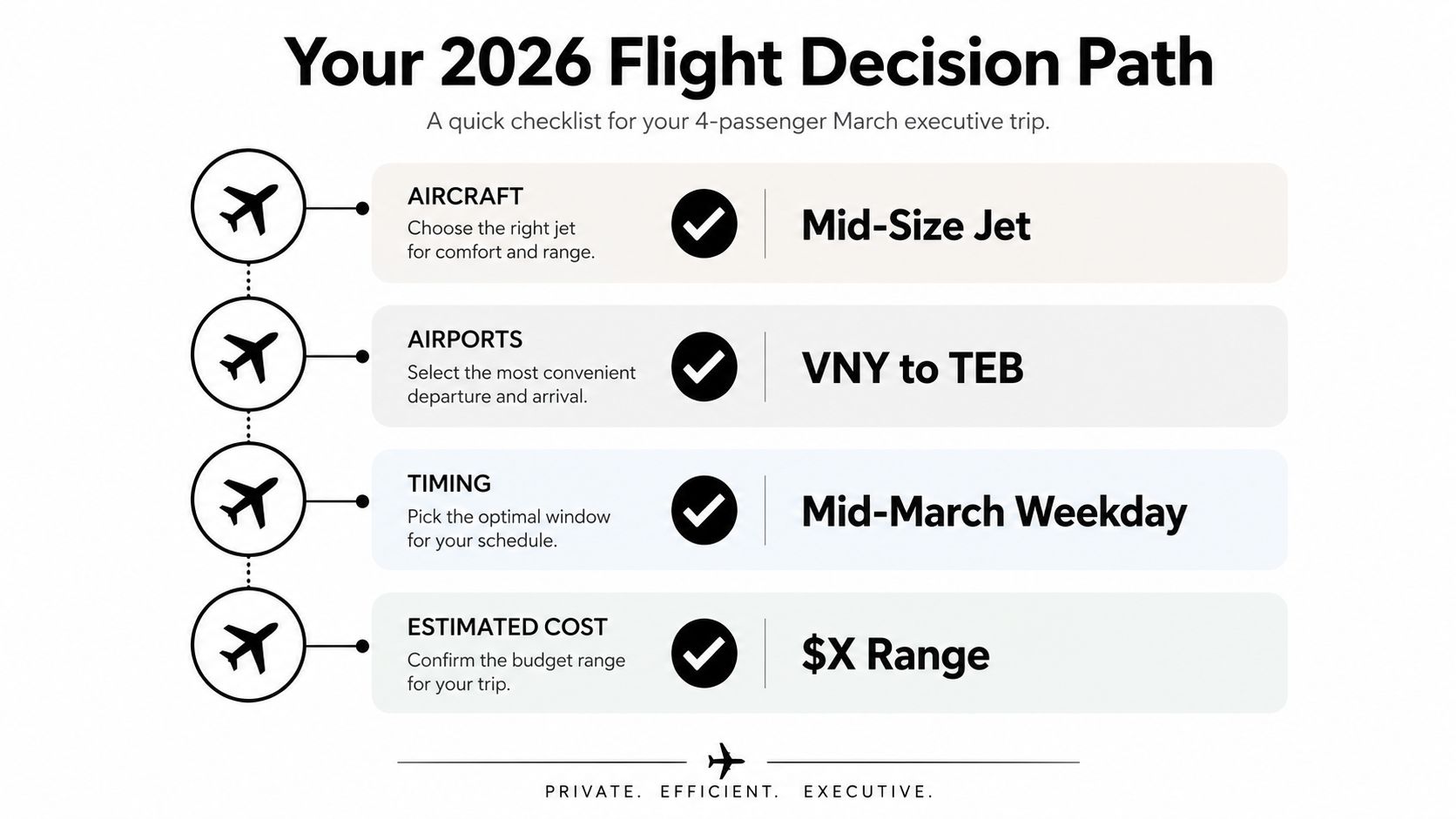
Before accepting the proposal, confirm the following:
- Aircraft model and exact cabin layout
- Nonstop range assumptions in both directions
- Passenger, baggage, and pet requirements
- Departure and arrival FBOs
- Repositioning charges and ferry legs
- Crew, catering, de-icing, and ground transportation costs
- Cancellation and schedule-change terms
- Final pre-flight confirmation process
A good private jet charter los angeles to new york quote is specific enough that you can explain why it costs what it costs. If the provider can't identify the aircraft, positioning plan, airport assumptions, and included services, you're not comparing charter prices. You're comparing incomplete estimates.
Haute Jets can source on-demand transcontinental aircraft from owner-operators, compare locally positioned options, and provide an all-in proposal for your Los Angeles to New York itinerary. Visit Haute Jets with your dates, passenger count, baggage needs, and preferred airports, and request a quote built around the aircraft that fits your mission.