

You've got a client arriving in Nashville with two days' notice, a board meeting that can't move, and no patience for a generic “we'll find you a jet” answer. The first decision isn't whether you want a light jet or a Gulfstream. It's which Nashville airport fits the mission, then which aircraft can operate efficiently from that airport.
Nashville's private aviation market gives you two distinct choices, BNA and JWN. Your airport selection affects FBO access, privacy, ground time, aircraft availability, and whether the operator can position the right cabin without adding unnecessary ferry miles. This private jet charter Nashville guide focuses on the decisions that affect the flight in practice, including aircraft utility, sourcing, documentation, event timing, and final-mile service.
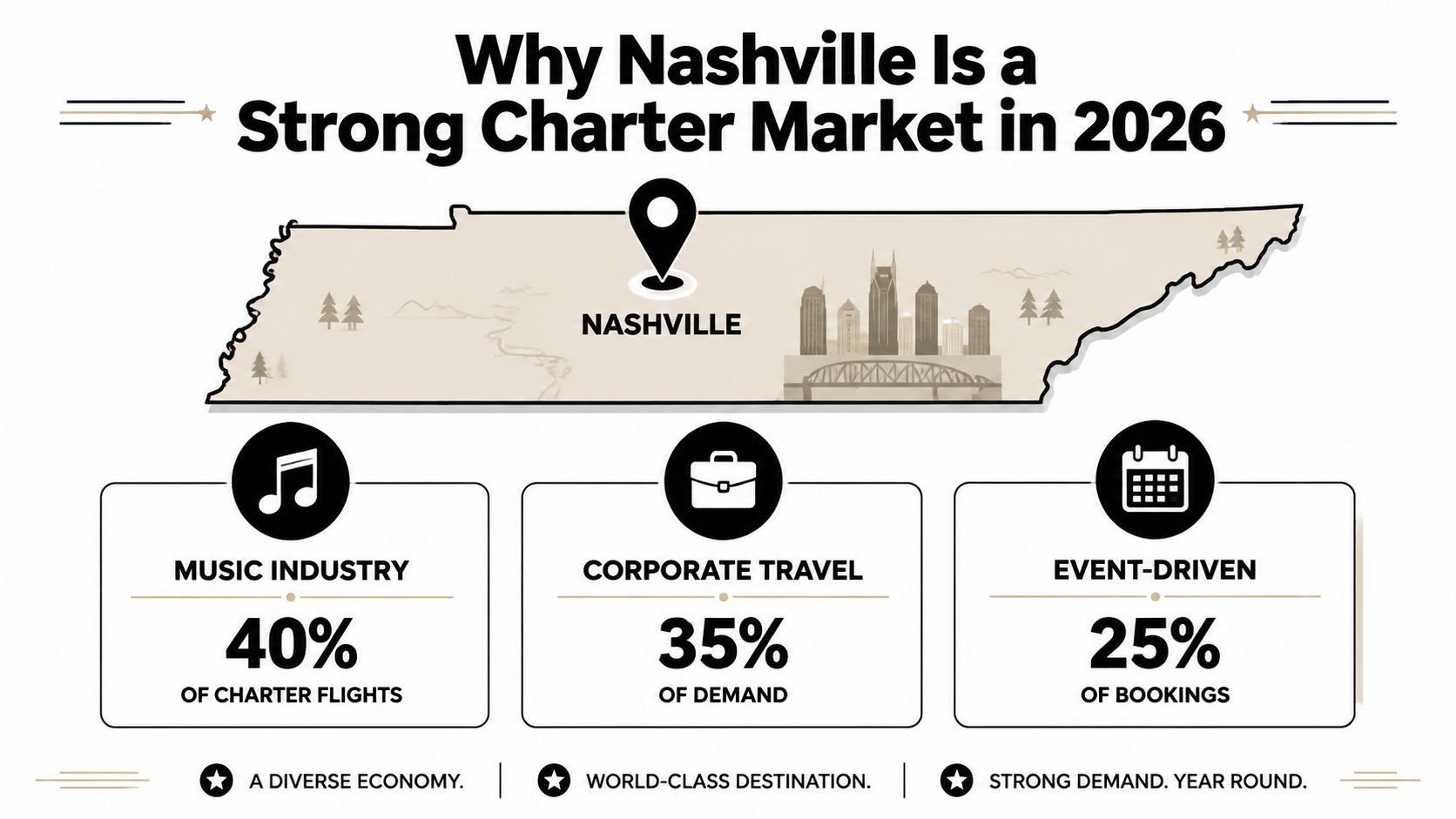
Why Nashville Is a Strong Charter Market in 2026
A music executive booking a Nashville to Austin flight on short notice needs more than a polished cabin. The executive needs an aircraft already nearby, a departure slot that works, an FBO that won't add friction, and a crew prepared to handle a fast-turn itinerary. Nashville's strength is that it has both the scale of a major commercial airport and a dedicated general-aviation alternative.
John C. Tune Airport, or JWN, opened in 1986 after construction began in 1983, giving Nashville a dedicated general-aviation base for private aircraft well before the current charter boom. Nashville International Airport's history of JWN places the airport within the city's long-term aviation infrastructure, not as a temporary overflow option.
Tennessee had 3,460 active private aircraft by 2026, and approximately 111,000 private flights departed the state in 2025, with Tennessee ranked ninth nationally in private jet departures. State aviation data reported by The Tennessean also identifies Nashville International as one of the state's largest aircraft-basing airports, with 90 aircraft based there. That local depth can improve availability and reduce the chance that you'll pay to bring an aircraft in from another market.
Start with the airport, not the aircraft
BNA handled 11.8 million enplanements in fiscal year 2024, up from 10.9 million the prior year, according to Metropolitan Nashville Airport Authority financial data. In the June 2025 to May 2026 reporting period, BNA recorded 12.576 million arrivals, 12.587 million departures, and 112,706 scheduled departures. That activity reinforces Nashville's position as a high-traffic aviation market.
For a charter client, the practical lesson is simple. Ask the broker or operator to search both BNA and JWN before presenting an aircraft. A locally based aircraft at JWN may be the cleanest answer for a domestic business trip, while BNA may make more sense for an international itinerary or a larger cabin.
Dispatcher's rule: A strong local fleet matters because it can mean faster dispatch, better aircraft choice, and fewer repositioning miles.
Choosing Between BNA and JWN for Your Flight
BNA and JWN serve different missions. Nashville International has two FBOs, while John C. Tune is the dedicated general-aviation airport that many private travelers prefer for faster, more private handling. Haute Jets' BNA charter page is a useful starting point if your passengers need commercial-airport connectivity or a larger aircraft capability.
JWN is usually the first airport to test for a domestic light- or midsize-jet trip. Its general-aviation focus can reduce terminal friction and place you closer to downtown, with commonly cited transfer times of about 15 minutes from JWN compared with 20 to 25 minutes from BNA. Nashville charter airport guidance supports using airport access as part of the aircraft decision, not treating it as an afterthought.
BNA remains the more flexible choice when the mission involves international arrivals, larger aircraft, or passengers connecting through the main airport. Independent airport listings describe BNA as open 24 hours every day and suitable for aircraft ranging from light jets through ultra-long-range categories. Nashville International Airport operating information supports that broader capability.
BNA vs JWN decision matrix
| Factor | BNA, Nashville International | JWN, John C. Tune |
|---|---|---|
| Best fit | International travel, larger cabins, commercial-airport connections | Domestic light- to midsize-jet trips, quick business departures |
| FBO access | Two FBOs | Dedicated general-aviation handling |
| Privacy | Professional, larger-airport environment | More discreet general-aviation setting |
| Downtown transfer | Commonly about 20 to 25 minutes | Commonly about 15 minutes |
| Aircraft flexibility | Supports light jets through ultra-long-range aircraft | Strong choice for smaller private aircraft |
| First booking question | Can the aircraft and FBO support the full mission? | Is the aircraft already positioned locally? |
Choose JWN for speed and discretion when the aircraft fits. Choose BNA for capability and connectivity when the itinerary demands it. Don't let a broker default to the airport that's easiest for their inventory.
Matching Aircraft Type to Your Nashville Trip
Aircraft selection should solve a transportation problem. It shouldn't function as a status ladder. A turboprop can be the smarter choice for a short regional flight, while a midsize jet earns its premium when passengers need speed, baggage capacity, or a longer nonstop segment.
For short regional missions, a King Air 350 or Phenom 100 can suit trips such as Nashville to Memphis, Birmingham, or Atlanta. A turboprop generally makes sense when the route is short, the passenger group is small, and cabin speed matters less than access and operating efficiency. A Phenom 100 adds jet performance for a compact passenger group without moving into a larger cabin than the mission requires.
Match the cabin to the job
Light jets, including the Citation CJ3 and Learjet 75, are better for same-day business travel where speed and schedule control matter. They can serve routes toward Chicago or Dallas and are often a practical match for JWN. The key check is not only the published range. Ask the operator to confirm runway, payload, weather, fuel, and baggage assumptions for your actual departure.
Midsize aircraft such as the Citation Latitude and Hawker 900XP are the workhorses for longer domestic flights and Caribbean itineraries. They offer a more capable cabin, space for a larger passenger group, and a fuller baggage compartment. BNA is often the cleaner operational choice when the aircraft is heavier or the itinerary needs broader airport flexibility.
Super-midsize and heavy cabins, including the Challenger 350, Falcon 2000, and Gulfstream G280, should be selected for a clear reason. That reason may be transcontinental range, international reach, a flat-floor cabin, or the need to work and rest during a demanding itinerary. Booking a heavy jet for a short hop because it looks impressive is poor sourcing.
| Aircraft Class | Typical Model | Seats | Best Nashville Mission |
|---|---|---|---|
| Turboprop | King Air 350 | Small group | Short regional trips where access and efficiency lead |
| Very light jet | Phenom 100 | Small group | Compact regional travel with jet performance |
| Light jet | Citation CJ3, Learjet 75 | Small to midsize group | Same-day business trips to markets such as Chicago or Dallas |
| Midsize jet | Citation Latitude, Hawker 900XP | Up to eight passengers | Longer domestic and Caribbean travel with baggage needs |
| Super-midsize or heavy | Challenger 350, Falcon 2000, Gulfstream G280 | Larger group | Transcontinental, international, or rest-focused missions |
For a more detailed framework, review Haute Jets' guide to choosing an aircraft for short-haul private flights. The right answer is the smallest aircraft that comfortably satisfies the route, payload, cabin, and schedule.
Booking Timeline, Documentation, and Pre-Flight Confirmation
A smooth charter booking has a visible chain of decisions. The operator should be able to tell you what has been quoted, what remains on hold, and which passenger or operational details could still change the aircraft.
Routine flights should enter the quoting process early enough for the sourcing team to compare BNA and JWN inventory. For major demand periods, ask for aircraft options as soon as your dates are firm. The earlier search gives the operator more room to find a locally positioned aircraft rather than accepting the first available solution.
The booking sequence
A soft hold gives the operator time to confirm aircraft, crew, routing, and airport handling. That hold should eventually become a firm confirmation, followed by a final manifest lock before departure. The exact commercial deadlines vary by operator, so ask for them in writing rather than assuming every company uses the same process.
Your passenger file should include legal names matching government identification, dates of birth, any applicable known passenger information for screening, and accurate baggage details. Weight and size matter because payload affects fuel planning, especially on smaller aircraft or longer sectors.
A signed rental agreement and accepted quote allow the operator to assign the flight internally and coordinate crew, handling, catering, and ground transportation. If your broker goes quiet before departure, that doesn't automatically mean the flight is at risk. Ask which items are complete and which are still awaiting operational confirmation.
The final confirmation call
The morning-of call should verify:
- Weather: Conditions at both BNA and JWN, including any operational impact.
- FBO handling: Parking, arrival instructions, security process, and vehicle access.
- Crew release: Confirmation that the crew and aircraft are released for the trip.
- Catering: Final menu, loading time, and dietary requirements.
- Passenger manifest: Names and baggage information match the final booking.
- Ground transport: Vehicle location, driver contact, and pickup timing.
The most useful pre-flight document is the one that removes ambiguity. Request the tail number, aircraft configuration, crew details, departure FBO, and final timing before you leave for the airport.
Pricing Reality and the Wholesale Sourcing Advantage
Two charter quotes can describe the same route while representing very different economics. The difference often sits in aircraft positioning, broker margin, handling, catering, and whether the operator has separated ferry costs from the actual passenger leg.
A useful comparison begins with the aircraft class and route, not with a single headline price. Ask whether the quote is for a locally based aircraft, whether the aircraft must reposition, and whether the return leg is included or treated as a separate operational requirement.
Nashville private jet charter pricing by class
The table below is a comparison framework for reviewing a quote. The actual price depends on aircraft availability, routing, crew requirements, airport fees, and the specific itinerary. It should not be treated as a guaranteed fare.
| Route | Light Jet | Midsize Jet | Super-Midsize | Repositioning Fee |
|---|---|---|---|---|
| BNA to LAX | Request an aircraft-specific quote | Request an aircraft-specific quote | Request an aircraft-specific quote | Ask for a separate line item |
| BNA to EGE | Request an aircraft-specific quote | Request an aircraft-specific quote | Request an aircraft-specific quote | Confirm aircraft return requirements |
| JWN to DPA | Request an aircraft-specific quote | Request an aircraft-specific quote | Usually unnecessary unless mission needs justify it | Check whether the aircraft is locally based |
The largest mistake is accepting a one-way quote without asking what happens to the aircraft afterward. A jet that must return empty can make the one-way itinerary materially more expensive than a round trip. Have the broker show the repositioning leg separately so you can decide whether changing the return timing, airport, or aircraft class improves the economics.
For a general explanation of the cost variables that affect private aviation, browse the EC Minibus private jet cost guide. Use it as background, then demand a route-specific proposal from the operator or sourcing team.
A direct-to-operator or wholesale sourcing model can reduce the margin layers associated with traditional brokering, but transparency matters more than the label. Ask who operates the aircraft, who holds the applicable certificate, what is included, and which fees remain variable. Haute Jets' private jet charter cost guide provides additional context for evaluating a quote.
Pricing test: If the proposal doesn't show the aircraft, airport, operating party, and repositioning treatment, you're comparing a sales estimate, not a complete charter solution.
Event and Seasonal Demand in Nashville
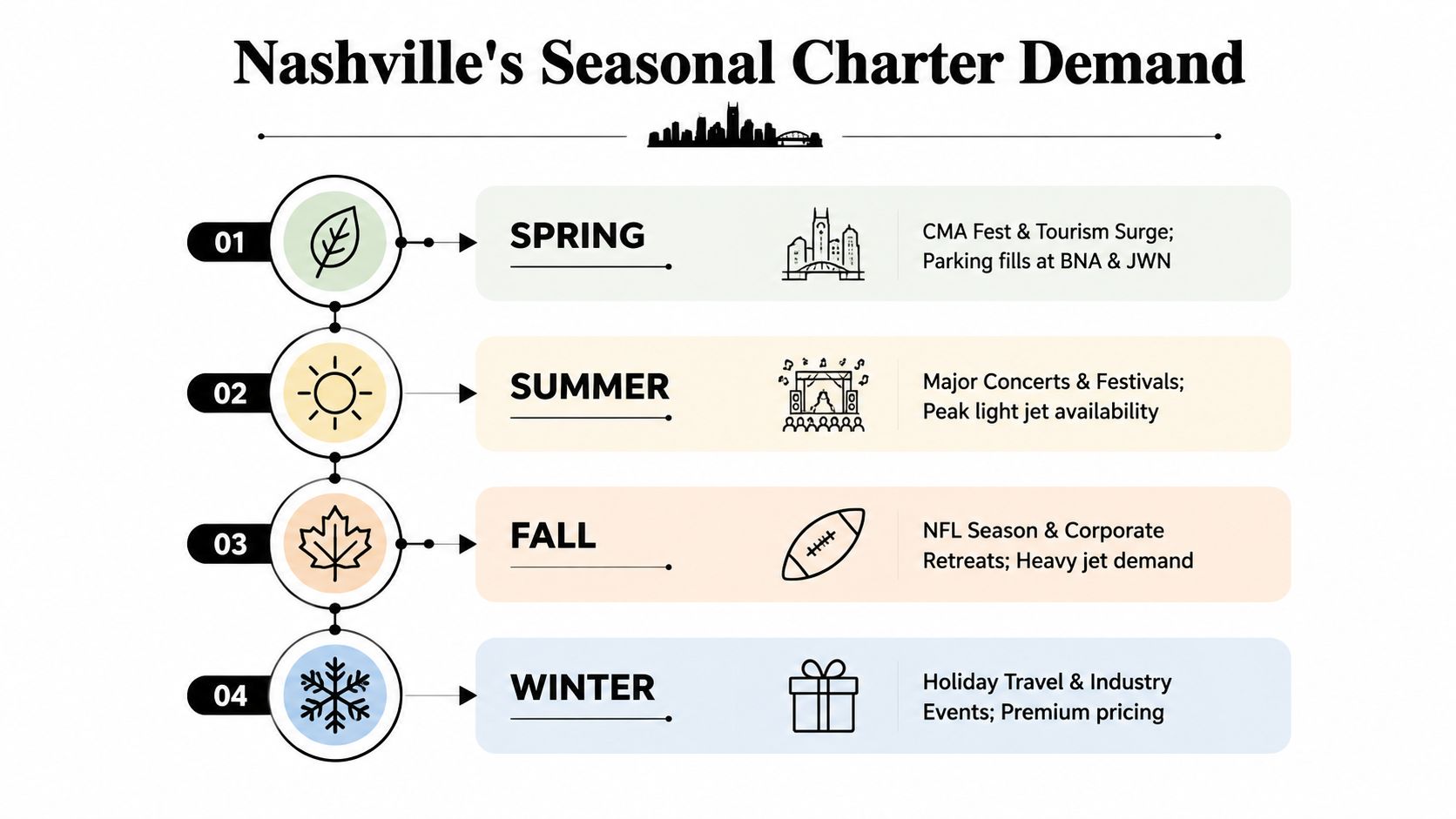
Nashville's event calendar changes the aircraft search. A Thursday departure during a major entertainment weekend can draw from the same local inventory as corporate travel, artist movements, and high-end leisure trips. The airport pair matters even more during these periods because a JWN aircraft may be the only practical local option while BNA absorbs larger or more complex missions.
CMA Fest is the clearest example. Demand concentrates around the event, and clients who wait until the final days may face fewer suitable aircraft and less flexibility on departure time. The same principle applies to NFL playoff periods, major festival weekends, the NFL Draft, Bonnaroo, SEC-related travel, and country-music award events.
How event pressure changes the booking
A Titans home game can create a narrow outbound or inbound window around the weekend. Business travelers may want to arrive before the crowd and leave immediately after the event, while leisure groups often want the opposite. If your schedule allows, shifting the departure away from the dominant movement can produce a better aircraft match and a calmer FBO experience.
Bachelor and bachelorette travel creates a different pattern. Groups often cluster their departures and returns around weekends, with demand flowing toward Gulf Coast destinations, mountain resorts, and other leisure markets. A flexible group should compare both Nashville airports and consider whether a turboprop or light jet handles the mission better than a larger cabin.
Book early when the calendar is loud
Prioritize early aircraft sourcing for:
- CMA Fest: Entertainment traffic and leisure demand can compete for the same aircraft.
- NFL playoffs: Short booking windows create concentrated movement around game dates.
- Bonnaroo: Festival travel can pressure regional inventory and ground logistics.
- NFL Draft activity: Event-related traffic can alter availability even when the itinerary isn't directly tied to the event.
- Award and SEC weeks: Corporate, entertainment, and hospitality travel can overlap.
Softer periods may offer more choice, particularly mid-January, late August, and early November. Those periods still require a proper aircraft check, but the sourcing conversation is usually less constrained.
When your schedule permits, test a departure shift of 12 to 48 hours around a major event. That adjustment can change the aircraft pool, reduce repositioning complexity, and avoid the most crowded handling windows. The saving isn't guaranteed, but the option is valuable because charter economics respond sharply to concentrated demand.
Safety Vetting, Empty Legs, Catering, and Ground Transport
The final-mile details decide whether a private flight feels controlled or improvised. A polished cabin doesn't compensate for unclear operator responsibility, missing passenger data, or a vehicle waiting at the wrong FBO.
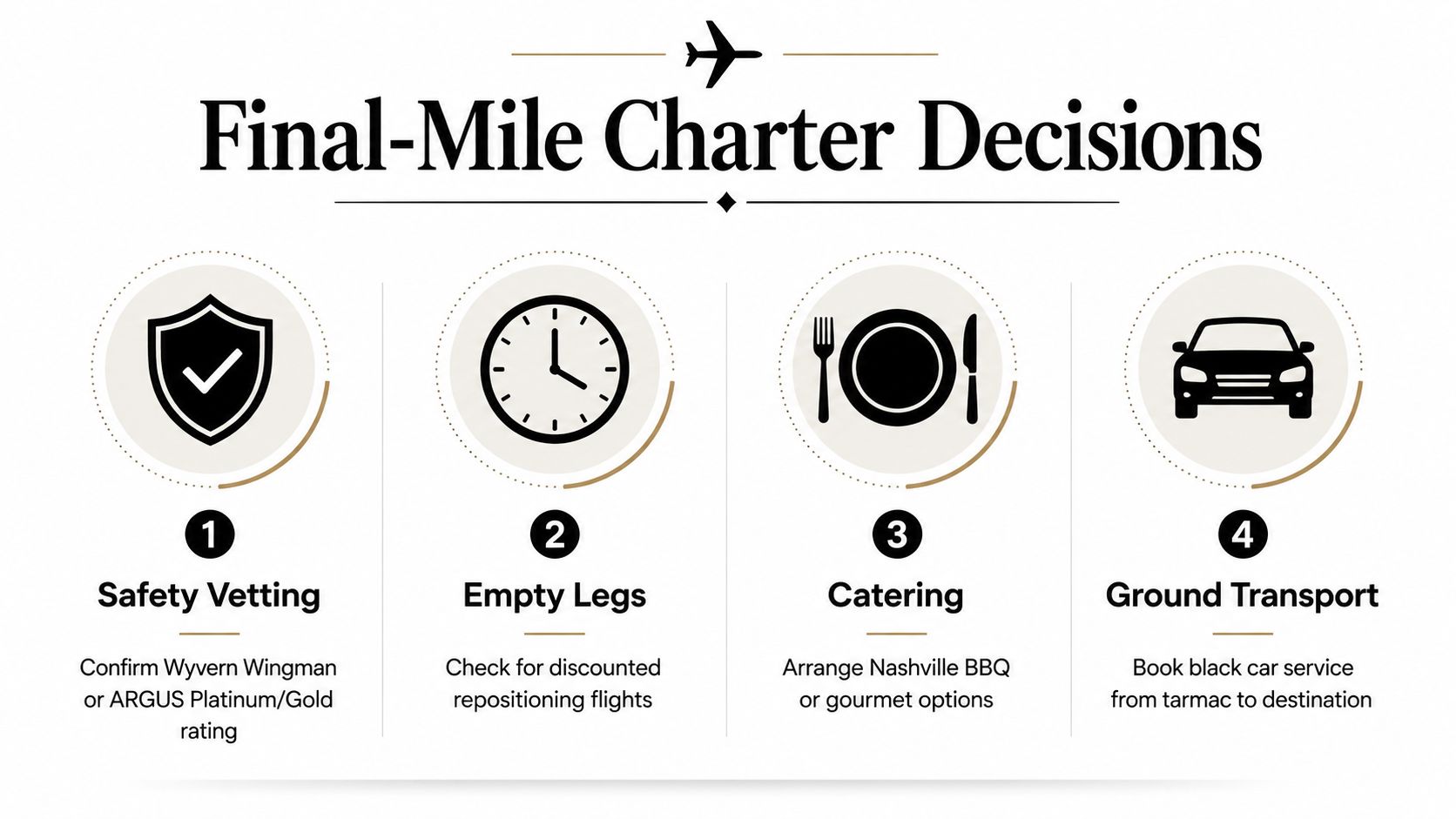
Start with the operator, not the aircraft photographs. Ask whether the company holds a Wyvern Wingman or ARGUS Gold or Platinum rating, then request the relevant safety documentation for the operating party. Confirm whether the Part 135 operation is handled in-house or through another certificate holder, and make sure the entity named in the agreement matches the entity operating the flight.
Four checks before signing
- Safety vetting: Confirm the third-party rating and request the safety report or trip assessment tied to the proposed operator and aircraft.
- Empty legs: Ask whether an available repositioning flight has a fixed schedule. The lower price only works if you can accept limited flexibility.
- Catering: Specify meals, allergies, beverages, and loading timing. Don't assume a local favorite will be available unless it's confirmed.
- Ground transport: Give the FBO and driver enough lead time to coordinate vehicle access and passenger pickup.
Empty-leg searches can be useful when your schedule is flexible. Nashville departures may connect with larger business aviation markets such as Dallas, Atlanta, or Teterboro, but an empty leg can change or disappear because the primary passenger itinerary controls the aircraft. Treat it as an opportunity, not as the foundation of a time-critical trip.
For catering, request the exact loading location and handoff time. Nashville-style barbecue, gourmet sandwiches, and specialty bakery items can all work, but the operator needs clear instructions about packaging, refrigeration, and passenger timing. Confirm Wi-Fi, pet acceptance, baggage capacity, and any special equipment in writing.
The pre-flight package should identify the tail number, crew, FBO, weather briefing, and passenger manifest. That information lets you catch a mismatch before you arrive at the airport.
Haute Jets connects clients with aircraft sourced from owner-operators across a broad international network, with options ranging from turboprops to long-range cabins and operator screening based on Wyvern and ARGUS ratings. For a Nashville itinerary, visit Haute Jets and request a quote that compares BNA and JWN, identifies the exact aircraft, and separates repositioning costs from the passenger flight.