
Your return date isn't fixed. The meeting may turn into a multi-city roadshow. The family may stay longer at the house. Or you're flying to a yacht, a resort, or a seasonal residence and you have no reason to pay for an aircraft to sit and wait.
That's exactly where a private jet charter one way makes sense.
Most clients still ask the wrong first question. They ask, “What's the hourly rate?” That matters, but it's not the true pricing trap. The key issue is whether you're paying for an aircraft you genuinely need, or for an empty airplane moving around the map to satisfy someone else's operating model.
This guide appears on Haute Jets Journal because clients need a straight answer. One-way charter is no longer a niche workaround. It's now a standard way to fly private. The smart move is knowing how to book it without absorbing hidden positioning costs, weak sourcing, or vague safety standards.
Your Guide to One-Way Private Jet Charters
A one-way charter is simple. You book a private aircraft for a single mission from your departure airport to your destination, without building the quote around a return leg.
That sounds obvious, but private aviation used to treat round trips as the default. That's outdated. According to Amalfi Jets' analysis of one-way private jet demand, more than half of the flights coordinated by the company today are one-way itineraries. That tells you exactly where the market has gone. Savvy travelers now book for the mission, not for an artificial round trip.
Why clients choose one-way now
The appeal isn't luxury language. It's control.
- Uncertain return timing: You may leave after the deal closes, after the event ends, or after weather shifts.
- Open-ended leisure travel: Seasonal homes, yacht transfers, and resort stays rarely fit a rigid outbound-and-return structure.
- Multi-leg planning: You may fly private in one direction and continue commercially, by car, or on another charter from a different city.
Practical rule: If you don't know your return date with confidence, don't let anyone build your quote as if you do.
What a good one-way charter should feel like
It should feel precise, not complicated. You choose the route, passenger count, luggage profile, timing, and aircraft that fits the mission. Then your advisor sources an operator that can execute that trip cleanly.
Where clients get burned is assuming “one-way” automatically means efficient pricing. It doesn't. Some brokers still structure one-way trips around aircraft that aren't near your departure point. That's where the hidden waste starts.
The right way to think about one-way charter is this. You're not buying glamour. You're buying a direct transportation solution. Freedom is the product. Transparent pricing is the discipline.
Understanding the True Cost of Flying One Way
A one-way charter isn't expensive because it's one-way. It gets expensive when the aircraft is in the wrong place.
That distinction matters more than any glossy quote sheet. A broker can show you an acceptable hourly rate and still hand you a bloated total because the jet has to fly empty to reach you, then empty again to reach its next assignment.
What's actually inside the quote
The total usually includes more than flight time alone. You'll typically see these cost drivers:
- Base aircraft time: The core flying cost tied to the aircraft category.
- Positioning or empty segments: What it costs to move the aircraft before or after your trip.
- Fuel-related charges: These can fluctuate with operating conditions.
- Crew and airport charges: Crew expenses, handling, and landing items can appear depending on the routing.
- Taxes and regulatory items: Government and compliance charges may apply.
If you want a broader grounding in charter pricing, review Haute Jets' private jet charter cost guide.
The fee clients miss
Here's the part I'd challenge every client to inspect line by line. A 2025 ICAS study found that 65% of one-way charter quotes from traditional brokers included hidden repositioning fees averaging $8,000 to $15,000, and those fees were non-refundable and unwaivable.
That is not a small detail. That is often the quote.
Repositioning fees show up when the aircraft isn't already near your departure city. So instead of paying for your mission, you pay for the broker's sourcing inefficiency. In many traditional models, those costs can inflate pricing by 20% to 40%.
If the jet has to come find you from somewhere else, you're paying for a problem you didn't create.
Local sourcing is the fix
The intelligent alternative is local sourcing. That means the advisor finds an aircraft already based near your departure airport, or close enough that the quote isn't loaded with waste.
This is the key lever in one-way pricing. Not marketing language. Not “fleet access.” Not membership branding.
When a provider sources locally, you remove the structural inefficiency that turns a straightforward one-way trip into a disguised round-trip bill. That's why I tell clients to stop asking only, “What's your hourly rate?” Ask this instead:
- Where is the aircraft based?
- Is repositioning included in this quote?
- Was this jet sourced locally or brought in from another market?
- Am I paying any empty flight time I didn't request?
A serious advisor should answer those questions immediately. If they can't, keep shopping.
One-Way Flight Examples and Price Ranges for 2026
Use market ranges as a budgeting tool, not as a substitute for a real quote. One-way charter pricing is typically built on billable flight hours, and the verified ranges for 2026 are $1,300 to $3,000 per hour for small jets and turboprops, $4,000 to $8,000 for midsize jets, and $8,600 to $13,000 for large jets.
That gives you a clean framework. It does not give you a final total, because routing, airport choice, and sourcing quality still matter. But it does help you spot nonsense quickly.
Budgeting by aircraft category
| Aircraft category | Typical billable hourly range |
|---|---|
| Small jets and turboprops | $1,300 to $3,000 |
| Midsize jets | $4,000 to $8,000 |
| Large jets | $8,600 to $13,000 |
What to expect on common trip types
Instead of pretending every route has a fixed sticker price, use the route to determine the aircraft class first.
| Mission type | Likely fit | What usually drives the choice |
|---|---|---|
| Short regional hop | Turboprop or small jet | Airport access, passenger count, baggage |
| Business trip with a larger cabin need | Midsize jet | Cabin comfort, nonstop capability, meeting-friendly layout |
| Longer stage length or larger group | Large jet | Range, baggage volume, cabin size |
For a short route such as a coastal or regional shuttle, a turboprop or light aircraft may be the financially disciplined answer. Clients often overbuy cabin size on short sectors. That's unnecessary unless luggage, runway limitations, or passenger count justify it.
For a more executive-style mission, a midsize aircraft often lands in the sweet spot. You get a better cabin, stronger range, and a more balanced experience without stepping into heavy-jet economics.
Buy the aircraft for the mission, not for the ego of the tail number.
A smarter way to read quote ranges
There's another verified pricing framework worth knowing. The hourly cost for one-way charter can also run from $1,200 to $1,800 for turboprops and $5,000 to $8,000 for heavy jets, with total flight-hour costs shaped by repositioning fees, taxes, and fuel surcharges, according to evoJets' charter cost pricing overview.
That's useful because it reinforces the core truth. The aircraft category matters, but the final bill still depends on whether your provider sourced intelligently. If a quote looks high, don't assume the route is the problem. The aircraft may be coming from the wrong place.
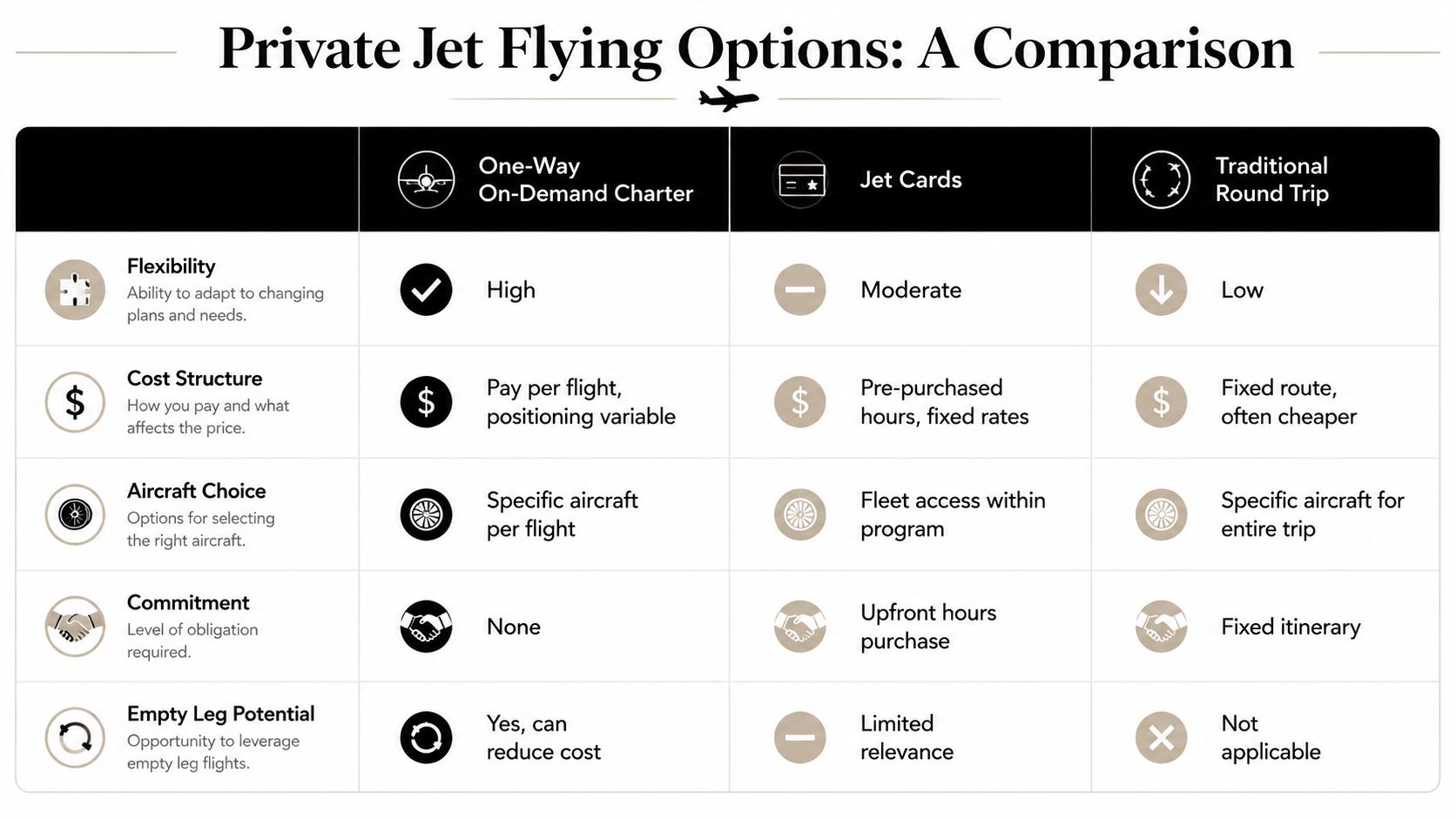
One-Way Charter vs Jet Cards and Round Trips
Most private flyers don't need ownership. Many don't need a jet card either. They need the right structure for the specific trip.
That's why this comparison matters. The wrong buying model can turn a simple mission into an expensive commitment.
When round-trip still works
A round-trip can make sense if your stay is very short and you know the exact return timing. Outside of that, it often becomes wasteful. As noted by Element Aviation's private charter trends and statistics overview, one-way charters are often more cost-effective than traditional round-trip bookings because they eliminate daily minimums or standby fees tied to an aircraft waiting on the tarmac for your return.
That's the problem with forcing a round-trip structure onto an open schedule. You're paying for idle time instead of productive flying.
For a deeper side-by-side breakdown, see Haute Jets' one-way vs round-trip comparison.
How jet cards fit, and where they don't
Jet cards appeal to clients who like fixed hourly pricing and a packaged program. I understand the appeal. But many buyers overestimate the value and underestimate the constraints.
Here's the tradeoff:
- You prepay hours or commit capital: That works if your pattern is consistent.
- You access a program fleet: Convenient, but not always the same as choosing the exact aircraft for each mission.
- You may still absorb sourcing inefficiency: A card doesn't magically eliminate repositioning exposure.
- You accept program rules: Availability terms, category substitutions, and blackout-style limitations can matter.
Side-by-side decision guide
| Option | Best for | Main downside |
|---|---|---|
| One-way on-demand charter | Variable schedules, open-ended plans, custom sourcing | Quote quality depends on advisor discipline |
| Jet card | Frequent flyers who want a prepaid structure | Upfront commitment and less mission-by-mission control |
| Traditional round trip | Short stays with fixed return times | Waiting-time and standby economics can become inefficient |
If your travel pattern changes often, a pay-per-flight model usually beats a prepaid promise.
My view is straightforward. If your itinerary is fluid, one-way on-demand charter is usually the cleanest answer. You avoid locking yourself into prepaid hours, and you avoid paying an aircraft to sit around if your return isn't immediate.
How to Book Your Ideal One-Way Private Flight
The booking process should be simple, but you need to ask better questions than most buyers do. That's how you get a clean aircraft, a clean quote, and no surprises on departure day.
Start with the mission, not the jet
Give your advisor the operational facts first.
- Route and timing: Departure airport, destination, preferred wheels-up time, and whether your timing is hard or flexible.
- Passenger profile: Headcount matters, but so do age ranges, mobility needs, and whether anyone is traveling with pets.
- Luggage and special items: Golf bags, skis, garment bags, instruments, and oversized cases can change the aircraft recommendation.
- Cabin expectations: Wi-Fi, catering, sleeping configuration, and ground transport should be discussed before the quote, not after it.
A good request saves time because it narrows the field to aircraft that fit.
Interrogate the quote properly
Most clients glance at the total and the aircraft photo. That's not enough.
Ask for the following:
- Tail number: You want the actual aircraft, not just a category label.
- Operator identity: Know who is operating the flight.
- All-in pricing clarity: Confirm what's included and whether any repositioning is built into the quote.
- Safety credentials: Ask specifically for Wyvern or Argus status.
- Cancellation terms: They should be plain, not buried.
If you want a more complete walkthrough of the buying process, review Haute Jets Journal's guide to chartering a private jet in 2026.
Confirm payment and pre-flight details
One-way charter works well because it's a pay-per-flight structure. You're not forced into annual fees or prepaid blocks just to secure lift.
For some clients, digital-asset payment matters too. Bitcoin or USDC can be useful, but the transaction still needs proper rate locking, compliance handling, and clear settlement timing. Don't assume every broker that “accepts crypto” has a serious process behind it.
Before departure, insist on a final confirmation package. A professional standard includes the final itinerary, aircraft details, crew information, and the passenger manifest review. That package should remove uncertainty, not create new questions.
The smoothest charter flights happen because the client asked operational questions early, not because the broker sounded polished on the phone.
The Non-Negotiable Standard of Aviation Safety
Pricing matters. Safety matters more.
If a provider can save you money only by relaxing operator standards, you're talking to the wrong provider. In private aviation, safety is not a menu item and it isn't a marketing slogan. It is the baseline filter before anyone discusses cabin finishes, catering, or convenience.
What the serious ratings are
The benchmark you should know is simple. Every operator available for on-demand one-way charters in the global network must hold either a Wyvern Wingman or Argus Gold/Platinum rating, which are the two highest third-party safety audits in private aviation.
That matters because these are independent safety benchmarks, not self-issued claims. They examine the operator, the aircraft, and the crew through an external audit process.
What those audits tell you
A top-tier third-party rating helps verify issues that should never be left vague:
- Aircraft maintenance oversight: The operator must maintain aircraft records and standards at a high level.
- Crew qualification review: Pilot experience, training, and operational readiness are part of the picture.
- Operational history: Safety systems and operating discipline matter as much as the aircraft itself.
When an advisor can name the operator, confirm the rating, and show you the actual aircraft details, you're dealing with a real charter process. When the answers are fuzzy, the risk is usually hidden behind convenience.
This short video gives useful context on what disciplined private aviation operations should look like.
What clients should insist on before departure
I'd keep the safety checklist blunt:
- Ask for the operating carrier, not just the broker name
- Confirm the specific aircraft, not only the category
- Require the third-party safety status
- Review the pre-flight package before wheels-up day
Safety should feel boring. That's a compliment. In this business, boring means disciplined, documented, and controlled.
The Haute Jets Difference Fly On Your Terms
The smartest one-way booking strategy is clear. Pay for the flight you need. Don't pay for an aircraft repositioning problem you didn't create.
That means transparent, pay-per-flight pricing. It means asking where the aircraft is based. It means rejecting vague quotes that bury empty flight time inside a polished total. And it means choosing operators that meet real third-party safety standards.
What this model looks like in practice
One option built around that logic is Haute Jets. The platform sources from more than 3,500 owner-operators across 175 countries, focuses on local aircraft sourcing to reduce repositioning waste, and works on a no-membership, no-jet-card basis. The client can choose the specific aircraft and book by mission instead of by program.
That structure fits how many discerning travelers move now. Some trips are business-critical. Some are seasonal. Some are opportunistic. Very few justify locking into a rigid membership just to secure one clean flight.
The practical takeaway
If you remember only three things, remember these:
- One-way charter is normal now: It's not a workaround. It's how many experienced private flyers book.
- Repositioning fees are often a significant cost problem: The sourcing model matters as much as the aircraft.
- Safety isn't negotiable: Wyvern Wingman and Argus Gold/Platinum should be the floor, not the aspiration.
A good one-way charter should feel efficient, accountable, and fully transparent. You should know what you're paying for, which aircraft is flying you, who is operating it, and why that quote makes sense.
That's how you become a smarter charter client. Not by chasing the cheapest number. By demanding the right structure.
If you want a one-way quote that's built around the actual mission, with transparent aircraft sourcing and no membership commitment, request a flight through Haute Jets.