

You're probably dealing with one of two Orlando trips right now. Either you need to move fast for a meeting, event, or site visit and commercial schedules don't work. Or you're trying to get your family into Central Florida without burning half a day in terminal lines, parking shuttles, delays, and baggage chaos.
That's where a smart private jet charter Orlando decision stops being a luxury purchase and starts being a logistics decision. You're buying control. You choose the airport, the schedule, the aircraft, the terminal, and the ground transfer. You also avoid one of the biggest mistakes I see in this market. Clients focus on cabin photos and hourly rates, then overlook repositioning fees and operator-level safety standards.
This guide appears on Haute Jets Journal for a reason. Orlando is a high-traffic private aviation market, but it's also a market where buyers overpay when they use the wrong booking model and under-vet safety when they rely on buzzwords.
Welcome to On-Demand Aviation in Orlando
Orlando works because it serves both business and leisure travelers unusually well. A corporate team can fly in for a convention, investor meeting, or property tour. A family can land closer to where they want to be and skip the commercial airport grind entirely.
The broader market is telling the same story. The global private jet charter services market is valued at $17.67 billion in 2026, with Florida contributing 19% of domestic departure growth in Q1 2026, and Orlando posting a 15% operational increase in 2024 according to private aviation market data for 2026. Orlando isn't just a tourism city. It's a serious access point.
Why Orlando works for private flyers
Private charter makes sense here because the city creates friction for commercial travelers. Big events, holiday peaks, theme park traffic, and spread-out destinations all punish rigid airline schedules.
A disciplined approach looks like this:
- Choose the airport by destination. Downtown business and executive meetings call for one choice. Theme park access may call for another.
- Choose the aircraft by mission. Don't book more cabin than you need.
- Fix the ground transfer before wheels up. If you're moving a family or executive group, coordinate the last mile in advance. For larger groups or travelers who want a single premium transfer from the private terminal, Max's Luxury Rides Sprinter solutions are a practical option in Orlando.
- Check empty-leg opportunities when your timing is flexible. That's the one scenario where spontaneity can work in your favor. You can monitor that through Haute Jets empty leg listings.
Orlando rewards travelers who plan backwards from the destination, not forwards from the airport.
That's the essential shift. On-demand aviation in Orlando isn't about showing up in style. It's about removing friction from a market that creates plenty of it.
Choosing Your Orlando Airport and FBO
Airport selection in Orlando is where experienced flyers separate themselves from first-time buyers. If you choose the wrong field, you can lose the time advantage you paid for.
An FBO, or Fixed Base Operator, is your private terminal. That's where you arrive, clear directly for departure, wait in a private lounge, board the aircraft, and avoid the commercial terminal entirely. Under FAA Part 135 charter practice, FBO access is part of the private aviation experience, not an add-on.
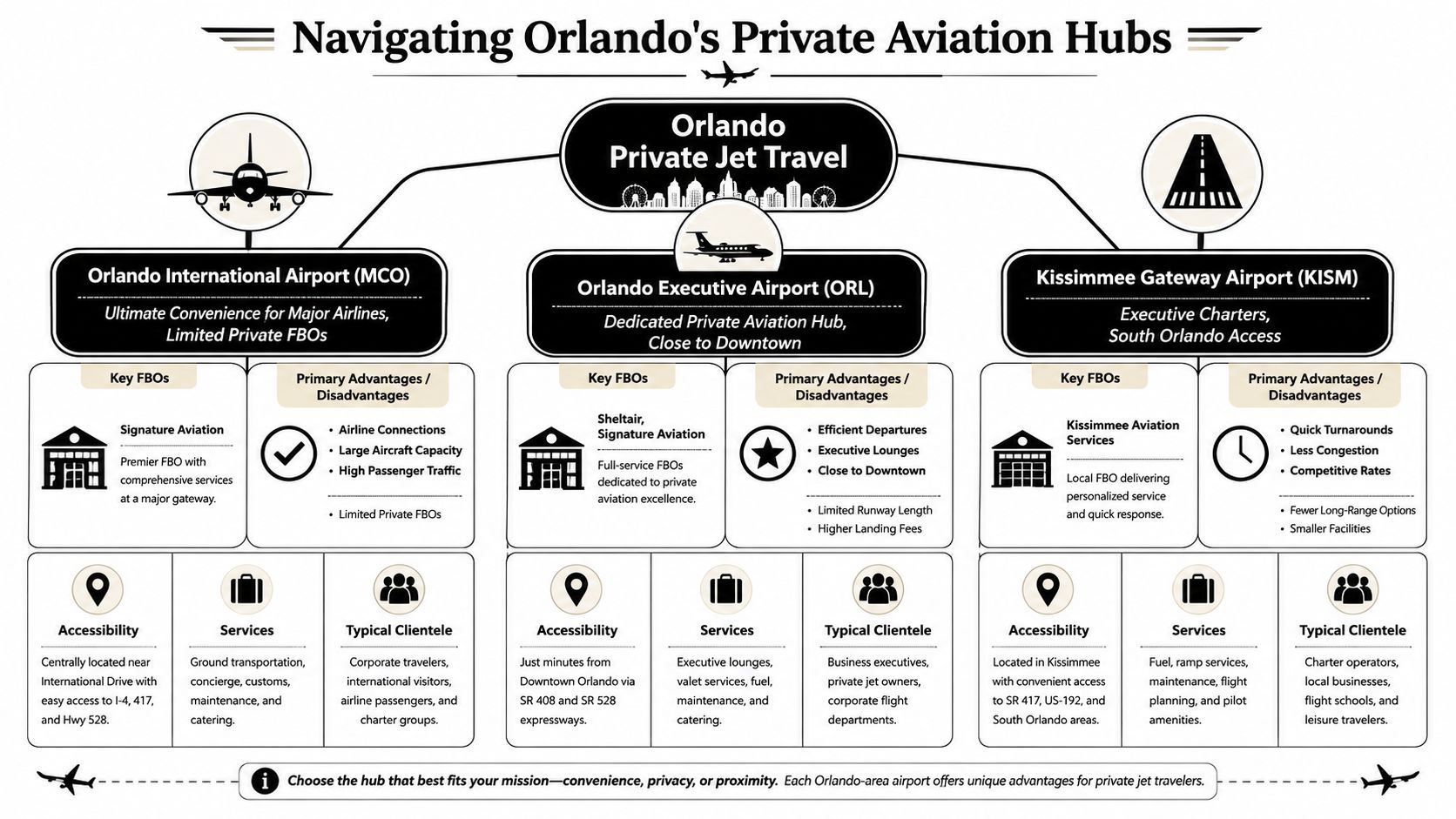
Orlando International Airport MCO
MCO is the practical choice when airline connectivity matters or when you're using a larger aircraft profile. It's familiar, easy to coordinate with mixed commercial and private itineraries, and suitable when international arrival logistics are part of the trip.
The tradeoff is obvious. It's a major airport. That means more complexity and less of the tight, efficient feel private travelers usually want.
Typical fit:
- Best for mixed itineraries when some passengers are arriving commercially
- Useful for larger cabin missions that benefit from a major-field environment
- Less ideal for downtown access if speed on the ground is your top priority
If you want to understand the private-side terminal flow at this field, review the Orlando International private terminal guide.
Orlando Executive Airport ORL
ORL is the airport I'd push most business travelers toward. It's built for private aviation logic. Shorter ground movements, executive-focused traffic, and easier access to downtown make it the cleanest option for meetings and same-day turns.
FBO names matter here because they shape the passenger experience. Signature Aviation and Sheltair are the kind of facilities private flyers expect. Quiet lounge, direct ramp access, crew support, and no commercial-terminal detour.
Decision rule: If your Orlando trip is centered on business, start with ORL and only move away from it for a specific operational reason.
Kissimmee Gateway KISM and Sanford SFB
KISM makes sense for travelers heading south of central Orlando, especially when the final destination isn't downtown. It can be a cleaner answer for leisure itineraries that don't benefit from entering through MCO.
SFB has a narrower use case, but it can still be useful depending on aircraft placement and final routing. I wouldn't treat it as the default. I'd treat it as a tactical option.
Three airport filters usually settle the question fast:
| Airport | Best Use | Typical Strength | Likely Tradeoff |
|---|---|---|---|
| MCO | Mixed airline and private itineraries | Major-airport flexibility | More congestion |
| ORL | Business and executive travel | Fast private access | Less relevant for airline connections |
| KISM | South Orlando leisure access | Convenient regional positioning | Not the first choice for downtown business |
Decoding Private Jet Charter Costs for Orlando Flights
Most clients ask the wrong first question. They ask, “What's the hourly rate?” The better question is, “What's the all-in trip cost, and what's driving it?”
For Orlando, the baseline aircraft pricing is clear. The average hourly charter cost for flights to or from Orlando starts at approximately $5,000 to $6,000 for light jets, $7,000 to $9,000 for midsize jets, and $10,000 to $15,000+ for large jets. A Miami to Orlando flight on a 6-passenger light jet runs about $7,500 according to Orlando private jet charter pricing data.
What those numbers actually mean
Those brackets are useful, but they don't tell you what creates the final invoice. Charter pricing moves because of four practical variables:
- Aircraft class. Cabin size, speed, range, and operating cost all change the rate.
- Route length. Longer missions increase billable flight time and operating cost.
- Aircraft positioning. If the jet isn't already near your departure airport, someone pays to move it.
- Market pressure. Peak-demand windows and fuel conditions push quotes up quickly.
That last point matters in 2026. Private jet charter costs in summer 2026 have risen 15% to 20% above comparable 2025 trips, with Jet A fuel prices 30% higher since March 1, stronger-than-usual seasonal demand, and insufficient active aircraft supply according to summer 2026 private jet cost analysis.
Estimated one-way charter costs from Orlando MCO
These are planning-level examples, not universal quotes. Real pricing depends on aircraft availability, positioning, and schedule specifics.
| Destination | Aircraft Type | Passengers | Estimated Cost |
|---|---|---|---|
| Miami | Light jet | 6 | ~$7,500 |
| Regional Florida trip | Light jet | Small group | Based on hourly pricing of approximately $5,000 to $6,000 |
| East Coast business trip | Midsize jet | Mid-size group | Based on hourly pricing of approximately $7,000 to $9,000 |
| Long-range leisure or corporate mission | Large jet | Larger group | Based on hourly pricing of approximately $10,000 to $15,000+ |
Where buyers get caught
The hidden cost in Orlando charter isn't usually the cabin. It's the movement behind the cabin.
A low headline rate can become a bad deal if the aircraft has to reposition from another market, sit overnight, or absorb a peak-demand premium. That's why I tell clients to review the total charter structure, not just the aircraft category. If you want a clean baseline for comparing options, use a detailed private jet charter cost guide.
Cheap-looking quotes often become expensive flights once repositioning and timing realities show up.
My pricing advice
Don't start with the biggest aircraft your budget allows. Start with the trip profile.
Ask these questions in order:
- How many passengers are flying
- How much baggage is really coming
- Is this a short regional hop or a longer nonstop mission
- Is the aircraft local to departure
- What's included in the quote, and what's conditional
That sequence will save you more money than negotiating a glossy hourly rate.
The Booking Process From Quote to Takeoff
You request a 9:00 a.m. departure out of Orlando, get a quote that looks sharp, then learn the aircraft is coming in from another city and your “good rate” now carries extra movement costs and timing risk. That is a common booking mistake here.
A well-run Orlando charter starts with aircraft sourcing, not paperwork. The right provider checks what is based in or near your departure airport, then builds the quote around that availability. That is how you avoid hidden repositioning charges and last-minute schedule creep that many traditional brokers fail to flag upfront.
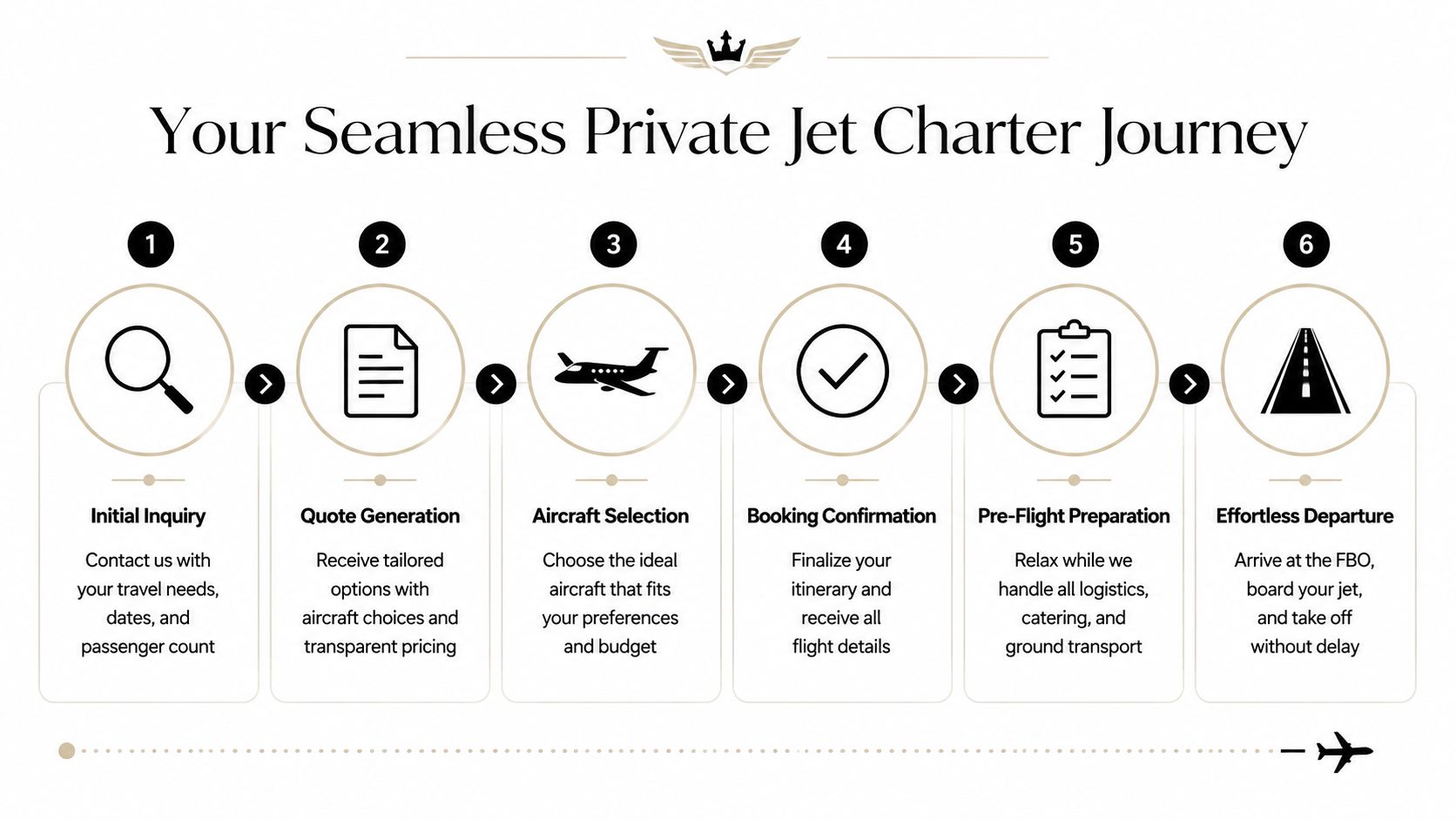
A proper booking flow is simple. You share the route, passenger count, timing, and trip constraints. You get aircraft-specific options with clear terms. You approve one aircraft, sign the charter agreement, confirm trip details, and arrive at the FBO ready to board.
What a proper charter includes
Buyers should verify the basics instead of assuming the quote is all-inclusive. Under FAA Part 135 regulations, a private jet charter in 2026 generally includes the aircraft, flight crew, fuel, insurance, permits, and FBO access, as outlined in this 2026 private jet charter inclusion guide.
The problem is not the standard items. The problem is everything left vague around them. In Orlando, I would press on three points before approving any quote: where the aircraft is sourced, whether crew duty timing could affect departure, and which costs can still change after signature. If the answer is soft on any of those, keep shopping.
The practical sequence
Initial request
Give the exact route, date, preferred departure window, passenger count, and baggage details. Specific requests produce better aircraft matches.Aircraft shortlist
Ask for tail-specific or operator-specific options, not just “light jet” or “midsize jet.” Category labels hide too much.Quote review
Check the full trip structure. Confirm where the aircraft is positioned, what is included, what is variable, and whether the quoted schedule is realistic for that crew and aircraft.Confirmation and documents
Review the charter agreement, passenger manifest, identification requirements, and airport handling details before funds are sent.
Here's a useful walkthrough before you book:
What to finalize before flight day
The cleanest departures happen when operational details are closed out early, not handled by text message on the morning of travel.
- Catering requests if you want anything beyond standard service
- Ground transport to and from the FBO
- Pet approval if animals are traveling
- Passenger manifest details so there's no delay at departure
The best charter days are boring. The aircraft is local, the paperwork is done, and nobody is renegotiating details at the FBO.
Insisting on Uncompromising Safety and Certification
Most charter buyers still ask the wrong safety question. They ask whether the aircraft is safe. That's incomplete.
The question is whether the operator meets a high enough standard, because the operator controls the crew, training culture, maintenance oversight, and procedural discipline. A pretty aircraft and a vague assurance don't protect you.
Why buzzwords aren't enough
You'll hear brokers throw around Wyvern and ARGUS because those names sound reassuring. Fine. But name recognition alone doesn't tell you enough.
The issue in Orlando is specific. FAA audits reveal that 31% of Orlando-area Part 135 operators lack documented Safety Management Systems, and discerning clients should demand proof of Wyvern Wingman or Argus Gold/Platinum certification per operator, not generic aircraft safety ratings according to this charter safety review focused on operator certification.
That should change how you buy.
What to ask before you approve a flight
Ask for these items directly:
- Operator-level certification. Not “the aircraft meets standards.” Ask whether the operating company holds Wyvern Wingman or Argus Gold/Platinum.
- Crew details. You want to know who is flying the trip.
- SMS confirmation. If there's no documented Safety Management System, move on.
- Pre-flight transparency. You should receive concrete trip information, not broad reassurances.
My recommendation
Treat safety as a screening function, not a discussion point. If the operator can't verify top-tier third-party certification and a documented SMS, stop there and request another aircraft.
A serious charter client doesn't buy a flight on trust. They buy it on documentation.
That standard eliminates a lot of noise and protects you from the soft language that too often surrounds charter sales.
The Haute Jets Advantage for Orlando Flyers
You approve an Orlando charter quote on Friday afternoon. By evening, the total cost shows up. The aircraft is coming in empty from another state, and you are paying for that positioning leg whether anyone says the word or not.
That is a common Orlando pricing problem. The market has heavy traffic, irregular aircraft flow, and constant demand spikes tied to business travel, events, and family leisure routes. A lazy sourcing process gets expensive fast.
Why local sourcing matters
The cleanest Orlando quote usually starts with one question. Is the aircraft already near your departure airport?
If the answer is no, the price is already carrying waste. Traditional brokers often shop the broad market first, then fit the client to whatever airplane they can secure. That approach can work, but it often hides repositioning inside the quote instead of isolating it clearly. Orlando flyers should care less about sales language and more about aircraft location at the time of booking.
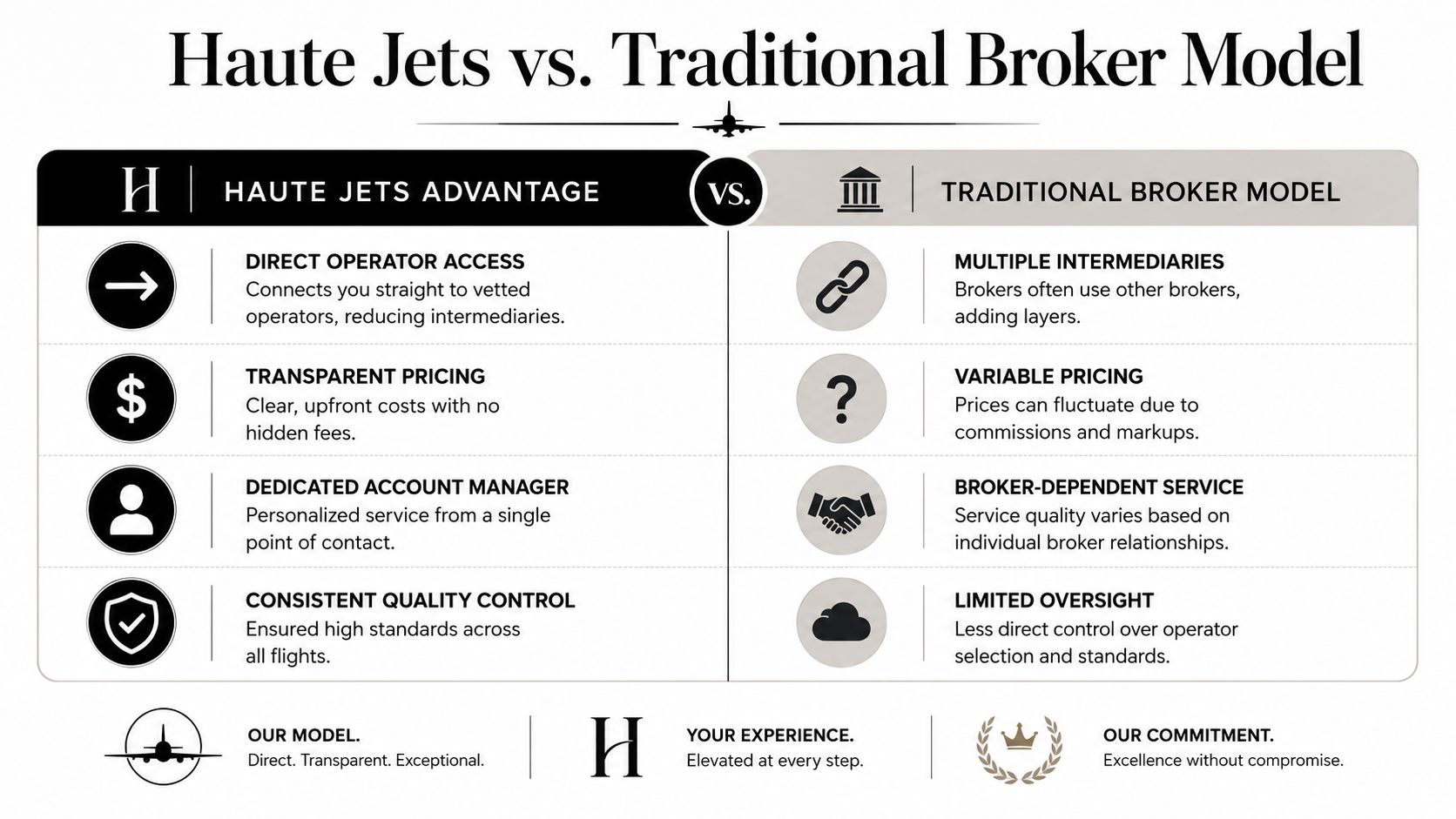
Traditional broker model versus local operator sourcing
| Model | What happens | What it means for you |
|---|---|---|
| Traditional broker | Aircraft may be sourced from outside your departure market | Higher chance of repositioning charges |
| Jet card model | You prepay for access but still may absorb inefficient sourcing | Less flexibility than many buyers expect |
| Local operator sourcing | Aircraft is matched near your departure city | Cleaner pricing and less waste |
My view on the smart Orlando booking model
For Orlando trips, start with nearby lift, then verify the operator, then review the aircraft details. In that order.
That is the advantage in the Haute Jets approach. The company works from a large operator network and prioritizes aircraft positioned close to the departure point instead of defaulting to a repositioned solution. In Orlando, that matters more than a membership pitch. A local aircraft can reduce wasted flight time, simplify scheduling, and make the quote easier to audit.
Here is what I would judge on every Orlando quote:
- Aircraft position. Ask where the jet is sitting now, not where it is based on paper.
- Line-item clarity. If repositioning is included, it should be obvious.
- Specific tail and operator. Category-only selling leaves too much unanswered.
- Operational fit. The right aircraft for Orlando is the one that matches the mission without extra ferry cost or unnecessary cabin size.
Plenty of buyers focus on hourly rate and stop there. That is a mistake. In Orlando, the better question is whether the sourcing model respects the local market or ignores it.
If you are comparing options for a private jet charter Orlando trip, ask this directly: is this aircraft already near my airport, and if not, what am I paying to bring it here? The answer usually tells you which quote is honest.
Your Orlando Charter Flight Questions Answered
The final questions are usually the practical ones. Good. Those are the ones that affect your travel day.
Can I bring pets on a private charter
Usually, yes. But don't assume. Confirm pet policy with the operator before you sign, especially if you're traveling with a larger dog, a carrier, or multiple animals. Private charter is generally far more flexible than commercial travel, but operator approval still matters.
What can I request for catering
You can usually request anything from simple snacks and beverages to more specific meal preferences. The key is timing. Put catering requests in early, especially if you have dietary restrictions, children in the group, or a very early departure.
Ask for catering based on the actual mission. A short Orlando hop doesn't need the same setup as a longer multi-hour flight.
How is ground transportation handled
The cleanest private trip is curb to cabin, then cabin to final destination. That means arranging ground transportation to the FBO and from the arrival FBO before departure day. If you're moving an executive team, a family, or guests with luggage, coordinate vehicle size and pickup timing in advance.
How early do I need to arrive
Private charter dramatically reduces airport friction, but don't treat that as a license to cut it too close. Arrive with enough time to board without stress, confirm manifest details, and handle any last-minute adjustments calmly.
Can I book last minute
Sometimes, yes. Orlando is active enough that short-notice options do appear. But urgency narrows your aircraft pool, reduces your bargaining power, and may force operational compromises. If your schedule is fixed, book as early as you can.
What's the single biggest mistake buyers make
They compare cabin photos instead of trip structure. The aircraft matters, but the smarter comparison is this:
- Is the aircraft local
- Is the operator properly certified
- Is the quote complete
- Is the airport choice right for the final destination
Get those four right and the rest becomes much easier.
If you want a cleaner way to book your next Orlando charter, start with Haute Jets. Review aircraft options based near your departure city, confirm operator-level safety credentials, and compare real trip economics before you approve a flight.