
A prospect just asked for a last minute transatlantic charter. You moved fast, found lift, built the quote, and felt the deal was close. Then the client saw a bloated reposition line, asked why the aircraft wasn't local, and went cold.
That happens because too many brokers still sell access instead of clarity. In private jet charter sales, speed matters, but pricing confidence closes the trip. If a buyer thinks you're hiding margin, you've already lost control of the conversation.
This playbook appears on Haute Jets Journal for one reason. Buyers are more informed now, and junior brokers need a cleaner system. You need to explain why one quote is leaner, why one aircraft is a better operational fit, and why zero membership pricing beats prepaid programs for many charter clients.
Introduction to Private Jet Charter Sales Playbook
A shaky quote usually fails in the same place. The broker presents a nice aircraft, a polished total, and a vague explanation of “positioning.” The client hears one thing: extra cost with no extra value.
That mistake is more dangerous now because the market is bigger, faster, and more competitive. The private jet charter services market was valued at USD 16.38 billion in 2025 and is projected to grow to USD 17.67 billion in 2026 before reaching USD 25.79 billion by 2031, reflecting a 7.86% CAGR. More demand brings more brokers. More brokers bring more bad quoting.
Here's the practical issue. A client calling for a same day or next day mission doesn't want a lecture on aviation logistics. They want three things:
- A safe aircraft
- A clean price
- A reason to trust your recommendation
If you can't explain the economics behind the quote in plain English, your prospect will assume you're padding it. That's why a step by step sales framework matters. It protects margin by removing confusion before the objection lands.
What junior brokers get wrong
Most junior brokers focus too hard on aircraft category and not hard enough on aircraft location. Category matters. Proximity often matters more to the final number.
They also lean on generic language. “Best available option.” “Competitive market rate.” “Premium operator.” None of that answers the primary buyer question, which is, “Why does this trip cost what it costs?”
Practical rule: If you can't show a client where the quote gets cleaner, you can't defend the quote when they push back.
A solid playbook fixes that. It gives you a positioning statement, a prospecting system, a pricing method, an operational checklist, and a tighter way to present custom aircraft options without getting buried in fluff.
Crafting Your Broker Positioning
Your positioning is your first close. It decides whether the client treats you like an advisor or a shopping tab.
Most brokers position themselves badly. They say they have access to many aircraft, personalized service, and around the clock support. That's table stakes. Every broker says that. Buyers tune it out.
Lead with what buyers actually care about
Your value proposition should sit on three pillars:
- Safety discipline
- Cost transparency
- Exact aircraft fit
That's the order. Safety gets you considered. Transparency gets you trusted. Aircraft fit gets you chosen.
If you open with luxury language, you sound expensive. If you open with access language, you sound replaceable. Open with operational control and financial clarity.
The message that works
Here's the positioning I'd train a junior broker to use:
“I don't sell random lift. I source the right aircraft for the mission, show you what's driving cost, and remove avoidable repositioning where possible.”
That statement works because it addresses the client's fear immediately. They're not worried about whether you know what a Gulfstream is. They're worried about overpaying for a plane that starts the day in the wrong city.
Common positioning mistakes
Talking like a marketplace instead of an advisor
A marketplace gives options. An advisor gives direction.
If you send five aircraft with no recommendation, you've dumped work on the client. Give fewer choices and defend each one with logic tied to the trip.
Hiding behind vague “all in” language
“All inclusive” means nothing unless you explain what's included. Buyers don't mind paying for a legitimate operating cost. They mind surprises.
Pushing memberships too early
A lot of prospects are tired of annual commitments, prepaid hours, and rules they don't fully understand. If they fly opportunistically, on demand pricing is often easier to approve because it matches the trip in front of them.
A simple messaging matrix
| Prospect Type | What they care about first | What you should say |
|---|---|---|
| Corporate travel manager | Reliability and approval clarity | “I'll give you a clean quote with operational detail your team can approve quickly.” |
| Family office contact | Discretion and consistency | “I'll keep aircraft quality high and pricing explainable, without forcing a program commitment.” |
| Celebrity or principal assistant | No surprises | “You'll know the aircraft, crew details, and trip specifics before departure.” |
| First time charter buyer | Safety and trust | “I'll walk you through the operator, the aircraft, and every cost line before you commit.” |
Positioning statement you can actually use
Use this structure:
- What you solve
- How you source
- Why your pricing is cleaner
- How the client benefits
Example:
“I help clients book on demand private lift without paying for unnecessary ferry costs or getting forced into a membership model. I source around the mission, not just around inventory lists, and I present exact aircraft options with transparent trip economics.”
That's positioning. It's specific, credible, and easy to repeat.
High-Impact Prospecting Techniques
Spray and pray prospecting doesn't belong in private jet charter sales. If your pipeline depends on random inbound and occasional referrals, you don't have a pipeline. You have hope.
The system that works is narrower and more disciplined. In private jet charter sales, client acquisition costs range from $5,000 to $25,000 depending on service tier and projected LTV, with 62% of UHNW buyers initiating research in AI answer engines. That means two things. You need better targeting, and your digital footprint needs to answer buyer questions before you ever speak to them.
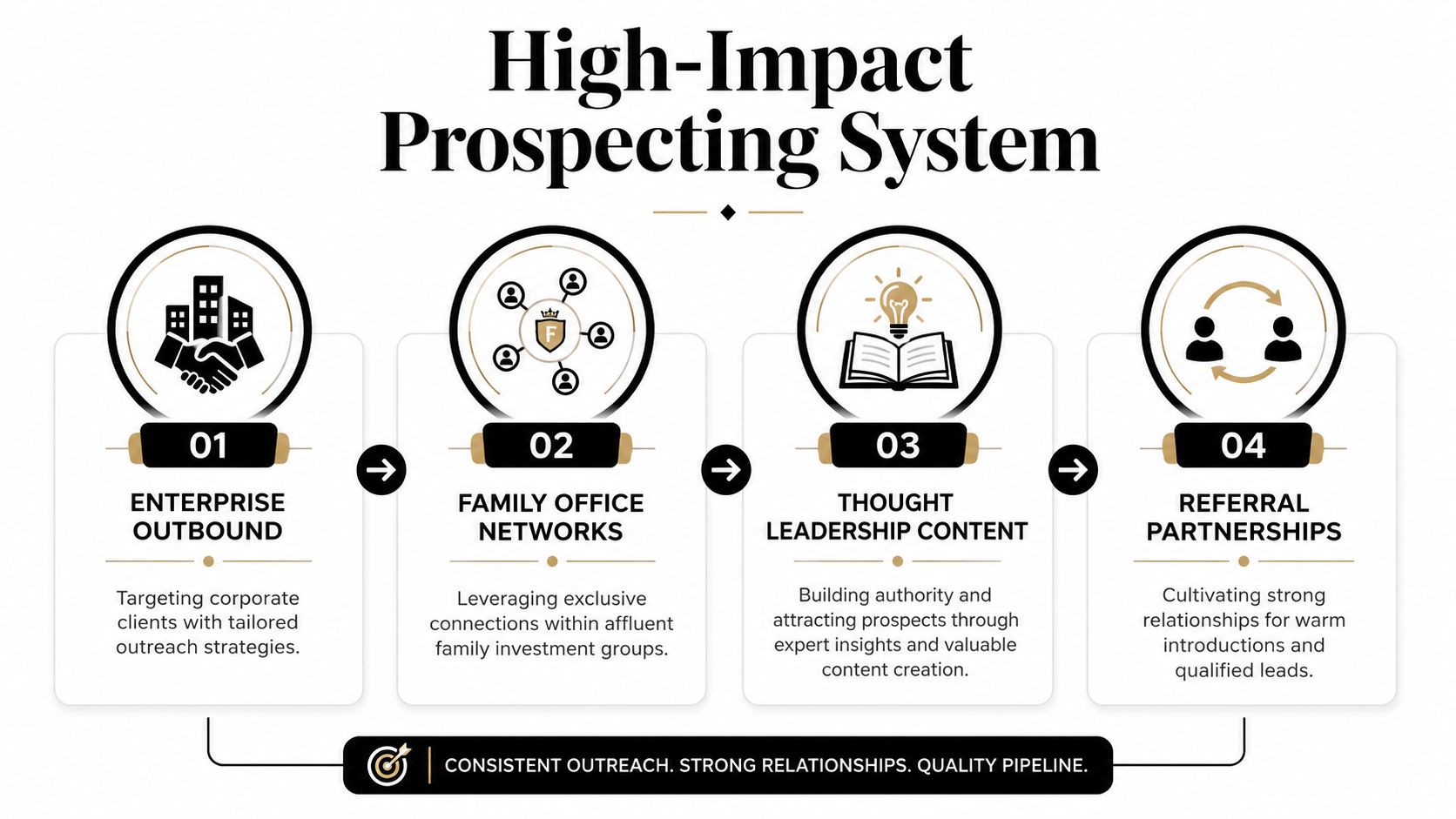
Pillar one: enterprise outbound
Go after companies with recurring executive travel pain. Don't send generic “book private jet travel with us” emails. Send trip logic.
A strong opening references a business problem. Last minute routing. Multi city executive schedules. Commercial disruption. Tight same day returns. You're not selling glamour to this buyer. You're selling control.
What to do
- Target decision paths: Reach travel managers, chiefs of staff, executive assistants, and finance approvers.
- Write around friction: Focus on itinerary complexity, approval speed, and price clarity.
- Track conversations, not raw leads: Cost per qualified conversation matters more than form fills.
Pillar two: family office networks
Family offices rarely respond to cold vanity messaging. They respond to discretion, relevance, and introductions that feel sane.
The mistake junior brokers make is chasing the principal. Go through the people who protect the principal's time. That means assistants, office heads, lifestyle managers, and trusted advisors.
Don't ask for a booking on first contact. Ask for the rules they use to evaluate charter providers.
That question opens better conversations. It also gives you the exact language to mirror later in the sales process.
Pillar three: thought leadership content
If wealthy buyers start research in AI answer engines, your content can't be shallow. Publish useful material that answers the questions clients ask when money is on the line.
Write about hidden repositioning fees. Write about exact aircraft selection. Write about how international trip pricing gets messy. Write about what clients should demand before departure.
One practical option is Haute Jets, which states that it sources from 3,500+ aircraft across 175 countries and operates on a no membership pricing model through owner-operator access and safety-rated operators. That kind of factual positioning gives buyers language they can evaluate instead of generic luxury copy.
Pillar four: referral partnerships
Referrals shouldn't be accidental. Build them with intent.
Good partners include FBO contacts, concierge firms, wealth service providers, and luxury travel advisors. Give them a tight explanation of your lane. If they can't describe you in one sentence, they won't refer you accurately.
CRM discipline that actually matters
Your CRM should flag:
- Who asked for a quote but didn't buy
- Who objected to price structure
- Who prefers exact aircraft over category
- Who needs follow-up before a known travel window
If you don't automate follow-up, you'll bleed expensive opportunities. In this business, silence doesn't mean no. It often means “not today.”
Crafting Pricing Offers That Convert
Bad offers make clients suspicious. Good offers make comparison easy.
The biggest pricing mistake in private jet charter sales is presenting a total without teaching the client how the total was built. You don't need to show every internal detail, but you do need to explain the logic behind the number.
Most guides miss the core issue. Direct-to-owner sourcing eliminates 20–40% repositioning markups that brokers without operational control often add. If you don't address that directly, a cheaper looking quote from a sloppy broker can pull your buyer off course.
What to put in the offer
Your quote should answer four questions fast:
- What aircraft is this, exactly?
- Is it local or repositioning?
- What's included in the price?
- What could change on an international or special mission?
If you bury those answers, you create objections.
Pricing Model Comparison
| Pricing Model | Features | Typical Markup |
|---|---|---|
| On-demand direct sourcing | Pay per trip, exact aircraft selection, no annual commitment, pricing tied to the mission | Lower exposure to hidden repositioning when aircraft is sourced near departure |
| Membership or jet card program | Prepaid hours or annual fees, program terms, limited flexibility depending on structure | Can carry inflated cost when clients pay for access rules and non-local lift |
| Non-operational broker sourcing | Wide inventory search, variable transparency, indirect control over aircraft logistics | Often includes repositioning markups in the 20–40% range |
How to present zero-membership pricing
Don't sell “no membership” as a slogan. Sell it as a buying advantage.
Tell the client they're evaluating a single mission on its own economics. No annual fee. No pressure to burn prepaid hours. No artificial reason to pick the wrong plane just because it sits inside a program.
That framing works because it makes the quote feel cleaner and more rational.
For a stronger client education piece on quote construction, point them to this private jet charter pricing cost breakdown.
Script for international or special mission quotes
Use plain language.
“This rate covers the aircraft and expected mission profile. For international or special missions, I'll also identify operational items that can affect final cost, such as permits, handling, crew overnight needs, and weather-driven ground services, so you're not surprised later.”
That script does two jobs. It protects trust, and it keeps you from overpromising on complicated itineraries.
Ensuring Safety and Operational Excellence
Clients pay for confidence. If you can't prove operational discipline, your pricing discussion won't matter.
The global private jet industry recorded 3,878,836 flights in 2025, a 4.6% rise from 2024, with U.S. operations accounting for 60% of movements and average reposition savings of 20–40%. In a market moving at that scale, sloppy broker habits get exposed fast. The broker who confirms details wins. The broker who assumes details loses.
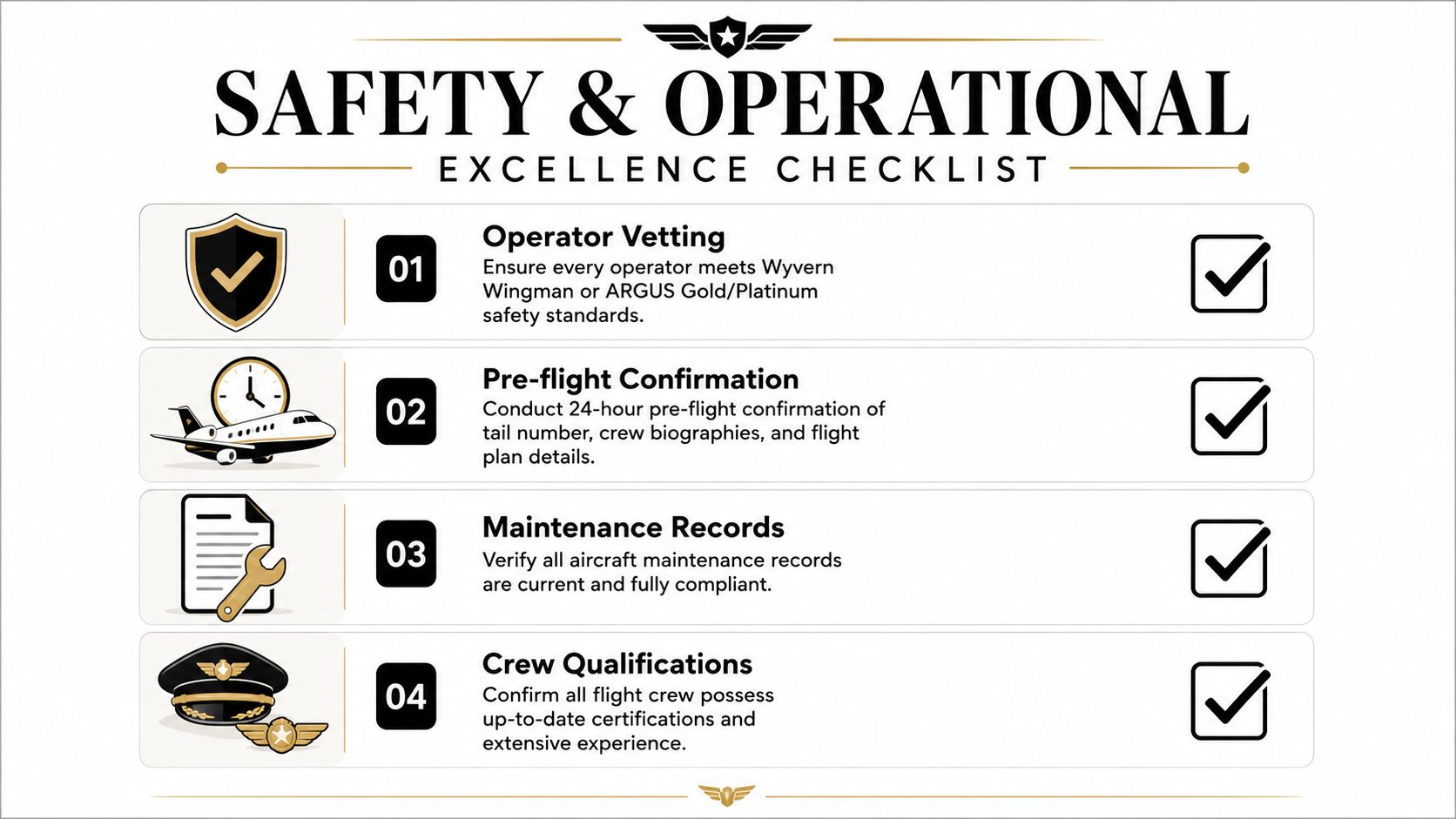
Your non-negotiable operator screen
Start with third party safety standing. If an operator doesn't meet the standard you require, move on.
Your checklist should include:
- Operator vetting: Confirm the operator meets Wyvern Wingman or ARGUS Gold/Platinum expectations.
- Aircraft review: Check that the proposed tail fits the mission, runway, baggage, and passenger profile.
- Maintenance confidence: Verify that records are current and compliance is not in question.
- Crew review: Confirm qualifications and current readiness for the mission.
The 24-hour confirmation workflow
A lot of trust is built the day before departure. That's where weak brokers get exposed.
At minimum, send:
| Pre-flight item | Why it matters |
|---|---|
| Tail number | Confirms the actual aircraft, not just the category |
| Crew bios | Reassures the client that real professionals are assigned |
| Weather briefing | Sets expectations and reduces last minute confusion |
| Passenger manifest review | Prevents avoidable mistakes at the terminal |
Operational advice: Never assume a client feels reassured just because the aircraft is booked. Reassurance comes from documented confirmation.
Why local sourcing improves safety communication
Local sourcing doesn't only help price. It shortens the operational chain.
When the aircraft is closer to departure and the dispatch path is cleaner, you usually have fewer blind handoffs. Fewer handoffs mean fewer opportunities for wrong tail assumptions, stale timing updates, and incomplete passenger handling details.
That's why I'd rather present one clean local option than three vague remote ones.
If you need a client-friendly explainer on this side of the business, use this guide to private jet safety and reliability.
Expanding Offers with Aircraft Selection and Payment Options
Once trust is established, customization becomes a closing tool. It enables you to stop selling “a jet” and start selling the right mission setup.
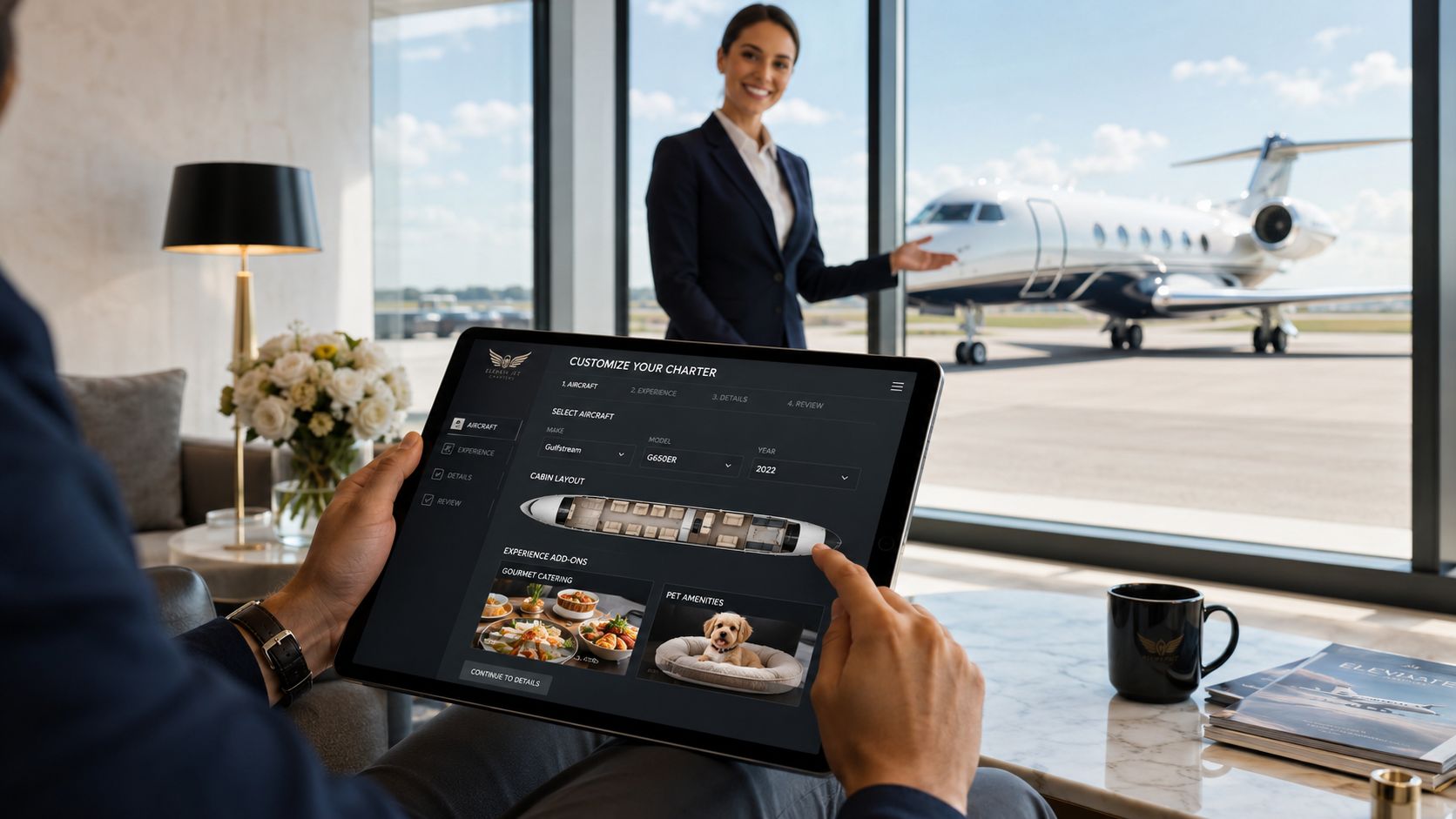
A serious client often cares about details that junior brokers ignore. Exact make and model. Cabin layout. Year of aircraft. Wi-Fi. Catering standards. Pet policy. Luggage fit. Ground transfer timing. If you only sell by category, you'll miss opportunities to separate yourself from commodity brokers.
Match the aircraft to the mission
Don't start with what's available. Start with what the mission needs.
Corporate retreat or executive roadshow
Prioritize cabin productivity, predictable boarding flow, and room for baggage. You want an aircraft that supports meetings in transit and doesn't create friction on multi stop scheduling.
Wedding or family event travel
Cabin comfort matters, but so does emotional tolerance for delays and confusion. Keep the proposal simple. Explain luggage constraints early. Confirm catering and ground transportation before the family starts asking.
Sports team or production movement
These trips fail when the broker underestimates logistics. Focus on baggage profile, equipment handling, airport access, and schedule rigidity. If the mission looks simple on paper, double check it anyway.
Give clients exact-aircraft choices
Use a short option set. Three options is usually enough:
- Best fit option: The strongest balance of cost, comfort, and proximity
- Premium step-up: Better cabin or range profile for buyers who value comfort more than savings
- Utility option: A leaner aircraft that still meets the mission if the client wants discipline on spend
This structure keeps the client in control without drowning them in inventory.
A buyer who can choose the exact aircraft feels ownership before the contract is signed. That shortens hesitation.
Add payment flexibility without making it messy
Some high-net-worth clients want digital wallet or crypto payment options because they prefer speed, privacy, or treasury flexibility. If your operation supports that, keep the workflow controlled.
Use a straightforward sequence:
- Confirm the quote and contracting entity.
- Verify compliance and identity requirements.
- Lock payment instructions before release of final trip details.
- Coordinate treasury confirmation with operations before departure.
Here's a useful visual explainer for clients who want to understand the booking flow more clearly:
Payment flexibility should reduce friction, not create ambiguity. If your finance process is fuzzy, don't advertise optionality you can't execute cleanly.
Conclusion and Sales Templates
Private jet charter sales gets easier when you stop improvising. Build a repeatable system and run it every time.
Your KPI dashboard should stay tight. Track cost per qualified conversation, prospect to close ratio, and average margin by flight type. Those numbers tell you where your process is leaking. Vanity metrics won't.
Core scripts worth keeping in your CRM
Initial outreach email
Subject: Cleaner charter quoting for complex trips
I help clients source on-demand lift with clear aircraft and pricing logic. If you're comparing providers, I can show you exact-aircraft options and where avoidable positioning cost tends to creep in.
Price objection response
I understand the pushback. The right comparison isn't only the total. It's whether the aircraft is correctly sourced, whether the quote is clean, and whether operational details are already accounted for.
Last-minute upsell
I have a stronger aircraft option that improves comfort and timing for this mission. If cabin experience or schedule resilience matters more than lowest cost, it's worth a look.
If you want fresh messaging ideas without starting from scratch, you can get templates from hireSDR.io and adapt them for charter outreach, follow-up, and reactivation.
Next actions for junior brokers
- Set quarterly targets: Pick realistic activity and close goals tied to margin, not just trip count.
- Automate follow-up: Every quote that doesn't close should trigger a structured nurture path.
- Standardize your offer format: Clients should see the same clean logic every time.
- Keep one booking explainer ready: This private jet booking guide is the kind of resource that helps buyers understand the process without forcing your sales team to rewrite the basics on every call.
The brokers who close consistently aren't always the smoothest talkers. They're the ones who explain price clearly, control the details, and make the client feel safe saying yes.
If you want on-demand charter guidance built around transparent pricing, exact-aircraft selection, and clean operator sourcing, visit Haute Jets.