
You're likely looking at two very different booking paths right now. On one screen, a first-class fare that feels expensive but familiar. On the other, a private charter quote that looks high until you start asking the only questions that matter: How much total time do I save, and what does the entire trip cost?
That's private jet charter vs first class decision.
A common mistake is comparing the wrong things: a ticket to an hourly rate, cabin photos, or prestige. Serious travelers compare door-to-door efficiency, schedule control, privacy, and cost per traveler. That's how you make the right call for a board meeting, a family trip, a last-minute ski weekend, or a transatlantic run with no room for delay.
I'll give you the direct answer up front. If you're flying alone, first class is usually the smarter financial choice. If you're flying as a group, heading to a secondary airport, or placing a premium on time and control, charter can become the better business decision. If you want a broader look at why private travel keeps winning high-value itineraries, Haute Jets' overview of private flying benefits is a useful companion read.
Here's the fast comparison before we go deeper.
| Decision Factor | First Class | Private Charter |
|---|---|---|
| Pricing model | Per seat | Per aircraft |
| Best for | Solo travelers, couples on major routes | Groups, time-critical trips, privacy-sensitive travel |
| Airport access | Major commercial network | Far broader airport access |
| Schedule control | Airline schedule | Your schedule |
| Privacy | Limited | Full cabin privacy |
| Door-to-door efficiency | Slower ground process | Faster terminal flow and airport access |
| Cost logic | Usually cheaper for one traveler | Can make sense when costs are split |
The Ultimate Travel Decision
A client recently asked me a version of the same question I hear every week. He had an important meeting, a hard return deadline, and two booking options. One was a top-tier first-class seat. The other was a private aircraft that could leave when he wanted, land closer to where he needed to be, and avoid the usual airport drag. His instinct was to treat it as a luxury question.
It wasn't.
It was a resource allocation question. If he bought first class, he'd save money on airfare and lose control over the day. If he chartered, he'd spend more upfront but potentially reclaim hours, protect confidentiality, and remove the risk that one commercial delay would derail the trip.
Stop treating this like a status purchase
That's where most comparisons go wrong. Private jet charter vs first class isn't about whether one option is more glamorous. It's about choosing the right tool for the trip.
Ask three questions first:
- How many people are flying? A seat-based purchase behaves very differently from an aircraft-based purchase.
- How rigid is the schedule? If your day can't absorb delays, private aviation changes the math.
- Where are you going? The final destination matters more than the city pair printed on a ticket.
Practical rule: If missing a meeting, losing half a day in transit, or exposing confidential conversations carries a real cost, stop evaluating travel like a consumer purchase. Evaluate it like an operating decision.
That's the lens I use with clients. Not indulgence versus restraint. Return on time, return on control, and total cost of mission success.
Calculating Your Total Journey Time
The right time metric is not wheels up to wheels down. It is the full day consumed by the trip.
A first-class ticket buys a better seat inside the same commercial system. You still have to work around airline schedules, arrive early, clear a crowded terminal, wait at the gate, deplane with everyone else, and often finish with a longer drive from a major airport. Charter changes the structure of the day because you use a private terminal, depart closer to your preferred time, and can often land closer to the final stop.
What the clock captures
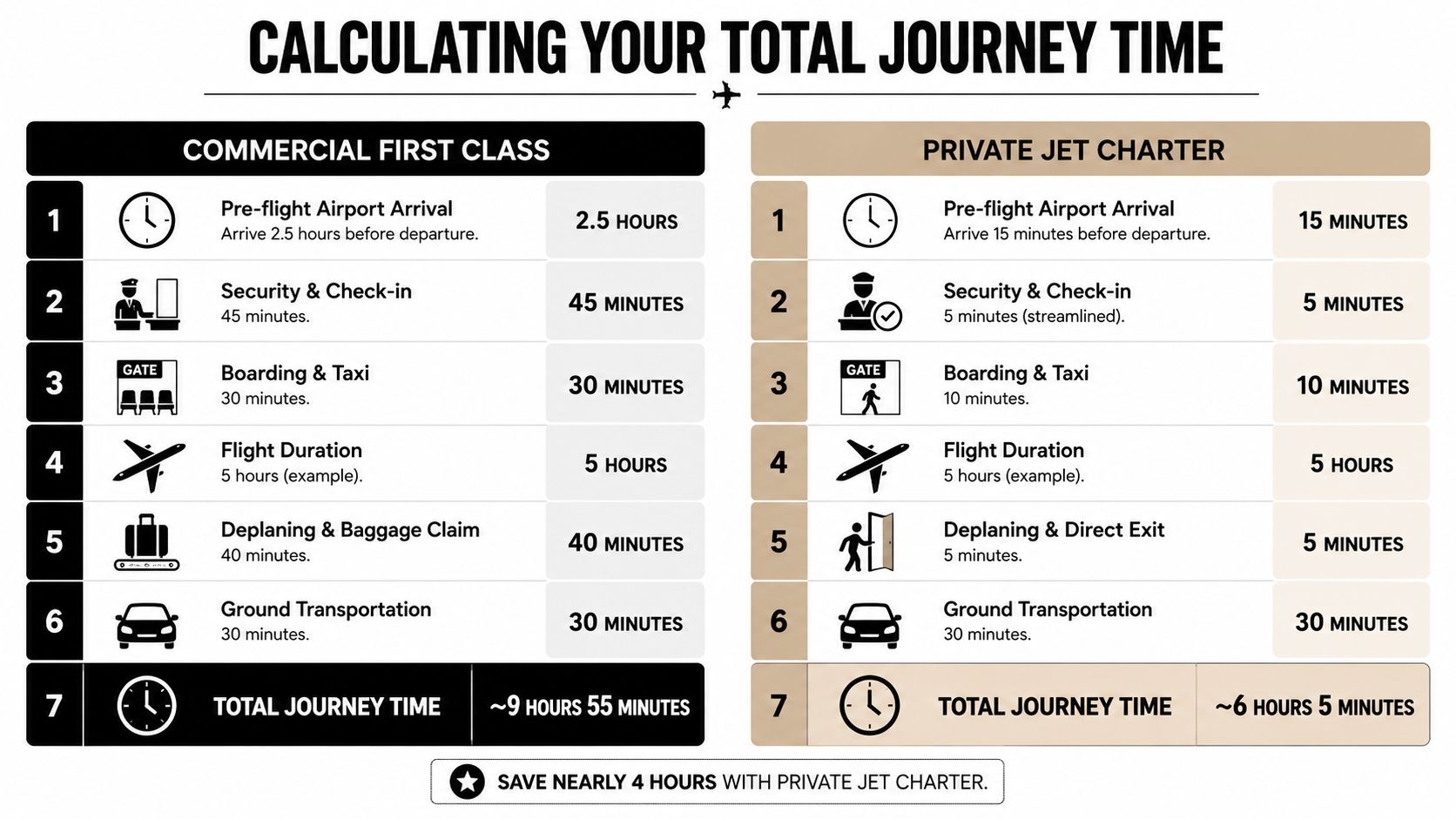
The infographic above shows the issue clearly. In that example, commercial first class takes about 9 hours 55 minutes door to door. Private charter takes about 6 hours 5 minutes. The difference is not mainly cruise speed. The difference sits in the ground process.
That time gap usually comes from four places:
- Pre-flight time at the airport
- Boarding and deplaning delays inside the commercial flow
- Post-arrival congestion after landing
- Longer ground transfers because major airlines do not serve the airport closest to your real destination
For a traveler billing by the hour, or a company flying multiple executives, those hours have a dollar value. Treat them that way.
Airport choice matters more than flight time
Airport access is where private aviation often wins the day. According to ACC Aviation's comparison of private jet charter and first class, commercial airlines serve roughly 550 airports worldwide, while private jets can access more than 5,000 airports. ACC Aviation also notes that global private jet flights reached 3.3 million in 2021, U.S. private jet flight hours reached 5.5 million in 2022, and charter and fractional hours increased 5.7% in 2022.
Those numbers matter because schedule flexibility is only half the value. The other half is geography. If charter puts you 20 minutes from the meeting instead of 90 minutes away, the private option may beat first class even before you account for check-in and gate time.
That is why I tell clients to price the whole mission, not the seat.
If you want to benchmark the commercial side of the equation, review published fare ranges in INVOLUNTARY REROUTE's first class guide. Then add the value of the hours lost before departure, after arrival, and in transit to and from the airport.
My recommendation on time
Choose first class when the destination is served well by a major airport, the schedule has room for delays, and the trip is simple enough that losing a few hours does not change the outcome.
Choose charter when total day efficiency matters. That includes same-day deal meetings, multi-stop itineraries, event schedules with fixed start times, family travel with narrow windows, and any route where a private airport cuts a long ground transfer. For a practical look at how operators reduce avoidable delays, Haute Jets explains the operational factors that shorten private jet travel time.
The Financial Breakdown Charter vs First Class
A client flying alone from New York to London rarely needs a charter quote. A client moving five executives to two meetings in one day should run the charter math immediately.
That is the right way to judge this decision. Start with total trip cost, then weigh it against total time saved.
For solo travelers, first class usually wins on direct price. Published comparisons from IONA Jets put first-class tickets at roughly $3,000 to $15,000 per person, while private jet charter often starts around $4,000 to $7,000 per flight hour for the whole aircraft. The same source notes that on long-haul routes such as London to New York, first class is typically about GBP 5,000 to GBP 12,000 round trip, while an ultra-long-range private jet can cost EUR 80,000 to EUR 130,000 each way.
Hourly rates and ticket prices are only the starting point. The accurate comparison is the full spend for everyone traveling, plus the value of the hours recovered by using a private aircraft.
Cost comparison by traveler count
| Route | Travelers | First Class (Per Person) | Light Jet (Per Person) | Mid-Size Jet (Per Person) |
|---|---|---|---|---|
| Shorter route example such as London to Geneva | 1 | Usually cheaper than charter | Usually much higher than first class | Usually much higher than first class |
| Shorter route example such as London to Geneva | 2 | Usually cheaper than charter | Often still higher per person | Often still higher per person |
| Shorter route example such as London to Geneva | 4 | Can be comparable depending on aircraft and trip structure | Can begin approaching first class per person | Depends on aircraft and operating structure |
| London to Geneva light-jet example | 6 | GBP 3,000 to GBP 5,000 | About EUR 1,700 per person | Not provided in verified data |
| Long-haul example such as London to New York | 1 | GBP 5,000 to GBP 12,000 round trip | Not the relevant aircraft category | Private jet remains dramatically more expensive per person on a solo basis |
| Long-haul example such as London to New York | Group | Per-seat cost rises linearly | Not the relevant aircraft category | Whole-aircraft economics depend on party size, but charter remains a deliberate premium unless the trip's time value is high |
Where charter starts to make financial sense
Group size changes the economics first. Trip design changes them second.
IONA Jets notes that once four or more passengers share the aircraft cost on shorter routes, charter can start to approach or beat first-class pricing on a per-person basis. That does not mean charter is automatically cheaper. It means the gap narrows enough that time savings can decide the outcome.
Use a simple framework:
- One traveler. Book first class unless privacy, schedule control, or airport access changes the business outcome.
- Two travelers. First class is still usually the cleaner cost decision.
- Four or more on a short route. Price charter against the total commercial spend for the group.
- Six travelers on the right route. Charter can move from premium purchase to rational operating choice.
Do not compare one charter quote to one first-class ticket. Compare the aircraft cost to the total commercial cost for the entire party, then add hotels avoided, ground transfers reduced, and the value of executives getting productive hours back.
If you want a clearer view of how operators build quotes, fuel, positioning, minimums, and aircraft category all matter, review this Haute Jets guide to charter pricing mechanics. For the commercial side, INVOLUNTARY REROUTE's first class guide is a useful benchmark before you line up seat prices against a full-aircraft charter.
The In-Flight Experience Compared
First class is polished. Private charter is controlled.
That's the cleanest way to describe the difference.
On a commercial airline, even the best first-class cabin is still part of a public system. The service can be excellent, the seat can be exceptional, and the food can be impressive. But you're still operating inside someone else's schedule, someone else's boarding process, and someone else's cabin environment.
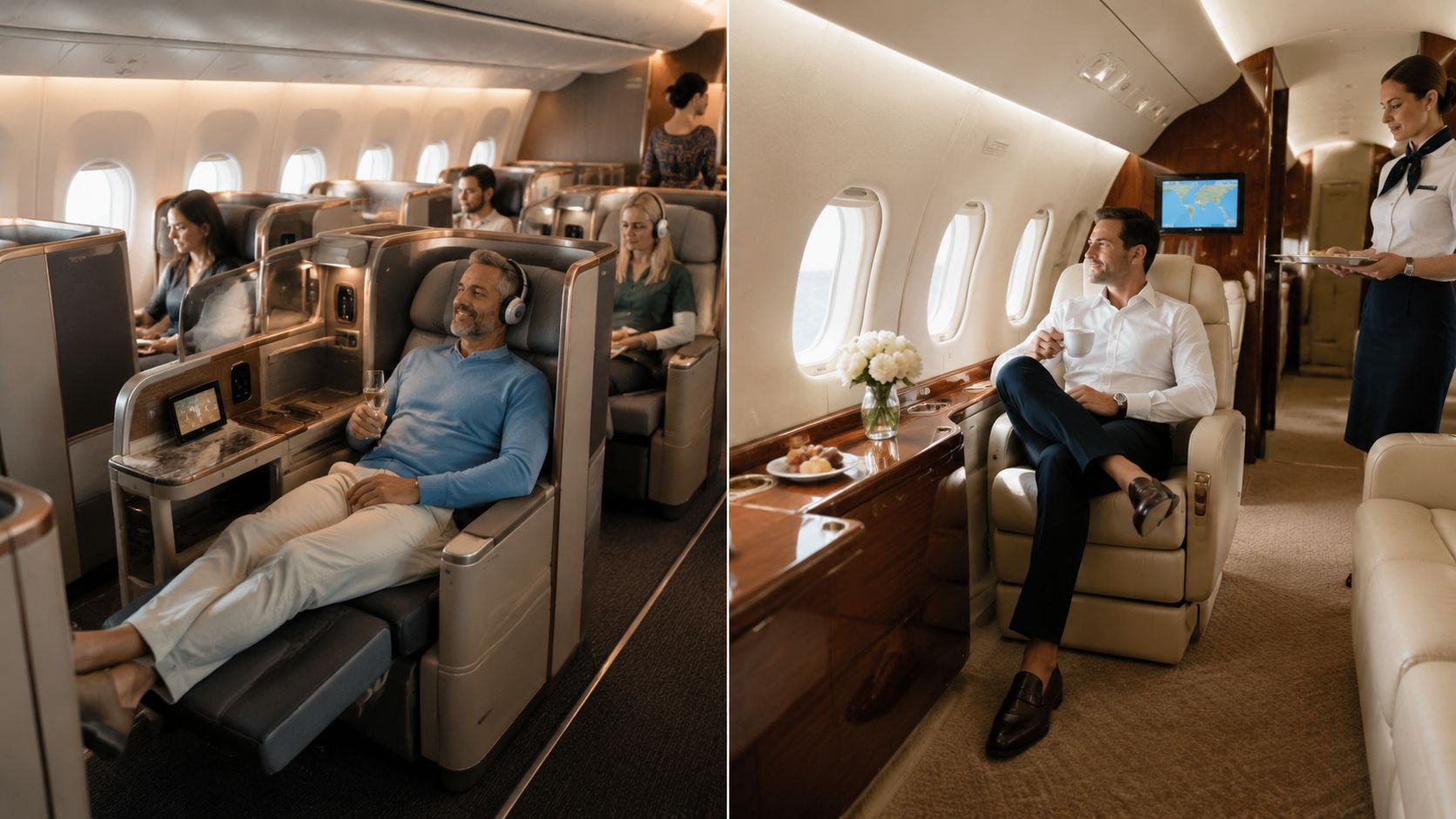
First class gives you premium treatment in a shared setting
That works well for many travelers. If you want a flat bed, attentive cabin crew, quality dining, and a quieter cabin than business class, first class can be a very good product.
But it has hard limits:
- You can't turn the cabin into a confidential meeting room.
- You can't shape the departure around your day.
- You can't assume full discretion.
- You can't customize the environment beyond what the airline offers.
Charter gives you control, not just comfort
Private aviation changes the relationship. You're not one premium passenger among many. The aircraft is dedicated to your party and your itinerary.
That affects the experience in practical ways:
- Business privacy for calls, documents, and in-person discussion
- Family ease when traveling with children, caregivers, or pets
- Custom service including catering and cabin preferences
- Reduced exposure for public figures or anyone who values discretion
For clients carrying sensitive conversations, the main benefit isn't leather seating. It's the ability to speak freely from wheels up to wheels down.
The visual difference is easy to see, but the functional difference matters more. If you're curious what that cabin experience looks like in motion, this short video is a useful reference.
My recommendation on experience
Pick first class when you want comfort and can tolerate standardization.
Pick charter when privacy, discretion, flexibility, or cabin control isn't negotiable. That includes executive travel, high-visibility individuals, family itineraries with moving parts, and trips where the journey itself needs to function like a private workspace or living room.
Understanding Aviation Safety Standards
Safety shouldn't be reduced to a marketing line. You need to know how the system works.
Commercial airlines operate under rigorous government oversight. So do legitimate charter operators. The difference for private flyers is that there's often an additional layer of screening available through respected third-party auditors. That extra layer matters because it helps clients evaluate operator quality beyond a sales pitch.
What Wyvern and ARGUS ratings mean
In private aviation, two names come up constantly for a reason: Wyvern and ARGUS.
These organizations conduct third-party safety audits and operational reviews. Their ratings help buyers identify operators that meet higher standards of oversight, documentation, procedures, and risk management. You'll commonly hear terms such as Wyvern Wingman and ARGUS Gold or Platinum. Those designations signal that the operator has passed a deeper level of review than simple self-description.
How I advise clients to vet a charter operator
Use a short checklist:
- Confirm the operator, not just the broker. You want to know who is flying the aircraft.
- Ask for current third-party audit status. Wyvern Wingman and ARGUS Gold or Platinum are meaningful markers.
- Review aircraft and crew details before departure. A serious provider should make this easy.
- Avoid vague answers. If the response on safety is generic, keep looking.
A polished quote means nothing if the operator vetting behind it is thin.
One factual point matters here. The publisher states that its network includes only Wyvern Wingman and ARGUS Gold/Platinum-rated operators. That's relevant because it gives clients a defined screening threshold rather than leaving safety review entirely on their shoulders.
My recommendation on safety
Don't assume “private” means less regulated, and don't assume every charter option is equal. Commercial first class offers the familiarity of major airline systems. Private charter can offer excellent safety assurance when the operator is properly vetted and independently audited. The key is choosing a booking path that tells you exactly who is flying you and what standards they meet.
A Framework for Choosing Your Flight
You have a 9:00 a.m. meeting in a secondary market, two executives traveling, and a same-day return on the table. The wrong flight choice does not just change the cabin experience. It changes the number of productive hours you keep, the ground transport you need, and the cost of a missed schedule. That is why private jet charter vs first class should be treated as a business decision first.
A useful outside comparison from Air Charter Service makes the core point clearly. First class usually wins on price for solo travelers. Charter starts to make more financial sense when you spread the aircraft cost across several passengers and account for the trip itself, not just the seat price.
That is the right filter. Measure total trip cost and total time saved.
Ask these seven questions
- How many total hours does charter save on this trip? Count drive time to the airport, early airline check-in, connections, baggage wait, and the ground transfer on arrival.
- What is one saved hour worth to you or your team? If the travelers are senior operators, revenue producers, or decision-makers, that number is usually higher than they first assume.
- How many people are flying? One traveler usually points to first class. A group changes the math fast.
- Which airport gets you closest to the actual destination? If private aviation cuts out a long car transfer, charter gets stronger.
- What happens if the schedule slips? If a delay means a missed meeting, an extra hotel night, or a dead day, airline savings can disappear quickly.
- Do you need the cabin to function as a private workspace? If confidential calls or focused prep matter, charter has a clear advantage.
- Am I comparing total trip cost or just the headline fare? Ticket price alone is the wrong metric.
A practical decision matrix
Choose first class when:
- You are traveling alone or with one other person
- The route is nonstop on a major airline
- The commercial airport is close to where you need to be
- The schedule is flexible
- The lower upfront cash cost matters more than time recovery
Choose charter when:
- You are flying a group
- You need access to a smaller or closer airport
- The trip is built around a fixed meeting, site visit, or event window
- Privacy has operational value, not just comfort value
- Losing half a day would cost more than the flight savings
My recommendation
Start with two numbers. Total trip cost. Total time saved.
If first class costs less but burns five extra hours across the day, include the value of those hours before you call it the cheaper option. If charter looks expensive on the quote but keeps a full meeting schedule intact, avoids an overnight stay, and moves several people at once, it may be the better financial decision.
For solo leisure travel on a simple major-city route, book first class and move on. For multi-passenger, time-sensitive, or hard-to-reach itineraries, run the full charter comparison. That is where the better decision usually shows up.
How Haute Jets Delivers Unmatched Value
Once you've decided charter is the right tool, the next problem is market inefficiency.
A lot of charter buyers overpay because they accept whatever aircraft a broker can place quickly, even if that aircraft has to reposition from somewhere else. That can distort the quote before the trip even starts. Another common issue is lack of transparency. You get a category label, not the exact aircraft details that matter to your itinerary.
The cleaner approach is to source aircraft that are already positioned near departure and to book trip by trip instead of locking yourself into a program you may not need.
What changes the economics
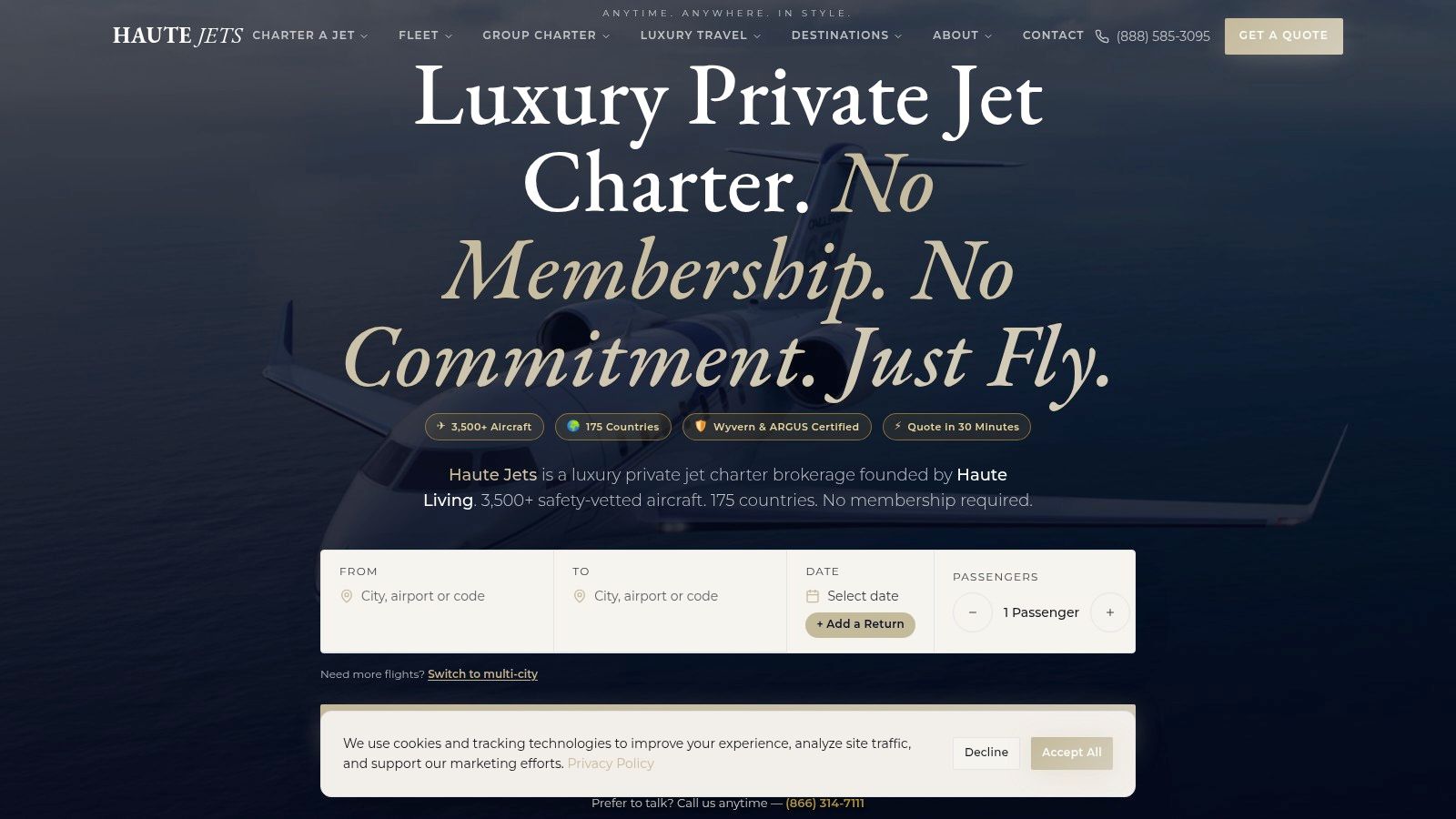
According to the publisher information, Haute Jets sources from 3,500+ owner-operators across 175 countries and focuses on local aircraft sourcing to reduce the repositioning problem. The same publisher information states that repositioning fees can inflate charter prices by 20 to 40% with traditional brokers and jet card models. The model described here is pay per flight, with no membership dues or jet card commitment, and with access to the exact aircraft selected for the mission.
That structure matters for buyers who want charter advantages without paying for unnecessary program overhead.
When this booking model makes sense
It fits travelers who want:
- On-demand access without prepaid hours
- Aircraft choice down to make, model, and cabin layout
- Lower wasted spend by avoiding far-away lift when local lift is available
- Clear pre-flight information before departure
If you've already done the private jet charter vs first class math and charter wins for your trip, this is the part of the market where details start affecting value just as much as the aircraft itself.
If your trip calls for charter, Haute Jets offers an on-demand booking model built around exact-aircraft selection, local sourcing, and third-party-audited operators. It's a practical option for travelers who want private aviation without memberships, jet cards, or generic fleet promises.