
Reagan National Airport is only 3 miles from downtown Washington, D.C., but severe security restrictions make Dulles International or Manassas Regional the standard choices for most private charters. If you're arranging a private jet charter Washington DC trip around a meeting, hearing, or same-day return, operational feasibility matters more than the shortest drive.
You may be looking at a schedule that leaves no room for a commercial terminal delay. The meeting is fixed, the passengers are senior, and arriving at the closest airport feels like the obvious answer. In Washington, that assumption can create the very problem private aviation is supposed to eliminate.
The capital region combines dense business travel demand with unusually restrictive airspace and a wide network of public, private, heliport, and specialized aviation facilities. The two-airport system handled more than 53.9 million passengers in 2025, a record for Reagan National and Dulles International combined, according to the National Archives' account of Washington's aviation history. That scale explains the demand. The security environment explains why local scheduling knowledge is essential.
Navigating Private Aviation in the Capital
A fixed Capitol Hill meeting can turn into a scheduling problem before the aircraft moves. Commercial passengers lose time in terminals, security lines, gate changes, and downtown traffic. A private jet charter Washington DC itinerary removes much of that friction, but only when the airport, aircraft, and ground plan are selected together.
Washington adds operational constraints that do not appear in a standard airport search. The D.C. Special Flight Rules Area, or SFRA, and Reagan National's Flight Restricted Zone, or FRZ, limit which aircraft and passenger movements are practical. Security and access requirements, including the applicable TSA process, are covered with the airport restrictions later in this guide. They can narrow aircraft availability and require additional planning time.
Haute Jets' local sourcing model helps schedulers compare feasible airports and aircraft before committing to a downtown address. That approach matters because the airport furthest from the capital can produce the most reliable overall itinerary when access rules, aircraft approval, and road conditions are considered together.
Scheduler's rule: In Washington, “closest” describes geography, not the booking decision.
The region's aviation history reflects its long role in government, business, and official travel. The first U.S. airmail flight departed Polo Field in Washington on May 15, 1918, and passenger service between Washington and Philadelphia began on July 16, 1926, according to the National Archives. That history supports a mature corridor serving government, legal, corporate, diplomatic, and leisure movements.
Airport design also affects how quickly passengers reach the aircraft. Guidance on Mappedin airport navigation solutions explains how terminal layout and passenger flow influence travel time. For charter passengers, the practical checklist is direct: confirm the FBO, verify airport access, approve the aircraft, and plan the ground route before finalizing the itinerary.
The Three Key Airports for Your Flight
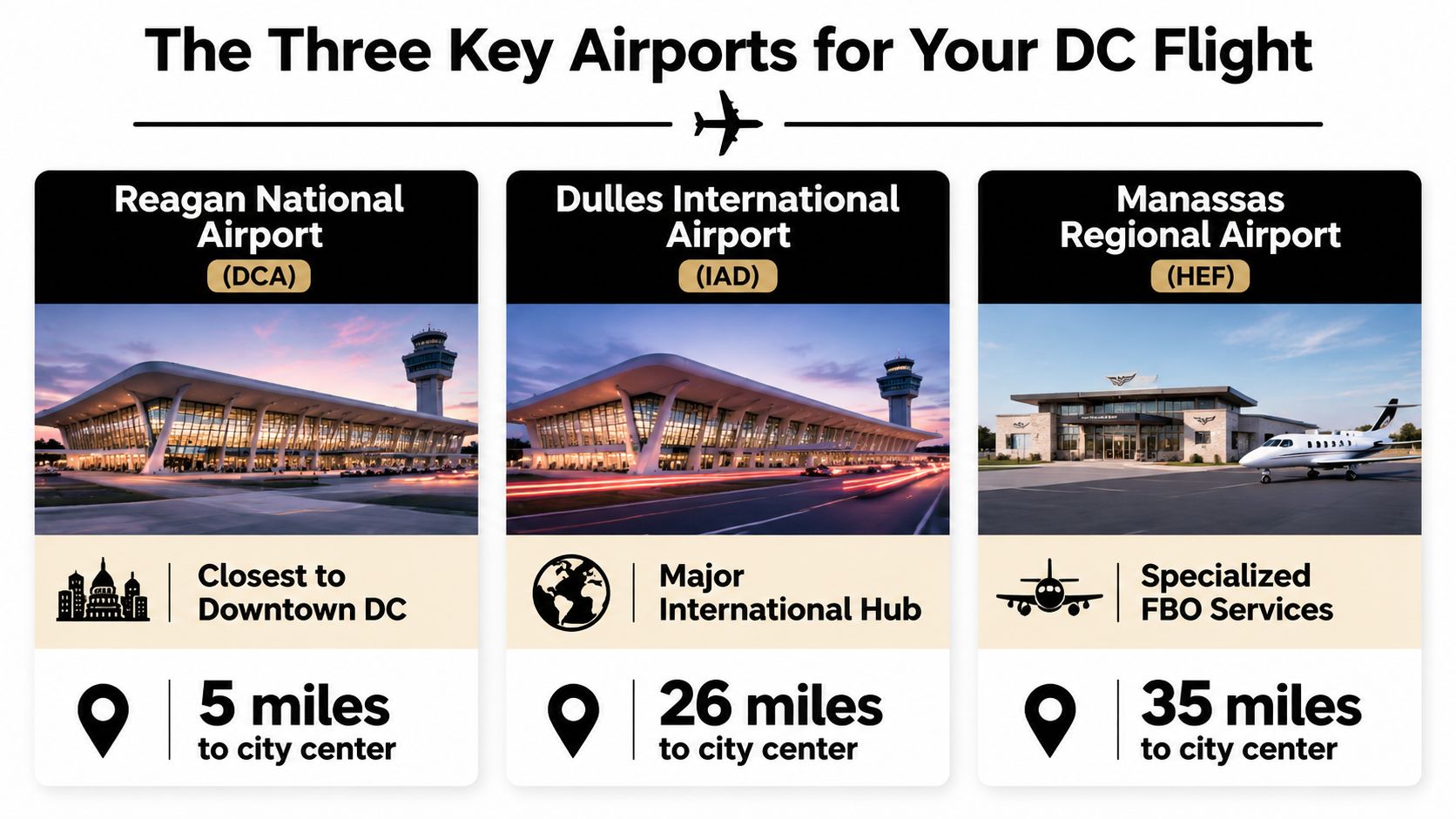
A downtown address can point you toward the wrong runway. Washington's private aviation network includes more than the airport beside the capital, with 15 private and public airports in Washington, D.C. and 20 aviation facilities in the District, including one towered airport, according to GlobalAir's District of Columbia airport directory.
| Airport | Code | Primary Advantage |
|---|---|---|
| Reagan National | DCA | Downtown proximity, continuous attendance, and customs landing rights |
| Dulles International | IAD | Main international and general-aviation gateway |
| Manassas Regional | HEF | Flexible private-aviation access with on-site FBO support |
Reagan National
Ronald Reagan Washington National is 3 miles south of downtown, sits at an elevation of 14.1 feet, and maintains 24-hour attendance. It also offers customs landing rights. Those features make DCA attractive for a carefully qualified mission, not a default charter choice. FRZ, DASSP, slot, and security requirements still govern access, as outlined earlier.
Dulles International
Dulles handles many international and larger-aircraft missions because it combines broad runway capability with established private-aviation services. Jet Aviation and Signature Flight Support operate on the field, according to Washington DC Jet Charter's airport guide. Review the Dulles International private terminal when your itinerary needs international handling or a capable FBO operation.
Haute Jets' local sourcing model helps schedulers compare IAD, DCA, KHEF, and other feasible facilities before assigning an aircraft. That review often favors the airport furthest from downtown because aircraft approval, handling capacity, and road reliability matter more than map distance.
Manassas Regional
Manassas Regional, code KHEF, gives private travelers a practical Virginia alternative. It has at least two FBOs on site and can reduce exposure to congestion at Reagan and Dulles, according to Evojets' Washington charter airport guidance. Chantilly Air at KHEF sits about 13 nautical miles from Dulles and roughly 36 miles from downtown Washington, according to Chantilly Air. That location can solve an access problem when downtown convenience conflicts with airport approval requirements.
Why the Closest Airport Is Not Always Best
DCA may appear efficient on a map, yet it can create the least predictable schedule for a private flight. The access requirements outlined above make Reagan National an approval and coordination decision, not just a downtown convenience.

Use DCA only for a specific reason
Choose DCA only after the operator confirms the aircraft, crew, security arrangements, and passenger clearance plan. A map search cannot answer those questions. If any approval remains uncertain, the airport's short drive to downtown is not worth the risk of a delayed departure, aircraft substitution, or failed movement.
Dulles is usually the stronger choice for international travel, larger aircraft, and longer-range missions. Its established FBO infrastructure supports more complex handling. Manassas can suit Virginia-side departures, smaller aircraft, and schedules that do not justify DCA's additional coordination.
Haute Jets' local sourcing model strengthens this decision process. A scheduler can compare the aircraft's actual location, available facilities, runway requirements, passenger destination, and road transfer before assigning the airport. That review often favors the field furthest from downtown because operational certainty matters more than map distance.
The reliable Washington itinerary is the one with the fewest unresolved approvals, not necessarily the one with the shortest drive.
Airport choice also affects aircraft continuity. A nearby alternative may offer better access to an aircraft that already fits the route, baggage, and runway requirements, reducing the chance of a forced change. Ask your scheduler to compare the complete movement, including aircraft positioning and ground transfer, rather than judging airports by downtown mileage alone.
Understanding Charter Costs and Aircraft Options
Private charter pricing is a mission calculation, not a menu price. The aircraft category, passenger count, baggage, route, operating airport, aircraft location, and security requirements all affect the quote.
For a short regional mission, a light jet may be the sensible choice. A midsize aircraft offers more cabin space and range for a longer domestic route. Ultra-long-range aircraft are appropriate when nonstop international reach and cabin endurance matter. The right answer isn't the largest aircraft available. It's the smallest aircraft that meets the route, passenger, baggage, runway, and comfort requirements without creating a positioning problem.
Match the aircraft to the mission
A light jet can suit a small executive group traveling regionally. A midsize jet becomes more useful when passengers need additional cabin space, luggage capacity, or range. An ultra-long-range aircraft makes sense for a nonstop international itinerary, but using one for a short domestic hop can create unnecessary cost.
The most important pricing question is often where the aircraft starts. Haute Jets' explanation of private jet charter cost is useful because repositioning can materially increase the quote when a broker sources an aircraft far from Washington.
| Factor | Impact on Cost |
|---|---|
| Aircraft location | A distant aircraft may require paid repositioning |
| Aircraft category | Larger cabins generally require more operating resources |
| Airport selection | Security, handling, and access requirements vary by airport |
| Passenger and baggage profile | Capacity and loading needs influence aircraft suitability |
| Schedule flexibility | Flexible timing can open more aircraft choices |
| International handling | Customs and operational coordination can add complexity |
Traditional memberships, jet cards, and fractional programs can offer structured access, but they may not provide the exact aircraft or airport combination your itinerary needs. Direct-to-owner and local-sourcing models can create a more precise comparison when the goal is to avoid paying for an aircraft to travel empty into the region.
The quote should identify the aircraft, operator, routing, airport, crew, inclusions, and cancellation terms. If it only shows a category and a total, you don't yet have enough information to compare offers intelligently.
Your Step-by-Step Booking Process
A clean booking starts with a complete mission brief. Send the scheduler the departure city or preferred airport, destination, travel date, departure window, passenger count, baggage, pets, international documentation needs, and any hard arrival deadline.
Build the quote correctly
State the deadline. Tell the scheduler when you must reach the destination, not merely when you'd like to depart. A board meeting and a flexible weekend departure require different airport and aircraft strategies.
Name preferred airports, but stay open. Request DCA, IAD, and KHEF if downtown access matters, then ask the scheduler to rank them by operational feasibility. Don't force DCA before its approvals are confirmed.
Choose by aircraft details. Review the specific make, model, cabin layout, year, baggage capacity, Wi-Fi, catering, and pet policy. A category label alone doesn't tell you how the flight will feel.
Verify the operator. Confirm the operating carrier, applicable certifications, crew experience, and aircraft documentation before paying. The broker may arrange the trip, but the certified operator performs the flight.
Read the contract. Check the full price, deposit terms, cancellation policy, ground transportation, catering, and any airport-specific security charges. Ask what happens if the selected aircraft becomes unavailable.
Review the pre-flight package. Haute Jets describes a 24-hour pre-flight confirmation containing the tail number, crew biographies, weather briefing, and passenger manifest. Treat that package as a final operational checkpoint, not a formality.
Your passenger details must be accurate, especially for any itinerary affected by Washington security rules. A last-minute name correction can become a serious scheduling issue when the flight depends on vetted access.
The Arrival Experience and Ground Logistics
A private arrival should feel controlled from curb to aircraft. At the FBO, passengers avoid the pace of a commercial terminal and move through a private-aviation facility with direct access to the lounge, security process, and aircraft. The details vary by airport, operator, aircraft, and itinerary, so the scheduler must confirm the handoff instead of assuming every Washington airport works the same way.
At IAD, Jet Aviation and Signature Flight Support provide established private-aviation handling options. KHEF also has multiple FBOs, giving the scheduler more flexibility when matching the ground experience to the aircraft, route, and passenger needs. DCA may look attractive on a map, but its regulatory and approval requirements can make a farther airport the more reliable choice.

Plan the ground segment before departure
Reserve more than a vehicle. Confirm the FBO, driver, vehicle type, passenger name, luggage expectations, and exact destination before takeoff. Washington traffic can consume the time saved in the air when the transfer receives attention only after landing.
Report pets early. Give the charter team the animal's size, breed, carrier requirements, and destination details. The operator can then confirm aircraft suitability and required documentation. Policies vary, especially on international routes.
Review packing against the selected aircraft. Keep identity documents, medication, electronics, and meeting materials accessible, then verify baggage capacity rather than assuming every jet offers the same storage.
International arrivals need customs planning in the original itinerary. Reagan National's customs landing rights affect the operation, and private access remains subject to applicable security and approval rules. Dulles is often the more practical choice when the mission requires international handling and established private-aviation infrastructure.
Leveraging Empty Leg Opportunities
An empty leg is a repositioning flight that would otherwise operate without booked passengers. In Washington, these flights can appear when an aircraft moves to meet a client, returns to its home base, or shifts for event-driven demand.
The discount can be substantial. Recent market reporting says empty legs are typically booked 48 to 72 hours before departure, may appear up to 14 days ahead, and are usually 25% to 75% cheaper than a full charter, according to the SkyAccess empty-leg market report. The same report estimates that 30% to 40% of private jet flight hours involve repositioning flights.
Treat the discount as tactical
An empty leg works when your schedule can move with the aircraft. It fails when you need a guaranteed departure time, a specific airport, a particular aircraft, or a reliable same-day return.
Washington is especially sensitive to this distinction because meetings, hearings, political events, and sporting events can compress availability and shift aircraft positioning. A flight that looks attractive can disappear when the underlying occupied charter changes.
Use empty legs for flexibility, not for a deadline.
Ask five questions before accepting one:
- What created the leg? Confirm the aircraft's preceding and following missions.
- Is the timing firm? Clarify whether the departure window can change.
- Which airport is involved? A low fare into an inconvenient field may raise total trip cost.
- What happens if the primary flight changes? Confirm rebooking or cancellation terms.
- Can the aircraft carry your passengers and baggage? Discounted availability doesn't guarantee mission fit.
For a deeper explanation of the mechanics, see what an empty-leg flight means. For a fixed meeting, optimize aircraft positioning instead. That approach may produce a better total result than chasing a discount that creates ground-transfer or schedule risk.
Building Your Seamless Travel Strategy
A dependable Washington charter begins with the airport decision, not the aircraft photo. Start with the meeting location, passenger deadline, international requirements, baggage, and acceptable ground-transfer time. Then compare DCA, IAD, KHEF, and other viable regional fields against actual approvals and aircraft availability.
The local-sourcing model matters because a nearby aircraft can remove repositioning from the quote. Haute Jets sources aircraft from owner-operators across a broad international network and presents specific aircraft choices rather than forcing the traveler to accept an unnamed category. Its stated safety model uses operators with Wyvern Wingman or ARGUS Gold or Platinum ratings, which gives the buyer a concrete credential set to verify before booking.
Make the itinerary resilient
A strong plan has four parts:
- Airport discipline: Use DCA only when the security and access plan is confirmed. Select IAD or KHEF when they offer lower operational friction.
- Aircraft discipline: Match cabin, range, baggage, and runway needs to the mission. Don't pay for capacity you won't use.
- Pricing discipline: Compare the aircraft's location, positioning, handling, security, and ground costs, not only the headline charter total.
- Confirmation discipline: Require the final aircraft, tail number, crew, weather information, passenger manifest, catering, pet arrangements, and transportation details before departure.
The same operational mindset applies after landing. If your Washington meeting ends in a holiday trip, coordinate the flight with a vetted destination plan and use a specialist resource to find exclusive holiday packages rather than separating air and ground arrangements at the last minute.
Private aviation in the capital doesn't need to feel bureaucratic or chaotic. It becomes manageable when a scheduler treats regulatory approval, aircraft positioning, FBO selection, and ground transport as one connected movement.
Haute Jets arranges on-demand private jet charter with access to specific aircraft and Washington-area airport options, including Dulles and Manassas, while coordinating operator credentials, final flight details, and ground logistics. Visit Haute Jets to request a Washington itinerary built around the airport and aircraft that fit your schedule.