A new private flyer usually notices cleaning at the exact moment the cabin door closes. The seats either feel crisp and ready, or they feel used. The side ledges either look polished, or they show fingerprints, dust, and the residue of rushed servicing. On a private aircraft, that first impression isn't a small detail. It's part of the product you paid for.
A proper private jet cleaning service also sits much closer to operations than most passengers realize. It affects presentation, yes, but it also affects how safely crews can turn an aircraft, how well delicate materials hold up over time, and how confidently an owner or charter client can put passengers on board. If the work is handled casually, the cost doesn't stay in the cleaning line item. It shows up later in damaged acrylic, worn leather, stained carpeting, scratched trim, scheduling friction, and awkward conversations with clients.
Why Impeccable Cleaning Is Non-Negotiable in Private Aviation
Private aviation sells certainty. The car is waiting. The cabin is quiet. The itinerary is tight. The aircraft should feel as if no one else has touched it. That standard doesn't happen by accident, and it doesn't come from a generic cleaning crew with a cart of household products.
The broader market makes that clear. The aircraft cleaning services market is projected to grow from $6.30 billion in 2026 to $9.67 billion by 2034, and the interior cleaning segment holds the largest share at 44.81% according to Fortune Business Insights' aircraft cleaning service market outlook. For private aviation, that matters because the cabin is where passengers judge quality first. They don't inspect a maintenance log. They notice the smell, the leather, the tray tables, the carpet edges, and whether the lavatory feels untouched.
Cleanliness Is Part of the Brand Promise
A private jet isn't a hotel room that can hide wear behind dim lighting and decorative finishes. It's a compact environment where every mark stands out. Smudged windows, lint around seat tracks, dried water spots near galley hardware, and residue on control touchpoints all send the same message. Someone rushed this aircraft.
That message hurts more in private aviation because the expectation is premium by default. Owners want asset protection. Charter clients want consistency. Corporate travel managers want assurance that senior passengers won't walk into a cabin that feels improvised.
Practical rule: If a cleaning standard would be unacceptable in front of a principal, board member, or celebrity client, it isn't acceptable on the aircraft at all.
Hygiene and Asset Protection Are Tied Together
People often separate hygiene from preservation. In practice, they're linked. Cabin air quality, surface cleanliness, and material care all shape the passenger experience. Haute Jets has covered the cabin side of that equation in its look at private jet cabin air and how fresh and clean it is. Surface cleaning has to support that same standard, not undermine it with harsh chemicals or sloppy methods.
A quality private jet cleaning service protects three things at once:
- Passenger confidence by presenting a spotless, odor-free cabin
- Operational readiness by preparing the aircraft for the next leg without introducing avoidable delays
- Residual value by preserving leather, trim, carpets, windows, and finishes
When buyers treat cleaning as a commodity, they usually learn the lesson through damage, not savings.
Understanding the Four Levels of Aircraft Detailing
Not every aircraft needs the same service after every trip. That's where clients get confused. They ask for a "full clean" when they really need a quick reset, or they book a simple turn when the cabin needs corrective work. A serious private jet cleaning service defines scope before a single bottle comes out.
Industry practice already separates work by task requirements. Exterior work may include dry washes, waxing, and metal polishing, while interior work involves carpet extraction, leather conditioning, and lavatory or galley sanitation, as noted in this aircraft detailing overview. That's more than terminology. The tools, chemicals, labor, and risk profile change with each service tier.
Turnaround Cleaning
This is the aviation version of a five-star turndown. The goal is readiness, not restoration.
A turnaround clean usually focuses on visible presentation and hygiene between flights. Trash is removed. Surfaces are wiped. Seatbelts are straightened. Tabletops, armrests, and touchpoints are cleaned. The lavatory is refreshed. The galley is reset. Carpets are vacuumed, and obvious smudges are addressed.
This level works when the aircraft is already in good condition and time is short.
Deep Cleaning
Deep cleaning is closer to a seasonal property reset. It deals with accumulated use, not just the last leg.
Expect more labor-intensive interior work such as carpet extraction, upholstery treatment, leather conditioning, trim polishing, and more detailed attention to storage compartments, seams, rails, and high-touch zones that don't get enough attention during a quick turn. If a cabin has been flying hard on charter or carrying families, pets, catering, and repeated short sectors, this is usually the right level.
Deep cleaning isn't about making an aircraft look nice for one departure. It's about bringing the cabin back to standard before small issues become permanent ones.
Biohazard Remediation
This sits in a different category altogether. If there's bodily fluid exposure, heavy contamination, or a sanitation event that goes beyond normal cabin servicing, the work needs escalation.
A professional team isolates the affected areas, uses the correct protective equipment, applies approved sanitation procedures, and handles waste properly. This isn't a cosmetic upgrade. It's controlled remediation, and it should be treated that way operationally and contractually.
Exterior Detailing
Exterior work has its own logic and shouldn't be bundled mentally with cabin cleaning. The aircraft may need a dry wash, wet wash, waxing, brightwork attention, or polishing depending on finish type and condition. Painted surfaces, polished metal, and protective coatings all respond differently to chemicals and tools.
If someone says they can clean every aircraft exterior with the same approach, that's a warning sign.
Turnaround vs Deep Cleaning at a Glance
| Feature | Turnaround Clean | Deep Clean |
|---|---|---|
| Primary goal | Prepare the cabin for the next flight | Restore the cabin to a higher standard after accumulated use |
| Typical use case | Between trips or same-day operations | After heavy charter use, extended travel, or visible buildup |
| Focus areas | Trash removal, wipe-downs, vacuuming, lavatory refresh, galley reset | Carpet extraction, leather conditioning, trim polishing, detailed sanitation |
| Time profile | Short-window servicing | Longer ground time or planned downtime |
| Corrective work | Limited | Much more likely |
| Best for | Well-maintained aircraft needing a reset | Aircraft showing wear, odor, staining, or embedded dirt |
The Standards That Separate Amateurs from Professionals
The easiest way to damage a private aircraft is to let someone treat it like a house, a hotel suite, or a car. Aviation interiors don't forgive guesswork. Screens, veneers, leather, coatings, and windows all have narrower tolerances, and the wrong product can create expensive problems fast.
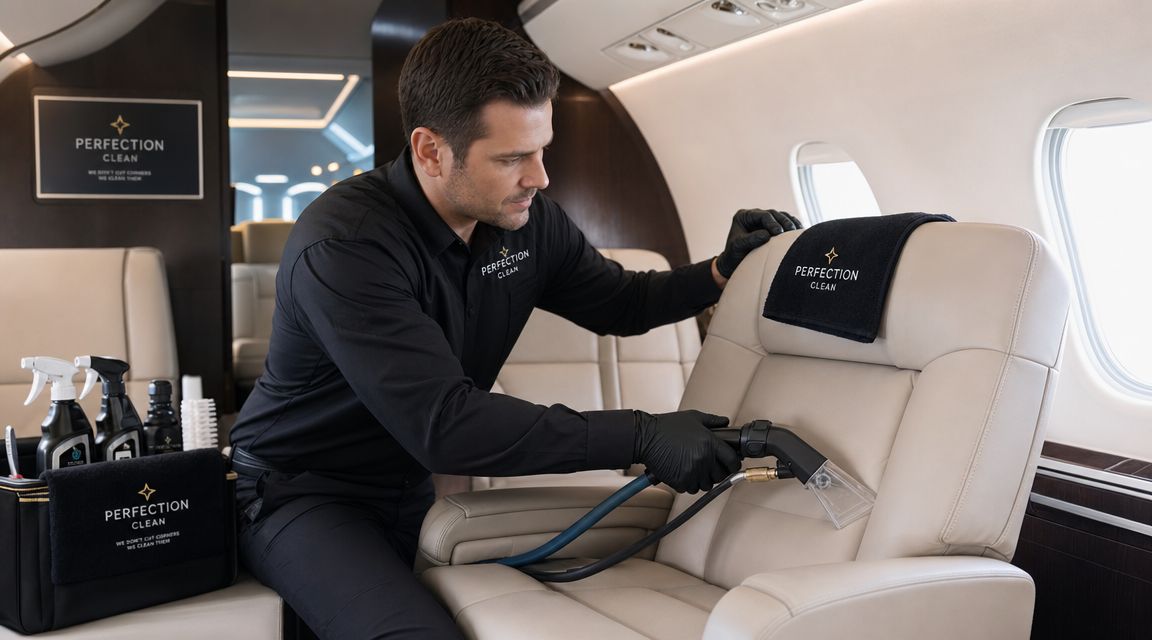
A good vendor proves professionalism in process, not in marketing language. They ask for aircraft type, interior materials, current condition, service history, and access limitations before they quote aggressively. They don't improvise on the ramp.
Material-Specific Knowledge Matters
One of the clearest dividing lines is product selection. Acrylic windows are "highly vulnerable" and require an aircraft-approved polish rather than a standard glass cleaner, according to Latitude 33's guidance on cleaning private jets inside and out. That same guidance notes that a professional service cross-references the aircraft maintenance manual before applying products.
That single habit tells you a lot. Professionals verify. Amateurs assume.
Here are the standards worth asking about:
- Manual-based product selection so the crew checks the aircraft's maintenance documentation before using chemicals on windows, displays, leather, wood, or trim
- Surface separation so lavatory tools don't migrate to food-service areas and exterior tools don't touch cabin materials
- Controlled application so products go onto cloths or applicators when appropriate, not sprayed carelessly around vents, switches, and seams
- Escalation discipline so stains, scratches, or unknown residues are reported, not attacked with stronger chemistry
Anyone who cleans yachts or high-end vehicles may understand luxury finishes, and some crossover methods are useful. If you want to see how detailing logic carries across premium assets, this guide on how to achieve showroom shine on your vessel offers a useful comparison in surface care mindset. The key difference is that aircraft cleaning has less room for experimentation and more need for maintenance-manual compliance.
Hygiene Isn't the Same as Over-Chemical Cleaning
Clients often ask for "maximum disinfecting." That's understandable, but more chemistry isn't automatically better. A professional service balances sanitation against material safety. Cabin touchpoints, galleys, and lavatories need disciplined hygiene. Screens, acrylics, and delicate finishes need restraint.
The wrong cleaner can leave a cabin looking acceptable for one trip and still create long-term damage underneath that appearance.
This is also where operations teams should ask for documentation. Training records, approved product lists, and insurance matter more than polished sales language. If a provider can't explain what they use on acrylic, leather, and cabin displays, they shouldn't be on the aircraft.
Video can help clients recognize the difference between surface-level cleaning and standards-based servicing.
For owners and charter managers evaluating service partners, this is closely aligned with the broader discipline behind maintaining excellence in private jet safety and reliability. Cleaning sits downstream from maintenance, but it still has maintenance consequences when it's done poorly.
What to Expect When Booking a Private Jet Cleaning Service
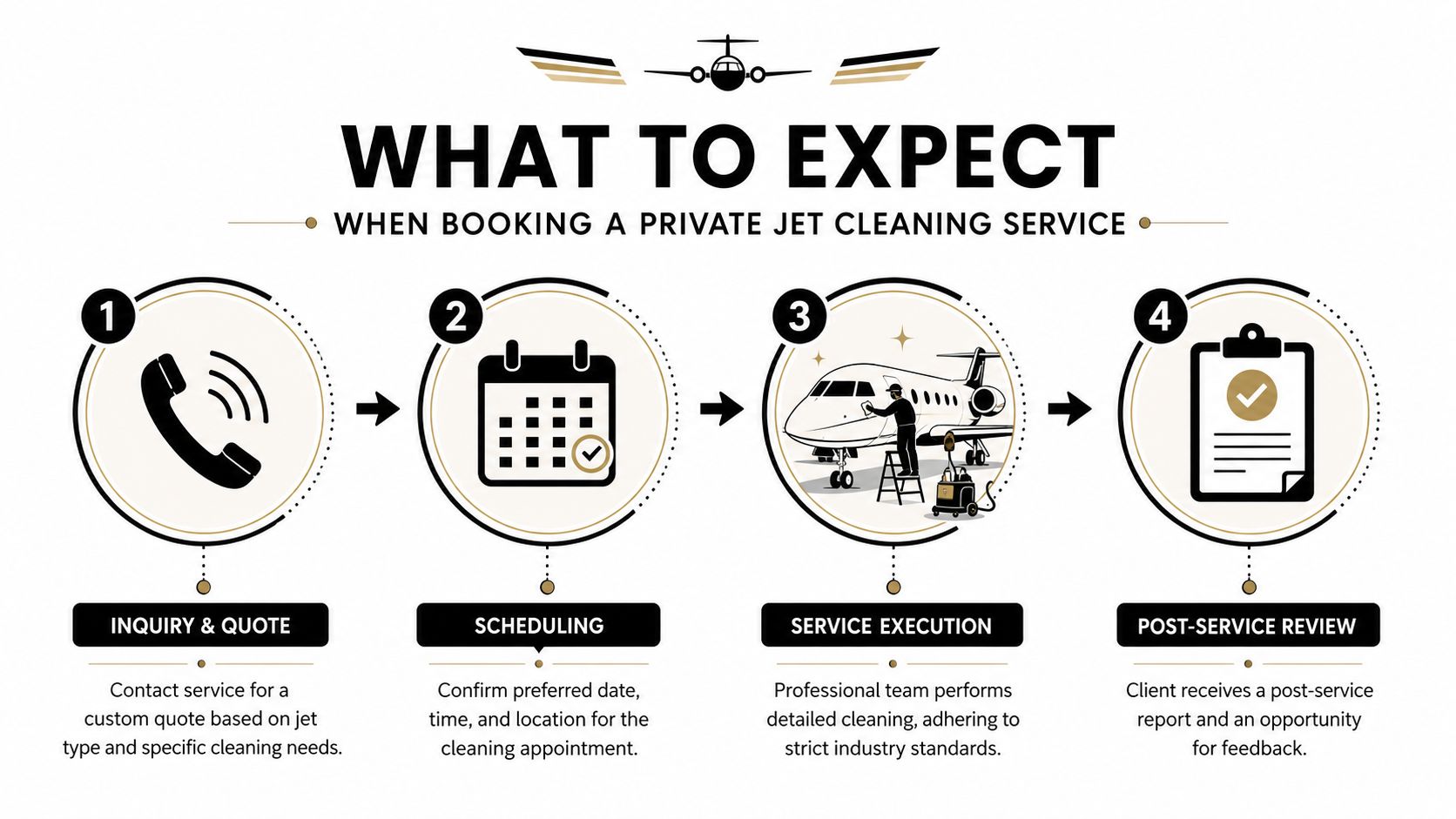
The booking process should feel organized from the first call. If it feels vague, the service usually is. Good aircraft cleaners don't just ask where the plane is parked and when you need them there. They gather enough information to protect the aircraft, schedule labor correctly, and avoid scope disputes on the ramp.
The First Inquiry
Expect to provide the aircraft type, location, desired service level, and timing window. You may also be asked about recent use. Was it a short executive trip, a family leisure leg, a catering-heavy charter rotation, or an aircraft returning from a longer period of inactivity? Those details change both labor and risk.
The best providers also ask about specific problem areas. Stains, pet hair, food odor, lavatory issues, heavy dust, or sticky residue all matter. If you don't mention them up front, the quote may not match reality.
Quoting and Pre-Inspection
A serious quote is usually conditional on condition. That's a good thing, not a hassle.
Aircraft cleaning workload scales with size, contamination level, and service scope. Providers who understand the work often reserve the right to confirm pricing after a visual review. That protects both sides. The client avoids surprise shortcuts, and the vendor avoids underpricing a corrective job that was described as routine.
Booking advice: Ask what would trigger a scope change before the team arrives. Good vendors can answer that in plain language.
Access and Ramp Coordination
Cleaning doesn't happen in isolation. Someone needs access authorization. The FBO may need notice. The crew or flight department may need to secure documents, catering, valuables, and maintenance-sensitive areas. If the aircraft is in a hangar, there may be additional access rules.
A smooth booking usually includes:
- Confirmed access permissions with the FBO, hangar, or operator
- Defined work scope so the team knows whether this is turnaround, deep cleaning, exterior detailing, or a combined service
- Ground-time alignment with departure schedule, crew duty considerations, and any fueling or maintenance activity
- Post-service sign-off by the responsible contact, whether that's an owner representative, chief pilot, scheduler, or cabin attendant
Execution and Final Review
On arrival, the team should inspect first, work second. They should identify material sensitivities, protect vulnerable areas, and confirm priorities before starting.
The final review matters just as much. A proper private jet cleaning service should walk the aircraft, document completion if requested, and flag any pre-existing damage or unresolved issue rather than hiding it under a rushed finish. That final discipline is what separates a service vendor from an operational partner.
Decoding Pricing and Turnaround Times for Jet Cleaning
The first pricing mistake clients make is assuming aircraft cleaning is mostly about labor hours. It isn't. Labor matters, but the bigger drivers are aircraft size, cabin complexity, current condition, and the difference between maintenance cleaning and corrective detailing.
Industry pricing examples show how sharply cost scales. A small Cessna exterior wash may cost about $150 to $200, while a larger business jet such as a Gulfstream G650 may cost around $1,000 for exterior cleaning, according to this airplane detailing cost breakdown. The same source notes that full detailing packages can range from $1,000 to $5,000 for smaller private jets and $5,000 to $20,000 for midsize and larger private jets.
What Drives the Quote
The same aircraft can produce very different invoices depending on what happened before it landed.
A provider usually prices around these variables:
- Aircraft size and layout because more cabin zones, larger lavatories, more seating positions, and more exterior surface area all require more labor
- Service scope because a turnaround clean, an interior restoration, and a full exterior detail don't use the same tools or time
- Condition on arrival because embedded stains, galley residue, neglected leather, and heavy contamination create corrective work
- Material sensitivity because premium woods, acrylics, polished metal, and display surfaces require slower, more careful methods
If a quote seems unusually low, ask what's excluded. That's usually where the problem is.
Why Pre-Inspection Saves Money
A rough quote over the phone can be useful for planning, but the most accurate pricing comes after someone understands the condition of the aircraft. That's especially true if the plane has flown repeated charter legs, has been sitting, or has specific contamination issues.
What clients often call "cleaning" can include restoration tasks. Once a team has to extract carpets, treat leather, address residue, and work around delicate finishes, the labor profile changes quickly.
Turnaround Times Depend on Scope
Turnaround time should be discussed in the same breath as price. A rushed provider may promise unrealistic timing and then either cut corners or ask for more time after the aircraft is already committed.
As a planning framework:
| Service type | Time expectation |
|---|---|
| Turnaround cleaning | Short ground-time service when the cabin is already in good order |
| Deep cleaning | Longer scheduled service, often better during planned downtime |
| Biohazard remediation | Variable, depending on affected areas and sanitation requirements |
| Exterior detailing | Dependent on aircraft size, finish type, and whether polishing or protective work is included |
The safest assumption is simple. The dirtier the aircraft and the more delicate the materials, the less wise it is to chase speed. Fast isn't valuable if the finish work is poor or the aircraft leaves with missed contamination.
Ensuring Security and Discretion During On-Ground Servicing
An aircraft can leave the ramp looking spotless and still leave the operator with a security problem. I have seen cleaning crews disturb sealed documents, move passenger electronics without logging them, and create avoidable exposure because nobody set rules before the cabin door opened. On a private jet, poor servicing discipline creates operational risk, client trust issues, and, in some cases, direct financial loss.
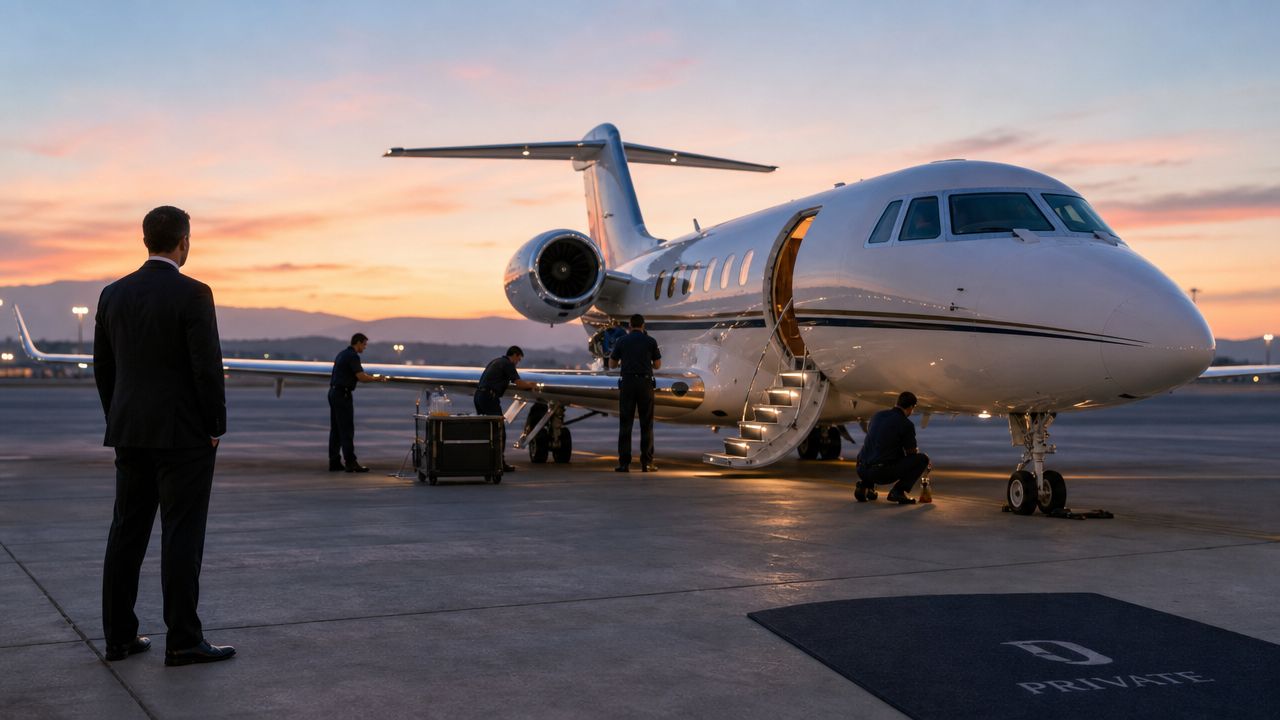
A qualified private jet cleaning service works under the same control mindset as the rest of the flight operation. Staff should arrive identified, cleared for access, briefed on scope, and supervised. They should know which compartments are off-limits, which systems they are not authorized to touch, and who receives any item found onboard. Discretion is not a courtesy. It is part of the service standard.
The Risks That Actually Matter on the Ground
The obvious concern is theft, but that is only one failure mode. More often, the damage comes from loose process.
A weak vendor can expose:
- Passenger information through visible manifests, briefing folders, medication labels, or itinerary notes
- Sensitive equipment by touching cabin controls, displays, charging stations, or cockpit-adjacent areas without approval
- Personal property when watches, jewelry, documents, or children's items are relocated with no chain of custody
- Ramp access control if extra personnel enter the aircraft or service area without coordination
- Interior materials when untrained staff use the wrong products on leather, veneers, plated fixtures, or screens
That last point gets missed. A single careless wipe on the wrong surface can turn a cleaning invoice into a repair bill. In private aviation, presentation and asset protection are tied together.
What Professional Discretion Looks Like
Good providers run a controlled process. The work order defines the service area. Personal devices and photography are prohibited. Found items are documented and handed over through a named contact. Entry and exit times are recorded. If anything unusual is discovered, the supervisor reports it before the aircraft is released.
The best teams also coordinate closely with the FBO and operator, because access discipline starts before anyone steps onto the ramp. A better understanding of that controlled environment appears in Haute Jets' article on the benefits of private FBO terminals for jet travelers.
For clients who prefer to work inside an established private aviation network, Haute Jets is one example of a provider that operates within that standard of discretion and operational control. That does not remove the need to vet the cleaning company itself. It does narrow the field toward partners who already understand confidentiality, ramp protocol, and the cost of getting any of it wrong.
The Ultimate Checklist for Selecting Your Cleaning Partner
Most cleaning proposals sound similar on the surface. They promise spotless results, fast response, and discretion. The useful differences only appear when you ask operational questions.
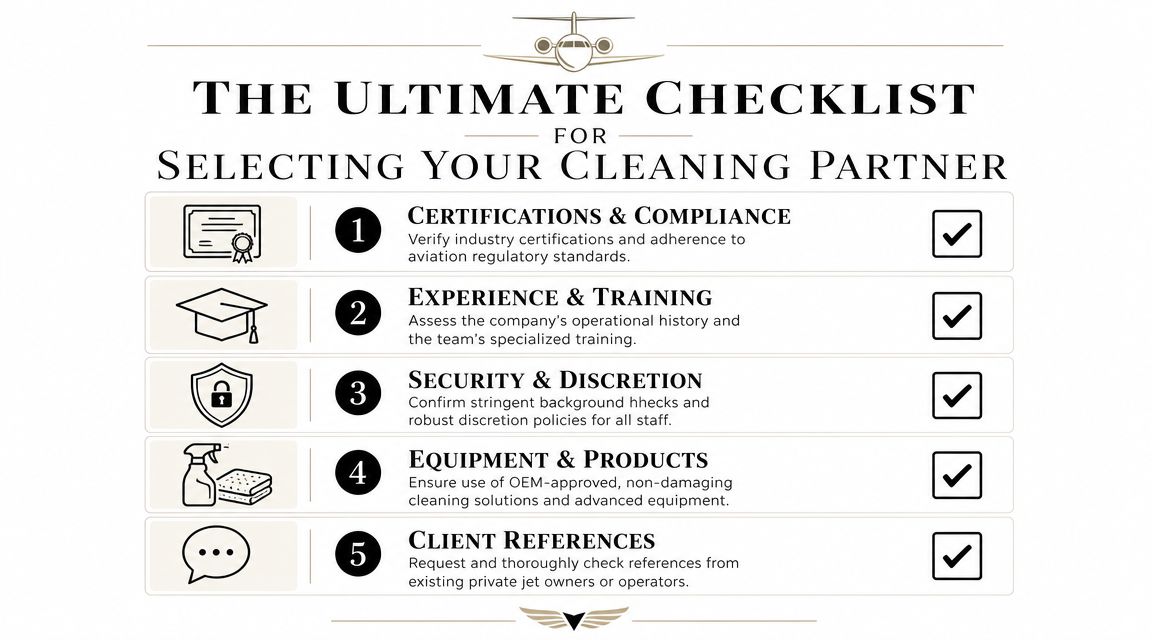
Questions That Expose Real Capability
Use this checklist before approving any private jet cleaning service:
- Ask about aviation-specific insurance and whether the policy clearly covers aircraft interiors, exteriors, and on-ramp work
- Ask for product discipline and whether the team can document what they use on acrylic windows, leather, trim, displays, and galleys
- Ask how they verify scope before work begins, especially when the aircraft condition may change the quote or timing
- Ask about personnel controls including background checks, access logs, supervision, and rules on photos, personal devices, and confidentiality
- Ask how they separate tools and workflows between lavatory areas, food-service zones, passenger seating, and exterior surfaces
- Ask how they handle found items such as documents, jewelry, electronics, medications, and child belongings
- Ask what they won't touch because good providers know where their authority ends
- Ask how they report damage or pre-existing wear instead of cleaning around it
Signs You Should Keep Looking
A few answers should stop the conversation quickly.
Watch for providers who:
- Use household terminology for aircraft materials and can't distinguish acrylic from standard glass care
- Quote instantly without asking condition questions
- Promise every job can be done urgently regardless of aircraft size or service scope
- Speak vaguely about staff vetting or insurance
- Treat discretion as branding language rather than a written protocol
The right cleaning partner protects presentation, materials, schedule integrity, and privacy at the same time. If they only talk about shine, they're not thinking at aircraft level.
The Standard Clients Should Expect
The smartest buyers don't shop for the cheapest clean. They shop for the lowest operational risk. That means choosing providers who can work inside aviation constraints, respect sensitive materials, coordinate with crews and FBOs, and deliver a cabin that looks untouched in the best possible way.
For readers of Haute Jets Journal, that's the useful standard to keep. You don't need a vendor who says yes to everything. You need one who knows exactly what should be done, what shouldn't be done, and how to document both.
If you're arranging private aviation and want support from a team that already understands premium operating standards, Haute Jets can help you coordinate the right aircraft experience with the level of discretion, preparation, and service quality serious clients expect.