

You're probably asking the question at the exact moment it matters. You have a trip in mind, a schedule that doesn't leave much room for compromise, and one simple goal: get from your departure airport to your destination nonstop if possible, without paying for more airplane than the mission requires.
That's where range starts to matter. Not as a brochure number, but as a planning tool.
A lot of first-time charter clients assume private jet flight distance works like a fixed promise. It doesn't. The aircraft's published range is a starting point, then real-world factors shape what's practical on your specific day, with your passenger count, bags, routing, and weather. The useful question isn't just “How far can this jet fly?” It's “Can this jet fly my route the way I want to fly it?”
On Haute Jets Journal, that distinction matters because it's often the difference between a smooth nonstop and an avoidable fuel stop.
Planning Your Journey How Far Can a Private Jet Fly
A client planning New York to Paris usually asks one question first. Can we do it nonstop? Someone flying Miami to Aspen often asks a different version of the same thing. What kind of aircraft do we need?
Those sound like simple distance questions, but they rarely are. Private jet flight distance depends on the aircraft category, the day's conditions, and the trip profile. A jet that looks perfect on paper can become the wrong fit once luggage, routing, or reserve fuel enter the picture.

That's why raw maximum range figures can be misleading if you don't know how to read them. Most private flying isn't intercontinental at all. In fact, 86% of North American business jet flights in 2024 were under 1,000 nautical miles, while top-tier aircraft still make nonstop missions like Hong Kong to Los Angeles possible, according to SherpaReport's analysis of private jet flight distance.
What clients usually expect versus what they actually book
Many people start by looking at the longest possible routes. In practice, they often end up booking for one of these goals:
- Regional efficiency: Get in and out the same day without airline schedules driving the trip.
- Cabin comfort: Choose an aircraft that feels right for the passengers, not just one that can technically make the route.
- Nonstop practicality: Avoid adding time on the ground unless a stop creates a clear advantage.
Practical rule: The best aircraft for your trip isn't the one with the biggest published range. It's the one that can operate your route cleanly, comfortably, and economically.
Why this question gets confusing fast
A jet may be marketed as long-range, but range is not the same as guaranteed nonstop performance on every mission. Published capability and actual trip planning are related, not identical.
That's why experienced charter advisors begin with the route, airport pair, passenger count, baggage profile, and schedule. The aircraft comes after that.
What Aircraft Range Really Means
When operators talk about range, they mean the maximum distance an aircraft can cover under ideal conditions, much like a car's highway fuel economy figure. While useful, this figure isn't a promise about what you'll get in city traffic with passengers, luggage, and air conditioning running.
In private aviation, range is usually discussed in nautical miles. That's the standard unit flight planners use. For clients, the important part isn't mastering the math. It's understanding that the number on a spec sheet is a benchmark, not a booking guarantee.
According to Paramount Business Jets' guide to private jet range categories, typical benchmarks under ideal conditions are 1,000 to 1,500 nautical miles for very light jets, 1,500 to 2,500 for light jets, 2,500 to 3,500 for midsize jets, and 4,000 to over 7,700 for heavy and ultra-long-range jets.
A better way to read a range number
When you see a range figure, read it as: this aircraft can cover up to this distance in a favorable scenario.
Then ask the practical questions:
- How many people are flying?
- How much luggage is coming?
- Are we trying to go nonstop?
- Is there any reason this route might need extra fuel planning?
Those questions matter because flight planners don't use every drop of onboard fuel as available trip fuel. They also have to account for required reserves and operational margins.
Why reserves matter to you
Clients sometimes hear that an aircraft can fly a certain distance and assume their route should fit comfortably. But charter planning includes fuel that isn't there for cruising to the destination. It's there for safety, routing changes, and operational requirements.
A range number tells you what's theoretically possible. A dispatchable flight plan tells you what's actually smart.
A simple category view
| Aircraft category | Typical range benchmark |
|---|---|
| Very light jet | 1,000 to 1,500 nm |
| Light jet | 1,500 to 2,500 nm |
| Midsize jet | 2,500 to 3,500 nm |
| Heavy and ultra-long-range jet | 4,000 to over 7,700 nm |
This is why cabin size alone shouldn't drive the decision. A beautiful cabin doesn't help if the airplane can't operate your mission efficiently.
Key Factors That Modify Flight Distance
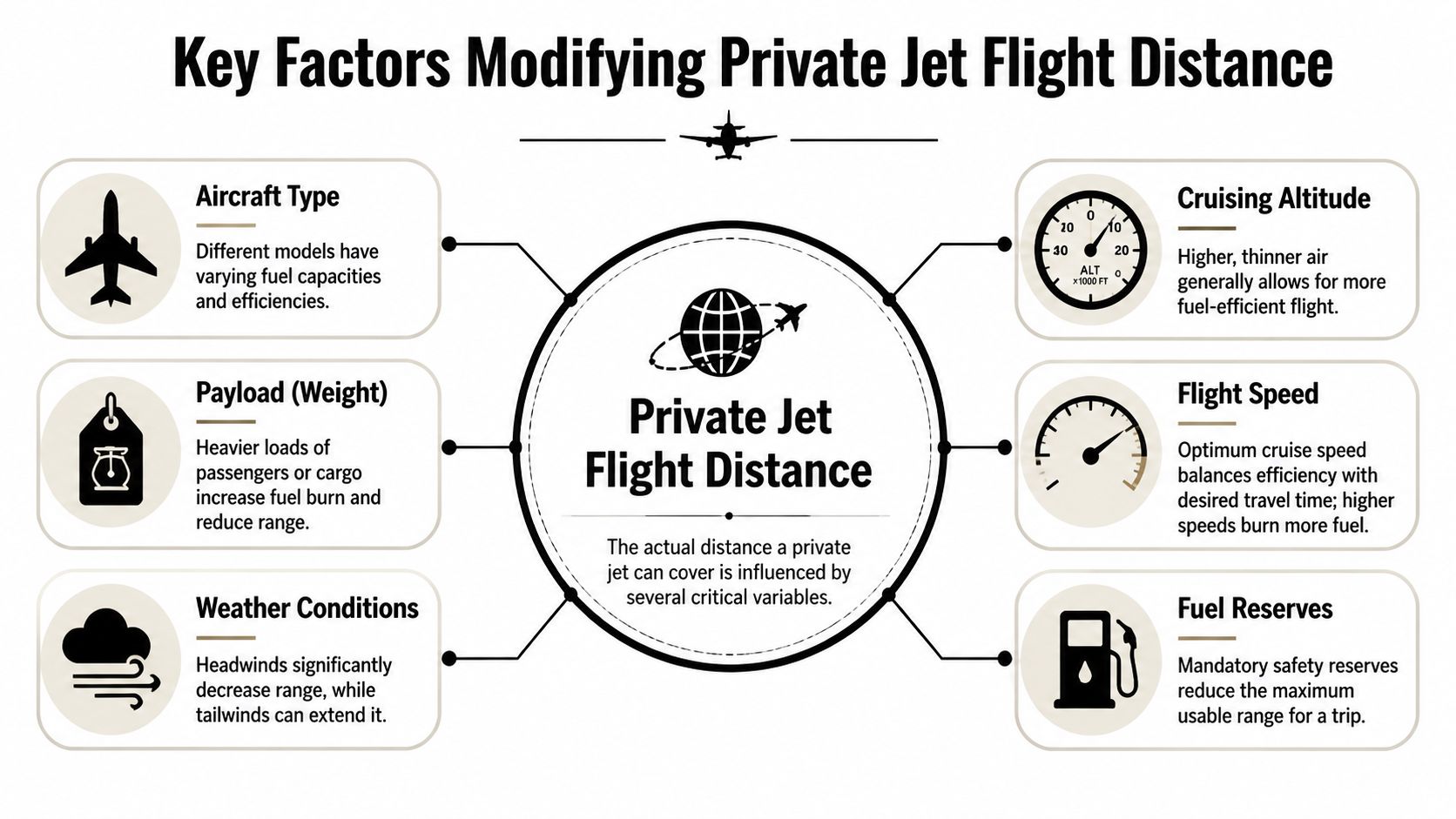
The number in the brochure is only the opening bid. The actual private jet flight distance available on your trip depends on what the aircraft is carrying, what the atmosphere is doing, and how the flight is being operated.
Industry range data notes that range is a maximum theoretical distance, while actual distance is shaped by payload, weather, and routing. The same source also notes that some of the most capable long-range aircraft can remain airborne for 10 to 16 hours and, in some cases, cover distances up to 11,645 nautical miles under particular conditions, as shown in Aviapages range map data.
Payload changes the mission
Every passenger, suitcase, golf bag, ski bag, and pet setup adds weight. More weight generally means more fuel burn or less flexibility in fuel loading. On a shorter route, that may not matter. On a longer one, it can be the difference between nonstop and a fuel stop.
A common point of confusion is cabin size versus carrying ability. A jet may seat the group comfortably, but the combination of passengers, bags, and route length can still push the mission outside the most efficient operating envelope.
Wind and weather can work for you or against you
Headwinds act like a moving walkway going in the wrong direction. The aircraft is still flying at cruise speed through the air, but it covers less ground efficiently. Tailwinds help the opposite way.
Weather also affects routing. Crews may need to fly around turbulence or storms, and those deviations add distance that doesn't appear in the straight line between two cities.
Westbound long-haul flights often feel more demanding from a range standpoint because the airplane may spend more of the trip fighting the atmosphere instead of being carried by it.
Altitude and speed matter too
Jets become more efficient once they reach their preferred cruise levels, where the air is thinner. But they don't always get ideal altitude immediately, especially in busy airspace or on shorter sectors.
Speed is another trade-off. Faster flight can save time, but higher cruise settings may burn more fuel. Operators and crews balance that against schedule, comfort, and mission length.
Aircraft specifics aren't interchangeable
Two jets in the same broad category won't always perform the same way. Fuel capacity, engine efficiency, wing design, baggage limitations, and airport performance all matter. That's why experienced planners start with the exact route, then narrow to the most suitable models.
A simple way to think about the main modifiers:
- Weight on board: More people and baggage can shrink practical nonstop distance.
- Atmospheric conditions: Wind and weather can either extend or reduce what's realistic.
- Cruise profile: Altitude and speed choices affect efficiency.
- Model-specific capability: Similar-looking aircraft may deliver very different trip results.
Private Jet Range by Aircraft Category
Once you understand that range is mission-dependent, aircraft categories become much more useful. They help narrow what kind of airplane can serve a route well, even before you get into exact models and operator availability.
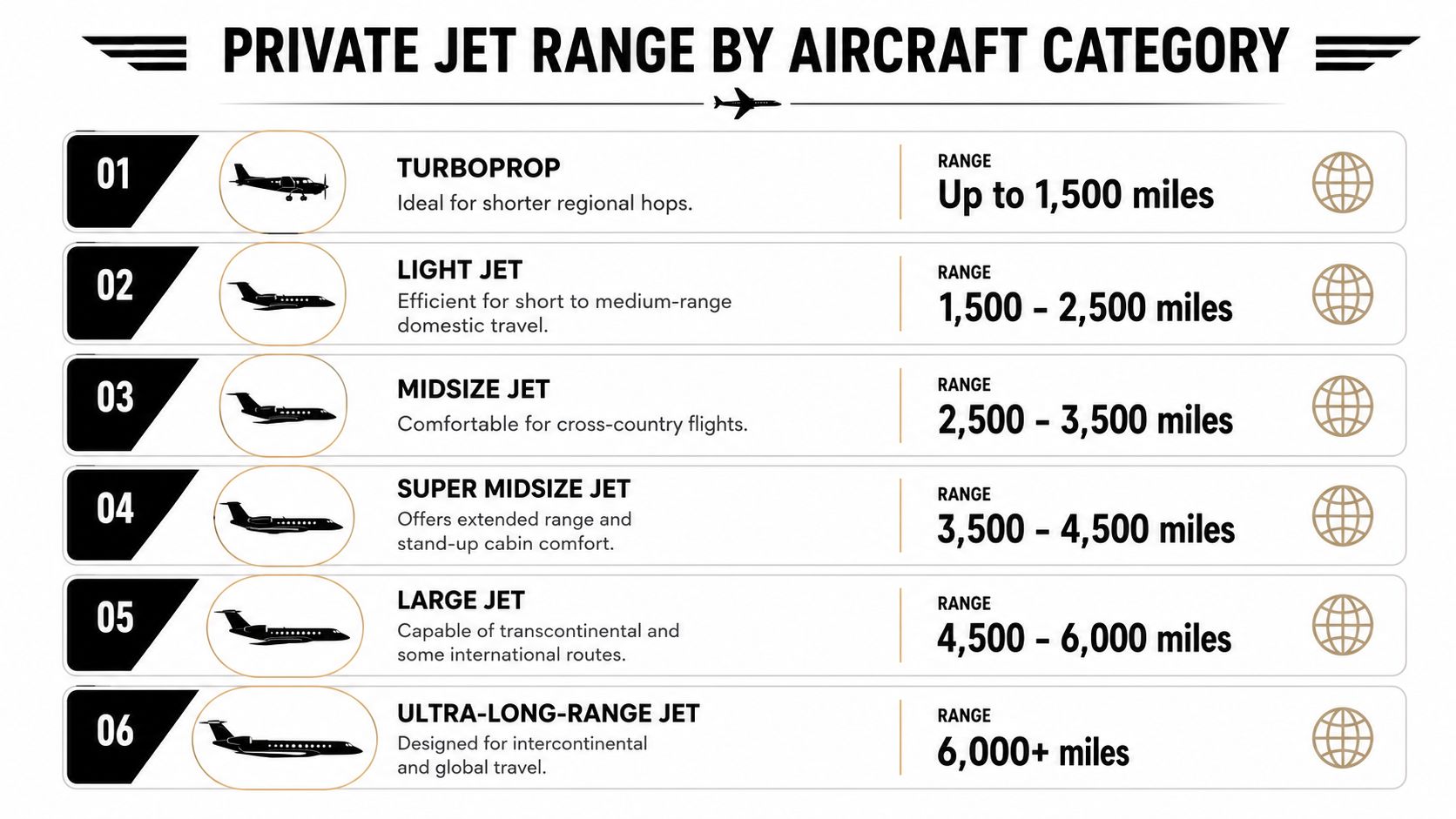
The private jet market is strongly segmented by range. According to Element Aviation's overview of aircraft range classes, turboprops cover up to 1,700 nautical miles, light jets reach 1,500 to 2,500, midsize jets 2,500 to 3,500, super-midsize jets 3,500 to 4,500, heavy jets 4,000 to 6,500, and ultra-long-range jets can exceed 7,700+ nautical miles.
Turboprops and light jets
These aircraft are usually the smartest fit for short regional missions and many domestic trips.
Turboprops are useful when you want efficient short-haul flying, especially into smaller airports. They're often a strong choice for practical regional travel where runway access matters as much as speed.
Light jets move the mission forward when you want jet performance for shorter to medium-length flights. Aircraft often discussed in this part of the market include models like the Phenom 300. They're a common fit for business day trips, quick leisure flights, and short domestic sectors where nonstop efficiency matters more than a large cabin.
Midsize and super-midsize jets
Many clients find the sweet spot between comfort and reach.
A midsize jet often works well for longer domestic trips where cabin comfort starts to matter more. For many travelers, this is the category where the onboard experience begins to feel more relaxed, especially if the route is long enough that passengers want more room to work or unwind.
A super-midsize jet extends that flexibility. Aircraft such as the Challenger 350 are often associated with this category. They're frequently chosen for missions that need strong domestic range, a stand-up cabin, and a better chance of staying nonstop when the trip gets more ambitious.
Heavy and ultra-long-range jets
When the trip becomes transcontinental or intercontinental, heavy and ultra-long-range aircraft enter the conversation.
Heavy jets are often selected for longer missions where cabin space, luggage capacity, and operational flexibility all matter. They're a practical answer for many transatlantic-style charter requests.
Ultra-long-range jets sit at the top of the range spectrum. If your mission is built around minimizing stops on long international sectors, this is the category to study. Readers comparing aircraft in this class can browse ultra-long-range jet options to see how these cabins are positioned for long missions.
Bigger isn't automatically better. A larger aircraft only makes sense when the route, passenger load, comfort expectations, and airport considerations actually call for it.
A quick planning view
| Category | What it's often best for |
|---|---|
| Turboprop | Short regional hops, smaller airports |
| Light jet | Short to medium domestic trips |
| Midsize jet | Longer domestic travel with added comfort |
| Super-midsize jet | Extended domestic routes and select international missions |
| Heavy jet | Long-haul routes with larger cabin needs |
| Ultra-long-range jet | Intercontinental nonstop priorities |
The right category is the one that fits the mission cleanly. Not the one that looks most impressive on paper.
From Theory to Tarmac Common Long Haul Routes
It helps to stop thinking in abstract categories and look at familiar trips.
Take Los Angeles to Las Vegas. The route itself doesn't demand a long-range aircraft. Clients usually prioritize speed, convenience, and airport access. A lighter category often makes more sense than booking a larger cabin that spends most of the trip climbing and descending.
Now consider Miami to Aspen. The map may suggest one thing, but the airport environment can suggest another. Aspen's elevation and operating conditions can affect aircraft choice, so planners may favor a jet with stronger performance margins than distance alone would imply.
The route is only half the story
A trip like New York to London usually shifts the conversation from domestic convenience to nonstop transatlantic capability. Here, the mission isn't just about whether an airplane can make the crossing in theory. It's about whether it can do so with the passenger load, baggage, and operational margin the client expects.
For charter flights to the Bahamas, the planning process often moves in the opposite direction. The distance may be manageable for a broad set of aircraft, so airport access, group size, baggage, and customs logistics become central.
How advisors think through route matching
Instead of asking only “How far is it?”, experienced planners ask:
- What airport are you using? Some airports change the performance picture.
- Is nonstop essential or just preferred? That answer can widen or narrow aircraft options quickly.
- What matters more, cabin size or mission efficiency? The right choice isn't always the largest cabin available.
If you want a broader look at the kinds of city pairs clients request most often, this roundup of popular private jet routes in 2025 is a useful companion.
A route that looks simple on a map can become more demanding because of airport conditions, baggage, or the client's nonstop requirement.
That's why good charter planning feels less like shopping from a list and more like matching the aircraft to the mission.
Charter Implications Nonstops Fuel Stops and Empty Legs
Once range becomes a practical planning issue, charter decisions get easier.
Many clients begin with a firm preference for nonstop travel. That makes sense. A nonstop flight usually protects time, keeps the experience smooth, and avoids an extra landing, refueling process, and time on the ground. But nonstop isn't always the smartest answer if it forces you into a much larger aircraft than the mission otherwise needs.
When a fuel stop is a rational choice
A planned fuel stop can make sense when it allows for a better overall fit. You might prefer a certain cabin layout, need a specific baggage setup, or want to use an aircraft that is otherwise ideal for the group and route economics.
That doesn't make the trip worse. It just changes the balance between speed, cost, and aircraft choice.
A useful way to frame it:
- Choose nonstop when schedule protection and simplicity matter most.
- Accept one stop when the trade-off improves aircraft fit or broadens suitable options.
- Compare total trip logic rather than reacting to the word “stop” alone.
Why repositioning matters in charter pricing
One of the biggest misunderstandings in charter is that the airplane's flight time is the only thing you're paying for. Often, the aircraft has to travel before your trip begins or after it ends. That repositioning can materially change the quote.
This is one reason local aircraft sourcing matters. If the airplane is already near your departure city, there's less chance of paying for unnecessary movement before your passengers even board. Haute Jets uses a local sourcing model aimed at finding aircraft based near the point of departure, which can help reduce repositioning exposure compared with approaches that rely on farther-away inventory.
Where empty legs fit
Empty legs are different from custom charter. They exist because an aircraft already needs to reposition. If your plans line up with that movement, they can be useful. If your schedule is rigid, they may not.
For travelers who want to understand how those opportunities work, this guide on empty leg flights explains the trade-offs clearly.
The key is knowing what problem you're solving. If you want exact timing and aircraft choice, on-demand charter usually wins. If your dates and airports are flexible, an empty leg can be worth watching.
Booking the Right Jet for Your Flight with Haute Jets
The best charter decisions start with a simple shift in thinking. Don't begin with the aircraft. Begin with the mission.
That means looking at the route, passenger count, baggage, airport pair, desired comfort level, and whether nonstop travel is a requirement or a preference. Once those variables are clear, the aircraft list usually narrows quickly.
What a smart booking process looks like
A strong charter process should answer a few questions clearly before you book:
- Can this aircraft operate the route the way I want it to?
- Is the quote based on a nearby aircraft or one that must reposition?
- Am I paying for cabin size I'll use, or just range I don't need?
Those questions help protect both schedule and budget. They also keep you from overcorrecting. Some travelers choose too small an aircraft and end up with a stop they didn't expect. Others choose too much aircraft and pay for capability the mission never required.
Here's a visual overview of the booking experience:
A good advisor should walk you through those trade-offs in plain language. You shouldn't have to decode aircraft specs on your own or guess whether a quoted range figure applies to your actual trip.
If your next flight involves a route where nonstop performance, airport access, or aircraft selection could materially change the experience, it's worth getting a trip-specific recommendation instead of relying on generic range charts.
If you're planning a trip and want a clear aircraft recommendation based on route, passenger load, airport pair, and nonstop goals, request a quote from Haute Jets.