
You're probably booking Dubai for one of two reasons. Either the trip is commercially inconvenient, or the stakes are too high to tolerate friction. A board meeting, a fund close, a family office event, a launch, a short-notice appearance, a winter holiday with zero patience for airport chaos. In all of those cases, the aircraft is only part of the decision.
What matters is whether the trip runs cleanly from the first quote to the final curbside transfer.
First-time Dubai charter clients often focus on the wrong questions. They ask about the jet category before they lock the airport. They compare quotes without checking repositioning exposure. They assume any large-cabin jet will do. That's how expensive trips become sloppy trips.
A private jet to Dubai should be handled like a mission, not a luxury purchase. If you source the right aircraft, verify the operator properly, and choose the right arrival strategy, Dubai is smooth. If you get any of those wrong, you'll feel it immediately.
Why Dubai Is a Premier Private Aviation Hub
A lot of clients call when the calendar has already tightened. They need to leave London, New York, Geneva, Riyadh, or Miami and arrive in Dubai without connections, public terminals, or schedule risk. That urgency is exactly why Dubai matters in private aviation. It sits at the center of high-value traffic: finance, family office movement, sovereign and corporate activity, major events, and long-haul leisure.
Dubai also rewards precision. It's not a casual charter market where you can leave major details vague and expect the trip to sort itself out later.

Demand is rising for a reason
The wider market explains why Dubai has become such a critical node. A 2025 private jet market summary says the global business aviation market reached $35 to $38 billion in 2025, with more than 22,000 active business jets completing about 5.2 million flights annually. The same source reports that the Middle East is the fastest-growing region, and the UAE posted a 9% increase in business-jet movements in 2024.
That matters because high-growth hubs punish lazy booking. More traffic means more competition for the right aircraft, tighter airport handling windows, and less room for mistakes on premium long-haul sectors.
If you want context on where Dubai fits globally, Haute Jets Journal's look at the world's most popular private jet routes in 2025 is useful.
Practical rule: Treat Dubai like a high-density international charter market, not a simple destination request. The client who books early and briefs precisely gets better options.
Dubai is both business-critical and operationally sensitive
Dubai is also a true intercontinental destination. It pulls traffic from Europe, North America, and the Middle East at the same time. That mix changes how you should book. A short-notice regional flight and an ultra-long-range transatlantic mission are not interchangeable, even if both end in the same city.
My opinion is simple. If Dubai is important enough to charter, it's important enough to plan properly. That means choosing the aircraft for the exact mission, not the broad category, and solving arrival logistics before anyone signs a contract.
Estimating the Cost of Your Private Jet to Dubai
Cost questions should be answered directly. For a private jet to Dubai from London, quoted charter pricing typically ranges from $90,000 to $130,000, with estimated flight times of 6.5 to 7 hours, according to RightJet's Dubai charter guidance. The same source notes that Dubai's peak season runs from November to March, and travelers are advised to book 1 to 2 weeks ahead during that period to secure preferred aircraft.
That's your baseline. Not your guaranteed total on every trip, and not a number you should compare in isolation.
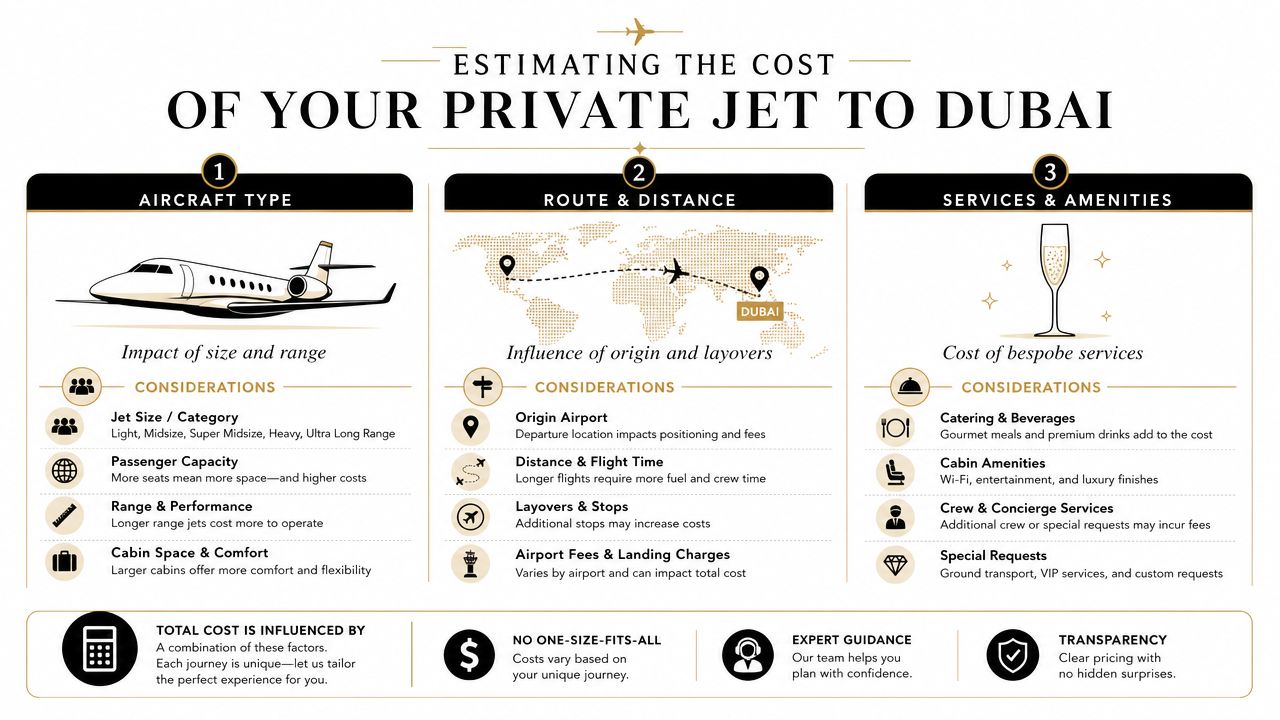
Here's a visual breakdown of what moves the quote.
What actually changes the price
A serious Dubai quote usually moves based on four factors:
- Aircraft capability: A long-haul Dubai mission narrows the field quickly. Range, baggage profile, cabin setup, and passenger count matter more than the marketing label.
- Routing reality: Nonstop and one-stop options price differently, and not every itinerary should be forced into the same operating pattern.
- Repositioning exposure: If the aircraft has to move in from elsewhere before your departure, your quote can swell for reasons that have nothing to do with your actual flight.
- Season pressure: November through March is not the time to wait around for the market to improve.
If you want a broader primer on quote mechanics, Haute Jets Journal has a useful guide on how much a private jet charter flight costs.
Don't chase the cheapest quote
New buyers make the same mistake over and over. They compare two numbers and assume lower means better buying. It often means one of three things: a weaker operator, an aircraft mismatch, or missing operational detail that gets corrected later.
Use this table instead of chasing headline price alone:
| Decision point | What to ask | Why it matters |
|---|---|---|
| Aircraft type | Is this model appropriate for my route and passenger load? | A bad match creates fuel-stop, comfort, or luggage problems |
| Positioning | Where is the aircraft based before my trip? | A distant aircraft can add avoidable cost |
| Seasonality | Am I booking inside peak Dubai demand? | Availability tightens faster than most first-time clients expect |
| Quote scope | What services are included on the contract? | Missing ground items create friction later |
Later in the process, ask for the exact aircraft details, not just “heavy jet” or “ultra-long-range.”
A provider like Haute Jets can be useful here because it sources from nearby owner-operators across a broad network and focuses on the exact aircraft rather than a generic category. That matters when you're trying to reduce repositioning waste and avoid paying premium pricing for the wrong cabin.
Before you get too deep into aircraft shopping, this short video gives a practical overview of charter cost thinking.
A clean Dubai quote is specific. It tells you what you're buying, where the aircraft is coming from, and what assumptions are built into the mission.
My recommendation on timing
If you know your travel window and you're flying during Dubai's busy season, lock the aircraft sooner than feels necessary. Waiting can leave you with fewer acceptable options, not just higher pricing. On this route, aircraft quality and operational fit matter more than last-minute quote shopping.
Securing Your Ideal Aircraft and Itinerary
Booking well starts with a strong brief. Booking badly starts with “I need a jet to Dubai next week” and not much else.
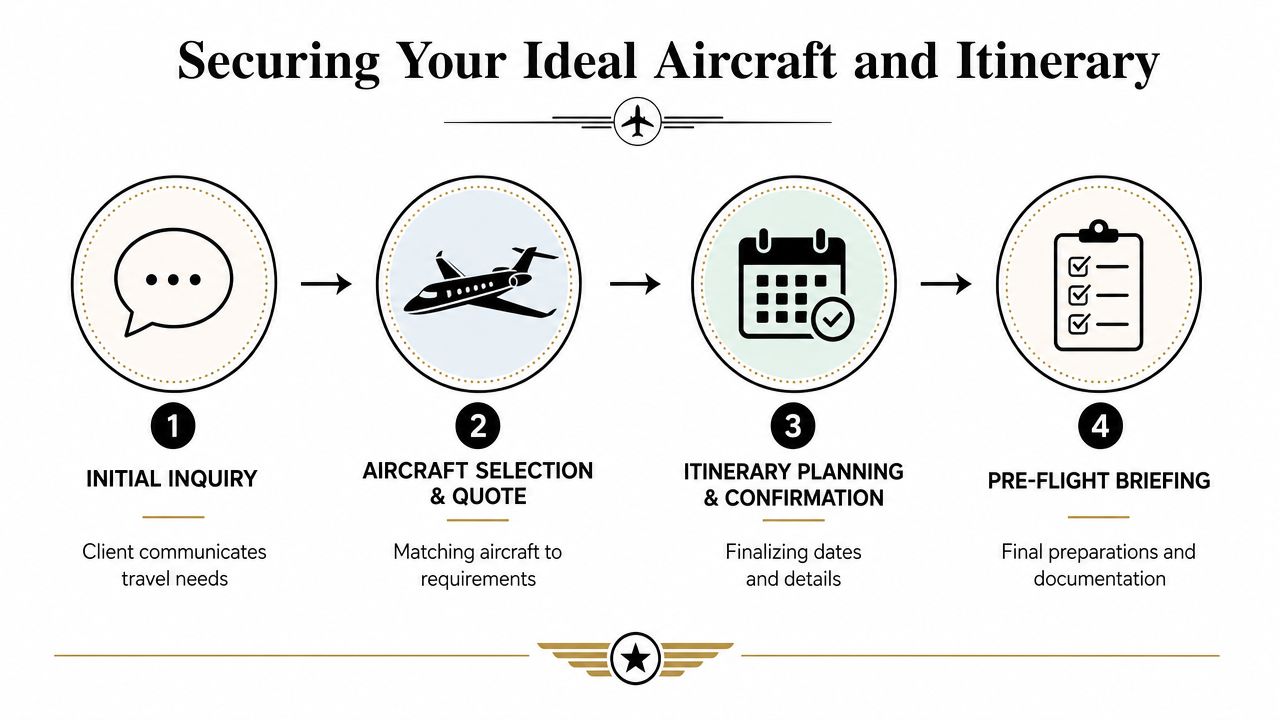
A structured charter workflow matters because Dubai trips often combine long range, international handling, and tight ground timing. According to Paramount Business Jets' step-by-step booking guide, a professional process involves a detailed brief, an aircraft shortlist developed for the client's requirements, safety and operator review, a binding agreement, and final logistics. The same guidance warns that under-specifying needs upfront is a common failure.
Start with a real mission brief
If you want accurate aircraft options, provide the details that drive the operation:
- Departure and arrival airports
- Passenger count
- Baggage expectations
- Dates and preferred departure times
- Special needs, such as catering, pets, onboard connectivity, or mobility support
That's not paperwork for its own sake. It's how you avoid being shown the wrong aircraft.
A first-time client often thinks passenger count alone determines the cabin. It doesn't. Seven passengers with significant luggage on a long sector can be a completely different mission from seven passengers traveling light.
Compare aircraft specifically, not vaguely
If a broker sends “heavy jet options,” push back. Ask for the exact make, model, and cabin layout, and ask to review amenities before payment. Wi-Fi is the classic example. “Wi-Fi available” and “reliable enough for business use” are not the same thing.
Use this filter when comparing options:
- Cabin practicality: Can your group work, rest, and move comfortably on this mission?
- Connectivity: Is the onboard system suitable for the way you travel?
- Luggage fit: Will your baggage profile work without compromise?
- Operator credentials: Are the safety standards documented and current?
- Arrival handling: Has the Dubai-side plan already been considered?
For a broader primer on process, Haute Jets Journal's guide on how to charter a private jet in 2026 lays out the basics clearly.
Booking advice: Don't sign first and ask cabin questions later. Confirm the exact aircraft and service details before funds move.
Contract first, assumptions never
Once you choose the aircraft, the agreement should reflect the actual mission. Then you move into final logistics. That should include FBO details, crew contact information, catering notes, and day-of-travel instructions.
I also recommend discussing payment flexibility early. Some clients want traditional wire settlement. Others prefer alternative arrangements, including crypto, where available through the charter provider. The key is to settle payment mechanics before the final rush.
Empty legs can sometimes be relevant, but they should be treated as opportunistic, not foundational. If the Dubai trip is time-sensitive, build around certainty, not chance.
Your Arrival Strategy Choosing the Right Dubai Airport
Many first-time clients lose time without realizing it.
For private arrivals into Dubai, I strongly prefer Al Maktoum International Airport (DWC) over DXB for most charter missions. The reason is operational, not cosmetic. According to Charter Jet One's guidance for Dubai private arrivals, DWC is often the most efficient option because private jet travelers can use exclusive VIP terminals and fast-track immigration, reducing processing to minutes, not hours.
Why DWC usually wins
A private jet is supposed to remove friction. DWC aligns with that objective far better than a default commercial-airport mindset.
Here's the practical comparison:
| Airport choice | Typical private aviation experience |
|---|---|
| DWC | More streamlined private terminal handling, easier VIP processing, lower friction on arrival |
| DXB | Familiar name, but often less aligned with the smoothest private arrival flow |
That doesn't mean DXB is never appropriate. It means you should have a reason for choosing it.
Understand the role of the FBO
Your FBO, or Fixed-Base Operator, is the private terminal environment that manages the ground side of the flight. That includes passenger handling, coordination with the aircraft, and the handoff to ground transportation.
If you've only flown commercially, this is one of the biggest mental shifts. You are not arriving into the standard passenger system. You're arriving into a private handling process. That process works beautifully when the airport choice supports it.
Choose the airport as part of the routing decision, not as an afterthought. In Dubai, that choice can shape the entire arrival experience.
My recommendation
If privacy, speed, and low-friction arrival matter, ask for DWC first. Then test any alternative against that standard. Don't let the larger, more recognizable airport win by default. In private aviation, the obvious choice is often the slower one.
Customizing Your Onboard and Ground Experience
This is the part clients enjoy discussing, but it still deserves discipline.
The right Dubai charter doesn't just get the route right. It gets the atmosphere right. I've handled trips where one client wanted a quiet working cabin with simple, clean catering and no interruptions. I've handled others where the aircraft needed a family-friendly setup, pet accommodation, a specific tea service, and a secure vehicle waiting planeside.
Those are very different missions, even if the route is identical.
What to confirm before departure
Some customizations are obvious. Others get missed until they become annoying.
- Catering: Don't ask for “premium catering.” Ask for what you want. Breakfast timing, dietary restrictions, preferred restaurants, hydration preferences, and service pacing all matter.
- Connectivity expectations: If you need to send large files, hold a video call, or stay continuously online, say so plainly and verify the onboard setup in advance.
- Pet travel: If you're flying with an animal, clear the policy early and coordinate documentation and handling before travel day.
- Ground transport: Specify whether you want executive sedan service, SUV security transport, family transfer arrangements, or a low-profile meet-and-go setup.
The difference between luxury and control
The amateur version of private aviation is “nice snacks and a leather seat.” The professional version is control. Control over when you eat, how you work, who meets you, where your bags go, and how much attention the trip attracts.
I'm opinionated on this point because clients often under-brief the service layer. They assume the team will “make it nice.” That's too vague. If you want a calm cabin, say so. If you want no cabin interruptions while you sleep, say so. If your children need a different catering rhythm than the adults, say so.
The best private flights don't feel extravagant. They feel frictionless.
A simple way to brief the experience
When I advise first-time clients, I tell them to answer four practical questions:
- Will you work, sleep, or socialize onboard?
- Does anyone have dietary, medical, or pet-related needs?
- What should be waiting on arrival?
- What would make the trip feel irritating if it were handled poorly?
That last question usually reveals the true priorities.
Your Final Pre-Flight Compliance Checklist
Luxury clients hate surprises. Compliance is where surprises tend to hide.
The best private jet to Dubai experience is built on detail that nobody sees. Document validity. operator vetting. arrival paperwork. passenger manifest accuracy. baggage assumptions. customs awareness. None of it is glamorous. All of it matters.
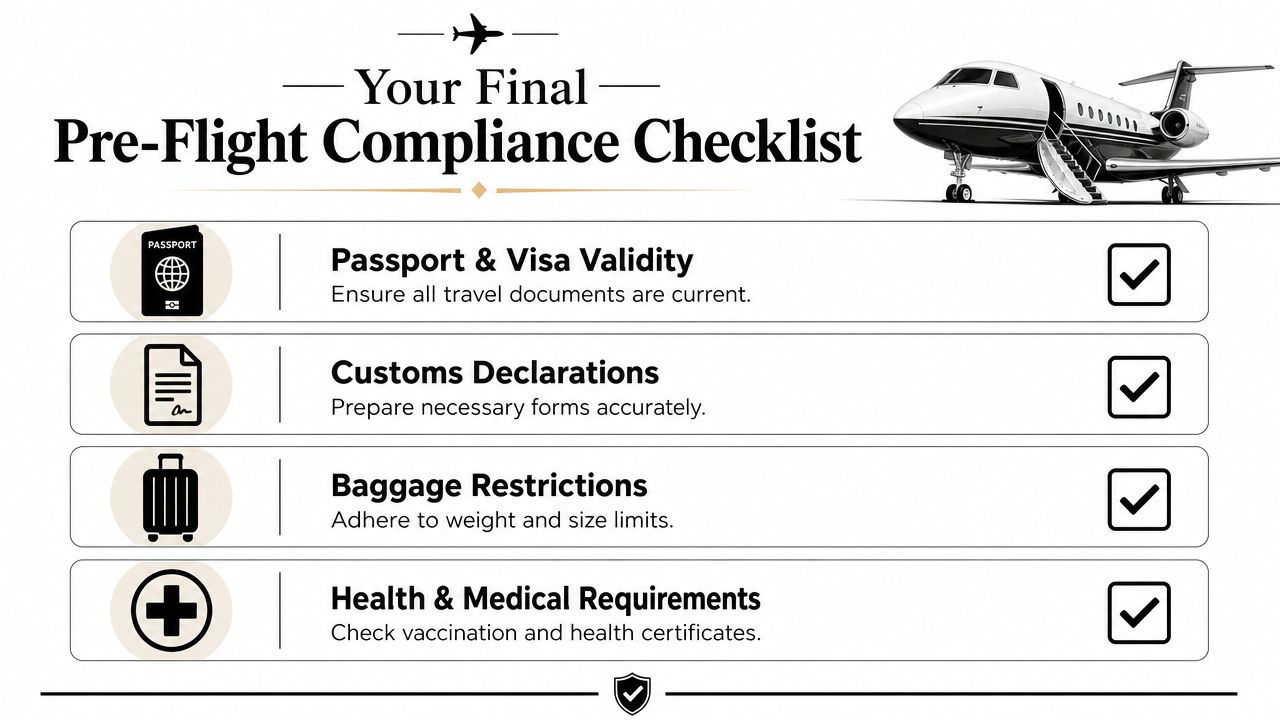
Here's the final document and compliance view to keep the trip clean.
What I'd verify before wheels up
Use this as your pre-departure standard:
- Passport and visa status: Confirm that every traveler has valid documents for UAE entry before the aircraft is finalized.
- Manifest accuracy: Names should match travel documents exactly. Small errors create unnecessary delays.
- Customs-sensitive items: If you're carrying high-value items, business materials, or unusual baggage, disclose it early so the handling team can advise properly.
- Special passenger requirements: Medical devices, mobility needs, and pet documentation should be flagged in advance, not at the terminal.
Safety verification is not optional
I don't treat safety credentials as marketing copy. I treat them as a hard screen.
My recommendation is straightforward. Ask whether the operator holds Wyvern Wingman or ARGUS Gold/Platinum credentials, and confirm that review before you approve the aircraft. If a provider dodges that conversation, move on.
Also remember that permit work and operational clearances are generally handled by the operator and charter team. Your job is not to file the aviation paperwork yourself. Your job is to make sure the team managing the flight is competent, transparent, and precise.
Final day checklist
On the day before departure, you should have the essentials in hand:
| Item | What you should receive |
|---|---|
| Aircraft details | Exact tail number and aircraft confirmation |
| Crew information | Direct operating contacts or relayed charter contacts |
| Terminal plan | FBO location and check-in instructions |
| Ground arrangements | Confirmed onward transport details |
| Passenger review | Final manifest and any special service notes |
A well-run charter feels easy because somebody did the hard administrative work early.
That's true luxury. Not guessing. Not chasing updates. Not finding out at the terminal that someone assumed the wrong airport, the wrong baggage profile, or the wrong service level.
If you're planning a private jet to Dubai and want the booking handled with exact aircraft selection, operator screening, and clear arrival planning, Haute Jets is one option to consider for on-demand charter support.